Distinct mechanisms of platelet aggregation as
a consequence of different shearing flow
conditions.
S Goto, … , E Saldívar, Z M Ruggeri
J Clin Invest.
1998;
101(2)
:479-486.
https://doi.org/10.1172/JCI973
.
Platelet aggregation contributes to arresting bleeding at wound sites, but may cause
occlusion of atherosclerotic vessels, thus curtailing blood flow to vital organs. According to
current dogma, the integrin alphaIIbbeta3 plays an exclusive role in linking platelets to one
another through interactions with fibrinogen or vWf. We demonstrate here that, depending
on shearing flow conditions, this process may require vWf binding to glycoprotein Ibalpha,
even when alphaIIbbeta3 is competent to bind adhesive ligands. Platelet activation induced
solely by high shear stress is initiated by glycoprotein Ibalpha interaction with vWf, but
results in aggregation only if the latter can bind concurrently to alphaIIbbeta3. In contrast,
platelets exposed to high shear rate after activation by exogenous agonists such as ADP
and epinephrine can aggregate when fibrinogen is the alphaIIbbeta3 adhesive ligand, yet
only if vWf binding to glycoprotein Ibalpha can also occur. Thus, the latter interaction
appears to provide a bond with biomechanical properties necessary to overcome the effects
of high shear rate and initiate interplatelet cohesion. These findings highlight the distinct
function of two adhesive receptors mediating platelet aggregation under varying fluid
dynamic conditions, and modify the current interpretation of a crucial event in hemostasis
and thrombosis.
Research Article
Find the latest version:
J. Clin. Invest.
© The American Society for Clinical Investigation, Inc. 0021-9738/98/01/0479/08 $2.00
Volume 101, Number 2, January 1998, 479–486 http://www.jci.org
Distinct Mechanisms of Platelet Aggregation as a Consequence of Different
Shearing Flow Conditions
Shinya Goto,Yasuo Ikeda, Enrique Saldívar, and Zaverio M. Ruggeri
Roon Research Center for Arteriosclerosis and Thrombosis, Division of Experimental Hemostasis and Thrombosis, Department of Molecular and Experimental Medicine and Department of Vascular Biology, The Scripps Research Institute, La Jolla, California 92037
Abstract
Platelet aggregation contributes to arresting bleeding at wound sites, but may cause occlusion of atherosclerotic ves-sels, thus curtailing blood flow to vital organs. According to current dogma, the integrin aIIbb3 plays an exclusive role in linking platelets to one another through interactions with fi-brinogen or vWf. We demonstrate here that, depending on shearing flow conditions, this process may require vWf binding to glycoprotein Iba, even when aIIbb3 is competent to bind adhesive ligands. Platelet activation induced solely by high shear stress is initiated by glycoprotein Iba interac-tion with vWf, but results in aggregainterac-tion only if the latter can bind concurrently to aIIbb3. In contrast, platelets ex-posed to high shear rate after activation by exogenous ago-nists such as ADP and epinephrine can aggregate when fi-brinogen is the aIIbb3 adhesive ligand, yet only if vWf binding to glycoprotein Iba can also occur. Thus, the latter interaction appears to provide a bond with biomechanical properties necessary to overcome the effects of high shear rate and initiate interplatelet cohesion. These findings high-light the distinct function of two adhesive receptors mediat-ing platelet aggregation under varymediat-ing fluid dynamic condi-tions, and modify the current interpretation of a crucial event in hemostasis and thrombosis. (J. Clin. Invest. 1998. 101:479–486.) Key words: hemostasis • thrombosis • von Willebrand factor • fibrinogen • rheology
Introduction
Platelet aggregation is a key mechanism for normal hemostasis limiting blood loss after tissue trauma (1, 2), but may lead to arterial occlusion in the setting of atherosclerosis and precipi-tate diseases such as myocardial infarction (3, 4). The first platelet response to vascular injury is adhesion to exposed re-active surfaces, followed (as presently understood) by
aggrega-tion of platelets linked to one another by fibrinogen or vWf bound to the activated GP IIb-IIIa complex (5), now more commonly designated as integrin aIIbb3. In experimental con-ditions, interplatelet cohesion also occurs when vWf binds to GP Iba in the presence of the bacterial glycopeptide ristocetin (6) or the snake protein botrocetin (7). This process, however, is of uncertain biological significance because it requires solu-ble modulators without known counterparts in mammalian or-ganisms, and is more akin to passive agglutination indepen-dent of active platelet metabolism than to aggregation. On the other hand, it has been recognized that vWf binding to GP Iba, whether in the presence (8) or absence (9, 10) of exoge-nous modulators, is coupled to activating signals that may re-sult in the binding of adhesive proteins to aIIbb3. Such a mech-anism can explain aggregation initiated by vWf under the influence of high shear stress (11, 12) as well as by asialo-vWf (13) or mutant type IIB vWf (14) at lower shear stress levels. Thus, the vWf-GP Iba interaction may induce aggregation, but there is no evidence that it directly mediates platelet–platelet contact in biologically relevant situations. Here we demon-strate a role for vWf and GP Iba in interplatelet cohesion, nec-essary to complement the function of activated aIIbb3 under the effect of elevated fluid dynamic forces.
Methods
Blood collection and platelet preparation. Blood containing as anti-coagulant D-phenylalanyl-L-prolyl-L-arginine chloromethyl ketone dihydrochloride (PPACK; Bachem Bioscience Inc., King of Prussia, PA), an inhibitor of a-thrombin not affecting divalent cation concen-trations (12), was used both in perfusion studies (15) and for obtain-ing platelet-rich plasma by centrifugation (12). Washed platelets were prepared as described elsewhere (16). All experiments involving hu-man volunteers were performed with approval by the appropriate In-stitutional Review Committee and in accordance with the Declara-tion of Helsinki.
Preparation and characterization of purified proteins. Fibrinogen and vWf were purified and characterized as reported previously (17, 18). Asialo-vWf was obtained by treatment with neuraminidase (13). The methods used for the preparation and characterization of fibrin-ogen and vWf labeled with FITC (Calbiochem-Novabiochem Intl., La Jolla, CA) have been published in detail (16). The monoclonal an-tibodies used for selective platelet receptor blockade as well as the procedures for IgG purification and preparation of monovalent Fab fragment by papain digestion have been described elsewhere (16). In particular, two anti-aIIbb3 antibodies were used: LJ-CP8 and LJ-P5.
LJ-CP8 inhibits receptor interaction with both fibrinogen and vWf among other ligands (18, 19), while LJ-P5 selectively inhibits vWf binding to aIIbb3 without affecting fibrinogen binding, as documented
in previous publications (16, 20, 21). The anti-vWf antibody NMC-4 (22), directed against the A1 domain of the molecule (23) that con-tains the GP Iba-binding site (24, 25), was a gift of Dr. Akira Yoshioka (Nara Medical College, Nara, Japan).
Shear stress-induced aggregation and ligand binding to platelets.
Platelet-rich plasma or washed platelet suspensions were exposed to selected shear rates by varying the speed of the rotating cone in a Address correspondence to Zaverio M. Ruggeri, M.D., The Scripps
Research Institute, SBR-8, 10550 N. Torrey Pines Road, La Jolla, CA 92037. Phone: 619-784-8950; FAX: 619-784-2026; E-mail: ruggeri@ scripps.edu
Shinya Goto’s present address is First Department of Internal Medicine, Tokai University School of Medicine, Isehara, Japan; Ya-suo Ikeda’s present address is Department of Internal Medicine, Keio University School of Medicine, Tokyo, Japan.
computer-controlled cone-and-plate viscometer at room temperature (22–258C) for 6 min. Aggregation was monitored continuously (12). FITC-labeled ligand binding to activated platelets was measured be-fore and after exposure to shear stress using flow cytometric analysis as previously reported in detail for vWf binding (16).
Flow chamber perfusion studies. Platelet thrombus formation onto collagen type I–coated surfaces was evaluated in a modified Hele-Shaw flow chamber as described (15, 26) using an epifluorescence confocal microscope (Axiovert 135M; Carl Zeiss, Inc., Thornwood, NY). Platelets were labeled with 10 mM mepacrine (quinacrine dihy-drochloride; Sigma Chemical Co., St. Louis, MO), a fluorescent dye that accumulates in the dense granules. Leukocytes were labeled con-currently, but did not show any surface interactions under the condi-tions tested, nor did they interfere with the measurement of platelet thrombi. Moreover, they could easily be identified on the basis of morphologic criteria. Platelet adhesion and thrombus growth were evaluated in real time using a silicon-intensified videocamera (Model C2400; Hamamatsu Photonic Systems Corp., Bridgewater, NJ) and recorded on tape with a videocassette recorder (Magnavox; Philips, Eindhoven, The Netherlands). At selected time points, thrombi were visualized in three dimensions by a series of confocal images repre-senting planes at progressively increasing distance from the collagen-coated surface covering the entire height of thrombi. The scanning time to generate each image was 2 s, and the separation interval in the
z axis was 5 mm. Image processing and measurement of surface cover-age were performed with the Metamorph software packcover-age (Univer-sal Imaging Corp., West Chester, PA).
Results
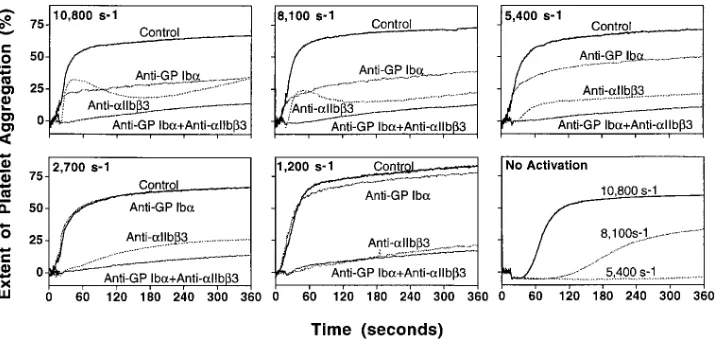
Influence of shear rate on the aggregation of nonactivated and activated platelets suspended in plasma. Normal platelets sus-pended in their native plasma and not interacting with any sur-face were induced to aggregate in the absence of exogenous agonists when the shear rate exceeded 5,400 s21 (Fig. 1). In agreement with published findings (11, 12), this response was inhibited by blocking GP Iba as well as aIIbb3 (see below). Prior platelet stimulation with the combination of ADP and epinephrine resulted in more rapid onset of aggregation that
was similar at all shear rates tested between 1,200 s21 and 10,800 s21 (Fig. 1), reflecting agonist-induced a
IIbb3 activation independent of fluid forces. Blocking aIIbb3 on these activated platelets using an antibody that inhibits nonselectively binding of all ligands known to interact with the receptor (antibody LJ-CP8) impaired aggregation under all shearing flow conditions. In contrast, blocking GP Iba with an antibody that prevents vWf binding (antibody LJ-Ib1) caused only 2% inhibition of aggregation at 1,200 s21, increasing progressively to 10% inhi-bition at 2,700 s21, 46% at 5,400 s21, 48% at 8,100 s21, and 77% at 10,800 s21 (average of two separate experiments). Concur-rent blockade of GP Iba and aIIbb3 showed no synergistic ef-fects at low shear rate, but enhanced considerably the inhibi-tion of aggregainhibi-tion at higher shear rate levels (Fig. 1).
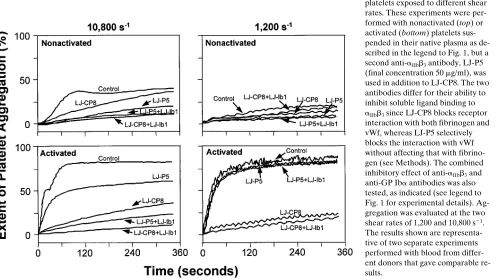
[image:3.612.59.423.489.659.2]Effect of selective aIIbb3 inhibition on the aggregation of nonstimulated and stimulated platelets at different shear rates. An anti-aIIbb3 monoclonal antibody that selectively blocks vWf binding with no effect on fibrinogen binding (antibody LJ-P5) markedly inhibited the aggregation observed when normal platelets suspended in their native plasma in the ab-sence of exogenous agonists were exposed to a shear rate of 10,800 s21. This antibody was at least as effective as LJ-CP8 in blocking high shear stress-induced aggregation, even though the latter blocks not only vWf but also fibrinogen binding to aIIbb3. The inhibition of aggregation caused by LJ-P5 was es-sentially complete, and was only marginally increased by con-current blockade of GP Iba (Fig. 2). Platelets activated with the combination of ADP and epinephrine and exposed to the same shear rate of 10,800 s21 aggregated more rapidly and to a greater extent than nonactivated platelets. In marked contrast to the results seen with nonactivated platelets, antibody LJ-P5 was much less effective than LJ-CP8 in inhibiting the aggrega-tion of activated platelets at a high shear rate. With either anti-aIIbb3 antibody, however, concurrent blockade of GP Iba re-sulted in nearly complete inhibition of aggregation (Fig. 2). The results seen at the lower shear rate of 1,200 s21 were re-markably different. Aggregation was negligible in the absence
Figure 1. Effect of fluid dynamic
forces on platelet aggregation. Platelet-rich plasma was tested with-out addition of exogenous agonists at three different shear rates (no ac-tivation, bottom right) or immedi-ately after activation with ADP and epinephrine, 20 mM each, at five dif-ferent shear rates (remaining five, as indicated). The software controlling the cone-and-plate viscometer al-ways imposed an initial shear rate of 120 s21 for 15 s, followed by
acceler-ation in 5 s to the value stated for each experiment. Agonist-stimu-lated platelets were tested with or without inhibition of GP Iba and
aIIbb3 by specific monoclonal
anti-bodies (see below). Note that activated platelets exhibited similar extent of aggregation regardless of shear rate and shorter lag phase preceding aggregation as compared with nonactivated platelets under corresponding conditions. All experimental mixtures contained 400 ml of platelet-rich plasma with 40 ml of Hepes-Tyrode buffer, pH 7.4 (16), in the control sample; or 40 ml of the anti-aIIbb3 antibody LJ-CP8 (50 mg/ml); or 40 ml
of the anti-GP Iba antibody LJ-Ib1 (144 mg/ml); or 20 ml each of the anti-GP Iba and anti-aIIbb3 antibodies (144 and 50 mg/ml, respectively), as
Figure 2. Effect of anti-aIIbb3
anti-bodies with distinct ligand-blocking selectivity on the aggregation of platelets exposed to different shear rates. These experiments were per-formed with nonactivated (top) or activated (bottom) platelets sus-pended in their native plasma as de-scribed in the legend to Fig. 1, but a second anti-aIIbb3 antibody, LJ-P5
(final concentration 50 mg/ml), was used in addition to LJ-CP8. The two antibodies differ for their ability to inhibit soluble ligand binding to
aIIbb3 since LJ-CP8 blocks receptor
interaction with both fibrinogen and vWf, whereas LJ-P5 selectively blocks the interaction with vWf without affecting that with fibrino-gen (see Methods). The combined inhibitory effect of anti-aIIbb3 and
[image:4.612.63.565.91.371.2]anti-GP Iba antibodies was also tested, as indicated (see legend to Fig. 1 for experimental details). Ag-gregation was evaluated at the two shear rates of 1,200 and 10,800 s21.
The results shown are representa-tive of two separate experiments performed with blood from differ-ent donors that gave comparable re-sults.
of exogenous agonists, but developed rapidly and was exten-sive after stimulation with the combination of ADP and epi-nephrine. This response was obliterated by the anti-aIIbb3 anti-body blocking vWf and fibrinogen binding (LJ-CP8), whereas the antibody blocking vWf, and not fibrinogen binding (LJ-P5), allowed aggregation to occur as in the control sample. Ad-dition of the antibody inhibiting GP Iba function had no influ-ence on the effect, of lack thereof, of the anti-aIIbb3 antibodies (Fig. 2).
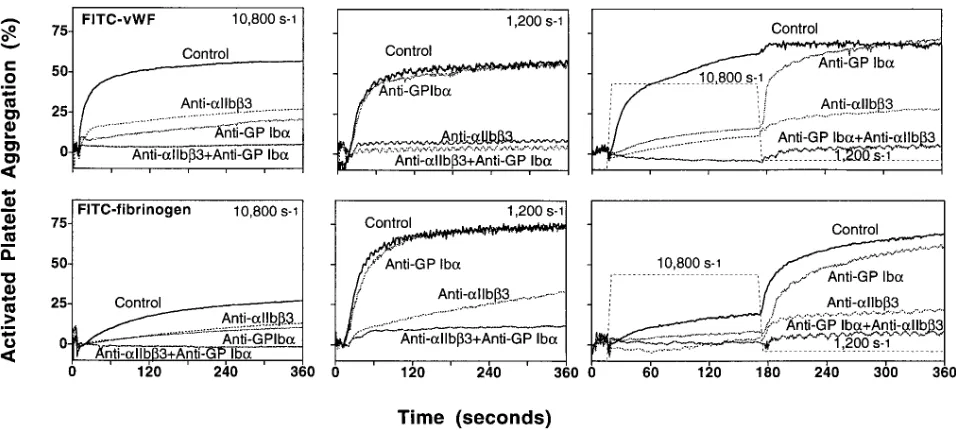
Role of fibrinogen and vWf in platelet aggregation at differ-ent shear rates. Addition of either purified fibrinogen or vWf to washed platelets was sufficient to support agonist-induced aggregation at the shear rate of 1,200 s21. This effect was inhib-ited by blocking aIIbb3, but not GP Iba. At 10,800 s21, in con-trast, only vWf could mediate maximum aggregation that was inhibited by blocking either aIIbb3 or GP Iba, but more effec-tively by concurrent blockade of both receptors (Fig. 3). The limited aggregation with slow initial onset seen at a high shear rate in the presence of fibrinogen was also inhibited by the anti-GP Iba antibody (Fig. 3), an indication that it was possibly mediated by released platelet vWf (27). Activated platelets that failed to aggregate significantly at 10,800 s21 in the pres-ence of fibrinogen, or even if the prespres-ence of vWf if GP Iba was blocked, promptly formed aggregates when the shear rate was decreased to 1,200 s21. Such a response was inhibited by blocking aIIbb3 (Fig. 3), a demonstration that the functional in-tegrity of platelets was not affected by shearing flow.
Washed platelets suspended in buffer exhibited minimal aggregation at a high shear rate in the absence of added solu-ble vWf, but aggregated promptly when the latter was present. Even prior activation with the combination of ADP and
epi-nephrine resulted in just a modest increase in aggregation at a high shear rate unless soluble vWf was present in the suspen-sion. Moreover, the anti-A1 domain antibody NMC-4 mark-edly inhibited this effect of added vWf, confirming that inter-action of the latter with GP Iba was essential to support the aggregation of washed platelets exposed to a high shear rate, whether or not platelets had been activated by exogenous ago-nists (Fig. 4). Washed platelets exposed to the higher shear rate of 10,800 s21 in the absence of added soluble vWf showed increasing aggregation when the shear rate was decreased to 1,200 s21. The final extent of this response was similar whether activation with exogenous ADP and epinephrine had taken place or not (Fig. 4). These results indicate that ligands re-leased from platelets as a consequence of activation and/or as-sociated with their membrane can support some degree of ag-gregation, particularly at lower shear rate levels. Nevertheless, additional soluble vWf appears to be essential for significant aggregation to occur at higher shear rates (Fig. 4), presumably reflecting the role of plasma as opposed to platelet vWf in pro-cesses that occur in blood.
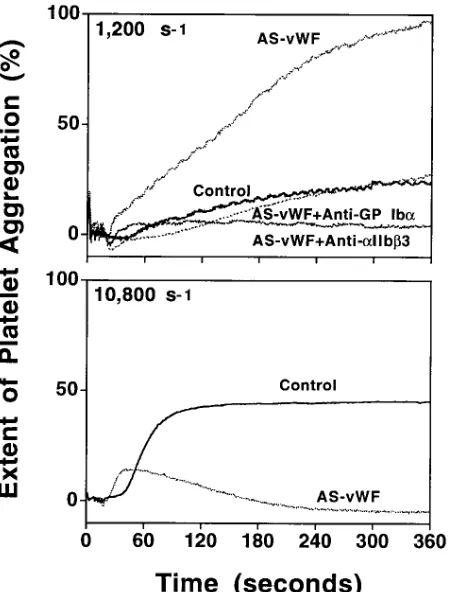
or biomechanical modulation (13), and should therefore sup-port aggregation more efficiently than the native counterpart regardless of fluid forces. Addition of asialo-vWf to platelet-rich plasma resulted in extensive aggregation at a shear rate of 1,200 s21, albeit with typical slow onset, confirming that activa-tion does not necessarily require high shear stress once vWf can bind to GP Iba (13). This response was, as expected, inhib-ited by blocking GP Iba as well as aIIbb3 (Fig. 5). In sharp con-trast, however, asialo-vWf not only failed to promote inter-platelet cohesion if the shear rate was increased to 10,800 s21, but also markedly inhibited the expected aggregation medi-ated by native vWf (Fig. 5). Such an effect was not due to any change in the ability to interact with stimulated aIIbb3, since asialo-vWf was equal to or better than the native molecule in this regard (not shown). Moreover, the effect was dose-depen-dent, and decreasing asialo vWf concentrations resulted in progressively less aggregation at a lower shear rate as well as less inhibition of aggregation at a higher shear rate (not shown). It is apparent, therefore, that the role of vWf in plate-let aggregation under conditions of high shear rate is not likely to be predominantly dependent on its ability to act as an ago-nist after binding to GP Iba (8).
[image:5.612.58.536.58.273.2]Influence of shear rate on ligand binding to activated plate-lets. To evaluate whether the effects of shear forces on aggre-gation were the consequence of changes in ligand binding, fi-brinogen and vWf interaction with agonist-activated platelets was measured before and after exposure to shearing flow, with
Figure 4. Effect of added soluble vWf on washed platelet aggregation
[image:5.612.316.554.439.602.2]at different shear rates. These experiments were performed with washed platelets prepared as described in the legend to Fig. 3, with-out added exogenous agonists (traces 1 and 3) or after activation with the combination of ADP and epinephrine, 20 mM each (traces 2, 4, and 5). When indicated, vWf was added at the final concentration of 15 mg/ml (traces 3, 4 and 5), or replaced by an equal volume of Hepes-Tyrode buffer, pH 7.4. The anti-A1 domain antibody NMC-4 was used as Fab fragment at the final concentration of 500 mg/ml. The specificity of its effect on vWf binding to platelets under the influence of shear stress has been documented previously (16). The transition from higher to lower shear rate was attained as described in the leg-end to Fig. 3.
Figure 3. Aggregation of activated washed platelets as a function of shear rate in the presence of vWf or fibrinogen. Washed platelet suspensions
were prepared at a count of 2.4 3 105/ml in modified Hepes-Tyrode buffer, pH 7.4, with the addition of 6.5 mg/ml BSA and 1.25 mM CaCl 2. 400
ml of the suspension was mixed with 40 ml of the same buffer in the control sample, or with specific monoclonal antibodies as described in the legend to Fig. 1. After adding 50 ml of either FITC-vWf (15 mg/ml; top) or FITC-fibrinogen (20 mg/ml; bottom) and 10 ml of a solution of ADP and epinephrine (20 mM each), the mixtures were incubated at room temperature for 10 min in order to reproduce the conditions used to mea-sure ligand binding to platelets not exposed to shear forces (see Fig. 6). All reagents were either in 20 mM Hepes with 150 mM NaCl, or in mod-ified Hepes-Tyrode buffer, pH 7.4. Aggregation was measured either at constant shear rate (1,200 s21 or 10,800 s21 for 6 min) or at 10,800 s21 for
3 min followed by 1,200 s21 for 3 min. The results shown are representative of two separate experiments performed with blood from different
do-nors that gave comparable results. At the higher shear rate, the maximal extent of aggregation (average of the two experiments) was 67% in the presence of vWf and 32% in the presence of fibrinogen. The corresponding initial rates of aggregation were 3.26 and 1.12% per second, respec-tively. The inhibition of aggregation was between 70 and 80% when GP Iba or aIIbb3 were blocked individually, but it was . 99% when the two
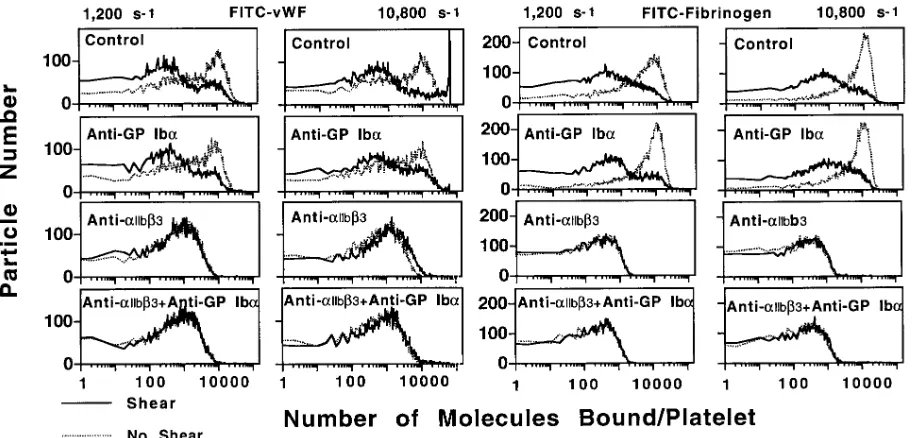
or without specific receptor blockade. Control and anti-GP Iba–treated platelets exhibited similar binding of both ligands, but single platelets with maximum numbers of bound ligand molecules were markedly reduced in both instances after ex-posure to either low (1,200 s21) or high (10,800 s21) shear rate (Fig. 6). Although the latter finding may appear to indicate de-creased average receptor occupancy in the platelet population exposed to shearing flow, it is actually more likely to be an in-direct sign of the continued presence of adhesive proteins bound to aIIbb3 on both control and anti-GP Iba treated plate-lets. This apparent paradox can be explained by noting the fol-lowing: (a) both fibrinogen and vWf could promote aggrega-tion of platelets exposed to low shear rate by binding directly to activated aIIbb3 (Fig 3); (b) transition to low shear rate al-lowed aggregation of control as well as GP Iba–blocked plate-lets, even after exposure to a high shear rate (Fig. 3; such a transition always occurred during the experiments shown in Fig. 6 when the device used to impose fluid motion was stopped to measure platelet-bound ligand); and (c) aggregates were excluded from the flow cytometric analysis used for these studies since gating parameters for fluorescent particles were set on the size of single platelets, a necessary requirement for
meaningful quantitative evaluation of ligand binding. Conse-quently, because platelets with aIIbb3-bound fibrinogen or vWf would be expected to aggregate during the course of the ex-periments shown in Fig. 6, the results for control and anti-GP Iba–treated platelets may represent only the population that was not incorporated into aggregates, i.e., mostly with lower levels of receptor occupancy. In contrast, activated platelets treated with the anti-aIIbb3 antibody exhibited markedly re-duced receptor occupancy by fibrinogen or vWf whether or not they were exposed to high or low shear rate (Fig. 6), in agreement with their impaired ability to aggregate at any shear rate tested (Fig. 3). Altogether, it is apparent that shear stress has little influence on ligand binding to activated aIIbb3. All the results presented so far, therefore, are compatible with the conclusion that platelets can be linked to one another by adhe-sive proteins interacting solely with aIIbb3 if fluid dynamic forces are relatively low, whereas optimal aggregation at higher shear rate levels requires the function of vWf and GP Iba, even when aIIbb3 is fully activated and occupied by com-petent ligands.
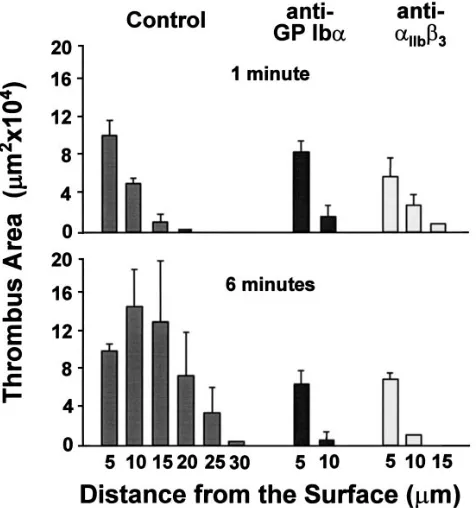
Role of vWf and GP Iba in platelet thrombus development under flow conditions. To obtain comparable initial surface coverage for all conditions to be tested in these experiments and to eliminate the influence of platelet–substrate interac-tions, thrombus formation was initiated by perfusing a con-stant volume of normal blood over collagen type I fibrils at shear rate of 1,500 s21 for 1 min (26). This perfusion was imme-diately followed by an aliquot of the same blood, either un-treated or containing specific monoclonal antibodies, perfused at the same shear rate for additional 5 min. The sum of the cross-sectional area of thrombi, measured in planes at 5-mm in-tervals in the z axis during uninterrupted flow, was markedly increased at the end of the second perfusion period with con-trol blood (Fig. 7). The changes occurring in planes located at more than 5 mm from the surface reflected greater thrombus height because of platelet–platelet interactions, and were com-pletely inhibited by blocking either GP Iba or aIIbb3 (Fig. 7). These results, therefore, demonstrated that both receptors are necessary (and neither one sufficient) to support platelet ag-gregation under conditions that may mimic those in vivo. In-deed, shear rate values between 500 and 5,000 s21 have been measured during normal circulation in arterioles of 10–50-mm diameter (29). In vessels of this caliber, as in perfusion cham-bers, blood is assumed to behave as a Newtonian fluid with steady laminar flow not influenced by the cardiac cycle.
Discussion
[image:6.612.60.288.59.355.2]We show here that aggregation of platelets moving with a high velocity differential requires the concurrent function of GP Iba and aIIbb3 as well as vWf as adhesive ligand. Such a mech-anism of interplatelet contact is evoked at higher shear rates in the cone-and-plate viscometer where aggregates form in sus-pension, than in the perfusion chamber where thrombi grow anchored to a surface. This difference may indicate that there is a lower level of stress on adhesive bonds forming between freely moving platelets that can accelerate their motion upon attaching to faster ones (Fig. 8) as compared with bonds teth-ering flowing platelets to others already immobilized. Conse-quently, the shear rate needed to elicit specific platelet func-tions in vivo may be overestimated by studying the process of aggregation in suspension (11, 12, 16).
Figure 5. Shear stress–induced platelet aggregation in the presence of
asialo-vWf. The experiments were performed at either 1,200 s21 or
10,800 s21 as indicated, using platelet-rich plasma to which asialo-vWf
(final concentration 40 mg/ml) was added immediately before expo-sure to shear forces. Control experiments were performed using mod-ified Hepes-Tyrode buffer, pH 7.4, instead of asialo-vWf. Monoclonal antibodies against GP Iba and aIIbb3 were used as described in the
This notwithstanding, experimental models that establish a velocity differential between platelets in adjacent planes (Fig. 8) emulate conditions in the circulation (28), where flow limits the time available for receptor–ligand coupling. It has been shown previously that only GP Iba binding to immobilized vWf can mediate platelet attachment to surfaces under rapid flow. This interaction is favored by a fast forward rate with high resistance to tensile stress, but is transient owing to a high dissociation rate (15). In contrast, interactions involving aIIbb3 are almost immediately irreversible, but of limited efficacy in high velocity shearing flow because of the relatively slow for-ward rate. These distinct properties synergistically support sta-ble platelet adhesion because the initially transient tethers cre-ated by GP Iba binding to vWf prolong the time available for activation and formation of bonds mediated by aIIbb3 (15). Our results now indicate that vWf and GP Iba are similarly re-quired to support aIIbb3 function in linking one platelet to an-other at high shear rates.
It is commonly thought that agonist-dependent stimulation needed for soluble ligand binding to aIIbb3 must precede plate-let involvement in aggregation. The data presented here, how-ever, support the different model depicted schematically in Fig. 8, suggesting that stimulated platelets with membrane-bound adhesive proteins are an appropriate surface for attach-ment of additional platelets, whether the latter are activated or not. Indeed, the concepts proven valid for adhesion (15) seem to justify this model of aggregation, at least at high shear rates, since GP Iba and vWf may promote initial interplatelet bond-ing regardless of activation. Accordbond-ingly, nonactivated aIIbb3 may contribute to this function at lower shear rates by interact-ing selectively (30) with immobilized fibrinogen or fibrin (15). The newly recruited platelets are then activated by locally re-leased or generated agonists, as well as by the effect of shear stress itself (28), so that their aggregation becomes irreversible
and soluble ligands bind to their membranes, forming the sub-strate for continuation of the process (Fig. 8). This model of aggregation may better explain thrombus formation in vessels, since only platelets already attached at sites of injury (not those being recruited from circulating blood) are likely to have been stimulated by locally generated agonists.
[image:7.612.58.515.60.279.2]The higher plasma concentration (z 8 3 1026 M) appears to favor fibrinogen for interacting with activated platelets (31). Nevertheless, vWf (z 2 3 1028 M in plasma) may become im-mobilized onto the platelet membrane at adequate functional levels owing to increased concentrations in the local microen-vironment after a-granule release, but also as a consequence of shear stress–induced mechanisms that, independently of other stimuli, promote its binding in a process requiring both GP Iba and aIIbb3 (16). Indeed, our findings (Fig. 2) indicate that, depending on the mechanism of activation, either fibrino-gen or vWf can become the aIIbb3-bound adhesive ligand, sup-porting aggregation at high shear rates. Binding of vWf may occur preferentially as a result of shear stress–induced activa-tion because the latter process depends on an initial interac-tion of vWf itself with GP Iba (9, 10). Thus, the changes that render aIIbb3 capable of interacting with soluble ligands may involve only the platelets onto which vWf is already immobi-lized, albeit perhaps transiently (16), effectively increasing the local concentration of this ligand and favoring its binding to aIIbb3 over that of fibrinogen. In contrast, the presence of ex-ogenous agonists in solution is likely to lead to aIIbb3 activation even on platelets that have not previously interacted with vWf through GP Iba, so that the higher concentration in plasma be-comes the factor leading to preferential fibrinogen rather than vWf binding to aIIbb3. In any case, it is apparent that aggrega-tion at high shear rates is always strictly dependent on vWf in-teraction with GP Iba, regardless of the nature of the aIIbb3 ac-tivation process and even when fibrinogen is the adhesive
Figure 6. Platelet binding of FITC-labeled vWf and fibrinogen analyzed by flow cytometry. Experimental mixtures were prepared as described
ligand bound to the latter receptor. Moreover, our findings (Fig. 4) indicate that this function is likely to be predominantly related to plasma rather than platelet vWf.
The mechanistic role proposed here for vWf and GP Iba— to mediate interplatelet cohesion not dependent on aIIbb3— differs substantially from that envisioned in the presence of ris-tocetin or botrocetin, and expands the concepts derived from the study of shear stress–induced aggregation. While promot-ing activation may be relevant in specific pathophysiological conditions (28), it appears that the vWf-GP Iba interaction has a more general function in supporting interplatelet bridging under high flow conditions, providing adhesive properties syn-ergistic with those of aIIbb3. The results obtained with asialo-vWf support this concept since enhanced binding to GP Iba, favoring receptor saturation on individual platelets (13), was detrimental for aggregation at higher shear rates in spite of the
ability to cause effective activation. In this regard, asialo-vWf may act like an anti-GP Iba antibody preventing tethering to vWf molecules immobilized onto the membrane of adjacent platelets. The synergism of ligand–receptor interactions with different kinetic properties demonstrated here for platelet ag-gregation in response to varying flow conditions may apply to other situations in which homotypic and heterotypic contacts occur between cells in circulating blood. Such may be the case in pathophysiological processes mediating immune response (32), inflammation (33), and allergic reactions involving eosin-ophils (34) and baseosin-ophils (35). Similarly, lymphocytes may ac-quire adhesive properties mediated by platelet receptors after forming heterotypic aggregates (36), so that the synergism of distinct adhesion pathways may benefit cells originally not en-dowed with specific recognition specificities.
[image:8.612.312.555.58.169.2]In conclusion, our findings support a novel interpretation of the mechanisms of platelet aggregation, highlighting the es-sential role of vWf and GP Iba in response to varying hemody-namic conditions. This is likely to be important for normal he-mostasis, but even more prominent in situations relevant to thrombosis since wall shear rates of 3,000–10,000 s21 have been measured at the top of plaques causing 50% occlusion of coro-nary arteries (37). It should be possible, therefore, to inhibit
Figure 7. Effect of specific monoclonal antibodies on thrombus
de-velopment in flowing blood. Blood containing 40 mM PPACK as anti-coagulant was aspirated through a parallel plate flow chamber (15) at a constant flow rate calculated to give an initial wall shear rate of 1,500 s21. Cumulative cross sectional area occupied by
mepacrine-labeled platelets in planes positioned at the indicated distance from the collagen type I-coated surface after 1 min of perfusion with nor-mal blood (top); cumulative cross-sectional thrombus areas after un-interrupted continuation of the perfusion for additional 5 min with blood containing anti-GP Iba or anti-aIIbb3 monoclonal antibody, as
indicated, or 0.04 M phosphate buffer, pH 7.4, with 0.15 M NaCl in the control (bottom). Antibodies were used as described in the legend to Fig. 1, with concentrations in plasma calculated assuming a packed red cell volume of 45% of the total blood volume. Note that the plane 5 mm from the surface shows similar platelet coverage under all ex-perimental conditions, with minimal difference after 1 or 6 min of perfusion, indicating that adhesion to collagen was essentially com-plete at the end of the 1-min perfusion with untreated normal blood. The results shown are the mean6SE of the mean of five separate ex-periments performed with blood from different donors.
Figure 8. Schematic representation of the mechanisms of platelet
ag-gregation in shearing flow. Platelets in adjacent planes of a fluid mov-ing with laminar flow have different velocity. In the case of the cone-and-plate viscometer depicted here, the velocity increases linearly with the distance from the stationary plate at the bottom (arrows). The linear slope of the velocity profile indicates that the shear rate, directly proportional to the speed of the rotating cone, is constant in all points of the moving fluid. In a parallel plate perfusion chamber, in contrast, the velocity profile is parabolic and the shear rate de-creases progressively from the wall to the center of the lumen (not shown here). In a high velocity flow field, only GP Iba interaction with vWf multimers immobilized onto the surface of other platelets can initiate interplatelet attachment irrespective of the activation state of aIIbb3. This GP Iba-dependent interaction supports initially
transient tethering, depicted by the ongoing detachment of the two top platelets from vWf multimers bound to already activated plate-lets. The process is amplified by the activation of aIIbb3 that may
oc-cur during the transient tethering, resulting eventually in stable at-tachment of recruited platelets and irreversible membrane binding of soluble adhesive ligands (16), thus providing the substrate for addi-tional recruitment of nonactivated platelets. Note that nonactivated
aIIbb3 is assumed not to be able to bind soluble ligands. Activated
aIIbb31 LJ-P5 depicts a receptor-binding pocket that cannot interact
[image:8.612.59.297.60.314.2]thrombus formation selectively in areas of the circulation where flow generates higher shear rates by blocking vWf bind-ing to GP Iba, and to accomplish more effective global inhibi-tion, when required, by dual receptor blockade. These consid-erations may support the evaluation of new anti-thrombotic strategies.
Acknowledgments
This work was supported by National Institutes of Health grants HL 31950, HL 42846, and HL 48728, and by the Stein Endowment Fund (to Z.M. Ruggeri). Support from National Institutes of Health grant RR00833 to the General Clinical Research Center of The Scripps Re-search Institute is also acknowledged. S. Goto received a travel grant from Tokai University School of Medicine Research Aid 1996.
References
1. Weiss, H.J. 1975. Platelet physiology and abnormalities of platelet func-tion (first of two parts). N. Engl. J. Med. 293:531–541.
2. Weiss, H.J. 1975. Platelet physiology and abnormalities of platelet func-tion (second of two parts). N. Engl. J. Med. 293:580–588.
3. Fuster, V., L. Badimon, J.J. Badimon, and J.H. Chesebro. 1992. The pathogenesis of coronary artery disease and the acute coronary syndromes (1).
N. Engl. J. Med. 326:242–250.
4. Fuster, V., L. Badimon, J.J. Badimon, and J.H. Chesebro. 1992. The pathogenesis of coronary artery disease and the acute coronary syndromes (2).
N. Engl. J. Med. 326:310–318.
5. Lefkovits, J., E.F. Plow, and E.J. Topol. 1995. Platelet glycoprotein IIb/ IIIa receptors in cardiovascular medicine. N. Engl. J. Med. 332:1553–1559.
6. Howard, M.A. and B.G. Firkin. 1971. Ristocetin—a new tool in the inves-tigation of platelet aggregation. Thromb. Haemostasis. 26:362–369.
7. Read, M.S., S.V. Smith, M.A. Lamb, and K.M. Brinkhous. 1989. Role of botrocetin in platelet agglutination: formation of an activated complex of botrocetin and von Willebrand factor. Blood. 74:1031–1035.
8. Kroll, M.H., T.S. Harris, J.L. Moake, R.I. Handin, and A.I. Schafer. 1991. von Willebrand Factor binding to platelet GPIb initiates signals for platelet ac-tivation. J. Clin. Invest. 88:1568–1573.
9. Chow, T.W., J.D. Hellums, J.L. Moake, and M.H. Kroll. 1992. Shear stress-induced von Willebrand factor binding to platelet glycoprotein Ib ini-tiates calcium influx associated with aggregation. Blood. 80:113–120.
10. Ikeda, Y., M. Handa, T. Kamata, K. Kawano, Y. Kawai, K. Watanabe, K. Sakai, F. Mayumi, I. Itagaki, A. Yoshioka, and Z.M. Ruggeri. 1993. Trans-membrane calcium influx associated with von Willebrand factor binding to GP Ib in the initiation of shear-induced platelet aggregation. Thromb. Haemostasis. 69:496–502.
11. Peterson, D.M., N.A. Stathopoulos, T.D. Giorgio, J.D. Hellums, and J.L. Moake. 1987. Shear-induced platelet aggregation requires von Willebrand factor and platelet membrane glycoproteins Ib and IIb-IIIa. Blood. 69:625–628. 12. Ikeda, Y., M. Handa, K. Kawano, T. Kamata, M. Murata, Y. Araki, H. Anbo, Y. Kawai, K. Watanabe, et al. 1991. The role of von Willebrand Factor and fibrinogen in platelet aggregation under varying shear stress. J. Clin. Invest. 87:1234–1240.
13. De Marco, L., A. Girolami, S. Russell, and Z.M. Ruggeri. 1985. Interac-tion of asialo von Willebrand factor with glycoprotein Ib induces fibrinogen binding to the glycoprotein IIb/IIIa complex and mediates platelet aggregation.
J. Clin. Invest. 75:1198–1203.
14. De Marco, L., A. Girolami, T.S. Zimmerman, and Z.M. Ruggeri. 1985. Interaction of purified IIB von Willebrand factor with the platelet membrane glycoprotein Ib induces fibrinogen binding to the glycoprotein IIb/IIIa complex and initiates aggregation. Proc. Natl. Acad. Sci. USA. 82:7424–7428.
15. Savage, B., E. Saldivar, and Z.M. Ruggeri. 1996. Initiation of platelet adhesion by arrest onto fibrinogen or translocation on von Willebrand factor.
Cell. 84:289–297.
16. Goto, S., D.R. Salomon, Y. Ikeda, and Z.M. Ruggeri. 1995. Character-ization of the unique mechanism mediating the shear-dependent binding of
sol-uble von Willebrand factor to platelets. J. Biol. Chem. 270:23352–23361. 17. Ruggeri, Z.M., L. De Marco, L. Gatti, R. Bader, and R.R. Montgomery. 1983. Platelets have more than one binding site for von Willebrand factor. J.
Clin. Invest. 72:1–12.
18. Niiya, K., E. Hodson, R. Bader, V. Byers-Ward, J.A. Koziol, E.F. Plow, and Z.M. Ruggeri. 1987. Increased surface expression of the membrane glyco-protein IIb/IIIa complex induced by platelet activation. Relationship to the binding of fibrinogen and platelet aggregation. Blood. 70:475–483.
19. Savage, B., S.J. Shattil, and Z.M. Ruggeri. 1992. Modulation of platelet function through adhesion receptors: A dual role for glycoprotein IIb-IIIa (in-tegrin aIIbb3) mediated by fibrinogen and glycoprotein Ib-von Willebrand
fac-tor. J. Biol. Chem. 267:11300–11306.
20. Trapani-Lombardo, V., E. Hodson, J.R. Roberts, T.J. Kunicki, T.S. Zimmerman, and Z.M. Ruggeri. 1985. Independent modulation of von Wille-brand factor and fibrinogen binding to the platelet membrane glycoprotein IIb/ IIIa complex as demonstrated by monoclonal antibody. J. Clin. Invest. 76:1950– 1958.
21. Weiss, H.J., J. Hawiger, Z.M. Ruggeri, V.T. Turitto, P. Thiagarajan, and T. Hoffmann. 1989. Fibrinogen-independent platelet adhesion and thrombus formation on subendothelium mediated by glycoprotein IIb-IIIa complex at high shear rate. J. Clin. Invest. 83:288–297.
22. Fujimura, Y., Y. Usami, K. Titani, K. Niinomi, K. Nishio, T. Takase, A. Yoshioka, and H. Fukui. 1991. Studies on anti-von Willebrand factor (vWf) monoclonal antibody NMC-4, which inhibits both ristocetin- and botrocetin-induced vWf binding to platelet glycoprotein Ib. Blood. 77:113–120.
23. Shelton-Inloes, B.B., K. Titani, and J.E. Sadler. 1986. cDNA sequences for human von Willebrand factor reveal five types of repeated domains and five possible protein sequence polymorphisms. Biochemistry. 25:3164–3171.
24. Fujimura, Y., K. Titani, L.Z. Holland, S.R. Russell, J.R. Roberts, J.H. Elder, Z.M. Ruggeri, and T.S. Zimmerman. 1986. von Willebrand factor. A re-duced and alkylated 52/48 kDa fragment beginning at amino acid residue 449 contains the domain interacting with platelet glycoprotein Ib. J. Biol. Chem. 261:381–385.
25. Miyata, S., S. Goto, A.B. Federici, J. Ware, and Z.M. Ruggeri. 1996. Conformational changes in the A1 domain of von Willebrand factor modulat-ing the interaction with platelet glycoprotein Iba. J. Biol. Chem. 271:9046–9053. 26. Alevriadou, B.R., J.L. Moake, N.A. Turner, Z.M. Ruggeri, B.J. Folie, M.D. Phillips, A.B. Schreiber, M.E. Hrinda, and L.V. McIntire. 1993. Real-time analysis of shear-dependent thrombus formation and its blockade by inhibitors of von Willebrand factor binding to platelets. Blood. 81:1263–1276.
27. Moake, J.L., N.A. Turner, N.A. Stathopoulos, L. Nolasco, and J.D. Hel-lums. 1988. Shear-induced platelet aggregation can be mediated by vWf re-leased from platelets, as well as by exogenous large or unusually large vWf mul-timers, requires adenosine diphosphate, and is resistant to aspirin. Blood. 71: 1366–1374.
28. Kroll, M.H., J.D. Hellums, L.V. McIntire, A.I. Schafer, and J.L. Moake. 1996. Platelets and shear stress. Blood. 88:1525–1541.
29. Tangelder, G.J., D.W. Slaaf, T. Arts, and R.S. Reneman. 1988. Wall shear rate in arterioles in vivo: least estimates from platelet velocity profiles.
Am. J. Physiol. 254:H1059–H1064.
30. Savage, B., and Z.M. Ruggeri. 1991. Selective recognition of adhesive sites in surface-bound fibrinogen by GP IIb-IIIa on nonactivated platelets. J.
Biol. Chem. 266:11227–11233.
31. Pietu, G., G. Cherel, G. Marguerie, and D. Meyer. 1984. Inhibition of von Willebrand factor-platelet interaction by fibrinogen. Nature. 308:648–649.
32. Springer, T.A. 1990. Adhesion receptors of the immune system. [Re-view]. Nature. 346:425–434.
33. Entman, M.L., L. Michael, R.D. Rossen, W.J. Dreyer, D.C. Anderson, A.A. Taylor, and C.W. Smith. 1991. Inflammation in the course of early myo-cardial ischemia. [Review]. FASEB J. 5:2529–2537.
34. Teixeira, M.M., T.J. Williams, B.T. Au, P.G. Hellewell, and A.G. Rossi. 1995. Characterization of eosinophil homotypic aggregation. J. Leukocyte Biol. 57:226–234.
35. Knol, E.F., T.W. Kuijpers, F.P. Mul, and D. Roos. 1993. Stimulation of human basophils results in homotypic aggregation. A response independent of degranulation. J. Immunol. 151:4926–4933.
36. Diacovo, T.G., K.D. Puri, R.A. Warnock, T.A. Springer, and U.H. von Andrian. 1996. Platelet-mediated lymphocyte delivery to high endothelial venules. Science. 273:252–255.