International Journal of Emerging Technology and Advanced Engineering
Website: www.ijetae.com (ISSN 2250-2459, ISO 9001:2008 Certified Journal, Volume 3, Issue 10, October 2013)
43
Potential Collapse for a Clay Soil
BENCHOUK Assia
1, ABOU-BEKR Nabil
2, TAIBI Said
31,2EOLE, Department of Civil Engineering, University of Tlemcen, BP 230-13000, Tlemcen, Algeria
3LOMC, FRE CNRS 1302, Université du Havre, 53 rue de Prony 76600- Le Havre, France
Abstract— Collapsible soils are in unsaturated state. They
are characterized by a metastable structure. However, the saturation, cause the destruction of the connexion giving a denser structure followed by a sudden collapse.
In this study, an experimental work was done to characterise the potential of collapsibility of a clayey soil, under different initial states, used as aengineered barriers.
Keywords— Collapse, compacted clay, dry density,
metastable structure, water content.
I. INTRODUCTION
In most countries of the world landfill is the primary method of solid waste disposal. Relevant legislation requires that waste disposal must be carried out providing containment systems to prevent or mitigate the threat to ground water and neighbouring environments.
An important aspect of the operation of waste disposal facilities is the prediction of the effect of wetting on the subsequent performance of the compacted layer. In general wetting induces volume changes, and this leads to corresponding changes in strength and stiffness. The two induced volumetric change problems (i.e. collapse and swelling) that concern the operation of waste disposal facilities are both related to wetting processes (Montanez, 2002).
In this paper we focused on the collapsibility of soils. For this aim, an experimental study was done on a clayey soil used in engineered barriers in Tlemcen which is located in the north west of Algeria.
II. OVERVIEW OF COLLAPSIBLE SOILS
Man-made fills, which were compacted at the optimum water content, may also develop a collapsible or metastable structure at low density (Tadepalli and Fredlund, 1991 in Ayadat, 2007). Collapsible soils are very sensitive to changes of porosity and moisture content. Their volume suddenly decreases with an increase of moisture content under practically unchanged total vertical stress (Reznik, 2007).
Several authors (Abou-Bekr & al, 2006; Houston & Houston, 1997; Abbeche & al, 2010; Al-Rawas, 2000 and Ali M.M., 2011) have studied the soil collapse and listed the factors contributing to the occurrence of this phenomenon. The main factors are summarized as follows:
An open unstable structure and partially saturated.
A high total stress is applied.
The presences of cementing agent in the soil, for example calcium carbonate (CaCO3), in unsaturated conditions contribute to stabilize the soil. A moistening the soil will reduce the suction and destroy the liaison officers.
Jennings and Knight (1975) in Al-Rawas, 2000, suggested a classification (see table 1) after determining collapse potential CP, which is defined as:
( )
With:
ΔH : Change in height of the specimen upon flooding.
H0 : Original height of the specimen.
Δec : Change in void ratio upon flooding.
e0 : Void ratio before flooding.
III. SITE LOCATION AND IDENTIFICATION OF STUDIED
SOIL
The material of Saf-Saf used in the construction of the engineered barriers of the repository waste of Tlemcen region. It is located east of the capital of the department at a distance of 7 km. Tlemcen is situated in the North West of Algeria.
Table I summarizes the results of the physical, chemical and mechanical identification of the studied soil.
International Journal of Emerging Technology and Advanced Engineering
Website: www.ijetae.com (ISSN 2250-2459, ISO 9001:2008 Certified Journal, Volume 3, Issue 10, October 2013)
44
TABLEI STUDIED SOIL PROPERTIES
Soil Saf-Saf Standard Physical identification
Sieve distribution: Gravel (%) Sand (%) Silt (%) Clay (<2 μm) (%) < 80 μm (%) Atterberg limits Liquidity ωL (%)
Plasticity ωP (%)
Plasticity index Ip (%) Density of solid particles (Gs)
1 45 24 30 93.3 50 22 28 2.61
NF P 94-041
NF P 94-057
NF P 94-051 NF P 94-054
Chemical identification - VB
-SST (m2/g) -% CaCO3
-% MO
5 110 28.3 3.05
NF P 94-068
Mechanical identification Standard Proctor γdmax / γw
ωopt (%)
1.66 20
NF P 94-093
IV. TESTING METHODS
In order to characterize the collapse potential of Saf-Saf material’s we used the method of the simple oedometer test. The procedure used is that recommended by the standard ASTM D5333-1992 (Standart Test Method for Measurement of Collapse potential of Soils) which is a standard for the study of the collapsible soils.
The test method consists of placing a compacted soil specimen at the desired water content in an oedometer, applying a predetermined applied vertical stress to the specimen and inundating the specimen with distilled-deionised water to induce the potential collapse in the soil specimen.
The test method follows theses steps (from ASTM D5333-1992):
Place the specimen in the loading device immediately after compaction at the initial conditions of water content and dry density.
Enclose the specimen ring with a loose fitting plastic membrane to avoid change in specimen water content due to evaporation.
Then apply a seating stress of 5 kPa.
Within 5 min of applying the seating stress, apply load increments each hour at initial water content until the appropriate vertical stress is applied to the soil.
Load increments should be 12, 25, 50, 100, and 200 kPa.
Record the deformation before each load increment is applied.
Inundate the specimen with water 1 h after loading to 200 kPa.
Record deformation 24 h after the inundation and then continue the load as a classical saturated oedometer test.
V. RESULTS AND DISCUSSION
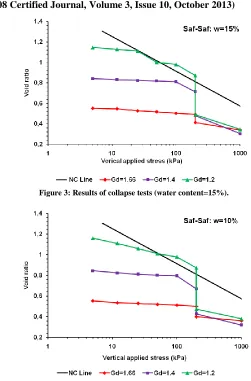
The twelve experimental tests carried out on Saf-Saf marl, compacted at different dry densities (1.62, 1.4 and 1.2) and different water contents (20, 18, 15 and 10%) gave the results reported in the graphs of Figures 1, 2, 3 and 4.
The oedometric paths found are compared with the reference lines NC derived from correlation with the liquid limit of material by Biarez and Favre (1975).
At the standard Proctor optimum (SPO) conditions of dry density and water content respectively 1.66 and 20%, the recorded collapse is less than 1% (cf. Figure 1) so under these conditions the soil is not collapsible. With the same water content (20%), and decreasing the initial density of 1.66 to 1.4 and 1.2, higher potentials of collapse are obtained (cf. Figure 1).
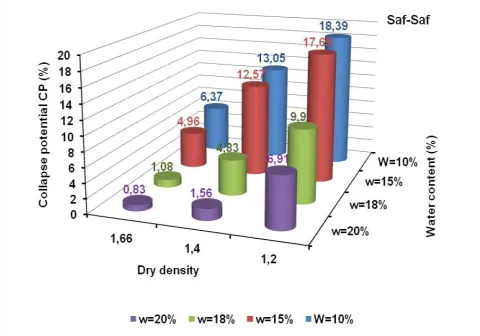
In Figures 2 and 3 the initial water content is respectively 18 % and 15%. In this case the potential collapse decreases while increasing applied dry density. The highest rate of collapse (Figure 4) is obtained for a density of 1.2 (it’s represent 72% of the density at the optimum) and a water content of 10%, the rate of collapse is 18.39%. This is explained by the fact that the soil structure is open: it has an important initial void ratio of about1.2.
International Journal of Emerging Technology and Advanced Engineering
Website: www.ijetae.com (ISSN 2250-2459, ISO 9001:2008 Certified Journal, Volume 3, Issue 10, October 2013)
[image:3.612.57.486.90.513.2]45
Figure 1: Results of collapse tests (water content=22%).
[image:3.612.310.561.120.501.2]Figure 2: Results of collapse tests (water content=18%).
Figure 3: Results of collapse tests (water content=15%).
[image:3.612.47.291.123.423.2]International Journal of Emerging Technology and Advanced Engineering
Website: www.ijetae.com (ISSN 2250-2459, ISO 9001:2008 Certified Journal, Volume 3, Issue 10, October 2013)
46
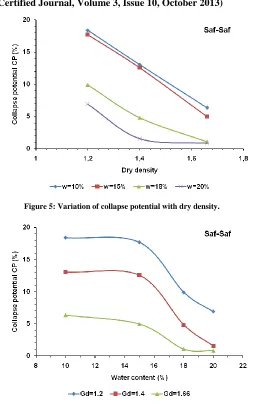
In order to establish the influence of dry density and water content on collapse potential of the studied soil, we calculate this later (table 2) and plotted the variation of collapse potential with both dry density (figure 5) and the water content (figure 6).
Analysing the table II, we can do some conclusions:
We obtain the lowest potential at the characteristics of standard Proctor optimum SPO (w=20%, Gd=1.66).
At lower density and water content we found the highest potential of collapse (18.39%) for the studied soil.
According to the classification of Jennings and Knight (1975), the soil of Saf-Saf presents a several trouble (12.75% to 18.39%) when we are in the dry side of the optimum Proctor.
When we approach the optimum Proctor, the potential severity of collapse decrease from trouble (CP from 6.37 to 9.9%) to moderate (CP from 1.08 to 4.94%).
TABLEII
POTENTIAL COLLAPSE OF STUDIED SOIL.
w = 20%
w = 18%
w = 15% w = 10%
Gd = 1.66 0.83 1.08 4.96 6.37 Gd = 1.4 1.56 4.83 12.57 13.05 Gd = 1.2 6.91 9.9 17.69 18.39
Classification of Jennings and Knight (1975) Legend:
No problem (CP from 0 to 1%)
Trouble (CP from 5 to 10%)
Moderate trouble (CP from 1 to 5%)
Several trouble (CP from 10 to 20%)
Very sever trouble (CP > to 20%)
[image:4.612.324.576.121.323.2]The results in Table II are expressed as graphs (figures 5 and 6). We saw clearly that there is an inverse relation between the collapse potential (CP) and dry density. The same think is observed for the relation between CP and water content. At higher value of water content, we obtain a lowest potential of collapse.
Figure 5: Variation of collapse potential with dry density.
Figure 6: Variation of collapse potential with water content.
[image:4.612.322.575.122.526.2] [image:4.612.50.288.386.540.2]International Journal of Emerging Technology and Advanced Engineering
Website: www.ijetae.com (ISSN 2250-2459, ISO 9001:2008 Certified Journal, Volume 3, Issue 10, October 2013)
47
[image:5.612.48.288.165.333.2]A summary of the potential collapse of the studied soil in 3D presentation is given in figure 7.
Figure 7: Summary of the potential collapse of Saf Saf material (3D representation).
VI. CONCLUSION
The principal conclusions which we can do in the end of this study are presented as follows:
The test of collapse carried out on Saf-Saf soil, show that for constant water content (constant suction), the potential of collapse increases when the dry density decreases.
The presence of about 28% of CaCO3 creates a
cementation between soil particles. This cementation disappears when the soil is wetted.
For this reasons, the soil in-situ is compacted near the optimum to minimize the risks to obtain collapse phenomena.
REFERENCES
[1] Abbech E.K., Laouar M.S., Messaoud F., 2010: Prediction of collapsible soils by cone penetrometer and ultra sonic tests. Studia Geotechnica et Mechanica, vol. Xxxii, N° 2.
[2] Abou-Bekr N., Bendi-Ouis A. & Taibi S., 2006 : Characterization of the clay of Sikkak core earth dam (West of Algeria) in The Fourth International Conference on Unsaturated Soils, Carefree, Arizona, U.S.A. on April 2-5, 2006, pp 1607-1616. Edited by American Society of Civil Engineers ASCE, Geotechnical Special Publication
N°. 147, ASCE / Geo Institute, 978-0-78 44-1095-0. Doi: 10.1061/40802(189)134.
[3] Ali M.M, 2011: Identifying and analysing problematic soils. Geotechnical and Geological Engineering. Doi 10.1007/s 10706-010-9380-y.
[4] Al-RawasA.A., 2000 : State of the art reviewof collapsible soils. Science and technology, Special review.
[5] Ayadat T. & Hanna A., 2007: Prediction of collapse behaviour in soil. Revue Européenne de Génie Civil, volume 11, Issue 5, Taylor & Francis Group.
[6] Houston, S.L., Houston, W.N. and Spadola, D.J. 1988. Prediction of field collapse of soils due to wetting. Journal of Geotechnical Engineering, American Society of Civil Engineers (ASCE), 114: 40-58.
[7] Montanez J.E.C., 2002: Suction and volume change of compacted sand-bentonite mixtures. Ph. D. Thesis. Imperial College of Science, Technology and Medicine. London, U.K.