Antennaassisted picosecond control of
nanoscale phase transition in vanadium
dioxide
Muskens, OL, Bergamini, L, Wang, Y, Gaskell, JM, Zabala, N, de Groot, CH, Sheel,
DW and Aizpurua, J
http://dx.doi.org/10.1038/lsa.2016.173
Title
Antennaassisted picosecond control of nanoscale phase transition in
vanadium dioxide
Authors
Muskens, OL, Bergamini, L, Wang, Y, Gaskell, JM, Zabala, N, de Groot,
CH, Sheel, DW and Aizpurua, J
Type
Article
URL
This version is available at: http://usir.salford.ac.uk/id/eprint/48557/
Published Date
2016
USIR is a digital collection of the research output of the University of Salford. Where copyright
permits, full text material held in the repository is made freely available online and can be read,
downloaded and copied for noncommercial private study or research purposes. Please check the
manuscript for any further copyright restrictions.
ORIGINAL ARTICLE
Antenna-assisted picosecond control of nanoscale
phase transition in vanadium dioxide
Otto L Muskens
1, Luca Bergamini
2,3, Yudong Wang
1,4, Jeffrey M Gaskell
5, Nerea Zabala
2,3, CH de Groot
4,
David W Sheel
5and Javier Aizpurua
3Nanoscale devices in which the interaction with light can be configured using external control signals hold great interest for next-generation optoelectronic circuits. Materials exhibiting a structural or electronic phase transition offer a large modulation contrast with multi-level optical switching and memory functionalities. In addition, plasmonic nanoantennas can provide an efficient enhancement mechanism for both the optically induced excitation and the readout of materials strategically positioned in their local environment. Here, we demonstrate picosecond all-optical switching of the local phase transition in plasmonic antenna-vanadium dioxide (VO2) hybrids, exploiting strong resonant field enhancement and selective optical pumping in plas-monic hotspots. Polarization- and wavelength-dependent pump–probe spectroscopy of multifrequency crossed antenna arrays shows that nanoscale optical switching in plasmonic hotspots does not affect neighboring antennas placed within 100 nm of the excited antennas. The antenna-assisted pumping mechanism is confirmed by numerical model calculations of the resonant, antenna-mediated local heating on a picosecond time scale. The hybrid, nanoscale excitation mechanism results in 20 times reduced switching energies and 5 times faster recovery times than a VO2film without antennas, enabling fully reversible switch-ing at over two million cycles per second and at local switchswitch-ing energies in the picojoule range. The hybrid solution of antennas and VO2provides a conceptual framework to merge thefield localization and phase-transition response, enabling precise, nanos-cale optical memory functionalities.
Light: Science & Applications(2016)5,e16173; doi:10.1038/lsa.2016.173; published online 21 October 2016
Keywords: insulator-metal phase transition; nanoantenna; plasmonics; VO2
INTRODUCTION
With the miniaturization of optical components and the convergence of electronic and photonic technologies, ultracompact devices are needed to control and switch light on length scales comparable to the optical wavelength. Resonant plasmonic antennas at visible and near-infrared wavelengths offer the capability to concentrate energy in space and time and enhance light–matter interaction and nonlinear response1,2. To achieve order-unity switching effects, hybrid devices
combining plasmonic antennas with materials showing a structural or electronic phase transition provide unique opportunities because they can provide very large changes in optical response. Recent investiga-tions of such hybrid systems include switchable metal hydrides3–5,
interface-mediated solid-liquid transitions of gallium6, resonant
bond-ing phase-change materials7–10 and insulator-to-metal transitions
(IMTs) in correlated oxides11. Chalcogenide phase-change materials,
such as Ge:Sb:Te (GST), allow for non-volatile writing and rewriting of photonic devices using a pulsed laser8–10,12,13. Excitation of this
phase-change response using the optical near-field opens up routes for achieving ultrasmall switching volumes and low-energy devices14,15.
Compared with chalcogenide phase-change materials, which pro-vide rewritable, non-volatile memory functionality at relatively high temperatures, vanadium dioxide (VO2) is characterized by a reversible
IMTs at only modestly elevated temperatures of ~ 68 °C11,16. This
phase transition can be driven using ultrafast laser pulses, where the precise mechanisms depend on the pulse duration and energy injection mechanisms involved, with a structural bottleneck as short as 80 fs17–19. While strong nonequilibrium physics occur on ultrafast
time scales, the VO2IMT is quasi-thermal for times41 ps18.
Several studies have reported the effects of a global, thermally or optically driven phase transition in VO2on the plasmonic response
of nanoparticles and metamaterials over a broad spectral range from terahertz20–23, mid-infrared24,25, near-infrared26–28 to visible29,30. In
the THz range, the giant electric-field strength in micrometer-sized antenna feed gaps has been used to overcome the Coulomb potential barrier for IMT, analogous to DCfield-induced switching21. In the
visible and near-infrared, studies of plasmonic effects on the optical excitation of the IMT have focused on hot-electron injection-driven ultrafast processes31,32 and on non-resonant,
continuous-wave-mediated plasmonic heating28,33.
1Physics and Astronomy, Faculty of Physical Sciences and Engineering, University of Southampton, Southampton SO17 1BJ, UK;2Department of Electricity and Electronics,
FCT-ZTF, UPV-EHU, Bilbao 48080, Spain;3Materials Physics Center, CSIC-UPV/EHU and DIPC, San Sebastian 20018, Spain;4Nano Group, Faculty of Physical Sciences and Engineering, University of Southampton, Southampton SO17 1BJ, UK and5Materials and Physics Research Centre, University of Salford, Manchester M5 4WT, UK Correspondence: OL Muskens, Email: [email protected]
Here, we use picosecond pulsed excitation to drive a highly localized phase-transition around resonant plasmonic nanoantennas. The picosecond pulsed regime is of relevance for many practical applica-tions, and nonlinear devices on this time scale are needed to enable all-optical switching34. Our experiments are enabled by very high-quality
VO2films that are grown with a surface roughness o10 nm using
atmospheric chemical vapor deposition35. Gold nanoantennas were
fabricated on top of thesefilms, forming a hybrid system together with the VO2, with an effective response that is governed by the nanoscale
interplay between the plasmonic and IMT components. Resonant antenna-assisted switching is studied using optical pump–probe experiments, where we perform picosecond pulsed excitation at a
fixed pump wavelength while tuning the antenna resonance condition via the antenna length. Multifrequency arrays of crossed antennas36
were specifically designed to individually address the cross-coupling of optically induced phase transitions between adjacent antennas with mutual separations o100 nm. Antenna-assisted optical pumping is identified through the dependence of the IMT switching on the polarizations of the pump and readout, on the pulse energy of the optical pump, and on the cycling rate and hysteresis of the IMT. A model combining resonant antenna-mediated absorption, heat diffusion and thermally induced local IMT successfully explains the resonant pumping on picosecond time scales. Nanoantenna–VO2
hybrids with fast, picosecond response and picojoule switching energies enable new directions in all-optical switching, active control of quantum emission37 and plasmonic memristor-type devices
exploiting nanoscale thermal memory28,38.
MATERIALS AND METHODS Fabrication of VO2thinfilms
VO2 thin films with low surface roughness were fabricated using
atmospheric pressure chemical vapor deposition following the meth-ods described elsewhere35. In short, VO
2 films were deposited
on boroaluminosilicate glass (Eagle by Corning, St Davids Park, UK) coated with a 30-nm layer of fluorine-doped tin oxide (FTO). The inclusion of this intermediate layer allowed the production of VO2films with low surface roughness and suitable thermochromic
transition temperature. FTO films were deposited onto 1-mm boroaluminosilicate glass using a precursor mixture of monobutyltin-trichloride (MBTC), oxygen, water and trifluoroacetic acid (TFA). A laboratory-scale atmospheric pressure chemical vapor deposition (CVD) coater was used. The substrate was heated to 600 °C and repeatedly translated underneath a coating head to produce a 30-nm-thick layer. MBTC was heated to 95 °C in a stainless-steel bubbler and introduced to a CVD reactor in a nitrogen carrier gasflow. Water and TFA were mixed to give a 0.1 M solution and introduced to the CVD reactor byflash evaporation in a nitrogen carrier gasflow.
VO2 was deposited on top of the FTO layer using a precursor
mixture of vanadium chloride and water in a ‘static’ cold wall atmospheric pressure CVD reactor. The substrate was sealed in a reaction chamber, allowing the area to be pressure-purged and backfilled with nitrogen, producing a controlled, oxygen-free environ-ment for deposition. The temperature was increased to the coating temperature, and the reactants were passed parallel over the substrate for 1 min to produce a 50-nm coating. Vanadium chloride was heated to 100 °C in a stainless-steel bubbler and was introduced into the coater in a nitrogen carrier gasflow. Water was heated to 60 °C in a stainless-steel bubbler and was introduced to the coater in a nitrogen carrier gas flow. After film deposition, the sample was cooled to
o200 °C before removal from the coater to prevent oxidation of the coating.
Fabrication of nanoantennas
Gold nanoantennas were fabricated on top of the 50-nm VO2layer
using e-beam lithography (JBX-9300FS by JEOL, Tokyo, Japan) at 100 keV with a dose of 650μC cm−2. After development, 45 nm of
gold was evaporated followed by lift off in acetone. The width of the antenna arms wasfixed at 80 nm, and the length was varied between 160 and 360 nm. A Ti layer of 5-nm thickness was used to improve the adhesion of the gold to the VO2. Helium-ion microscopy (HIM)
was performed on all arrays under study (Orion, Zeiss, Jena, Germany). Compared with conventional electron microscopy, the helium-ion microscope allows high-resolution imaging of non-conducting samples without charging the substrate.
Optical experiments
The dielectric function of the VO2 film was characterized using
variable-angle ellipsometry (Uvisel 2, Horiba, Stanmore, UK)35. Antenna experiments were performed using a picosecond pulsed Yb-fiber laser (Fianium, Hamble, UK) with a variable repetition rate between 0.1 and 20 MHz and afixed pulse duration of 9.2±0.1 ps, as determined using an autocorrelator (FR-103XL, Femtochrome, Berkeley, CA, USA). The oscillator output was amplified using two separate amplifier stages, one of which was used as the pump laser, with a fixed wavelength of 1060 nm, and the second output was used to produce a broadband supercontinuum spanning the range 400–2500 nm. A spectral band with tuneable centre wavelength and 2% spectral width was selected using a double-prism monochromator in subtractive mode. The 1060-nm pump and the continuously tuneable probe were combined onto an 1100-nm long-pass dichroic beam splitter and were focused onto the array using a 0.5 numerical aperture (NA), reflective Cassegrain objective (Edmund Optics, York, UK). All reported energies were measured before the objective, which has a transmission of 82%. Approximately 65% of the transmitted intensity was focused to a waist of 1.4±0.1μm, while 35% of the intensity was contained in much weaker satellite structures of the Cassegrain point-spread function extending up to several micrometers from the focus. Fluence values were calculated for the central 6±1μm2focus area taking into account these factors. The absolute
transmission measurements and pump–probe spectroscopy were obtained using a combination of optical choppers and lock-in detection. A motorized variable optical density (OD)filter (OD 2.0) was used to scan the pump power between 1 and 100% of the available range, with 100% corresponding to 13 nJ of pulse energy. For experiments without optical pumping, extinction measurements over a larger spectral window from the visible were collected by removing the dichroic splitter. The sample was mounted on a heater stage with a temperature controller capable of maintaining stable temperatures in the range 25–80 °C.
Numerical modeling
The optical response of the antennas on the VO2–glass substrate stack
was modeled using FDTD simulations (Lumerical, Vancouver, BC, Canada). Following detailed HIM images (see Supplementary Fig. S3), the antennas were modeled as semi-cylinders with rounded end caps. Three-dimensional near-field absorption profiles were extracted and used as the source distribution for a heat-transport simulation performed using the Multiphysicsfinite element software (COMSOL 5.1, Cambridge, UK). The resulting temperature profiles were used to generate a three-dimensional contour map of the phase-change response around the antenna, which was subsequently used to calculate the modified antenna resonances. A more extensive descrip-tion of the theoretical model is given in the Supplementary Secdescrip-tion II.
Antenna-assisted picosecond control
OL Muskenset al
2
RESULTS AND DISCUSSION
Thermally induced phase transition of antenna–VO2hybrids
To investigate the resonant antenna-assisted pumping of the VO2
IMT, arrays of crossed gold nanoantennas were fabricated on top of a VO2film, with antenna lengths varying from 160 to 360 nm in steps
of 50 nm (HIM images shown in Supplementary Fig. S2). A continuous VO2 film of 50-nm thickness with a roughness of
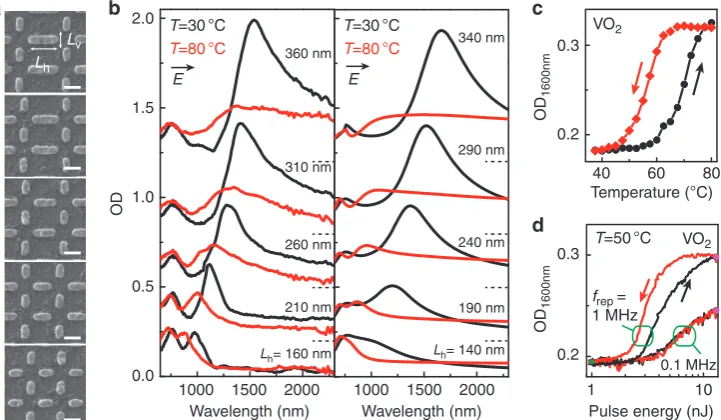
5 nm, estimated using atomic force microscopy, was used as the substrate for depositing gold nanoantennas using e-beam lithography. Figure 1a shows five selected arrays, where the vertical antenna length Lv was kept fixed at 160 nm while the length Lh of the
horizontal antennas was varied. This subset represents the behavior of all arrays of antennas, which follow very similar trends (see Supplementary Fig. S5). Figure 1b presents horizontally polarized extinction spectra (OD) for temperatures below (black) and above (red) the critical phase transition. A background spectrum was subtracted from all spectra corresponding to the bare VO2substrate
(see Supplementary Fig. S1). At temperatures far below the phase transition, the spectra show pronounced optical resonances in the near-infrared corresponding to the longitudinal half-wave (λ/2) antenna mode with a resonance wavelength shifting from 950 to 1500 nm with increasing antenna length. Above the phase transition (red lines, 80 °C) these resonant modes are strongly suppressed. This suppression can be qualitatively understood by the large changes in the optical permittivity of the VO2 film35, which is characterized by a
strong reduction of the real part and an increase of the imaginary part of the permittivity in the infrared. The VO2film acts as a load on the
antenna response, resulting in both a blueshift and strong damping of its resonance.
The spectral response at temperatures below and above the phase transition is reproduced well by numerical calculations of the antenna–VO2 hybrid, as shown in Figure 1b, obtained using
the measured dielectric function of the VO2 film, as detailed in the
Supplementary Section II. Good agreement is obtained for the shape and amplitude of the spectra both below and above the phase transition, showing that a suppression of the antenna resonance OD by up to 60% is achieved through temperature control of the VO2
substrate. A small adjustment of all antenna lengths to 20-nm lower values was made to improve the agreement of the spectral resonance positions at low temperature. Furthermore, for shorter antennas with resonances near the visible range, the calculated antenna resonances are somewhat broadened compared with the experimental data, indicating an overestimate of the local absorption in the VO2substrate
in this spectral range. We attribute these small deviations to variation in the optical properties over thefilm thickness that is not captured fully by the ellipsometry35, which provides only the average film
properties.
Optically induced phase transition of antenna–VO2hybrids
The reduction of the antenna OD above the phase transition is opposite to the effect of the VO2film itself, where the OD is increased
above the phase transition due to increased absorption in the switched metallic state, as shown in Supplementary Fig. S1. The spectral response shows an isosbestic point (that is, wavelength of constant OD between the two states) at ~ 1000 nm, with an increasing IMT-induced OD at longer wavelengths. In the following, we choose a probe wavelength of 1600 nm, sufficiently far from the isosbestic point, as representative for the dynamics of the VO2 film
without antennas. The temperature-dependent OD of the VO2 film
without antennas is presented in Figure 1c. The VO2film shows a
typical hysteresis loop when the temperature is cycled between 25 and 80 °C, as indicated by the arrows. This hysteresis shows that thermal memory is present in the system, that is, the sample response depends on its thermal history.
Next to controlling the sample temperature, the phase transition could be triggered through optical pumping. For this purpose, we
T=80 °C
T=30 °C 2.0
1.5
1.0
0.5
OD
OD
1600nm
OD
1600nm
0.0
a b
Lh= 160 nm
210 nm 260 nm 310 nm 360 nm
Lh= 140 nm
190 nm 240 nm 290 nm 340 nm
T=80 °C
T=30 °C
T=50 °C c
frep = 1 MHz
0.1 MHz d
Lh Lv
E E
VO2
0.3
0.2
40 60 80
0.3
0.2
1 10
Pulse energy (nJ) Wavelength (nm)
1000 1500 2000 1000 1500 2000
Wavelength (nm)
Temperature (°C)
[image:4.595.112.473.460.670.2]VO2
fixed the sample temperature to 50 °C, sufficiently below the hysteresis loop of the VO2 to allow full relaxation of the sample to its
low-temperature, unswitched state. The optical excitation makes use of a picosecond pulsed laser, as described in the Materials and Methods section, producing a train of pulses with variable repetition rate. To study the switching caused by individual pulses over a single cycle, as opposed to accumulated heating effects, it is important that the time between subsequent pump pulses is sufficiently long to allow the sample to recover its unperturbed state without a memory of previous events. Figure 1d shows the response of the VO2 film at 1600 nm
under excitation by a train of picosecond pump pulses at a repetition rate of 1.0 MHz and a pump wavelength of 1060 nm. The OD was sampled at a pump–probe time delay of 100 ps following pulsed laser excitation, corresponding to a fully developed phase transition. With increasing pulse energy, the OD increases to a level close to the thermal switching amplitude of Figure 1c at the highest available pump energy of 13 nJ, indicating that a complete phase transition is achieved using optical pumping under these conditions. However, when ramping down the power, hysteresis behavior is observed. This hysteresis indicates that thermal memory is still present for pulsed excitation at a 1-MHz repetition rate, and part of the response results from heat accumulated in the sample over subsequent excitation cycles. The hysteresis in the optical pumping cycle is completely suppressed when reducing the repetition rate to 0.1 MHz, where it is evident that single-cycle pulsed excitation only achieves approximately half of the modulation amplitude of Figure 1c.
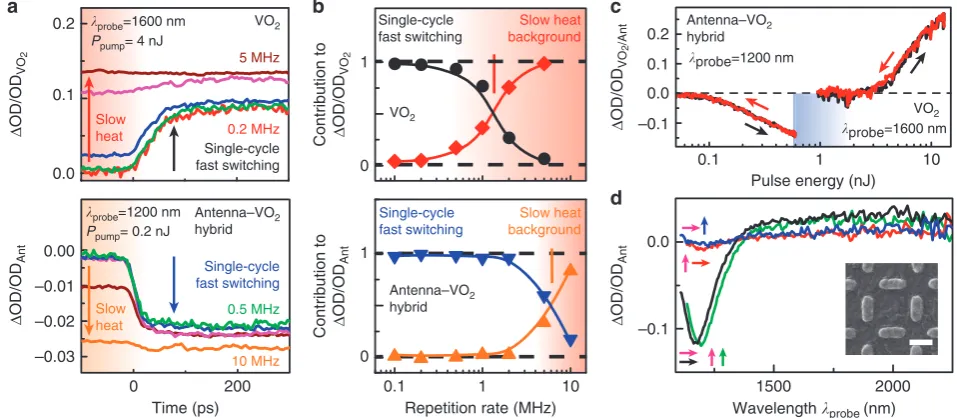
The balance between fast, single-cycle switching and slow, accu-mulated heat effects is investigated in more detail in Figure 2 by studying the dependence on the optical pumping repetition rate. We used a pulse picker to reduce the laser repetition rate in steps from 10
to 0.1 MHz. The top panel of Figure 2a shows the differential transmission ΔOD/ODVO2 against the pump–probe delay time for
the bare VO2film without antennas. The bottom panel in Figure 2a
shows the response measured for the antenna–VO2hybrid array with
Lv=Lh=210 nm at the antenna resonance (λprobe=1200 nm),
normalized to the maximum OD of the antenna, ODAnt=0.4
(see Supplementary Fig. S4). The pump energy of Ppump=0.2 nJ
was limited by the damage threshold at the highest repetition rates. The relevant dynamics did not depend on the pulse energy.
A picosecond, fast component is identified by the step in theΔOD/ OD response at ~ 0 ps. At high-repetition rates, the amplitude of this fast, picosecond component is reduced, whereas instead theΔOD/OD response is governed by a flat, stationary response that does not depend on the picosecond dynamics. The balance between these two effects is best illustrated by plotting the relative contributions to the total response shown in Figure 2b, where the contributions are defined asΔODslow/ΔOD andΔODfast/ΔOD. HereΔOD is the total change,
and ΔODslow and ΔODfast are the slow and fast components,
identified by the ΔOD before and after 0 ps, respectively. For low-repetition rates, the response is entirely governed by the fast, picosecond component corresponding to excitation by a single-pump pulse at every cycle. At higher repetition rates above a critical threshold (indicated by the vertical line), the stationary thermal background dominates, and the fast, picosecond component is suppressed to zero. The stationary background corresponds to an increased temperature of the sample around the excitation area, which is built up over many pumping cycles because the sample is not completely relaxed between subsequent pulses. Because both the background and picosecond effects act on the same IMT, an increase of the slow effect results in suppression of the fast component because
Slow heat background
Contribution to Δ
OD/OD
VO
2
Contribution to Δ
OD/OD
Ant
Δ
OD/OD
Ant
Δ
OD/OD
VO
2
/Ant
Δ
OD/OD
Ant
Δ
OD/OD
VO
2
a b c
10 MHz
0.5 MHz
5 MHz
0.2 MHz
d
VO2
Antenna–VO2
hybrid
Antenna–VO2
hybrid probe=1600 nm
probe=1200 nm Single-cycle
fast switching Slow
heat
Single-cycle fast switching
Slow heat
Single-cycle fast switching
probe=1600 nm probe=1200 nm
Antenna–VO2
hybrid
VO2
0.2
1
0
1
0
0.2
0.1
0.0
0.0 –0.1
0.1 1 10
Pulse energy (nJ)
–0.1 0.1
0.0
0 200 0.1 1 10 1500 2000
Wavelength probe (nm)
Time (ps) Repetition rate (MHz)
0.00
–0.01
–0.02
–0.03
VO2
Single-cycle fast switching
Slow heat background
Ppump= 4 nJ
[image:5.595.65.544.424.633.2]Ppump= 0.2 nJ
Figure 2 Contributions of the fast picosecond and slow thermal response to the optically driven IMT in VO2and antenna–VO2hybrids. (a) Time-dependent response of VO2(top,λprobe=1600 nm) and antenna array withLv=Lh=210 nm (bottom,λprobe=1200 nm) for repetition rates of 0.2 MHz (red), 0.5 MHz (green), 1 MHz (blue), 2 MHz (magenta), 5 MHz (brown) and 10 MHz (orange). The effect before 0 ps corresponds to a slow heat background, with the step at 0 ps corresponding to single-cycle fast switching caused by picosecond phase transition. Pump energyPpumpfor the VO2film, 4 nJ; for the antenna array, 0.2 nJ. (b) Relative contributions of single-cycle fastΔODfast/ΔOD and slow heat backgroundΔODslow/ΔOD (see text) obtained from the time traces ina. The antenna array shows 5 × increased operating speed for single-cycle fast switching compared with pure VO2. (c) Phase-change modulationΔOD/OD versus optical pulse energy atλprobe=1200 nm for the antenna array and atλprobe=1600 nm for the VO2film, both at 0.1 MHz. The blue shaded region indicates the damage threshold for the antenna array. (d) Differential nonlinear response spectrumΔOD/ODAntfor an antenna array withLv=Lh=210 nm, for different combinations of pump (magenta arrows) and readout (black/red arrows, horizontal, green/blue arrows, vertical) polarizations, at a temperature of 50 °C, 0.1 MHz pump laser repetition rate, and 0.6 nJ pump energy.
Antenna-assisted picosecond control
OL Muskenset al
4
the sample is maintained in the switched state by the accumulated heat. For the VO2film without antennas, this crossover from a fast
picosecond response (black dots) to the slow heat background signal (red diamonds) occurs at an ~ 1 MHz repetition rate, indicating that the typical recovery time of the system is ~ 1μs. For the antenna–VO2
hybrid system, the crossover from picosecond to slow heat back-ground response occurs at ~ 5 MHz,five times higher frequency than for the VO2film. Thus, the typical recovery time of the hybrid system
is ~ 200 ns.
The response of the antenna–VO2 hybrid is characterized by a
strong reduction in the optical switching energy. Figure 2c compares
ΔOD/ODAnt for the Lv=Lh=210 nm antenna–VO2 hybrid with ΔOD/ODVO2of the bare VO2film against pulse energy at a repetition
rate of 0.1 MHz. While the bare VO2shows an onset of IMT switching
for amplitudes 42 nJ, the antenna–VO2hybrids show an onset at
~ 100 pJ, which is a 20 times lower pulse energy. Irreversible damage to the antenna–VO2 hybrids is caused above 800 pJ, limiting the
maximum modulation for this configuration to ~ 15%. The VO2film
itself reaches similar modulation contrast values of up to 20%; however, this requires a much higher pulse energy of 13 nJ.
Antenna-assisted resonant pumping of the phase transition
Thefivefold reduction in thermal recovery time and420 times lower switching energy of the antenna–VO2hybrids suggests a new
excita-tion pathway distinct from bulk switching of the VO2 film without
antennas. To further explore the contribution of antenna-assisted mechanisms in the antenna–VO2hybrid response, we measured the
switching response while independently controlling the polarizations of both excitation and readout. This strategy was used successfully in
previous studies for antennas on an ITO substrate36. Figure 2d shows
the spectrally resolvedΔOD normalized to ODAntmeasured on the
Lv,h=210 nm antenna–VO2 hybrid array for the four different
combinations of pump and probe polarizations, as indicated by the pairs of arrows, with thefirst (magenta) and second (colored) arrow, indicating pump and probe polarizations, respectively. The pumping was performed at a 0.1 MHz repetition rate and 0.6 nJ energy at 1060 nm pump wavelength. A large modulation amplitude is observed only for the condition, where the pump and readout polarizations are parallel to each other. For perpendicular polarizations, no switching response is observed. Given that perpendicularly oriented antennas are positioned within 100 nm from each other in the array, the lack of cross-interaction of the antenna-mediated IMT is remarkable and shows experimentally that the induced effects are limited to only a nanoscale-sized volume around the antenna–VO2hybrids, which can
be specifically addressed by the combination of the polarization and wavelength of the excitation laser.
Experiments performed on different arrays of antenna–VO2
hybrids, corresponding to different combinations of lengthsLh and
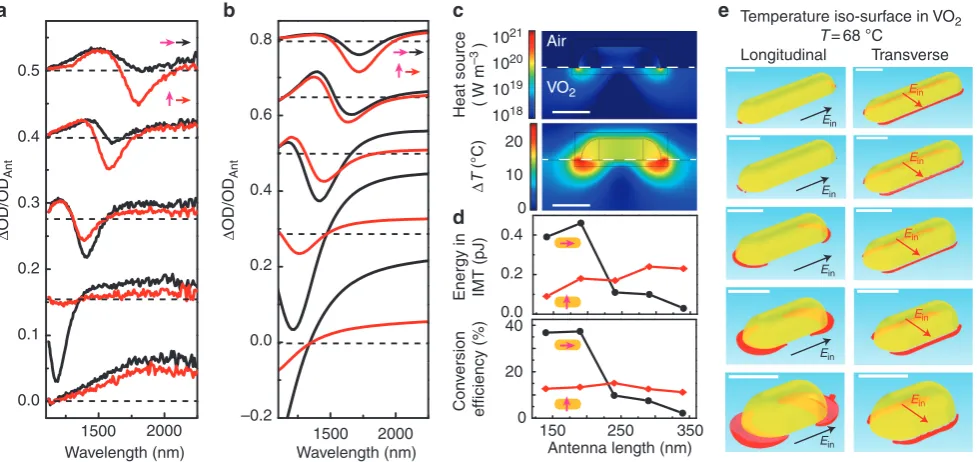
Lv, show the response when tuning the system from resonant to non-resonant pumping conditions. Figure 3a shows the results for arrays of crossed antennas with equal arm lengthsLhandLvtuned (bottom to
top) from 160 to 360 nm. The polarization-dependent response is shown for the pump and readout polarizations that are parallel (black curves) and perpendicular (red curves). The strong IMT response around the plasmon resonance for parallel polarizations, which is most clearly observed for the 210-nm length antennas corresponding to Figure 2d, disappears with increasing arm length. For crossed
Δ
T
(°C)
c Temperature iso-surface in VO
2
T= 68 °C
Heat source ( W
m
–3
)
0 20
10
Air
VO2 1021
1018
1019 1020
a
0.5
0.4 0.6 0.8
0.3 0.4
0.2 0.2
0.1
0.0
1500
0.0
–0.2
b e
d
150 250 350
Antenna length (nm) 0
20 40
Con
v
ersion
efficiency (%)
0.0 0.2 0.4
Energy in IMT (pJ)
Wavelength (nm) Wavelength (nm)
2000 1500 2000
Longitudinal Transverse
Δ
OD/OD
Ant
Δ
OD/OD
Ant
Ein
Ein
Ein
Ein
Ein
Ein
Ein
Ein
Ein
[image:6.595.48.537.414.645.2]Ein
polarizations, the nonlinearΔOD response increases as the antenna length is increased.
Model of antenna-assisted phase transition
These trends are reproduced well by the detailed numerical calcula-tions plotted in Figure 3b. The physical model underlying these calculations is presented in Figure 3c–3e. First, the near-field absorp-tion profile around the antenna was calculated based on full electrodynamic calculations of the near-field intensity. The top panel of Figure 3c shows resulting maps for an L=190 nm antenna and incident light polarized along the antenna axis, for an excitation power corresponding to an integrated energy of 300 pJ (fluence of 2.75 mJ cm−2) over the pulse duration. The calculated local absorption
profile was used as a quasi-stationary heat source distribution for the heat-transport equation, resulting in the temperature profile shown in the bottom panel of Figure 3c. To separate the different contributions to the total temperature rise originating from energy absorbed in the gold antenna and in the VO2film, we independently evaluated the role
of the antenna as a heat source (results shown in the Supplementary Fig. S8), and found that absorption outside the plasmonic antenna dominates the heat source distribution under conditions of resonant pumping and nearly completely explains the temperature increase without requiring additional energy transport from inside the nano-particle into the VO2layer.
From the calculated local temperature profile, nanoscale volumes can be extracted, in which the temperature is sufficiently high to induce the VO2IMT. Figure 3e shows the resulting contours, plotted
in red, for antennas with lengths increasing from 140 to 340 nm (the length of the model antennas corresponds to the experimental cases
from 160 to 360 nm). Both the longitudinal and transverse pump polarizations are shown for each antenna. For longitudinal pump polarization, resonant pumping results in pronounced pockets of IMT response around the end caps of the antenna for the shortest antennas. For longer antenna lengths, the effect of resonance is weaker, and the critical temperature threshold is reached within a much smaller volume. In comparison, the transverse pump polarization shows approximately the same effect for all antenna lengths. This contribu-tion is caused by off-resonance absorpcontribu-tion of the transverse plasmon mode, which causes a narrow band of IMT that increases linearly in length as the antenna length is increased.
The optical spectra in Figure 3b were obtained by including the calculated IMT volumes in the electrodynamic simulation, using the known dielectric response of the switched VO2. Our microscopic
model satisfactorily explains the two trends for the longitudinal and transverse excitation conditions, corresponding to the resonant pumping of the IMT for longitudinal polarization and the non-resonant increase for transverse polarization. The model predicts an effective switching energy of up to 0.46 pJ per antenna at resonance, as shown in Figure 3d. Up to 39% of the total absorbed energy is converted into the VO2 phase transition, making the resonant,
antenna-assisted absorption mechanism a potentially highly efficient process for device applications. For the pumping of the transverse resonance, the model calculates energy conversion efficiencies in the range of 12–15%.
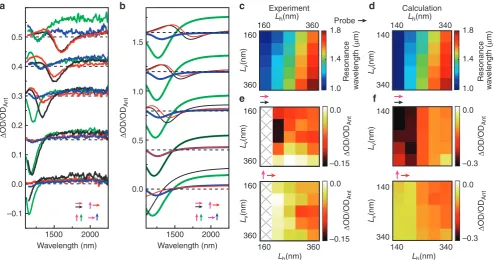
The results in Figure 3 show that the switching spectra for cross-antenna arrays with equal lengths can be explained using the cross- antenna-assisted IMT response of single antennas without cross-coupling. The case of unequal antenna lengths is investigated in Figure 4. Figure 4a
c
1.0 1.8
1.4
Resonance
w
a
v
elength (
μ
m)
160
360
160 360 Probe
Experiment Lh(nm)
Calculation Lh(nm)
d
140
340 Lv
(nm)
Lv
(nm)
Lv
(nm)
140 340
1.0 1.8
1.4
Resonance
w
a
v
elength (
μ
m)
160
360 Lv
(nm)
Lv
(nm)
Lv
(nm)
–0.15 0.0
Δ
OD/OD
Ant
Δ
OD/OD
Ant
140
–0.3 0.0
Δ
OD/OD
Ant
–0.15 0.0
360 160
Lh(nm)
160
360
340 140
Lh(nm)
–0.3 0.0
Δ
OD/OD
Ant
140
340
a
b
e
f
Wavelength (nm) 1500 2000 Wavelength (nm)
1500 –0.1
0.0 0.5 1.0 1.5
0.1
0.0 0.2 0.3 0.4 0.5
2000
Δ
OD/OD
Ant
Δ
OD/OD
[image:7.595.59.554.401.661.2]Ant
Figure 4Full investigation of the multifrequency antenna–VO2hybrids shows resonant contribution in antenna-mediated IMT response. (a) Experimental and (b) calculated switching responseΔOD/ODAnt of antenna–VO2 hybrids for fixed Lv=210 nm and, bottom to top, varying Lh=160, 210, 260, 310 and 360 nm (calculated antennas are 20 nm shorter). Arrows indicate pump (magenta) and probe (black/red arrows, horizontal, green/blue arrows, vertical) polarizations. (candd) Experimental (c) and calculated (d) resonance positions of the horizontal (top panel) antennas in multifrequency antenna arrays with combinations ofLhandLv(see Supplementary Fig. S2 for helium-ion microscopy images). (eandf) Experimental (e) and calculated (f) normalized amplitude ΔOD/ODAntfor the horizontal readout (probe, black/red arrows) and for two pump polarizations, as indicated by magenta arrows. Crosses indicate arrays for which the resonance lies outside the spectral window of the probe.
Antenna-assisted picosecond control
OL Muskenset al
6
shows the full polarization response for four combinations of pump and probe polarizations for antennas withfixedLv=210 nm andLh
varying from 160 to 360 nm. EachΔOD spectrum was normalized to the ODAntof the corresponding antenna resonance. The
correspond-ing calculated response is shown in Figure 4b. Both experiment and theory show good agreement in the spectral positions and line shapes of the ΔOD switching response, resembling that of the uncoupled single rods. The only deviation is for the resonant excitation of the
fixed vertical antenna (green curves), which shows a suppression and change in shape for the longest horizontal antenna lengths.
The global trends over the 25 (5 × 5) different arrays are illustrated by the color maps shown in Figure 4c–4f. Figure 4c and 4d shows the spectral resonance positions extracted from the linear extinction spectra (see Supplementary Figs. S4 and S6). The maximum negative
ΔOD/ODAntamplitudes are shown in Figure 4e and 4f for two of the
polarization combinations. The other two polarization cases can be obtained by mirroring the matrices along the diagonal. For the shortest 160-nm length antennas, the resonance lies below the accessible spectral range; therefore, we discarded these data points (crossed out).
The diagonal components of the matrices correspond to the equal length antenna arrays in Figure 3a and 3b, and show good agreement between experiment and theory. For the off-diagonal components, the transverse (cross-polarized) pumping conditions are reproduced for all combinations and show little dependence on the ratio of the horizontal and vertical antenna lengths (vertical bands of equal modulation intensity). For the longitudinal excitation (parallel polar-izations), much stronger co-dependence on the antenna parameters is
observed for the experimental case than for the calculations, as was observed in Figure 4a. The strongest overall modulation response is found for the Lv=Lh=210 nm array, and the presence of longer
antennas in the cross-direction reduces the modulation depth in the experimental data but does not affect the calculated response. Thus, the experimental data indicate stronger cross-interaction effects between antennas, which are not yet fully captured by our model. These variations correspond to subtle differences in the microscopic energy distribution, which may befine-tuned in future work. Overall, wefind that the simple localized absorption picture provides a good qualitative and semi-quantitative description of the observed behavior.
Thermal latching optical memory of antenna–VO2hybrids
The above investigation shows that it is possible to achieve local IMT switching through resonant optical pumping of VO2using nanoscale
hotspots. The local pumping significantly reduces the required optical power, thermal load and recovery time of the device. These characteristics are of interest for applications in optical memory, memristors, switches and modulators. The memory functionality of antenna–VO2 hybrids is based on the thermal hysteresis
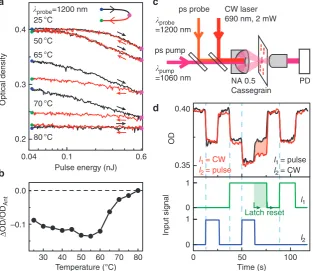
character-istics, which we minimized by using pulsed laser excitation at sub-MHz repetition rates. However, memory functionality can be introduced by raising the base temperature into the hysteresis regime28. Figure 5a shows the dependence of the optically induced state on the base sample temperature, as set by the external heater stage. At room temperature, picosecond optical switching is fully reversible and can be cycled over millions of times per second. At elevated temperatures above 55 °C, the system is latched to a value
a
d
OD
probe=1200 nm
Optical density
l1 = CW
l2 = pulse
l2 l1
l1 = pulse
l2 = CW
Input signal
0 1 0 1
Time (s) 100 50
0 0.40
Latch reset
b
NA 0.5 Cassegrain ps probe CW laser
690 nm, 2 mW
PD c
probe
=1200 nm
pump
=1060 nm ps pump
0.35 0.4
0.2
0.04
0.0
–0.1
30 40 50 Temperature (°C)
60 70 80
0.1 0.6
Pulse energy (nJ) 0.3
25 °C
50 °C
65 °C
70 °C
80 °C
Δ
OD/OD
[image:8.595.135.449.392.663.2]Ant
determined by the downward branch of the hysteresis loop of Figure 1c. This latching effect for the case of resonant plasmonic pumping is nontrivial because it involves maintaining the integrity of the small, nanoscale pockets of switched VO2around the antenna end
caps. In our experiments, we did not observe degradation of the latched state over typical time scales of minutes. At sample tempera-tures above the IMT (80 °C in Figure 5a), optical pumping does not induce further effects because the whole sample is already switched thermally by the heater stage.
In the differentialΔOD/ODAntresponse (Figure 5b), taken at the
pulse energy of 0.6 nJ, the thermal latching effect is observed as a reduction of the picosecond transient signal to zero as the system crosses the hysteresis regime of the IMT. Furthermore, while the largest signal amplitudes are obtained just below the hysteresis regime at ~ 50 °C, a modulation response is obtained all the way down to room temperature, showing that operation of antenna–VO2hybrids
for picosecond switching is possible without requiring an elevated base temperature.
In addition to setting the base temperature, latching of the phase transition could also be achieved through continuous-wave optical pumping of the sample. Figure 5c shows the experimental arrange-ment, where a continuous wave (CW) diode laser at a wavelength of 690 nm was used to achieve continuous thermal excitation at aΔOD level comparable to that of the picosecond laser-induced response. We tested the latching effect using two pulse sequences, where the CW and picosecond pulsed pump lasers were combined to provide an additive effect on the IMT response of the readout beam. In thefirst scheme, intensity sequence I1 was applied to the CW laser and
sequenceI2was applied to the picosecond laser. In this sequence, the
switch was prepared in the trigger state at 40 s using the CW laser (I1),
after which the memory was triggered by the picosecond laser (I2) at
50 s. When the picosecond signal I2 was switched off at 65 s, the
system remained in the latched state until the removal of the CW control signal at 80 s. Similar to thermal latching using the heater stage, the optically latched state was very stable over minutes, and the
fluctuations in Figure 5d mainly reflect stability of the microscope setup itself. WhenI1andI2are reversed, that is,I1corresponds to the
single-shot reversible excitation, this latching effect is no longer obtained because the base temperature is not retained for pulsed excitation. Thus, picosecond pulsed excitation and CW thermal excitation with the same optical response provide different memory functionalities and can be used in combination to achieve different switching operations.
Discussion
It is of interest to compare our results obtained in the picosecond regime with other works using continuous-wave or ultrafast (sub-100 fs) pulsed excitation. The critical pulse energies for the antenna–VO2 hybrid and the bulk VO2 translate to fluences of
~ 0.9 mJ cm−2and 18 mJ cm−2, respectively. Continuous-wave experi-ments show a threshold for the VO2IMT of ~ 100 mW cm−2(Refs. 28
and 33). However, this mechanism involves slow heating of both the VO2 and substrate to the critical temperature over hundreds of
milliseconds33. For sub-100 fs excitation, the criticalfluence amounts
to 4.7 mJ cm−2 for bulk VO
218,39,40. The fluences in our work are
therefore higher than the values reported for nonthermal excitation of VO2domains, which benefit from highly nonequilibrium effects to
cross the energy barrier for the IMT. While the use of picosecond pulses does not benefit from the nonequilibrium physics of ultrafast lasers, there is a strong motivation for device applications to exploit efficient picosecond mechanisms for optical devices, such as those
based on the fast thermal response of plasmonic nanoantennas34.
Because the pump area contains ~ 60 of the resonant antennas, the experimental switching energies between 100 and 600 pJ correspond to 1.6 and 10.0 pJ per antenna, closely matching our numerical model calculations. Thus, picojoule single-antenna switches are feasible using this approach.
In comparison, the reported switching fluence of chalcogenide phase-change materials using femtosecond laser pulses is 140 mJ cm 2
(Ref. 13), corresponding to 1.5 nJ pulse energy for a full set-reset cycle. In particular, the reset pulse in non-volatile GST phase-change memory locally exposes the device to temperatures above the melting point of 620 °C, resulting in a significant thermal load and crosstalk, which can pose limitations in practical applications. In contrast, the temperature in picosecond antenna–VO2 hybrids never rises far
above the phase transition of 68 °C and is therefore friendlier toward integration into nanophotonic devices. Given that a single picojoule pulse induces persistent IMT switching for several hundreds of nanoseconds, the average power requirement to sustain a single-antenna–VO2 hybrid memory can be estimated as ~ 10–100μW.
Thus, antenna–VO2hybrids are expected to be competitive with GST
phase change, especially for short-term memory applications with cycling times shorter than 1 ms.
In addition to the thermally mediated phase transition, recent studies have proposed contributions of ultrafast plasmon-induced hot electrons31,32. These additional effects are more likely to play a role for
much shorter laser pulses in the 100 fs range, that is, much shorter than the 9.2 ps pump laser used in this work. Our modeling based on the measured optical constants predicts absorption primarily in the VO2itself and reproduces our experimental results without requiring
the additional mechanism of hot-electron excitation and escape through the gold–VO2interface. Therefore, we have not considered
these effects in our interpretation.
CONCLUSION
We have demonstrated that resonant pumping of plasmonic nanoan-tenna–VO2hybrids results in high-repetition, fully reversible switching
of the insulator-to-metal phase transition. The use of plasmonic
near-field enhancement and hybrid antenna–VO2 response results in an
order of magnitude lower switching energy and faster cycling time than bulk VO2 without antennas. Moreover, the antenna-assisted
process allows precise, local control of the VO2 optical properties
down to the nanoscale. These properties render antenna–VO2hybrids
of great interest for application in optical modulation and fast picosecond control of nanoscale devices. As a result of the large difference in switching energy between antenna-mediated and bulk VO2, the antenna–VO2 hybrid response can be selectively excited
without inducing a background response from the VO2 film itself.
Optical experiments show that fully reversible switching of antenna resonances with over two million cycles per second is possible using resonant pumping schemes. The insulator-to-metal phase transition mediated by local pumping of a plasmon resonance does not influence the resonance of a perpendicular nanoantenna positionedo100 nm from the modulated antenna. Further improvement of the response may include optimization of the design, including selective deposition of VO2 in the direct surroundings of the antenna, embedding of
antennas inside a VO2matrix and improved cooling using substrates
and coatings with high-thermal conductivity.
CONFLICT OF INTEREST
The authors declare no conflict of interest.
Antenna-assisted picosecond control
OL Muskenset al
8
ACKNOWLEDGEMENTS
We acknowledge M Abb for valuable contributions to the experimental setup and H Yates for stimulating discussions and support in the development of the VO2 deposition. This work was financially supported by EPSRC through
research grant EP/J011797/1. OLM acknowledges support through an EPSRC Early Career Fellowship EP/J016918/1. LB, NZ and JA acknowledgefinancial support from Project No. FIS2013-41184-P of the Spanish Ministry of Econ-omy and Competitiveness, project ETORTEK IE14-393 NANOGUNE’14 of the Department of Industry of the Government of the Basque Country, and sup-port from the Basque Department of Education and the UPV-EHU (Grant No. IT-756-13). All data supporting this study are openly available from the University of Southampton repository at http://dx.doi.org/10.5258/SOTON/ 392922.
1 Zheludev NI, Kivshar YS. From metamaterials to metadevices.Nat Mater2012;11: 917–924.
2 Schuller JA, Barnard ES, Cai W, Jun YC, White JSet al.Plasmonics for extreme light concentration and manipulation.Nat Mater2010;9: 193–204.
3 Strohfeldt N, Tittl A, Schäferling M, Neubrech F, Kreibig Uet al.Yttrium hydride nanoantennas for active plasmonics.Nano Lett2014;14: 1140–1147.
4 Tittl A, Michel AKU, Schäferling M, Yin XH, Gholipour Bet al.A switchable mid-infrared plasmonic perfect absorber with multispectral thermal imaging capability.Adv Mater 2015;27: 4597–4603.
5 Sterl F, Strohfeldt N, Walter R, Griessen R, Tittl Aet al.Magnesium as novel material for active plasmonics in the visible wavelength range.Nano Lett2015;15: 7949–7955.
6 Waters RF, Hobson PA, MacDonald KF, Zheludev NI. Optically switchable photonic metasurfaces.Appl Phys Lett2015;107: 081102.
7 Shportko K, Kremers S, Woda M, Lencer D, Robertson Jet al.Resonant bonding in crystalline phase-change materials.Nat Mater2008;7: 653–658.
8 Gholipour B, Zhang JF, MacDonald KF, Hewak DW, Zheludev NI. An all-optical, non-volatile, bidirectional, phase-change meta-switch.Adv Mater2013;25: 3050–3054. 9 Michel AKU, Chigrin DN, Maß TWW, Schönauer K, Salinga Met al.Using low-loss
phase-change materials for mid-infrared antenna resonance switching.Nano Lett2013;
13: 3470–3475.
10 Michel AKU, Zalden P, Chigrin DN, Wuttig M, Lindenberg AMet al.Reversible optical switching of infrared antenna resonances with ultrathin phase-change layers using femtosecond laser pulses.ACS Photonics2014;1: 833–839.
11 Yang Z, Ko C, Ramanathan S. Oxide electronics utilizing ultrafast metal-insulator transitions.Annu Rev Mater Res2011;41: 337–367.
12 Ríos C, Stegmaier M, Hosseini P, Wang D, Scherer Tet al.Integrated all-photonic non-volatile multi-level memory.Nat Photonics2015;9: 725–732.
13 Wang Q, Rogers ETF, Gholipour B, Wang C-M, Yuan GHet al.Optically reconfigurable metasurfaces and photonic devices based on phase change materials.Nat Photonics 2016;10: 60–65.
14 Hosaka S, Shintani T, Miyamoto M, Kikukawa A, Hirotsune Aet al.Phase change recording using a scanning near-field optical microscope.J Appl Phys1996;79: 8082–8086.
15 Kühler P, de Abajo FJG, Leiprecht P, Kolloch A, Solis Jet al.Quantitative imaging of the optical nearfield.Opt Express2012;20: 22063–22078.
16 Qazilbash MM, Brehm M, Chae B-G, Ho P-C, Andreev GOet al.Mott transition in VO2 revealed by infrared spectroscopy and nano-imaging.Science2007;318: 1750–1753. 17 Cavalleri A, Tóth C, Siders CW, Squier JA, Ráksi Fet al.Femtosecond structural dynamics in VO2during an ultrafast solid-solid phase transition.Phys Rev Lett2001;
87: 237401.
18 Wegkamp D, Stähler J. Ultrafast dynamics during the photoinduced phase transition in VO2.Prog Surf Sci2015;90: 464–502.
19 O’Callahan BT, Jones AC, Park JH, Cobden DH, Atkin JMet al.Inhomogeneity of the ultrafast insulator-to-metal transition dynamics of VO2.Nat Commun2015;6: 6849.
20 Driscoll T, Kim HT, Chae BG, Kim BJ, Lee YWet al.Memory metamaterials.Science 2009;325: 1518–1521.
21 Liu MK, Hwang HY, Tao H, Strikwerda AC, Fan KBet al.Terahertz-field-induced insulator-to-metal transition in vanadium dioxide metamaterial.Nature2012;487: 345–348.
22 Seo M, Kyoung J, Park H, Koo S, Kim H-Set al.Active terahertz nanoantennas based on VO2phase transition.Nano Lett2010;10: 2064–2068.
23 Thompson ZJ, Stickel A, Jeong J-G, Han S, Son BHet al.Terahertz-triggered phase transition and hysteresis narrowing in a nanoantenna patterned vanadium dioxidefilm. Nano Lett2015;15: 5893–5898.
24 Shelton DJ, Coffey KR, Boreman GD. Experimental demonstration of tunable phase in a thermochromic infrared-reflectarray metamaterial.Opt Express2010;18: 1330–1335. 25 Kats MA, Blanchard R, Genevet P, Yang Z, Qazilbash MMet al.Thermal tuning of mid-infrared plasmonic antenna arrays using a phase change material.Opt Lett2013;
38: 368–370.
26 Dicken MJ, Aydin K, Pryce IM, Sweatlock LA, Boyd EMet al.Frequency tunable near-infrared metamaterials based on VO2phase transition.Opt Express2009;17: 18330–18339.
27 Son TV, Ba COF, Vallée R, Haché A. Nanometer-thickflat lens with adjustable focus. Appl Phys Lett2014;105: 231120.
28 Lei DY, Appavoo K, Ligmajer F, Sonnefraud Y, Haglund RFet al.Optically-triggered nanoscale memory effect in a hybrid plasmonic-phase changing nanostructure.ACS Photonics2015;2: 1306–1313.
29 Lei DY, Appavoo K, Sonnefraud Y, Haglund RF, Maier SA. Single-particle plasmon resonance spectroscopy of phase transition in vanadium dioxide.Opt Lett2010;35: 3988–3990.
30 Appavoo K, Haglund RF. Polarization selective phase-change nanomodulator.Sci Rep 2014;4: 6771.
31 Appavoo K, Wang B, Brady NF, Seo M, Nag Jet al.Ultrafast phase transition via catastrophic phonon collapse driven by plasmonic hot-electron injection.Nano Lett 2014;14: 1127–1133.
32 Hada M, Zhang DF, Casandruc A, Dwayne Miller RJ, Hontani Yet al.Hot electron injection driven phase transitions.Phys Rev B2012;86: 134101.
33 Ferrara DW, MacQuarrie ER, Nag J, Kaye AB, Haglund RF. Plasmon-enhanced low-intensity laser switching of gold: vanadium dioxide nanocomposites.Appl Phys Lett2011;98: 241112.
34 Khurgin JB, Sun G, Chen WT, Tsai WY, Tsai DP. Ultrafast thermal nonlinearity.Sci Rep 2015;5: 17899.
35 Gaskell JM, Afzaal M, Sheel DW, Yates HM, Delfanazari Ket al.Optimised atmospheric pressure CVD of monoclinic VO2thinfilms with picosecond phase transition.Surf Coat Technol2016;287: 160–165.
36 Abb M, Wang YD, de Groot CH, Muskens OL. Hotspot-mediated ultrafast nonlinear control of multifrequency plasmonic nanoantennas.Nat Commun2014;5: 4869. 37 Cueff S, Li DF, Zhou Y, Wong FJ, Kurvits JAet al.Dynamic control of light emission
faster than the lifetime limit using VO2phase-change.Nat Commun2015;6: 8636. 38 Chettiar UK, Engheta N. Modeling vanadium dioxide phase transition due to
continuous-wave optical signals.Opt Express2015;23: 445–451.
39 Pashkin A, Kübler C, Ehrke H, Lopez R, Halabica Aet al.Ultrafast insulator-metal phase transition in VO2studied by multiterahertz spectroscopy.Phys Rev B2011;83: 195120.
40 Hilton DJ, Prasankumar RP, Fourmaux S, Cavalleri A, Brassard Det al.Enhanced photosusceptibility nearTcfor the light-induced insulator-to-metal phase transition in
vanadium dioxide.Phys Rev Lett2007;99: 226401.
This work is licensed under a Creative Commons Attribution 4.0 Inter-national License. The images or other third party material in this article are included in the article’s Creative Commons license, unless indicated otherwise in the credit line; if the material is not included under the Creative Commons license, users will need to obtain permission from the license holder to reproduce the material. To view a copy of this license, visit http://creativecommons.org/licenses/by/4.0/
rThe Author(s) 2016