S O F T W A R E
Open Access
Web Apollo: a web-based genomic annotation
editing platform
Eduardo Lee
1, Gregg A Helt
1, Justin T Reese
2, Monica C Munoz-Torres
1, Chris P Childers
2, Robert M Buels
3,
Lincoln Stein
4,5, Ian H Holmes
1,3, Christine G Elsik
2,6and Suzanna E Lewis
1*Abstract
Web Apollo is the first instantaneous, collaborative genomic annotation editor available on the web. One of the natural consequences following from current advances in sequencing technology is that there are more and more researchers sequencing new genomes. These researchers require tools to describe the functional features of their newly sequenced genomes. With Web Apollo researchers can use any of the common browsers (for example, Chrome or Firefox) to jointly analyze and precisely describe the features of a genome in real time, whether they are in the same room or working from opposite sides of the world.
Keywords:GENOME, COLLABORATIVE, EDITOR
Introduction
The multitude of genome browsers in genomics all grew out of the need to‘see’the full array of predictions and alignments, their relative positions and their component parts. Among these are a small number of more sophis-ticated genome‘editors’which allow users to go beyond passive viewing to interactively modifying and refining precise locations and structures of genome functional elements. The desktop version of Apollo [1], Artemis [2], and FMAP [3] are all examples of such tools. The genome sequencing and annotation paradigm typically involved a large, national genome center that undertook the raw sequencing in coordination with gene prediction pipelines and subsequent manual curation (for example, RefSeq [4], Ensembl [5], FlyBase [6], Wormbase [7], Sac-charomyces Genome Database [8], The Arabidopsis Information Resource [9], and Mouse Genome Infor-matics [10]). The Model Organism Databases (MODs) often include staff members (that is, biocurators) who review and amend the gene structures. The Human and Vertebrate Analysis and Annotation (HAVANA) team at the Sanger Institute manually annotates the human [11], mouse [12], and zebrafish [13] genomes. The amended predictions are subsequently used either as training sets
or as empirical standards whose alignments are used to improve prediction software’s accuracy. For example, the HAVANA team uses their in-house genome editor (Otterlace [14]) to manually annotate, and then the improved annotations are fed back into the Ensembl [15] pipeline during subsequent quarterly runs [16].
Unfortunately, while this model of a central biocuration team is considered the gold standard for genome annota-tion, it scales poorly. Technical advances have made sequencing faster and cheaper, thereby democratizing genome-scale sequencing and allowing a rapidly growing number of researchers to launch sequencing projects ran-ging from population, to evolutionary, to phenotype, to disease, to classroom projects across a huge spectrum of organisms. And, while next generation sequencing tech-nology provides annotators with significantly more infor-mation, this, perhaps paradoxically, actually increases the need for manual review because there are more biological data points to assess and integrate. Individual researchers and small research groups do not have access to a centra-lized biocuration team, but their need for hand curation is often greater than that of a large genome center due to their focused interest in a particular gene family, pathway or evolutionary relationship, and the generally lower quality of the genome assembly.
An ideal solution would conceptually be a ‘genome wiki’, where curators could collaboratively edit genome annotations online, much like the distributed curators of * Correspondence: [email protected]
1
Genomics Division, Lawrence Berkeley National Laboratory, Berkeley, CA 94720, USA
Full list of author information is available at the end of the article
a wiki document [17]. Biological text corpora, success-fully exposed to‘crowd-sourced’ curation via the wiki-type model, include Wikipedia pages directly associated with human genes [18] along with pages for protein [19] and RNA domain families [20]. Other projects offer similar wiki-like editing features for text, including revi-sion control [21]. However, while editable textboxes have been present in browsers since the earliest days of the web, a completely integrated genome editor that operates seamlessly in the web browser (and saves anno-tations to a persistent data store in a client-server model) has been lacking. The natural user interface for genome data is the genome browser, and a true‘genome wiki’ should allow curators to edit annotations seam-lessly from within the genome browser.
For this reason, we built Web Apollo, a browser-based genome editor that supports geographically dispersed researchers whose work is coordinated through auto-matic synchronization. The overall platform is currently comprised of a visualization component - JBrowse [22], and an editing and user authentication component -Apollo. Just as the costs of sequencing have gone down our aim was to make manual annotation correspond-ingly cost-effective. With Web Apollo the task of man-ual curation is spread out among many hands and eyes, enabling the creation of virtual research networks of researchers linked by a common interest in a particular organism or population (Figure 1).
Our development team included investigators repre-senting multiple genome research communities who car-ried out usability testing to evaluate the effectiveness of Web Apollo’s interface and annotation management. We took this user-centered-design approach to ensure real world usability was built into the system from the ground up. They evaluated usability by revising annota-tions for honeybee (Apis mellifera) and, from the outset, for community annotation of insect genomes such as ants (Cardiocondyla obscurior, Pogonomyrmex barbatus, and Wasmannia auropunctata), leading to a better understanding of the biology of these insects and simul-taneously evaluating the effectiveness of the software.
Results
This section briefly explains Web Apollo’s core opera-tions for importing data, editing, and exporting protein-coding gene models. Additionally we describe additional features supporting the annotation of corrections to lower quality genome assemblies, import and visualiza-tion of transcriptome data, and real-time collaboravisualiza-tion.
Protein-coding gene annotation
To annotate a gene, curators commonly proceed by: (1) locating the region of interest; (2) inspecting all available gene predictions and biological evidence aligned to the
region; (3) creating a gene model; (4) if necessary, modi-fying these gene models using the editing functions; (5) corroborating the accuracy of the annotation by com-paring the resulting annotation with available homologs; and (6) ensuring that correct naming conventions and relevant comments have been added, utilizing available literature as needed.
Importing genomic data: Using server-side middleware, the system can load data tracks from a variety of sources, including the UCSC genome database [23], Chado databases [24], Ensembl DAS [25], and GenBank XML [26]. In our recent experience, however, the most common sources of genomic information are the labora-tories of individual researchers themselves and therefore we focused our attention on direct loading of genomic data files. The system accepts results of computational genomic analyses in the standard, widely used file for-mats GFF3 (Generic File Format, ade factostandard for sharing analysis results), SAM (Sequence Alignment/ Map, accepted standard for efficient representation of high throughput sequencing alignments [27]), BAM (binary version of SAM), and BigWig (a binary index of
‘wiggle’formatted files for the storage of dense, continu-ous data [28]). The initial server for an organism is typi-cally primed with data using the combined output from a full genome analysis pipeline, such as MAKER [29]. Working with the MAKER developers, a feature that dynamically instantiates a Web Apollo server as the final step in a MAKER run has been implemented. In addition, users may augment pipeline results with other data, either during the initial installation and configura-tion process (in which case it is stored on the server), or loading them dynamically from a local file or URL dur-ing a session. The URL alternative makes it possible for a group of users to share their data without having to add it to the central server, for example to share and display the output from a Galaxy process [30].
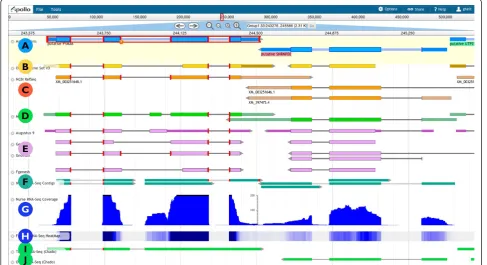
As an example, Figure 2 displays a small region of a scaffold from the honeybee (Apis mellifera) genome assembly. Each horizontal track presents a particular type of data, variously shown as graphs,‘heat maps’, or as discrete features depending on the type of data and on user preferences. The data tracks retrieved from the server or uploaded by the user are read-only and are used as the evidence to support or refute individual gene models.
[image:3.595.58.541.88.491.2]evidence, we expressly decided not to include any meta-data listing the evidence tracks used to create an anno-tation. The former would cause the meta-data captured to balloon, and the latter would make it extremely diffi-cult to maintain data integrity. In our experience it is more effective to keep track of dates. If the annotation itself is dated (both for creation and for modification) as well as the evidence, then it is a straightforward opera-tion to compare these and flag discrepancies. It is also important to use the available screen area optimally, particularly as the volume of information increases. Towards this end we added the capacity to restrict the view to a single strand, and to lock the editable white-board track into position so it is visible regardless of whether the user scrolls vertically.
Modifying a gene model: Basic editing operations such as deleting, merging, splitting, or duplicating a transcript or part of one, can be accessed from a pop-up menu available for each feature using a right-click of the mouse. To modify exon boundaries, users click to select the subject exon and drag either one of the edges. Apollo facilitates correct determination of exon boundaries by
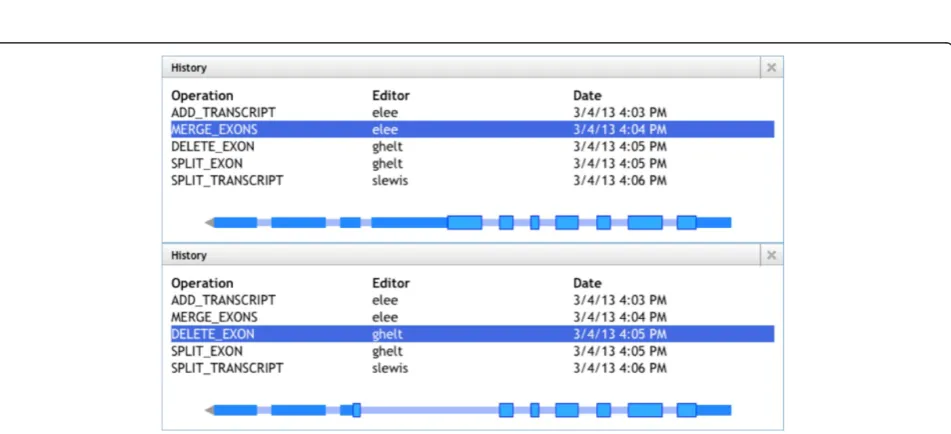
[image:4.595.56.544.91.356.2]All operations performed in the‘User-created Annota-tions’ track are recorded in the history and can be reversed or repeated with the‘Undo’and‘Redo’options.
Exporting data: To conduct further analyses, users may export their annotations as FASTA-formatted sequences, GFF3 files, or record them in a Chado database.
Sequence alterations
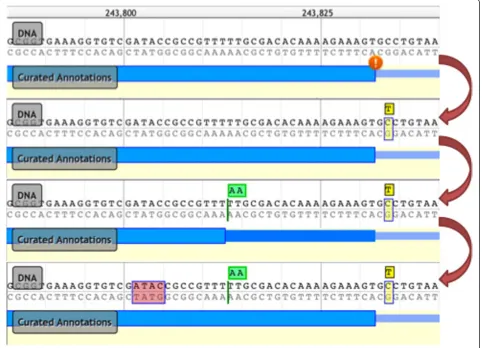
During the development of Web Apollo, we encoun-tered a scenario among the newer genome projects that was radically different from our previous experience with large sequencing centers and MODs. The centers and MODs historically focused on assembling reference genomes with deep coverage from Sanger sequencing resulting in full chromosomal assemblies. In contrast, more recent projects are often assembled from Next Generation Sequencing (NGS) technologies which gen-erate shorter reads with higher error rates, resulting in assemblies that are not only more fragmented but also contain a relatively higher number of errors in the geno-mic sequence [32]. For example, some errors introduced indels in coding sequence, disrupting the reading frame. Biologists needed to annotate the features on the gen-ome, but in order to create the correct transcript anno-tation, correcting these suspected sequencing and assembly errors was also necessary, and it became a highly requested feature. Curators may now correct sus-pected assembly errors using Apollo’s ability to perform genomic sequence insertions, deletions, and substitu-tions (Figure 3). These sequence changes do not alter the underlying reference assembly stored on the server, but are maintained as annotations so they can poten-tially be incorporated into subsequent assemblies for incremental improvements. Within the context of Apollo, these genomic sequence annotations create an underlying virtual sequence that is incorporated when calculating mRNA and protein sequences for these annotations. The resulting sequences can be exported as described below in the Methods section.
Visualizing stage and cell-type specific transcription Using new sequencing technologies researchers are able to capture snapshots of the entire RNA content of samples from particular cell types, particular tissues, at particular developmental stages, or under any number of other speci-fic environmental conditions. These techniques measure expression levels more precisely and offer better opportu-nities to identify alternate transcripts than the previous methods [33], providing essential information for thor-ough gene structure annotation. To gain an understanding of expression levels Web Apollo offers multiple modes for transcriptome data visualization, as coverage plots, as‘heat maps’, and as alignments. Graphs of expression levels
across the genome may be driven from data loaded in Big-Wig format; alternatively the number of reads per base can be calculated using either the raw sequence data (FASTQ, SFF, and so on) or using alignment data from BAM files. Expression data may also be shown as‘heat map’plots (Figure 2, track H) in which regions with scores above a given threshold acquire a progressively brighter shade of blue, and scores below that threshold progres-sively become more intensely red. The display of aligned reads (BAM) includes base-by-base alignments for each read, if the MD or CIGAR fields for the read are provided. As shown in Figure 4, Web Apollo can display high-throughput RNA sequencing data from files in any of these formats, either from the server or from user-uploaded data files through a web browser.
Real-time collaboration
In addition to supporting an individual’s work, Web Apollo allows groups of researchers to share their anno-tations and to collaboratively add, delete, and revise annotations. Collaboration is enabled through the ser-ver’s management of user login, authentication, and editing authorization permissions. The application is flexible enough to support members of a group working concurrently or at different times. Multiple users may work simultaneously on the same region while discuss-ing their work in chat windows or usdiscuss-ing Voice-over IP services (for example, Skype, Google Hangout, Vidyo, and so on). All changes made in one client are instantly pushed and visible to all other clients. Alternatively, users may work asynchronously, monitoring the changes that occur in their absence. This is possible because the mechanism that supports ‘Undo’ and ‘Redo’ functions also supports graphical browsing of an annotation’s edit history (Figure 5). Each revision is tracked, dated, and signed so collaborators can visually review the changes and identify the user(s) who made them. Users may add as many details as necessary in support of each annota-tion in the form of comments. Comments can be cho-sen from a predefined set, be added as free-text, and/or as cross-references to related resources (for example, gene ontology (GO) functional terms).
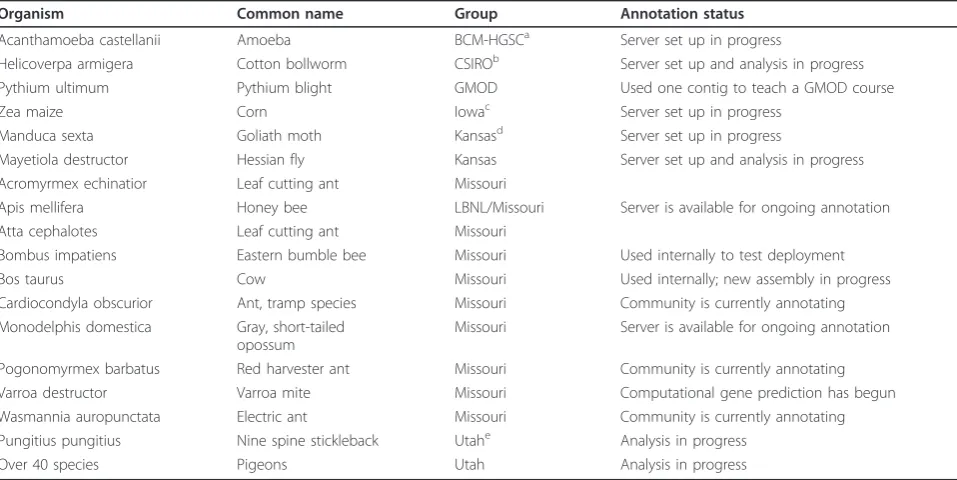
Community adoption:In the three months since its pub-lic release in December of 2012, 18 servers (Table 1) for eight different annotation groups have been set up, some with our group’s assistance and others independently.
Discussion
is falling largely on research consortia orad hoc commu-nity efforts. Some sequencing centers have supported consortium annotation efforts, either by providing web-sites for community members to submit annotations (for example, [34-38]), by collaborating with a centra-lized, external genome annotation group (for example, [39-42]), or by providing Otterlace (for example, [43]). However, more and more often research communities are organizing manual curation efforts among them-selves, independent of sequencing centers.
Desktop Apollo gained popularity among smaller groups and over time it became one of the standards used by smaller-scale genome projects in research com-munities dispersed throughout the world. However, its original design legacy did not make it a perfect fit for the needs of these smaller genome projects. Installation was
[image:6.595.58.541.91.439.2]at times an insurmountable technical hurdle for groups lacking an on-site bioinformaticist. Furthermore, there was no support for automatically sharing annotations among members of the research team. Groups were con-strained to saving files to disk and e-mailing these to one another, which is slow, inconvenient, and creates addi-tional bookkeeping work as conflicts were resolved by database curators taking the time to contact the disagree-ing annotators individually. With the need to provide a seamlessly integrated annotation flow for smaller teams of researchers in mind we built Web Apollo focusing on support for collaborative annotation efforts. By being browser-based it allows users to see changes made by collaborators working on the same region, in real time, which enables community annotators to quickly resolve issues among themselves directly. Early in the project we Figure 3Example of sequence alteration editing operations. The top panel shows a transcript annotation (in blue) flagged with an orange exclamation icon indicating that the curated intron-exon junction does not follow a canonical splice site pattern, that is, having a‘GT’
Figure 4RNA-Seq evidence provides support for alternative isoforms. In this example from the bovine genome (Bos taurus) the RNA-Seq data was stored as a BAM file and dynamically uploaded. Individual aligned reads are shown in teal. The example highlights the importance of utilizing deep RNA sequencing for curation. Two different splice variants are visible: one variant is visible in the Dog Ensembl track and a different one is visible in the Mouse Ensembl track. The RNA-Seq data track clearly shows evidence that both variants are present in the bovine. Edge-matching (in red) highlights the concordance in exon boundaries between the different tracks.
[image:7.595.61.537.479.696.2]made the decision to build the Web Apollo client using the visualization techniques of an existing web-based genome browser, JBrowse [22], the best of the genome browsers alternatives available, thereby lowering overall development costs.
Web Apollo also addresses two key requirements that are particular to the smaller community annotation pro-jects [44,45]. First, recent research communities tend to organize into teams based on areas of biological exper-tise, often preferring to annotate specific genes or gene families, rather than entire scaffolds. Web Apollo allows users to quickly identify their specific loci of interest by integrating BLAT sequence comparison as an optional entry point. Second, the norm for smaller sequencing efforts is fragmented rather than polished assemblies. Web Apollo scaffold list sorting features provide easy access to scaffolds based on identifiers, even when the assembly consists of tens of thousands of scaffolds.
The establishment of best practices and quality con-trol becomes increasingly important with the wide range of genomic expertise available within different research communities. Research projects must develop appropri-ate standards given their data and offer some training to assure the success of any community annotation project. The built-in quality control features of Web Apollo are similar to those used in desktop Apollo and other
annotation editors such as Otterlace. These include flag-ging non-consensus splice sites and validating transla-tion of coding sequences. In additransla-tion we have developed tutorials and a demonstration site to train users in the gestures required for annotation. Accessibility over the web makes it easy to hold long-distant training sessions.
But perhaps most importantly for the continued improvement of the annotations is that Web Apollo allows continued input to gene annotation as long as a server is maintained for the genome, thus researchers can continue to improve annotations as more data is collected over time. If a research community chooses to follow the‘ gate-keeper’approach to community annotation [46], Web Apollo also makes it easy for the gatekeeper to view and revise annotations.
Future enhancements
As sequencing technologies advance and analytical packages improve, the software providing the visualization and the annotation tools needed for iterative refinement, will necessarily have to keep step. There are a number of natural and powerful extensions to a tool like Web Apollo that will enable more analysis functions to be carried out within a browser.
[image:8.595.58.537.100.340.2]In the immediate future enhancing the convenience and curatorial utilities for biologists is of central importance. Table 1 List of currently known servers
Organism Common name Group Annotation status
Acanthamoeba castellanii Amoeba BCM-HGSCa Server set up in progress
Helicoverpa armigera Cotton bollworm CSIROb Server set up and analysis in progress
Pythium ultimum Pythium blight GMOD Used one contig to teach a GMOD course
Zea maize Corn Iowac Server set up in progress
Manduca sexta Goliath moth Kansasd Server set up in progress
Mayetiola destructor Hessian fly Kansas Server set up and analysis in progress Acromyrmex echinatior Leaf cutting ant Missouri
Apis mellifera Honey bee LBNL/Missouri Server is available for ongoing annotation Atta cephalotes Leaf cutting ant Missouri
Bombus impatiens Eastern bumble bee Missouri Used internally to test deployment
Bos taurus Cow Missouri Used internally; new assembly in progress
Cardiocondyla obscurior Ant, tramp species Missouri Community is currently annotating Monodelphis domestica Gray, short-tailed
opossum
Missouri Server is available for ongoing annotation
Pogonomyrmex barbatus Red harvester ant Missouri Community is currently annotating Varroa destructor Varroa mite Missouri Computational gene prediction has begun Wasmannia auropunctata Electric ant Missouri Community is currently annotating Pungitius pungitius Nine spine stickleback Utahe Analysis in progress
Over 40 species Pigeons Utah Analysis in progress
The list is organized by hosting group. Light gray shading indicates that the group participated in beta testing of this application. Other servers may also be active but we do not track server instances.
a
Baylor College of Medicine Human Genome Sequencing Center, USA.
b
Commonwealth Scientific and Industrial Research Organization, Australia.
c
Iowa State University and United States Department of Agriculture Agricultural Research Service.
d
Kansas State University Arthropod Genomics Center.
e
We propose to add the capability to annotate further genomic feature types including cis-regulatory regions, transcription factor binding sites, and non-coding RNAs, along with providing an intuitive way to browse, navigate and visualize these. Another improvement is extending the current methods of accessing data to include data from UCSC [23] and Ensembl [5] by adding support for UCSC data hubs and the Ensembl REST API via the basic JBrowse platform. In addition, the introduction of compo-site tracks that can utilize multiple data files by integrating metadata about how the files are related, for example sequencing read alignment data in a BAM file and cover-age plots derived from those alignments in a BigWig file. This will enable a single track to show sequence read alignments at high zoom levels and transition to showing derived coverage plots at lower resolutions, without the high overhead of dynamically calculating the coverage plot from the alignments. The ability to compose integrated tracks of closely related data, independent of particular input formats, will be extremely useful in other situations, such as a single track combining variant data with back-ground population frequency data. Biologists will also be empowered by enriching feature meta-data to include other attributes, such as description, and status flags in the user’s dialog box for editing textual and related identifier information. For example a status flag could be used to signal that a team member requests a review of their annotation. The choice of attributes a curator can edit would be configurable so that each project can decide pre-cisely what meta-data attributes are appropriate for their needs. Other enhancements would offer increased assis-tance to dispersed research teams, by supporting fine-grained, track-by-track sharing options controlled by the user on the client-side, rather than sharing access coarsely genome-by-genome. This way a researcher can choose with whom to share their individual data tracks (this is available now, but limited to the server side). Most impor-tantly there are several seemingly disparate problems that can be addressed with the same technical solution; chal-lenges such as the fragmented nature of some assemblies, the length of the intronic regions for some genes, and the desire to annotate a single gene family or set of duplicated genes simultaneously. Each of these require that distant regions of the genome be brought into the same visual field - which can be done by synthetically splicing the dif-ferent regions into a single virtual genome sequence as was done in the Integrated Genome Browser [47], and which our current team of developers have the expertise to implement. As an open-source project we welcome contributions from the community to address these and other natural enhancements to provide a feature-rich, powerful genomic research environment.
Our two over-arching aims are actually two perspectives on the same work. Integration with related community
annotation projects whose aims are complementary will enrich the feature set available to the user. Specific inte-gration examples include: (1) establishing interactive, dynamic re-analysis of a particular genomic region using Galaxy or SeqWare [48] for example, rerunning with dif-ferent analysis parameters; (2) placing a newly predicted protein into a protein family using PANTHER services [49]; (3) using protein family information to examine pos-sible roles a protein may have in particular pathways through interactions with the Reactome pathway annota-tor [50]; and (4) offering connections to resources such as WikiGenes [51] or RFAM:Wikipedia [20] which focus on capturing more textual types of information.
From a targeted audience point of view actively working with researchers in a wide variety of domains will ensure that Apollo is responsive to biologist’s requirements and meets their needs. For smaller genome research investiga-tions ease of installation, an enriched set of annotation capabilities and integration with other community annota-tion projects are key. We also envision Apollo’s increased use in educational and classroom settings. This is one motivation for emphasizing integration with analytical pipeline services such as Galaxy and providing tutorials, training, and annotation guidelines. Lastly, Apollo can support research groups whose focus is exploring geno-type to phenogeno-type correlations for the study of human dis-ease. For this group we have already implemented some initial prototypes for enhanced visualization of sequence polymorphisms and variation data, and mockups for allelic frequency and dynamic visualization of the effect or impact a set of variants may have on functional genomic elements. For each of these domains we will continue to take a user-centered design approach and directly engage with the researchers in these areas through future itera-tions of the framework, as well as with software developers who can contribute to the overall platform.
The current challenge is scaling to accommodate the growing amount of work. These projects must operate using a new paradigm, requiring new software work-flows and training in the nuances of genomic annota-tion. A framework that can enable any individual researcher to generate their own sequence data, run an analysis pipeline using a remote service to analyze their organism of interest, and ultimately generate their own models to publish. Web Apollo represents a major step toward achieving the goal of an integrated genomic ana-lysis environment. It provides a comprehensive toolbox to biologists for manually annotating the features of the genome(s) they are investigating.
Methods
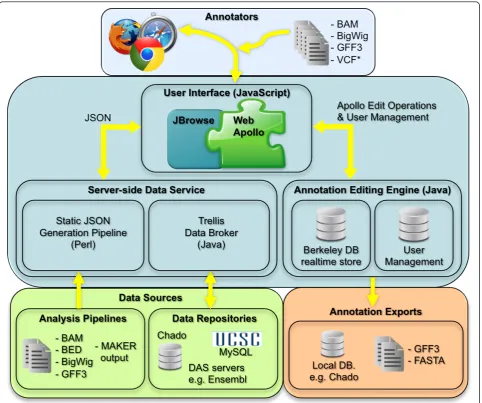
different files and databases (Figure 1). These three soft-ware components are open source and available free of charge.
Web-based client
Web Apollo uses JBrowse as its visualization component. JBrowse is a JavaScript-based genome browser that pro-vides a fast, highly interactive interface for the visualization of genomic data on the Web. It handles most rendering of data within the web browser using a combination of standard HTML‘div’and‘canvas’elements, in contrast to traditional web-based genome browsers where the server renders the data as an image and sends that image to the client for display. It also heavily utilizes asynchronous and partial (lazy) data loading. These strategies allow for very dynamic zooming and scrolling. In addition to visualizing many types of data on the server, it allows direct uploading of data from local or remote BAM, GFF3, and BigWig files via the user’s web browser. Because JBrowse and Web Apollo are active projects whose development is coordi-nated, the decision to base Web Apollo visualization on JBrowse has the significant added benefit of leveraging ongoing improvements in JBrowse. For example, during the course of Web Apollo development, the JBrowse team added support for powerful metadata-based annotation track searching, which Web Apollo was able to seamlessly incorporate. Conversely, developments in Web Apollo have both significantly influenced, and in some cases been directly incorporated into JBrowse. For instance, direct display of BAM data was initially implemented in Web Apollo, then revised, improved, and incorporated into JBrowse. Also, the initial design of the JBrowse plug-in sys-tem was driven by the needs of Web Apollo. As such, JBrowse plug-ins can extend and alter nearly every aspect of JBrowse’s behavior, such as adding new track types, inserting menu items, adding Cascading Style Sheet (CSS) rules for customizing the display, using plug-in-specific images for graphics, and even interacting with other plug-ins that may be available. As a plug-in, the Web Apollo client augments the standard JBrowse feature tracks to support multiple feature selection (including any combina-tion of features and subfeatures), seleccombina-tion highlighting, and edge matching, which can highlight the left or right edge of any feature that match the start or end genome coordinate of a selected feature. Two entirely new track types are also implemented, a gene annotation track (’User-created Annotations’track, A in Figure 2.) and a sequence alteration track (’DNA’track in Figure 3). The
‘User-created Annotations’track provides users with the ability to manipulate elements and edit annotations; these manipulations include dragging and dropping features from other tracks to create or modify transcripts, dragging exon edges to change exon boundaries of existing annota-tions, and using context-specific menus to modify
annotations. The‘DNA’track provides user with the abil-ity to create and edit sequence alterations, and also imple-ments rendering of DNA residues and six-frame protein translation. Both tracks connect asynchronously to the annotation-editing server to retrieve existing annotations, send edit requests, and receive edit notifications (Figure 1, arrows).
Annotation-Editing Engine
The Annotation-Editing Engine is written in Java. It han-dles all the necessary logic for editing and deals with the complexities of modifications in a biological context, where a single change can have multiple cascading effects (for example, splitting or merging transcripts). The Annotation-Editing Engine currently supports: (1) adding and deleting transcripts; (2) merging and splitting tran-scripts; (3) manually setting the translation start for a transcript (otherwise the longest ORF is automatically calculated with every edit); (4) flipping the strand for a transcript; (5) adding and deleting exons from existing transcripts; (6) changing exon boundaries; and (7) mer-ging and splitting exons, including the ability to search for canonical splice sites to create a biologically relevant intron when splitting an exon. The Annotation-Editing Engine uses a plug-in architecture, which assists in the identification of isoforms wherever overlapping tran-scripts are present; the architecture allows groups to con-figure customized rules to determine whether two transcripts should come from the same gene or from separate ones. Currently, we provide options for‘no over-lap’(every transcript comes from a separate gene regard-less of whether it overlaps another transcript), ‘simple overlap’(a transcript is considered an isoform if it has any overlap with an existing transcript), and‘ORF over-lap’(a transcript is considered an isoform only if it over-laps another transcript’s coding region, in the same frame). Lastly, as previously described in the‘Sequence alterations’section of the Results, the Annotation-Editing Engine also supports editing of genomic insertions, dele-tions, and substitutions.
Edits are stored persistently in the server, allowing users to quickly recover their data in the event of unexpected browser or server crashes. We employ a two-stage editing approach. First, data are stored in a BerkeleyDB database for live edits, which provides very responsive storage and retrieval of annotations. Edit histories are also stored in the BerkeleyDB database. Later, after they have been reviewed, these edits can be exported to different formats for further analysis or for non-Web Apollo specific storage. The data exporters also implement a plug-in based architecture that allows easy addition of new exporters. Currently, we sup-port exsup-porting annotations to FASTA, GFF3, and Chado.
levels of user permissions, allowing project owners to decide with whom to share their work, and whether to allow read-only or read-and-write access. User authenti-cation implements a plug-in based architecture, allowing users to adopt their own authentication back-end if needed. We currently support authentication through either a Web Apollo specific SQL database or through Mozilla’s Persona authentication service [52]. The server supports multiple, concurrent users through synchro-nized updates over multiple browser instances, so that every edit is immediately visible to all users who are viewing or editing the same region. The server employs the Comet model to allow the server to push data to cli-ents in real time. The client and server use a long held HTTP connection and when edits are made, the server pushes these updates to the client without it having to explicitly request them.
The server also allows searching of genomic sequences. Its plug-in based architecture allows any number of searching strategies to be used without hav-ing to modify the searchhav-ing framework. Currently Web Apollo supports BLAT for nucleotide and translating searches.
Server-side genomic data service
Two different server-side genomic data services provide data to the Web Apollo client; one is static and one dynamic. The first is a modified version of the JBrowse data pipeline, a set of Perl scripts that support conversion of analysis data in GFF3 and BED formats to JavaScript Object Notation (JSON [53]) files compatible with the Web Apollo. This conversion is performed once, and the JSON files are stored and served to the web-based client as needed. This pipeline is considered static in the sense that the JSON files are pre-generated before they are needed, and once the JSON files are created the original data files are no longer used.
The second data service we have implemented is a server-side component called Trellis that supports dynamic queries to genomic data sources over HTTP. Trellis is implemented as a Java servlet and uses plug-in architecture for both data sources and output formats. Data source plug-ins are implemented for directly querying the UCSC MySQL database, the Chado Post-gres database, and servers supporting the Distributed Annotation System (DAS) protocol [25]. An output plug-in converts responses to the JBrowse JSON format used by the Web Apollo client. This service is consid-ered dynamic because if the data source is updated with new data, the JSON returned will reflect this.
Testing
We tested server installation and the user interface using new genome assemblies and computed evidence
data forApis mellifera (honey bee) andBombus impa-tiens (bumble bee), contributed by the Honey Bee and Bumble Bee Genome Sequencing Consortiums. We per-formed additional testing and created a demonstration instance, available at [54], using published bovine gen-ome data [39]. The test datasets from real consortiums allowed us to develop solutions to several formatting issues that may otherwise be problematic in future installations. The sources of gene prediction evidence included NCBI Gnomon [55], Ensembl [15], GLEAN [56], MAKER [29], N-SCAN [57], Fgenesh, Fgenesh++ [58,59], Augustus [60], Geneid [61], and SGP2 [62]. Pro-tein homolog alignments had been generated by Exoner-ate [63]. Alignments of Sanger-sequenced ESTs and contigs were generated by Exonerate, GMAP [64] or Splign [65]. Alignments of RNASeq data were from TopHat [66].
Installation options
The original process for setting up the Web Apollo server requires familiarity with server administration, with data-base administration, and with the applications used by Web Apollo [67]. To facilitate the installation process and assist researchers in overcoming these requirements, we recently developed two solutions. The first is‘ GMOD-in-the-Cloud’[68], a virtual machine for deployment on the cloud, which comes with Web Apollo (among other GMOD tools) already installed. This provides a great solu-tion for researchers who do not have any restricsolu-tions on hosting their instances and data elsewhere. In addition, for those who manage sensitive data that may need to be kept away from shared spaces and the cloud, we have provided a virtual machine, which can be deployed locally [69].
Data Access
The first version of Web Apollo was released in Decem-ber 2012 [70]. At the time of this publication Web Apollo has been downloaded 179 times, from 104 unique IP addresses. Web Apollo is implemented in JavaScript, Java, and Perl, with all major browsers sup-ported. The source code is freely available and main-tained in Google Code [71] (server) and GitHub [72] (client). Detailed information can be found online [73], including a user guide [74] and demonstration site.
Authors’contributions
EL (server side edit engine and client side interactive interface), GH (trellis and client side interactive interface), and RB (basic JBrowse visualization framework) designed, implemented, and deployed the Web Apollo application with contributions from JR (Chado and GFF3 handling) and CC (upstream analysis pipeline, server setups, usability testing, and
commented on the manuscript. All authors read and approved the final manuscript.
Acknowledgements
This work was supported by the National Institutes of Health grant numbers 5R01GM080203 from the National Institute of General Medical Sciences and 5R01HG004483 from the National Human Genome Research Institute, and by the Director, Office of Science, Office of Basic Energy Sciences, of the U.S. Department of Energy under Contract No. DE-AC02-05CH11231.
We would especially like to thank Mitch Skinner for the development of JBrowse, Nomi Harris for preliminary work on the Web Apollo client, Thomas Down for permitting the reuse of his binary parsing libraries for BAM and BigWig files (Down et al. 2011), and Carson Holt for providing a direct connection to MAKER.
We would also like to thank Sue Brown, Sanjay Chellapilla, Daniel Ence, Juergen Gadau, Nicolae Herndon, Elisabeth Huguet, Carolyn Lawrence, Dan Lawson, Sasha Mikheyev, Barry Moore, Jan Oettler, Xiang Qin, Lukas Schrader, Kim Worley, Mark Yandell, Jing-Jiang Zhou for feedback on server installation, data management, and/or user interface. We thank the Honey Bee and Bumble Bee Genome Sequencing Consortiums for genome assemblies and accompanying computed gene prediction evidence for honey bee (Amel_4.5) andBombus impatiens(Bimp_1.0), which we used in development and beta testing. We thank Anna Bennett for input on formatting of test datasets.
Authors’details
1
Genomics Division, Lawrence Berkeley National Laboratory, Berkeley, CA 94720, USA.2Division of Animal Sciences, University of Missouri, Columbia,
MO 65211, USA.3Department of Bioengineering, University of California Berkeley, Berkeley, CA 94720, USA.4Ontario Institute of Cancer Research,
MaRS Centre, South Tower, 101 College Street, Suite 800 Toronto, Ontario, Canada M5G 0A3.5Department of Molecular Genetics, University of Toronto,
172 St. George Street Toronto, Ontario, Canada M5R 0A3.6Division of Plant
Sciences, University of Missouri, Columbia, MO 65211, USA.
Received: 10 May 2013 Revised: 23 August 2013 Accepted: 30 August 2013 Published: 30 August 2013
References
1. Lewis SE, Searle SM, Harris N, Gibson M, Lyer V, Richter J, Wiel C, Bayraktaroglir L, Birney E, Crosby MA, Kaminker JS, Matthews BB, Prochnik SE, Smithy CD, Tupy JL, Rubin GM, Misra S, Mungall CJ, Clamp ME:
Apollo: a sequence annotation editor.Genome Biol2002,3:RESEARCH0082. 2. Rutherford K, Parkhill J, Crook J, Horsnell T, Rice P, Rajandream MA, Barrell B:
Artemis: sequence visualization and annotation.Bioinformatics2000,
16:944-945.
3. Eeckman FH, Durbin R:ACeDB and macace.Methods Cell Biol1995,
48:583-605.
4. Pruitt KD, Tatusova T, Brown GR, Maglott DR:NCBI Reference Sequences (RefSeq): current status, new features and genome annotation policy. Nucleic Acids Res2012,40:D130-135.
5. Flicek P, Ahmed I, Amode MR, Barrell D, Beal K, Brent S, Carvalho-Silva D, Clapham P, Coates G, Fairley S, Fitzgerald S, Gil L, Garcia-Giron C, Gordon L, Hourlier T, Hunt S, Juettemann T, Kahari AK, Keenan S, Komorowska M, Kulesha E, Longden I, Maurel T, McLaren WM, Muffato M, Nag R, Overduin B, Pignatelli M, Pritchard B, Pritchard E,et al:Ensembl 2013. Nucleic Acids Res2013,41:D48-55.
6. Marygold SJ, Leyland PC, Seal RL, Goodman JL, Thurmond J, Strelets VB, Wilson RJ:FlyBase: improvements to the bibliography.Nucleic Acids Res 2013,41:D751-757.
7. Yook K, Harris TW, Bieri T, Cabunoc A, Chan J, Chen WJ, Davis P, de la Cruz N, Duong A, Fang R, Ganesan U, Grove C, Howe K, Kadam S, Kishore R, Lee R, Li Y, Muller HM, Nakamura C, Nash B, Ozersky P, Paulini M, Raciti D, Rangarajan A, Schindelman G, Shi X, Schwarz EM, Ann Tuli M, Van Auken K, Wang D,et al:WormBase 2012: more genomes, more data, new website. Nucleic Acids Res2012,40:D735-741.
8. Cherry JM, Hong EL, Amundsen C, Balakrishnan R, Binkley G, Chan ET, Christie KR, Costanzo MC, Dwight SS, Engel SR, Fisk DG, Hirschmann JE, Hitz BC, Karra K, Krieger CJ, Miyasato SR, Nash RS, Park J, Skrzypek MS, Simison M, Weng S, Wong ED:Saccharomyces Genome Database: the genomics resource of budding yeast.Nucleic Acids Res2012,40:D700-705.
9. Lamesch P, Berardini TZ, Li D, Swarbreck D, Wilks C, Sasidharan R, Muller R, Dreher K, Alexander DL, Garcia-Hernandez M, Karthikeyan AS, Lee CH, Nelson WD, Ploetz L, Singh S, Wensel A, Huala E:The Arabidopsis Information Resource (TAIR): improved gene annotation and new tools. Nucleic Acids Res2012,40:D1202-1210.
10. Bult CJ, Eppig JT, Blake JA, Kadin JA, Richardson JE:The mouse genome database: genotypes, phenotypes, and models of human disease.Nucleic Acids Res2013,41:D885-891.
11. Internation Human Genome Sequencing Consortium:Finishing the euchromatic sequence of the human genome.Nature2004,431:931-945. 12. Church DM, Goodstadt L, Hillier LW, Zody MC, Goldstein S, She X, Bult CJ,
Agarwala R, Cherry JL, DiCuccio M, Hlavina W, Kapustin Y, Meric P, Maglott D, Birtle Z, Marques AC, Graves T, Zhou S, Teague B, Potamousis K, Churas C, Place M, Herschleb J, Runnheim R, Forrest D, Amos-Landgraf J, Schwartz DC, Cheng Z, Lindblad-Toh K, Eichler EE,et al:Lineage-specific biology revealed by a finished genome assembly of the mouse.PLoS Biol 2009,7:e1000112.
13. Howe K, Clark MD, Torroja CF, Torrance J, Berthelot C, Muffato M, Collins JE, Humphray S, McLaren K, Matthews L, McLaren S, Sealy I, Caccamo M, Churcher C, Scott C, Barrett JC, Koch R, Rauch GJ, White S, Chow W, Kilian B, Quintais LT, Guerra-Assuncao JA, Zhou Y, Gu Y, Yen J, Vogel JH, Eyre T, Redmond S, Banerjee R,et al:The zebrafish reference genome sequence and its relationship to the human genome.Nature2013,
496:498-503.
14. Otterlace.[http://www.sanger.ac.uk/resources/software/otterlace/]. 15. Curwen V, Eyras E, Andrews TD, Clarke L, Mongin E, Searle SM, Clamp M:
The Ensembl automatic gene annotation system.Genome Res2004,
14:942-950.
16. Harrow J, Frankish A, Gonzalez JM, Tapanari E, Diekhans M, Kokocinski F, Aken BL, Barrell D, Zadissa A, Searle S, Barnes I, Bignell A, Boychenko V, Hunt T, Kay M, Mukherjee G, Rajan J, Despacio-Reyes G, Saunders G, Steward C, Harte R, Lin M, Howald C, Tanzer A, Derrien T, Chrast J, Walters N, Balasubramanian S, Pei B, Tress M,et al:GENCODE: the reference human genome annotation for The ENCODE Project.Genome Res2012,22:1760-1774.
17. Salzberg SL:Genome re-annotation: a wiki solution?.Genome Biol2007,
8:102.
18. Huss JW, Orozco C, Goodale J, Wu C, Batalov S, Vickers TJ, Valafar F, Su AI:A gene wiki for community annotation of gene function.PLoS Biol2008,6: e175.
19. Punta M, Coggill PC, Eberhardt RY, Mistry J, Tate J, Boursnell C, Pang N, Forslund K, Ceric G, Clements J, Heger A, Holm L, Sonnhammer EL, Eddy SR, Bateman A, Finn RD:The Pfam protein families database.Nucleic Acids Res2012,40:D290-301.
20. Gardner PP, Daub J, Tate J, Moore BL, Osuch IH, Griffiths-Jones S, Finn RD, Nawrocki EP, Kolbe DL, Eddy SR, Bateman A:Rfam: Wikipedia, clans and the“decimal”release.Nucleic Acids Res2011,39:D141-145.
21. Sterck L, Billiau K, Abeel T, Rouze P, Van de Peer Y:ORCAE: online resource for community annotation of eukaryotes.Nat Methods2012,9:1041. 22. Skinner ME, Uzilov AV, Stein LD, Mungall CJ, Holmes IH:JBrowse: a
next-generation genome browser.Genome Res2009,19:1630-1638. 23. Kuhn RM, Haussler D, Kent WJ:The UCSC genome browser and
associated tools.Brief Bioinform2013,14:144-161.
24. Mungall CJ, Emmert DB:A Chado case study: an ontology-based modular schema for representing genome-associated biological information. Bioinformatics2007,23:i337-346.
25. Dowell RD, Jokerst RM, Day A, Eddy SR, Stein L:The distributed annotation system.BMC Bioinformatics2001,2:7.
26. GenBank XML..[http://www.ncbi.nlm.nih.gov/IEB/ToolBox/XML/]. 27. Li H, Handsaker B, Wysoker A, Fennell T, Ruan J, Homer N, Marth G,
Abecasis G, Durbin R:The Sequence Alignment/Map format and SAMtools.Bioinformatics2009,25:2078-2079.
28. Kent WJ, Zweig AS, Barber G, Hinrichs AS, Karolchik D:BigWig and BigBed: enabling browsing of large distributed datasets.Bioinformatics2010,
26:2204-2207.
29. Cantarel BL, Korf I, Robb SM, Parra G, Ross E, Moore B, Holt C, Sanchez Alvarado A, Yandell M:MAKER: an easy-to-use annotation pipeline designed for emerging model organism genomes.Genome Res2008,18:188-196. 30. Goecks J, Nekrutenko A, Taylor J:Galaxy: a comprehensive approach for
31. Kent WJ:BLAT–the BLAST-like alignment tool.Genome Res2002,
12:656-664.
32. Alkan C, Sajjadian S, Eichler EE:Limitations of next-generation genome sequence assembly.Nat Methods2011,8:61-65.
33. Wang Z, Gerstein M, Snyder M:RNA-Seq: a revolutionary tool for transcriptomics.Nat Rev Genet2009,10:57-63.
34. Honey Bee Genome Sequencing Consortium:Insights into social insects from the genome of the honeybee Apis mellifera.Nature2006,
443:931-949.
35. Kirkness EF, Haas BJ, Sun W, Braig HR, Perotti MA, Clark JM, Lee SH, Robertson HM, Kennedy RC, Elhaik E, Gerlach D, Kriventseva EV, Elsik CG, Graur D, Hill CA, Veenstra JA, Walenz B, Tubio JM, Ribeiro JM, Rozas J, Johnston JS, Reese JT, Popadic A, Tojo M, Raoult D, Reed DL, Tomoyasu Y, Kraus E, Mittapalli O, Margam VM,et al:Genome sequences of the human body louse and its primary endosymbiont provide insights into the permanent parasitic lifestyle.Proc Natl Acad Sci USA2010,
107:12168-12173.
36. Sea Urchin Genome Sequencing Consortium:The genome of the sea urchin Strongylocentrotus purpuratus.Science2006,314:941-952. 37. Tribolium Genome Sequencing Consortium:The genome of the model
beetle and pest Tribolium castaneum.Nature2008,452:949-955. 38. Werren JH, Richards S, Desjardins CA, Niehuis O, Gadau J, Colbourne JK,
Werren JH, Richards S, Desjardins CA, Niehuis O, Gadau J, Colbourne JK, Beukeboom LW, Desplan C, Elsik CG, Grimmelikhuijzen CJ, Kitts P, Lynch JA, Murphy T, Oliveira DC, Smith CD, van de Zande L, Worley KC, Zdobnov EM, Aerts M, Albert S, Anaya VH, Anzola JM, Barchuk AR, Behura SK,et al:
Functional and evolutionary insights from the genomes of three parasitoid Nasonia species.Science2010,327:343-348.
39. Bovine Genome Sequencing and Analysis Consortium:The genome sequence of taurine cattle: a window to ruminant biology and evolution.Science2009,324:522-528.
40. Heliconius Genome Consortium:Butterfly genome reveals promiscuous exchange of mimicry adaptations among species.Nature2012,487:94-98. 41. International Aphid Genomics Consortium:Genome sequence of the pea
aphid Acyrthosiphon pisum.PLoS Biol2010,8:e1000313.
42. Suen G, Teiling C, Li L, Holt C, Abouheif E, Bornberg-Bauer E, Bouffard P, Caldera EJ, Cash E, Cavanaugh A, Denas O, Elhaik E, Fave MJ, Gadau J, Gibson JD, Graur D, Grubbs KJ, Hagen DE, Harkins TT, Helmkampf M, Hu H, Johnson BR, Kim J, Marsh SE, Moeller JA, Munoz-Torres MC, Murphy MC, Naughton MC, Nigam S, Overson R,et al:The genome sequence of the leaf-cutter ant Atta cephalotes reveals insights into its obligate symbiotic lifestyle.PLoS Genet2011,7:e1002007.
43. Groenen MA, Archibald AL, Uenishi H, Tuggle CK, Takeuchi Y, Rothschild MF, Rogel-Gaillard C, Park C, Milan D, Megens HJ, Li S, Larkin DM, Kim H, Frantz LA, Caccamo M, Ahn H, Aken BL, Anselmo A, Anthon C, Auvil L, Badaoui B, Beattie CW, Bendixen C, Berman D, Blecha F, Bomberg J, Bolund L, Bosse M, Botti S, Bujie Z,et al:Analyses of pig genomes provide insight into porcine demography and evolution. Nature2012,491:393-398.
44. Elsik CG, Worley KC, Zhang L, Milshina NV, Jiang H, Reese JT, Childs KL, Venkatraman A, Dickens CM, Weinstock GM, Gibbs RA:Community annotation: procedures, protocols, and supporting tools.Genome Res 2006,16:1329-1333.
45. Reese JT, Childers CP, Sundaram JP, Dickens CM, Childs KL, Vile DC, Elsik CG:
Bovine Genome Database: supporting community annotation and analysis of the Bos taurus genome.BMC Genomics2010,11:645. 46. Loveland JE, Gilbert JG, Griffiths E, Harrow JL:Community gene annotation
in practice.Database (Oxford)2012,2012:bas009.
47. Nicol JW, Helt GA, Blanchard SG, Raja A, Loraine AE:The Integrated Genome Browser: free software for distribution and exploration of genome-scale datasets.Bioinformatics2009,25:2730-2731.
48. O’Connor BD, Merriman B, Nelson SF:SeqWare Query Engine: storing and searching sequence data in the cloud.BMC Bioinformatics2010,
11(Suppl 12):S2.
49. Mi H, Muruganujan A, Thomas PD:PANTHER in 2013: modeling the evolution of gene function, and other gene attributes, in the context of phylogenetic trees.Nucleic Acids Res2013,41:D377-386.
50. Croft D, O’Kelly G, Wu G, Haw R, Gillespie M, Matthews L, Caudy M, Garapati P, Gopinath G, Jassal B, Jupe S, Kalatskaya I, Mahajan S, May B, Ndegwa N, Schmidt E, Shamovsky V, Yung C, Birney E, Hermjakob H,
D’Eustachio P, Stein L:Reactome: a database of reactions, pathways and biological processes.Nucleic Acids Res2011,39:D691-697.
51. Hoffmann R:A wiki for the life sciences where authorship matters.Nat Genet2008,40:1047-1051.
52. Mozilla Persona.[http://www.mozilla.org/en-US/persona/]. 53. JSON.[http://www.json.org/].
54. Web Apollo Demo.[http://genomearchitect.org/WebApolloDemo/]. 55. Souvorov A, T T, D L:Eukariotic Genome Annotation with Gnomon - a
Multi-step Combined Gene Prediction Tool.ISMB2004. 56. Elsik CG, Mackey AJ, Reese JT, Milshina NV, Roos DS, Weinstock GM:
Creating a honey bee consensus gene set.Genome Biol2007,8:R13. 57. van Baren MJ, Koebbe BC, Brent MR:Using N-SCAN or TWINSCAN to
predict gene structures in genomic DNA sequences.Curr Protoc Bioinformatics2007, Chapter 4:Unit 4 8.
58. Salamov AA, Solovyev VV:Ab initio gene finding in Drosophila genomic DNA.Genome Res2000,10:516-522.
59. Solovyev V:Statistical Approaches in Eukaryotic Gene Prediction.In Handbook of Statistical Genetics.Edited by: Balding DJ, Bishop M, Cannings C. Chichester: John Wiley 2007:97-159.
60. Stanke M, Schoffmann O, Morgenstern B, Waack S:Gene prediction in eukaryotes with a generalized hidden Markov model that uses hints from external sources.BMC Bioinformatics2006,7:62.
61. Parra G, Blanco E, Guigo R:GeneID in Drosophila.Genome Res2000,
10:511-515.
62. Parra G, Agarwal P, Abril JF, Wiehe T, Fickett JW, Guigo R:Comparative gene prediction in human and mouse.Genome Res2003,13:108-117. 63. Slater GS, Birney E:Automated generation of heuristics for biological
sequence comparison.BMC Bioinformatics2005,6:31.
64. Wu TD, Watanabe CK:GMAP: a genomic mapping and alignment program for mRNA and EST sequences.Bioinformatics2005,21:1859-1875. 65. Kapustin Y, Souvorov A, Tatusova T, Lipman D:Splign: algorithms for
computing spliced alignments with identification of paralogs.Biol Direct 2008,3:20.
66. Trapnell C, Pachter L, Salzberg SL:TopHat: discovering splice junctions with RNA-Seq.Bioinformatics2009,25:1105-1111.
67. Web Apollo Installation.[www.gmod.org/wiki/WebApollo_Installation]. 68. GMOD-in-the-Cloud.[http://www.gmod.org/wiki/Cloud].
69. Web Apollo Virtual Machine User Guide.[http://genomearchitect.org/ webapollo/virtual_machine/docs/user_guide.html].
70. Web Apollo Releases.[http://genomearchitect.org/webapollo/releases]. 71. Google Code.[http://code.google.com].
72. GitHub.[http://github.com].
73. Web Apollo.[http://genomearchitect.org].
74. Web Apollo User Guide.[http://genomearchitect.org/webapollo/docs/ webapollo_user_guide.pdf].
doi:10.1186/gb-2013-14-8-r93
Cite this article as:Leeet al.:Web Apollo: a web-based genomic annotation editing platform.Genome Biology201314:R93.
Submit your next manuscript to BioMed Central and take full advantage of:
• Convenient online submission
• Thorough peer review
• No space constraints or color figure charges
• Immediate publication on acceptance
• Inclusion in PubMed, CAS, Scopus and Google Scholar
• Research which is freely available for redistribution