2018 3rd International Conference on Computational Modeling, Simulation and Applied Mathematics (CMSAM 2018) ISBN: 978-1-60595-035-8
Simulation of Knowledge Emergence Based on Complexity
Fu JIN
1,*, Jie JIN
2, Jun-li HOU
1and Xia WANG
11
School of Management, Shenyang Normal University, Shenyang110034, P.R. China
2
Department of Software, Shengyang Polytechnic College, Shenyang 110045, P.R. China
*Corresponding author
Keywords: Knowledge emergence, Knowledge agent, Knowledge evolution, Simulation studies.
Abstract. In order to reveal the law of knowledge evolution and solve the problem of knowledge emergence, this paper constructs the mathematical model of knowledge evolution with the complexity research method on base of defining the scales of knowledge agents. This paper reveals three states of knowledge evolution by directly observing the surface simulation model and using the knowledge evolution equation and three-dimensional vector. Only if the intensity, scale or quantity of knowledge agents reaches a certain degree that when n1< h1 <h2 < n2. Within the interval (h1, h2), a
large number of knowledge agents enter the chaotic region, and the system formalizes a chaotic order state. Studies have found that knowledge emergence is most likely to generating when the above conditions are satisfied.
Introduction
The latest knowledge management research shows that the knowledge agent system is a complex adaptive system [1]. The knowledge management emphasis on technical advantage, while it must pay attention to the subject of knowledge—human factors, and put it in the system study [2]. This study based on complexity, used time as a variable, and observes the number of knowledge subjects, the intensity of interaction among these subjects, the scale of dynamic change and other factors, emphasizes human initiative, adaptability and interpersonal interaction, through the establishment of a reliable environment, providing the conditions for interaction between learning space and environment, we reveal the rules of knowledge evolution [3]. knowledge emergence is an important way of knowledge creation [4]. In previous literature, the research on knowledge evolution before knowledge emergence is still insufficient. There is no quantitative study on the scale of knowledge subject and the constraints on the chaotic edge of knowledge emergence [5,6]. In this paper, we will focus on the scale of knowledge subject, research on knowledge evolution process before the knowledge emergence and its boundary conditions. Through mathematical simulation model, reveal the rules of knowledge evolution, and prove the knowledge evolution phenomena and knowledge emergence conditions matching with the constraints.
Background
Alex Bennet and other scholars proposed intelligent complex adaptive system (ICAS)[1,8]. In ICAS theory, agent is defined as "person" with professional knowledge and skills, which reflects the ability of knowledge subject to adapt to the environment [9]. The deficiency of this study is that it only emphasizes the emergence of organizational knowledge, ignoring the emergence of knowledge at the micro level [10]. The SECI spiral model represented by Ikujiro Nonaka and others has some supplementary explanations for the operational mechanism of knowledge emergence, but they have not established a systematic concept and neglected the "simple rules" ,it also have not realized that the parameters of time variables is a necessary condition for studying knowledge emergence[11].
Among chinese scholars, Hua Yanfeng and others have constructed a cyclic and interactive model of knowledge emergence system based on the perspective of educational science[10]. This model has made a descriptive study of knowledge evolution, but it not discussed the conditions of knowledge emergence. On the basis of ICAS, Jin Fu and others put forward the knowledge emergence mechanism and management policy of the Intelligence resource system [12,13]. This research regards human as the core element of the subject of the knowledge system, and pays attention to tacit knowledge sharing and environmental conditions. Xu Libo and others based on the elementary of extension theory research intelligent emergence, to a certain extent, the "black box" dilemma caused by knowledge emergence has been solved, but it only solved the problem of information and knowledge co-processing[14]. Therefore, the following is based on the complexity method to construct the knowledge evolution model and analyze the conditions of knowledge emergence.
Knowledge Agents and Research Methods
According to relevant research make the following definition [15,16]:
Rule 1: Knowledge agents in organizations are persons with characteristics of interaction, self-organization and adaptability. And their knowledge constitutes the characteristics of different knowledge agents.
Rule 2: Knowledge emergence studies are limited to self-organizing with emerging attributes and include individual cognitive systems.
The self-organization levels are different, and the knowledge agents are different, so we can do a general understanding of the knowledge agents here. For example, when studying the knowledge emergence of specific organizations, we can regard the individual in the organization -- "person" as the unit of knowledge agent[17,18]. When studying the knowledge emergence of individual brain, We can use the "neurons" of different behaviors in the brain as the agent units. They constantly accept, process and integrate information, forming knowledge emergence when conditions are ripe. This comprehensive information integration, decision-making and control of subsequent behaviors characterize the evolution of brain knowledge, later knowledge emergence and intelligence emergence. Every knowledge system is an intelligent and complex adaptive system. These systems have the basic characteristics of organizational intelligence[19,20]. These characteristics and CAS mechanism determine the inevitable generation of knowledge emergence[22,23]. Under this premise, we study the conditions of knowledge emergence.
Knowledge Evolution Simulation Model
The self-organization evolution of knowledge emergence needs two conditions. First, the repeated learning and interaction between the knowledge agent and the unit of the agent, the knowledge emergence is the result of constant mutual selection and influence. Second, the attribute of knowledge itself plays an important role in the process of evolution. The integration of knowledge among agents produces assistance. According to the theory of self-organization evolution[23,24],
P is the state variable of knowledge scale. In an organization, heterogeneous class agents provide conditions for knowledge emergence through interaction, tacit knowledge sharing and other comprehensive behaviors. With the help of environment, the scale and maturity of knowledge agents are increasing.
Hypothesis 1: The knowledge of the knowledge agent has an effect on its level and scale change is ma, environment influence is mb, then the two interactions are ma*mb.
Hypothesis 2: Self-organization emergence enables the knowledge agent to obtain a growth rate of βl. The growth rate of environmental interaction on the influence of knowledge level scale of
knowledge agent is β2, which is obtained by Eq. 1.
; m
;
ma 1p b 2p mamb1p2p
(2) Due to the existence of positive and negative feedback mechanisms, knowledge evolution enhances or inhibits development. If the existing knowledge satisfies the needs of the knowledge agent, the speed of knowledge evolution will gradually decrease and the system will become steady.
It is assumed that the knowledge level of the knowledge agent is affected by the obstruction coefficient ψ=1-p, and the change rate of the knowledge scale is dp/dt, thus
) , (
dp/dt11p2p f pt (3) Assume that the dynamic factor λ = λ1β1β2, substitute into Eq. 3 to get the Eq. 4.
) , (
dp/dtp2 f p t (4)
For f (t, p), we use -εp to represent the change of knowledge level and scale because of the damping factors in the process of knowledge evolution, such as poor communication between agents and obstacles between teams. (ε>0, represents damping coefficient).
There are various uncertain factors in the evolution of knowledge that cause fluctuations, expressed as Г(t). Substituting it into Eq. 4 to get the Eq. 5.
) (
-dp/dtp2 p t (5)
We call Eq. 5 as knowledge evolution equation.
Analysis of Evolution Rule of Knowledge Emergence
The essence of knowledge emergence is to regard knowledge as a state function from steady state to chaotic state. The process of chaos changing from critical point to new steady state.
In this process, the core issue is critical point analysis.
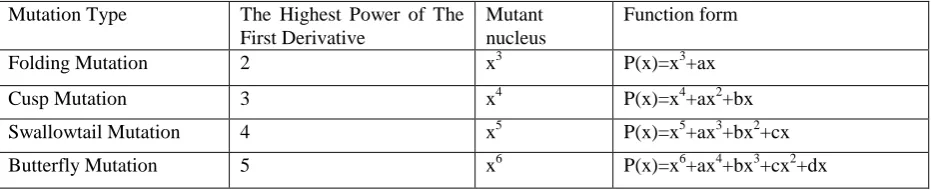
For this reason, we assume that the model is composed of potential functions similar to its process. When the state variable is one and the control variable does not exceed 4, We obtained 4 kinds of catastrophe models (Table 1).
The equilibrium surfaces of the 4 models in three dimensions are shown below (Figure 1).The equations are as follows: ① folding mutation; ② cusp mutation; ③ swallowtail mutation; ④ butterfly mutation.
Table 1. Four Kinds of Mutation Equation Mutation Type The Highest Power of The
First Derivative
Mutant nucleus
Function form
Folding Mutation 2 x3 P(x)=x3+ax
Cusp Mutation 3 x4 P(x)=x4+ax2+bx
Swallowtail Mutation 4 x5 P(x)=x5+ax3+bx2+cx Butterfly Mutation 5 x6 P(x)=x6+ax4+bx3+cx2+dx
Therefore, according to the Haken evolution theory, the variable q is introduced to simplify the knowledge evolution equation, and it is assumed that:
dt dq dt dp q p
, 1
3 1 1 p , 3
q
Bring the above formula into Eq. 5 to get the Eq. 6.
( ) 27 1 9 3 3 3 3 t q q dt
dq
(6) At this time, let
( ) t 27 1 -9 -3 3 3
- t
, , ( )
Bring them in Eq. 6 to get the Eq. 7.
) ( /
dq dtq3q t (7)
According to CAS theory, the knowledge evolution process before knowledge emergence is an orderly process from low level to high level. Moreover, knowledge evolution is a potential system, and its potential function is expressed as Eq. 8.
dq q q
( )q 3
( )
(8) Finishing Eq. 8 to get Eq. 9
dq q q
( )q 3
( )
(9) We call Eq. 9 the knowledge mutation equation.
If we assume that the mutation manifolds in the evolution of knowledge are represented by N. Solving equation 9 gets
0
3
q q
D( ) (10)
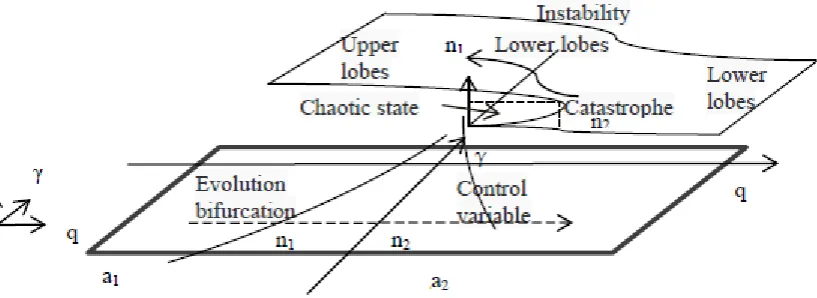
Constructing a visual image using Eq. 10 depicted by three-dimensional vectors (q, λ, γ) (Figure 1). When the original point is greater than 0, we can see that there is a three leaf folding region with gradual diffusion on the surface N. The middle leaf is the σ(q) extreme point. The middle lobe corresponds to a chaotic region with unstable characteristics, which is the condition for knowledge emergence.
Assume that D(σ) = 0 and D2(σ) = 0 in Equation 10. Elimination parameter q obtained:
0 27
42 3 (11)
Figure 1. Visualization of abrupt changes in knowledge evolution.
Discussion
The following discussion is about the form of knowledge evolution
① When the knowledge evolution point starts at 1 and moves to the right to the n1 fork point, the system falls within the lower lobe of the mutation stream N.
② When the knowledge evolution point moves from 1 to the n2 Fork point, the system jumps from the lower lobe to the upper lobe, with irreversible mutation
③ In a small region of the mutation point, any form of action may affect the control variables, and then the knowledge evolved into mutations, resulting in knowledge emerging.
Conclusion
To sum up, we have the following three conclusions:
Conclusion 1. Based on the simulation model analysis: knowledge emergence occurred on the edge of chaos of the system.
Conclusion 2. In the process of from simple to complex, the action intensity, scale or quantity of the interaction among knowledge agents in the system reaches the appropriate degree, which may lead to knowledge emergence.
intensity, scale or quantity of the interaction among knowledge agents
Conclusion 3. The scale, hierarchy and action intensity of knowledge agents create constraints on knowledge emergence., that is, if and only if there are two points h1 and h2, satisfying n2 < h2 < h1 < n1, the system reaches the chaotic boundary in the range of h2 to h1, at this moment, the system is most likely to produce knowledge emerging.
Summary
Based on the complexity method, this paper makes a preliminary study on the condition of knowledge emergence from the breakthrough point by the scale of knowledge agent. The question to be further considered is: how to accelerate the evolution of knowledge to the chaotic edge by mean of the mechanism of environmental intervention? We will use the computer software to do further simulation experiment research.
Acknowledgement
References
[1] Alex and David Bennt. Characterization the Next Generation Knowledge
Organization[J].Knowledge and Innovation: Journal of the KMCI, 2000, (1): 8-42.
[2] Jin Fu, Wang Qian. New Development of Research on Human Resource Management—Research on Intellectual Resource Management [J]. China Soft Science, 2005(1): 88-93.
[3] Fu Jin, Intellectual Management of Knowledge Organization, Beijing: Science Press, 2011, pp. 39-57; pp. 146-159.
[4] Birkinshaw J, Hamel G, Mol M J., Management innovation. Acad Manage Rev.[ J].Academy of Management Review, 2008, 33(4):51-59 .
[5] Hua Yanfeng, Zhang Longge. Model Construction of the Operation Mechanism of Knowledge Emerging System[J]. Modern Information, 2014, 34(7): 50-55.
[6] John Holland, Hidden Order: How Adaptation Builds Complexity. MA: Addision-Wesley publishing Company, Inc. 1995. 10-36.
[7] John Holland, Emergence from Chaos to Order. MA: Helix Books, 1998. 115-124.
[8] Alex Bennet and David Bennet, Organizational survival in the new world: the Intelligent Complex Adaptive Systems. Boston, MA: Butterworth Heinemann, 2004.25-36. 149-161.
[9] Li Haibo, Liu Zeyuan, Ding Wei. Research on the Subject of Organizational Knowledge System Based on Complex Adaptive System Theory[J]. Science and Technology Management Research, 2006, 26(7): 199-202.
[10] Hua Yangfeng, Zhang longge. Aconstruction pf Knowledge Emergency System Operation Mechanism Model, Journal of Modern Information, Vol. 34 No. 7, July, 2014.
[11] Ikujiro Nonaka, Ryoko Toyama and Noboru Konno. SECI, Ba and Leadership: A Unified Model of Dynamic Knowledge Creation[J].Range Planning 2000, 33:5-34.
[12] Fu Jin, Li-jun Zou, Jie Jin, Xia Wang, Characteristics and Management of Knowledge Emergence, J.CPCI-S, 3rd Annual 2017 International Conference Management Science and Engineering MSE2017, Atlantis Press, 2017, pp. 161-163.
[13] Fu Jin, Li-jun Zou, Jie Jin, Xia Wang, Research on the Simulation Models of Knowledge Emergence Based J.CPCI-S, 3rd Annual 2017 International Conference Management Science and Engineering MSE2017, Atlantis Press, 2017, pp. 257-261.
[14] Xu Li-bo, Pan Xu-wei, Yu An-ping, Li Xing-sen, Knowledge innovation by intelligent emergence concept, framework and its pathway, CAAI Transactions on Intelligent Systems J. 2017, 12(1):47-54.
[15] M. Lynne Markus, Ann Majchrzak, Les Gasser. A Design Theory for Systems That Support Emergent Knowledge Processes. Mis Quarterly. 2002, 26(3):179-212.
[16] Zhou Jinbo, Huang Sheng. Research on Multi-level Organizational Knowledge Transformation Mechanism under the Framework of SECI [J]. Science and Technology Management Research, 2009(6): 400-403.
[17] Hu Yanping, Liu Xiaomin. Re-recognition of Knowledge Innovation Process Based on SECI Model[J]. Enterprise Economy, 2009(3): 45-48.
[19] Li Yan, Zhang Zhi-ping, The Emergence of Intelligence, Progress in Biochemistry and Biophysics, 2016, 43(4):348-353.
[20] Dharshan Kumaran, Jennifer J. Summerfield, Demis Hassabis, and Eleanor A. Maguire. Tracking the Emergence of Conceptual Knowledge during Human Decision Making[J], Neuron, 2009, September 63(24):889-901.
[21] Masao Kakihara & Carsten Sorensen. Exploring Knowledge Emergence: From Chaos to Organizational Knowledge[J]. Journal of Global Information Technology Management, 2002, 5(3): 48-66.
[22] Sterman, John D. Business Dynamics: Systems Thinking and Modeling for a Complex World[J].Boston: McGraw Hill, 2002: 515-535.
[23] Dong Wei, Yan Zexian. Analysis on the Emerging Characteristics and Mechanism of Knowledge Innovation System[J]. Science and Technology Management Research, 2007, 27(10): 227-229.