Localized Expression of Small RNA Inhibitors
in Human Cells
Cynthia P. Paul,
1Paul D. Good,
1Shirley X. L. Li,
2Annette Kleihauer,
2John J. Rossi,
2and David R. Engelke
1,*
1Department of Biological Chemistry, The University of Michigan, Ann Arbor, Michigan 48109-0606 2Department of Molecular Biology, Beckman Research Institute of the City of Hope, Duarte, California 91010
*To whom correspondence and reprint requests should be addressed. Fax: (734) 763-3399. E-mail: [email protected].
Several types of small RNAs have been proposed as gene expression repressors with great potential for use in gene therapy. RNA polymerase III (pol III) provides an ideal means of expressing small RNAs in cells because its normal products are small, highly structured RNAs that are found in a variety of subcellular compartments. We have designed cassettes that use human pol III promoters for the high-level expression of small RNAs in the cytoplasm, nucleoplasm, and nucleolus. The levels and subcellular destinations of the transcripts are compared for transcripts expressed using the U6 small nuclear RNA (snRNA), 5S ribosomal RNA (rRNA), and the 7SL RNA component of the signal recognition particle. The most effective location for a particular inhibi-tory RNA is not necessarily predictable; thus these cassettes allow testing of the same RNA insert in multiple subcellular locations. Several small interfering RNA (siRNA) inserts were tested for efficacy. An siRNA insert that reduces lamin expression when transcribed from the U6 snRNA promoter in the nucleus has no effect on lamin expression when transcribed from 5S rRNA and 7SL RNA-based cassettes and found in the nucleolus and cytoplasm. To test further the generality of U6-driven siRNA inhibitors, siRNAs targeting HIV were tested by co-transfection with provirus in cell culture. Although the degree of HIV-1 inhibition varied among inserts, results show that the U6 cassette provides a means of expressing an siRNA-like inhibitor of HIV gene expression.
Key Words: siRNA, RNA interference, U6 promoter, 5S ribosomal RNA, 7SL RNA, RNA polymerase III, HIV
I
NTRODUCTIONThe many types of small RNAs with potential use as therapeutics include ribozymes, artificially selected high-affinity ligands (aptamers), antisense RNAs, and small interfering RNAs (siRNAs). The diversity in their mecha-nisms of action and the variety of targets with which they are capable of interacting suggest a wide range of possible applications, both as tools for research and for the devel-opment of new therapies for both metabolic and infec-tious diseases. The secondary and tertiary structures are important for the function of most of these RNAs. The correct cellular location of the RNA is also critical. The normal cellular products of RNA polymerase III (pol III) are small, highly structured RNAs that are abundant in cells; thus pol III is a logical agent for expressing small therapeutic RNAs in cells. Additionally, pol III products are constitutively expressed in most cell types, making them useful for a variety of applications.
Promoters for pol III are often found within the coding
region of the gene, and in these cases, require the inclusion of extensive sequences from the gene encoding pol III in the RNA transcripts. In addition, endogenous sequences from the normal transcript can provide enhanced stability of the RNA and direct the RNA to particular subcellular locations. These localization elements are often composed of relatively small regions of RNA that are recognized by cellular pro-teins, that in turn have localization signals and provide the vehicles by which the bound RNAs are transported. The inclusion of these domains of the RNA in the product of an expression cassette allows any potentially therapeutic RNA to be ‘carried’ to various locales within the cell. Natural pol III products are found in the cytoplasm, nucleoplasm, and nucleolus, allowing all three different subcellular compart-ments to be targeted using pol III-based expression systems. This is especially useful because it is not always possible to predict the subcellular location in which a particular target will be most accessible. In addition to the U6 snRNA pro-moter, tRNA, RNase P RNA, and adenovirus VA RNA pol III
A
RTICLEpromoters have been used successfully to express therapeu-tic RNAs in cells [1–3].
Although ribozymes have been studied extensively in vitro,they are frequently not effective in cells [4]. Among the reasons for this is that they might not be in the same sub-cellular location as their substrate. In cases in which local-ization has been determined, a correlation between effective RNA locations and expected target locations is observed [1,5]. Nuclear expression of a Rev-binding element (RBE) from U6 and tRNAmetpromoters proved effective in inhib-iting HIV-1 gene expression [6]. In contrast, Bertrandet al.
[7] found that a cytoplasmic ribozyme was more efficient at destroying target HIV-1 mRNA. An interesting counterex-ample to cytoplasmic function by ribozymes was provided by nucleolar localization of an anti-HIV ribozyme through incorporation of U16 small nucleolar RNA targeting se-quences [8]. The resulting effective inhibition of HIV-1 in-dicates that HIV RNA probably passes through the nucleolus at some point and is exposed for attack by the ribozyme. These results are consistent with subcellular location being an important component of intracellular RNA inhibitor ef-ficacy. The success of an RNA designed to carry out a partic-ular function within the cell depends on its ability to reach its target in addition to its capacity to recognize the target and do the intended task. Here we present a collection of pol III expression cassettes designed to test multiple intracellular locations. In particular, we test efficacy of an RNA interfer-ence inhibitor when expressed from these cassettes.
The use of long double-stranded RNAs to reduce the level of gene expression through RNA interference has been a useful tool in many organisms [9,10]. The recent discovery that very small RNA duplexes (siRNA) cause interference in mammalian gene expression, while avoid-ing the interferon response (Tuschl), has opened the way for the use of synthetic RNA duplexes in mammalian experimental systems [42]. Expression of siRNA within cells from DNA constructs greatly expands the potential of siRNA as both an experimental and a therapeutic tool. Several reports have now appeared showing that effective siRNA-like RNAs can be expressed using RNA pol III pro-moter strategies [2,3,11–16]. In several of these, propro-moter constructs were used that normally produce nuclear RNAs (U6 snRNA or ribonuclease P RNA). In this report we show that effective expression of siRNA-like inhibitors corre-lates well with delivery to the nucleoplasm, but not the cytoplasm or nucleolus. We go on to show that this nu-clear strategy for siRNA delivery can be used to suppress gene expression from HIV-1.
R
ESULTSDesign of Cassettes
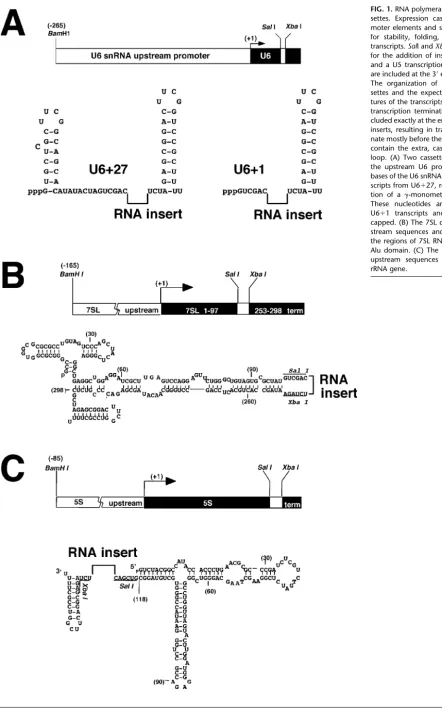
Cassettes for the expression of small RNAs from pol III promoters were adapted from the genes for the U6 snRNA, 5S rRNA, and the 7SL RNA from the signal recognition particle (1Figs. 1A- 1C). The three promoters rely on
dif-ferent contributions of sequences upstream or within the RNA coding region. The human U6 snRNA gene promoter is entirely upstream of the transcription start site [17–20], whereas the 5S rRNA gene relies most heavily on se-quences between⫹40 and⫹100 bp in the coding region for transcription with additional contributions from up-stream sequences located⬃30 bp from the transcription start site [21,22]. The 7SL gene promoter is intermediate, with substantial contributions from upstream sequences, but also essential contributions from A and B boxes and other internal sequences [23–26].
In addition to the promoters, sequences that may be important for subcellular localization or stability are in-cluded in the transcribed region of the cassettes.SalI and
XbaI restriction sites are used in all the cassettes for inser-tion of sequences encoding the test RNAs. In each of the cassettes, an artificial stem-loop sequence followed by five uridines is present at the 3⬘ end, after the insertion site. This is designed to terminate transcription, provide pre-dictable 3⬘structure, and increase the stability of the RNA if no pol III terminator is present in the insert. Endoge-nous U6, 5S, or 7SL RNA sequences are included in each cassette, as well as the 3⬘stem-loop, to help drive the RNA transcript to fold into discrete subdomains that should not interfere with the structure of the insert. Cassettes based on the human U6 gene, U6⫹1 and U6⫹27, have been used to express ribozymes, antisense, and aptamers designed to inhibit viral infection [6 – 8] and to express siRNA-like RNAs that inhibit endogenous and viral targets in human cells [11,12].
The U6 cassettes include 265 bp upstream of the tran-scription start site, a region containing the entire human U6 promoter [17–20] (Fig. 1A). The 27 nt from the 5⬘end of the U6 RNA are included in the products of the U6⫹27 cassette, providing for enhanced stability of the RNA and directing transcript capping [6]. These bases are followed by the re-striction enzyme sites for the cloning of inserts and then by the 3⬘stem and termination signal. Transcription of the U6
⫹1 cassette begins with theSalI site and therefore lacks the sequences required for capping and stability. However, all transcripts from the U6 promoter have been shown to have similar nuclear localization [6].
is included in the insert resulting in transcripts predicted to lack the 3⬘half of the Alu domain. However, transport to the cytoplasm is expected because the 5⬘half of the Alu domain is sufficient to bind the p9/14 protein heterodimer [33], which is thought to be responsible for transport to the cytoplasm [32].
The 5S cassette includes 85 bases upstream of the 5S gene transcription start site and the region encoding the entire 5S rRNA (Fig. 1C). TheSalI andXbaI sites for clon-ing of inserts are at the end of the 5S rRNA codclon-ing se-quence where the endogenous 5S terminator normally resides. The same 3⬘stem terminator that is used for the other cassettes is present immediately following the in-sertion site. Having the entire 5S sequence, transcripts are expected to undergo normal nucleolar assembly and transport to the cytoplasm. The 3⬘ends of the transcripts are likely to be exposed to solution, even when the 5S rRNA becomes part of the ribosome [27].
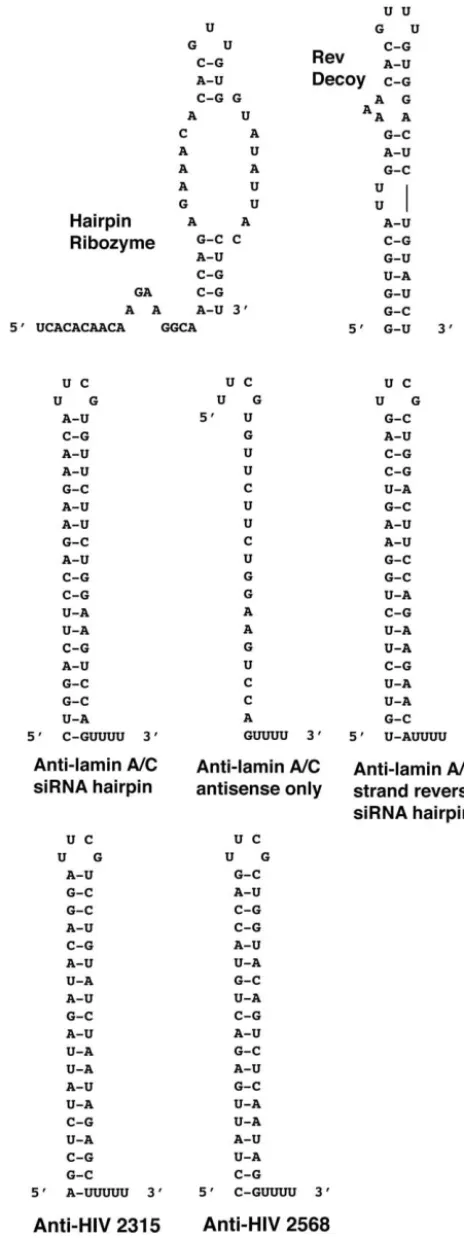
Sequences that have been inserted between the SalI andXbaI sites in the expression cassettes include a hair-pin ribozyme, a decoy RNA, and siRNA-like stem-loops (Fig. 2). The hairpin ribozyme insert targets the U5 region of the HIV large transcript [6,34 –36]. The RBE insert was designed to serve as a potential decoy to bind Rev protein in infected cells [37], thus competing with the virus for available protein. The siRNA-like inserts target endoge-nous lamin A/C message [11] or the polymerase coding region of HIV-1 RNA. These inserts are made up of a 19 – bp stem in which the two paired regions are connected by a tetraloop [11]. A pol III transcription termination signal of four or five uridines is located at the 3⬘end of the siRNA inserts, before the stem terminator at the 3⬘ end of the cassette. The ‘antisense only’ control insert for the anti-lamin construct contains the antisense anti-lamin target se-quence alone; thus it does not form the strong stem.
Subcellular Localization of RNA from pol III Cassettes Is Dependent on the Expression Cassette
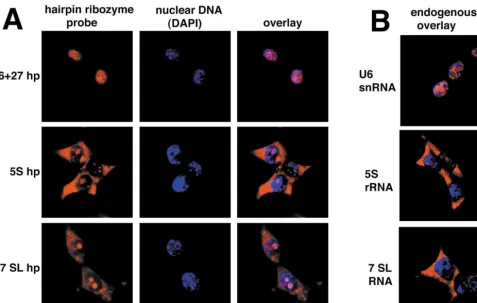
We have shown elsewhere that transcription of the U6⫹ 27 cassette with several inserts, including the lamin siRNA-like insert and the hairpin ribozyme insert, results in the accumulation of the RNA expressed from this cas-sette in the nucleus [6,11]. Transcription from the U6⫹ 27 cassette results in the accumulation of the RNA in nucleoplasmic speckles, similar in distribution to endog-enous U6 snRNA (Fig. 3). U6⫹1 transcripts lacking any endogenous RNA sequences and pol III transcripts from tRNA genes, but without tRNA structure, are also nucleo-plasmic [6]. This has led to the conclusion that pol III transcripts remain in the nucleus by default unless given specific localization signals.
In contrast, RNA transcribed from the 5S and 7SL cas-settes accumulates primarily in the cytoplasm, with addi-tional nuclear staining that often corresponds to nucleoli, as defined by DAPI staining (Fig. 3). For both 5S and 7SL transcripts, the RNA is expected to traffic through the
nucleolus before exit to the cytoplasm [30,31]. Probes to the endogenous 5S and 7SL sequences suggest that more 5S than 7SL RNA is nucleolar under steady-state condi-tions, but the artificial constructs from both cassettes give bright nucleolar signals in addition to strong cytoplasmic localization. Thus, the 5S and 7SL cassettes can be used when the target is available in the nucleolus or cytoplasm.
Expression of RNA from pol III Cassettes in Human Cells
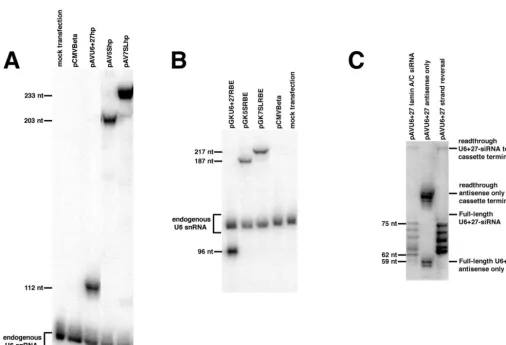
RNA expressed from the pol III cassettes accumulates to high levels in human cells. RNA of the expected sizes for full-length transcripts accumulated in cells transfected with the U6 ⫹ 27, 5S, and 7SL cassettes containing a hairpin ribozyme insert (Fig. 4A) or the RBE insert (Fig. 4B). These results are consistent with earlier observations for antisense, decoy, and ribozyme inserts in cassettes driven by tRNA and U6 pol III promoters [6]. It was earlier shown [6] that transcription began at the expected sites and gave transcripts of the expected full length, but with some exonuclease trimming of one to four uridine resi-dues from the 3⬘end of the cassette-encoded stem termi-nator. Transcripts expressed from the U6 ⫹ 27 cassette have a␥- monomethyl phosphate cap [6]. RNA from all cassettes was generally present at 104⫺106copies per cell when normalized to the level of endogenous U6 RNA [38], although there was variability between transfections. Transcripts expressed from the 7SL promoter generally accumulate to at least as high a concentration as those from the strong U6 promoter and resulted in even greater levels of expression in some experiments. In contrast, the 5S promoter results in a lower level of transcript accumu-lation in cells than the U6 promoter.
In addition to the strong transcription terminator pro-vided by the cassette-encoded stem-loop and five uridine residues at the 3⬘ end of all cassettes, cassettes that con-tain anti-lamin siRNA-like inserts have four uridine resi-dues immediately after the insert (Fig. 2). The ‘antisense only’ U6⫹27 control construct contains only the anti-sense strand from the siRNA construct, along with the loop and U4terminator sequences. Transcription of this construct in HeLa cells sometimes terminates at the first U4 sequence after the insert (25%), but a substantial amount reads through to the cassette-encoded stem ter-minator (75%) (Fig. 4C). This termination inefficiency was unexpected, given that U4 is normally sufficient to terminate vertebrate pol III transcripts [39], but serves to warn that at least five uridine residues should be used to terminate transcripts in this system definitively. Both ter-mination sites result in products that are one to four nucleotides shorter than predicted from the sequence. The exact number of uridine residues remaining on the 3⬘ end is variable, presumably as a result of heterogeneous post-transcriptional trimming by endo- and exonclease activities, as is commonly seen in pol III products.
con-taining the 19-bp stem-loop of the anti- lamin siRNA-like RNA (forward or reverse orientation) were expressed in HeLa cells (Fig. 4C). Small amounts of transcripts are the appropriate length for termination of transcription to have occurred at the fourth uridine in the U4terminator immediately following the siRNA insert, but most of the transcripts are found in four or five shorter bands, each one to three nucleotides shorter than the preceding band. The sizes of these transcripts indicate that the first strand, the loop, and part of the second strand of the siRNA duplex are present, but that the 3⬘ end of the second strand is truncated. This pattern was not observed with any other types of RNA inserts. The shortened RNAs might be the work of nucleases after transcription, but might also result from pol III itself chewing back from the terminator in one- to three-nucleotide bites. pol III, like other RNA polymerases, is known to have this propensity at strong pause sites [40]. It is possible that the especially strong 19-bp siRNA stems act as strong transcription pause sites to encourage this trimming. Whatever mech-anism creates these products appears to require the U4 terminator after the strong stem, in that removing two of the uridines causes readthrough to the cassette stem ter-minator (data not shown), eliminating the strong ladder of bands. Characterization of events leading to the shorter products is in progress.
Effectiveness of the Therapeutic Insert Is Dependent on the Cassette from Which It Is Expressed
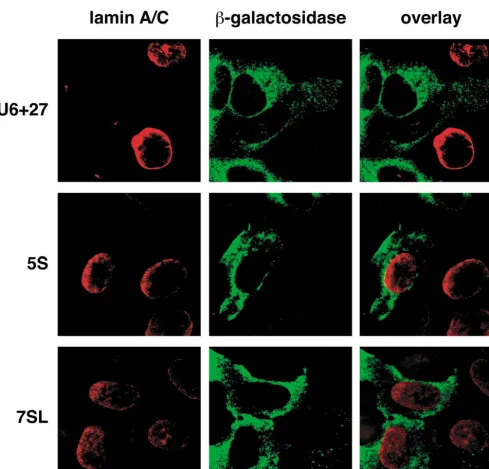
[image:5.612.54.286.99.719.2]Of the previous RNA inserts that were tested for inhibiting targets [6,11,41], the ones that worked well were ex-pressed from U6 cassettes, resulting in nuclear localiza-tion. An anti-lamin siRNA-like insert strongly reduces lamin A/C levels in HeLa cells when expressed from the U6⫹27 or U6⫹1 cassettes [11]. The 19-base lamin sense and antisense sequences that make up the duplex in this insert target the region of the lamin mRNA already shown by Tuschl and co- workers [42] to be sensitive to synthetic siRNA. The synthetic siRNA reduced lamin levels in the cell when transfected into cells using lipid-based reagents. ’Hairpin siRNA’ inhibition of lamin A/C levels appeared to use an siRNA-like mechanism, because neither the sense nor the antisense strands alone suppressed lamin levels [11]. The effectiveness of the nuclear siRNA expres-sion was intriguing, in that there were suggestions that RNA interference might operate in the cytoplasm [9]. It was theoretically possible that small amounts of siRNA expressed from the U6 promoter were leaking into the cytoplasm, and that localizing larger amounts of siRNA in the cytoplasm would be even more effective. We therefore
FIG. 2.Cassette inserts used in this study include a ribozyme, Rev-binding element (RBE) decoy, and hairpin siRNAs with controls. Sequences and ex-pected secondary structures of the inserts are shown.
A
RTICLEextended our earlier experiment by comparing the effects of U6-driven anti-lamin siRNA to that of the same insert expressed from either the 5S or the 7SL cassette (Fig. 5). 5S- and 7SL-driven expression of the insert did not reduce lamin A/C levels. Thus, the promoter cassette and result-ing subcellular location of the product RNA are important considerations in designing effective strategies for the expression of therapeutic RNAs.
Use of the U6 Promoter Cassette to Interfere with HIV Gene Expression
Intracellular expression of effective siRNA is useful in experimentally ablating cellular gene products, but might also prove extremely useful as gene therapy against viral infection. As a preliminary test of this, we next asked whether an siRNA-like insert expressed from the same cassette (U6 ⫹ 27) could interfere with gene expression from co-transfected HIV-1 provirus. The siRNA-like RNAs, designed to target sequences within the HIV-1 pol se-quence (Fig. 2), were expressed from the U6⫹27 cassette
and tested for the ability to interfere with gene expression from the long HIV transcript. Two examples (positions 2315 and 2568 in the HIV NL4-3 sequence, GenBank accession no. AF070521) were compared to control cas-settes containing no inserts (Fig. 6). Construct 2315 con-sistently inhibited HIV gene expression and, whereas there was significant variability between experiments, im-munoassay for p24 showed that viral gene expression was decreased by up to 90%. In contrast, the second insert targeted to a different sequence in the same region, posi-tion 2568, did not consistently reduce p24 levels by
[image:6.612.66.543.95.398.2]⬎50%. Thus, different target sequences for siRNA-like in-hibition are not equally effective, just as synthetic siRNA sequences vary substantially in their effects against the same target [42,43]. At this time, the rules for effective target selection are not understood for siRNAs expressed from pol III promoters. It is therefore best to try several sequences against any gene of interest when expressing these RNAs within the cell.
FIG. 3.The subcellular distribution of the transcripts depends on the cassette from which they are expressed. Transcripts were detected in human 293 cells byin situ
D
ISCUSSIONThe development of the 5S and 7SL promoter cassettes for the expression of small RNAs in human cells provides a mechanism for delivering small RNA products to both the nucleolus and cytoplasm. Together with the earlier de-scribed cassettes based on the U6 snRNA promoter [6] that result in nucleoplasmic localization of their products, this set of cassettes provides for delivery of small RNAs to a variety of cellular compartments. The ability to reach different subcellular locations could be important for de-livery of diverse small RNAs, depending on the intended targets. For example, a ribozyme targeting HIV-1 mRNA was effective when localized in the cytoplasm, but not when localized to the nucleoplasm [7].
The location in which a particular target will be most accessible is not necessarily predictable in advance. The lamin mRNA target of siRNA is expected to be found primarily in the cytoplasm, but only nuclear delivery of
[image:7.612.51.558.91.436.2]an siRNA-like insert caused a decrease in the lamin signal in transfected cells. Although the presence of small amounts of the products from the U6⫹27 cassette in the cytoplasm cannot be excluded, the vast majority of the hairpin siRNA is in the nucleoplasm [11] (Fig. 3A). The same insert did not reduce lamin levels when expressed from the 5S or 7SL cassettes. Although this cytoplasmic delivery of siRNA from the 5S and 7SL cassettes might not work for reasons other than location, the combined re-sults strongly suggest that a nuclear function is required. The lamin messages (or pre-mRNA) might be more acces-sible for attack while in the nucleus. Alternatively, nuclear processing of the siRNA or interaction of the siRNA-con-taining protein complex with nuclear proteins might be necessary. The availability of a set of cassettes that provide for different subcellular distributions of a particular RNA insert allows simultaneous testing of an insert in the dif-ferent cellular compartments. It should be noted that FIG. 4.RNA synthesis from pol III cassettes. RNA isolated from cells that had been transfected with plasmids containing the pol III cassettes was subjected to polyacrylamide gel electrophoresis, transferred to membrane, and probed with32P-labeled DNA oligomers that hybridize to the insert and to endogenous U6 snRNA (panels A and B) or to the first 27 bases of U6 snRNA (panel C). (A) A hairpin ribozyme insert expressed from the U6⫹27, 5S, and 7SL cassettes. Lanes containing RNA from mock-transfected cells or cells transfected with pCMValone are included as controls. (B) The RBE decoy expressed from the U6⫹27, 5S, and 7SL cassettes. Controls are as described for (A). (C) Anti-lamin A/C siRNA inserts expressed from the U6⫹27 cassette.
A
RTICLEanother group [44] recently demonstrated that transfec-tion with exogenous, pre-made RNA triggers substantial turnover in the cytoplasm, as well as reducing nuclear levels. This result suggests that exogenous siRNA applica-tion might use different pathways from that used most efficiently by siRNA expressed from within the nucleus.
[image:8.612.57.547.90.559.2]presumably also expressing RNAs primarily in the nu-cleus. Two reports used the promoter for the RNA subunit of human RNase P [2,3]. This is also a promoter used by pol III, and the normal transcripts, like those from the U6 promoter, are thought to remain in the nucleus [45]. The sense and antisense strands can be expressed indepen-dently or as a stem-loop connected by a linker. In our hands, siRNA-like RNA expressed from the U6⫹27 cas-sette was effective in reducing lamin A/C levels in cells to amounts similar to what is attained using chemically syn-thesized siRNA [11]. Here we report that in addition to providing a means of expressing siRNA-like RNAs against an endogenous target, the U6 ⫹ 27 cassette provides a
mechanism for expressing siRNA hairpin inserts against a viral target that is introduced into the cell on another plasmid along with the siRNA-like construct.
RNA from U6⫹27 cassettes with inserts that do not form a long stem-loop (hairpin ribozyme and RBE) show no evidence of intermediate processing events, and no processing of siRNA hairpins was detected. The U6⫹27 cassette differs from other published constructs in that the sequences of the pol III transcript include leader se-quences in addition to the siRNA that provide added stability. The 5⬘ 27 nt of the U6-coding sequence are required for modification of the RNA by the addition of a 5⬘ ␥-monomethyl phosphate cap structure and provide protection against attack by exonucleases [6]. Although it is possible that a small amount of nicking is occuring, and that this produces a minor active form, the absence of processing suggests that a free 5⬘ end is not required for interference with gene expression by these RNAs.
The finding that siRNA expression is effective when ex-pressed in the nucleus, rather than in the cytoplasm as expected, underscores the need to test multiple expression pathways when testing the function of small RNAs inside cells. The U6, 5S, and 7SL expression cassettes described here provide both nucleoplasmic and cytoplasmic delivery ca-pacity. When combined with the earlier described nucleolar delivery using similar cassettes [8], these strategies allow testing of a broad spectrum of subcellular destinations.
M
ATERIALS ANDM
ETHODSPlasmid construction and purification.The U6⫹27 and U6⫹1 con-structs have been described [6].
The human 5S cassette was created by PCR amplifying the 85 nt upstream of the transcription start site through the entire 5S rRNA se-quence using the ph5S 8544 plasmid (gift of Beth Moorfield) as template [46]. The oligonucleotides for this PCR were designed with aBamHI site on the upstream side and aSalI site downstream of the 5S rRNA sequence. The fragment was cut and subsequently ligated into pAVU6⫹27 [6], which was treated with the same restriction endonucleases as the PCR product.
The 7SL cassette was made by PCR, amplifying and subcloning two distinct regions of the p7L30.1 plasmid [47] (gift of Christian Zwieb). The first fragment amplified contained 7SL RNA sequence from nt 258 to 298 of the transcript. The PCR oligonucleotides for the first amplification were designed with anXbaI restriction endonuclease site on the upstream side of the frag-ment and aNheI site on the downstream side. This fragment was ligated into theXbaI site of the pTZU6⫹1 vector [6]. This intermediate vector was cut withBamHI andSalI and used to clone the second PCR product, which contained sequence from 165 nt upstream of the 7SL transcription start site to nt 97 of the 7SL RNA. Oligonucleotides used in this second PCR were engi-neered with aBamHI site upstream of the 7SL promoter and aSalI site downstream of nt 97 of the 7SL RNA. The resulting expression cassette was later subcloned into pCWRSVN [48] in the same manner as the U6⫹27 cassette [6].
Inserts were made by annealing oligos of the desired sequence.SalI and XbaI sites were present near the 5⬘ and 3⬘ ends of the annealed oligos, respectively. The annealed oligos and the plasmids carrying the cassettes were cleaved by these enzymes and then ligated. All constructs were sequenced.
[image:9.612.70.274.91.476.2]Plasmids were amplified in DH5␣F’int or SURE2 (Stratagene, La Jolla, CA) cells and purified using Qiagen kits (Valencia, CA), and then were extracted with phenol or phenol-chloroform- isoamyl alcohol (25:24:1) and ethanol precipitated.
FIG. 6.Reduction in HIV-1 gene expression by siRNA hairpins expressed from the U6 promoter. HIV-1 mRNA was targeted using siRNA-like RNAs expressed from the U6⫹27 cassette. HIV-1 gene expression following co-transfection of cells with provirus was measured using an immunoassay for HIV p24. The siRNA inserts are directed against positions 2315 and 2568 in the HIV-1 sequence. Their ability to interfere with HIV-1 gene expression is compared to that of a control U6⫹27 cassette with no insert.
A
RTICLEIntroduction of pol III expression cassettes into human cells for localiza-tion and transcriplocaliza-tion studies.HeLa and 293 cells were grown in DMEM (Invitrogen, Carlsbad, CA) supplemented with 10% FBS (HyClone, Logan, UT), 100 units/ml penicillin, 100g/ml streptomycin, and 4 mM L-glu-tamine. Cells were maintained at 37 °C in 5% carbon dioxide by splitting twice each week.
HeLa cells were transfected with plasmids containing expression cas-settes using Lipofectin with Plus reagent or Lipofectamine 2000 (Invitro-gen, Carlsbad, CA) following the manufacturer’s instructions [49]. When transfecting using Lipofectin, cells were plated one day in advance in medium lacking antibiotics so that they would be⬃50% confluent at the time of transfection. For 60-mm plates, 2.8 –3.3l Lipofectin and 20l Plus reagent were used. Plasmids were transfected into cells at a 3:1 ratio of experimental plasmid to pCMV(Clontech, Palo Alto, CA) so that a total of 4.4g DNA was added to each plate. The amounts of Lipofectin and DNA were adjusted in proportion to the surface area when the size of the plates was varied. One day after transfection, cells were trypsinized, resus-pended in DMEM with 10% FBS and L-glutamine, but without antibiotics, and split. Cells to be used for microscopy were plated onto coverslips. Transfection efficiency was determined by cytochemical assay for -galac-tosidase expression 3 days after transfection [50].
When transfecting using Lipofectamine 2000, cells were plated one day in advance in six-well dishes so that they would be 90 –95% confluent on the day of transfection. A total of 3.8g of DNA was used per well, in a 3:1 molar ratio of experimental plasmid to pCMV. Following transfec-tion, cells were treated in the same way as described for Lipofectin trans-fection.
293 cells were transfected using calcium phosphate as described in Goodet al.[6]. Cells were plated at 5–10% confluency in 100-mm plates containing coverslips 1–2 hours before transfection. A total of 10g DNA was added to each 100-mm plate in a 3:1 molar ratio of experimental plasmid to pCMV. The medium was not changed after transfection when the cells were plated onto coverslips. Transfection efficiency was assayed 2 days after transfection as described for HeLa cells.
Localization of transcripts by in situ hybridization.Cells were fixed on coverslips directly in growth medium by adding fixative to bring the concen-tration to 4% paraformaldehyde (EMS Sciences, Ft. Washington, PA) and 10% acetic acid 2 days after transfection. After fixation, cells were permeabilized by submersion in 70% ethanol and storage at 4 °C. The cassette transcripts were localized using oligos tagged with Cy3 (Operon, Alameda, CA) that recog-nized the hairpin ribozyme insert sequence (5⬘-Cy3- GCCAGGTAATATAC-CACAACGTGTGTTTCTCTGGTTGCCTTCTTG-3⬘). Probes for the endoge-nous RNA controls were also labeled with Cy3 (U6: 5⬘-Cy3- CACGA-ATTTGCGTGTCATCCTTGCGCAGGGGCC-3⬘, 5S: 5⬘-Cy3- CTTAGCTTC-CGAGATCAGACGAGATCGGGCGCG-3⬘, 7SL: 5⬘-Cy3- CCGGGAGGTCAC-CATATTGATGCCGAACTTAGTGCG-3⬘) (Operon, Alameda, CA and the Uni-versity of Michigan Biomedical Research Core Facilities). Hybridization to oligonucleotide probes was in 10% dextran sulfate, 2 mM vanadyl ribonucle-oside complex, 0.02% BSA, 40g yeast tRNA, 2⫻SSC, 50% formamide, and 30 ng of probe (http://singerlab.aecom.yu.edu/protocols). After hybridization overnight at 37 °C, coverslips were washed twice at 37 °C for 30 minutes each time in 2⫻SSC, 50% formamide and once in PBS (58 mM Na2HPO4, 17 mM
NaH2PO4, 68 mM NaCl, pH 7.4) for 15 minutes. Cells were stained with
4⬘,6-diamidino 2-phenlindole (DAPI) at 2 ng/l in PBS for 5 minutes and washed with PBS three times for 5 minutes each time. Coverslips were affixed to slides in Prolong mounting medium (Molecular Probes, Eugene, OR). Slides were viewed and photographed with a Nikon (Melville, NY) Eclipse E800 microscope and a Hamamatsu (Bridgewater, NJ) Orca II digital camera. Im-ages were subjected to deconvolution using Isee Analytical Imaging Software (Inovision Corporation, Raleigh, NC).
Detection of transcripts by northern blotting.RNA was isolated from transfected 293 cells using Trizol reagent (Invitrogen, Carlsbad, CA) 2 days after transfection (Figs. 4A and 4B). HeLa cells were transfected as de-scribed with experimental plasmids and pEGFP (Clontech, Palo, Alto, CA) in an equimolar ratio. The media was replaced 24 hours after transfection. HeLa cells were subjected to cell sorting by the University of Michigan Flow Cytometry Core using a BD FACS Vantage SE (BD Biosciences, San
Jose, CA) 2 days after transfection. RNA was isolated from sorted HeLa cells using Trizol reagent according to the manufacturer’s instructions (Fig. 4C). RNA samples and size markers were separated on 6% (Figs. 4A and 4B) or 8% (Fig. 4C) polyacrylamide gels containing 8.3 M urea. The RNA was then blotted to Nytran (Schleicher and Schull, Keene, NH) using the Genie elec-troblotter (Idea Scientific, Minneapolis, MN) under conditions specified by the manufacturer. The RNA was crosslinked to the Nytran membrane using UV light by placing each side on a transilluminator (Fotodyne Model 3-3000, Hartland, WI) for 2 minutes. Oligodeoxynucleotide probes (Invitrogen, Carls-bad, CA) that recognize insert RNA were labeled using polynucleotide kinase (New England Biolabs, Beverly, MA) and␥- [32P]ATP (NEN Life Science
Prod-ucts, Boston, MA). Separate probes were prepared that hybridize to the hair-pin ribozyme’s catalytic domain (5⬘- GCCAGGTAATATACCACAACGTGT-GTTTCTCTGGTTGCCTTCTTG-3⬘), the RBE insert (5⬘ -AGATACAGAG-TCCACAAACGTGTTTCTCAATGCACCC-3⬘), the U6⫹27 cassette (5⬘- GTC-GACTAGTATATGTGCTGCCGAAGCAGCAC-3⬘), and endogenous human U6 snRNA (5⬘-CACGAATTTGCGTGTCATCCTTGCGCAGGGGCC-3⬘). The U6⫹27 and endogenous U6 probes are specific, because the probe for the endogenous U6 snRNA does not hybridize to the U6 sequences included in the U6⫹27 cassette, and the U6⫹27 probe does not recognize endogenous U6 snRNA under the hybridization and wash conditions used. RNA blots underwent a 1-hour prehybridization in 6⫻SSPE buffer (20⫻ ⫽3 M NaCl, 200 mM NaH2PO4䡠H2O, 20 mM EDTA, pH 7.4), 200g/ml salmon testis DNA
(Sigma, St. Louis, MO), 1% SDS, 5⫻Denhardt’s reagent (USB, Cleveland, OH). Hybridization was conducted by adding labeled oligo probes in 6⫻SSPE, 1% SDS. The U6⫹27 probe was hybridized to the membrane for 2 hours at 70 °C, and then 3 hours at 65 °C. All other probes were allowed to hybridize overnight at 68 °C. Blots were washed three times with 250 ml of wash buffer (6⫻SSPE, 1% SDS) for 30 minutes at room temperature, and then one 250-ml wash for 3 minutes at 65 °C for the U6⫹27 probe and 68 °C for all other probes. A final 250-ml wash in 6⫻SSPE was done at room temperature for 30 minutes. The membrane was then exposed to a storage phosphor screen that was subsequently scanned on the Molecular Dynamics PhosphorImager 445 SI (Piscataway, NJ). Image analysis, for quantification of hybridization signals, was carried out using IP Lab Gel Software (Signal Analytic Corporation, Vienna, VA). Expressed RNA copy number was estimated relative to endog-enous U6 snRNA in each sample (400,000 copies/cell) [38], normalizing for approximate transfection efficiency measured by cytochemical detection of
-galactosidase expression in parallel co-transfections with pCMV.
Immunolocalization of lamin A/C.Cells were fixed in methanol for 6 minutes at⫺20 °C 3 days after transfection. Transfected cells were iden-tified by the detection of-galactosidase (expressed from pCMVthat was co-transfected with the plasmid expressing the anti-lamin A/C plasmid) using anti--galactosidase polyclonal antibodies at 1.0g/ml (A-11132; Molecular Probes, Eugene, OR) and Oregon Green 488-labeled goat anti-rabbit antibodies at 5g/ml (O-11038; Molecular Probes, Eugene, OR). Monoclonal antibodies against lamin A/C were from Santa Cruz Biotech-nology (lamin A/C (636):sc-7292; Santa Cruz, CA) and were used at 1
g/ml. The Cy3-labeled goat anti-mouse secondary antibodies used to detect lamin A/C were from Amersham Pharmacia Biotech (PA 43002; Piscataway, NJ) and were used at 1g/ml. Primary and secondary anti-bodies were diluted in PBS containing 3% BSA and were incubated with the coverslips for 1–2 hours at 37 °C. Cells were stained with DAPI and coverslips were mounted, viewed, and photographed as described for the localization of transcripts.
Immunoassay for HIV gene expression.A modified calcium phosphate co-transfection method [51] was used to transfect 293 cells (NIH) for the HIV inhibition assay. Cells were plated in six- well polystyrene tissue culture plates (5⫻105cells/well) in 2 ml EMEM (Quality Biological Inc.,
Gaithersburg, MD) supplemented with 10% FBS (Gemini Bio-Products Inc., Woodland, CA) and grown for 24 hours. DNA was added at either a 5:1 ratio (0.8g to 0.2g) or a 10:1 ratio (3.6g to 0.4g) of anti-HIV agent to pNL4-3, the plasmid carrying the proviral sequence.
DNAs were mixed in 96-well polystyrene tissue culture plates and the volume adjusted to 83l with TET9/10 (1 mM Tris, pH 7.9, 0.1 mM EDTA). After the thorough mixing of 13l 2 M calcium chloride and 100l 2⫻
minutes at room temperature, then added to the cell cultures. The cultures were incubated at 37 °C, medium was changed after 4 hours, and super-natant was collected for the p24 assay daily for 4 days. Samples of the supernatant culture fluids were tested in a p24(HIV-1) antigen assay using ELISA commercial kits (Beckman Coulter, Hialeah, FL) according to the manufacturer’s recommendations.
ACKNOWLEDGMENTS
We are indebted to Gary Kunkel, Beth Moorefield, and Christian Zwieb for gifts of human U6, 5S, and 7SL genes, respectively. This work was supported by NIH grants AI 40936 to D.R.E. and AI 29329, AI 42552, and AI 46030 to J.J.R.
RECEIVED FOR PUBLICATION AUGUST 15; ACCEPTED NOVEMBER 18, 2002.
REFERENCES
1.Medina, M. F. C., and Joshi, S. (1999). RNA polymerase III-driven expression cassettes in human gene therapy.Curr. Opin. Mol. Ther.1:580 –594.
2.Brummelkamp, T. R., Bernards, R., and Agami, R. (2002). A system for stable expression of short interfering RNAs in mammalian cells.Science296:550 –553.
3.McManus, M. T., Petersen, C. P., Haines, B. B., Chen, J., and Sharp, P. A. (2002). Gene silencing using micro-RNA designed hairpins.RNA8:842– 850.
4.Rossi, J. J. (1998). Therapeutic ribozymes: principles and applications.BioDrugs9:1–10.
5.Paul, C. P., Good, P. D., and Engelke, D. R. (1999). The use of small RNAs as expression cassettes for the delivery of therapeutic RNAs).Intracellular Ribozyme Applications:
Principles and Protocols(In: J. J. Rossi, and L. A. Couture, Eds.), pp. 93–102. Horizon
Scientific Press, Wymondham, UK.
6.Good, P. D.,et al.(1997). Expression of small, therapeutic RNAs in human cell nuclei.
Gene Ther.4:45–54.
7.Bertrand, E.,et al.(1997). The expression cassette determines the functional activity of ribozymes in mammalian cells by controlling their intracellular localization.RNA3:
75– 88.
8.Michienzi, A., Cagnon, L., Bahner, I., and Rossi, J. J. (2000). Ribozyme-mediated inhibition of HIV 1 suggests nucleolar trafficking of HIV-1 RNA.Proc. Natl. Acad. Sci. USA
97:8955– 8960.
9.Bernstein, E., Denli, A. M., and Hannon, G. J. (2001). The rest is silence.RNA7:
1509 –1521.
10.Zamore, P. D. (2001). RNA interference: listening to the sound of silence.Nat. Struct.
Biol.8:746 –750.
11.Paul, C. P., Good, P. D., Winer, I., and Engelke, D. R. (2002). Effective expression of small interfering RNA in human cells.Nat. Biotechnol.20:505–508.
12.Lee, N. S.,et al.(2002). Expression of small interfering RNAs targeted against HIV-1rev
transcripts in human cells.Nat. Biotechnol.20:500 –505.
13.Miyagishi, M., and Taira, K. (2002). U6 promoter-driven siRNAs with four uridine 3⬘
overhangs efficiently suppress targeted gene expression in mammalian cells.Nat.
Biotechnol.20:497–500.
14.Yu, J.-Y., DeRuiter, S. L., and Turner, D. L. (2002). RNA interference by expression of short-interfering RNAs and hairpin RNAs in mammalian cells.Proc. Natl. Acad. Sci. USA
99:6047– 6052.
15.Sui, G.,et al.(2002). A DNA vector-based RNAi technology to suppress gene expression in mammalian cells.Proc. Natl. Acad. Sci. USA99:5515–5520.
16.Paddison, P. J., Caudy, A. A., and Hannon, G. J. (2002). Stable suppression of gene expression by RNAi in mammalian cells.Proc. Natl. Acad. Sci. USA99:1441–1448.
17.Kunkel, G. R., Maser, R. L., Calvet, J. P., and Pederson, T. (1986). U6 small nuclear RNA is transcribed by RNA polymerase III.Proc. Natl. Acad. Sci. USA83:8575– 8579.
18.Kunkel, G. R., and Pederson, T. (1989). Transcription of a human U6 small nuclear RNA
genein vivowithstands deletion of intragenic sequences but not of an upstream
TATATA box.Nucleic Acids Res.17:7371–7379.
19.Danzeiser, D. A., Urso, O., and Kunkel, G. R. (1993). Functional characterization of elements in a human U6 small nuclear RNA gene distal control region.Mol. Cell. Biol.
13:4670 – 4678.
20.Noonberg, S. B., Scott, G. K., Garovoy, M. R., Benz, C. C., and Hunt, C. A. (1994).In vivogeneration of highly abundant sequence-specific oligonucleotides for antisense and triplex gene regulation.Nucleic Acids Res.22:2830 –2836.
21.Hallenberg, C., and Frederiksen, S. (2001). Effect of mutations in the upstream pro-moter on the transcription of human 5S rRNA genes.Biochim. Biophys. Acta1520:
169 –173.
22.Nielsen, J. N., Hallenberg, C., Frederiksen, S., Sorensen, P. D., and Lomholt, B. (1993).
Transcription of human 5S rRNA genes is influenced by an upstream DNA sequence.
Nucleic Acids Res.21:3631–3636.
23.Ullu, E., and Weiner, A. M. (1985). Upstream sequences modulate the internal pro-moter of human 7SL RNA.Nature318:371–374.
24.Kleinert, H., Gladen, A., Geisler, M., and Benecke, B.-J. (1988). Differential regulation of transcription of human 7SK and 7SL RNA genes.J. Biol. Chem.263:11511–11515.
25.Bredow, S., Kleinert, H., and Benecke, B. -J. (1990). Sequence and factor requirements for faithfulin vitrotranscription of human 7SL DNA.Gene86:217–225.
26.Bredow, S., Su¨rig, D., Mu¨ller, J., Kleinert, H., and Benecke, B.-J. (1990). Activating-transcription-factor (ATF) regulates human 7SL RNA transcription by RNA polymerase
IIIin vivoandin vitro.Nucleic Acids Res.18:6779 – 6784.
27.Man’kin, A. S., Maribona, R., Korneva, S. B., Borylow, A. M., and Skriabin, K. G. (1982). Differential accessibility to RNase T1 of 5S- and 5.8S-rRNA in 60S subunits and 80S ribosomes of yeast.Biokhimiia47:864 – 868.
28.Strub, K., Moss, J., and Walter, P. (1991). Binding sites of the 9- and 14-kilodalton heterodimeric protein subunit of the signal recognition particle (SRP) are contained exclusively in theAludomain of SRP RNA and contain a sequence motif that is conserved in evolution.Mol. Cell. Biol.11:3949 –3959.
29.Weichenrieder, O., Kapp, U., Cusack, S., and Strub, K. (1997). Identification of a minimalAluRNA folding domain that specifically binds SRP 9/14.RNA3:1262–1274.
30.Jacobson, M. R., and Pederson, T. (1998). Localization of signal recognition particle RNA in the nucleolus of mammalian cells.Proc. Natl. Acad. Sci. USA95:7981–7986.
31.Politz, J. C.,et al.(2000). Signal recognition particle components in the nucleolus.Proc.
Natl. Acad. Sci. USA97:55– 60.
32.He, X.-P., Bataille´, N., and Fried, H. M. (1994). Nuclear export of signal recognition particle RNA is a facilitated process that involves theAlusequence domain.J. Cell Sci.
107:903–912.
33.Weichenrieder, O., Wild, K., Strub, K., and Cusack, S. (2000). Structure and assembly of theAludomain of the mammalian signal recognition particle.Nature408:167–173.
34.Yu, M.,et al.(1993). A hairpin ribozyme inhibits expression of diverse strains of human immunodeficiency virus type 1.Proc. Natl. Acad. Sci. USA90:6340 – 6344.
35.Yamada, O.,et al.(1994). Intracellular immunization of human T cells with a hairpin ribozyme against human immunodeficiency virus type 1.Gene Ther.1:38 – 45.
36.Yamada, O., Kraus, G., Leavitt, M. C., Yu, M., and Wong-Staal, F. (1994). Activity and cleavage site specificity of an anti-HIV-1 hairpin ribozyme in human T cells.Virology
205:121–126.
37.Jensen, K. B., Green, L., MacDougal-Waugh, S., and Tuerk, C. (1994). Characterization of anin vitro-selected RNA ligand to the HIV-1 Rev protein.J. Mol. Biol.235:237–247.
38.Weinberg, R. A., and Penman, S. (1968). Small molecular weight monodisperse nuclear
RNA.J. Mol. Biol.38:289 –304 .
39.White, R. J. (1998).RNA polymerase III transcription. R. G. Landis, Georgetown, pp.102– 108 .
40.Whitehall, S. K., Bardeleben, C., and Kassavetis, G. A. (1994). Hydrolytic cleavage of nascent RNA in RNA polymerase III ternary transcription complexes.J. Biol. Chem.269:
2299 –2306.
41.Browning, C. M.,et al.(1999). Potent inhibition of human immunodeficiency virus type 1 (HIV-1) gene expression and virus production by an HIV-2 Tat activation-response RNA decoy.J. Virol.73:5191–5195.
42.Elbashir, S. M.,et al.(2001). Duplexes of 21-nucleotide RNAs mediate RNA interference in cultured mammalian cells.Nature411:494 – 498.
43.Elbashir, S. M., Lendeckel, W., and Tuschl, T. (2001). RNA interference is mediated by 21- and 22-nucleotide RNAs.Genes Dev.15:188 –200.
44.Zeng, Y., and Cullen, B. R. (2002). RNA interference in human cells is restricted to the cytoplasm.RNA8:855– 860.
45.Jacobson, M. R.,et al.(1997). Nuclear domains of the RNA subunit of RNase P.J. Cell Sci.110:829 – 837.
46.Moorefield, B., and Roeder, R. G. (1994). Purification and characterization of human transcription factor IIIA.J. Biol. Chem.269:20857–20865.
47.Ullu, E., and Wiener, A. M. (1984). Human genes and pseudogenes for the 7SL RNA component of signal recognition particle.EMBO J.3:3303–3310.
48.Chatterjee, S., Johnson, P. R., and Wong, K. K. Jr. (1992). Dual-target inhibition of HIV-1
in vitroby means of an adeno-associated virus antisense vector.Science258:1485–
1488.
49.Evans, K., Schifferli, K., and Hawley-Nelson, P. (1999). High-efficiency transfection of HeLa cells.Focus21:15.
50.Sanes, J. R., Rubenstein, J.L. R., and Nicolas, J.-F. (1986). Use of a recombinant retrovirus to study post-implantation cell lineage in mouse embryos.EMBO J.5:3133–3142.
51.Wigler, M., Pellicer, A., Silverstein, S., and Axel, R. (1978). Biochemical transfer of single-copy eucaryotic genes using total cellular DNA as donor.Cell14:725–731.