Open Access
Research article
An interdisciplinary clinical practice model for the management of
low-back pain in primary care: the CLIP project
Stéphane Poitras*
1, Michel Rossignol
1, Clermont Dionne
2,
Michel Tousignant
3, Manon Truchon
4, Bertrand Arsenault
5, Pierre Allard
6,
Manon Coté
7and Alain Neveu
8Address: 1Montreal Department of Public Health, McGill University, Montreal, Canada, 2Department of Rehabilitation, Laval University, Quebec City, Canada, 3Department of Rehabilitation, Sherbrooke University, Sherbrooke, Canada, 4Department of Industrial Relations, Laval University, Quebec City, Canada, 5School of Rehabilitation, University of Montreal, Montreal, Canada, 6Sir Mortimer B Davis Jewish General Hospital, Montreal, Canada, 7Jewish Rehabilitation Hospital, Montreal, Canada and 8Constance Lethbridge Rehabilitation Centre, Montreal, Canada Email: Stéphane Poitras* - [email protected]; Michel Rossignol - [email protected];
Clermont Dionne - [email protected]; Michel Tousignant - [email protected]; Manon Truchon - [email protected]; Bertrand Arsenault - [email protected];
Pierre Allard - [email protected]; Manon Coté - [email protected]; Alain Neveu - [email protected] * Corresponding author
Abstract
Background: Low-back pain is responsible for significant disability and costs in industrialized countries. Only a minority of subjects suffering from low-back pain will develop persistent disability. However, this minority is responsible for the majority of costs and has the poorest health outcomes. The objective of the Clinic on Low-back pain in Interdisciplinary Practice (CLIP) project was to develop a primary care interdisciplinary practice model for the clinical management of low-back pain and the prevention of persistent disability.
Methods: Using previously published guidelines, systematic reviews and meta-analyses, a clinical management model for low-back pain was developed by the project team. A structured process facilitating discussions on this model among researchers, stakeholders and clinicians was created. The model was revised following these exchanges, without deviating from the evidence.
Results: A model consisting of nine elements on clinical management of low-back pain and prevention of persistent disability was developed. The model's two core elements for the prevention of persistent disability are the following: 1) the evaluation of the prognosis at the fourth week of disability, and of key modifiable barriers to return to usual activities if the prognosis is unfavourable; 2) the evaluation of the patient's perceived disability every four weeks, with the evaluation and management of barriers to return to usual activities if perceived disability has not sufficiently improved.
Conclusion: A primary care interdisciplinary model aimed at improving quality and continuity of care for patients with low-back pain was developed. The effectiveness, efficiency and applicability of the CLIP model in preventing persistent disability in patients suffering from low-back pain should be assessed.
Published: 21 April 2008
BMC Musculoskeletal Disorders 2008, 9:54 doi:10.1186/1471-2474-9-54
Received: 21 May 2007 Accepted: 21 April 2008
This article is available from: http://www.biomedcentral.com/1471-2474/9/54
© 2008 Poitras et al; licensee BioMed Central Ltd.
Background
Low-back pain (LBP), e.g. pain in the lumbosacral area of the spine, is one of the most prevalent health problems in industrialized countries, engendering significant disabil-ity and costs. Back pain will generally resolve itself in the short term, with only a minority of patients developing persistent disability[1], disability defined as a reduction in an individual's capacity to perform usual activities, including work. However, this minority of patients is responsible for the majority of costs and has the poorest health outcomes. There is also scientific consensus that predictors of persistent disability are more psychosocial than biomedical in nature[2]. Thus, a shift of clinical focus from pathophysiology to the prevention of persist-ent disability is needed in primary care clinicians involved in LBP management[3]. Interdisciplinarity has also been proposed as a way to effectively address the multidimen-sional aspects of persistent disability related to LBP[4].
Several guidelines have been published on the clinical management of LBP[5], but they tend to devote a great deal of space to the efficacy of individual therapeutic interventions in LBP in general, and not on the prevention of persistent disability and process of care. A workshop held at the Fifth International Forum on Low Back Pain in Primary Care in Montreal (Canada) in May 2002 high-lighted the fact that there were variations and lack of coor-dination among primary care clinicians in the management of LBP, resulting in inefficient care. It con-cluded that practice guidelines jointly developed by researchers and clinicians from various disciplines were needed[6]. The previous elements and the lack of guide-lines in LBP management in the province of Quebec (Can-ada) triggered a movement to bring the different stakeholders in the province to work together on the elab-oration of an interdisciplinary primary care LBP model aimed at the prevention of persistent disability. This proc-ess was a direct result of the previously mentioned work-shop.
The objective of this project was to develop an interdisci-plinary model aimed at the clinical management of adult LBP in primary care, with the aim of preventing persistent disability. The model address the following question: What actions should be taken by primary care providers when an adult presents with LBP in the acute, subacute or persistent stages of the condition, in order to prevent or manage persistent disability? The model was to contribute to better quality and continuity of care for adult patients with LBP.
Methods
The Clinic on Low-back pain in Interdisciplinary Practice (CLIP) initiative was created and led by a project team (manuscript authors) representing research, academic and
clinical experiences: one occupational health physician researcher, two physiotherapist researchers, one occupa-tional therapist researcher, one psychologist researcher, two family physicians, and one physiotherapist clinician. A set of guidelines was chosen by the project team as a base. The Royal College of General Practitioners (RCGP) LBP guidelines[7] published in 2001 was chosen because it is a primary care multidisciplinary guideline of high quality[5]. The RCGP guidelines were updated by asking all project team members to independently search Medline, Embase and Cochrane libraries using the follow-ing strategy: "Back pain" in the title or subject headfollow-ing; published in English; limited to systematic reviews, meta-analyses or RCTs; and published between 2000 and Sep-tember 2005. They were asked to only select evidence related to primary care conservative management of adult LBP.
Numerous meetings were used by the project team to elaborate the model. During these meetings, project team members brought their findings. Criteria from RCGP guidelines were used to assess the quality of RCTs, with high quality studies having at least 10 patients in each group, and using patient centered validated outcomes (criteria from RCGP guidelines)[7]. The Oxman checklist was used to assess the quality of systematic reviews and meta-analyses[8]. Through discussions and consensus, the project team members identified shifts in evidence since the 2001 RCGP guidelines, and key evidence that would have the greatest impact on the prevention of per-sistent disability related to LBP. The project team designed the model in two sections composed of specific elements: 1) evaluation of LBP; 2) therapeutic approach of LBP. Using this evidence, project team members jointly elabo-rated elements of the model on a maximum of one page, including a clinical management statement, brief descrip-tion of scientific evidence in support of the statement, an interpretation in terms of best practice options and a short list of references selected for educational purposes. Exam-ples of tools to apply the model, such as questionnaires, were also provided. Using e-mail, several iterations of the model was circulated among project team members until there was consensus.
forms. A seven member independent scientific commit-tee, composed of researchers from five universities and of various disciplines (orthopedics, occupational therapy, physiotherapy, epidemiology, rheumatology and anthro-pology), provided comments on the validity of the model. Taking into account comments, the project team decided by consensus if and how the model should be revised, without deviating from the evidence. The final model was summarized in the form of a clinical algorithm.
Results: Model elements
1. Assessing the patient1.1. In order to detect serious problems requiring immediate or specialized treatment, the clinical examination should triage patients according to the three types of low back pain: non-specific, with neurological involvement, with serious pathology (red flags)
Table 1 describes the characteristics of the three types of low back pain. The most common recommendation pub-lished throughout the world in clinical practice guidelines concerns initial patient triage[9]. The main sought after goal is the identification of red flags (category "C") requir-ing immediate medical or surgical attention[10]. In gen-eral, patients with neurological signs and symptoms (category "B") progress statistically twice as slow as patients with simple back pain (category "A")[11,12].
Interpretation
Red flags are warning signs that should lead the clinician to investigate for a serious pathology in need of immedi-ate diagnosis (cimmedi-ategory "C"). These are mainly lumbar complications from a serious trauma or a disease such as cancer. In practice, such complications are rare but sys-tematic questioning and examination is required in order to detect them[10]. Neurological signs and symptoms in the patient with back pain with no red flags (category "B") often resolve themselves without recourse to surgery[10]. A referral for a specialized consultation should not be required until the clinician has observed a functional def-icit that is persistent or deteriorating[10] after four weeks. Hence, aside from observing the progression of neurolog-ical signs and symptoms, management of these patients is identical to that for simple pack pain (category "A"). Diag-nostic triage can be repeated when needed according to progression. Diagnostic triage of low back pain is useful in screening for red flags and weighing the urgency of medico-surgical treatment. It does not exclude the use of validated sub-categories to guide treatment choices and adjustments. Although commonly recommended, there is no direct evidence that triaging positively impacts patient outcomes.
Table 1: Three types of low-back pain to be used in patient triage
A) Non-specific back pain
General characteristics:
- Lumbar or lumbosacral pain with no neurological involvement - "Mechanical" pain, varying over time and with physical activity - Patient's general health is good
B) Back pain with neurological involvement
The patient should have one or more symptoms andsigns indicating possible neurological involvement.
Symptoms
- Pain radiating below the knee, which is as intense or more intense than the back pain - Pain often radiating to the foot or toes
- Numbness or paresthesia in the painful area
Signs
- Positive sign for radicular irritation as tested, for example, by straight leg raising - Motor, sensitivity or reflex signs supporting nerve root involvement.
C) Back pain with suspected serious spinal pathology (red flags)
General characteristics:
- Violent trauma (such as a fall from height or an automobile accident) - Constant, progressive, non-mechanical pain
- Thoracic or abdominal pain
- Pain at night that is not eased by a prone position
- History of or suspected cancer, HIV or other pathologies that can cause back pain - Chronic corticosteroid consumption
- Unexplained weight loss, chills or fever
- Significant and persistent limitation of lumbar flexion
- Loss of feeling in the perineum (saddle anesthesia), recent onset of urinary incontinence
1.2. Radiographic, MRI or CT scan examinations are rarely indicated for patients with non-specific back pain
In patients suffering from simple low back pain, X-ray, CT scan or MRI results are not associated with the symptoms described by the patient or his perceived disability.
A review on the relationship between simple back pain and X-ray results concluded that there is no evidence of a causal relationship between X-ray findings, particularly degenerative changes, and simple back pain[13]. For the two other types of back pain, particularly in patients over 55 years of age, a literature review concluded that simple X-ray were sufficient to exclude spinal pathology[14]. Spe-cialized imaging tests (such as CT scan and MRI) should be reserved for cases in which surgery is being considered or where there is a strong suspicion of systemic disease.
Interpretation
When patient history and physical examination reveal no red flags, a reliable clinical diagnosis can be made without recourse to medical imaging techniques[14]. When spe-cialized diagnostic imaging examinations are performed e.g. a scan or MRI, results should always be interpreted in light of the clinical findings. Unnecessary use of these highly sensitive examinations will produce numerous false positive results[13], which can create a labelling effect for the clinician and his patient that can in itself contribute to a less favourable prognosis[15].
1.3. The clinician should assess the patient's perceived disability and the probability of a return to usual activities, either in the fourth week if back pain related disability persists, or at the first consultation if the patient has a history of long lasting disability due to back pain
The probability of return to work decreases with the length of disability due to low back pain, creating three stages: Acute (less than 4 weeks of disability); subacute (4 to 12 weeks of disability); persistent (more than 12 weeks of disability)[16]. The study of the relationship between a longer absence from work and a weaker probability of return to usual activities has shown reproducible results. A review shows that the progression of prognosis in rela-tion to the durarela-tion of back pain is confirmed not only for return to work but also for level of perceived disability[1]. The assessment of perceived disability to determine the impact of low back pain on the patient's health is one of the recommendations most frequently found in practice guidelines[9].
Interpretation
The classification of low back pain into stages permits the identification of the turning points (acute, subacute and persistent) at which the clinician should adapt the treat-ment on the basis of a deteriorating prognosis[1]. This adjustment is determined in part by the prediction of per-sistent disability[17]). Examples of prediction rules for
persistent disability are the Symptom Checklist Back Pain Prediction Model (SCL BPPM) questionnaire[18] or the "Recherche sur les Affections Musculo-Squelettiques" (RAMS) questionnaire[19] The SCL BPPM can be used for the general population, while the RAMS can be used for workers. When the rule predicts persistent disability (SCL BPPM: moderate or elevated risk of disability; RAMS: par-tial success or failure to return to work), the clinician should intensify the search for the barriers preventing the return to usual activities or refer the patient to a clinician capable of identifying such barriers[17]. Adjustment of management also depends on the assessment of the patient's perceived disability using a standardized ques-tionnaire. Examples of tools that can be used for this assessment are the "Quebec back pain disability scale"[20], the Roland-Morris Disability Question-naire[21] or the Oswestry Disability Questionnaire[22].
1.4. When the probability of returning to usual activities is deemed to be low (Principle 1.3), the clinician should seek to identify the barriers preventing the return to usual activities
There is a high level of evidence supporting the influence of certain clinical, psychosocial and work-related factors in the probability of returning to usual activities[2]. In order to reduce their impact, these factors or barriers should be identified[17]. The identification of the barriers preventing the return to usual activities is one of the most commonly recurring recommendations in clinical prac-tice guidelines published internationally[23].
Interpretation
As mentioned in Principle 1.3, where the likelihood of returning to daily activities is deemed to be low, the clini-cian should intensify his efforts to identify barriers pre-venting the return to usual activities. By identifying these barriers, the clinician can adapt treatment or quickly refer the patient to other resources if necessary to avoid chro-nicity[17]. A review[2] identified the barriers having a major impact on the ability to return to usual activities. These barriers appear to be interrelated, that is, when improvement is obtained in one area it results in improve-ment in the others[24]. The following describes the key barriers that should be assessed as well as examples of tools that can be used in their assessment:
• Intensity of pain (visual analogue scale)
• Perceived disability (Quebec Back Pain Disability Scale[20] or Roland-Morris Disability Questionnaire[21] or Oswestry Disability Questionnaire[22])
• Symptoms (with no signs) of radiating pain below the knee (Clinical consultation)
• Patient projection regarding return to work (3-month projection question in the Fear-Avoidance Beliefs Ques-tionnaire)[26]
• Catastrophizing (Pain Catastrophizing Scale)[27]
• Absence from any type of work (Employment status)
1.5. If the patient's perceived disability improves little or not at all in the 4 weeks following assessment of this perception, the clinician should reassess the barriers preventing the return to usual activities and revise management
Patient perceived disability has been demonstrated in the literature to be related to the barriers influencing the return to usual activities mentioned in Principle 1.4[2,17]. Lack of or slow progression of this perception can indicate that barriers preventing the return to usual activities are present and should be identified and managed[17].
Interpretation
A perceived disability questionnaire can be used at four week intervals. The score obtained with this assessment should improve by a certain amount (Quebec Back Pain Disability Scale: at least 15 points; Oswestry Disability Questionnaire: at least 10 points; both out of 100[28]) over a period of four weeks. Little or no improvement is an indication that the clinician should look for barriers preventing the return to usual activities[17]. Moreover, where the progress of the patient's back pain and per-ceived disability is slow but regular, a referral to a rehabil-itation clinic can be indicated where a program aimed at the return to usual activities will be undertaken.
2. Therapeutic approach
2.1 Reassure the patient with back pain by (1) providing essential, coherent, accessible and valid information about his condition and (2) correcting beliefs
Interest in the importance of the type of information given to patients with low back pain at the first consulta-tion and thereafter is relatively recent. Two corroborating studies on the subject have shown that essential, coherent and accessible information can have a positive impact on the patient's recovery [29,30]. Essential information con-sists of a limited number of clear messages (three to five). Coherent information is the clinician's verbal informa-tion accompanied by a written document containing the same information. Accessible information is that which is adapted to the patient and the patient's health.
Interpretation
Information given to the patient with low back pain is important because it allows the patient to understand what is at stake therapeutically and become involved in his functional recovery. However, information can be a double-edged sword since contradictory or poor quality
information can work against the patient's wellbeing and slow down the return to usual activities[31]. Regarding the available information on low back pain, two studies, three years apart highlighted the poor quality of that information available in 90% of English language web sites[32,33]. Today, patients have access to tens of thou-sands of web sites on back pain alone increasing the importance of the clinician's role in providing informa-tion particularly in correcting beliefs and percepinforma-tions. Sev-eral tools have been developed to provide validated information to the patient with back pain. "The Back Book"[34] is an example of works that have contributed to rendering the information coherent among clinicians and improving patient access to quality information, while respecting the spirit of clinical practice guidelines. Among the key messages contained in the Back Book to convey to the patients, the following are noted:
• Reassure the patient about the generally positive prog-nosis of back pain;
• Reassure the patient that serious spinal problems are rare and that the signs (red flags) for such problems are not present;
• Reassure the patient regarding returning to or continu-ing usual activities, includcontinu-ing work, even in the presence of symptoms;
• Avoid labelling the patient by putting an exaggerated emphasis on a specific spinal problem and its impact.
2.2 The clinician should encourage and guide the patient to continue or to resume usual activities
Evidence supported by high quality studies show the superior advantage of encouraging activity to prescribing bed rest[35]. Although superficially dissimilar, the con-vergent results of these studies illustrate varying aspects of the principle of remaining active while never contradict-ing it. To remain as active as possible is the most widely respected clinical and scientific recommendation in the world today [9].
Interpretation
of the clinician's job. Consistency among messages deliv-ered to the patient by clinicians from one visit to the next might well be the most important parameter in imple-menting Principle 2.2. Encouragement to remain active is a recommendation that is subordinate to the information provided to the patient and to the correction of beliefs (Principle 2.1). Examples of tools for the evaluation and management of barriers are available to guide the return to work[37].
2.3 The clinician should give priority to treatments of proven efficacy
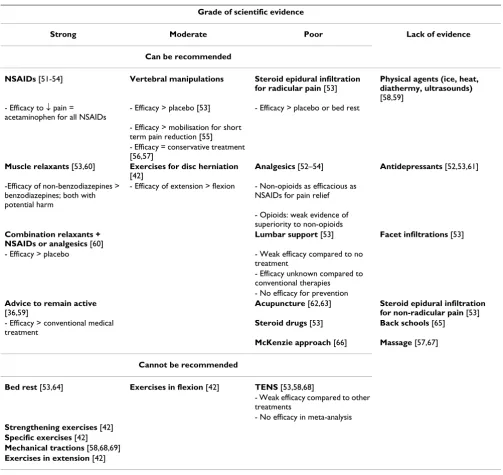
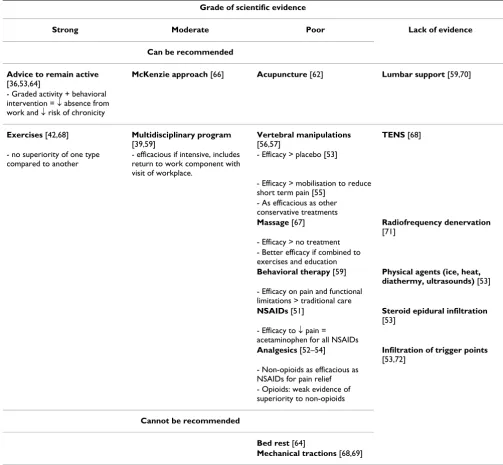
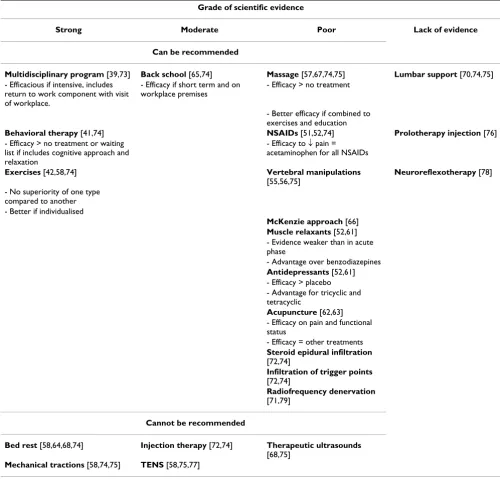
[image:6.612.54.557.242.717.2]Numerous therapeutic interventions have been proposed for the treatment of low back pain. In recent years consid-erable research has been devoted to the rigorous evalua-tion of the most common therapeutic intervenevalua-tions. The syntheses of these Cochrane type studies or the most up to date meta-analyses were compiled to create tables 2, 3 and 4 classifying therapeutic modalities according to their level of scientific evidence in the stages of low back pain. Strength of evidence is based on the following criteria[7]:
Table 2: Therapeutic interventions for acute low-back pain (0–4 weeks)
Grade of scientific evidence
Strong Moderate Poor Lack of evidence
Can be recommended
NSAIDs [51-54] Vertebral manipulations Steroid epidural infiltration for radicular pain [53]
Physical agents (ice, heat, diathermy, ultrasounds)
[58,59] - Efficacy to ↓ pain =
acetaminophen for all NSAIDs
- Efficacy > placebo [53] - Efficacy > placebo or bed rest
- Efficacy > mobilisation for short term pain reduction [55]
- Efficacy = conservative treatment [56,57]
Muscle relaxants [53,60] Exercises for disc herniation
[42]
Analgesics [52–54] Antidepressants [52,53,61]
-Efficacy of non-benzodiazepines > benzodiazepines; both with potential harm
- Efficacy of extension > flexion - Non-opioids as efficacious as NSAIDs for pain relief
- Opioids: weak evidence of superiority to non-opioids
Combination relaxants + NSAIDs or analgesics [60]
Lumbar support [53] Facet infiltrations [53]
- Efficacy > placebo - Weak efficacy compared to no
treatment
- Efficacy unknown compared to conventional therapies
- No efficacy for prevention
Advice to remain active
[36,59]
Acupuncture [62,63] Steroid epidural infiltration for non-radicular pain [53] - Efficacy > conventional medical
treatment
Steroid drugs [53] Back schools [65]
McKenzie approach [66] Massage [57,67]
Cannot be recommended
Bed rest [53,64] Exercises in flexion [42] TENS [53,58,68]
- Weak efficacy compared to other treatments
- No efficacy in meta-analysis
Strengthening exercises [42]
Specific exercises [42]
Mechanical tractions [58,68,69]
Exercises in extension [42]
• Strong: consistent findings in several high quality stud-ies;
• Moderate: consistent findings in lesser quality studies, particularly with small numbers of subjects;
• Poor: Based on the results of only one study or inconsist-ent findings in several studies
• Lack of evidence: Based on studies with no comparison group, on theoretical considerations or on expert consen-sus.
Interpretation
[image:7.612.52.555.101.566.2]Each of the modalities is qualified as "recommendable", "not recommendable" or "unknown efficacy". Because the design of the tables requires some interpretation of the
Table 3: Therapeutic interventions for subacute low-back pain (4–12 weeks)
Grade of scientific evidence
Strong Moderate Poor Lack of evidence
Can be recommended
Advice to remain active
[36,53,64]
McKenzie approach [66] Acupuncture [62] Lumbar support [59,70]
- Graded activity + behavioral intervention = ↓ absence from work and ↓ risk of chronicity
Exercises [42,68] Multidisciplinary program
[39,59]
Vertebral manipulations
[56,57]
TENS [68]
- no superiority of one type compared to another
- efficacious if intensive, includes return to work component with visit of workplace.
- Efficacy > placebo [53]
- Efficacy > mobilisation to reduce short term pain [55]
- As efficacious as other conservative treatments
Massage [67] Radiofrequency denervation
[71] - Efficacy > no treatment
- Better efficacy if combined to exercises and education
Behavioral therapy [59] Physical agents (ice, heat, diathermy, ultrasounds) [53] - Efficacy on pain and functional
limitations > traditional care
NSAIDs [51] Steroid epidural infiltration
[53] - Efficacy to ↓ pain =
acetaminophen for all NSAIDs
Analgesics [52–54] Infiltration of trigger points
[53,72] - Non-opioids as efficacious as
NSAIDs for pain relief - Opioids: weak evidence of superiority to non-opioids
Cannot be recommended
Bed rest [64]
Mechanical tractions [68,69]
source documents, it is necessary to refer directly to them to understand the meaning and impact of these recom-mendations. Clinical application methods can vary con-siderably among the studies and the meaning of the conclusions can differ according to clinical context.
In addition, there are many treatments for which no stud-ies exist and no recommendation can be made. Further studies are necessary before it is possible to rate their
effi-cacy. The lack of scientific evidence does not in itself dis-credit a treatment
2.4 When individual or environmental barriers to the return to usual activities are identified after the acute phase of low back pain, the clinician should reorient treatment towards minimizing those barriers
[image:8.612.54.554.101.580.2]As mentioned in Principle 1.3, the possibility of returning to usual activities diminishes significantly with the approach of persistent low back pain. In addition, the risk
Table 4: Therapeutic interventions for persistent low-back pain (12 weeks +)
Grade of scientific evidence
Strong Moderate Poor Lack of evidence
Can be recommended
Multidisciplinary program [39,73] Back school [65,74] Massage [57,67,74,75] Lumbar support [70,74,75] - Efficacious if intensive, includes
return to work component with visit of workplace.
- Efficacy if short term and on workplace premises
- Efficacy > no treatment
- Better efficacy if combined to exercises and education
Behavioral therapy [41,74] NSAIDs [51,52,74] Prolotherapy injection [76]
- Efficacy > no treatment or waiting list if includes cognitive approach and relaxation
- Efficacy to ↓ pain = acetaminophen for all NSAIDs
Exercises [42,58,74] Vertebral manipulations
[55,56,75]
Neuroreflexotherapy [78]
- No superiority of one type compared to another - Better if individualised
McKenzie approach [66]
Muscle relaxants [52,61] - Evidence weaker than in acute phase
- Advantage over benzodiazepines
Antidepressants [52,61] - Efficacy > placebo - Advantage for tricyclic and tetracyclic
Acupuncture [62,63] - Efficacy on pain and functional status
- Efficacy = other treatments
Steroid epidural infiltration
[72,74]
Infiltration of trigger points
[72,74]
Radiofrequency denervation
[71,79]
Cannot be recommended
Bed rest [58,64,68,74] Injection therapy [72,74] Therapeutic ultrasounds
[68,75]
Mechanical tractions [58,74,75] TENS [58,75,77]
of persisting symptoms is greater. Evidence related to the treatment of sub-acute and persistent low back pain is concerned primarily with communication and the multi-dimensional nature of the barriers preventing the return to usual activities[38]. With regards to communication, the primary clinical concerns rests on the sharing of com-mon information acom-mong the caregivers involved in treat-ment[6]. Regarding the multidimensional nature of barriers present in the patient with low back pain, a review emphasized the importance of acting on both the individ-ual (physical and psychological) and environmental (social and work-related) levels[39].
When the patient does not return to all or some activity after 12 weeks of back pain, the possibility of returning to usual activities decreases significantly and the risk of per-sisting symptoms increases[6]. The literature indicates that the barriers to returning to activity for the persistent low back pain sufferer are not only physical but are also and foremost biopsychosocial, including the patient's environment[2]. The clinician should identify the limit-ing barriers and attempt, with the patient, to understand why and how these barriers interact in limiting return to usual activities[38].
Interpretation
Care should be oriented towards the identification and management of individual and environmental barriers preventing the return to usual activities (see Principle 1.4) and on decreasing symptom-based treatment. This change can be done by encouraging patient participation in his management of low back pain and by involving the stake-holders who can contribute to diminishing the barri-ers[38].
Once persistent disability is present, the multiplicity and entrenchment of individual and environmental barriers results in a handicap that keeps the individual from returning to usual activities. A review identified most of the barriers that limit the return to usual activities, includ-ing work, in the presence of persistent low back pain[40]. They reiterate most of the barriers discussed in Principle 1.4 but in the context of persistent back pain. Only those barriers that could potentially be modified by the clini-cian should be addressed (age, for example, cannot be modified). The clinician should systematically identify these barriers in order to understand their impact on the patient's handicap and to account for them in the treat-ment plan[40]. A treattreat-ment can act directly or indirectly on barriers to returning to usual activities. For example, behavioural therapy or generic exercises can both have an impact on patient fears and beliefs, the former directly[41] and the latter indirectly[42]. Hence, the clini-cian's objective is to choose the interventions that will best act to change the barriers identified.
Although standardized tools to assess the extent of barri-ers to return to usual activities are proposed, precise inter-ventions to manage these barriers are not available in the literature. It is not known if these barriers are modifiable by a clinician, or how they should be managed. Also, it is not known if managing these barriers can actually prevent persistent disability. This reflects the current relative lack of knowledge in the literature in this area needing further research[43].
When the clinician feels that help is needed to facilitate the return to usual activities for a patient suffering from persistent low back pain, he can refer the patient to spe-cialized resources available in his area. The primary care clinician remains a resource for the patient throughout the rehabilitation process and during subsequent low back pain episodes.
3 Clinical algorithm
Figures 1 to 3 show the model's algorithm through differ-ent stages of LBP: acute (less than 4 weeks), subacute (4 to 12 weeks) or persistent (more than 12 weeks). Figure 2 shows the section of the algorithm for subacute LBP, where are situated three central elements aimed at the pre-vention of persistent disability. The first is the evaluation of the prognosis at the fourth week of disability, and of key modifiable barriers to return to usual activities if the prognosis is unfavourable. The second is the evaluation of the patient's perceived disability every four weeks, with the evaluation of barriers to return to usual activities if perceived disability has not sufficiently improved.
Discussion
This process had the objective of developing a primary care interdisciplinary model aimed at preventing persist-ent disability related to LBP. The CLIP model was designed for family physicians, physiotherapists and occupational therapists, irrespective of their specific expertise. It's goal was to promote the use of similar tools and common language in the management of LBP from a bio-psycho-social perspective. The model promoted com-mon therapeutic goals in terms of returning the patients to their usual activities, periodic evaluation of perceived disability and re-orientation of care when limited results are achieved. The shift of focus from specific therapeutic interventions to process of care has two important impli-cations for clinical practice: 1) evaluate the patient's per-ceived disability with a validated instrument; 2) identify barriers to return to activity and to orient the patient's management accordingly. The CLIP model can be used in interdisciplinary training sessions, with several types of health professionals present at the same time.
exchanges among researchers and health professionals. The interpretation of the evidence on the efficacy of ther-apeutic interventions provided in the summary tables was consistent with previously published guidelines[5,23]. However, this efficacy is evaluated for each individual treatment, which does not reflect everyday clinical prac-tice combining different types of interventions pursuing different objectives. Future trials assessing the efficacy of representative clinician practices are needed. This model emphasises the assessment and management of barriers related to return to activity, because of their strong and consistent predictive relationship to persistent disability. However, the effectiveness and efficiency of this model to prevent persistent disability in patients suffering from LBP are not known and should be assessed. Research in ways to effectively address barriers to return to activity is needed.
This model does not take into account the time, resources and costs needed to use it. Resistance in use should be expected, since this model requires a shift from a patho-physiological to a biopsychosocial model of disease man-agement. Difficulties in using such evidence have been
previously demonstrated [44-49]. In order to evaluate the model's feasibility, it should be piloted among end users working in various in various clinical, organizational and geographical settings, and among patients with varying level of disability. Taking into account the identified bar-riers and facilitators in use, adapted versions of the model should be elaborated[50]. The process used for the devel-opment of the model remains in place and will be used for further interdisciplinary exchanges and integration of new evidence. It is planned that the model will be updated in the end of 2008. It is hoped that shared use of this model by primary care health professionals will prevent persist-ent disability and its consequences in persons suffering from LBP.
Conclusion
A model for the clinical management of low-back pain and prevention of persistent disability was developed. The following five elements were elaborated for the evaluation of LBP: 1) In order to detect serious problems requiring immediate or specialized treatment, the clinical examina-tion should triage patients according to the three types of low back pain: non-specific, with neurological involve-Clinical algorithm for acute low-back pain
Figure 1
Clinical algorithm for acute low-back pain.
Non-specific LBP
Evaluation and classification
Return to usual activities
Pursuit / adaptation of clinical management
Management favouring interventions with demonstrated effectiveness towards:
x Pain control
x Return to usual activities Star t of
stage
LBP associated with serious pathology LBP with neurological involvement
Medico-surgical management No
Yes History of persistent LBP
disability?
Go to subacute stage
Medico-surgical management
required? No
ment, with serious pathology (red flags); 2) Radiographic, MRI or CT scan examinations are rarely indicated for patients with non-specific back pain; 3) The clinician should assess the patient's perceived disability and the probability of a return to usual activities, either in the fourth week if back pain related disability persists, or at the first consultation if the patient has a history of long lasting disability due to back pain; 4) When the probabil-ity of returning to usual activities is deemed to be low, the clinician should seek to identify the barriers preventing the return to usual activities; 5) If the patient's perceived disability improves little or not at all in the 4 weeks fol-lowing assessment of this perception, the clinician should reassess the barriers preventing the return to usual activi-ties and revise management. The following four elements were elaborated for the management of LBP: 1) Reassure the patient with back pain by providing essential, coher-ent, accessible and valid information about his condition
and correcting beliefs; 2) The clinician should encourage and guide the patient to continue or to resume usual activ-ities; 3) The clinician should give priority to treatments of proven efficacy; 4) When individual or environmental barriers to the return to usual activities are identified after the acute phase of low back pain, the clinician should reo-rient treatment towards minimizing those barriers.
Competing interests
The authors declares that they have no competing inter-ests.
Authors' contributions
All authors participated in conception and design of the study, acquisition of data, interpretation of data, and revi-sion of the manuscript. All authors read and approved the final manuscript. SP and MR additionally analyzed the data and drafted the manuscript.
Clinical algorithm for subacute low-back pain Figure 2
Clinical algorithm for subacute low-back pain. Evaluation of
perceived disability
Evaluation of prognosis: favourable?
At ar ound the 4th week of disability
Management favouring interventions with
demonstrated effectiveness towards
return to usual activities
Evaluation of key barriers to return to usual activities
x Clinical: pain intensity, perceived disability, radiating symptoms below the knee
x Psychosocial: kinesiophobia, catastrophizing, patient expectations to return to usual activities
x Work-related: absence from any type of work
Return to usual activities
Sufficient improvement in perceived disability
in 4 weeks?* Pursuit / adaptation of clinical management
Yes
No No
Yes
Management favouring interventions to:
x Reduce barriers
x Promote return to usual activities
Star t of stage
Acknowledgements
Development of this model was funded by a grant from the Institut de Recherche Robert-Sauvé en Santé et en Sécurité du Travail du Québec (IRSST), from which the research team was independent. The authors would like to thank the members of the scientific committee: Diane Ber-thelette, Ron Donelson, Marie-José Durand, Debbie Feldman, Jaime Guz-man, Patrick Loisel, Ian Shrier, and the members of the clinical synthesis team: Claude Bélisle, André Boutet, Norma-Christine Cassane, Jean-Pierre Dumas, Marcel Giguère, Elyse Marois, Michel Nadon, Vincent Piette, Claude Tremblay. We are grateful to François-Pierre Dusseault and Michel Girard for their guidance and support. Finally we wish to thank all clinicians who participated generously to this project.
References
1. Pengel LH, Herbert RD, Maher CG, Refshauge KM: Acute low back pain: systematic review of its prognosis. BMJ 2003, 327:323. 2. Waddell G, Burton AK, Main CJ: Screening to Identify People at Risk of
Long-term Incapacity for Work London, Royal Society of Medicine Press Ltd; 2003:80.
3. Borkan J, Van TM, Reis S, Schoene ML, Croft P, Hermoni D:
Advances in the field of low back pain in primary care: a report from the fourth international forum 1. Spine 2002,
27:E128-E132.
4. Karjalainen K, Malmivaara A, van Tulder M, Roine R, Jauhiainen M, Hurri H, Koes B: Multidisciplinary biopsychosocial
rehabilita-tion for subacute low back pain among working age adults.
Cochrane Database of Systematic Reviews 2003:CD002193.
5. van Tulder MW, Tuut M, Pennick V, Bombardier C, Assendelft WJ:
Quality of primary care guidelines for acute low back pain.
Spine 2004, 29:E357-E362.
6. Breen AC, van Tulder MW, Koes BW, Jensen I, Reardon R, Bronfort G: Mono-disciplinary or multidisciplinary back pain guide-lines? How can we achieve a common message in primary care? European Spine Journal 2006, 15:641-647.
7. Royal College of General Practitioners (RCGP): Clinical guidelines for the management of acute low back pain. London; 2001.
8. Oxman AD: Systematic Reviews: Checklists for review arti-cles. BMJ 1994, 309:648-651.
9. Koes BW, van Tulder MW, Ostelo R, Kim Burton A, Waddell G:
Clinical guidelines for the management of low back pain in primary care: an international comparison. Spine 2001,
26:2504-13.
10. Weiser S, Rossignol M: Triage for nonspecific lower-back pain.
Clinical Orthopaedics & Related Research 2006, 443:147-155. 11. Loisel P, Vachon B, Lemaire J, Durand MJ, Poitras S, Stock S, Tremblay
M: Discriminative and predictive validity assessment of the Quebec task force classification 2. Spine 2002, 27:851-857. 12. van der Weide WE, Verbeek JHAM, Salle HJA, van Dijk FJH:
Prog-nostic factors for chronic disability from acute low-back pain in occupational health care. Scandinavian Journal of Work, Environ-ment & Health 1999, 25:50-56.
Clinical algorithm for persistent low-back pain Figure 3
Clinical algorithm for persistent low-back pain. Complete evaluation
of barriers to return to usual activities
Return to usual activities
Sufficient improvement in perceived disability
in 4 weeks?*
No Yes
x Management favouring interventions to reduce all barriers x If necessary: management of
persistent pain
Star t of stage
Return to usual activities?
No Yes
Reevaluation Pursuit / adaptation of clinical management
Use of specialized r esour ces if necessar y
13. van Tulder MW, Assendelft WJ, Koes BW, Bouter LM: Spinal radi-ographic findings and nonspecific low back pain. A system-atic review of observational studies. Spine 1997, 22:427-434. 14. Jarvik JG, Deyo RA: Diagnostic evaluation of low back pain with
emphasis on imaging. Annals of Internal Medicine 2002,
137:586-597.
15. Breslau J, Seidenwurm D: Socioeconomic aspects of spinal imag-ing: impact of radiological diagnosis on lumbar spine-related disability. Topics in Magnetic Resonance Imaging 2000, 11:218-223. 16. Frank JW, Brooker AS, DeMaio SE, Kerr MS, Maetzel A, Shannon HS,
Sullivan TJ, Norman RW, Wells RP: Disability resulting from occupational low back pain. Part II: What do we know about secondary prevention? A review of the scientific evidence on prevention after disability begins. Spine 1996, 21:2918-29. 17. Shaw WS, Pransky G, Fitzgerald TE: Early prognosis for low back
disability: intervention strategies for health care providers.
Disability & Rehabilitation 2001, 23:815-828.
18. Dionne CE: Psychological distress confirmed as predictor of long-term back-related functional limitations in primary care settings. Journal of Clinical Epidemiology 2005, 58:714-718. 19. Dionne CE, Bourbonnais R, Fremont P, Rossignol M, Stock SR,
Larocque I: A clinical return-to-work rule for patients with back pain. Canadian Medical Association Journal 2005,
172:1559-1567.
20. Kopec JA, Esdaile JM, Abrahamowicz M, Abenhaim L, Wood-Dau-phinee S, Lamping DL, Williams JI: The Quebec Back Pain Disa-bility Scale. Measurement properties. Spine 1995, 20:341-352. 21. Roland M, Morris R: A study of the natural history of back pain: Part 1: Development of a reliable and sensitive measure of disability in low back-pain. Spine 1983, 8:141-144.
22. Fairbank JC, Couper J, Davies JB, O'Brien JP: The Oswestry low back pain disability questionnaire. Physiotherapy 1980,
66:271-273.
23. Staal JB, Hlobil H, van Tulder MW, Waddell G, Burton AK, Koes BW, van Mechelen W: Occupational health guidelines for the man-agement of low back pain: an international comparison.
Occupational & Environmental Medicine 2003, 60:618-26.
24. Sullivan MJL, Ward LC, Tripp D, French DJ, Adams H, Stanish WD:
Secondary prevention of work disability: Community-based psychosocial intervention for musculoskeletal disorders.
Journal of Occupational Rehabilitation 2005, 15:377-392.
25. Kori SH, Miller RP, Todd DD: Kinesiophobia: A new view of chronic pain behavior. Pain Management 1990, 3:35-43. 26. Waddell G, Newton M, Henderson I, Somerville D, Main CJ: A
Fear-Avoidance Beliefs Questionnaire (FABQ) and the role of fear-avoidance beliefs in chronic low back pain and disability.
Pain 1993, 52:157-168.
27. Sullivan MJL, Bishop SR, Pivik J: The Pain Catastrophizing Scale: Development and validation. Psychological Assessment 1995,
7:524-532.
28. Davidson M, Keating JL: A comparison of five low back disability questionnaires: reliability and responsiveness. Physical Therapy
2002, 82:8-24.
29. Burton AK, Waddell G, Tillotson KM, Summerton N: Information and advice to patients with back pain can have a positive effect. A randomized controlled trial of a novel educational booklet in primary care. Spine 1999, 24:2484-2491.
30. Little P, Roberts L, Blowers H, Garwood J, Cantrell T, Langridge J, Chapman J: Should we give detailed advice and information booklets to patients with back pain? A randomized control-led factorial trial of a self-management booklet and doctor advice to take exercise for back pain. Spine 2001, 26:2065-2072. 31. Abenhaim L, Rossignol M, Gobeille D, Bonvalot Y, Fines P, Scott S:
The prognostic consequences in the making of the initial medical diagnosis of work-related back injuries. Spine 1995,
20:791-795.
32. Butler L, Foster NE: Back pain online: A cross-sectional survey of the quality of Web-based information on low back pain.
Spine 2003, 28:395-401.
33. Li L, Irvin E, Guzman J, Bombardier C: Surfing for back pain patients: the nature and quality of back pain information on the Internet. Spine 2001, 26:545-557.
34. Burton AK: The Back Book Norwich, TSO; 2002.
35. Hagen KB, Hilde G, Jamtvedt G, Winnem MF: The cochrane review of advice to stay active as a single treatment for low back pain and sciatica. Spine 2002, 27:1736-1741.
36. Hilde G, Hagen KB, Jamtvedt G, Winnem M: Advice to stay active as a single treatment for low back pain and sciatica. Cochrane Database of Systematic Reviews 2005:CD003632.
37. Stock S, Baril R, Dion-Hubert C, Lapointe C, Paquette S, Sauvage J, Simoneau S, Vaillancourt C: Work-related Musculoskeletal Dis-orders. Guide and Tools for Modified Work. 2005 [http:// www.irsst.qc.ca/files/documents/PubIRSST/OMRT-En.pdf]. Montréal 38. Pransky G, Shaw W, Franche RL, Clarke A: Disability prevention
and communication among workers, physicians, employers, and insurers--current models and opportunities for improve-ment. Disability & Rehabilitation 2004, 26:625-634.
39. Karjalainen K, Malmivaara A, van Tulder M, Roine R, Jauhiainen M, Hurri H, Koes B: Multidisciplinary biopsychosocial rehabilita-tion for subacute low back pain among working age adults.
Cochrane Database of Systematic Reviews 2005:CD002193.
40. Durand MJ, Loisel P, Hong QN, Charpentier N: Helping clinicians in work disability prevention: The work disability diagnosis interview 7. Journal of Occupational Rehabilitation Vol 12(3)()(pp 191-204), 2002 2002:191-204.
41. Ostelo RW, van Tulder MW, Vlaeyen JW, Linton SJ, Morley SJ, Assen-delft WJ: Behavioural treatment for chronic low-back pain.
Cochrane Database of Systematic Reviews 2005:CD002014.
42. Hayden JA, van Tulder MV, Malmivaara A, Koes BW: Exercise ther-apy for treatment of non-specific low back pain. Cochrane Database of Systematic Reviews 2005:UB2.
43. Sullivan MJL, Feuerstein M, Gatchel R, Linton SJ, Pransky G: Integrat-ing psychosocial and behavioral interventions to achieve optimal rehabilitation outcomes. Journal of Occupational Rehabil-itation 2005, 15:475-489.
44. Bekkering GE, van Tulder MW, Hendriks EJ, Koopmanschap MA, Knol DL, Bouter LM, Oostendorp RA: Implementation of clinical guidelines on physical therapy for patients with low back pain: randomized trial comparing patient outcomes after a standard and active implementation strategy. Physical Therapy
2005, 85:544-555.
45. Gonzalez-Urzelai V, Palacio-Elua L, Lopez-de-Munain J: Routine pri-mary care management of acute low back pain: adherence to clinical guidelines. European Spine Journal 2003, 12:589-594. 46. Bishop PB, Wing PC: Compliance with clinical practice
guide-lines in family physicians managing worker's compensation board patients with acute lower back pain. Spine Journal: Official Journal of the North American Spine Society 2003, 3:442-450. 47. Espeland A, Baerheim A: Factors affecting general practitioners'
decisions about plain radiography for back pain: implications for classification of guideline barriers--a qualitative study.
BMC Health Services Research 2003, 3:8.
48. Overmeer T, Linton SJ, Holmquist L, Eriksson M, Engfeldt P: Do evi-dence-based guidelines have an impact in primary care? A cross-sectional study of Swedish physicians and physiothera-pists. Spine 2005, 30:146-151.
49. Schers H, Wensing M, Huijsmans Z, van Tulder M, Grol R: Imple-mentation barriers for general practice guidelines on low back pain a qualitative study. Spine 2001, 26:348-53.
50. Graham ID, Logan J, Harrison MB, Straus SE, Tetroe J, Caswell W, Robinson N: Lost in knowledge translation: time for a map?
Journal of Continuing Education in the Health Professions 2006, 26:13-24. 51. van Tulder MW, Scholten RJ, Koes BW, Deyo RA: Non-steroidal anti-inflammatory drugs for low back pain. Cochrane Database of Systematic Reviews 2005:CD000396.
52. Bogduk N: Pharmacological alternatives for the alleviation of back pain. Expert Opinion on Pharmacotherapy 2004, 5:2091-2098. 53. van Tulder MW, Waddell G: Conservative treatment of acute
and subacute low back pain. In Neck and back pain: the scientific evidence of causes, diagnosis and treatment Edited by: Nachemson A and JE. Philadelphia, Lippincott Williams & Wilkins; 2000:241-269. 54. Jackson KC: Pharmacotherapy in lower back pain. Drugs of
Today 2004, 40:765-772.
55. Bronfort G, Haas M, Evans RL, Bouter LM: Efficacy of spinal manipulation and mobilization for low back pain and neck pain: A systematic review and best evidence synthesis. Spine Journal: Official Journal of the North American Spine Society 2004,
4:335-356.
Publish with BioMed Central and every scientist can read your work free of charge "BioMed Central will be the most significant development for disseminating the results of biomedical researc h in our lifetime."
Sir Paul Nurse, Cancer Research UK
Your research papers will be:
available free of charge to the entire biomedical community
peer reviewed and published immediately upon acceptance
cited in PubMed and archived on PubMed Central
yours — you keep the copyright
Submit your manuscript here:
http://www.biomedcentral.com/info/publishing_adv.asp
BioMedcentral 57. Cherkin DC, Sherman KJ, Deyo RA, Shekelle PG: A review of the
evidence for the effectiveness, safety, and cost of acupunc-ture, massage therapy, and spinal manipulation for back pain. Annals of Internal Medicine 2003, 138:898-906.
58. Nadler SF: Nonpharmacologic management of pain. Journal of the American Osteopathic Association 2004, 104:S6-12.
59. van Tulder M, Koes B: Low back pain (acute). Clinical Evidence
2004:1643-1658.
60. van Tulder MW, Touray T, Furlan AD, Solway S, Bouter LM: Muscle relaxants for non-specific low back pain. Cochrane Database of Systematic Reviews 2005:CD004252.
61. Schnitzer TJ, Ferraro A, Hunsche E, Kong SX: A comprehensive review of clinical trials on the efficacy and safety of drugs for the treatment of low back pain. Journal of Pain & Symptom Man-agement 2004, 28:72-95.
62. Furlan AD, van Tulder MW, Cherkin DC, Tsukayama H, Lao L, Koes BW, Berman BM: Acupuncture and dry-needling for low back pain. Cochrane Database of Systematic Reviews 2005:CD001351. 63. Manheimer E, White A, Berman B, Forys K, Ernst E: Meta-analysis:
Acupuncture for low back pain. Annals of Internal Medicine 2005,
142:651-663.
64. Heymans MW, van Tulder MW, Esmail R, Bombardier C, Koes BW:
Back schools for non-specific low-back pain. Cochrane Database of Systematic Reviews 2005:CD000261.
65. Clare HA, Adams R, Maher CG: A systematic review of efficacy of McKenzie therapy for spinal pain. Australian Journal of Physio-therapy 2004, 50:209-216.
66. Furlan AD, Brosseau L, Welch V, Wong J: Massage for low back pain. Cochrane Database of Systematic Reviews 2005:CD001929. 67. Hagen KB, Hilde G, Jamtvedt G, Winnem M: Bed rest for acute low
back pain and sciatica. Cochrane Database of Systematic Reviews
2005:CD001254.
68. Philadelphia P: Philadelphia Panel evidence-based clinical prac-tice guidelines on selected rehabilitation interventions for low back pain. Physical Therapy 2001, 81:1641-74.
69. Harte AA, Baxter GD, Gracey JH: The efficacy of traction for back pain: a systematic review of randomized controlled tri-als. Archives of Physical Medicine & Rehabilitation 2003, 84:1542-53. 70. Jellema P, van Tulder MW, van Poppel MNM, Nachemson AL, Bouter
LM: Lumbar supports for prevention and treatment of low back pain: A systematic review within the framework of the cochrane back review group. Spine 2001, 26:377-386. 71. Niemisto L, Kalso E, Malmivaara A, Seitsalo S, Hurri H:
Radiofre-quency denervation for neck and back pain. A systematic review of randomized controlled trials. Cochrane Database of Systematic Reviews 2003:CD004058.
72. Nelemans PJ, DeBie RA, DeVet HCW, Sturmans F: Injection ther-apy for subacute and chronic benign low back pain. Spine
2001, 26:501-515.
73. Guzman J, Esmail R, Karjalainen K, Malmivaara A, Irvin E, Bombardier C: Multidisciplinary bio-psycho-social rehabilitation for chronic low back pain. Cochrane Database of Systematic Reviews
2002:CD000963.
74. van Tulder M, Koes B: Low back pain (chronic). Clinical Evidence
2004:1659-1684.
75. Maher CG: Effective physical treatment for chronic low back pain. Orthopedic Clinics of North America 2004, 35:57-64.
76. Yelland MJ, Mar C, Pirozzo S, Schoene ML, Vercoe P: Prolotherapy injections for chronic low-back pain. Cochrane Database of Sys-tematic Reviews 2004:CD004059.
77. Urrutia G, Burton K, Morral A, Bonfill X, Zanoli G: Neuroreflexo-therapy for nonspecific low back pain: a systematic review.
Spine 2005, 30:E148-E153.
78. Slipman CW, Bhat AL, Gilchrist RV, Issac Z, Chou L, Lenrow DA: A critical review of the evidence for the use of zygapophysial injections and radiofrequency denervation in the treatment of low back pain. Spine Journal: Official Journal of the North American Spine Society 2003, 3:310-316.
79. Khadilkar A, Milne S, Brosseau L, Robinson V, Saginur M, Shea B, Tug-well P, Wells G: Transcutaneous electrical nerve stimulation (TENS) for chronic low-back pain. Cochrane Database of System-atic Reviews 2005:CD003008.
Pre-publication history
The pre-publication history for this paper can be accessed here: