Desorption Ionization–Time of Flight Analysis for Simultaneous
Detection of 21 Common Respiratory Viruses
Chi Zhang,aYan Xiao,a,bJiang Du,aLili Ren,a,bJianwei Wang,a,bJunping Peng,aQi Jina
MOH Key Laboratory of Systems Biology of Pathogensa
and Christophe Mérieux Laboratory,b
Institute of Pathogen Biology, Chinese Academy of Medical Sciences & Peking Union Medical College, Beijing, People’s Republic of China
Respiratory infections continue to pose a significant threat to human health. It is important to accurately and rapidly detect
re-spiratory viruses. To compensate for the limits of current rere-spiratory virus detection methods, we developed a 24-plex analysis
(common respiratory virus-mass spectrometry [CRV-MS]) that can simultaneously detect and identify 21 common respiratory
viruses based on a matrix-assisted laser desorption ionization–time of flight (MALDI-TOF) mass spectrometry system. To
evalu-ate the efficacy of the CRV-MS method, we used 102 samples that were confirmed positive for these common respiratory viruses.
All tests using the CRV-MS method were effective, with no cross-reactivity observed with other common respiratory viruses. To
confirm the usefulness of the CRV-MS method, we screened 336 nasal and throat swabs that were collected from adults or
chil-dren with suspected viral acute respiratory tract infections using the CRV-MS method and consensus PCR/reverse
transcription-PCR (RT-transcription-PCR) methods. Excluding four RNase P-negative samples, the CRV-MS and consensus transcription-PCR/RT-transcription-PCR methods detected
respiratory viruses in 92.5% (307/332) and 89.5% (297/332) of the samples, respectively. The two methods yielded identical
re-sults for 306 (92.2%) samples, including negative rere-sults for 25 samples (7.5%) and positive rere-sults for 281 samples (84.6%).
Dif-ferences between the two methods may reflect their different sensitivities. The CRV-MS method proved to be sensitive and
ro-bust, and it can be used in large-scale epidemiological studies of common respiratory virus infections.
R
espiratory infections continue to pose a threat to public
health. A World Health Organization (WHO) report
indi-cated that lower respiratory infections (LRIs) remain among the
top five causes of death worldwide, killing 3.1 million people in
2012. In low-income countries, LRIs are the number one cause
of death (
http://www.who.int/mediacentre/factsheets/fs310/en/
index.html
). Many pathogens, especially respiratory viruses, are
associated with respiratory infections. Different pathogens may
cause similar clinical presentations, whereas their treatment
dif-fers greatly. Thus, it is important to accurately and rapidly detect
respiratory pathogens.
For different respiratory viruses, the mean time to detection of
conventional cell culture varies from 3 to 8 days. Because many
respiratory viruses exhibit high mutation rates, traditional
meth-ods do not to provide complete and reliable etiological
informa-tion. Pavia (
1
) indicated that better diagnostic tests can reduce
antibiotic use and control nosocomial transmission. At present,
molecular methods have been widely used to detect respiratory
viruses. With respect to traditional methods, molecular methods
have great sensitivity and a short turnaround time, and they can
simultaneously detect multiple pathogens (
2
). This progress has
enabled us to better understand the phenomenon of pathogen
coinfection. For example, based on a number of different
plat-forms, many multiplex methods have been applied in the
detec-tion of respiratory viruses, and they were shown to be sensitive and
specific (
3–9
). However, there are still some disadvantages, such as
limited detection range, high cost, complicated operation, and
be-ing labor-intensive. In this study, which is based on the
MassARRAY matrix-assisted laser desorption ionization–time of
flight (MALDI-TOF) mass spectrometry system (Sequenom, Inc.,
San Diego, CA, USA), we developed a common respiratory virus
panel test (CRV-MS) that can simultaneously detect and identify
21 common respiratory virus types/subtypes, including several
influenza A viruses (Flu-A H1N1, H1N1pdm09, and H3N2),
in-fluenza B viruses (Flu-B), parainin-fluenza virus types 1 to 4 (PIV1 to
-4), adenovirus (AdV), four human coronaviruses (HCoV)
(HCoV-OC43, 229E, NL63, and HKU1), respiratory syncytial
vi-ruses A and B (RSV-A and RSV-B, respectively), human
metap-neumoviruses A and B (HMPV-A and HMPV-B, respectively),
human bocavirus 1 and 2 (HBoV1 and HBoV2, respectively),
hu-man rhinovirus (HRV), and huhu-man enterovirus (HEV). The
MassARRAY MALDI-TOF MS system has successfully been used
to detect multiple pathogens (
10–16
). Here, we also compare the
performances of the CRV-MS and consensus PCR/reverse
tran-scription-PCR (RT-PCR) methods.
Received8 April 2015Returned for modification4 May 2015
Accepted26 May 2015
Accepted manuscript posted online27 May 2015
CitationZhang C, Xiao Y, Du J, Ren L, Wang J, Peng J, Jin Q. 2015. Application of multiplex PCR coupled with matrix-assisted laser desorption ionization–time of flight analysis for simultaneous detection of 21 common respiratory viruses. J Clin Microbiol 53:2549 –2554.doi:10.1128/JCM.00943-15.
Editor:A. J. McAdam
Address correspondence to Junping Peng, [email protected], or Qi Jin, [email protected].
J.W., J.P., and Q.J. contributed equally to this work and are co-senior authors of the paper.
Supplemental material for this article may be found athttp://dx.doi.org/10.1128 /JCM.00943-15.
Copyright © 2015, American Society for Microbiology. All Rights Reserved.
doi:10.1128/JCM.00943-15
on May 16, 2020 by guest
http://jcm.asm.org/
MATERIALS AND METHODS
Clinical samples.This study was approved by the institutional review board of the Institute of Pathogen Biology, China. All nasal and throat swabs were obtained from our institute collections. These samples were collected from adults or children with suspected viral acute respiratory tract infections between January 2013 and November 2013. Nasal and throat swabs that were collected from the same patient were combined in one tube containing 3 ml of viral transport medium and stored at⫺80°C (17). Informed consent was obtained from all patients or from the parents of all of the children who provided specimens.
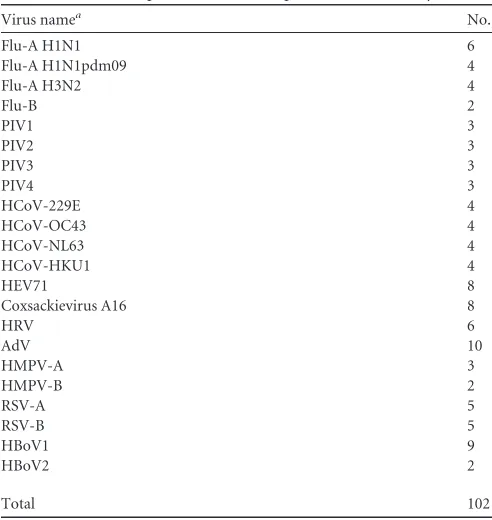
In an exploratory test, the target genes of each respiratory virus were amplified from confirmed clinical samples by RT-PCR/PCR and cloned into the pGEM-T Easy vector (Promega, Madison, WI, USA), as described in previous reports (3,17). To evaluate the specificity of the CRV-MS method, we used plasmids (500 copies per reaction) containing specific inserts of each target respiratory virus. To evaluate the sensitivity of the CRV-MS method, we used a standard 10-fold dilution series (1 to 10,000 plasmid copies/reaction) of these plasmids. Each plasmid concentration was tested in triplicate. Sterile water was used as a negative control. In this study, we also used 102 clinical samples, which were confirmed positive for 21 common respiratory viruses, to test the specificity of the CRV-MS method (Table 1). In a validation test, 336 nasal and throat swabs were used.
Total DNA and RNA were extracted from 200l of viral transport medium, according to a previous report (17). The Invitrogen One-Step RT-PCR kit (Invitrogen, Carlsbad, CA, USA) was used in the RT-PCR experiments.
The CRV-MS method.Representative respiratory virus strains used in the CRV-MS method design are shown in Table S1 in the supplemental material. The nucleotide sequences of these representative respiratory vi-rus strains were downloaded from the GenBank database. The CRV-MS method was designed using MassARRAY assay design 4.0 software, ac-cording to the user’s guide (Sequenom, Inc., San Diego, CA, USA). All
primers and probes (see Table S2 in the supplemental material) were analyzed using BLASTn searches against the nonredundant nucleotide database of the National Center for Biotechnology Information.
The experimental procedures of the CRV-MS method are described briefly in Table S3 in the supplemental material. Primary PCR amplifica-tions and iPLEX reacamplifica-tions were performed in 384-well plates using an S1000 thermal cycler (Bio-Rad, Hercules, CA, USA), according to a pre-vious report (12).
Consensus PCR/RT-PCR assays.All target respiratory viruses were screened using consensus PCR/RT-PCR assays, according to previous re-ports (3,4,18–23). PCR was performed using the FastStart high-fidelity PCR system (Roche Molecular Systems, Inc., Pleasanton, CA, USA). RT-PCR was performed using the One-Step RT-RT-PCR kit (Invitrogen). Ampli-fied DNA was puriAmpli-fied using a QIAquick gel extraction kit, according to the manufacturer’s protocol (Qiagen, Valencia, CA, USA) and sequenced on an ABI3730 automated sequencer (Applied Biosciences, Foster City, CA, USA).
Statistical analysis.Differences between the detection rates of the two methods were tested using the McNemar’s test. APvalue of⬍0.01 was considered statistically significant.
RESULTS
The CRV-MS method.
In this study, we developed a 24-plex
anal-ysis that targets 21 common respiratory viruses, using

-globin
and RNase P as DNA and RNA extraction quality controls,
respec-tively. The results of the BLASTn search showed that the CRV-MS
method can detect 21 common respiratory viruses. For Flu-A
vi-rus, our new method can detect Flu-A H1N1, Flu-A H1N1pdm09,
and Flu-A H3N2. To expand the detection spectrum, we also
de-signed an assay that targets the Flu-A MP gene in the CRV-MS
method, thereby enabling the detection of nearly all Flu-A viruses.
For example, if the avian Flu-A H7N9 virus, which cannot be
detected using the CRV-MS method, is present in a tested sample,
we will obtain a Flu-A MP-positive result. Thus, we can confirm
the results using the other method.
Performance of the CRV-MS method.
We tested the
specific-ity of the CRV-MS method using virus-specific plasmids. The
re-sults showed that the CRV-MS method can accurately identify 21
common respiratory viruses, and no positive results were
ob-tained for the negative controls. The sensitivity test indicated that
the detection limit of the CRV-MS method is approximately 10 to
100 DNA copies (data not shown).
We also evaluated the CRV-MS method using 102 samples that
were confirmed positive for common respiratory viruses (
Table
1
). The results showed that all tested primers and probes worked
well (see Fig. S1 to S5 in the supplemental material). For any tested
respiratory virus, there was no cross-reactivity with other
respira-tory viruses.
Comparison with the consensus PCR/RT-PCR method.
A
to-tal of 336 nasal and throat swabs were analyzed using the CRV-MS
method, and the results were compared to those from the
consen-sus PCR/RT-PCR analysis (
Table 2
). Four samples that were
RNase P negative were excluded from further analysis.
[image:2.585.40.286.75.335.2]The CRV-MS and consensus PCR/RT-PCR methods detected
respiratory viruses in 92.5% (307/332) and 89.5% (297/332) of the
samples, respectively. The respiratory virus detection rate differed
significantly between the two methods (
P
⫽
0.002 by McNemar’s
test). All 297 positive samples detected by the consensus
PCR/RT-PCR method were also detected by the CRV-MS method.
Twenty-five samples tested negative by both methods. All of the 21
com-mon respiratory viruses were detected. Multiple respiratory
viruses were identified in 23.2% (77/332) and 20.8% (69/332) of
TABLE 1Confirmed positive clinical samples used in this studyVirus namea No.
Flu-A H1N1 6
Flu-A H1N1pdm09 4
Flu-A H3N2 4
Flu-B 2
PIV1 3
PIV2 3
PIV3 3
PIV4 3
HCoV-229E 4
HCoV-OC43 4
HCoV-NL63 4
HCoV-HKU1 4
HEV71 8
Coxsackievirus A16 8
HRV 6
AdV 10
HMPV-A 3
HMPV-B 2
RSV-A 5
RSV-B 5
HBoV1 9
HBoV2 2
Total 102
a
Flu-A, influenza virus A; Flu-B, influenza virus B; PIV, parainfluenza virus; HCoV, human coronavirus; HEV, human enterovirus; HRV, human rhinovirus; AdV, adenovirus; HMPV, human metapneumovirus; RSV, respiratory syncytial virus; HBoV, human bocavirus.
on May 16, 2020 by guest
http://jcm.asm.org/
the samples by the CRV-MS and consensus PCR/RT-PCR
meth-ods, respectively. The multiple-respiratory virus detection rate did
not differ significantly between the two methods (
P
⫽
0.04 by
McNemar’s test).
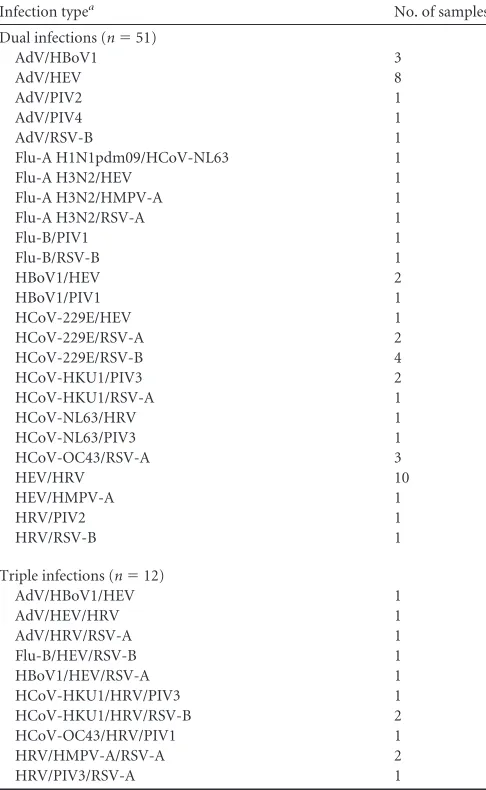
The two methods yielded identical positive results for 281
sam-ples (84.6%), including 218 single-infection and 63
multiple-in-fection samples (
Table 3
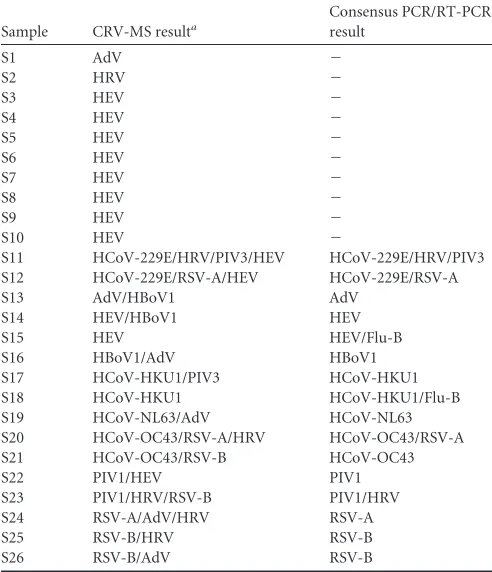
). Ten discordant samples tested positive
by the CRV-MS method and negative by the consensus
PCR/RT-PCR method. The CRV-MS method identified eight of these
sam-ples as HEV and the other two as HRV and AdV. The results for 16
other discordant samples are shown in
Table 4
. The difference
between the two methods may reflect their different sensitivities.
DISCUSSION
Thanks to the advances in multiplex PCR/RT-PCR technology,
many good methods have been developed to detect respiratory
viruses. The application of these methods demonstrated that
mul-tiplex PCR/RT-PCR is more sensitive and efficient in detecting a
broad spectrum of respiratory viruses (
2
). For example, Lam et al.
(
24
) developed five groups of multiplex nested-PCR assays that
can detect 18 respiratory viruses and three kinds of bacteria.
Bel-lau-Pujol et al. (
18
) designed three multiplex RT-PCR assays that
can detect 12 respiratory viruses. These methods depend on
aga-rose gel electrophoresis to differentiate amplification products
corresponding to different pathogens. If multiple respiratory
vi-ruses are present in one sample, the sensitivity of these methods
will be decreased.
The multiplex real-time PCR/RT-PCR assay is a good
alterna-tive to the conventional PCR/RT-PCR assay, as it can increase the
specificity and sensitivity of respiratory virus detection (
25–27
).
However, the ability of multiplex real-time PCR/RT-PCR to
iden-tify multiple respiratory viruses in one reaction is limited to the
number of fluorescent dyes that can be used. Based on liquid chip
technology, several commercial methods for multiple respiratory
virus detection have been developed, including xTAG (Luminex),
MultiCode-PLx (EraGen Biosciences), and ResPlex II panel
ver-sion 2.0 (Qiagen). Balada-Llasat et al. (
28
) performed an
evalua-tion study that showed that these methods work better than
tra-ditional methods. Some other multiplex methods have also been
developed (
5
,
6
,
29
,
30
).
Several novel common respiratory viruses have been identified
over the past 15 years, including HCoV-NL63, HCoV-HKU1, and
HBoV, which have been associated with respiratory infections (
22
,
31
,
32
). We need to update our routine detection method to deal
with newly discovered respiratory viruses. In this study, we
devel-TABLE 2Comparison of the results of CRV-MS and consensus PCR/RT-PCRa
IDb
CRV-MS
Consensus PCR/RT-PCR
No. of positive
samples %
No. of positive
samples %
AdV 54 16.3 49 14.8
Flu-A H1N1 8 2.4 8 2.4
Flu-A H1N1pdm09 8 2.4 8 2.4
Flu-A H3N2 13 3.9 13 3.9
Flu-B 6 1.8 8 2.4
HBoV1 33 9.9 31 9.3
HBoV2 2 0.6 2 0. 6
HCoV-229E 11 3.3 11 3.3
HCoV-NL63 9 2.7 9 2.7
HCoV-HKU1 9 2.7 9 2.7
HCoV-OC43 11 3.3 11 3.3
HEV 121 36.4 110 33.1
HMPV-A 7 2.1 7 0.2.1
HMPV-B 1 0.3 1 0.3
HRV 37 11.1 33 9.9
PIV1 13 3.9 13 3.9
PIV2 8 2.4 8 2.4
PIV3 15 4.5 14 4.2
PIV4 3 0.9 3 0. 9
RSV-A 17 5.1 17 5.1
RSV-B 16 4.8 14 4.2
aThe total number of samples was 332. b
[image:3.585.299.542.79.474.2]AdV, adenovirus; Flu-A, influenza virus A; Flu-B, influenza virus B; HBoV, human bocavirus; HCoV, human coronavirus; HEV, human enterovirus; HMPV, human metapneumovirus; HRV, human rhinovirus; PIV, parainfluenza virus; RSV, respiratory syncytial virus.
TABLE 3Concordant multiple infections detected by two methods
Infection typea No. of samples
Dual infections (n⫽51)
AdV/HBoV1 3
AdV/HEV 8
AdV/PIV2 1
AdV/PIV4 1
AdV/RSV-B 1
Flu-A H1N1pdm09/HCoV-NL63 1
Flu-A H3N2/HEV 1
Flu-A H3N2/HMPV-A 1
Flu-A H3N2/RSV-A 1
Flu-B/PIV1 1
Flu-B/RSV-B 1
HBoV1/HEV 2
HBoV1/PIV1 1
HCoV-229E/HEV 1
HCoV-229E/RSV-A 2
HCoV-229E/RSV-B 4
HCoV-HKU1/PIV3 2
HCoV-HKU1/RSV-A 1
HCoV-NL63/HRV 1
HCoV-NL63/PIV3 1
HCoV-OC43/RSV-A 3
HEV/HRV 10
HEV/HMPV-A 1
HRV/PIV2 1
HRV/RSV-B 1
Triple infections (n⫽12)
AdV/HBoV1/HEV 1
AdV/HEV/HRV 1
AdV/HRV/RSV-A 1
Flu-B/HEV/RSV-B 1
HBoV1/HEV/RSV-A 1
HCoV-HKU1/HRV/PIV3 1
HCoV-HKU1/HRV/RSV-B 2
HCoV-OC43/HRV/PIV1 1
HRV/HMPV-A/RSV-A 2
HRV/PIV3/RSV-A 1
a
AdV, adenovirus; Flu-A, influenza virus A; Flu-B, influenza virus B; HBoV, human bocavirus; HCoV, human coronavirus; HEV, human enterovirus; HMPV, human metapneumovirus; HRV, human rhinovirus; PIV, parainfluenza virus; RSV, respiratory syncytial virus.
on May 16, 2020 by guest
http://jcm.asm.org/
[image:3.585.39.286.88.352.2]oped a 24-plex assay that can detect and identify 21 common
respiratory viruses simultaneously in one reaction, which can help
us to delineate the clinical role played by these respiratory viruses.
Therefore, the CRV-MS method can be a useful alternative for
those samples that are suspected to contain multiple respiratory
viruses.
Respiratory virus coinfections have been frequently detected in
clinical samples (
33–41
). Pretorius et al. (
8
) found that 17% of
8,173 patients with a severe acute respiratory illness in South
Af-rica had respiratory virus coinfections. Several studies indicated
that respiratory virus coinfections were associated with increased
disease severity, such as HMPV-RSV (
39
,
40
), RSV-HCoV (
42
),
RSV-influenza virus, RSV-HRV, and PIV-HRV (
43
). Two studies
indicated that coinfection with avian and human viral strains is a
potential source for influenza virus reassortment (
41
,
44
). Kouni
and colleagues (
43
) also indicated that respiratory virus
coinfec-tions may increase the risk of hospitalization. In this study, we
found that 19.0% of patients had respiratory coinfections,
includ-ing HEV-HRV and RSV-HCoV coinfections.
Several important respiratory viruses have been identified in
recent years, including severe acute respiratory syndrome
corona-virus, Middle East respiratory syndrome coronacorona-virus, avian Flu-A
H5N1, H7N9, H10N8, etc. However, these viruses are not
com-mon in humans (
45–49
). We will develop specific methods that
can be used to complement the CRV-MS method designed in this
study to target these viruses in the future.
Compared to other multiplex methods, the CRV-MS method
demonstrates high throughput. Following nucleic acid extraction
and RT-PCR for RNA respiratory viruses, one technologist in a
clinical laboratory can use the CRV-MS method to analyze two
384-format plates, which are sufficient for 760 clinical specimens,
within one working day. Moreover, the results can be
automati-cally determined by the software. However, the turnaround time
of CRV-MS method is longer than FilmArray and ResPlex II. The
CRV-MS method does not employ fluorescent dyes, which will
help to improve repeatability and stability. Because of the high
degree of multiplexing, the cost for analyzing all 21 common
re-spiratory viruses using the CRV-MS method is
⬍
$4, excluding the
cost of nucleic acid extraction and RT-PCR for RNA viruses. Thus,
the CRV-MS method can be used in large-scale epidemiological
studies of common respiratory virus infections, and it can provide
more comprehensive information for disease control and vaccine
research.
ACKNOWLEDGMENTS
This work was supported by grants from the Ministry of Science and Technology of the People’s Republic of China (grant 2014ZX10004-001), the National Health and Family Planning Commission of the People’s Republic of China (grant 201402001), the Program for Changjiang Schol-ars and Innovative Research Team in University (grant IRT13007), the Institute of Pathogen Biology, CAMS&PUMC (grant 2013IPB102), the PUMC Youth Fund, and the Fundamental Research Funds for the Central Universities (grant 3332013118).
We declare no conflicts of interest.
We thank Junhua Guo for technical assistance.
REFERENCES
1.Pavia AT.2011. Viral infections of the lower respiratory tract: old viruses, new viruses, and the role of diagnosis. Clin Infect Dis52(Suppl 4):S284 – S289.
2.Caliendo AM.2011. Multiplex PCR and emerging technologies for the detection of respiratory pathogens. Clin Infect Dis52(Suppl 4):S326 – S330.
3.Coiras MT, Aguilar JC, García ML, Casas I, Pérez-Breña P. 2004. Simultaneous detection of fourteen respiratory viruses in clinical speci-mens by two multiplex reverse transcription nested-PCR assays. J Med Virol72:484 – 495.http://dx.doi.org/10.1002/jmv.20008.
4.Coiras MT, Pérez-Breña P, García ML, Casas I. 2003. Simultaneous detection of influenza A, B, and C viruses, respiratory syncytial virus, and adenoviruses in clinical samples by multiplex reverse transcription nested-PCR assay. J Med Virol69:132–144.http://dx.doi.org/10.1002/jmv .10255.
5.Kodani M, Yang G, Conklin LM, Travis TC, Whitney CG, Anderson LJ, Schrag SJ, Taylor TH, Jr, Beall BW, Breiman RF, Feikin DR, Njenga MK, Mayer LW, Oberste MS, Tondella ML, Winchell JM, Lindstrom SL, Erdman DD, Fields BS.2011. Application of TaqMan low-density arrays for simultaneous detection of multiple respiratory pathogens. J Clin Microbiol49:2175–2182.http://dx.doi.org/10.1128/JCM.02270-10. 6.Lin B, Blaney KM, Malanoski AP, Ligler AG, Schnur JM, Metzgar D,
Russell KL, Stenger DA.2007. Using a resequencing microarray as a multiple respiratory pathogen detection assay. J Clin Microbiol45:443– 452.http://dx.doi.org/10.1128/JCM.01870-06.
7.Mahony J, Chong S, Merante F, Yaghoubian S, Sinha T, Lisle C, Janeczko R.2007. Development of a respiratory virus panel test for de-tection of twenty human respiratory viruses by use of multiplex PCR and a fluid microbead-based assay. J Clin Microbiol45:2965–2970.http://dx .doi.org/10.1128/JCM.02436-06.
8.Pretorius MA, Madhi SA, Cohen C, Naidoo D, Groome M, Moyes J, Buys A, Walaza S, Dawood H, Chhagan M, Haffjee S, Kahn K, Puren A, Venter M.2012. Respiratory viral coinfections identified by a 10-plex real-time reverse-transcription polymerase chain reaction assay in pa-tients hospitalized with severe acute respiratory illness–South Africa, 2009 –2010. J Infect Dis206Suppl 1:S159 –S65.
[image:4.585.40.286.79.365.2]9.Roth SB, Jalava J, Ruuskanen O, Ruohola A, Nikkari S.2004. Use of an oligonucleotide array for laboratory diagnosis of bacteria responsible for TABLE 4Discordant results of two methods
Sample CRV-MS resulta
Consensus PCR/RT-PCR result
S1 AdV ⫺
S2 HRV ⫺
S3 HEV ⫺
S4 HEV ⫺
S5 HEV ⫺
S6 HEV ⫺
S7 HEV ⫺
S8 HEV ⫺
S9 HEV ⫺
S10 HEV ⫺
S11 HCoV-229E/HRV/PIV3/HEV HCoV-229E/HRV/PIV3 S12 HCoV-229E/RSV-A/HEV HCoV-229E/RSV-A
S13 AdV/HBoV1 AdV
S14 HEV/HBoV1 HEV
S15 HEV HEV/Flu-B
S16 HBoV1/AdV HBoV1
S17 HCoV-HKU1/PIV3 HCoV-HKU1
S18 HCoV-HKU1 HCoV-HKU1/Flu-B
S19 HCoV-NL63/AdV HCoV-NL63
S20 HCoV-OC43/RSV-A/HRV HCoV-OC43/RSV-A
S21 HCoV-OC43/RSV-B HCoV-OC43
S22 PIV1/HEV PIV1
S23 PIV1/HRV/RSV-B PIV1/HRV
S24 RSV-A/AdV/HRV RSV-A
S25 RSV-B/HRV RSV-B
S26 RSV-B/AdV RSV-B
aAdV, adenovirus; Flu-B, influenza virus B; HBoV, human bocavirus; HCoV, human
coronavirus; HEV, human enterovirus; HRV, human rhinovirus; PIV, parainfluenza virus; RSV, respiratory syncytial virus.
on May 16, 2020 by guest
http://jcm.asm.org/
acute upper respiratory infections. J Clin Microbiol42:4268 – 4274.http: //dx.doi.org/10.1128/JCM.42.9.4268-4274.2004.
10. Li K, Guo J, Zhao R, Xue Y, Chen L, Yang J, Peng J, Jin Q.2013. The prevalence of 10 human polyomaviruses in fecal samples from children with acute gastroenteritis: a case-control study. J Clin Microbiol51:3107– 3109.http://dx.doi.org/10.1128/JCM.01324-13.
11. Li K, Zhang C, Zhao R, Xue Y, Yang J, Peng J, Jin Q.2015. The prevalence of STL polyomavirus in stool samples from Chinese children. J Clin Virol66:19 –23.http://dx.doi.org/10.1016/j.jcv.2015.02.017. 12. Peng J, Gao L, Guo J, Wang T, Wang L, Yao Q, Zhu H, Jin Q.2013.
Type-specific detection of 30 oncogenic human papillomaviruses by genotyping both E6 and L1 genes. J Clin Microbiol51:402– 408. 13. Peng J, Wang T, Zhu H, Guo J, Li K, Yao Q, Lv Y, Zhang J, He C, Chen
J, Wang L, Jin Q.2014. Multiplex PCR/mass spectrometry screening of biological carcinogenic agents in human mammary tumors. J Clin Virol 61:255–259.http://dx.doi.org/10.1016/j.jcv.2014.07.010.
14. Peng J, Yang F, Xiong Z, Guo J, Du J, Hu Y, Jin Q.2013. Sensitive and rapid detection of viruses associated with hand foot and mouth disease using multiplexed MALDI-TOF analysis. J Clin Virol56:170 –174.http: //dx.doi.org/10.1016/j.jcv.2012.10.020.
15. Söderlund-Strand A, Dillner J, Carlson J.2008. High-throughput geno-typing of oncogenic human papilloma viruses with MALDI-TOF mass spectrometry. Clin Chem54:86 –92.
16. Yang H, Yang K, Khafagi A, Tang Y, Carey TE, Opipari AW, Lieberman R, Oeth PA, Lancaster W, Klinger HP, Kaseb AO, Metwally A, Khaled H, Kurnit DM.2005. Sensitive detection of human papillomavirus in cervical, head/neck, and schistosomiasis-associated bladder malignancies. Proc Natl Acad Sci U S A102:7683–7688.http://dx.doi.org/10.1073/pnas .0406904102.
17. Li J, Wang Z, Gonzalez R, Xiao Y, Zhou H, Zhang J, Paranhos-Baccala G, Vernet G, Jin Q, Wang J, Hung T. 2012. Prevalence of human metapneumovirus in adults with acute respiratory tract infection in Bei-jing, China. J Infect64:96 –103.http://dx.doi.org/10.1016/j.jinf.2011.10 .011.
18. Bellau-Pujol S, Vabret A, Legrand L, Dina J, Gouarin S, Petitjean-Lecherbonnier J, Pozzetto B, Ginevra C, Freymuth F.2005. Develop-ment of three multiplex RT-PCR assays for the detection of 12 respiratory RNA viruses. J Virol Methods 126:53– 63. http://dx.doi.org/10.1016/j .jviromet.2005.01.020.
19. Echavarria M, Forman M, Ticehurst J, Dumler JS, Charache P.1998. PCR method for detection of adenovirus in urine of healthy and human immunodeficiency virus-infected individuals. J Clin Microbiol36:3323– 3326.
20. Kapoor A, Simmonds P, Slikas E, Li L, Bodhidatta L, Sethabutr O, Triki H, Bahri O, Oderinde BS, Baba MM, Bukbuk DN, Besser J, Bartkus J, Delwart E.2010. Human bocaviruses are highly diverse, dispersed, re-combination prone, and prevalent in enteric infections. J Infect Dis201: 1633–1643.http://dx.doi.org/10.1086/652416.
21. Vabret A, Dina J, Gouarin S, Petitjean J, Corbet S, Freymuth F.2006. Detection of the new human coronavirus HKU1: a report of 6 cases. Clin Infect Dis42:634 – 639.http://dx.doi.org/10.1086/500136.
22. van der Hoek L, Pyrc K, Jebbink MF, Vermeulen-Oost W, Berkhout RJ, Wolthers KC, Wertheim-van Dillen PM, Kaandorp J, Spaargaren J, Berkhout B.2004. Identification of a new human coronavirus. Nat Med 10:368 –373.http://dx.doi.org/10.1038/nm1024.
23. Viazov S, Ratjen F, Scheidhauer R, Fiedler M, Roggendorf M.2003. High prevalence of human metapneumovirus infection in young children and genetic heterogeneity of the viral isolates. J Clin Microbiol41:3043– 3045.http://dx.doi.org/10.1128/JCM.41.7.3043-3045.2003.
24. Lam WY, Yeung AC, Tang JW, Ip M, Chan EW, Hui M, Chan PK.2007. Rapid multiplex nested PCR for detection of respiratory viruses. J Clin Microbiol45:3631–3640.http://dx.doi.org/10.1128/JCM.00280-07. 25. Osterback R, Tevaluoto T, Ylinen T, Peltola V, Susi P, Hyypia T, Waris
M.2013. Simultaneous detection and differentiation of human rhino- and enteroviruses in clinical specimens by real-time PCR with locked nucleic acid probes. J Clin Microbiol51:3960 –3967.http://dx.doi.org/10.1128 /JCM.01646-13.
26. Templeton KE, Scheltinga SA, Beersma MF, Kroes AC, Claas EC.2004. Rapid and sensitive method using multiplex real-time PCR for diagnosis of infections by influenza A and influenza B viruses, respiratory syncytial virus, and parainfluenza viruses 1, 2, 3, and 4. J Clin Microbiol42:1564 – 1569.http://dx.doi.org/10.1128/JCM.42.4.1564-1569.2004.
27. Vijgen L, Keyaerts E, Moes E, Maes P, Duson G, Van Ranst M.2005.
Development of one-step, real-time, quantitative reverse transcriptase PCR assays for absolute quantitation of human coronaviruses OC43 and 229E. J Clin Microbiol43:5452–5456.http://dx.doi.org/10.1128/JCM.43 .11.5452-5456.2005.
28. Balada-Llasat JM, LaRue H, Kelly C, Rigali L, Pancholi P.2011. Eval-uation of commercial ResPlex II v2.0, MultiCode-PLx, and xTAG respi-ratory viral panels for the diagnosis of respirespi-ratory viral infections in adults. J Clin Virol50:42– 45.http://dx.doi.org/10.1016/j.jcv.2010.09.022. 29. Liu J, Gratz J, Amour C, Kibiki G, Becker S, Janaki L, Verweij JJ,
Taniuchi M, Sobuz SU, Haque R, Haverstick DM, Houpt ER.2013. A laboratory-developed TaqMan array card for simultaneous detection of 19 enteropathogens. J Clin Microbiol51:472– 480.http://dx.doi.org/10 .1128/JCM.02658-12.
30. Renois F, Talmud D, Huguenin A, Moutte L, Strady C, Cousson J, Leveque N, Andreoletti L.2010. Rapid detection of respiratory tract viral infections and coinfections in patients with influenza-like illnesses by use of reverse transcription-PCR DNA microarray systems. J Clin Microbiol 48:3836 –3842.http://dx.doi.org/10.1128/JCM.00733-10.
31. Allander T, Tammi MT, Eriksson M, Bjerkner A, Tiveljung-Lindell A, Andersson B.2005. Cloning of a human parvovirus by molecular screen-ing of respiratory tract samples. Proc Natl Acad Sci U S A102:12891– 12896.http://dx.doi.org/10.1073/pnas.0504666102.
32. Woo PC, Lau SK, Chu CM, Chan KH, Tsoi HW, Huang Y, Wong BH, Poon RW, Cai JJ, Luk WK, Poon LL, Wong SS, Guan Y, Peiris JS, Yuen KY.2005. Characterization and complete genome sequence of a novel coronavirus, coronavirus HKU1, from patients with pneumonia. J Virol 79:884 – 895.http://dx.doi.org/10.1128/JVI.79.2.884-895.2005. 33. Arruda E, Jones MH, Escremim de Paula F, Chong D, Bugarin G,
Notario G, Matsuno AK, Pitrez PM, Vo P, Suzuki C, Rosario Filho N, Stein RT.2014. The burden of single virus and viral coinfections on severe lower respiratory tract infections among preterm infants: a prospective birth cohort study in Brazil. Pediatr Infect Dis J33:997–1003.http://dx.doi .org/10.1097/INF.0000000000000349.
34. Bonzel L, Tenenbaum T, Schroten H, Schildgen O, Schweitzer-Krantz S, Adams O.2008. Frequent detection of viral coinfection in children hospitalized with acute respiratory tract infection using a real-time poly-merase chain reaction. Pediatr Infect Dis J27:589 –594.http://dx.doi.org /10.1097/INF.0b013e3181694fb9.
35. Brunstein JD, Cline CL, McKinney S, Thomas E.2008. Evidence from multiplex molecular assays for complex multipathogen interactions in acute respiratory infections. J Clin Microbiol46:97–102.http://dx.doi.org /10.1128/JCM.01117-07.
36. Debiaggi M, Canducci F, Ceresola ER, Clementi M.2012. The role of infections and coinfections with newly identified and emerging respira-tory viruses in children. Virol J9:247.http://dx.doi.org/10.1186/1743 -422X-9-247.
37. Echenique IA, Chan PA, Chapin KC, Andrea SB, Fava JL, Mermel LA. 2013. Clinical characteristics and outcomes in hospitalized patients with respiratory viral co-infection during the 2009 H1N1 influenza pandemic. PLoS One8:e60845.http://dx.doi.org/10.1371/journal.pone.0060845. 38. Espinola EE, Basualdo W, Guillen RM, Pavlicich V, Maldonado L,
Aquino C, Paranhos-Baccala G, Russomando G.2013. High incidence of viral co-infections and atypical bacterial detection in acute respiratory infections among hospitalized children in the Central Department of Par-aguay, 2010 –2011. J Infect66:196 –198.http://dx.doi.org/10.1016/j.jinf .2012.10.014.
39. Greensill J, McNamara PS, Dove W, Flanagan B, Smyth RL, Hart CA. 2003. Human metapneumovirus in severe respiratory syncytial virus bronchiolitis. Emerg Infect Dis 9:372–375. http://dx.doi.org/10.3201 /eid0903.020289.
40. Semple MG, Cowell A, Dove W, Greensill J, McNamara PS, Halfhide C, Shears P, Smyth RL, Hart CA.2005. Dual infection of infants by human metapneumovirus and human respiratory syncytial virus is strongly asso-ciated with severe bronchiolitis. J Infect Dis191:382–386.http://dx.doi .org/10.1086/426457.
41. Zhu Y, Qi X, Cui L, Zhou M, Wang H.2013. Human co-infection with novel avian influenza A H7N9 and influenza A H3N2 viruses in Jiangsu province, China. Lancet 381:2134. http://dx.doi.org/10.1016/S0140 -6736(13)61135-6.
42. Kuypers J, Martin ET, Heugel J, Wright N, Morrow R, Englund JA. 2007. Clinical disease in children associated with newly described corona-virus subtypes. Pediatrics 119:e70 – 6. http://dx.doi.org/10.1542/peds .2006-1406.
on May 16, 2020 by guest
http://jcm.asm.org/
43. Kouni S, Karakitsos P, Chranioti A, Theodoridou M, Chrousos G, Michos A.2013. Evaluation of viral co-infections in hospitalized and non-hospitalized children with respiratory infections using microarrays. Clin Microbiol Infect19:772–777.http://dx.doi.org/10.1111/1469-0691 .12015.
44. Li J, Kou Y, Yu X, Sun Y, Zhou Y, Pu X, Jin T, Pan J, Gao GF.2014. Human co-infection with avian and seasonal influenza viruses, China. Emerg Infect Dis 20:1953–1955. http://dx.doi.org/10.3201/eid2011 .140897.
45. Chen H, Yuan H, Gao R, Zhang J, Wang D, Xiong Y, Fan G, Yang F, Li X, Zhou J, Zou S, Yang L, Chen T, Dong L, Bo H, Zhao X, Zhang Y, Lan Y, Bai T, Dong J, Li Q, Wang S, Li H, Gong T, Shi Y, Ni X, Li J, Fan J, Wu J, Zhou X, Hu M, Wan J, Yang W, Li D, Wu G, Feng Z, Gao GF, Wang Y, Jin Q, Liu M, Shu Y.2014. Clinical and epidemiological characteristics of a fatal case of avian influenza A H10N8 virus infection: a descriptive study. Lancet383:714 –721.http://dx.doi.org/10.1016/S0140 -6736(14)60111-2.
46. Gao R, Cao B, Hu Y, Feng Z, Wang D, Hu W, Chen J, Jie Z, Qiu H, Xu K, Xu X, Lu H, Zhu W, Gao Z, Xiang N, Shen Y, He Z, Gu Y, Zhang Z, Yang Y, Zhao X, Zhou L, Li X, Zou S, Zhang Y, Yang L, Guo J, Dong J, Li Q, Dong L, Zhu Y, Bai T, Wang S, Hao P, Yang W, Han J, Yu H,
Li D, Gao GF, Wu G, Wang Y, Yuan Z, Shu Y.2013. Human infection with a novel avian-origin influenza A (H7N9) virus. N Engl J Med368: 1888 –1897.http://dx.doi.org/10.1056/NEJMoa1304459.
47. Ksiazek TG, Erdman D, Goldsmith CS, Zaki SR, Peret T, Emery S, Tong S, Urbani C, Comer JA, Lim W, Rollin PE, Dowell SF, Ling AE, Humphrey CD, Shieh WJ, Guarner J, Paddock CD, Rota P, Fields B, DeRisi J, Yang JY, Cox N, Hughes JM, LeDuc JW, Bellini WJ, Anderson LJ, SARS Working Group.2003. A novel coronavirus associated with severe acute respiratory syndrome. N Engl J Med348:1953–1966.http: //dx.doi.org/10.1056/NEJMoa030781.
48. Li KS, Guan Y, Wang J, Smith GJ, Xu KM, Duan L, Rahardjo AP, Puthavathana P, Buranathai C, Nguyen TD, Estoepangestie AT, Chais-ingh A, Auewarakul P, Long HT, Hanh NT, Webby RJ, Poon LL, Chen H, Shortridge KF, Yuen KY, Webster RG, Peiris JS.2004. Genesis of a highly pathogenic and potentially pandemic H5N1 influenza virus in east-ern Asia. Nature430:209 –213.http://dx.doi.org/10.1038/nature02746. 49. Zaki AM, van Boheemen S, Bestebroer TM, Osterhaus AD, Fouchier
RA.2012. Isolation of a novel coronavirus from a man with pneumonia in Saudi Arabia. N Engl J Med367:1814 –1820.http://dx.doi.org/10.1056 /NEJMoa1211721.