The GSA Algorithm at Two Methods of Feature Selection
and Weighting Features to Improve the Recognition Rate
of Persian Handwrite Digits with Fuzzy Classifier
Najme Ghanbari
Department of Electrical Engineering, Faculty of Engineering, University of
Zabol, Zabol, Iran
B. Somayeh Mousavi
Department of Electrical Engineering, Hatef Higher Education Institue, Zahedan,
Iran
Mohammad Allahbakhsh
Department of Computer Engineering, Faculty of Engineering, University of
Zabol, Zabol, Iran
ABSTRACT
In this paper, using Gravitational search algorithm or GSA recognition rate of Persian handwritten digits can be improved. Two methods have been proposed to improve the recognition rate. in the first method, with using of version binary of Gravitational search algorithm or BGSA, we choose optimal features among the overall features extracted. Finding the best feature sets from entire extracted features, not only the number of features and computational burden will be reduced but also recognition rate will be significantly improved. Also In this paper, real version of GSA or RGSA has been used in different way (secondary methods) to improve recognition rate. In this method, instead of choosing some of the features, one random weight has been assigned to each feature. Indeed, feature vector has been multiplied in weight vector to obtain a new feature vector. This Weight vector is obtained with RGSA. After several iterations, RGSA algorithm determines Weight set of features so that Classification accuracy increases. In this paper, the fuzzy classifier is used for classification. Fitness function in BGSA and RGSA algorithms is the number of fuzzy classifier errors and the aim is to make this value minimum. The obtained results confirmed that these algorithms have proper performance.
Keywords
Increase the recognition rate, feature selection, binary Gravitational search algorithm (BGSA), Real Gravitational search algorithm (RGSA), Weight vector of features, fuzzy classifier and recognition of Persian handwritten digits.
1.
INTRODUCTION
Recognizing Persian handwritten digits is a field of pattern recognition and image processing that has been undergone extensive research and is still evolving. Digits recognition is currently used in different applications such as office automation, review and verification of banking cheque, types of banking businesses and banking tickets, financial reporting forms, statistical reporting forms, postal codes, reading mailing address, name, number of national, rial quantities that are written on bills and forms by hand, data importing applications, etc. Many activities have been done regarding handwritten digits recognition. In a research aimed for Persian Handwritten digits recognition, characteristics of places, Bays classification and Markov chain is used [4]. Another research has been done in final Persian Handwritten digits using fuzzy methods [1]. In an another research performed in algorithm, matching shapes and classifying the nearest distance from the representative or representatives of each class for Persian Handwritten digits recognition has been used [5]. In another method aimed of classification by neural networks and combining three features of characteristics of places, gradient
is improved and Krish has been used for recognizing digits [8]. In reference [6] of neural networks and combining two-class-ten classification has been used for Persian Handwritten digits recognition. Practically, using just one system of handwritten digits recognition is faced with some challenges; most importantly, high recognition rate is necessary. In the field of Persian language, because of high similarities of the digits and also the difference in how they map, creating a system with an acceptable accuracy for practical purposes is faced with some problems. Hence it is necessary to develop ways to improve their accuracy. One of the most efficient ways to improve accuracy in a handwritten digits recognition system is selecting optimal features among the entire set of extracted features.
By feature selection, it means selecting a small set of features that are collectively ideal to describe specific patterns. This will avoid extracting unnecessary features. Different features can usually be measured from the real world patterns. However, using the overall extracted features is not affordable in the end. Also, is the feature vector becomes very large; recognition system performance will be decreased. feature selection can have a significant effect on appropriate recognition rate of classification algorithm. The main aim of feature selection is to reduce feature vector dimension in classification in a way that a reasonable classification rate is achieved.
Finding a subset of features among a large set of feature is an issue that is faced with in many problems. It is not generally clear that what subset of features make the most distinction for regarded pattern classes, and on the other hand, it is not affordable to consider all the current subsets. Population based search methods are appropriate ones to reduce the number of features.
12 weight has been assigned to each feature in order to improve
recognition rate. In this method one random weight has been assigned to each feature so that multiplied by the weight vector of features in the feature vector, a new feature vector be achieved and by applying this new vector, the recognition rate and classification accuracy will increase.
Finding the Weight vector by mathematical and statistical computational methods is very difficult. This Weight vector is obtained with real version of GSA (RGSA).
In this paper, HODA database [9] is used which is a very large database of Persian handwritten digits. Also a fuzzy method is used to classification [1]. In the used fuzzy method, the features of database training samples are extracted and Gaussian membership functions are obtained for fuzzy model using them. The applied fuzzy model in this article is a Mamdani model with 10 rules. Each rule is assigned to just one number. In testing phase, this fuzzy model is used to classify the database experimental samples. Some of Population-based algorithms are Binary Gravitational Search Algorithm (BGSA), Binary Genetic Algorithm (BGA) and Binary Particle Swarm Optimization (BPSO). Among them, the BGSA is the newest one. In this paper, two methods were proposed in order to increase the recognition rate of Persian handwritten digits by the fuzzy classifier. One method is finding the optimal features from entire extracted features and other method is weighting to features. To perform two methods, Gravitational Search Algorithm is used. BGSA is used to solve the first method and RGSA, is used to find weight-optimized features in the second method.
The remained samples are used to evaluate the two algorithms.
The obtained results showed that high costs should be spent due to replicate the problem in GSA algorithm in the phase of selection features and finding optimal weights for features through the used methods. However, in the test phase (training and test data) higher recognition rate is achieved. In feature selection method, in addition higher recognition rate the cost is reduced due to reducing the problem dimensions.
2.
DATABASE
This recognition method is applied to Farsi hand-written digits in the HODA database [9], which is a standard database. Approximately 11942 binary images have been extracted out of 102353 digits of two types of registration forms filled in by students in undergraduate and graduate. These forms are scanned with a high-speed scanner with an accuracy of 200 pints per inch. These forms contain letter information including name, surname, father’s name and some digital information written in separate letters and digits in pre-determined spaces. Two large databases from digits and letters have been prepared out of these forms which digit database is used in this article. The overall digits in this database are 102352 digits in which 60000 digits are considered as training samples, 20000 digits as test samples and 22352 digits as remaining digits. Training samples have been used to train proposed classifier, testing samples to test Classifier and the remaining digits have been used in population-based algorithms.
3.
EXTRACTING FEATURES
To recognize Persian handwritten digits, some features such as zoning features, Geometric Moments, Zernike Moments, instant descriptors, Invariant Moments, histogram display, features of characteristics of places, Krish, border profile, gradient, gradient histogram, projection, etc[1-5]. The zoning
features are used for recognition in this article. Zoning features has low computational complexity and has often been used in recognizing Persian and Latin handwritten digits [7].
3.1
Image Normalization
By normalization, it means to convert input images of any size to an image with n*m pre-determined dimensions. In binary images of database digits, there are many zeros in four sides (i.e. white spots that are related to the field and contain no data). Initially, the tetragonal containing redundant information is removed and each digit is confined to one tetragonal. The digits are normalized to 32*32 in terms of size. For this reason, 32*32 images are divided into smaller blocks to reduce the number of features and the spots within each block are enumerated and are considered as feature. The block are selected 4*4, therefore the image have 64 blocks and 16 spots. The number of black spots in each 4*4 block is considered as recognition system features. Each digit consists of 64 features in this phase which the digits within these features can be changed from zero to 16.
4.
FUZZY MODEL
There are 10 rules in the fuzzy system introduced in reference [1] in which each rule is used to recognize each digit. An instance of such rule can be seen in reference [1]. The fuzzy set of Ai,j can be obtained from training samples [1]. The algebraic multiplication and minimum are used for “and” operator.
Multiplication algebraic operator results have been reported because the results were better. Two methods are proposed for improving the results obtained in fuzzy method, in which they explain.
5.
GRAVITATIONAL SEARCH
ALGORITHM
Gravitational search algorithm is presented by Mrs. Rashdi and colleagues in 2009 [10]. The binary version of this algorithm is also provided by the same authors in 1386 [3]. Here, a brief description about Gravitational search algorithm is given. For more details you can refer to the above references. in GSA optimization is done using the laws of gravity and motion, in an artificial system with discrete time. According to the law of gravity, each mass understands the location and status of other objects through the force of gravitational attraction. Therefore, this force can be used as a tool to exchange information. Designed Optimal detector can be used to solve the optimization problem in which each answer to the question if position in space can be defined and its similarities with other answers to the problem is expressed as a distance. The masses are determined according to objective function.
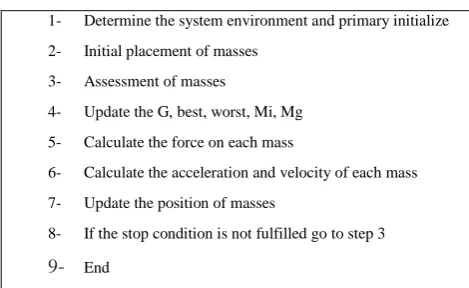
stage according to the corresponding relations that is in [10, 3]. Stop condition can be determined after the specified period. In figure 1 is given pseudo-code for this algorithm.
1- Determine the system environment and primary initialize
2- Initial placement of masses 3- Assessment of masses
4- Update the G, best, worst, Mi, Mg
5- Calculate the force on each mass
6- Calculate the acceleration and velocity of each mass
7- Update the position of masses
8- If the stop condition is not fulfilled go to step 3
9- End
Figure1:pseudo-code for used algorithm [10]
5.1
Selecting of Optimal Features for
Persian Handwritten Digits using the
Algorithm BGSA
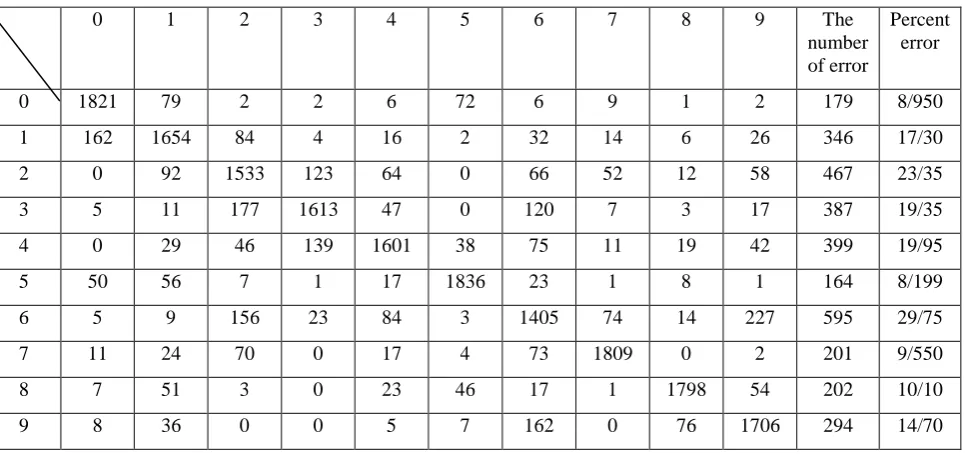
Each database digits of 64 features has been extracted from zoning method. The appropriate features are selected for classifying digits here using binary Gravitational search algorithm (BGSA) among this 64 features. The initial population of masses is randomly created. In the problem of feature selection with the BGSA, each mass can be an answer to the problem. Any answer or mass is defined as a string of zeros and ones. String length is equal to the total number of features (64). If each bit of string is one, it means using the feature related to the bit in digits classification and if each bit of string is zero, it means not using the feature related to the bit in digits classification. After creating the initial population of masses, the fitness value is calculated for each mass using the fitness function which is the number of errors here. At each stage, the best mass is selected as for the fitness values. The algorithm runs as the number of iteration. And finally, the good features are obtained by selecting the mass with the lowest fitness. Initial population in our algorithm is about 20 mass. With this method recognition rate is significantly improved. Also number of features dropped from 64 to 30. Results are shown in table (1). Table (2) shows the performance matrix of this way on the test samples.
5.2
Weighting to Features using RGSA
Another way that we offered for increasing the recognizing rate is, instead of using binary version of GSA and choosing some of features as optimum features, real version of this algorithm and weighting to features is used. In real rate of GSA, first group as a set of real masses. Every mass is as a string with 64 lengths. Every bite of this string has a real amount that these amounts a point the analogous weight with every feature. These amounts a point with fitness function that is the amount of phase classification errors here. After performing RGSA in amount of specific repetition, mass has the lowest fitness function is determined. This mass is the feature weight vector that multiplied in amount of feature vector and will produce a new feature vector. With this way, recognizing rate will improve much. Result is shown in table (1). Table (3) shows the effective matrix of this way in trial samples. Also figure (2) show the convergence of BGSA and RGSA algorithms from two above way for decreasing the phase classification error.6.
CONCLUSION
[image:3.595.48.283.104.248.2]The Zoning features are used in this article due to low computational complexities it has. This method can be tested with other features. In this paper, the two methods mentioned to increase the recognition rate of Persian handwritten digits. In two methods GSA was used. BGSA was used to select the optimal features and RGSA was used to find the optimal weights of features. Both methods significantly improve the recognition rate. These methods can also be implemented with other algorithms based on population. There is always a tradeoff between training and testing stages. That is, if high speed decision making and low computational costs is achieved in application stage, much more costs should be spent to appropriately select the patterns and features. The more additional costs are incurred for training, the more the costs will be compensated in practice stage. Most methods used until now for recognition of Persian handwriting digits were compared to each other in different articles are different in databases. Hence, their comparison is not very secure, because data quality has been different in different articles. Mr. Khosravi’s database is used in this article which is better compared to other databases in terms of both data volume and data diversity [9]. Furthermore, the results of recognition are without any preprocessing and post processing operations; hence the obtained recognition rate is a good one.
Table 1: Recognition rate in different scenarios
The number of error on train samples recognition rate on
train samples The number of
error on test samples recognition rate
on test samples Number of
features Recognition method
8276 86.21
3962 80.19
64 Fuzzy method with Total Number of
features
6003 90.01
3098 84.55
30 Feature selection using BGSA with The
initial population of 20 masses and 300 iteration
6330 89.39
3155 84.25
33 Feature selection using BGSA with The
initial population of 20 masses and 200 iteration
6715 88.51
3345 83.33
64 Weighting to features using RGSA with
The initial population of 20 masses and 250 iteration
6736 88.43
3361 83.18
64 Weighting to features using RGSA with
14 Table 2: Final recognition system performance on test samples while assigned weights to each of the features with BGSA
0 1 2 3 4 5 6 7 8 9 The
number of error
Percent error
0 1821 79 2 2 6 72 6 9 1 2 179 8/950
1 162 1654 84 4 16 2 32 14 6 26 346 17/30
2 0 92 1533 123 64 0 66 52 12 58 467 23/35
3 5 11 177 1613 47 0 120 7 3 17 387 19/35
4 0 29 46 139 1601 38 75 11 19 42 399 19/95
5 50 56 7 1 17 1836 23 1 8 1 164 8/199
6 5 9 156 23 84 3 1405 74 14 227 595 29/75
7 11 24 70 0 17 4 73 1809 0 2 201 9/550
8 7 51 3 0 23 46 17 1 1798 54 202 10/10
[image:4.595.39.554.315.720.2]9 8 36 0 0 5 7 162 0 76 1706 294 14/70
Table 3: final recognition system performance on test samples while assigned weights to each of the features with RGSA
0 1 2 3 4 5 6 7 8 9 The number of
error
Percent error
0 1835 68 6 2 4 62 10 9 1 3 165 8/2500
1 156 1677 75 1 11 0 37 11 1 31 323 16/1500
2 2 134 1471 119 74 0 40 75 0 85 529 26/4500
3 5 22 156 1686 49 1 62 10 0 11 314 15/7000
4 4 30 86 127 1582 51 54 14 8 44 418 20/9000
5 64 49 3 1 8 1841 22 1 10 1 159 7/9500
6 3 9 107 12 24 5 1411 96 17 316 589 29/4500
7 0 12 118 7 34 1 54 1767 0 7 233 11/6500
8 10 60 2 0 10 38 32 2 1838 8 162 8/0999
9 11 38 0 1 5 0 132 0 36 1777 223 11/1500
7.
REFERENCES
[1] Johari majd. V, razavi. S. m, fuzzy recognition of Persian handwritten digits, First Iranian Conference on Machine Vision and Image Processing, pp. 144 -151, 2000. [2] Razavi. S. m, sadoghi yazdi. H, kabir. E, feature
selection for Persian handwritten digits recognition using of Genetics algorithm, Seventh Annual Conference of Computer Society of Iran , pp. 285-292, 2001.
[3] Rashedi,esmat, Nezamabadi Pour,H, Saryazdi,S. binary Gravitational search algorithm, the first member of congress on fuzzy and intelligent systems,mashhad, 2007.
[4] Nafisi. H. r, kabir. E, Persian handwritten digits recognition, Second Iranian Conference on Electrical Engineering, pp. 295- 304,1994.
[5] Darwish,A., Kabir,E., Khosravi,H., application of shape match in Persian handwritten digits recognition, Journal of Jihad, No. 22, 2005.
[6] Nahvi,M., Rafiei,M.,Ebrahim Pour,R.,Kabir,E.,The combination of the two-class classifiers for recognition of Persian handwritten figures, Sixteenth Conference of Electrical Engineering, Iran, 2008.
[7] Tohidi,H., Nezamabadi Pour,H,Saryazdi,S., feature selection algorithm using binary population of ants", First International Conference on Fuzzy and Intelligent Systems, Ferdowsi University of Mashhad, 2005. [8] Khosravi,H., Kabir,E., The letters and numbers
recognition of Persian handwritten in the national exam registration forms , Fifteen of the first page master's thesis,2006.
[9] H. Khosravi, E. Kabir,” Introducing a very large dataset of handwritten Farsi digits and a study on their varienties”, Pattern recognition letters 28, 1133-1141, 2007.
[10]E. Rashedi, H. Nezamabadi-pour, S. Saryazdi, “GSA: A Gravitational Search Algorithm”, Information Sciences 179, 22322248, 2009.
[11]Y.Qi, J.Tian, R.W.Dai, “Fingerprint classification system with feedback mechanism based on genetic algorithm”, IEEE, 1998.