A Single Phase Current Source PFC Converter
Based on UC3854
*
Jianbo Yang1, Weiping Zhang2,Faris Al-Naemi1,Xiaoping Chen2
1Materials and Engineering Research Institute (MERI), Sheffield Hallam University (SHU), Sheffield, UK 2Lab of Green Power & Energy System (GPES), North China University of Technology (NCUT), Beijing, China
Email: [email protected]
Received September, 2012
ABSTRACT
A novel high-power-factor Buck type converter with average current control based on UC 3854 is proposed. The input current is directly controlled by average current control scheme to deliver sinusoidal input current and to gain a high power factor. The practical results, which illustrate the proposed control philosophy, were obtained from a 120 W AC/DC Buck type converter. The power factor can reach 0.97.
Keywords: Current Source; PFC; UC3854
1. Introduction
With the extensive application of high frequency power supply, severe distortions will be introduced into the in-put current. Thus, the inin-put current which contains a lot of harmonics will degrade the Power Factor. Therefore, high power factor techniques are required [1].
PFC can be divided into two main types by the output. One is voltage source PFC, and the counterpart is current source PFC (power factor correction). However, the main research work has been focusing on the voltage source PFC for quite a long time. The reason is that capacitor used in voltage source PFC as an energy storage element is smaller and cheaper than inductor used in current source PFC. Therefore, the research and application of the current source PFC is restricted [2,3]. Nevertheless, the energy storage problem of current source PFC is go-ing to be solved by the development of superconductgo-ing technology [4]. As a result, the current source PFC will be more popular. With the research going deep, the reac-tive power compensation of the power system [5], acreac-tive electric power filter [6], solar and wind energy and other renewable energy, which are based on current source PFC, are developing rapidly.
A 120 w single phase current source PFC based on Buck type converter has been developed in this paper. With the directly control scheme, the output current can be kept at 1 A. Also, the output voltage is 200 V which is lower than the input voltage 220 V (RMS), which
over-comes the disadvantage of the Boost PFC.
2. Power Stage
2.1. Circuit Configuration
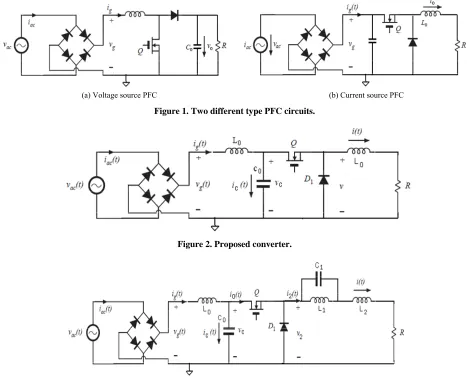
Topologies of the two kinds of PFC mentioned in chapter 1 are actually dual with each other, which is shown is
Figure 1[7]. The power stage of single phase current
source PFC can be suggested in Figure 1(b). One
prob-lem can be found easily is that the input power supply is an AC current source which is not the same as the AC voltage source usually used in the normal life. To coun-teract this inconsistency, an input inductor can be
em-ployed, as shown in Figure 2. The problem is solved as
the input AC voltage supply and the input inductor can form an analog AC current source. Therefore, the pro-posed single phase current source PFC base on Buck topology can be obtained.
The input voltage and input current can be expressed as follows when the PFC function is accomplished
sin sin
m m out o
u wt i wtu I (1)
The output voltage is suggested as:
2
sin (1 cos 2 ) 2
m m m m
out
o o
u i u i
u wt
I I
wt (2)
There exists a low frequency component which is twice of line frequency in the output voltage. If only an inductor servers for filter to file this low frequency ripple, the size of the inductor at the DC side will be obviously large. To reduce the size of the inductor at the output side
(L0), a LC parallel resonance net which is in series with
*Project supported by Natural Science foundation of China (N0.
the output inductor is employed. Figure 3 presents the
suggested converter.
The parallel resonant filter prevents the second har-monic distortions presenting at the output current. Thus, the specifications for the filter design are resonant
fre-quency and Q factor. The principles can be given as,
0
1 1
0
0 1
1 2
2
o
l e
w f
L C
f f
R Q
w L
(3)
The inductor should be large enough to attenuate the resonant current which may cause the inductor magnetic saturation.
2.2. Operation Principles
The parallel net shown in Figure 3 is just used to filter
out the two time of line-frequency harmonic of the output voltage. The design of the net is provided by (3). Thus, the net can be out of concern when the operation princi-ples of the proposed converter are discussed. Therefore, the operation discussed in this paper is based on the
con-figuration shown in Figure 2. However, the circuit used
in the experiment is based on Figure 3.
When the converter operates as a PFC Preregulator, the input current will follow the input voltage, which can
be presented as im sinwt . The operation principles of
the proposed converter shown in Figure 2 are illustrated
in Figure 4. As shown, the average voltage over L0 is
zero in steady state. Thus, the average voltage over C0 is
input voltage, Vm sinwt .
1) When Q is turned on, D1 is reverse-biased. The
current flows through the capacitor is
0 sin 0
C o m
i I i wt (4)
Io is the output current which is thought to be constant.
C0 is discharging and transfer energy to load and L2.
[image:2.595.130.215.164.237.2](a) Voltage source PFC (b) Current source PFC
Figure 1. Two different type PFC circuits.
Figure 2. Proposed converter.
[image:2.595.63.530.342.724.2]2) When Q is turned off, D1 is forward-biased. The
converter is divided into two parts as shown in Figure
4(b) the current, im sinwt , flows through the capacitor
C0. C0 absorbs energy from the input. L2 is discharging
and supporting output.
It is clear that the inner energy balance component is
C0, which is different from the conventional voltage
source PFC. In voltage source PFC converter, the energy balance components is usually inductor.
3. Control Scheme
[image:3.595.61.538.271.383.2]3.1. Control Block
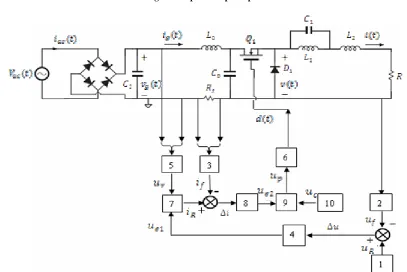
Figure 5 depicts the details of the average current control
strategy used for the proposed converter. As illustrated, the average current control consists of two loops structure. The outer loop is designed for maintaining the output constant. The inner loop is implemented to force the in-put current tracking the inin-put voltage, which can obtain high power factor. The difference lies in that the output single is sensed from the output current other than the output voltage due to the current source characteristic.
Figure 6 depicts the details of the entire proposed system.
As illustrated, the input and output current are both sensed by the inner loop sensed resistor and a current transducer of the outer loop. For this average current control strategy, a popular control chip UC3854 can be implemented here for the proposed converter.
[image:3.595.92.499.405.677.2]
(a) Q is turned on, D1 is reverse-biased (b) Q is turned off, D1 is forward-biased Figure 4. Operation principles.
Figure 5. Block diagram of the control scheme-double loop: 1- DC voltage reference; 2- DC output current sensing; 3- AC input current sensing; 4- voltage regulator; 5- input voltage sensing; 6- drive circuit; 7- multiplier; 8- current regulator; 9-
As depicted in Figure 6, the average current control
has the conventional double-loop structure. However, the difference lies in the output sensing. As the output is a constant DC current that works as a DC current source. Thus, the output current is sensed by a current transducer. Then, this sensed signal is transferred to voltage which is compared to the reference voltage to make the output stable. This makes sure that the conventional PFC IC can be used in this proposed converter.
There are two operational amplifiers and two corre-sponding compensation network, which is the same as the conventional average current control scheme used for the voltage source PFC converter.
3.2. Switching Current Analysis
The power stage of the converter has two different
con-figurations shown in Figure 4. If the input current is as-
sumed to track the input voltage correctly and the output current can be kept as a constant value, then the
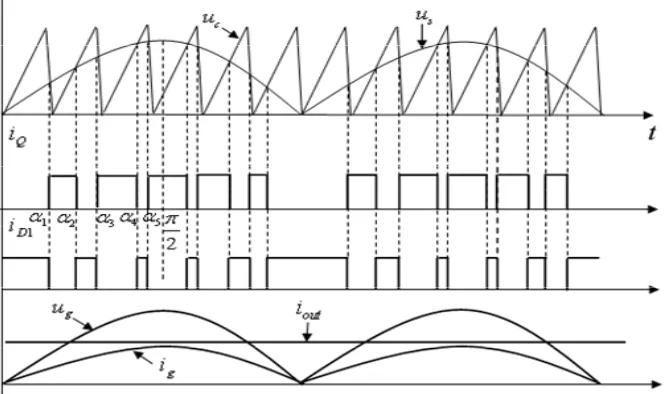
wave-forms of the proposed converter can be depicted as
Fig-ure 7 the output current of the proposed converter will be
higher than the peak of output current. This is very simi-lar with the relationship of the input voltage and output voltage of the single phase voltage source Boost PFC.
The modulating voltage and the carried voltage are both generated by the UC3854, which are used to
gener-ate the switch control signal [8]. us is sinusoidal and is
compared with the triangular voltage, uc When s c,
a turn-on signal is generated to make the switch open. When
u u
s c
u u , Q will be turned off.
The switch current varies in accordance with the on- time of the switch. Further analysis can be made that the switch current can be expanded by Fourier series as,
0
1 cos
2
Q n
n a
i a
[image:4.595.132.479.285.471.2] nwt (5)
Figure 6. Proposed “double current loop” control strategy,
Figure 7. Waveforms of proposed converters: us—modulating wave; uc—carrier wave; iQ—switch current; iD1—diode
[image:4.595.133.465.505.702.2]1~ 2
in Figure 7 mean the conduction angles in a
quarter of the line cycle. Consequently, the switch cur-rent can be expressed as,
2 4
1
1 3 5
2 4
[ (1 sin sin
sin sin sin ) cos ]
Q out out
n
i I I n n
n
n n n n
wt
(6) The fundamental wave and other harmonics of the switch current are decided by the conduction angle,
which is decided by the conjunction of the uc and us.
4. Results
4.1. Simulations
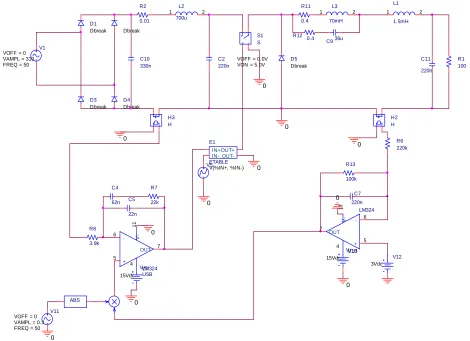
Simulations using Pspice has been carried out. As shown in Figure 8, the double-loop control structure is identical
to the theoretical analysis shown in Figure 6. The input
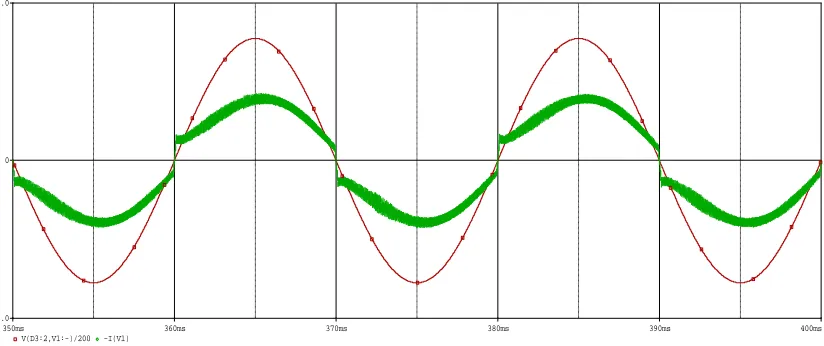
voltage was set to be 220 V (RMS) with 50 Hz frequency. The switch frequency is 100 kHz. The input power is 200 W and the output power is 170 W. The efficiency is
about 85%.
The results are shown below and prove that the power factor can be about 0.97 and the output current can be constant.
4.2. Experiments
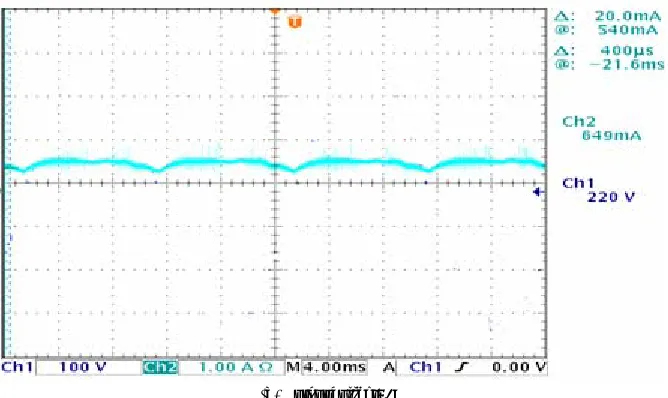
A 120 W prototype has been was proposed for verifying the features of the converter. The experimental results are in coincidence with the simulations ones. The results are
shown in Figure 10.
5. Conclusions
A high power factor single phase current source con-verter is proposed in this paper. Input current is directly controlled by the average current control scheme based on UC 3854, which forms a particular “double-current- loop” control programme. Moreover, a parallel resonant filter is employed to downsize the output inductor. The proposed converter can deliver a constant DC output current which can function as a DC current source. In addition, it does not require that the output voltage has to be higher than the input voltage.
R11 0.4 R13 100k C11 220n R12 0.4 C936u 1 2 L3 70mH R6 220k + 5 -6 V+ 4 V-11 OUT 7 U5B LM324 C4 62n C5 22n R7 22k 0 V7 15Vdc R8 3.9k 0 1 2 L2 700u C2 220n 0 0 Dbreak D5 Dbreak D1 Dbreak Dbreak D3 Dbreak D4 V1
FREQ = 50 VAMPL = 310 VOFF = 0
R1 100 +
-+ - S1 S
VON = 5.0V VOFF = 0.0V
0 OUT+ OUT-IN+ IN-E1 V(%IN+, %IN-) ETABLE 1 2 L1 1.5mH V5 R2 0.01 0 ABS 0 C7 220n V11
FREQ = 50 VAMPL = 0.3 VOFF = 0
[image:5.595.55.525.373.714.2]0 + - H2 H C10 330n 0 V10 15Vdc 0 + 5 - 6 V+ 4 V-11 OUT 7 U1B LM324 0 V12 3Vdc + - H3 H
Time
350ms 360ms 370ms 380ms 390ms 400ms
V(D3:2,V1:-)/200 -I(V1) 0
-2.0 2.0
(a) Input voltage: 310v (peak) ; Input current: 1.3A (peak)
Time
300ms 310ms 320ms 330ms 340ms 350ms
-I(R1) 0A
-2.0A 3.0A
[image:6.595.95.507.87.260.2](b) Output current: 1.4A
Figure 9. Simulation results.
(b) Output current: 1A
Figure 10. Experimental results.
[4] M. V. Aware and D. sutanto, “Improved Controller for Power Conditioner Using Hightemperature Supercon-ducting Magnetic Energy Storage(HTSSMES),” IEEE Trans. Applied superconductivity, Vol. 13, 2003, p. 3847.
Therefore, the proposed converter is more suitable for lower output voltage situations such as battery chargers and small output current source inverter induction drives. It appears that such a converter may also be useful for UPS applications, where a current source inverter is pre-ferred in terms of its compatibility with capacitor input loads, such as the cases of personal computers.
[5] Y. Hayashi, N. Sato and K. Takahashi, “A Novel Control of a Currentsource Active Filter for AC Power System Harmonic Compensation,” in Conf Rec. IEEEIAS Annual. Meeting, 1988, pp. 813-819
[6] Y. Ye, Kazerani and V. H. Quintana, “Current Source Converter Based STATCOM: Modeling and Control,” IEEE, Trans. Power Delivery, Vol. 20, 2005, pp. 795-800.
doi:10.1109/TPWRD.2004.837838
REFERENCES
[1] H. Endo, T. Yamashita and T. Sugiura, “A High-Power-Factor Buck Converter,” PESC’92 Record,
pp. 1071-1076 [7] H. Y. Wu, X. M. Yuan, J. F. Zhang and W. X. Lin, “Novel Single Phase Current Source Buck PC with Delta Modulation Control Strategy,” in Conf. Publ. Power Electronic and Variable Speed Drives, 6th International Conference, 1996. pp. 138-143.
[2] H. Mao, Fred C. Lee, Y. jiang and D. Borojevic, “Review of Power Factor Correction Techniques,” IPEMC, 1997, Vol. 11, No. 36.
[3] S. Nonaka and Y. Neba, “Single Phase PWM Current Source Converter with Doublefrequency Parallel Reso-nance Circuit for DC Smoothing,” in Conf. Rec. IEEEIAS Annual.