ISSN: 1992-8645 www.jatit.org E-ISSN: 1817-3195
FACTORS AFFECTING GLOBAL VIRTUAL TEAMS’
PERFORMANCE IN SOFTWARE PROJECTS
1
ALI YAHYA GHENI, 2YUSMADI YAH JUSOH, 3MARZANAH A. JABAR, 4NORHAYATI
MOHD ALI 1
Department of Software Engineering & Information System, Universiti Putra Malaysia (UPM);
Department of Computer Science, University of Baghdad
2, 3, 4
Department of Software Engineering & Information System, Universiti Putra Malaysia (UPM)
E-mail: [email protected], [email protected], [email protected],
4
ABSTRACT
Today the trend is to perform software development work via distributed geographical area among team, individual or even as an organization. However, due to the global market and international presence of many companies, there is a need to implement a global virtual teams. The global virtual team members are gradually engaged in globalized business environments across space, time and organizational boundaries via information and communication technologies. A global virtual team relies on communication, collaboration, and information exchange are the most important criteria in global virtual teams’ operations. The purpose of this paper is to answer two research questions. The first research question is to identify the factors affecting global virtual teams’ performance. A systematic literature review was conducted to answer the first research question. The second research question is on what the rank of the factor affecting the global virtual teams’ performance according to their level of effect on global virtual teams’ performance. Online survey was conducted within 103 developers and IT managers from eight IT companies to answer the second research question. The Statistical Package for Social Science (SPSS 22) was used to analyze the collected data. In this study, we investigated factors that affect global virtual teams’ performance; factors considered include cultural differences, language problems, time-zone differences, team size, technical problems, lack of trust, lack of sufficient training, and ICT problems. Also the findings indicated that lack of sufficient training is the highest level of effect on global virtual teams’ performance. On the other hand, team size is the lowest level of effect on global virtual teams’ performance.
Keywords: Global software projects,Global Virtual Teams (GVTs), performance factors
1. INTRODUCTION
Software project management is a type of project management that focuses on creating or updating software [1]. Each project is temporary, and with a specific goal to be completed within a specified time. Virtual projects have been defined as projects where team members are distributed across locations in different cities, states, countries and/or time zones, making face-to-face communication difficult or impossible. Such teams are referred to as global virtual teams. Since team members work from distributed locations, project team members depend on technology for communication, i.e. collaboration tools, often referred to information and communication technologies or ICTs. Powell, et al. [1] identified a
sometimes “exclusive reliance” on ICTs as a distinctive feature of global virtual teams.
ISSN: 1992-8645 www.jatit.org E-ISSN: 1817-3195
2. RELATED WORKS
2.1 Global Virtual Teams (GVTs)
Global virtual teams (GVTs) are groups of people who are working together from different places in world with different languages and cultures. And they are depending on information and communication technology to communicate with each other. These individuals are grouped in a team-based structure based on telecommunication technologies to complete their tasks interdependently and achieve desirable task and organizational outcomes [1]. According to [2], global virtual teams are becoming the “new normal” as businesses expand across borders and as skill shortages force companies to tap into broader talent pools. The global virtual teams offer many advantages via technology advantages, such as:
• Obtaining an international perspective on business challenges and solutions.
• Achieving economies of scale.
• Leveraging complementary work cycles that allow 24/7 productivity.
• Harnessing best talent, wherever it is located.
• Accelerating innovation and product launches.
• Enhancing local knowledge and presence.
The global virtual teams (GVTs) is a very important topic in the Information Systems (IS) field because GVTs employ a work structure that is heavily dependent on information communication technology. Besides the use of technology, GVTs are also composed of people from different culture backgrounds. As such, GVTs are challenged not only to collaborate and coordinate projects in virtual environment, but also to promote a trusting working relationship among culturally diverse members [3].
The terms of global project, international project, and virtual project are intertwined. According to [4] you can compare the number of organizations and locations involved in the implementation to find out whether the project belongs to one category or the other. In traditional projects a large majority of the team members are working for the same organization and in a single location. International projects involve team members working in many locations across country borders. Virtual projects are composed of team members in different organizations, dispersed geographically. Global projects combine the challenges of international and virtual projects, meaning the global project manager would have to
deal with cross-cultural and language differences as well as different time-zones [4] and these projects are typically carried out in institutionally demanding environments [5].
It should be noted that in spite of the advantages of technology provides, most of global software projects tend to face problems and risks, and great deal of such projects fail to reach all their objectives [6].
2.2 Global Virtual Teams’ Performance
Most of the organizations develop a performance measurement system to measure the teams’ outcome and individuals’ outcome. Some organizations focus on performance teams’ outcome because they believe that they not jeopardize team cohesiveness by focusing too much on individuals’ performance. Most organizations, however, choose the teams’ outcomes and individuals’ outcome. In face-to-face teams, individual output may be more obvious than in a virtual setting. Thus, global virtual team measures must provide for the explicit determination of individual contributions [7]. For example, from the team outcome perspective, organizations assess typical team outcomes like the quality, quantity, creativity, cost, and timeliness of the team’s deliverables. In the individual outcome domain, organizations assess the same outcomes at the individual level, but they may also assess the extent to which each individual team member meets personal deadlines or milestones to the overall performance of the team [7].
2.3 Factors Affecting Global Virtual
Teams’ Performance
Virtual work settings may cause some organizational challenges such as maintaining remote leadership, managing cultural differences, and developing trust relationships among the teams. According to [8], other challenges suggested that global virtual teams need to deal with such as communication difficulties, decreased cohesion, and high level of conflicts among teams. [9] Added the handling of technological issues such as adaptation and regular use of communication tools as another challenge that faces global virtual teams. Those challenges may pose a threat to the performance of any global virtual teams. However, the problem can be more perceptible in support teams in which troubleshooting customers’ technical problems is inherently complex and challenging [10], [11].
ISSN: 1992-8645 www.jatit.org E-ISSN: 1817-3195 which introduces a new layer of challenges to
support teams. Customers and support professionals have to collaborate to make the troubleshooting process succeed. Leaders of support organizations need to overcome the challenges of distributed settings to resolve technical problems and satisfy their customers [12].
[12] Investigated factors affecting global virtual team performance; factors considered include communication tools, cohesion and collaboration, leadership, trust, the location of team members and team size. One-hundred-twenty professionals in high-technology telecommunication industry participated in a survey to reveal the importance of how factors affecting global virtual team performance. The findings indicated that support professionals perceived reliable communication tools and cohesion among team members as more significant performance factors than leadership. A survey was conducted to determine the factors affecting global virtual teams. Research results suggest that leadership and establishing trust is first step in the initial stages of the global project.
3. METHODOLOGY
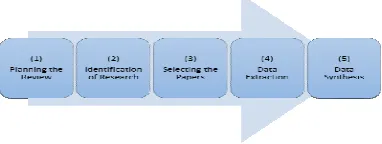
This study has been undertaken a systematics literature review (SLR) based on original guidelines as proposed by Kitchenham [13], [14], [15]. The SLR starts with planning the review, identifying the research, selecting the papers, extracting the data as shown in Figure 1. Systematic literature review was conducted to answer the first research question (RQ) bellow:
RQ1: What are the factors affecting global virtual teams’ performance?
Also a survey was conducted, the researchers conducted a survey to answer the second research question (RQ) bellow:
[image:3.612.100.291.587.659.2]RQ2: what are the ranking of these factors?
Figure 1: Systematic Literature Review
3.1 Systematic Literature Review
This study has been undertaken a systematics literature review (SLR) based on original guidelines
as proposed by Kitchenham [13], [14], [15]. The SLR starts with planning the review, identifying the research, selecting the papers, extracting the data as shown in Figure 1. Systematic literature review was conducted to answer the first research question (RQ) bellow:
RQ1: What are the factors affecting global virtual teams’ performance?
3.1.1 Planning the review
We start our research by providing a protocol for the systematic literature review to specify our research strategy. The strategy that will be used in our research is searching for specific terms and resources from specific databases, specific journals, conference and electronic books.
3.1.2 Identification of research
This research started with the identification of the keywords and specific terms related to the topic of the research. General keywords are used to search for many various relevant papers regarding global virtual teams, global virtual teams’ performance. The search strategy for the review was directed towards finding published papers in archival journals, conferences and electronic books from nine electronic database, IEEE Explore, IGI, ACM portal, Elsevier’s Science Direct, Scopus, Emerald, and Springer Link, Wiley Inter Science, and Management Science.
3.1.3 Selecting the papers
Two techniques are used to select the papers form published papers and archival journals and conferences. The initial list based on reading the abstract and conclusion of the papers and the final list based on reading the full paper with details. The initial list consisted of 45 papers which are found relevant to our topic. However, after reading 45 papers, only 31 papers are considered the final list. Around 14 papers that did not give any useful information were eliminated.
3.1.4 Data extraction
We extracted from the selected papers all the relevant information about the global virtual teams and the factors affecting global virtual teams’ performance.
3.1.5 Data synthesis
ISSN: 1992-8645 www.jatit.org E-ISSN: 1817-3195 factors affecting global virtual teams’ performance.
The researchers divided the work into two parts, the first part focused on collecting the information about the concepts, definitions of global virtual teams by going through to definitions of global virtual teams, and global virtual teams’ performance, and the second part focused on factors affecting the global virtual teams’ performance.
3.2 Data Collection
103 of questionnaires were distributed online among IT organizations in Technology Park Malaysia (TPM). The questionnaires were contained of six closed-ended sections (5-point Likert Scale) and total of question is 61 only. The first two parts which consist of 17 questions are related to our research. Statically Package for Social Sciences (SPSS), version 22 is used for data analysis in this study. This survey will address the second research question (RQ) below:
RQ2: what are the ranking of these factors?
4. RESULTS
4.1 Results of Systematic Literature Review
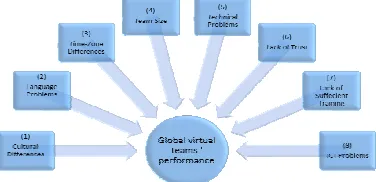
[image:4.612.101.289.439.530.2]From 31 papers we are able to answer the first research questions. Affect the global virtual teams’ performance as shown in Figure 2.
Figure 2: Factors affecting global virtual teams’ performance
4.1.1 Cultural differences
According to [16], [17], [18], [19], [20], it seems logical that some consideration should be given to the interaction of team members from a variety of different cultural backgrounds. Culture may be divided into national, or organizational and functional. For example, [21] notes that communicating by email is not a preferred choice for managers in Eastern countries such as Japan and Korea. This can result in tension amongst team members. Allied to the culture theme is conflict in global virtual teams and affecting the global virtual teams’ performance.
4.1.2 Language problems
According to [22], individuals from different counties have different language and understanding styles, which bring some difficulties to communication. Language problem is not a simple problem, including functional obstacles besides different ability of listening, reading, speaking and heavy accent. Because of cross-functional nature of GVTs, members may have different terms based on functional area which are hard to understand for laymen. Precisely when team members are unfamiliar with each other [23]. Listening, speaking and heavy accent are all important to synchronous communication, while reading is the key to asynchronous one. Sometimes the poor speaking makes the phenomenon that members' reluctance of speaking out themselves, which is likely to be considered as being inability or agreeing with others by mistake [22]. These problems lead to misunderstanding and affect the global virtual teams’ performance.
4.1.3 Time-zone differences
According to [24], teams which are distributed more on the temporal index would use asynchronous media like e-mail, message boards, etc. to communicate rather than tele/video conference. Use of synchronous media for communication such as tele/video conference would be contingent upon the number of overlapping work hours. Subsequently, the extent of communication would be severely impacted as almost all the communication is being done through the use of leaner media. Higher Time-zone index of a global virtual team will negatively affect the communication extensiveness between team members and affect the performance of global virtual teams’ members.
4.1.4 Team size
According to [12], [25], team size is important in software development project. Basically there are three different project team sizes: small team of 10 or fewer people for small project, medium size team of 11 to 25 people for medium project and large team of 26 or more for large project. Small group of team results in good communication and tends to be very flexible over large group of teams. It is easy to call meetings and get instant feedback. Projects sometimes fail due to improper communication.
4.1.5 Technical problems
ISSN: 1992-8645 www.jatit.org E-ISSN: 1817-3195 regions may not have access to new
communications infrastructures like ISDN, especially in rural areas, and employees in other countries may be subject to later release dates for software. Some other problems include incompatible networks, slow computers, and traffic on the network. Video conferencing solutions are either: expensive and good quality only in a LAN but not in WAN or cheap and unacceptably but low in quality. Broadband services may not be available everywhere and installing dedicated lines could increase the cost to the organization and therefore offsetting any cost savings from telecommuting or reduced travel. Good infrastructure may enhance the global virtual teams’ performance, on the other hand poor infrastructure will negatively affect on global virtual teams’ performance
4.1.6 Lack of trust
According to [27], the individual characteristics that help build trust in global virtual teams are well canvassed in the literature [28], [29], [30], [31], [32]. Orange, the mobile communications branch of France Telecom, is a fast-moving business in a dynamic, unpredictable and competitive market. At Orange, for example, low levels of trust among the global virtual team members was identified as hindering product development and reducing the capacity of the company to meet its goals [31]. Trust is at the foundation of all successful relationships and inn order for global virtual teams to succeed, they need to build and foster their relationship carefully and intentionally [32]. Trust is often the result of team members knowing that all people in a team can be counted on to complete their assigned tasks. Furthermore, trust is an important factor that must exist in all successful personal and team relationships. This trust factor is especially vital for global virtual teams because of the lack of personal face-to-face interaction.
4.1.7 Lack of sufficient training
According to [33], “Training and development is defined as a process of developing work-related knowledge and skills in employees for the purpose of improving performance systematically”.
Some technologies may not be available to all global virtual team members, or there may be issues regarding the compatibility of systems or the availability of hardware and software in certain parts of the organization or in partner organizations [34], [33]. It is not uncommon for one part of an organization, or for partner organizations, to be ahead or behind in hardware and/or software capability [33]. For example, one global virtual
team leader, in California’s Silicon Valley, was shocked to discover that one of her partner organizations, a biotechnology firm, did not have access to a groupware system for team meetings. She offered to buy the system for the partner organization but then discovered that it did not have money allocated for training. Even if there is money to buy and distribute technology for all team members, they need access to training and practice [34].
4.1.8 ICT problems
According to [35], the rise and continuous development of information and communication technologies have facilitated the creation of new mechanism for coordinating work and, subsequently, new collaborative organizational forms, business models and working practices. It should be noted that in spite of the advantages technology provides, most information technology projects tend to face problems and risks, and great deal of such projects fail to reach all their objectives [36]. So the global virtual teams should know how and when to use the ICT. Using the wrong ICT in the wrong time leads to delay and affect the global virtual teams’ performance.
4.2 Results of Statistical Analysis
4.2.1 Reliability and validity test
Validity is an indication of an instrument’s ability to measure what it claims to and reliability is the reliability and consistency of a survey. In order to ensure the validity, the questionnaire was checked by two experts in questionnaire design and English language. Their comments and suggestions were taken into account and the questionnaire was revised. Then a pilot study was conducted. Hence, a total of 40 copies of questionnaire were sent by via online survey (survey monkey) and 25 respondents competed the questionnaire. The results was analyzed by SPSS 22. The reliability test was conducted on the data from the pilot study for the other parts of the questionnaire which is not our focus in this research.
4.2.2 Respondents’ characteristics
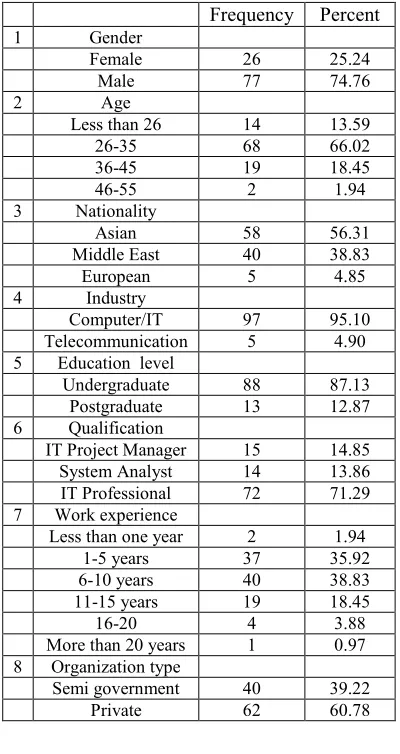
ISSN: 1992-8645 www.jatit.org E-ISSN: 1817-3195 have work experience from 6-10 years. Finally,
[image:6.612.316.517.114.324.2]60.78% of the IT companies are private. Table 1 shows more detail information regarding the demographic data of respondents.
Table 1: Demographic data of respondents.
Frequency Percent
1 Gender
Female 26 25.24
Male 77 74.76
2 Age
Less than 26 14 13.59
26-35 68 66.02
36-45 19 18.45
46-55 2 1.94
3 Nationality
Asian 58 56.31
Middle East 40 38.83
European 5 4.85
4 Industry
Computer/IT 97 95.10
Telecommunication 5 4.90
5 Education level
Undergraduate 88 87.13
Postgraduate 13 12.87
6 Qualification
IT Project Manager 15 14.85
System Analyst 14 13.86
IT Professional 72 71.29 7 Work experience
Less than one year 2 1.94
1-5 years 37 35.92
6-10 years 40 38.83
11-15 years 19 18.45
16-20 4 3.88
More than 20 years 1 0.97 8 Organization type
Semi government 40 39.22
Private 62 60.78
4.2.3 Ranking of factors affecting
global software projects
[image:6.612.317.517.115.323.2]According to the online survey, Table 2 shows the rank of factors affecting global virtual teams’ performance according to their level of affect. Lack of sufficient training is the highest level of effect on global virtual teams’ performance. On the other hand, team size is the lowest level of effect on global virtual teams’ performance.
Table 2: Ranking of factors affecting global virtual teams’ performance.
Frequency Percent Rank Lack of
sufficient training
68 66.0 1
National culture differences
54.4 56 2
Language problems
53.4 55 3
Organizational culture differences
51.5 53 4
ICT problems 42.7 44 5
Lack of trust 39.8 41 6
Technical problems
36.9 38 7
Time-zone differences
35.9 37 8
Team size 15.5 16 9
5. DISCUSSION
Reviewing the current literature in global virtual teams in global software projects, has identified factors affecting global virtual team’ performance. We investigated factors that affect global virtual teams’ performance; factors considered include cultural differences, language problems, time-zone differences, team size, technical problems, lack of trust, lack of sufficient training, and ICT problems. Also the findings indicated that lack of sufficient training is the highest level of effect on global virtual teams’ performance. On the other hand, team size is the lowest level of effect on global virtual teams’ performance. Table 2 shows more detail information regarding the ranking of factors affecting global virtual teams’ performance.
6. CONCLUSION AND FUTURE WORK
[image:6.612.95.295.165.542.2]ISSN: 1992-8645 www.jatit.org E-ISSN: 1817-3195
REFRENCES:
[1] Wildman Jessica L., Griffith Richard L., “Leading Global Teams”, Springer, 2015. [2] Derven Marjorie, “Four to enhance global virtual
teams”, Industrial and commercial training, 2016, 0019-7858.
[3] Yousif Shafiz Affendi Mohd, Zakaria Norhayati, “Exploring the State of Discipline of the Formation of Swift Trust within Global Virtual Teams”, Hawawi International Conference on System Sciences, 2012.
[4] Binder, J., “Global Project Management, Communication, Collaboration and Management across Borders”, Gower Farnham, 2007.
[5] Aaltonen, K., Kujala, J. and Oijala, T., “Stakeholder salience in global projects”, International Journal of Project Management, Vol. 26, 2008, pp. 509-516.
[6] Raisinghani, M., Arora, A., Baylor, E., Brown, P. S., Coleman, C., & Craig, K., “Virtual Project Management of Globally Outsourced IT Projects”, International Journal of Management and Information Systems, 2010, 14, 1–7. [7] Gibson B. Cristina, Cohnen G. Susan, “Virtual
teams that work”, John Wiley & Sons, Inc., 2003.
[8] Staples, D.D., Zhao, L., “The effects of cultural diversity in virtual teams versus face-to-face teams”, Group Decision & Negotiation 15 (4), 2006, 389–406.
[9] Indiramma, M.M., Anandakumar, K.R., “Behavioral analysis of team members in virtual organization based on trust dimension and learning” Proceedings of World Academy of Science: Engineering & Technology 39 (3), 2009, 269–274 (retrieved from EBSCOhost). [10] Cavaiani, T.P., “Using selected options of the
Ipconfig command to teach network troubleshooting techniques”, Journal of Information Systems Education 16 (3), 2005, 251–254 (retrieved from EBSCOhost).
[11] Williamson, D.M., Bauer, M., Steinberg, L.S., Mislevy, R.J., Behrens, J.T., DeMark, S.F., “Design rationale for a complex performance assessment”, International Journal of Testing 4 (4), 2004, 303–332.
[12] Saafein Oussama and Shaykhian A. Gholam, “Factors affecting virtual teams performance in telecommunication support environment”, Telematics and Informatics, 2014, PP. 459- 462.
[13] B. Kitchenham, “Procedures for Performing Systematic Review”, in Technical Report TR/SE-0401, Keele University, 2004.
[14] B. Kitchenham, R. Pretorius,D. Budgen,P. Brereton,M. Turner, and M. Niazi., “Systematic literature reviews in software engineering”. A tertiary study, Information and Software Technology, 2010, pp. 52, 792–805. [15] U. M. Z. Usman and M. N. Ahmed.
“Knowledge Management in Success of ERP Systems”, 2012, vol. 3, no. 1.
[16] Richardson, I., Casyey, V., McCaffery, F., Burton, J., Beecham, S., “A Process Framework for Global Software Engineering Teams”, Information and Software Technology, 2012, PP. 1175-1191.
[17] Lurey, J. and Raisinhgani, M., “An Empirical Study of Best Practices in Virtual Teams”, Organization Science, 2001, Vol. 10, No. 6, PP. 791-815.
[18] Noe, R.A. and Wilk, S.L., “Investigation of the factors that influence employees” participation in development activities”, Journal of Applied Psychology, 1993, Vol. 78, pp. 291-302. [19] Raisinghani, M., Arora, A., Baylor, E., Brown,
P. S., Coleman, C., and Craig, K. “Virtual Project Management of Globally Outsourced IT Projects”, International Journal of Management and Information Systems, 2010, pp. 14, 1–7. [20] Liz Lee-Kelley, Tim Sankey, “Global virtual
teams for value creation and project success: A case study”, International Journal of Project Management, 26 (2008), PP. 51–62.
[21] Lee O., “Cultural differences in email use of virtual teams: a critical social theory perspective”, CyberPsychol Behaver, 2002; 5(3):227–32.
[22] Ying Zhang, Qinfei Min, Liwen Wu, “GVTs Communication Management: A Conceptual Model”, 2008.
[23] J. Suchan, and G. Hayzak, "The communication characteristics of virtual teams: a case study," IEEE Transactions on Professional Communication, 2001, vol. 44, NO.3, Sep. [24] Saxena Ashay, Burmann Johanna, “Factors
Affecting Team Performance in Globally Distributed Setting”, ACM, 2014.
ISSN: 1992-8645 www.jatit.org E-ISSN: 1817-3195 [26] Robert Vinaja, “Major Challenges in
Multi-Cultural Virtual Teams”, Proceedings American Institute for Decision Sciences Southwest Region, University of Texas-Pan American, 2003.
[27] Bergiel Blaise J., Bergiel Erich B., Balsmeier Philip W.,“Nature of virtual teams: a summary of their advantages and disadvantages”, Management Research News, 2008, Vol. 31 No. 2, pp. 99-110.
[28] Shin, Y., ‘‘A person-environment fit model for virtual organizations’’, Journal of Management, 2004, Vol. 30 No. 5, pp. 725-44.
[29] Harvey, M., Novicevic, M. and Garrison, G., ‘‘Challenges to staffing global virtual teams’’, Human Resource Management Review, 2004, Vol. 14 No. 3, pp. 275-95.
[30] Derosa, D., Hantula, D.A. and D’Arcy, J., ‘‘Trust and leadership in virtual teamwork: a media naturalness perspective’’, Human Resource Management, 2004, Vol. 43 Nos. 2-3, pp. 219-33.
[31] Lawley, D., ‘‘Creating trust in virtual teams at Orange’’, KM Review, 2006, Vol. 9 No. 2, pp. 12-17.
[32] Coppola, N.W., Hiltz, S.R. and Rotter, N.G., ‘‘Building trust in virtual teams’’, IEEE Transactions on Professional Communication, 2004, Vol. 47 No. 2, pp. 95-105.
[33] A. Akhavan Tabassi and A. H. Abu Bakar, “Training, motivation, and performance: The case of human resources management in contruction projects in Mashhhad; Iran”, International Journal of Project Management, 2009, pp. 471-480, 27.
[34] L. Duarate and Tennant Snyeder, “Mastering virtual teams”, USA: JOSSY-BASS, 2006, pp. 10-15.
[35] R. Lee, “Leading Virtual Project Teams”, USA: Taylor and Francis Group, 2014, pp. 60-80. [36] Lilian Snellman Carita. “Virtual Teams: