IJPSR (2015), Vol. 6, Issue 8 (Research Article)
Received on 27 January, 2015; received in revised form, 19 March, 2015; accepted, 11 May, 2015; published 01 August, 2015
METHOD DEVELOPMENT AND VALIDATION FOR THE DETERMINATION OF TINIDAZOLE BY REVERSE PHASE HPLC TECHNIQUE
Amit Kumar De 1, Ashok Kumar Bera 2 and Biswajit Pal*3
R & D Division1, Dey’s Medical Stores (Mfg) Ltd., 62 Bondel Road, Kolkata - 700019,West Bengal, India Shri Ritam Vidyapith 2, 293/1 Raja Rammohan Roy Road, Kolkata - 700041, West Bengal, India
Department of Chemistry 3, St. Paul’s C. M. College, 33/1 Raja Rammohan Roy Sarani, Kolkata - 700009, West Bengal, India
ABSTRACT: The aim of the current study is to develop a simple,
specific, rapid and precise quantification technique for the estimation of tinidazole from tablet dosage form. Successful separation of the drug was carried out on a C18 column (particle size 5 µm, 250 mm length × 4 mm i.d.) using a mobile phase consisting of a 5.3 mM phosphate buffer solution and acetonitrile in the ratio of 60:40 (v/v). The detection wavelength is 318 nm. The method has been validated as per ICH (Q2) guidelines on the basis of accuracy, precession, linearity, sensitivity and robustness. The method is found to be linear with limit of detection and limit of quantitation 0.25μg/ml and 0.76μg/ml respectively. The average elution time is only 5.0 minutes with the analyte elution taking place at about 3.0 minutes making the method rapid and cost effective for routine analysis.
INTRODUCTION: Tinidazole (TZ) is 5-Nitro imidazole derivative, chemically related to metronidazole and is a drug of choice for the treatment of amoebic and parasitic infections 1. TZ is a popular anti protozoal agent 2 with established efficacy and acceptable tolerability and is approved by FDA for the treatment of giardiasis, amebiasis, amoebic liver abscess and trichomoniasis 3-7. It also found effective against a wide range of clinically significant anaerobic bacteria like Bacteroides and Clostridium difficile and microareophilic bacterium like Helicobacter pylori 7.
QUICK RESPONSE CODE
DOI:
10.13040/IJPSR.0975-8232.6(8).3594-98
Article can be accessed online on:
www.ijpsr.com
DOI link: http://dx.doi.org/10.13040/IJPSR.0975-8232.6(8).3594-98
In susceptible organisms tinidazole is reduced to cytotoxic intermediates that bind covalently with the protozal DNA causing an irreversible damage8. In adult human tinidazole has 100% bioavailability and is minimally bound to plasma proteins (12%). It has a plasma elimination half life of 12.3 hours and about 63% of this drug is eliminated through hepatic metabolism9, 10.
Its dosage is independent of sex, race and hepatic metabolism however it is not recommended for patients with hepatic impairment due to lack of clinical data in such patients. Recent comparative studies present greater clinical efficacies of TZ over metronidazole (MTZ) in the treatment of trichomoniasis, giardiasis and amebiasis 11-14.Due to its higher efficacy in a large number of disease conditions a large number of formulations containing TZ are available in the market. As a result suitable method for the quantification of the
Keywords:
Tinidazole, RP-HPLC technique, Method development, Estimation
Correspondence to Author: Biswajit Pal
Department of Chemistry, St. Paul’s C. M. College, 33/1 Raja Rammohan Roy Sarani, Kolkata - 700009, West Bengal, India
same from available marketed formulations is necessary. Current literature survey presents several methods for the quantification of TZ which include either a spectrophotometric or a chromatographic technique. Most of these methods reported the use of HPLC coupled with MS for the exact quantification making the quantification technique costly and complicated15-17. In the current study we reported a simple, rapid and yet specific chromatographic technique for the exact quantification of TZ from marketed formulation. The simplicity of the method may encourage its regular application in the quantification of TZ from marketed formulations. The method has been validated as per ICH (Q2) guidelines.
MATERIALS AND METHODS:
Apparatus: Quantitative HPLC determination was performed on a Waters Alliance e 2695 separation module with double pump18-22. An equilibriated C18 column (particle size 5 µm, 250 mm × 4 mm ID) was used for chromatographic separation23. A rheodyne injector with a 10 µl loop was used for the injection of standard and sample solutions of tinidazole. Chromatographic detection was made with Waters 2489 dual lambda absorbance detector. For preparation of HPLC grade water Aurium 611 UV water purifier of Sartorius, Germany was used. Chromatograms were analysed using Empower-3 software.
Chemicals and reagents:
Standard TZ (99.8%) was kindly gifted by a local pharmaceutical industry and was used as reference standard without further purification. TZ tablets (Tiniba 300) were purchased from local pharmacy. All solvents were of HPLC grade and reagents were of analytical grade. Potassium di-hydrogen phosphate, dipotassium hydrogen phosphate of AR grade and acetonitrile, phosphoric acid of HPLC grade were purchased from Merck Ltd., Mumbai.
Chromatographic condition:
The mobile phase used in the chromatographic separation was of 5.3 mM phosphate buffer solution and acetonitrile in the ratio of 60:40 (v/v). The pH of the mobile phase was adjusted to 3.5 ± 0.1 with orthophosphoric acid. The injection volume was 10 µl with a pump flow rate 1 ml /min. The column temperature was maintained at room
temperature (25 ± 2°C) and the eluent was detected at 318 nm.
Preparation of standard solution:
The standard solution of tinidazole was prepared by transferring 25 mg of the reference standard drug in 25 ml volumetric flask with 10 ml HPLC grade water and one drop of conc HCl followed by sonication for 15 minutes and the final volume was made by mobile phase. 1 ml of the above solution was taken in a 25 ml volumetric flask and diluted up to the mark by mobile phase in order to obtain the solution with final concentration of 0.04 mg/ml. The contents of standard solution were filtered through 0.45 µm syringe filter before making any injection.
Preparation of sample solution:
Twenty tablets (each containing 300 mg of TZ) were weighed accurately and ground to fine powder. The powdered mass equivalent to 25 mg of TZ was accurately weighed and transferred to a volumetric flask. About 10 ml of HPLC grade water and 1 drop of conc. HCl were added to it and sonicated for 15 minutes. The volume was then made up to the mark by mobile phase and filtered through Whatman filter paper no. 1. 1 ml of the filtered solution were taken in a 25 ml volumetric flask and diluted with mobile phase in order to obtain solution with final concentration of 0.04 mg/ml of TZ. The contents of sample solution were filtered through 0.45 µm syringe filter before making any injection.
Analysis of formulations:
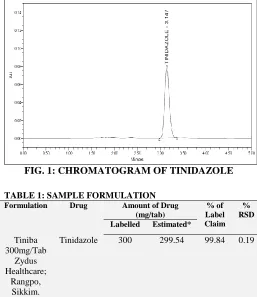
10 µl sample solution was injected on HPLC system in an optimized chromatographic conditions and chromatographed in triplicate. A representative chromatogram has been given in Fig. 1. Content of TZ in tablet was calculated by comparing mean peak area of sample with that of standard. Results of analysis of tablet formulation were shown in Table 1.
Method validation:
The proposed analytical method was validated as per recommendation of USP and ICH guidelines in terms of system suitability parameters, linearity, intraday and interday precision, accuracy, robustness, ruggedness, LOD and LOQ24, 25.
FIG. 1:CHROMATOGRAM OF TINIDAZOLE
TABLE 1: SAMPLE FORMULATION
Formulation Drug Amount of Drug
(mg/tab)
% of Label Claim
% RSD Labelled Estimated*
Tiniba 300mg/Tab
Zydus Healthcare;
Rangpo, Sikkim. Batch no. ZHN3780
Tinidazole 300 299.54 99.84 0.19
* Mean from three replicate analyses.
Method validation:
The proposed analytical method was validated as per recommendation of USP and ICH guidelines in terms of system suitability parameters, linearity, intraday and interday precision, accuracy, robustness, ruggedness, LOD and LOQ24, 25.
System suitability:
[image:3.612.314.566.210.374.2]To establish the validity of the proposed analytical procedure, a system suitability test was done. The standard solution of TZ was scanned in the UV range of 200–400nm and its wavelength of maximum absorbance was found to be 318nm (Table 2). Data from six injection of 10μl of the working standard solution of tinidazole was used for evaluation of the system suitability parameters like retention time, tailing factor, the number of theoretical plates. The results obtained were shown in Table 2.
TABLE 2: SYSTEM SUITABILITY PARAMETER
Parameters Tinidazole
Wavelength maxima (nm) 318
Retention Time (mins) 3.147
Tailing factor 0.2019
Theoretical Plate 301196
LOD (µg/ml) 0.25
LOQ (µg/ml) 0.76
Linearity:
The linearity for developed HPLC method was determined at five concentration levels of TZ ranging from 10.72 – 85.70 μg/ml. The calibration curve was calculated by plotting response factor against concentrations of TZ (Fig.2). The regression equation was found to by Y=13060x +995.5, where y is the peak area and x is the concentration of TZ. The linearity parameters were summarized in Table 3.
FIG.2: LINEARITY CURVE AT DIFFERENT CONCENTRATIONS
[image:3.612.314.571.410.470.2]OF TINIDAZOLE.
TABLE 3: LINEARITY PARAMETERS
Precession:
The precession of the proposed method was examined by intraday and interday studies. In the intraday studies, six repeated injections of standard solution were made whereas six repeated injections of standard solution were made for three consecutive days in case of interday variation studies. The percentage RSD with respect to the peak area, peak retention time and the amount were calculated for each case and presented in Table 4.
Accuracy:
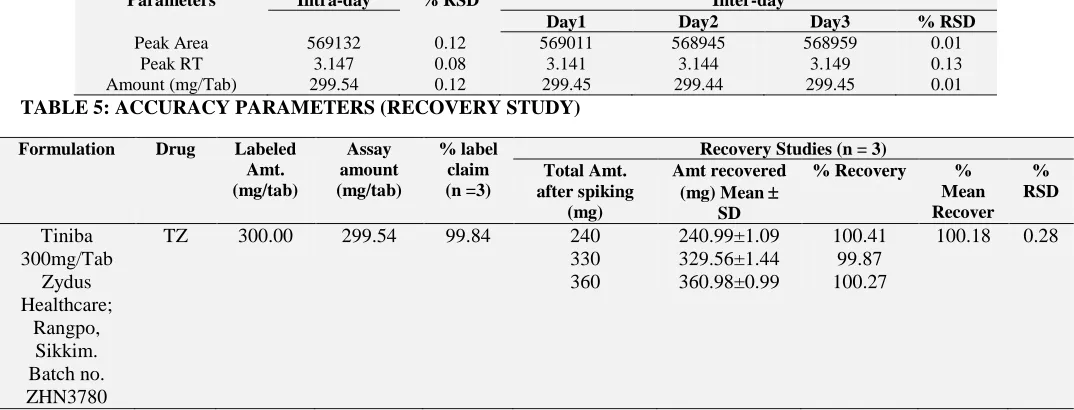
Recovery studies by the standard addition method at three different levels (80%, 110% and 120% of final concentration) were performed with a view to justify the accuracy the accuracy of the proposed method. A known amount standard solution of pure drug was added to pre-analysed sample solution. These solutions were subjected for analysis by the
Parameters Tinidazole
Linearity range (µg/ml) (10.72- 85.70)µg/ml
Regression coefficient 0.999
Intercept 995.5
[image:3.612.50.297.677.752.2]proposed method. Results of recovery studies were reported in Table 5.
TABLE 4: PRECISION PARAMETERS
Parameters Intra-day % RSD Inter-day
Day1 Day2 Day3 % RSD
Peak Area 569132 0.12 569011 568945 568959 0.01
Peak RT 3.147 0.08 3.141 3.144 3.149 0.13
Amount (mg/Tab) 299.54 0.12 299.45 299.44 299.45 0.01
TABLE 5: ACCURACY PARAMETERS (RECOVERY STUDY)
Robustness:
Robustness of the analytical method was checked by obtaining chromatogram with slight changes in the parameters like flow rate (± 0.1 ml/min), pH of the mobile phase (± 2%) and mobile phase composition (± 5%).
Ruggedness:
The ruggedness of the developed method was assessed by carrying out the experiment on different instrument by different operators and also different days25.
LOD and LOQ:
The limit of detection (LOD) and limit of quantification (LOQ) were determined by injecting progressively low concentrations of the standard solution using the developed HPLC method. The LOD with signal/noise ratio of 3:1 and the LOQ with signal/noise ratio of 10:1 were found to be 0.25 mg/ml and 0.76 mg/ml respectively (Table 2).
RESULTS AND DISCUSSION:
Preliminary experiments were carried out to achieve the chromatographic conditions for the determination of tinidazole. Several column type and lengths were tried. Other chromatographic parameters, chromatographic conditions were optimized by changing mobile phase composition and its pH. Eventually the optimum mobile phase containing 5.3 mM phosphate buffer: acetonitrile
(60:40 v/v) was selected because it was found ideal to give a well resolved, sharp peak for tinidazole with retention time of 3.147 min (Fig. 1). System suitability studies were carried out by using freshly prepared standard solution of tinidazole. Various parameters obtained are summarized in Table 2. Linearity was assessed by plotting concentration versus area (Fig.2) which was linear in the range of 10.72 – 85.70 μg/ml for tinidazole with correlation co-efficient 0.999. The mean recovery and RSD of recovery were 100.18% and 0.28% respectively (Table 5). The lower values showed that there was no interference due to excepients and mobile phase and hence the method was found to be specific24. Precision studies were carried out using parameters like intraday and interday analysis precision. The study showed the results were within the acceptable limit and indicating that the method was reproducible (Table 4).
The method was robust and rugged as observed from insignificant variation in the results of analysis by changing in flow rate, pH and composition of mobile phase and analysis being performed by different analyst with different instruments. The LOD and LOQ values were calculated based on the standard deviation of the response and the slope of the calibration curve. The values of LOD and LOQ were found to be 0.25 mg/ml and 0.76mg/ml respectively (Table 2) which showed that the method was very sensitive24.
Formulation Drug Labeled Amt. (mg/tab)
Assay amount (mg/tab)
% label claim (n =3)
Recovery Studies (n = 3) Total Amt.
after spiking (mg)
Amt recovered (mg) Mean
SD
% Recovery % Mean Recover
% RSD
Tiniba 300mg/Tab
Zydus Healthcare;
Rangpo, Sikkim. Batch no. ZHN3780
TZ 300.00 299.54 99.84 240
330 360
240.99±1.09 329.56±1.44 360.98±0.99
100.41 99.87 100.27
CONCLUSION: The results of the above studies indicate that the developed method was found to be simple, accurate, linear, sensitive and reproducible and have short run time which makes the method rapid and economical. Hence it can be concluded that the proposed method was a good approach for obtaining reliable results and found to be suitable for the routine analysis of tinidazole in bulk drug and pharmaceutical formulations.
ACKNOWLEDGMENTS: The authors gratefully acknowledge Dey’s Medical, Kolkata for providing necessary facilities for carrying out this study.
REFERENCES:
1. Gerald LM, In; Goodman and Gilman, The
Pharmacological Basis of Therapeutics, 9th Edn., McGraw-Hill, New York, 1998, 1065.
2. Fung HB and Doan T-Ly: Tinidazole: A nitroimidazole antiprotozoal agent. Clinical Therapeutics 2005; 27:1859-1884.
3. Wood BA and Monro AM: Pharmacokinetics of tinidazole and metronidazole in women after single large oral dose. Brit J Vener Dis 1975; 51: 51-.
4. Oderda G, Vaira D, Holton J, Ainley C, Altare F and Ansaldi N: Amoxycillin plus tinidazole for Campylobacter
pylori gastritis
in children: assessment by serum IgG antibody,
pepsinogen I, and gastrin levels. Lancet 1989; 1(8640): 690-692.
5. Mammen-Tobin A and Wilson JD: Management
of metronidazole-resistant Trichomonas vaginalis--a new approach. Int J STD AIDS 2005; 16(7): 488-490.
6. Narcisi EM and Secor WE: In
vitro effect of tinidazole and furazolidone on
metronidazole-resistant Trichomonas vaginalis.
Antimicrob Agents Chemother 1996; 40(5):1121-1125. 7. Oderda G, Vaira D, Ainley C, Holton J, Osborn J, Altare F
and Ansaldi N: Eighteen month follow up of Helicobacter pylori positive children treated with amoxycillin and tinidazole. Gut 1992; 33(10): 1328-1330.
8. Edwards DI: Mechanism of antimicrobial action of metronidazole. J Antimicrob Chemother 1979; 5: 499-502.
9. Lamp KC, Freeman CD, Klutman NE and Lacy MK:
Pharmacokinetics and pharmacodynamics of
the nitroimidazole antimicrobials. Clin Pharmacokinet 1999; 36: 353-373.
10. Wood BA, Faulkner JK and Monro AM: The
pharmacokinetics, metabolism and tissue distribution of tinidazole. J Antimicrob Chemother 1982; 10: 43-57.
11. Sobel JD, Nyirjesy P and Brown W:
Tinidazole therapy for metronidazole-resistant vaginal trichomoniasis. Clin Infect Dis 2001; 33: 1341-1346.
12. Hager WD: Treatment of metronidazole resistant
Trichomonas vaginalis with tinidazole: case reports of three patients. Sex Transm Dis 2004; 31: 343-345. 13. Seña AC, Bachmann LH and Hobbs MM: Persistent and
recurrent Trichomonas vaginalis infections: epidemiology, treatment and management considerations. Expert Rev Anti Infect Ther 2014; 12: 673-685.
14. Hamed KA and Studemeister AE: Successful response
of metronidazole-resistant trichomonal vaginitis
to tinidazole. A case report. Sex Transm Dis 1992; 19: 339-340.
15. Wu L, Liu J, Zhang Y and Hou Y: Development of a HPLC/MS/MS method for simultaneous determination of tinidazole, dyclonine andchlorhexidine in rat plasma and its application in the pharmacokinetic research of a film-forming solution. J Pharm Biomed Anal 2012; 62: 224-227.
16. Bakshi M and Singh S: HPLC and LC-MS studies on stress degradation behaviour of tinidazole and development of a validated specificstability-indicating HPLC assay method. J Pharm Biomed Anal 2004; 34: 11-18.
17. Prasad CV, Sripriya V, Saha RN and Parimoo P:
Simultaneous determination of tinidazole, furazolidone and diloxanide furoate in
a combined tablet preparationby second-derivative spectrophotometry. J Pharm Biomed Anal 1999; 21: 961-968.
18. Bera AK, De AK and Pal B: Simple isocratic RP-HPLC method development and validation for estimation of Gatifloxacin in tablet dosage form. Int J Pharm Sci Res 2014; 5(9): 3741-45.doi: 10.13040/IJPSR.0975-8232.5 (9).3741-45.
19. De AK, Bera AK and Pal B: Development and validation of same RP-HPLC method for separate estimation of Theophylline and Doxofylline in tablet dosage forms. J Curr Pharm Res 2012; 9(1): 55-58.
20. Bera AK, De AK and Pal B: RP-HPLC Method
development and validation for the determination of Ciprofloxacin from marketed tablet dosage forms. J Chem Pharm Res 2014; 6(5): 1214-1218.
21. Bera AK, De AK and Pal B: RP-HPLC Method
development and validation for the determination of Ciprofloxacin from marketed tablet dosage forms. J Chem Pharm Res 2014; 6(5): 1214-1218.
22. Bera AK, De AK and Pal B: Development and validation of a rapid RP-HPLC method for estimation of Sparfloxacin in tablet dosage form. Int J Pharm Sci Res 2014; 5(2): 563-567.doi: 10.13040/IJPSR.0975-8232.5(2).563-67
23. De AK, Bera AK and Pal B: Reverse phase high
performance liquid chromatographic method for
estimation of Metronidazole in tablet dosage form. J Chem Pharm Res 2014; 6(9): 370-375.
24. ICH (Q2, R1).Note for guidance on validation of analytical methods: Definitions and terminology. International conference on harmonization, 1994; 9-13.
25. United States Pharmacopeia. USP Convention, Rockville, MD, 2008; 1225.
All © 2013 are reserved by International Journal of Pharmaceutical Sciences and Research. This Journal licensed under a Creative Commons Attribution-NonCommercial-ShareAlike 3.0 Unported License.
This article can be downloaded to ANDROID OS based mobile. Scan QR Code using Code/Bar Scanner from your mobile. (Scanners are available on Google Playstore)
How to cite this article: