7587
IT SUPPORT IN DECISION-MAKING WITH REGARD TO
INFRA-RED GRAIN DRYING MANAGEMENT
1LAKHNO V., 1KASATKIN D., 2BURIACHOK V., 3PALEKHA Y., 4SAIKO V. 4DOMRACHEV V.
1Department of Computer systems and networks, The National University of Life and Environmental Sciences of Ukraine, Ukraine
2Department of Information and Cybersecurity, Borys Grinchenko Kyiv University, Ukraine 3Department of Documentation and Information-Analytical Activities, European University, Ukraine
4Department of Applied Information System Taras Shevchenko National University, Ukraine
E-mail: 1[email protected], 1[email protected], 2[email protected], 3[email protected], 4[email protected], 4[email protected]
ABSTRACT
The work is devoted to information support of grain infrared drying, on the basis of a rational choice of the process temperature and computer control. The model is developed and the original system of differential equations for double and single inlet of heat from the infrared source. Implemented into software a system of information support of infrared drying grain, with user-friendly interface, intuitive control components, as well as the presentation of the forecast and the resulting information. Experimental studies of the influence of various parameters of the information support system for infrared grain drying on heat exchange and evaporation of moisture in a drying chamber were performed. The evaluation of various options for using the module of information support systems for infrared grain drying was carried out.
Keywords: information technology, grain drying, infrared radiation, management, decision support.
1. INTRODUCTION
The electrical means efficiency of infrared (IR) radiation is caused by the appliance of new scientifically-founded methods and facilities of command over energy supply with controllers and personal computers (PC), the new information technologies and systems. The necessity and effectiveness of infrared grain drying information support are defined by the process control demand, which makes it possible to ensure high technical and economic indexes on account of reducing the loss of the final product, the consumption of raw material, conventional fuel or electricity.
The existence of various flow scenarios in IR grain drying provides need for appliance of situations recognition methods in the form of a set of expert knowledge about the material properties, and the feasibility of creating a system module of infrared grain drying information support. Such information support of IR drying process is to include the development of information-analytical database on material, forecasting module for determining the heat capacity, humidity, protein, gluten and other characteristics
that gives possibility to reduce losses in the course of IR drying, as compared to traditional process control technology.
As a real-world experience of the operation of infrared grain drying shows, there are still no models that allow for the density of the incident heat flux on the surface of the grain mass in the drying chamber. The lack of adaptability of information support systems for infrared drying of grain, is one of the problems hampering the introduction of computer technologies used in infrared drying of various agricultural products. The drying process, in many respects, remains imperative and is not provided with information support, which makes it possible to take into account the factors influencing penetration of infrared waves into capillary-porous products.
The indicated problems caused relevance of the research topic, its focus and content.
2. ANALYSIS OF THE PUBLISHED DATA AND THE FORMULATION OF THE PROBLEM
7588 A significant contribution to the development of industrial technology of grain drying process made the study [3], [4].
Methodological bases of grain drying processes are based on the theory of drying of capillary-porous colloidal bodies, without taking into account the parameters of the grain layer. This hinders the search for new ways, methods, parameters and modes. Therefore, to increase the efficiency of processes of drying freshly harvested grain is needed to further the study of patterns of interconnected heat and moisture in the drying chambers of various types of grain dryers. These issues are the subject of [5]–[8].
The checks carried out by different authors previously proposed mathematical models of IR drying [9–11] showed that the discrepancy between the models considered large enough (7– 12%). Thus all authors involved issues modeling drying process, note that even a slight excess of the threshold temperature drying medium (usually air) leads to a decrease in grain germination and denaturation of proteins, which in turn degrades the biological and economic final product value, and also complicates the possibility of applying these models in information systems for the various types of dryers [12–15].
The analysis of previous studies has shown that deviations in drying time, distinguished by the author, differ by several times. However, the heating time - this is one of the most important indicators, which determines the final consumer properties of the grain. The efficiency of electrical means of infrared radiation is determined by the application of new approved scientific methods and energy supply management tools using the controllers and PCs, the new information technologies and systems.
Beside this, analysis of works [1,4, 5, 7, 9, 11, 14] has shown that authors in their researches, do not touch such important aspect of drying process as its information support. However, with the informatization of many technological processes in the field of agricultural produce, authors are seeing this aspect of the study as very topical. This is related to the need for reduction of losses when drying grain, as well as other agricultural products, which can be achieved by introducing modern computerized systems. Although at some degree informatization of the technological process of infrared drying was touched by other authors in works [2, 3, 8, 10], these publications do not cover many of the issues that we are trying to solve in our study. In particular, in analyzed works, the models for information maintenance
systems of grain drying in the infra-red range are not fully considered, the influence of density of heat flux falling on a surface of a grain mass in the Drying chamber.
In this regard, our study differs from the work of other authors. Thus, all the foregoing makes our research relevant.
2.1. Aims and objectives of the study
The purpose of the research - to develop a mathematical model for the system of information support of grain infrared drying.
To achieve the goal of the work is necessary to achieve the following objectives:
– to develop a model of the heat flux density incident on the surface of the grain mass in the drying chamber, taking into account factors affecting the penetration of infrared waves in capillary-porous products;
– to carry out pilot studies the influence of various parameters of information support system of infrared drying grain on heat transfer and evaporation in the drying chamber, equipped with control hardware and software package.
2.2. The model of the system of information support of grain infrared drying
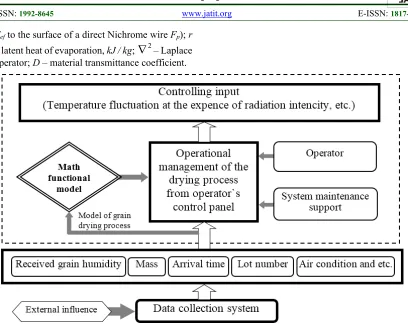
The information support system of IR grain drying is offered with due to external and controlling influences, as shown in Figure 1 .
In view of the infrared radiation heat transfer theory, is being offered a system of differential equations of motion of heat and moisture in the grain mass by using infrared drying with double-sided heat supply [16–18]:
T D Y Y Y c r T T p 2 2 2 ;
, (1)
where δ – heat and moisture factor 1/K;
T–
temperature gradient K/m;
Y– the gradient of
moisture content; – coefficient of proportionality р ef F F
(let`s assume that the
7589 Fef to the surface of a direct Nichrome wire Fp); r – latent heat of evaporation, kJ / kg;
2– Laplace operator; D – material transmittance coefficient.Figure 1: Scheme of the system module of infrared grain drying information support
Integral equation of warm and moisture transfer is as follows [19–21]
d dT c R d
Y d R r
q 0 0 p , (2)
where R = /F the ratio of volume of the body to the surface.
Thus, the components of heat and moisture transfer can be expressed as the following equations:
. )
(
; )
(
0 0
d T d c R q
d dY R r q
p T
Y
(3)
The resulting system of Equations (3) determines the main parameter for the system module of infrared grain drying information support - the moisture content in the grain mass, as it`s the very one which determines the quality of the process.
A solution to the equation provided with boundary conditions is a function T=f(x,,En,Wpr). In order both arguments, which are being differentiated, increased in the process of dehydration, it`s necessary to replace the moisture concentration with dry maters, we get:
.
2 2
p c p
с
p c
w c
r x
T a с
T
p
p (4)
As a result of the drying process mathematical model implementation (4), the thermal fields are determined by the product layer, depending on the concentration of dry matter, the optimum time exposure at various initial moisture content in grain, and others. Solution to differential equations of heat and moisture transfer with boundary conditions, which correspond to the combined drying of colloid capillary–porous materials, and their analysis using similarity criteria and internal evaporation rate showed, that the movement of moisture from the inner layers to the surface at a constant drying rate period occurs as a liquid as well as vapor.
7590 it is not realistic to provide an even layer height. Consequently, during the IR drying the heat unequally penetrates into the interior of the grain mass, and in various layers the material has a different temperature. Each layer is described by its equation, using the model constructing procedure for each separate layer [21–23].
For the first layer (heat supply directly from the IR source)
). (
) ( ) (
/
1 0 3
1 2 2 1 1
T T k
T T k T T k d
dT ик
(5)
The change in temperature in the i and n layer can be described respectively by the following equations:
). (
/
); ( ) ( /
1 2
1 2 1 2
n n n
i i i i i
T T k d dT
T T k T T k d dT
(6)
As a result of mathematical modeling of the IR grain drying system of differential equations of the drying process of colloidal capillary-porous bodies with unilateral and bilateral heat input depending on the concentration of dry matters,
taking into account the optimal exposure time at various initial moisture content of grain, was obtained.
2.3. Modeling infrared grain drying system withLABVIEW
Information technologies and the modern high-level programming languages have helped to develop a computer model and system of the IR grain drying processes optimization.
In order to increase measurement accuracy in the experimental researches, as well as to expedite processing of the statistical data arrays, the automated control system (ACS) to measure and record the IR drying parameters, based on the use of hardware and software information technology, have been developed.
[image:4.612.169.486.400.545.2]This ACS includes sensing devices (temperature and humidity sensors); an inputoutput devices (ADC - DAC); a computer; corresponding software; elements of hardware control, which are used for implementation of the processes; an operator (Figure 2.).
Figure 2: Scheme of the automated control and adjustment of parameters of studied IR grain drying system
Interfaces are implemented in Delphi, basic procedures - in Object Pascal, VBA, LabVIEW 10 technology were also used (see fig. 3 for the details).
[image:4.612.332.517.572.695.2]7591 The ACS system includes several subsystems with software modules for the information and intelligence support; databases with physico-chemical and biological indicators of dried products, as well as the module for statistical processing of the results of experiments; a statistical models repository in the form of regression equations combined in the generalized model; also modules to estimate the quality of a dried product.
Subsystem for modeling heat and mass transfer processes in the IR grain drying includes function to determine parametric field changes in temperature, humidity and biological components of the product while drying; it is designed to calculate the optimal process conditions and select the type of energy supply (IR, combined drying and other methods, mathematical models of which have been previously described in the second chapter).
The module for temperature control, developed in Delphi 2010, and partly in LabVIEW, was also designed for graphical representation of changes in temperature and humidity in the different zones (layers) of a grain mass in the drying chamber.
The subsystem for the temperature monitoring and control is designed based on a personal computer (PC) with LabVIEW software environment and NI DAQ - PCIX board modules (input-output device) on the following principles: a relatively simple hardware design, reliable and convenient software interface.
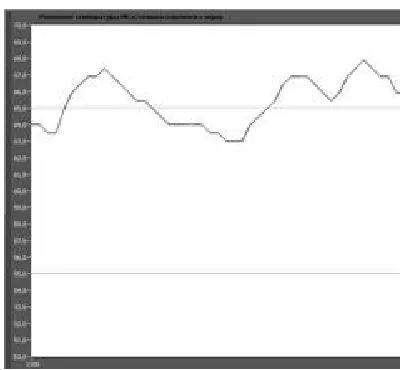
Subsystem is functioning in the following manner: the signals from the humidity sensors (MD7822) and temperature (USB thermometers) are transferred to DAQ-board - multifunction data collection unit, where they are converted into a digital code, filtered from interference and are translated into values in accordance to the selected units of measurement (in this case in volts). The signal in digital form was transferred into a computer, where via the software product "Control and regulation of the temperature of IR – drying grain" developed in Delphi and LabVIEW, it averaged over a specified time interval. Then the signal was calibrated using coefficients to the Celsius degrees and displayed on the monitor of the virtual oscilloscope, see. Fig. 2, and then compared with the critical values. Fig. 4 shows the results of simulation in LabVIEW of the process of IR grain drying for
K
Tp328338 option.
With the virtual oscilloscope made it possible to monitor changes in temperature of IR drying in time. Then the signal is fed to the device that
[image:5.612.322.524.135.320.2] [image:5.612.322.528.365.533.2]controls switching on and off of the infrared lamp. The block diagram of this software is shown in Fig. 5.
Figure 4: Oscillogram of the temperature simulation of a drying chamber generated in the LabVIEW
Figure 5: Block diagram of the drying chamber LabVIEW
Model developed ACS can be represented as an ordered set
),
,
,
S
,
Y
,
X
,
(
(7)where 𝜏 – a set of points in time at which there is an ACS; X, Y – respectively a set of input and output signals; S – the set of states of the ACS;
7592 output signal as a response of ACS to internal and external disturbances.
Measured parameters are observed in the state
t
S
s
in the multitude instants of time
n
t
when the input actionx
t
X
. This means that any change of the output vectory
t
Y
with fixed vectorx
t
X
corresponds to a certain change of the vector of state of ACS
2 1
2 1
2 1
,
;
t
t
t
t
t
t
y
s
s
y
(8).
Due to this, output variables yj, j1,J are
used as characteristics in the current state of ACS. With hardware and software defined value
~
y
of the measured physical quantity Y. Therewith, the measurement is represented as specific information process, the result of which is to obtain quantitative information on the measured physical quantities - measuring data.When determining the values of the observed physical quantity, measuring result were resented with LabVIEW virtual tools, in the form of the analytical correlation:
0
~
ky
y
, (9)where
y
~
– the current measured Y value; y0– the value of magnitude adopted as a sample; k – the ratio of the measured value to the value of the sample.Thus, information modeling in the initial phase of the research, allowed to study all aspects of information support of the grain drying. This enabled us to define efficient parameters and modes of IR grain drying, particularly through the introduction of a computerized data management system.
2.4. Experimental study of the influence of various parameters of information support system of grain infrared drying on heat and evaporation in a drying chamber
The laboratory studies were conducted on the experimental setup. The device is a double-strand drying chamber equipped with infrared drying sources and hardware-software operational modes control system – "Monitoring and control of IR grain drying temperature".
The purpose of experimental research of hardware-software part of the drying chamber – learning IR drying mode control system, detection of properties, which adversely affect the system availability as a whole, and any exception to these properties, or reduce of their influence.
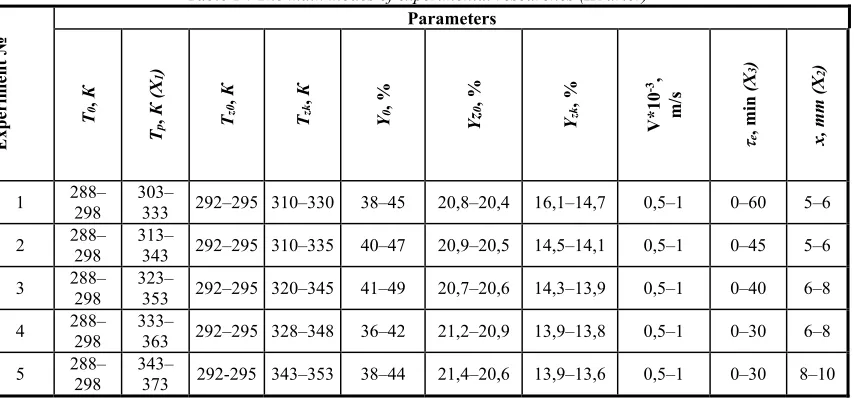
In each series three experiments were carried out: at a temperature of infrared heaters =303…373 K in the experiments with drier only by supply of radiant energy and at a constant temperature of prepared air Tв = 303…313K and Tp = 323…363 K. The experiments were performed with initial grain moisture in the range of – 20–22%.
7593
Table 1 : The main modes of experimental researches (IR drier)
Exp
erimen
t
№
Parameters
T0
,
К
Tp
,
К
(
Х1
)
Tz0
,
К
Tzk
,
К
Y0
, %
Yz
0
, %
Y
zk
, %
V*10
-3,
m/s
e
, mi
n
(
Х3
)
х
, m
m
(
Х2
)
1 288–298 303–333 292–295 310–330 38–45 20,8–20,4 16,1–14,7 0,5–1 0–60 5–6
2 288–298 313–343 292–295 310–335 40–47 20,9–20,5 14,5–14,1 0,5–1 0–45 5–6
3 288–298 323–353 292–295 320–345 41–49 20,7–20,6 14,3–13,9 0,5–1 0–40 6–8
4 288–298 333–363 292–295 328–348 36–42 21,2–20,9 13,9–13,8 0,5–1 0–30 6–8
[image:7.612.100.523.338.488.2]5 288–298 343–373 292-295 343–353 38–44 21,4–20,6 13,9–13,6 0,5–1 0–30 8–10
Table 2 : The main modes of experimental researches (IR drying + convective heat transfer)
Exp
erimen
t
№
Parameters
T
0
,
К
Tp
,
К
(
Х
1
)
Tz0
,
К
Tzk
,
К
Y0
, %
Yz0
, %
Yzk
, %
V*10
-3, m/s
e
, mi
n
(
Х
3
)
х
,
mm
(
Х
2
)
vb
, m
/s
1 288–298 303–323 292–295 310–330 39–44 20,7–20,4 15,7–4,5 0,5–1 0–60 5–8 2–5 2 288–298 313–333 292–295 310–335 42–49 20,6–20,5 14,2–14,0 0,5–1 0–45 5–8 2–5 3 288–298 323–343 292–295 320–345 42–47 20,7–20,6 14,0–13,8 0,5–1 0–40 8–10 2–5 4 288–298 333–353 292–295 328–348 40–45 20,9–20,5 13,8–13,7 0,5–1 0–30 8–10 2–5 5 288–298 343–353 292–295 343–353 45–49 21,7–21,1 13,7–13,6 0,5–1 0–30 10–12 2–5
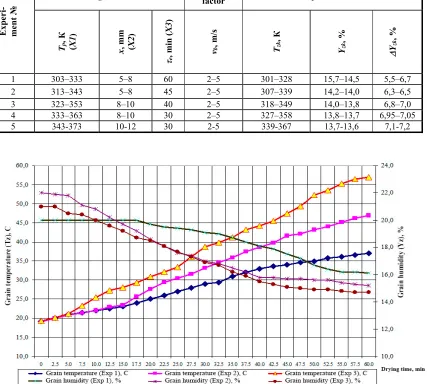
The basic research results obtained during the real experiment on the stand with appliance of the hardware-software operational modes control system of IR grain drying process are presented in Tables 3, 4 and also as shown in Figure 6.
It is intrinsic to all series of experiments that with increasing temperature of the infrared radiation source, the grain layer temperature is increasing continuously, which is connected to a decrease in the amount of humidity in the grain. Upon that with the increase of operating IR source temperature up to Tp=343–352 K, run up to the optimum temperature of the grain mass Tz=333–
7594
Table 3 : The results of experimental researches
Exp
erimen
t
№
Parameters
Manageable rates Response function
Тр
, К (
Х
1
)
х
, mm
(
Х
2
)
e
, mi
n
(
Х
3
)
Tzk
, К
Yzk
, %
Yzk
, %
1 303–333 5–8 60 300–330 16,1–14,7 3,9–5,3
2 313–343 5–8 45 309–341 14,5–14,1 6–6,4
3 323–353 8–10 40 321–352 14,3–13,9 6,2–6,6
4 333–363 8–10 30 331–361 13,9–13,8 6,6–6,7
5 343–373 10–12 30 342–370 13,9–13,6 6,85–7,25
Table 4 : The results of experimental researches
Exp
eri-ment №
Parameters
Manageable rates Addi-tional factor Response function
T
p
, К
(
Х
1
)
x
, mm
(
Х
2
)
e
, mi
n
(
Х
3
)
v
b
, m
/s
Tzk
, К
Yzk
, %
Yzk
, %
1 303–333 5–8 60 2–5 301–328 15,7–14,5 5,5–6,7
2 313–343 5–8 45 2–5 307–339 14,2–14,0 6,3–6,5
3 323–353 8–10 40 2–5 318–349 14,0–13,8 6,8–7,0
4 333–363 8–10 30 2–5 327–358 13,8–13,7 6,95–7,05
[image:8.612.99.526.328.712.2]5 343-373 10-12 30 2-5 339-367 13,7-13,6 7,1-7,2
7595 Developed computer IR drying control system allows selecting and calculating rational process parameters inclusive of grain material characteristics.
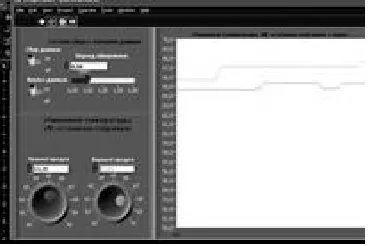
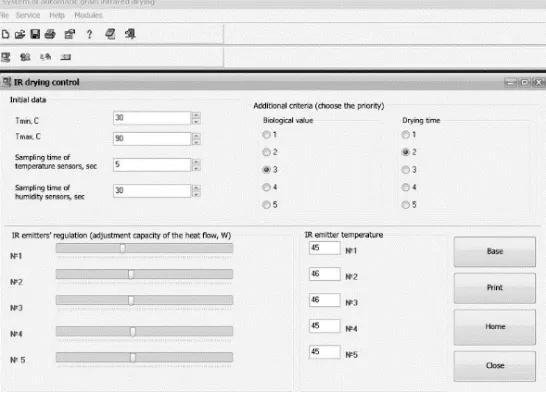
In the system module of infrared grain drying information support (SMIGDIS), a special input into windows is contemplated, thermal parameters – initial temperature and humidity of the drying product, as well as printing the
[image:9.612.169.442.211.409.2]outcome: changes in temperature and humidity of grain, the selection of technological regimes at which the drying of the products will have food and biological value in accordance to maximum value of the quality functional, as shown in Figure 7.
Figure 7 : Interface of IR heaters control module
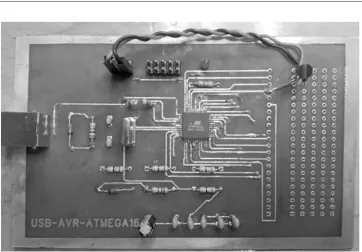
The hardware and software temperature control module of infrared sources "Quirin" for information support of grain infrared drying system was implemented on a printed circuit board with a microcontroller Atmel ATMega16.
As a result, the printed circuit board was designed for temperature control in the drying chamber, as shown in Figure 8 [23–27].
Ten sensors of USB thermometers (five in the upper and lower parts of the stand, as shown in
7596
Figure 8 : Machinery card for temperature control in drying chamber
Figure 9 : USB thermometers
In the frame of a module development of the system module of infrared grain drying information support and the program “System of automatic grain infrared drying”, are designed and created the database table with the biological parameters of the drying material. This makes it possible to more accurately predict the execution time of operations, depending on factors such as
heat transfer and heat transfer coefficients of various cereal species, content of protein and gluten and others.
3. RESULTS
[image:10.612.178.433.365.607.2]7597 in Ukraine, have shown the feasibility of the information systems use for the automated control systems of drying grain infrared radiation. Such an approach in grain drying saves a lot of conventional fuel, to use a modular approach to the revision of the existing equipment, as well as a dried product of high quality.
The lack of flexibility in reconfiguring SIPIKSZ – one of the main problems, hampering the development of computer technologies, used in information support drying processes of different agricultural production systems. In addition to the system of high-speed external peripherals imposed certain limitations due to the small capacity and the USB COM-2 personal computer ports, which is part of SIPIKSZ.
Therefore, the prospects for further research are to develop and equip the system with modern USB thermometers. These devices allow to accurately measure the temperature of the grain, the drying agent and IR radiation source. In the nearest future it is planned to equip the experimental set speed thermometers with 3 USB-interface to connect a PC with the installed program management and IR heating elements stand.
As a result of the research:
1. It was developed the mathematical model for the system of information support of infrared drying of grain, taking into account the density of the heat flux incident on the surface of the grain mass in the drying chamber, and other technological factors affecting the penetration of infrared waves in capillary-porous products. A system of differential equations of the drying process of colloidal capillary-porous bodies with double and single heat inlet;
2. Were conducted experimental studies of the influence of various parameters of information support system of infrared drying grain on heat transfer and evaporation in the drying chamber. The evaluation of the various options for using SIPIKSZ module. In a series of experiments, a combined supply of heat (IR + convective component), it was found that the reduction of time for drying is between 32% to 39% for the variant using the information system and high controls, measuring and recording the IR drying parameters.
However, the proposed model, in our opinion, is more effective than similar models described in works [1, 9, 11, 13].
The results presented here are not intended to cover all of the issues related to this topic. They simply reflect a set of shared conclusions that our
group agreed, during an intense period of common research (April 2014 – April 2018).
4. CONCLUSIONS
The work is devoted to information support of grain infrared drying, on the basis of a rational choice of the process temperature and computer control.
It is indicated that the efficiency of electrical means of infrared radiation (IR) used in the drying process, is due to the application of new scientific methods and energy supply management tools using programmable controllers, computers, new information technology (IT) and systems.
It was proposed a model of the drying process of colloidal capillary-porous bodies with double and single heat inlet depending on the concentration of solids, it was selected a rational exposure time of IR source with different initial moisture content of grain.
Experimental researches were conducted and testing of the proposed model, which showed high efficiency of IT for computer control systems grain drying using infrared radiation.
It was experimentally validated reducing drying time up to 39% for the options to apply the information system support and process control with combined heat inlet. It was educed the influence of the convective component of the dynamics of the process of evaporation of moisture from the grain mass with different thickness.
The results obtained while being researched, can significantly reduce the consumption of fuel, use a modular approach to the revision of the existing drying equipment, as well as a dried product of high quality.
REFERENCES
[1] Celmaa, A.R., Rojasa, S. & Lopez-Rodríguezb, F.. Mathematical modelling of thin-layer infrared drying of wet olive husk. Chemical Engineering and Processing: Process Intensification 2008, 47(9–10), 1810–1818.
[2] Celmaa, A. R., López-Rodríguezb, F. & Cuadros, B. F. Experimental modelling of infrared drying of industrial grape by-products. Food and Bioproducts Processing 2009, 87(4), 247–253.
vibration-7598 assisted infrared (IR) drying. Journal of Food Engineering 2009, 95(1), 166–171. [4] Pan, Z. Khir, R. Godfrey, L. D., Lewis, R.,
Thompson, J. F., & Salim, A. Feasibility of simultaneous rough rice drying and disinfestations by infrared radiation heating and rice milling quality. Journal of Food Engineering 2008, 84(3), 469–479.
[5] Khir, R., Pan, Z., Salim, A., & Hartsough, B. R. Moisture diffusivity of rough rice under infrared radiation drying. LWT - Food Science and Technology 2011, 44(4), 1126– 1132.
[6] Shi, J. Pan, Z. McHughc, T. H., Wood, D., Hirschberg, E., Olson, D. Drying and quality characteristics of fresh and sugar-infused blueberries dried with infrared radiation heating, LWT - Food Science and Technology 2008, 41(10), 1962–1972. [7] Terhoeven-Urselmans, T., Schmidt, H.,
Joergensen, R. G., Ludwig, Bernard (2008). Usefulness of near-infrared spectroscopy to determine biological and chemical soil properties: Importance of sample pre-treatment. Soil Biology and Biochemistry 2008, 40(5), 1178–1188.
[8] Li, Z.Y., Wang, R.F. & Kudra, T. Uniformity Issue in Microwave Drying. Drying Technology: An International Journal 2011, 29(6), 652–660.
[9] Ponkham, K., Meeso, N., Soponronnarit, S., Siriamornpun, S.. Modeling of combined far-infrared radiation and air drying of a ring shaped-pineapple with/without shrinkage. Food and Bioproducts Processing 2012, 90(2), 155–164.
[10] Kumar, C. Karim, M.A. & Joardder, Mohammad U.H. Intermittent drying of food products: A critical review. Journal of Food Engineering 2014, 121, 48–57. [11] Mujumdar, A.S., Law, C. L. Drying
Technology: Trends and Applications in Postharvest Processing. Food and Bioprocess Technology 2010, 3(6), 843– 852.
[12] Zare, D. & Chenb G. Evaluation of a simulation model in predicting the drying parameters for deep-bed paddy drying, Computers and Electronics in Agriculture 2009, 68(1), 78–87.
[13] Kaleta, A. & Górnicki, K. Evaluation of drying models of apple (var. McIntosh) dried in a convective dryer. International Journal of Food Science & Technology 2010, 45(5), 891–898.
[14] Hacıhafızoğlu, O., Cihan, A. & Kahveci K. Mathematical modelling of drying of thin layer rough rice. Food and Bioproducts Processing 2008, 86(4), 268–275.
[15] Vadivambal, R. & Jayas, D. S. Applications of Thermal Imaging in Agriculture and Food Industry – A Review. Food and Bioprocess Technology 2010, 4(2), 186–199.
[16] Doymaz, I.. Thin-layer drying of spinach leaves in a convective dryer. Journal of Food Process Engineering 2009, 32(1), p. 112– 125.
[17] Kumar, N., Sarkar, B.C. & Sharma, H.K. Mathematical modelling of thin layer hot air drying of carrot pomace. Journal of Food Science and Technology 2012, 49(1), 33–41. [18] Sagar, V.R. & Kumar, P. S. Recent advances
in drying and dehydration of fruits and vegetables: a review. Journal of Food Science and Technology 2010, 47(1), 15–26. [19] Doymaz, I. Thin-layer drying characteristics
of sweet potato slices and mathematical modelling. Heat and Mass Transfer 2011, 47(3), 277–285.
[20] Song, X., Zhang, M., Mujumdar, A.S. & Fan L.. Drying Characteristics and Kinetics of Vacuum Microwave–Dried Potato Slices. Drying Technology: An International Journal 2009, 27(9), 969–974.
[21] Kocabiyik, H. & Tezer D.. Drying of carrot slices using infrared radiation. International Journal of Food Science & Technology 2008, 44(5), 953–959.
[22] Doymaz, I.. Drying of pomegranate seeds using infrared radiation. Food Science and Biotechnology 2012, 21(5), 1269–1275. [23] Lahkno, V. A., Shirjaev, D. A., &
Romanchenko, T. P. Imitacionoe modelirovanie v sisteme LABVIEW 2010 infrakrasnoj sushki zerna.
[24] Lahkno, V. A. "Ispol'zovanie komp'juternyh sistem dlja povyshenija jeffektivnosti informacionnoj podderzhki infrakrasnoj sushki zerna monografija." Lugansk: Jelton-2, 2011.
[25] Lahno, V., Shiryaev, D. TeoretichnI aspekti rozrahunku peremischennya teploti v zernovIy masI pri vikoristannI ICh dzherela energiyi, 2010, 228–234.
[26] Borowik, B., et al. Theory of Digital Automata. Vol. 63. Springer Science & Business Media, 2012.