1060
AN EFFICIENT METHOD OF EEG SIGNAL COMPRESSION
AND TRANSMISSION BASED TELEMEDICINE
1ISMAIL@ISMAIL YUSUF PANESSAI; 1,2AZMI SHAWKAT ABDULBAQI
1 Computing Department, Faculty of Arts, Computing and Creative Industry, UPSI Malaysia.
2 College of Computer Science & Information Technology, University of Anbar, Iraq.
E-mail: [email protected]
ABSTRACT
In this article, an efficient algorithm for EEG signals compressing and transmission based on RLE and DWT was introduced. The compression ratio (CR) provided by this algorithm is relatively high with low percent root-mean-square difference (PRDN) values. 50 records of EEG patients were monitored from the life database. Each record of EEG signals is commonly reported at the sampling rates in clinical and research settings between 250 and 2000 Hz. On the other hand, the new EEG data collection systems are able to record at sampling rates more than 20,000 Hz. The signals can be analyzed in both the time domain (TD) and frequency domain (FD) under using DWT where it preserves the necessary and main features of the EEG signals. Next step to implement this proposed algorithm is using the thresholding and the quantization over EEG signals coefficients and then encoded the signals by using RLE that enhancement significantly the compression ratio (CR). This article presents a robust method of EEG signal compression and transmission consists of DWT (discrete wavelet transform) and RLE (run length encoding) in order to improve and enhanced the compression. The suggested model presents an average values of CR (compression ratio), PRD (percentage root mean square difference), PRDN (normalized percentage root mean square difference), QS (quality score ), and SNR (signal to noise ratio) of 44.0, 0.36, 5.87, 143, 3.53 and 59.52 alternately over 50 records of EEG data.
Keywords: Encephalopathy, Run-Length-Encoding(RLE)-Discrete Wavelet Transform(DWT);
Compression Ratio(CR);Telemedicine, Savitzky–Golay filter(SG filter).
1. INTRODUCTION
Since a long time, developing countries have been the biggest medical challenge in the world. Healthy rural areas provided the best opportunities for attracting professionals and diverse medical facilities. A telemedicine proved a strong base for rural regions in this regard. The term of telemedicine is a technological application for communication for medical data transmission and receiving and consulting between patients and specialists for healthcare in remote rural areas.
Through telemedicine, medical data can be sent remotely from remote areas to the appropriate doctor's premises and vice versa. After analyzing a medical data received from patients, sensitive medical consultations can be sent from caregivers to the remote areas in order to obtain appropriate healthcare for patients. By using the telemedicine, the people in the rural regions can be can benefited by caregivers (doctors and specialists). Recently, chronic diseases, (such as encephalopathy), are the first cause of death in the world and rising
exponentially. This is a caused by a great concern to caregivers as brain experts are unavailability in those remote rural areas. This trouble can be solved by using a telemedicine app. Using telemedicine, the data of EEG can be sent /received from rural areas to encephalopathy caregivers centers.
For better health monitoring of encephalopathy patients, caregivers can send and received a medical consultation to the remote regions after received and analyzed an EEG data. The EEG can be defined by electrophysiological signals caused by the human brain. One of the essential obstacles of better transmission via telemedicine is a huge continuous EEG data. To reduce the size of EEG data, A compression techniques can be employed. EEG data compression causes data to be transmission efficiently via telemedicine.
1061 Figure 1: Electrodes locations of EEG signals
acquisition
2. THE QUALITY ON-DEMAND
COMPRESSION ASSESSMENT
A higher compression can be performed by decreasing the quality of the reconstructed signal and vice versa.
A clear trade-off can be made for the good quality of the decoded signal with an important amount of compression. With the applications of telemedicine, specialists in the receiving side must adjust certain parameters interactively associated with compression algorithm according to specialist's quality interests.
There are two factors, namely, bits per sample (BPS) and percent of root-mean-square-difference (PRD) define the quality on-demand terms, rarely, bandwidth constants and reconstructed signal quality, sequentially. This article describes the quality of on-demand compression plan for EEG signal using hybrid proposed technique consists of DWT and RLE respectively.
The fidelity of the EEG reconstructed signals are measured quantitatively by four parameters, namely, SNR, PRD, PRDN, QS, and CR. For EEG signal compression, there is two-step of lossless compression plans including anticipator in the first step with an entropy encoder in the second step have been used successfully. Here, the main purpose of the predictor is to calculate the existing value of a sample using its past samples and then transmit only the error (signals residues), which are generally smaller and the size of the original samples. Both of the encoding and decoding simulate a symmetrical prediction process.
The prediction method begins with the transmission of initial header information and the selected number of input sample values. On the receiver side, the prediction method is returned and the original input is restored by adding
structural units sent to the expected values. If the error signals are sends based-on specific threshold values followed by quantification, there is a probability of best compression, and it may medically accepted as long as the reconstructed signal maintains the expected diagnostic features. The efficiency of the compression can be more enhancement by using an arithmetic entropy encoder in the second step. We can be performed a higher compression by decreasing the reconstructed signal quality and vice versa.
The main purpose of the proposed compression technique is to gain the reconstructed EEG signal suitable for clinical diagnosis at CR and PRD. The threshold and quantification effect determines the quality standards on-demand, and a better balance is achieved between CR and PRD for clinical examination. For the transmission and receiving in the telemedicine, there is one can be guaranteed the quality of diagnostic of the reconstructed EEGs based-on relevant election of the fidelity criteria with the utilization of effective low-bandwidth.
Based on outcomes shown in Table 3, that the proposed scheme was found achieves acceptable results if comparing with other methods
3. RELATED WORKS
To satisfy the article requirements, a survey of authors working in the field of EEG signal compression is conducted to carry out good and advanced applications with optimal operation. The survey includes a comparison between the various methods proposed and the transition between these methods for the purpose of achieving the best pressure for brain signals.
1062 problem method to perform the best compression outcome by using artificial neural network predictor. The EEG signal reconstructed is evaluated and estimated by using PRD, SNR, cross-correlation, and power spectral density parameters. With low-value PRD and single layer perception, the reconstructed signal can be retained for important information. It provides the best compression outcome if compared with lossless methods. Yu-Ting Pai,Fan-Chieh Cheng,Shu-Ping Lu, and Shanq-Jang Ruan [4] has displayed a low bit rate transmission method. The new contribution in the proposed method is the stuffing bit can be decreased conspicuously while retaining a high compression ratio. Tao Ma, Pradhumna Lalshrestha, Michael, Hempel, Dongming Peng, Hamind Sharif &Hsiao-Hwa Chen [5] have been mentioned on developments in energy saving communications, high-quality transmission, and security. With a proposed scheme to decrease the transmission bits under the same CR (compression ratio) and the proposed scheme can be utilized for multimedia data transfer. M. Somasundaram and R.Shivakumar, have reported a survey on the cases related to the security and possible outcomes utilized to address them in the study and the forthcoming IEEE standard. The survey displayed that the popularly proposed outcomes in the security are still having restrictions needing more research and then, the survey also mentioned more areas of research being proposed in the literature [6]. N. S. [7], present presents a novel and efficient high-performance lossless EEG compression using WT and ANN predictors. Z. Z. et al. [8], present a proposed study to use the structure of block sparse Bayesian learning, which has superior efficiency to another existing compressed sensing algorithms in retrieve non-sparse signals to overcome the problem of EEG is not sparse signals in the time-domain not sparse in transformed-time-domains. D.D. et al.[9], present an efficient method for single or multichannel EEG compression using EZW method as this method gives gradually encoding which can be stopped anywhere or depending upon required bit rate. S.U et al. [10], present a new and easy preprocessing method of arranging EEG in matrix form before compression. R.M.[11], present a high-performance hybrid multichannel EEG compression algorithm based-on frequency transformatibased-on and parameter extraction methods. S. C. et al.[12], improve an effective algorithm EEG lossless compression by using the WT followed by AC(arithmetic coding) on the residual. K. et al.[13], developed a lossless hybrid EEG compression method based on the characteristic of DCT frequency spectrum and the
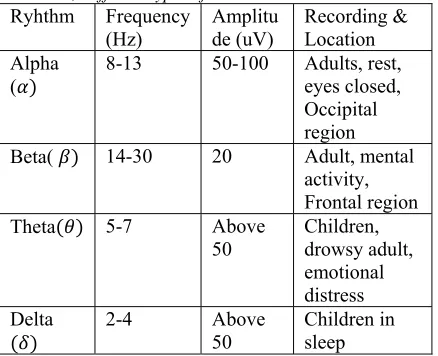
Huffman coding. Below fig.(2), show the different kinds of EEG waves. The following fig. (1 to 5) and table 1, illustrates the different types of EEG waves.
(a)
(b)
( c )
1063
(d)
( e )
[image:4.612.90.272.76.416.2]
(f)
Figure 2, Types of EEG waves, a. Delta Wave b. Theta Wave c. Alpha Wave d. Beta Wave e. Gamma Wave f.
Input EEG Signal
Table 1, Different types of brain waves in normal EEG Ryhthm Frequency
(Hz)
Amplitu de (uV)
Recording & Location Alpha
(𝛼 8-13 50-100 Adults, rest, eyes closed, Occipital region Beta( 𝛽 14-30 20 Adult, mental
activity, Frontal region Theta 𝜃 5-7 Above
50 Children, drowsy adult, emotional distress Delta
𝛿 2-4 Above 50 Children in sleep
4. RESEARCH OBJECTIVE :
The aim of this system is offering a reliable Hardware/Software solution for EEG diagnosis.
Moreover, the system is targeted for telemedicine, thus the needs of compression and transmission are therefore at the very core of this system. In order to solve this problem, proposed a new system-level architecture consists of DWT and RLE to transmit a compressed ECG signal during the acquisition.
This system is based on an acquisition device that is based on compression. When the EEG signal acquisition is done, the data are compressed and transferred to a remote server until the interpretation is performed by an expert. When the EEG signal acquisition is done, the data are compressed and transferred to a remote server until the interpretation is performed by an expert. Here, compression of the EEG signal is important, due to reducing the data size and minimizing the transmission time.
The main goal of the EEG signal compression is
1. Signal compression with adequate size.
2. Preserve the most valuable clinical information. 3. Provide a minimal loss in signal fidelity while maximizing CR
5. LOSSY COMPRESSION
Lossy data compression reduces bits by analyzing unnecessary information and removing this unwanted information.
From all available data lossy compression techniques, DWT is most efficient compression technique needs to be chosen due to[30]:
1. DWT is a powerful and influential method in the compression process, and methods based on DWT have been shown to perform well.
2. Have a little impact on the EEG signal data
3. Can compress EEG signal to several levels, due to wavelet-based methods offer good performance in terms of compression.
4. DWT is perfect for non- stationary signals compression.
5. Basically it gives multiple resolution decomposition of a signal
[image:4.612.85.304.472.650.2]1064
6. THE SCENARIO OF EEG SIGNALS
COMPRESSION
6.1 Compression Phase
1. Preprocessing of EEG signals
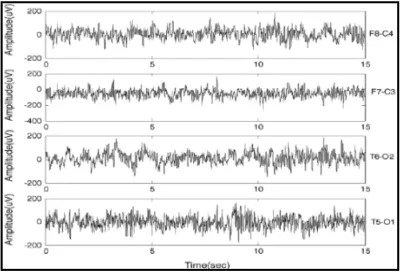
[image:5.612.93.295.394.532.2]The example of the EEG signal contains a noise in the power line. Therefore, it is necessary to extract the precise EEG characteristic to eliminate this noise. To create the proper pre-filter for the elimination of signal noise, each EEG signal is decomposed with the frequency response. The selected signals have a sampling frequency of 360 samples / second. Therefore, using the Nikyst standards, the frequency response range was selected from 0 Hz to 180 Hz. The signals are displayed in the frequency range from 0 Hz to 50 Hz in the lower range and from 130 Hz to 180 Hz. Hz. On a larger scale. Therefore, a notch filter of comparable ranges can be used for the pretreatment of EEG signals. When the original signals have a high resolution, these signals may be inactive. The sampling frequency of these real (original) signals is 360, then the original signal is sampled by a factor of 2. The fig.(3) described below show the normal EEG signal sample
Figure 3: Normal EEG Signal Sample
The example of the EEG signal contains a noise in the power line. Therefore, it is necessary to extract the precise EEG characteristic to eliminate this noise. To create the proper pre-filter for the elimination of signal noise, each EEG signal is decomposed with the frequency response. The selected signals have a sampling frequency of 360 samples / second. Therefore, using the Nikyst standards, the frequency response range was selected from 0 Hz to 180 Hz. The signals are displayed in the frequency range from 0 Hz to 50 Hz in the lower range and from 130 Hz to 180 Hz. Hz. On a larger scale. Therefore, a notch filter of comparable ranges can be used for the
pretreatment of EEG signals. When the original signals have a high resolution, these signals may be inactive. The sampling frequency of these real (original) signals is 360, then the original signal is sampled by a factor of 2 [13][28].
2. Peak detection:
The highest signal peaks are detected during the peak detection method. The proposed peak detection technique depends on the characteristics of the EEG signal. One of the characteristics of the EEG is the amplitude of the maximum threshold. the amplitude of the threshold is the value of the minimum possibility of the peak. Values below this threshold are not maximum. The second EEG attribute is the minimum distance between the vertices of the bottom part). The advanced detection method that is suggested here is described. First, specify the maximum value in some samples. If the maximum value is greater than the threshold, the peak is taken into account. Samples adjacent to the previously discovered peak may be larger than the maximum threshold amplitude. Therefore, to detect the next peak, all neighboring samples are removed from the current detected peaks. This will prevent the detection of pseudo-peak samples adjacent to the recently detected peak [14].
3. Linear transformation:
The EEG signal is evaluated in several shifts. Each round consists of a sample between two sequential peaks. Each EEG shift, a separate FFT is calculated. The FFT values are measured for the storage objective. Different quantification factors ranging from 0: 1 to 4 are chosen to analyze the impact of the quantification.
4. Entropic coding (Hoffman coding):
1065
6.2 Eeg Signals Reconstruction Phase:
The reconstruction phase of the EEG signals or the decompression procedure is the reverse compression procedure. This decoding phase comprises the encoded entropy signal, the inverse linear transformation and the post-processing. The constructed EEG signal is created to regenerate. The EEG signal is given as input to the decompression process [16].
6.2.1 Decoding of the entropic encoded signal:
There are two types of bits encoded in a compressed signal. First, a transmission containing Huffman coding codes is transmitted to the Huffman decoder. The Huffman Decoder decodes the bits using the Huffman Dictionary. Then, the second bitstream decoder, which does not have Huffman coding codes. The values of the second bit sequence contain the DWT values and their indices in the original vector. The values of these indices are assigned to the Huffman block previously decoded with the aforementioned DWT values in the second bit stream [17].
6.2.2 Reverse linear transformation:
DWT was used for the linear transformation in the compression stage. Therefore, the discrete transformation of discrete wavelets (IDWT) is used in the reverse process. An IDWT is calculated for each cycle. Each turn depends on a sample between two consecutive peaks. The result of the reverse entropy coding is divided into several cycles based on peak indicators. Then it is fed to the EFT block. The output of the EEG signal will be reconstructed with a certain tolerance due to the quantization used in the compression phase[18].
In postprocessing phase, the IFFT signal is fed to the samples. Then, the sample output is fed to the post-stop band filter. A generated signal reconstructs the EEG signal. This is compared to the original reference to estimate the performance of the suggested technique [19].
7. MATERIALS AND METHODS
7.1 Overview
EEG (Electroencephalography) involved a recording of the electrical potential stimulated by the scalp.
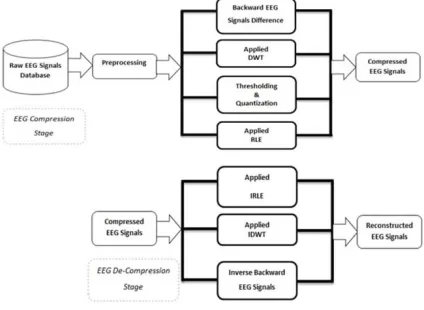
The proposed method consists of two phases : compression phase and decompression phase as shown in figures(4). Compression phase show both the EEG signals compression that is used at transmitter side (the patients) via telemedicine, and decompression phase is the EEG signals decompression at the receiver side( the specialists) via telemedicine[20].
[image:6.612.319.531.329.484.2]To achieve the compression process, there are 50 EEG signals records related have been preprocessing before backward signal difference (BSD) is applied. The preprocessing begin with filtering the EEG signals to reduces the power line interference of 50 Hz, and then applied backward signal difference for EEG signals which lossless compresses by 50%. After that, applied DWT for EEG signals after applying and implement threshold and quantization grades of these signals[21,22].
Figure 4: Two Stages of EEG Signals processing – Compression and Decompression (Reconstruction)
7.2 Savitzky–Golay filter (SGF):
A digital filter (also called DSP filters (digital smoothing polynomial filters)), used for signals data smoothing to set of digital data points in order to improve SNR (signal-to-noise ratio) without signals data deforming. SG filter smoothing filters present a better standard averaging FIR filters, which results in the filtering of a large portion of the high-frequency digital signal content along with the noise. The SG filter is very effective conserve a high-frequency component of signals if this signals compared with finite impulse response (FIR) filters. In the figure(5) below demonstrate the original EEG signals with using Savitzky –Golay filter [23].
1066 applied. At the reconstruction side, applied inverse run length encoding (IRLE) and inverse discrete wavelet transform (IDWT), and finally applied backward difference[31].
Figure 5: (a) The Noisy original EEG Signal and, (b) Enhanced EEG Signal after applied SG Filter.
7.3 Compression with Wavelet Transform
The wavelet transforms analysis (WTA) of EEG signal can be achieved in both time domain and frequency domain, and it also retains very well of the local features of the signal. Then, it is fitted well for use in the biomedical signal compression, where it preserves the features of the EEG signal safety[24].
In the time domain, a function of mother wavelet is ψ (t) with zero average, according the below equation (1):
ψ t
dt
0
(1)The function of daughter wavelet with parameter p (scale parameter) and parameter q (translation parameter) can be represented by the following equation (2):
ψ
,t
1
p
ψ
t
q
p
2
Wavelet transform can be calculated for a function x(t) by using the cross-correlation of x(t) function of daughter wavelet ψp,q (t) according the below equation (3):
Xw (p,q)
=
√
x t ψ ∗
dt
(3)According to the equation (3), the digital implementation for this equation is DWT.
7.4 Compression with RLE
Run length encoding (RLE) has been utilized to encode transform coefficients of EEG signal which is repeated in nature. DWT coefficients include a long run of data and can be collected as a single data value. RLE uses redundancy of data and it provides an improvement of compression ratio (CR) of EEG signal[25].
7.5 Performance Parameters
The effectiveness of an EEG compression method can be sentenced by both parameters, a compression efficiency, and the error criterion. These parameters include the ability of compression method to reconstruct the EEG signal and to conserve the relevant information.
To test the quality of reconstruction signal, the following performance parameters are used:
7.5.1 Compression Ratio (CR)
(CR) can be defined as the ratio of the original signal size and compressed signal size. The CR provides information about the degree by which the compression algorithm eliminates the unnecessary data. Higher the CR, less the number of bits needed to store or transmits the data which can be defined as a below equation (4):
Compression Ratio CR
The size of original signal in byte
The size of reconstructed signal in byte 4
If the (CR) is a high value, it means a high compression performance.
7.5.2 The Percentage Root Mean Square
Difference(PRD%)
The Percentage Root Mean Square Difference (PRD%) used to measures the error between the original signal and the reconstructed signals and can be described as a following equation(5)[26]:
PRDN ∑ X n Y n
∑ X n mean Xn
1067
7.5.3 The Quality Score (QS)
The Quality Score (QS) can be described as a following equation(6):
Quality Score QS CR
PRD 6
A high value of QS refer to a high quality of compression[27].
7.5.4 The Root Mean Square Error
(RMS)
The Root Mean Square Error (RMS) provides a measure of the error in reconstructed signal with respect to the original signal , and can be described as a following equation (7):
RMS
∑(7)
7.5.5 The signal to noise ratio (SNR)
The signal to noise ratio (SNR) can be described as the following equation (8):
SNR 10 log ∑ X n mean X n
∑ X n Y n 8
The dataset of the EEG signals from the Florida university[28].
[image:8.612.316.521.216.565.2]
Figure 6: Overall System Structure
8.
RESULTS AND DISCUSSION
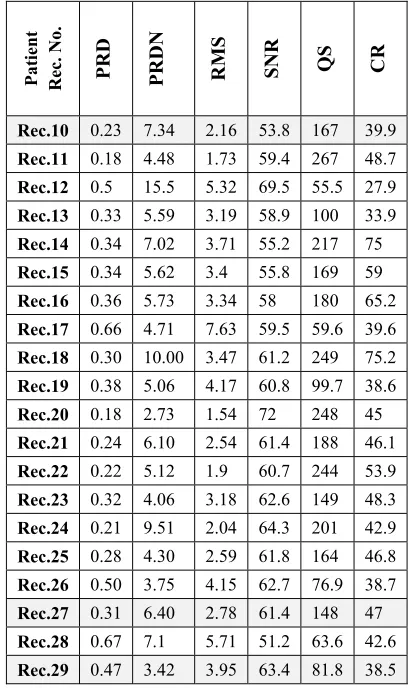
This section explains the performance evaluation of the proposed method for 20 patients records of EEG data taken from Florida university database. The results of the compression are shown in Table 1.
Table2 , Compression outcomes of the proposed method
Patient Rec.
No.
PRD PRDN RM
S
SNR QS CR
Rec.10 0.23 7.34 2.16 53.8 167 39.9
Rec.11 0.18 4.48 1.73 59.4 267 48.7
Rec.12 0.5 15.5 5.32 69.5 55.5 27.9
Rec.13 0.33 5.59 3.19 58.9 100 33.9
Rec.14 0.34 7.02 3.71 55.2 217 75
Rec.15 0.34 5.62 3.4 55.8 169 59
Rec.16 0.36 5.73 3.34 58 180 65.2
Rec.17 0.66 4.71 7.63 59.5 59.6 39.6
Rec.18 0.30 10.00 3.47 61.2 249 75.2
Rec.19 0.38 5.06 4.17 60.8 99.7 38.6
Rec.20 0.18 2.73 1.54 72 248 45
Rec.21 0.24 6.10 2.54 61.4 188 46.1
Rec.22 0.22 5.12 1.9 60.7 244 53.9
Rec.23 0.32 4.06 3.18 62.6 149 48.3
Rec.24 0.21 9.51 2.04 64.3 201 42.9
Rec.25 0.28 4.30 2.59 61.8 164 46.8
Rec.26 0.50 3.75 4.15 62.7 76.9 38.7
Rec.27 0.31 6.40 2.78 61.4 148 47
Rec.28 0.67 7.1 5.71 51.2 63.6 42.6
Rec.29 0.47 3.42 3.95 63.4 81.8 38.5
The original EEG signal and the reconstructed EEG signal, and the error signal for the record no. 10 are shown in Fig. 6 and it is clear that the reconstructed EEG signal retains the characteristic features of the original EEG signal very well.
1068 Figure 7: Three samples implementation of the record
10
[image:9.612.98.276.68.264.2]Based on the outcomes shown in table 2, it's clear that the performance of the proposed method provides a better compression than the other algorithms as shown in the records no. 10, 27 and 29 has been shown in Table 3.
Table 3, Comparison between the Compression Results
Method CR PRD
Darius Birvinskas et 2.66 10.33 Hakan G¨urkan et al (2009) 14.4 8.01 S.Chitra et al.(2015) 1.8347 0.0802 Seema .A.Taywade et al. 21.30 1.75 The proposed method 39.9 0.23
Fig. 7, refer to the CR and PRD values plots for 10 - 21 records of EEG signal. From these plots, it can be seen that there are not important variation in CR and PRD values. It means that the proposed algorithm is proper for compression and transmission of various morphologies of EEG data.
[image:9.612.84.271.414.502.2]
Fig. 7, Parameters of CR and PRD plotted from 10 – 21
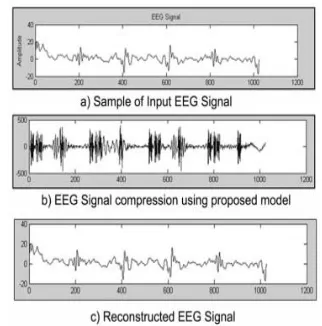
The below fig.(8), show the input EEG signals and extracted the EEG output signals with different types of EEG signals:
Figure 8: Samples of input, Compressed, and Reconstructed EEG signal
9. CONCLUSION
[image:9.612.341.502.419.582.2]1069 EEG data compression and transmission yet unaffected diagnostic features.
The attempts continued to improve detection algorithms but their performance is still not perfect. There is still room to enhance the parameters such as compression ratio, bandwidth, signal-to-noise ratio (SNR), quality score (QS), interconnection, data reliability and quality of service, the security and the privacy to meet the real-time challenge of compression and transmission of EEG data.
This article presented an efficient compression and transmission hybrid proposed technique using DWT (discrete wavelet transform) and RLE (run length encoding).
Compression outcomes of the proposed technique have been compared with other techniques and it is found that it gives the best performance. The proposed hybrid technique gives a high compression ratio and very less PRD (%), hence the features of the original EEG signal are preserved very well through the reconstructed signal.
REFERENCES
[1] S. lee et al., A real time ECG data compression and transmission algorithm for an e-health device , IEEE transaction on biomedical Engineering, Vol. 58, No.9, Sep., (2011). [2] N.S. and E. ,Performance Evaluation of Neural
network and linear predictor for near lossless Compression of EEG signal, IEEE transaction on Information Technology in biomedical, Vol.12, No.1, Jan., (2011). [3] N.S., Quality on demand compression of EEG
signals for telemedicine application using neural network predictor, International journal for telemedicine and applications, (2011).
[4] Yu-Ting Pai et al., Sub-Trees Modification of Huffman Coding for Stuffing Bits reduction and Efficient NRZI Data Transmission, , IEEE Transaction on Broadcasting, (2012). [5] T. M. et al., Assurance of energy efficiency and
data security for ECG transmission in Ban’s., IEEE transaction on biomedical engineering ,Vol. 59,No.4, April, (2012).
[6. M. S. and R. Sh., Security in Wireless Body Area Networks: A Survey, International Conference on Advancement in Information
Technology with Workshop of ICBMG, IPCSIT, Vol.20, (2011).
[7] N. Sriraam, " A High-Performance Lossless Compression Scheme for EEG Signals Using Wavelet Transform and Neural Network Predictors", International Journal of Telemedicine and Applications, Hindawi Publishing Corporation, Vol. 2012, Article ID 302581, 2012.
[8] Z.Z and T.J," Compressed Sensing of EEG for Wireless Telemonitoring with Low Energy Consumption and Inexpensive Hardware", IEEE TRANSACTIONS ON BIOMEDICAL ENGINEERING, Vol. 60, No. 1, p.p. 221-224, 2013.
[9] D.D and A.N, " EEG Compression Using EZW Technique", International Journal of Science, Engineering and Technology Research (IJSETR) Vol. 2, Issue 7, July 2013.
[10] S.U. et. al.," Improved Compression of EEG Data Using Wavelet ", International Journal of Advanced Research in Electronics and Communication Engineering (IJARECE) Vol. 2, Issue 5, May 2013.
[11] R.M and D.B., "Hybrid Multichannel EEG Compression Scheme for Tele-health Monitoring", IEEE, 978-1-4799-6896-1/14, 2014.
[12] S. Ch. Et al., "EEG Signal Compression Using Wavelet Based Arithmetic Coding ", International Journal of Science, Engineering and Technology Research (IJSETR) Vol. 4, Issue 4, April 2015.
[13] K.R and A.S., "Lossless EEG Compression Using the DCT and the Huffman Coding", JSIR Vol.75(10), Oct. 2016.
[14] S. Agarwal et al., Performance evaluation and FPGA based implementation of SGSF in smart diagnostic applications, J. Med. Sys. 40 (3), Dec., (2016).
[15] M. Ni., and M. Ziv. , Wavelet-based unsupervised learning method for electrocardiogram suppression in surface electromyograms, Med. Eng. Phys. 38 (3), 248–256, (2016).
[16] N. Bigdely-Shamlo et al., The PREP pipeline: standardized preprocessing for large- scale EEG analysis, Front. Neuro inf., (2015). [17] C. Candan and H. Inan, A unified framework
for derivation and implementation of Savitzky–Golay filters, Signal Process 30, Nov., p.p. 203–211, (2014).
1070 Based on EEG Signals IET Biometrics, Vol. 4, p.p. 179–90, (2015).
[19] J. Dau. Et al., Near-lossless multichannel EEG compression based on matrix and tensor decompositions, IEEE Journal of Biomedical and Health Informatics, Vol. 17,No. 3, p.p. 708–714, May, (2013). [20] P. Kh. and A. T., A survey on different noise
removal techniques of EEG signal , IJARCCE, Vol. 2, Issue 2, Feb, (2013). [21] K. Srinivasan et al. , Multichannel EEG
compression: Wavelet-based image and volumetric coding approach , IEEE Journal of Biomedical and Health Informatics, Vol. 17, No. 1, p.p. 113–120, Jan (2013).
[22] Abdulbaqi A.S., "Biometric Identification Using An Electroencephalogram Signals Compression Based on KC Function", The 6th International Scientific Conference of The Union of Arab Statisticians, Jordan, (2018). [23] A.K. et al." Machine Learning Approach for
Epileptic Seizure Detection Using Wavelet Analysis of EEG Signals", Int. Conf. on Medical Imaging-health and Emerging Communication Systems, pp. 412-416, 2014. [24] T. U, "Medical Data Compression and
Transmission in Wireless Ad Hoc Networks ", IEEE Sensor Journal, Vol. 5 o. pp. 778-786, 2015.
[25] M.H.et al., "A Nonlinear Feature based Epileptic Seizure Detection using Least Square Support Vector Machine Classifier", IEEE TE Co., 2015.
[26] R.K. et al., "Dual Tree DWT Analysis based Electrocardiogram Signal Compression using Zero Coding Technique", ICECS, p.p. 624-629, 2015.
[27] M.H. and S.S., "Bayesian Network-Based Customized Highlight Generation for Broadcast Soccer Videos", IEEE Transaction on Broadcasting, Vol. 61, No. 2, p.p. 195-209, 2015.
[28] L. L. et al, "Smart-eeg : A new platform for tele-expertise of electroencephalogram", Colloque du GDR SOC-SIP, 2012.
[29] N. Sriraam, "Quality on demand compression of EEG signals for telemedicine application using neural network predictor",. International journal for telemedicine and applications Volume 2011.
[30] M. M. Abo-Zahhad, T. K. Abdel-Hamid, and A. M. Mohamed, “Compression of ecg signals based on dwt and exploiting the correlation between ecg signal samples,” Int’l J. of Communications, Network and System Sciences, vol. 2014, 2014.