ISSN: 1992-8645 www.jatit.org E-ISSN: 1817-3195
4872
UNDERSTANDING CONSUMERS' PURCHASE INTENTIONS
IN ONLINE VIRTUAL COMMUNITIES: AN INTEGRATION
OF PERCEIVED BENEFIT AND COMMITMENT-TRUST
THEORY
1SAE BOM LEE, 2YUNG HO SUH, 3JAE YOUNG MOON
1Research Professor, Kyung Hee University, BigData Research Center, South Korea
2Professor, Kyung Hee University, School of Management, South Korea
3Professor, Dongseo University, Department of Business Administration, South Korea
E-mail: 1[email protected], 2[email protected], 3[email protected]
ABSTRACT
In the fourth industrial revolution era, people are purchasing products from e-commerce. Even within the online community, we purchase products that match the information provided by the community, or exchange used products. Therefore, this study intends to study consumers' behavioral intention in online community. The purpose of this study was to suggest factors affecting continuous participation and purchase intention in online community of interest drawing on the perceived benefit and Commitment-Trust Theory (CTT) to advance our understanding. The collected 231 data through the survey were analyzed using structural equating model analysis. SPSS 21.0 and AMOS 21.0 were used to analyze the data. According to the result, continuous use intention influenced purchase intention, and trust and commitment is critical for the continuance intention. Of the four benefits, only learning, economic and hedonic benefits affected trust and commitment. This study contributes to the existing research on online communities as it combines perceived benefit and CTT to explain variances for users’ continuous participation. This study also provides suggestions in numerous ways regarding interest-based online community operations.
Keywords: Digital Item Purchase, Online Community, Perceived Benefit, Commitment-Trust Theory, E-commerce
1. INTRODUCTION
Now, the Internet is permeating our lives. With the rapid development of Information Communication Technology (ICT) and the proliferation of smartphones, people are able to access 'online' anywhere and anytime. In other words, people can share information and interact with others in real time in a virtual online space, which is the background of the online community. According to the existing literature, the emergence of ICT has radically changed the social interaction and has an important influence on the formation of online community [1-2].
Online communities are different from social network services such as Linked In, Facebook, YouTube and etc. It is an online platform that is made up of people who have never met in offline and interacted with people of common interest or purpose. So users prefer similar things or similar
lifestyles [3]. According to figure 1 based on Global Market Intelligence Agency TNS Korea [4], the number of users of popular social network services such as ‘Facebook’ has decreased in recent 2 years. On the other hand, only the online community is showing an upward trend. In particular, 80% of Internet users in Korea are subscribing to online communities [5].
4873 collectively purchase the same items together. You can also buy services from the community [7].
[image:2.612.93.296.193.326.2]Therefore, this study intends to study what kind of benefits of the online community will the users continue to participate, and furthermore, willing to purchase products and services introduced by the online community.
Figure 1: Top 4 Services Monthly User Ration [4]
Figure 2: 2017 Korea Online Community Subscribers [5]
This study aims to contribute the following to the literature of computer-based communication and e-commerce: 1) identify the most critical determinants that effect consumer intention to participate in online communities; 2) by integrating two well recognized technology adaption theories: the perceived benefit theory and the commitment-trust theory (CTT), we help to understand the intention of consumers to participate in online community; 3) we examine the influence of consumers' intentions to participate on the intention to purchase in online communities. The findings will help e-commerce companies' managers and other communities’ operators to evolve strategies that enhance the intention of consumer to participate as well as evolving strategies that
improve consumer intentions to purchase products to the online community.
This study is organized as follow; the next section represents literature pertaining to the study variables and theories as well as the hypotheses development. Then we demonstrate our data collection and measures operationalization. Finally, we explain the study results, discussion, and managerial implications as well as demonstrating the limitations and future research.
2. BACKGROUNDS 2.1 Online Communities
Since the online community began to make American scholars to share information and research achievements in the 1970s, it has been extensively defined as an environment for communicating ideas and information, exchanging interests, mutual pleasure, promoting relationships, seeking help, providing support, and exchanging products and services [8]. An online virtual community can be defined as a new social entity. An online virtual community can be distinguished from traditional community concepts because it is built on a computer interface between people with similar interests and experiences [9]. Rheingold [10] defined the definition of an online community as “a social group in which consumers share emotions in an online space and share emotional ties by sharing ongoing communication”. Jones [11] defined the online community as a “virtual cultural activity space with the Internet as a medium”.
However, the definition of online community differs from that of previous studies, which is attributed to various types of online community. In other words, it is necessary to classify and approach the type of online community research. Online communities are categorized in terms of purpose, structure of interaction, and management aspects of the community [12].
[image:2.612.93.286.363.502.2]ISSN: 1992-8645 www.jatit.org E-ISSN: 1817-3195
4874 and sell products and services, and share information to reach their deals. Relationship-based online communities encourage the formation of relationships online with new users through participation of users. It also has the characteristic of developing into a meaningful relationship not only in life but also in terms of business through actual meeting. The fantasy-based online community creates a new environment, personality, and story for users to enjoy in cyberspace or game space. Table 1 below shows the classification and examples of online communities.
Table 1: Types of online communities by Armstrong and Hagel [13]
Type Definition Example
Communities of Transaction
Purchase or exchange of products or services
-Craigslist (USA) -OfferUp (USA) -Joonggonara (Korea) Communities of Interest Knowledge sharing and interaction on specific topics such as
hobbies and specializations
-Chiup ppogagi
(Korea)
-Moms Holic Baby (Korea)
-Raddit (USA)
Communities of Fantasy
Participation and creation needs related
to fantasy in virtual space -Gamasutra (global) -EbookNlove (Korea) Communities of Relationship
People with similar experiences gather to
form meaningful relationships by sublimation of
fellowship or fellowship
-Breast cancer story (Korea)
In this study, we focus on the interest-based online community rather than other types of online community. As has been pointed out in numerous previous studies, interaction maintains a more sticky relationship with online community members. Interest-based online communities, which have the highest degree of interactivity than other communities, are notable in that they make decisions based on recommendations and knowledge sharing from other users. Therefore, efficient and effective information acquisition and learning are possible in the flood of information and advertisement. In addition, interest-based online communities show the infinite possibilities of becoming an enterprise by possessing the advantages of clarifying the target group when expanding business from advertisement to education and commerce. Therefore, there is a tendency to activate an interest-based online community for sharing information about a specific field of interest for securing and maintaining members in various portal sites in recent years.
As shown in Table 2, the company that started from the online community had more than millions of users since its incorporation, enabling it to grow faster than other start-ups (initial venture companies) It can be said that it started with 'securing the number of users' from the beginning. Therefore, it is essential to understand the motives of users who use online communities and participate.
Table 2: Enterpriseization of online community Name of Company Original Community name Number of users Business diversification plan Joonggo Nara Jung-Go Nara 15 Million
ㆍMobile app launch
ㆍFraud prevention service
ㆍIM transaction service provision
Ya-Nolja Motel Tour Million 5.2
ㆍAccommodation
brokerage
ㆍConsumable materials business for accommodation business
ㆍEntry into hotel franchise business
Chippo ppogagi Chiup Million 2 ㆍOperate educational programs for job seekers
Mon’s Club Moms Holic Baby 2.3 Million
ㆍChild care and childbirth preparation
classes
ㆍChild care, maternity goods sale
Previous studies based on the interest-based online community have mainly focused on knowledge sharing and interaction in the online community [15-17]. However, research on the motivation of users to use online communities and purchasing behavior in the community are still insufficient [2, 6].
4875 based perceived benefit and commitment-trust theory.
2.2 Commitment-Trust Theory
Trust and commitment are crucial constituent concepts in relationship marketing, especially business-to-business and business-to-customer relationship marketing. Morgan and Hunt [18] developed Commitment-Trust Theory (CTT). The factors of successful relationship marketing are trust and commitment, and these two variables serve as key parameters in relationship marketing. This view provides a better explanation of customer retention and loyalty [19]. In marketing, the Trust serves as the basis for strategic partnerships between buyers and sellers. It is also an integrated concept that is widely used in various disciplines (economics, marketing, sociology, psychology, organizational behavior, information systems, decision making).
According to Humphrey and Schmitz [20], trust plays an important role in economic transactions because it reduces perceived risk. It also works in an online environment. Users who tend to trust online transactions tend to be less perceived risk and therefore more likely to trust online transactions. In a similar vein, users 'trust is especially important in an environment where users' interaction is difficult to predict due to the virtual spatial characteristics of online communities. This is because users who have confidence in the online community will participate more actively in online community activities.
The commitment-trust theory [18] focuses on explaining the development of long-term relationships between exchange parties. The key premise of this theory is to adopt both tie-in and trust as crucial factors for building and maintaining business relationships between exchange partners. This theory suggests that trust directly affects trusting. Because the trust between the two parties helps to reduce the vulnerability that the parties recognize when they commit the exchange relationship.
Existing online community studies have used commitment as an important dependent variable [21]. However, as in this study, studies on the effect on sustained use and purchase intention, which are based on trust and commitment, are insufficient.
2.3 Perceived Benefits
Several studies of online domains have expressed perceived benefits as 'consumer perceptions of acquisition' [22]. Gutman [23] described perceived benefits as a valuable outcome
or advantage that consumers can derive from consumption. In order to lead a successful online community, it is essential to provide the benefits that community users need, and these benefits can lead to continued participation of users.
The following is a list of prior studies that have explored the benefits offered by online communities. Previous studies have suggested that the benefits of online communities can increase attitudes and participation in online communities and affect the intention to use and information sharing intention.
First, Parra-Lopez et al. [24] presented as benefits, psychological benefits, and hedonic benefits. Chung and Buhalis [25] classified functional benefits (information acquisition), social and psychological benefits, and hedonic benefits. These studies mention the functions of the online community, which can continue to provide up-to-date knowledge of the area or activity of interest, cost savings in information retrieval, and information on other online community users. Wang and Fesenmaier [26] viewed the benefits of online community participation as functional, social, psychological, and hedonic benefits.
In this study, perceived benefits were defined as 'subjective perception of the benefits of interest-based online community users through community use. In addition, based on previous studies, the perceived benefit is composed of five dimensions (learning benefits, social benefits, hedonic benefits, and economic benefits) to examine the perceived benefits of consumers through online community use [26].
3. RESEARCH MODEL AND HYPOTHESES
The purpose of this study is to investigate the influence of online community on interest and purchase intention of online community. We divide perceived benefits into four dimensions and classify them into learning benefits, social benefits, hedonic benefits, and economic benefits. Next, based on the commitment-trust theory, we examine the effects of commitment and trust on the intention to use persistently. Finally, we examine the effect of intention to use on intention to purchase in online community. Therefore, in this study, a research model was developed as shown in Appendix 1.
3.1 Perceived Benefits and CTT
ISSN: 1992-8645 www.jatit.org E-ISSN: 1817-3195
4876 community use. After joining a community, users can easily find information in the community and acquire knowledge about a particular area of interest. Basically, interest-based online community users will benefit from honest feedback and information shared by other users, which will have a positive impact on community commitment and trust. Therefore, Hypothesis 1 and 2 is as follows.
H1: The learning benefits of the online community will have a positive impact on trust.
H2: The learning benefits of the online community will have a positive impact on commitment.
On the other hand, the interest-based online community is not only a platform for sharing information about related topics but also a place where friendship, fun and social status can be formed with other users [27]. Therefore, social benefits mean improved social relations that can be formed through interaction with other users in the community. These social benefits provide significant benefits to online community users in that they improve social identity and belongingness. Therefore, the following hypothesis was set up.
H3: The social benefits of the online community will have a positive impact on trust.
H4: The social benefits of the online community will have a positive impact on commitment.
The hedonic benefits mean the various joys and pleasures experienced by online community users, and these hedonic benefits make the users spend their time more on the online community [28] (Sicilia and Palazon, 2008). Wang and Fesenmaier [26] defined hedonistic benefits as the benefits of enjoyment, interest, happiness, enthusiasm, etc. In this study, we defined various pleasures obtained through online community use [26, 28]
H5: The hedonic benefits of the online community will have a positive impact on trust.
H6: The hedonic benefits of the online community will have a positive impact on commitment.
Finally, economic benefits mean price competitiveness of products or services that online community users can gain through community use. Interest-based online community users, many of the products or services that users are interested in are the same. Therefore, users can find and share ways
to purchase products they are interested in at relatively low prices. In other words, the users get the economic value because they acquire the products or services they are interested in through the online community. The economic benefits of many prior studies are still poorly researched [7].
H7: The Economic benefits of the online community will have a positive impact on trust.
H8: The Economic benefits of the online community will have a positive impact on commitment.
In addition, the results of this study suggest that trust is a predictor of commitment [18]. This implies that commitment and trust should be considered together in online community research, and that trust should be set and studied as a leading factor of commitment. Previous research argue that online users' experiences of online users interacting with others in the online community will encourage them to define others as trustworthy, and they will develop strong commitments to the community [29].
H9: Trust in online communities will have a positive impact on commitment.
Previous studies have shown that the success of information systems (IS) is driven by persistent use rather than by initial acceptance [30]. As in the online community as well, sustainability, not early participation by users, is a key factor in community success and must be considered for continued use. Trust is a mechanism for assessing the degree to which an individual expects positive outcomes in a particular behavior or decision, so that consumers' confidence in online community activity can motivate consumers to continue to participate [19]. Based on the above discussion, we have made the following hypothesis.
H10: The trust will have a positive impact on continuous intention of online community.
Li et al. [31] argue that strong committed consumers are more psychologically attached to a particular website because of the mutual benefits of maintaining this relationship, and thus they are more likely to continue to use the website. We hypothesized the following:
4877 According to McKnight al. [32], explaining purchase behavior used to measure purchase intention, which can be used to predict future purchase behavior. Therefore, purchase intention can be defined as the will and belief of a consumer who appears as a specific future action after consumers form an attitude toward a service or product.
H12: The continuous intention will have a positive impact on purchase intention in online community
4. RESEARCH METHODOLOGY
To test the models, we surveyed online community users on a 7-point scale, and conducted a confirmatory factor analysis to measure the reliability and validity of each variable. Next, a structural equation model (SEM) was implemented to confirm the causal relationship between variables. SEM is one modeling approach used to confirm relationships among underlying variables. In this case it was used to test our model offered Appendix1 in order to predict behavioral intention to purchase in online community. The theories that our model was based upon include CTT and perceived benefit.
4.1 Sampling and Data Collection
Quantitative data were collected through surveys and applied to this study. The target population of the current study comprises all users who are members of the interested-based online communities in South Korea. We conducted surveys of university students and graduate students attending university in Seoul. Thus, convenience sampling was used to collect data (San Martín & Herrero, 2012).
A total of 255 samples were collected from September to October, 2017 for a total of two months. The questionnaire was conducted only for users using the interest-based online community. The final 231 samples were used for the analysis by excluding the unused persons, inappropriate data, and untruthful responses.
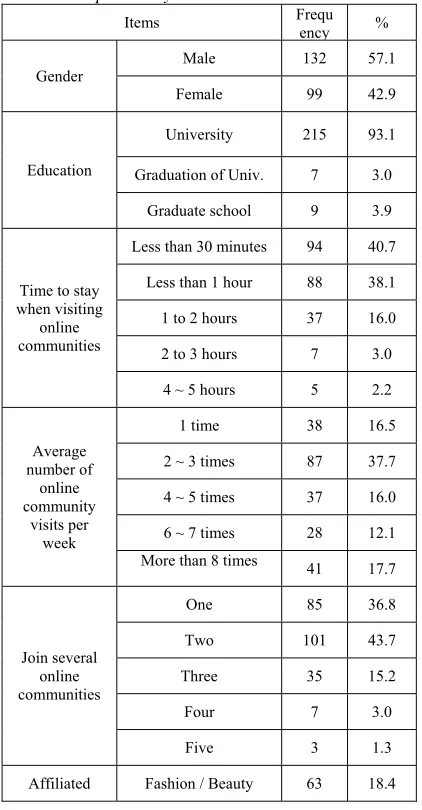
Of these 231 participants, 132 were men (57.1%) and 99 were women (42.9%). Since the questionnaires were conducted for university students and graduate students, the total age was 20 (100%). In terms of the number of online community users, 2-3 times accesses was 37.7%, 8 times (17.7%) and less than 1 time (16.5%). Also, if
you look at the community use time per week, 40.7% of less than 30 minutes and 38.1% of 30 minutes to 1 hour accounted for 78.8% of the total. Table 3 provides a demographic and behavior characteristic profile of the samples.
4.2 Questionnaire and measurements
[image:6.612.313.524.332.737.2]We developed the questionnaire based on the previous studies that were proved to examine the factors related to the intention to participate in online community. A Likert scale of 7 was used for the questionnaire. The perceived benefits of the four dimensions are based on the questionnaires of previous researches [26, 27, 28, 33, 34]. Commitment and trust refer to existing Commitment-Trust Theory studies [18, 35]. Finally, we developed questionnaires based on previous studies [36] based on e-commerce.
Table 3: Samples Analysis
Items Frequ
ency %
Gender Male 132 57.1
Female 99 42.9
Education
University 215 93.1
Graduation of Univ. 7 3.0
Graduate school 9 3.9
Time to stay when visiting
online communities
Less than 30 minutes 94 40.7
Less than 1 hour 88 38.1
1 to 2 hours 37 16.0
2 to 3 hours 7 3.0
4 ~ 5 hours 5 2.2
Average number of
online community
visits per week
1 time 38 16.5
2 ~ 3 times 87 37.7
4 ~ 5 times 37 16.0
6 ~ 7 times 28 12.1
More than 8 times 41 17.7
Join several online communities
One 85 36.8
Two 101 43.7
Three 35 15.2
Four 7 3.0
Five 3 1.3
ISSN: 1992-8645 www.jatit.org E-ISSN: 1817-3195
4878 Online
Communi-ty Sector (Duplicate
response)
Employment / Study 113 33.0
Travel 54 15.8
Hobby 88 25.7
others 24 7.0
total 342 100.0
Total 231 100.0
5. RESULTS
5.1 Measurement Model
In this study, confirmatory factor analysis was conducted through AMOS 21.0 before the hypothesis was tested through structural equation modeling (Bollen, 1989). The development of the measurement model enables verification and evaluation of the research model by verifying the intensive validity and discriminant validity of the study model prior to the structural model analysis. Convergent Validity means that the measure has a high relationship with the factors.
According to Bagozzi and Yi (1998), Standardized Factor Loadings (FL) is 0.7 or more, Construct Reliability (CR) is 0.7 or more, and Average Variance Extracted (AVE) If the score is 0.5 or more, it has intensive validity. In this study, as well as the results of Bagozzi and Yi (1998), we found a recommendation criterion of 0.7 or more and a mean variance extraction value of 0.5 or more.Previous studies have shown conservative scores of 0.6 or higher (hier et al 2014). In this study, some items were slightly below 0.7 and above 0.6.
As shown in table 4, factor loadings of all variables were 0.6 or more, and the conceptual reliability and mean variance extraction of the factors were 0.7 and 0.5 or more, respectively.
In order to verify the discriminant validity of the study model factors, the correlation coefficient between the factors was verified to be smaller than the square roots of AVE (Chin et al., 1997). The discriminant validity is verified that there is no correlation between the factors and indicates that each factor is independent. As shown in Table 5, correlation coefficients of all factors are lower than the square root of AVE of each factor. Therefore, the validity of discrimination was verified as shown as table 5.
In order to evaluate the fitness of the measurement model, the values of Goodness-of-Fit Indnex (CFI), Comparative FIt Index (CFI), Formed Fit Index (NFI) and Root Mean Square
[image:7.612.301.526.141.718.2]Residual (RMRS). The validity of the confirmatory analysis model was χ2 = 491.24, p <0.05, χ2 / d.f = 1.813, GFI = 0.855, NFI = 0.855, CFI = 0.928 and RMSEA = 0.059.
Table 4: Results of Measurement Model
Variables Items Estimate CR AVE
Learning Benefit
LB_1 0.756
0.801 0.574
LB_2 0.748
LB_3 0.768
Social Benefit
SB_1 0.827
0.907 0.710
SB_2 0.893
SB_3 0.832
SB_4 0.817
Hedonic Benefit
HB_1 0.803
0.851 0.656
HB_2 0.879
HB_3 0.742
Economic Benefit
EB_1 0.803
0.841 0.640
EB_2 0.891
EB_3 0.694
Trust
TRU_1 0.778
0.795 0.566
TRU_2 0.835
TRU_3 0.630
Commitment
COMM_1 0.696
0.840 0.639
COMM_2 0.850
COMM_3 0.842
Continuous Intention
CI_1 0.713
0.761 0.516
CI_2 0.796
CI_3 0.638
Purchas Intention
PI_1 0.749
0.857 0.601
PI_2 0.848
PI_3 0.737
4879 Table 5: the Result of Discriminant Validity
EB COMM LB SB HB TRUST CI PI
EB 0.800
COMMI 0.144 0.799
LB 0.418 0.135 0.757
SB 0.213 0.309 0.285 0.843
HB 0.405 0.425 0.361 0.496 0.810
TRUST 0.447 0.341 0.515 0.185 0.264 0.753
CI 0.410 0.444 0.461 0.317 0.515 0.611 0.719
PI 0.381 0.235 0.359 0.311 0.243 0.512 0.450 0.775
5.2 Structural Model
The purpose of this study is to investigate the factors affecting the intention to use persistent online community in terms of perceived benefits and immersion - trust theory. The results of the structural equation model are shown in Table 6 and Appendix 2. The fit of the model was χ2=539.79, p <0.05, χ2 / d.f = 1.921, GFI = 0.844, NFI = 0.840, CFI = 0.915 and RMSEA = 0.063.
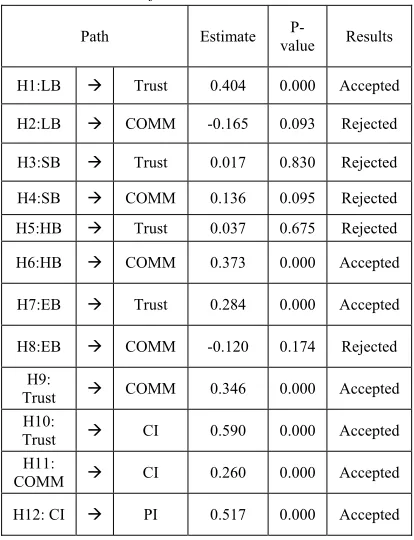
The estimated standardized structural coefficients for the hypothesized relationships between constructs and their significance are shown in Table 6. The results show that H1, H6, H7, H9, H10, H11, H12 hypothesized relationships are supported.
The first hypothesis that predicted that learning benefit of online community would positively affect trust in online community was supported (b= 0.404, p<0.01). Regarding the relationships between relative leering benefit and commitment, our finding is not supported (b= -0.165, p>0.05). As H3 and H4 predict, the study found not significant positive impacts of social benefit on trust and commitment, the study found not significant positive impacts of social benefit on trust (b=0.017, p>0.05) and commitment (b=0.136, p>0.05). In accord with H5, our findings not support the favorable effect of hedonic benefit on trust (b=0.037, p>0.05). However, for H6, the expected positive impact of hedonic benefit on commitment (b=0.373, p<0.01). Therefore, the results support H6. With regard to H7 and H8, economic benefit is positively related to trust (b=0.284, p<0.01) and commitment (b= -0.120, p>0.05). Therefore, the findings support H7 except H8.
[image:8.612.316.523.463.733.2]Hypotheses 9 and 10 concerned the influence of trust in online community on commitment, continues intention. Our findings support the favorable effect of trust on commitment (b=0.346, p<0.01), and continuous intention (b=0.590, p<0.01). Therefore, our findings support H9 and H10. As H11 and H12 predict, the study found significant positive impacts of commitment on continuous intention (b=260, p<0.01), also the study found significant positive impacts of continuous intention on purchase intention (b=0.517, p<0.01). Therefore, the findings support H11 and H12.
Table 6: the Result of Structural Model
Path Estimate value P- Results
H1:LB Trust 0.404 0.000 Accepted
H2:LB COMM -0.165 0.093 Rejected
H3:SB Trust 0.017 0.830 Rejected
H4:SB COMM 0.136 0.095 Rejected
H5:HB Trust 0.037 0.675 Rejected
H6:HB COMM 0.373 0.000 Accepted
H7:EB Trust 0.284 0.000 Accepted
H8:EB COMM -0.120 0.174 Rejected
H9:
Trust COMM 0.346 0.000 Accepted
H10:
Trust CI 0.590 0.000 Accepted
H11:
COMM CI 0.260 0.000 Accepted
ISSN: 1992-8645 www.jatit.org E-ISSN: 1817-3195
4880 6. DISUCUSSION
The purpose of this study is to analyze the factors affecting the intention to use online community continuously. The hypothesis test results are as follows.
First, the effect of learning benefits on community trust is significant, but the effect on community commitment is not significant. This can be interpreted as users who have acquired knowledge and information on topics of interest more profoundly and richly through interaction in the community become immersed after becoming trusted with the community.
Second, unlike previous studies [7], the effects of social benefits on community trust and commitment were not significant. It seems to reflect the fact that different people are joining and acting on the community based on common interests, but it is difficult to build trust with each other. And social benefits indicate that it is difficult to induce community commitment.
Third, the effect of hedonic benefits on community trust was not significant, but the influence on commitment was significant. This shows that users who have improved economic level and increased leisure time gradually understand online community activities as amusing activities. The fun and excitement that comes from this leads users to immerse themselves directly in the community.
Fourth, the economic benefits have a positive effect on community trust, but the influence on immersion is not significant. Users are inclined to continue to participate in the online community to gain economic and financial benefits and reduce losses. In this way, community managers can gain trust in the community by providing various economic benefits centered on the user, and can lead to user immersion through the medium.
Fifth, as in previous studies [18, 24] online community trust has a positive effect on community commitment. In an interest-based online community based on user interaction, users may be judging from the trustworthiness of the place before immersion. Because the user's mistrust reduces immersion, trust as a leading element of commitment must be considered. In other words, it means that the leading variables of online community involvement are trust, so it is necessary to maximize the factors that can attract trust to attract users' immersion.
Sixth, online community trust and commitment have a positive effect on online
community intention to use continuously. Continuous use intention is a result of community trust and commitment, and it is necessary to pay attention to the positive results (persistent intention to use, e-WOM, purchase intention) resulting from continuous interaction through trust and commitment. In particular, the trust and commitment of users should be considered as the success of an online community depends on the user's intention to use more than the initial acceptance.
Finally, the intention to use persistently has a positive effect on purchase intention. This means that those who continue to use it are willing to co-buy various discount coupons, services, and products offered by the online community.
7. CONCLUSION
The purpose of this study is to investigate the factors affecting the intention to use online community. For this, the perceived benefits were classified into four dimensions (learning, social, hedonic, and economic benefits), and the causal relationship between intention to use and intention to purchase through commitment and trust was verified.
As a result, the study benefit and economic benefit among four variables based on the perceived benefits presented in this study were found to be important independent variables affecting the trust of online community. In other words, if users can easily learn or obtain information about theirs interests in the community, they trust the community they use. It also builds trust when you feel the economic value of using services and products at reasonable prices through joint purchases within the online community. Hedonic benefits, on the other hand, have been found to have a significant impact on immersion because they make more time for the online community. After building trust in the community, it means that there must also be entertainment elements in order to engage users more.
4881 various benefits, users regard learning benefits, hedonic and economic benefits as important. Second, it is meaningful that it is verified by linking to purchase intention from continuing intention. Finally, it is meaningful to grasp the actual use motive of the user by dividing the benefit perceived by the user into four dimensions.
Practical implications are as follows. First, this study can show what is important to the community by understanding the motivation for users to join and use online communities. In addition, the positive perceived benefits of online community users can be derived from the manager side. Second, since the key to the ups and downs of the online community is the intention to participate, it is most significant in that it can provide insight into the direction of the online community by analyzing the success factors of the interest - based online community.
This study suggests the theoretical and practical implications by examining the factors affecting the intention to use online community continuously, but the following limitations exist.
First, it is necessary to examine how the factors (learning benefits, social benefits, self-esteem benefits, pleasure benefits, and economic benefits) that are considered as independent variables in this study affect other types of online communities. Furthermore, comparing these findings with other types of online communities also needs to be addressed in the future.
Second, there is a limitation in that it is not studied in detail by the division of online community. Finally, all of the survey respondents were in their twenties and were students. Therefore, it seems that there is a difficulty in generalizing the results of the research to the entire online community users who are interested in the interest. In future studies, it is necessary to expand the subjects and investigate whether there are gender or age differences.
ACKNOWLEDGMENT:
This work was supported by the Ministry of Edu cation of the Republic of Korea and National Researc h Foundation of Korea (NRF-2017S1A5B8059804).
REFERENCE:
[1] C. Wiertz, and K.D. Ruyter, “Beyond the Call of Duty: Why Customers Contribute to Firm-Hosted Commercial Online Communities”,
Organization Studies, Vol. 28, 2007, pp.
347-376.
[2] G. Agag and A. A. El-Masry, “Understanding Consumer Intention to Participate in Online Travel Community and Effects on Consumer Intention to Purchase Travel Online and WOM: An Integration of Innovation Diffusion Theory and TAM with Trust”, Computers in
Human Behavior, Vol. 60, 2016, pp. 97-111.
[3] L. Johnson, Social Network vs. Online Community: What is the Difference? https://www.socialmediatoday.com/content/soc ial-network-vs-online-community-what-difference, 25/7/2014.
[4] TNS Korea,
http://www.tnsglobal.co.kr/home/index.aspx, 2/6/2016.
[5] Embrain Trend Monitor,
https://www.trendmonitor.co.kr, 25/7/2017 [6] H. T. Tsai and P. Pai, “Why Do Newcomers
Participate in Virtual Communities? An Integration of Self-Determination and Relationship Management Theories”, Decision
Support Systems, Vol. 57, 2014, pp. 178-187.
[7] C.K Park, “A Study on the Influence of Benefits of Online Communities on the Level of Participation and the Intention of Joint Purchasing and Moderating Effect of Collectivism”, The Academy of Customer
Satisfaction Management, Vol. 19, No. 2,
2017, pp.65-91.
[8] J. Farrior, H. Sarah, J. Paul, K. Andy. L. Stacey, and M. Bill, “Online Communities”, White Paper, Kellogg Graduate School of Management, 1999.
[9] W.G. Kim, C. Lee, and S.J. Hier, “Effects of an Online Virtual community on Customer Loyalty and Travel Product Purchases”,
Tourism Management, Vol. 25, 2004, pp.
343-355.
[10] H. Rheingold, H, “The Virtual Community: Finding Connection in a Computerized World. London: Secker & Warburg. 1994.
[11] T.O Jones, and E.S. Sasser Jr., “Why Satisfied Customer Defect”. Harvard Business Review,
Vol. 73, 1995. pp. 88–99.
[12] S.E. Gallagher and T. Savage, “Cross-Cultural Analysis in Online Community Research: A Literature Review.” Computers in Human
Behavior, Vol. 29, No. 3, 2013, pp. 1028-1038.
[13] A. Armstrong. and III, J. Hagel, “The Real Value of On-Line Communities”, Harvard
Business Review, Vol. 74, No. 3, 1996, pp.
ISSN: 1992-8645 www.jatit.org E-ISSN: 1817-3195
4882 [14] A.A. Mahrous and A.K. Abdelmaaboud,
“Antecedents of Participation in Online Brand Communities and Their Purchasing Behavior Consequences” Service Business, Vol. 11,
No.2, 2017, pp. 229-251.
[15] L.V. Casaló, C. Flavián and M. Guinalíu, “Antecedents and Consequences of Consumer Participation in On-Line Communities: The Case of the Travel Sector.” International
Journal of Electronic Commerce, Vol.15, no.
2, 2010, pp. 137-167.
[16] M. Laroche, M.R. Habibi., and M-O. Richard. “To be or not to be in Social Media: How Brand Loyalty is Affected by Social Media?”
International Journal of Information
Management, Vol.33, 2013, pp. 76–82.
[17] C.M.K. Cheung and M.K.O. Lee, “Consumer Satisfaction with Internet Shopping: A Research Framework and Propositions for Future Research.” ICEC '05 Proceedings of the 7th international conference on Electronic
commerce. 2005, pp.327-334.
[18] R.M. Morgan, and S.D. Hunt, “The Commitment-Trust Theory of Relationship Marketing.” Journal of Marketing, Vol. 58,
1994, pp. 25-26.
[19] W-T. Wang, Y.S. Wang and E.R. Liu, “The Stickiness Intention of Group-Buying Websites: The Integration of the Commitment– Trust Theory and E-Commerce Success Model”, Information & Management, Vol. 53,
No. 5, 2016, pp. 625-642.
[20] J. Humphrey and H. Schmitz, “Trust and Inter‐Firm Relations in Developing and Transition Economies.” The Journal of
Development Studies, Vol. 34, No. 4, 1998, pp.
38-40.
[21] E. S-T. Wang and L. S-L. Chen, “Forming Relationship Commitments to Online Communities: The Role of Social Motivations.” Computers in Human Behavior,
Vol.28, No. 2, 2012, pp.570.575.
[22] S. Forsythe, C. Liu, D. Shannon, and L.C. Gardner, “Development of a Scale to Measure the Perceived Benefits and Risks of Online Shopping.” Journal of Interactive Marketing,
Vol. 20, No. 2, 2006, pp. 55-75.
[23] J. Gutman. “A Means-End Chain Model Based on Consumer Categorization Processes.”
Journal of Marketing, Vol. 46, No. 2, 1982, pp.
63-64.
[24] E. Parra-Lo´pez, J. Bulchand-Gidumal, D. Gutie´r ez-Tano, and R. Di´az-Armals, “Intention to Use Social Media in Organizing
and Taking Vacation Trips”, Computers in
Human Behavior, Vol. 27, No. 2, 2011, pp.
640-654.
[25] J.Y. Chung, and D. Buhalis, “Web2.0: A Study of Online Travel Community”, Information
and Communication Technologies in Tourism,
2008, pp. 70-81.
[26] Y. Wang, and D.R. Fesenmaier, “Towards Understanding Members' General Participation in and Active Contribution to an Online Travel Community”, Tourism Management, Vol. 25,
No. 6, 2004, pp. 709-722.
[27] H. R. Yen, S. H. Hsu, and C. Y. Huang, “Good Soldiers on the Web: Understanding the Drivers of Participation in Online Communities of Consumption.” International
Journal of Electronic Commerce, Vol. 15, No.
4, 2011, pp. 89–120.
[28] M. Sicilia, and M. Palazon, “Brand Communities on the Internet: A Case Study of Coca-Cola’s Spanish Virtual Community.”
Corporate Communications: An Inter-national
Journal, Vol. 13, No. 3, 2008, pp. 255–270.
[29] H. Jang, L. Olfman, I. Ko, J. Koh, and K. Kim, “The Influence of On-line Brand Community Characteristics on Community Commitment and Brand Loyalty, International Journal of
Electronic Commerce., Vol. 12, No. 3, 2008,
pp. 57-80
[30] M. Limayem, S.G. Hirt, and C.M.K. Cheung, “How Habit Limits the Predictive Power of Intention: The Case of Information Systems Continuance.” MIS Quarterly, Vol. 31, No. 4,
2007, pp. 705–737.
[31] D. Li, G.J. Browne, J.C. Wetherbe, “Why Do Internet Users Stick with a Specific Web Site? A Relationship Perspective”, International
Journal of Electronic Commerce. Vol. 10m
No. 4, 2006, pp. 105-141
[32] D.H. McKnight, V. Choudhury, and C. Kacmar, “The impact of Initial Consumer Trust on Intentions to Transact with a Web Site: A Trust Building Model”, Journal of Strategic
Information Systems, Vol. 11, 2002, pp.
297-323.
[33] U.M. Dholakia, R.P. Bagozzi, and L.K. Pearo, “A Social Influence Model of Consumer Participation in Network- and Small-Group-Based Virtual Communities.” International
Journal of Research in Marketing, Vol. 21, No.
3, 2004, pp. 241–263.
4883 and Oppositional Brand Loyalty in Online Brand Communities.” International Journal of
Information Management. Vol. 33, 2013, pp.
948-962.
[35] Zhou, “Understanding Users’ Initial Trust in Mobile Banking: An Elaboration Likelihood Prspective.” Computers in Human Behavior,
Vol. 28, 2012, pp. 1518-1525.
[36] X.L. Jin, M.K.O. Lee, and C.M.K. Cheung, “Predicting Continuance in Online Communities: Model Development and Empirical Test.” Behaviour and Information
ISSN: 1992-8645 www.jatit.org E-ISSN: 1817-3195
4884 Appendix 1: Research Model
4885 Appendix 3. Measurements of variables
Variables Items Measurements
Learning Benefit
LB_1 Online community involvement builds my knowledge of my interests.
LB_2 The online community helps me solve problems related to my interests.
LB_3 I think my participation in online communities has improved my knowledge of my interests.
Social Benefit
SB_1 By participating in online communities, you can build bonds with other users.
SB_2 Through online community participation, you can build social relationships with other users.
SB_3 You can interact with other users by sharing common interests in the online community.
SB_4 Connect with new people in online communities and stay connected.
Hedonic Benefit
HB_1 Have fun using the online community.
HB_2 Using the online community felt like a daily escape.
HB_3 Using the online community is enjoy.
Economic Benefit
EB_1 Participation in online communities is a great way to buy products or services that interest you.
EB_2 Participation in the online community can help you to benefit from products or services in your area of interest.
EB_3 Online community participation reduces the time spent choosing products or services of interest.
Trust
TRU_1 The online community I use is well known.
TRU_2 The online community I use is trusted.
TRU_3 The information provided by the online community I use is trusted.
Commitment
COMM_1 Using an online community is time gone quickly
COMM_2 Using an online community, I become more and more involve in the community.
COMM_3 I have a attachment for the online community I join.
Continuous Intention
CI_1 I am willing to continue to use my online community.
CI_2 I am willing to continue to use online community because it is useful.
CI_3 I would like to recommend the online community I use to others.
Purchas Intention
PI_1 I am intention to participate in the joint purchase or training or seminar program of products or services that I sell within my online community. PI_2 I can believe in and participate in joint purchases of products and services or education and seminar programs that you sell within your online
PI_3 I'm willing to buy or use a good product or service in my online community.
![Figure 1: Top 4 Services Monthly User Ration [4]](https://thumb-us.123doks.com/thumbv2/123dok_us/8898428.953962/2.612.93.286.363.502/figure-services-monthly-user-ration.webp)