LOCAL LINE BINARY PATTERN AND FUZZY K-NN
FOR PALM VEIN RECOGNITION
1
KHADIJAH FAHMI HAYATI HOLLE, 2JAYANTI YUSMAH SARI, 3YUWANDA PURNAMASARI PASRUN
1
Informatics Department, Universitas Islam Negeri Maulana Malik Ibrahim Malang, Indonesia
2,3
Informatics Department, Universitas Haluoleo Kendari, Indonesia
E-mail: [email protected], [email protected] , [email protected]
ABSTRACT
Recently, palm vein recognition has been studied to overcome the problem in terms of convenience and performance of conventional systems in biometrics technologies such as fingerprint, palm print, face, and iris recognitions. However, palm vein images that are used in palm vein recognition systems are not always clear but sometimes can show irregular shadings and highly saturated regions that can slow the processing time. To overcome this problem, we propose palm vein recognition system using Local Line Binary Pattern (LLBP) method that was reliable against irregular shadings and highly saturated regions. LLBP is a texture descriptor based on the gray level comparison of a neighborhood of pixels. Proposed method have been conducted in three major steps: preprocessing that includes Region of Interest (ROI) detection, image resizing, noise removal and image enhancement, feature extraction using LLBP method, and matching using Fuzzy k-NN classifier. We use CASIA Multi-Spectral Image Database as dataset to examine proposed method. Experimental results show that the proposed method using LLBP has a good performance with 93.2% recognition accuracy.
Keywords: Fuzzy K-NN, LLBP, Local Line Binary Pattern, palm vein
1. INTRODUCTION
Biometrics is the technology of identifying people using human physiological features. There are several kinds of biometrics recognition systems such as fingerprint, palm print, face, iris, etc. [1][2]. Fingerprint and palm print systems have some problems in terms of convenience and performance because users have to touch the surface of the input sensor by their finger and palm. In addition, degradation of recognition accuracy may occur in fingerprint recognition because the condition of the finger surface (e.g. sweat, dryness) and skin distortion [3]. Whereas in performance of face recognition highly depends on facial expressions and illuminations, which can change. In fact, iris recognition is most reliable in terms of accuracy, but the capturing device is expensive and can be inconvenient compared to other biometrics systems [1][4]. Therefore, many researcher focus on vein recognition in the study of biometric technology [1– 12].
The hand contains an amount of information. The characteristics of palm vein that captured from the hand, is more reliable than another biometric
characteristic. It’s because vein located in volume, so feature more robust and secure [1][5].
Both of feature extraction and feature matching methods take effect in the accuracy of palm vein recognition. Palm vein imaging can be seen by infrared light illuminators and a camera [6][11]. Different methods to extract features from infrared images have been studied. Recently, local texture descriptor also gained attention wherein a good texture descriptor is one of the key issues for palm vein feature extraction method.
A variety of different descriptor for the performance of image patches has been developed. The Local Binary Patterns (LBP) operator has been proposed for palm vein recognition [6], face recognition [13], and facial expression recognition [14]. The Local Derivative Patterns (LDP) has been proposed for palm vein recognition [6] and face recognition [13]. However, proposed Local Line Binary Pattern (LLBP) for finger vein recognition [10] and face recognition [15] has shown that LLBP descriptor better than LBP and LDP.
considered the fuzzy k-NN [16] to be a suitable classifier since it does not need any learning algorithm so that it can decrease the processing time.
Therefore, in this paper, we proposed to investigate palm vein recognition using Local Line Binary Pattern as a new variant of LBP feature extraction approach and Fuzzy k-NN as feature matching approach. This research has been conducted to address what the best descriptor for palm vein recognition to overcome the problems in infrared images feature extraction. Also, identifying what the appropriate feature extraction approach that combined with Fuzzy k-NN matching approach.
2. LITERATURE REVIEW
There are four key steps in palm vein recognition system: Infrared palm images captured, detection of Region of Interest (ROI), pre-processing, feature extraction and feature matching [6][12].
Many approaches have been studied in palm vein recognition [6][7][8]. Most of the currently available approaches for palm vein recognition have similarities on the feature extraction method which utilized the features from the segmented blood vessel network for recognition [7][9]. However, palm vein images are not always clear but irregular shadings and highly saturated regions may be occur. Therefore, segmentation errors can be occurred during the feature extraction process due to the low quality of palm vein images. When the networks are not segmented properly, the recognition accuracy may be degraded. Also, the step of palm vein extraction can slow the processing time.
To solve the problem, Leila and Andrzej [6] proposed a method for palm vein recognition using Local Binary Pattern (LBP) and Local Derivative Pattern (LDP). They modifying Gaussian high-pass filter to enhance the captured palm vein images. Then, LBP and LDP are applied to extract the binary codes from the enhanced images. The measurement of similarity between the extracted and enrolled binary using Hamming distance. The recognition accuracy when LDP is used as feature extraction method is good, but the processing time is 2.5 times longer than the LBP. Moreover, LDP needs the memory size four time bigger to store the binary codes than those of the LBP [11].
The main difference between LLBP and LBP or LDP is its neighborhood shape which is a straight line with length N pixel, while in LBP or LDP it is
a square [11]. The straight-line shape of LLBP can extract robust features from the images with unclear veins, it is suitable to capture the pattern inside a palm vein image and reliable against irregular shadings and highly saturated regions [10]. Therefore, recognition performance of palm vein will be good.
3. PROPOSED METHOD
Figure 1 shows the block diagram of the proposed method for palm vein recognition. The method consists of four main stages: image acquisition (image is downloaded from CASIA Database), preprocessing, feature extraction using Local Line Binary Pattern (LLBP) descriptor and palm vein matching/recognition using Fuzzy k-NN classifier.
ROI Detection, Resize, Noise Removal, Subtract Image
Local Line Binary Pattern (LLBP) descriptor
Figure 1: The Proposed Method For Palm Vein Recognition
2.1 Palm Vein Database
Figure 2: The Sample Of Palm Vein Image
2.2 Preprocessing
[image:3.612.351.483.207.578.2]There are three major steps in the preprocessing stage, which are ROI extraction, image resizing and image enhancement. The figure of ROI extraction phase is shown in Figure 3.
Figure 3: The Processing Of ROI Extraction
Step 1: The contour of the hand is extracted by a
threshold.
Step 2: For each point on the hand contour, the distance
to the mid-point of the wrist is calculated, and then the four valley points between the fingers can be located. We can find the valley point between the thumb and forefinger as the distance between these points and the mid-point of the wrist is calculated. Then, the points P1 and P2 showed in Figure 3(right) can be located.
Step 3: With the points P1 and P2, the ROI is defined as a
rectangular region P1–P2–P3–P4, where lP1P3 = 1.25 × lP1P2. Figure 5(a) shows the result of the extracted ROI for the palm vein image in Figure 3(right).
Figure 4: The procedure of ROI detection of palm vein image
To increase the recognition accuracy and reliability, it is important to extract the features of vein patterns from the same region within different palm vein images. The second and fourth finger
webs are selected to fix the region that is defined as ROI. The procedures are shown in Figure 4 [10].
After ROI extraction, the next step is image resizing using cubic interpolation which the dimension is 216 x 216 pixels, then image enhancement with subtracting the original image from the background. Figure 5(b) and 5(c) show the results of both steps.
(a)
(b)
(c)
Figure 5: Extracted ROI (A), Resized Image (B) And Subtracted Image (C)
2.3 Feature Extraction
The Local binary pattern (LBP) operator is a texture descriptor based on the gray level comparison of a neighborhood of pixels. The original operator considers a 3×3 neighborhood of 8 pixels around a center pixel. This neighborhood is thresholded by the value of the center pixel and the result considered as a binary number or its decimal
P1 P2
[image:3.612.90.314.364.464.2]equivalent [10]. LBP operator as defined in Equation (1).
(1)
(2)
Petpon and Srisuk [11] proposed an LLBP operator for face recognition. The operator consists of two components: horizontal component (LLBPh)
and a vertical component (LLBPv). The magnitude
of LLBP can be obtained by calculating the line binary codes for both components.
The main differences between LLBP and original LBP are as follows: 1) the LLBP operator has a straight line shape, it will greatly assist LLBP operator in capturing the change of image intensity. 2) the image patterns in the left and right side of the center pixel of the line are a mirror because of the distribution of binary weight at left and right side are equal, Thus, the number of the pattern can be reduced.
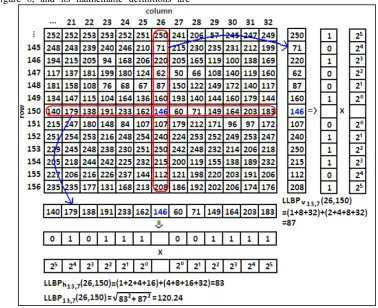
The illustration of LLBP operator is shown in Figure 6, and its mathematic definitions are
given in Equations (3), (4), and (5). LLBPh, LLBPv,
and LLBPm are LLBP on horizontal direction,
vertical direction, and its magnitude, respectively.
N is the length of the line in pixel, hn is the pixel along with the horizontal line and vn is the pixel along with the vertical line, c = N/2 is the position of the center pixel hc on the horizontal line and vc
on the vertical line and s(·) function defines a thresholding function as in Equation (2).
Employing Equations (2) and (3), the horizontal component of LLBP (LLBPh) extracts a binary
code of N − 1 bits for each pixel. The same numbers of bits are extracted by the vertical component of LLBP (LLBPv) using Equations (2)
and (4). Consequently, by concatenating the binary codes from LLBPh and LLBPv, the total binary
code of LLBP for each pixel is 2(N − 1) bits. In Figure 6, the binary sequence for the horizontal (vertical) component is defined from the left (top) as 010111001111(2) (101001011101(2)). Hence, the
binary code for LLBP is
010111001111101001011101(2). Figure 7 shows the
results of feature extraction using LBP and LLBP, respectively.
[image:4.612.109.487.387.695.2](3)
(4)
(5)
(a)
[image:5.612.95.529.55.495.2](b)
Figure 7: The Extracted Feature Of Image Using LBP
(A) And LLBP (B)
2.4 Matching/Recognition
[image:5.612.341.524.540.629.2]We use a fuzzy k-NN classifier to match the extracted palm vein images from testing data with the one from training data. The basic concept of this classifier is to assign membership as a function of the object’s distance from its k-nearest neighbors and the memberships in the possible class l. The pseudo-code of fuzzy k-NN classifier presented in Figure 8.
Figure 8: Pseudo-Code Of Fuzzy K-NN Classifier
Consider W={w1, w2, ..., wm} a set of m
labeled data, x is the input for classification, k is the number of closest neighbors of x and E is the set of
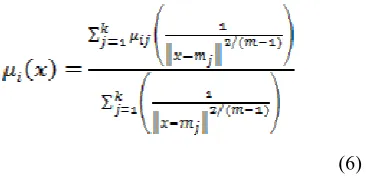
k nearest neighbors (NN). Let µi(x) is the membership of x in class i, m be the number of elements that identify the classes l, and W be the set that contains the m elements. To calculate µi(x), we use Equation (6) [16].
(6)
Since we use the fuzzy k-NN method, each element of x testing data is classified in more than one class with membership value µi(x). The decision to which class the element of x testing data belongs is made according to which class the element of x testing data has the highest membership value µi(x).
Set k
{Calculating the NN} for i = 1 to t
Calculate distance from x to mi
if i<=k
then add mi to E
else if mi is closer to x than any
previous NN
then delete the farthest neighbor
4. EXPERIMENT RESULT AND ANALISYS
The proposed method was implemented in Matlab and evaluated using palm vein image from
CASIA Palmprint databases
(http://www.cbsr.ia.ac.cn/english/Palmprint%20Dat abases.asp). There are 50 sets of left palm used with 5 image samples for each palm of a person. In total, the database contains 250 images. The spatial and depth resolution of the palm vein images were 768 × 576 pixel and 256 gray levels, respectively.
Using K-fold cross-validation procedure with K=5, we split data into 5 folds. In every K-fold, data was divided into 200 training data and 50 testing data that each palm of a person will have 4 images as training data and 1 image as testing data, respectively.
There are two experiments in this research. Experiment 1: we used 5 different k values in fuzzy
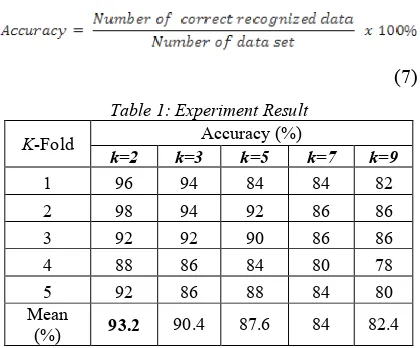
k-NN: k=2, k=3, k=5, k=7, k=9 and compared the accuracy of each k, k is the number of closest neighbors that used when data is being classified. Since we use 5-fold cross-validation procedure, the predictive accuracies on the testing data of the 5 run of each k are averaged and reported as the predictive accuracies. In Table 2, classification result with predictive accuracy is reported for all of the k values. Accuracy is a comparison between the number of correct recognized data and a total number of data set. The accuracy is calculated using Equation (7).
[image:6.612.315.528.211.359.2](7)
Table 1: Experiment Result
K-Fold Accuracy (%)
k=2 k=3 k=5 k=7 k=9
1 96 94 84 84 82 2 98 94 92 86 86
3 92 92 90 86 86 4 88 86 84 80 78 5 92 86 88 84 80 Mean
(%) 93.2 90.4 87.6 84 82.4
As shown in Table 1, the highest recognition result obtained from k=2 with 93.2% of mean accuracy while the lowest is obtained from
k=9 with 82.4% of mean accuracy. Experiment with higher k shows the lower value of mean accuracy.
This result also affected by the behavior of the data set used in this experiment that has many classes (50 classes) but few instances (4 instances). Considering the result of experiment 1, we use k=2 in experiment 2.
Experiment 2: we also use the LBP method to extract the feature in order to compare its accuracy with LLBP method. The result of experiment 2 shown in Figure 9.
0
20
40
60
80
100
1
2
3
4
5
A
cc
u
ra
cy
(
%
)
K-Fold
[image:6.612.90.300.486.660.2]LLBP
LBP
Figure 9: Comparison Accuracy Of LBP And LLBP
We have compared our proposed method results with the result of LBP method using k=2 for the Fuzzy k-NN classifier. As can be seen in Figure 9, our proposed method, LLBP method, has a higher accuracy (93.2%) compared to the LBP method (88%), it is validated by 5-fold cross validation procedure. Vein feature in extracted image using LLBP method is more distinct than vein feature in extracted image using LBP method as can be seen in Figure 7. The more distinct feature extracted, the higher the accuracy we get. Thus we conclude that LLBP method is more reliable than LBP method for extracting the feature on palm vein recognition.
recognition to understand the appropriate feature extraction method which can improve the recognition accuracy.
REFERENCES:
[1] Palm Vein Pattern Authentication Technology, Fujitsu white paper, 2005. [2] Watanabe, Masaki. "Palm vein
authentication." Advances in biometrics. Springer London, 2008, pp. 75-88.
[3] Sarkar, Ishani, et al. "Palm vein authentication system: a review." International Journal of Control and Automation Vol. 3, No. 1, March, 2010.
[4] Park, Kang Ryoung. "Finger vein recognition by combining global and local features based on SVM." Computing and Informatics 30.2, 2012, pp. 295-309.
[5] Trabelsi, Randa Boukhris, Alima Damak Masmoudi, and Dorra Sellami Masmoudi. "Hand vein recognition system with circular difference and statistical directional patterns based on an artificial neural network."
Multimedia Tools and Applications 75.2, 2016, pp. 687-707.
[6] Mirmohamadsadeghi, Leila, and Andrzej Drygajlo. "Palm vein recognition with local binary patterns and local derivative patterns."
Biometrics (IJCB), International Joint Conference on. IEEE, 2011, pp. 1-6.
[7] Olusayo, Omidiora Elijah, O. J. Babalola, and I. W. Oladimeji. "Palm vein recognition system using hybrid principal component analysis and artificial neural network."
International Journal of Advanced Research
in Computer Science and Software
Engineering 3.7, 2013, pp 69-78.
[8] Li, Qiang, Yan'an Zeng, and Kuntao Yang. "Wavelet-Based Palm Vein Recognition System." Journal of Innovative Optical Health Sciences 3.02, 2010, pp. 131-134.
[9] Kocer, H. Erdinc, Hasan Tutumlu, and Novruz Allahverdi. "An efficient hand dorsal vein recognition based on neural networks."
Journal of Selcuk University Natural and Applied Science 1.3, 2012, pp. 28.
[10] Rosdi, Bakhtiar Affendi, Chai Wuh Shing, and Shahrel Azmin Suandi. "Finger vein recognition using local line binary pattern."
Sensors 11.12, 2011, pp. 11357-11371.
[11] Lin, Chih-Lung, and Kuo-Chin Fan. "Biometric verification using thermal images of palm-dorsa vein patterns." IEEE Transactions on Circuits and systems for Video Technology 14.2, 2004, pp. 199-213. [12] Sharma, Mr. Bhudev. Palm Vein Technology.
Diss. Sardar Vallabhbhai National Institute of Technology Surat, 2010.
[13] Zhang, Baochang, et al. "Local derivative pattern versus local binary pattern: face recognition with high-order local pattern descriptor." IEEE transactions on image processing 19.2, 2010, pp. 533-544.
[14] Shan, Caifeng, Shaogang Gong, and Peter W. McOwan. "Facial expression recognition based on local binary patterns: A comprehensive study." Image and Vision Computing 27.6, 2009, pp. 803-816.
[15] Petpon, Amnart, and Sanun Srisuk. "Face recognition with local line binary pattern."
ICIG. Fifth International Conference on
IEEE, Vol. 9, September, 2009, pp. 533-539. [16] Keller, James M., Michael R. Gray, and James
A. Givens. "A fuzzy k-nearest neighbor algorithm." IEEE transactions on systems, man, and cybernetics 4, 1985, pp. 580-585. [17] Fuksis, Rihards, et al. "Infrared imaging
system for analysis of blood vessel structure."