Munich Personal RePEc Archive
Crossing the Lines: The Conditional
Relation between Exchange Rate
Exposure and Stock Returns in
Emerging and Developed Markets
Bartram, Söhnke M. and Bodnar, Gordon M.
Lancaster University Management School, Johns Hopkins University
- SAIS
22 June 2006
Online at
https://mpra.ub.uni-muenchen.de/14018/
Crossing the Lines:
The Conditional Relation between Exchange Rate Exposure
and Stock Returns in Emerging and Developed Markets
Söhnke M. Bartram* and Gordon M. Bodnar**
Abstract
This paper examines the importance of exchange rate risk in the return generating process for a large sample of non-financial firms from 37 countries. We argue that the effect of exchange rate exposure on stock returns should be conditional and show evidence of a significant return premium to firm-level currency exposures when conditioning on the exchange rate change. The return premium is directly related to the size and sign of the subsequent exchange rate change, suggesting fluctuations in exchange rates themselves as a source of time-variation in currency risk premia. For the entire sample the return premium ranges from 1.2 - 3.3% per unit of currency exposure. The premium is larger for firms in emerging markets, while in developed markets it is statistically significant only for local currency depreciations. Overall, the results indicate that exchange rate exposure plays an im-portant role in generating cross-sectional return variation. Moreover, we show that the impact of exchange rate risk on stock returns is predominantly a cash flow effect as opposed to a discount rate effect.
Keywords: Exchange rate exposure, exchange rate risk, return premia, international finance
JEL Classification: G3, F4, F3
First version: June 22, 2006
This version: March 6, 2009
* Lancaster University, Management School, Lancaster LA1 4YX, United Kingdom, phone: +44 (1524) 592 083, fax:
+1(425)952 10 70, email: <[email protected]>, internet: <http://www.lancs.ac.uk/staff/bartras1/>.
** Johns Hopkins University, SAIS, 1717 Massachusetts Ave NW Ste 704, Washington, DC 20036, USA, phone: +1
(202) 663 7731, fax: +1 (202) 663 7718, Email: <[email protected]>, Internet: <http://www.sais-jhu.edu/faculty/bodnar/>.
Crossing the Lines:
The Conditional Relation between Exchange Rate Exposure
and Stock Returns in Emerging and Developed Markets
Abstract
“The key but far from straightforward question is of course “how much” exchange rate movements matter.”
Exchange rate moves in a global economy: a central banking perspective, Speech by Gertrude Tumpel-Gugerell, Member of the Executive Board of the ECB, at the Federal Reserve Bank of Philadelphia, Philadelphia, 3 December 2004
1 Introduction
A fundamental issue in modern global finance is the degree to which exchange rate fluctuations
in-fluence firms’ stock returns. Of course changes in exchange rates can affect stock returns either by
altering firms’ expected cash flows or the cost of capital used to discount these cash flows. Previous
work has been done on both of these dimensions. One branch of research has looked at the pricing
of exchange rate risk in formal asset pricing models, but the results are mixed (e.g., Roache and
Mer-ritt, 2006; Vassalou, 2000; Prasad and Rajan, 1995; Gupta and Finnerty, 1992; Jorion, 1991). Doukas,
Hall and Lang (1999), De Santis and Gérard (1998) and Dumas and Solnik (1995), among others,
provide support for the existence of a time-varying risk premium for exchange rate risk using
condi-tional pricing models, but offer little insight into the expected size of the premium or the source of
its time variation. More recently Francis et al. (2007) show evidence of a time-varying currency
pre-mium for U.S. industries that they estimate adds about 2.47% to the cost of equity and accounts for
approximately 11.7% of the total risk premium in absolute value. However, they are unable to trace
the premium down to the level of the firm. Another branch of research on this broad question
looks at the sensitivity between exchange rate changes as stock return and focuses on estimating
ex-posures (e.g., Dominguez and Tesar, 2006, 2001a,b; Allayannis and Ihrig, 2001; Williamson, 2001;
He and Ng, 1998; Bodnar and Gentry, 1993; Jorion, 1990). These studies demonstrate that the past
distribution of firm returns is to some degree related to exchange rate changes; however, they tend
to focus on identifying corporate variables that explain the cross sectional variation in exposures.
What is less commonly examined in this line of research is the relation between the firm-level
expo-sures and subsequent stock return performance.
This paper investigates the importance of exchange rate exposure in the firm-level stock
re-turn generating process using a large sample of non-financial firms from 37 countries, both
devel-oped and emerging, over the period 1994 - 2006. We argue for the existence of and document a
conditional relation between stock returns and their sensitivity to exchange rates where the variation
is directly related to the realization of the exchange rate factor. Our results demonstrate that the
role in explaining the distribution of returns across firms in these countries. The economic
magni-tude of this conditional return premium per unit of exposure is significant, averaging +3.3% (annual)
for local currency depreciations and -1.2% (annual) for local currency appreciations across all firms
in all countries. The magnitude is larger for firms in the emerging markets and persists even after
excluding the effects of financial crises that some of these countries experienced. For firms in
de-veloped markets, a significant return premium exists only for local currency depreciations.
Our analysis involves running rolling regressions to estimate exposures to local currency
de-preciations for individual firms over the previous 60 months.1 We relate these exposure estimates
(along with the firms’ exposures to the local market portfolio) to the firms’ realized return in the
subsequent month via a cross-sectional regression to obtain an average return premium per unit of
exchange rate exposure for that month. Following Fama-MacBeth (1973), this process is repeated
each month for the remainder of the sample period. We argue that to examine the role of exchange
rate exposure in the stock return generating process, the relation between subsequent returns and
exchange rate exposures must be looked at conditionally based upon how the exchange rate variable
changes. Theoretically, the relation between a firm’s exposure to local currency depreciation and its
future stock return should be positive when the local currency depreciates, but negative when the
local currency appreciates. Since local currency appreciations and depreciations occur with close to
equal probability over the sample period, it is not surprising that the average effect of the exchange
rate on returns at the firm level is close to zero. This proposed conditional response suggests a set
of oppositely sloped relations between firm returns and exchange rate exposures, one for local
cur-rency appreciations and one for local curcur-rency depreciations. We document the existence of such a
pattern of a conditional relation between exchange rate exposure and realized returns in our data.
Further, we verify that exchange rate exposure is driving this conditional return pattern by
modeling return premia as being directly proportional to the realized change in the exchange rate in
each country. At the same time, we consider the firms’ market portfolio return premia as a function
of their market betas to insure that market risk is not driving the results in some way. The results
indicate that the return premia on both the exchange rate and market portfolio factors are significant
1 The exchange rate exposure we estimate is the exposure to a unit of local currency depreciation.
functions of the factor loadings and the realization of the risk factors. The fact that the factor
load-ings change only slowly over time suggests the time variation in the factor returns themselves as a
driver of the time-variation in the return premia of these factors.
To measure the economic magnitude of this exchange rate return premium, we examine
re-turns to portfolios sorted on the basis of the estimated exchange rate exposures. We document a
significant monotonic relation between the returns of these portfolios conditional on the change in
the exchange rate. Similar to the approach used in Doidge et al. (2006) we form zero-investment
portfolios on the basis of going long the extreme positive exposure quintile and short the extreme
negative exposure quintile and find that the returns to these portfolios are significantly positive when
the local currency depreciates and negative when the local currency appreciates. Normalizing these
portfolios’ returns by their net exchange rate exposure provides a crude estimate of the return
pmium per unit of exposure to the average local currency depreciation or appreciation. This unit
re-turn premium is 3.3% (annual) for local currency depreciations and -1.2% (annual) for local currency
appreciations.
Differences in the level of financial market depth and breadth as well as more extreme
char-acteristics of exchange rates variables suggest that there may be differences in these return premia
between firms in emerging market countries and developed market countries. As a result, we
re-estimate our tests separately for firms in developed markets and firms in emerging markets. As
ex-pected, there is a notable difference in results between these two samples. The conditional relation
between returns and exchange rate exposure for firms in the emerging markets is larger and more
significant than for firms in developed market. For the latter group the relation is only statistically
significant for local currency depreciations. In both samples, the exchange rate return premia is
sig-nificantly related to the exposure interacted with the realized exchange rate change. Looking at the
exposure sorted portfolios, the conditional return premia on the exchange rate for the emerging
market firms are much larger than the premia estimated for the full sample, at +8.0% (annual) per
unit of exposure for local currency depreciations and -5.5% (annual) for local currency
apprecia-tions. For the developed market firms, the exchange rate premia are smaller in magnitude and only
significant for local currency depreciations, at 2.3% (annual) per unit of exposure.
These results document that across a large sample of countries, firms’ experience a
signifi-cant return premium for possessing exchange rate exposure. However, the impact on return is not
change in the exchange rate over the period. Thus while exchange rate exposure has an
uncondi-tional return premium of zero, this result is really an average of significant and predictable return
impacts arising directly from exchange rate exposure and the stochastic behavior of exchange rate
changes over time. One question is whether this conditional return premium is a conditional risk
premium (a conditional change in the required rate of return) or just a conditional shock to realized
returns through the impact of exchange rate changes on the firm’s current and expected future cash
flows. We show – analytically and with simulations – that the cash flow channel would predict a
time-varying relation between exposure and return that is directly related to the subsequent
realiza-tion of the exchange rate, which is consistent with the empirical results above. In contrast, an
ex-change rate effect on firm value through the discount rate would lead to a relation between exex-change
rate movements and required returns opposite to what we observe. As a result, we conclude that the
effect of exchange rate changes on stock returns must predominantly, if not exclusively, be an effect
on the cash flows of a firm.
The remainder of the paper is organized as follows. Section 2 reviews the relevant literature.
Section 3 describes the hypotheses, methodology, data sources and sample. In Section 4, we present
the results of the empirical investigation. Section 5 discusses the issue of currency risk in
interna-tional financial markets more generally, while Section 6 concludes.
2 Related Work
The majority of studies on the impact of exchange rates on firm performance assess the exposure of
non-financial firms, typically by regressing exchange rate changes on contemporaneous stock returns
in the presence of control variables. The results of this line of research typically provide only weak
evidence of statistically significant currency exposures. For example, the seminal work by Jorion
(1990) finds a significant impact of foreign exchange rate risk on stock prices only for 5.2% of the
analyzed 287 U.S. multinationals at the 5% level. Choi and Prasad (1995) find that only 14.9% of
the individual firms in the United States show a significant foreign exchange rate exposure at the
10% level. 2 Similar findings often occur when looking at non-U.S firms (see, e.g., He and Ng, 1998;
Prasad and Rajan, 1995).
2 Generally, these papers document a percentage of firms with significant exposures that is seldom more than
Beyond estimating exposures for individual firms most of the papers in this literature turn
their attention to examining either the absolute magnitude or cross-sectional variation of the
expo-sure estimates. These results generally confirm that firm characteristics predicted by theory as well
as firm size seem to have explanatory power for the exposures (see Bartram and Bodnar (2007) for a
review).3 Seldom does this strand of the literature consider the future return implications of the
ex-posure estimates.
Another line of research in this area investigates whether exchange rate variability affects
firms in terms of volatility or exposure to volatility. Eun and Resnick (1988) show that currency risk
of firm returns can be diversified across international equity markets, but only to some extent.
Therefore, the impact of exchange rate risk may constitute in part diversifiable risk and in part
sys-tematic risk to the firm.4 If exchange rate risk is a source of systematic risk, it should affect the
firm’s exposures to market risk. Bartov, Bodnar and Kaul (1996) suggest that the increase of
ex-change rate volatility associated with the onset of floating exex-change rates after the breakdown of
Bretton Woods led to an increase in both total return volatility and market betas and of
multina-tional firms relative to comparable domestic firms. Bartram and Karolyi (2006) find that the
intro-duction of the euro was accompanied by significant reintro-ductions in market risk exposures for
non-financial firms in and outside of Europe. Nevertheless, neither of these papers directly measure the
return premium resulting from the impact of exchange rate risk on measures of systematic risk.
While these studies demonstrate that the past distribution of firm returns is to some degree
related to exchange rate changes, they tend to focus on identifying corporate variables that explain
the cross sectional variation in exposures. What is less commonly examined with respect to the
ex-change rate exposure estimates in these studies is the relation between the exposures and subsequent
stock returns. One goal of such an investigation would be to attempt determining the return
pre-mium investors receive for bearing a unit of exposure to the exchange rate factor, either
uncondi-tionally or condiuncondi-tionally.
3 Other studies in this line include Bodnar and Wong (2003), Allayannis and Ihrig (2001), Dominguez and
Te-sar (2006, 2001a, b), Griffin and Stulz (2001), and Williamson (2001).
4 Regressions of international APT factors on exchange rates show a strong statistical relationship between
Of course the impact of the exchange rate on firms’ required rates of return can be
exam-ined by estimating risk premium relative to an exposure over a sample period, where the currency
movements are distributed something close to the unconditional distribution.5 A series of papers
have used standard asset pricing models to determine whether exposure to exchange rate risk has an
identifiable risk premium. The results of most of these studies, however, do not present clear
evi-dence for the existence of an unconditional premium for exchange rate exposure. While some
stud-ies identify a significant unconditional return premium for currency exposure in the United States
(Aretz et al. 2005; Kolari, Moorman and Sorescu, 2005; Dukas, Fatemi and Tavakkol, 1996; Choi,
Elyasiani, and Kopecky, 1992; Dominguez, 1987) or Japan (He and Ng, 1998), other studies find no
such evidence for the United States (Jorion, 1991), Japan (Brown and Otsuki, 1990; Hamao, 1988)
and Australia (Loudon, 1993). A study of industry portfolios in the United States, Germany, Japan,
and the U.K. yields a significant return premium for exchange rate exposure only in the first country
when using 2- and 3-factor models (Prasad and Rajan, 1995). Similarly, a study that also includes the
Canadian stock market finds only low significance of a return premium for the bearing of exchange
rate exposure (Gupta and Finnerty, 1992).
The weak empirical evidence of an unconditional return premium for exchange rate
expo-sure is potentially the result of time variation in the risk premium, and several empirical studies give
some support for this effect. Doukas, Hall and Lang (1999) present evidence for a statistically
sig-nificant time-varying currency exposure premium in Japan, though this is related to trends in the
value of the yen in the two periods they study. Similarly, Francis, Hassan and Hunter (2007) present
evidence of a time-varying currency exposure premium in the United States at the industry level.
Other studies based on conditional pricing models that allow for time variation in return premia
support the presence of a time-varying return premium for exchange rate exposure (e.g., Roache and
Merritt, 2006; De Santis and Gerard, 1997,1998; Dumas and Solnik, 1995). These studies, however,
do not identify the economic determinants of the time-variation of the exchange rate premium, nor
do they provide investors with estimates of the required return premium per unit of exchange rate
exposure.
5 One potential issue with estimating currency risk premia is using a sample period in which the exchange rate
In contrast to time-variation in a currency exposure premium, recent research has looked at
the economic significance of exposure by examining the average returns of portfolios sorted by
ex-change rate exposure and or its determinants. Using a large sample of firms in mostly developed
markets, Doidge et al. (2006) provide evidence that firms with high international sales have higher
returns than those with no international sales during periods of large currency depreciations by
0.72% per month, whereas they underperform by 1.10% per month during periods of large currency
appreciations. A similar, though less pronounced return difference exists when looking at low
mi-nus high exposure to local currency depreciations portfolios, but only for large local currency
depre-ciations.
In summary, to date the evidence that estimates of exchange rate exposure relate in a
sys-tematic way to subsequent stock returns is mixed. While many studies suggests the presence of a
time varying return premium to currency exposure, there is little examination of the possible
deter-minants of this relation. Moreover, there has been no research considering whether the relation
be-tween exchange rate exposure and firm-level stock returns is similar across developed and emerging
market firms. In the section below, we discuss our methodology to examine this question directly.
3 Methodology and Data
To examine the importance of exchange rate exposure for firm-level stock returns, we must estimate
the sensitivity of each firm’s return to the change in an exchange rate factor. While the literature has
debated various specifications to best estimate exposure and demonstrated that estimating these
sen-sitivities is difficult and fraught with problems, we follow the traditional approach and estimate an
exposure regression using the simple structure proposed by Adler and Dumas (1984). Thus, as in
Jorion (1990), the following regression model is used:
α β δ ε
= + + +
jt j j Mt j XRt jt
R R R (1)
where Rjt is the stock return of firm j, RMt is the return of the local market portfolio, and RXRt is the
local currency return on a foreign currency exchange rate (index) variable. Given that the exchange
rate is measured as units of local currency per an index of foreign currencies, the estimated coeffi-cient δj measures the exposure of firm j to a depreciation of the local currency.6 Thus, firms that are
6 Note, that the estimated coefficients are really exposure elasticities that measure the sensitivity of changes in
for-net long foreign currency (exporters, multinationals) are expected to have positive exposures, while
firms that are net short foreign currency (importers) are expected to have negative exposure. Note
that these are residual exposures in that they measure the sensitivity of the firm’s stock return to a
local currency depreciation relative to the sensitivity of the local market portfolio to a local currency
depreciation.7 Equation (1) is estimated on a firm by firm basis for rolling 60 month windows. We
correct standard errors for autocorrelation and heteroskedasticity with the Newey-West procedure.
Subsequently, our estimated market betas and exchange rate exposures each period are used
in a second-stage, one period cross-sectional regression to estimate the return premium associated
with each risk exposure following the classic approach of Fama-MacBeth (1973):
β δ
= + ˆ + ˆ +
j j j j
R a b d e (2)
whereβˆjis the market beta (market exposure) of firm j, and δˆj is the exchange rate exposure of
firm j. Rj is the stock return in the month following the estimation period of the market beta and
exchange rate exposure elasticity. The estimated coefficients b and d are the return premia (in % per
month) for a unit of exposure to each factor. We repeat the estimation of Eq. (2) for each period
using updated exposure estimates from the five year rolling regression of Eq (1). Time series
aver-ages of the coefficients b and d are reported as the estimates of the (monthly) return premia. We
correct the standard errors with the Newey-West (1987) procedure.
Return data in monthly frequency in local currency for non-financial firms during the period
July 1994 to December 2006 are from DataStream. The sample covers non-financial firms from 37
countries: Argentina, Australia, Austria, Belgium, Brazil, Canada, Chile, Denmark, Finland, France,
Germany, Greece, Hong Kong, India, Indonesia, Ireland, Italy, Japan, Korea, Malaysia, Mexico, the
Netherlands, New Zealand, Norway, Peru, the Philippines, Portugal, Singapore, South Africa, Spain,
Sweden, Switzerland, Thailand, Turkey, the United Kingdom, the United States and Venezuela. The
respective value-weighted domestic market indices as well as trade-weighted foreign exchange rate
indices (in local currency relative to the basket of foreign currencies (HC/FC)) are also from
eign currency amount the home currency value of which changes with changes in the exchange rate. In line with most parts of the literature we will use the term exposure in this paper to refer to exposure elasticities.
7 As such, the weighted average exposure across all firms in the market (using the market portfolio weighting
Stream.8 The top and bottom 0.1% of observations are winzorized to remove the effect of outliers.
Firms are required to have at least 60 non-missing return observations and must not be classified as
belonging to the financial sector (banks, unit trusts, investment companies, capital investment trusts,
venture capital trusts, mutual funds, offshore investment companies, other investment, specialty and
other finance companies, life and other insurance companies, etc.), resulting in a final sample of
4,404 firms representing 80% of the market capitalization of non-financial firms in each of the 37
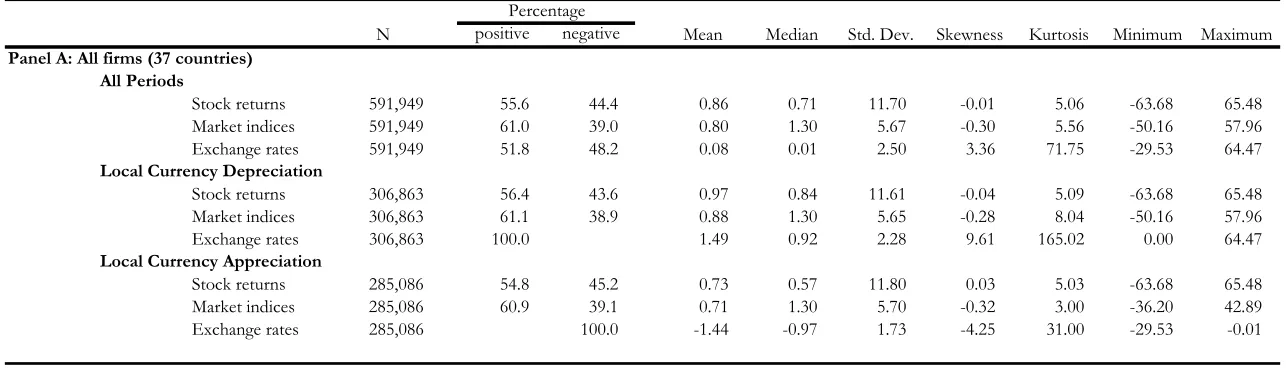
countries. Table 1 provides descriptive summary statistics of all variables. Over the entire sample
period, stocks yield an average annualized return of 10.3%. The market indices have an equal
weighted average annualized return of 9.6% (with a lower standard deviation), while equally
weighted average exchange rate returns are relatively small (1.0% annual).
4 Empirical Results
4.1 Foreign Exchange Rate Exposure
Table 2 reports summary statistics across all firms and time periods for the coefficient estimates, in
particular the exchange rate exposure and the market beta, from the time-series estimations (Eq. (1))
estimated over rolling windows of 60 months. The first row of Panel A shows the foreign exchange
rate exposure estimates. As expected, the mean exposure is close to zero, since the estimation
framework is producing exchange rate exposure elasticity estimates that are measured relative to the
market portfolio’s exchange rate exposure elasticity. While not a mechanical result, because the
mar-ket portfolios are value rather than equal weighted, the distribution is relatively symmetric, as
indi-cated by the mean of the positive and negative coefficients, both in total and for those that are
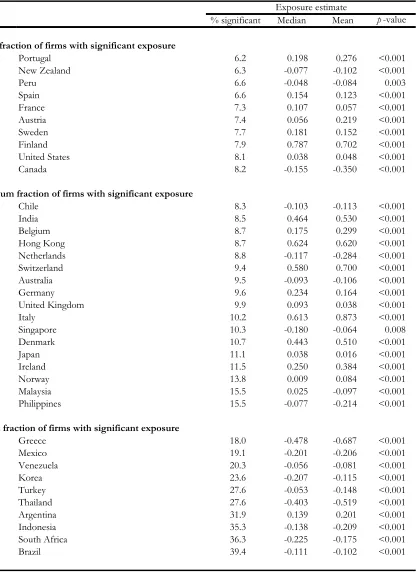
statis-tically significant. Following Bartram, Burns and Helwege (2006), we also test the hypothesis that
the mean exposure is equal to zero. Interestingly, this hypothesis can be dismissed with high
cer-tainty, providing evidence that foreign exchange exposure is evident in stock returns in aggregate.
Consistent with most of the previous research on exposure, we also find a relatively low percentage
of significant exchange rate exposures. In particular, the fraction of firms with significant exposure
coefficients is 6.4% for positive and 5.0% for negative exposures, which is only about double the
significance level (5% in our case) and not uncommon when compared with existing results in the
literature.
8 We also perform all tests using a value-weighed world market index (in local currency) instead of the local
The relatively small percentage of firms with statistically significant exposures has generally
been accepted to be largely the result of an underestimation by researchers of the endogeneity of
hedging and the various channels that it can take.9 Several papers show that corporate hedging
re-duces the sensitivity of stock returns to foreign exchange rate risk e.g., the use of financial hedging
(Allayannis and Ofek, 2001), or operational hedging (e.g. Cater Pantzalis and Simkins, 2004; Kim,
Mathur and Nam, 2004; Allayannis, Ihrig and Weston, 2001). Recent research documents that the
combination of passthrough, operational hedging and financial risk management strategies is
suffi-cient for explaining the observed levels of foreign exchange rate exposure for firms in developed
markets. Since the estimated exchange rate exposure from Eq. (1) are net of the firms’ hedging
ac-tivities, firms with large underlying exposure that effectively manage this exposure will show low
levels of exposure levels that will not be statistically significant.
This suggests that we should find lower percentages of significant exposures in markets with
more access to instruments for and experience with managing exchange rate risk. Correspondingly,
we should find a higher percentage of statistically significant exchange rate exposures in markets
where risk management tools, opportunities and experience are more limited; in particular the
emerging markets.10 Panel B of Table 2 ranks countries by the fraction of firms with significant
ex-posures and highlights the ten countries with the highest and lowest fraction of significant foreign
exchange rate exposure.11 The results reveal that the 10 countries with the lowest percentage of
sig-nificant coefficients consist of nine industrial markets and only one emerging market country. In
contrast, the 10 countries with the largest percentage of significant exposures are all emerging
mar-kets, and the percentage of significant exposure is over four times as high as compared to the
indus-trialized countries in the lowest 10. This suggests that stock returns of firms in emerging markets
are much more likely to have a significant sensitivity to exchange rate changes than firms in the
de-veloped markets.
9 In fact, recent research suggests that the results of a large body of empirical evidence may not be
unreason-able considering the fact that stock returns only reflect the exposure of firms net of corporate hedging (Bartram and Bodnar, 2007).
10 Gopinath, Itskhoki and Rigobon (2006) suggest that firms in emerging market countries have to bear more
foreign exchange rate risk when trading with developed marked firms due to lower exchange rate risk pass-through.
11 Consistent with Dominguez and Tesar (2001a) we generally find a greater percentage of significant exchange
4.2 Exchange Rate Return Premia
4.2.1 Evidence of an Unconditional Return Relation
We use the estimated exchange rate exposures and market betas to estimate monthly cross-sectional
return premia in a manner consistent with the approach of Fama-MacBeth (1973).12 Panel A of
Ta-ble 3 reports the time-series average of the 90 monthly return premia and the p-values of associated
t-tests for different samples of firms. For the entire sample of firms and countries, the results show
no evidence of an unconditional return premium for exchange rate exposure. The average return
premium is just 0.027% per month per unit of exposure to local currency depreciation and the test
for the significance indicates that it is not statistically significant (p-value = 0.396). Thus, in our
sample there is no unconditional return premium for exchange rate exposure. This result suggests
that an investor cannot expect, on average, to earn a return premium simply for holding firms that
are positively or negatively exposed to exchange rate fluctuations.
4.2.2 Evidence of an Conditional Return Relations
While the lack of an unconditional relation is consistent with most asset pricing tests on exchange
rates in a broad setting, we claim that the unconditional specification above is not appropriate for
determining whether there is any relation between exchange rate exposure and realized returns. If
past exposures are economically meaningful for returns, firms with positive exposures to local
cur-rency depreciations should produce higher returns than otherwise similar firms with negative
expo-sures to local currency depreciations in those periods when the local currency actually depreciates.
Similarly, in periods when the local currency appreciates, firms with negative exposures to local
cur-rency depreciations will experience higher returns than otherwise similar firms with positive
sures to local currency depreciations. This suggests that any relation between exchange rate
expo-sures and realized returns needs to be conditional on the realization of the exchange rate change
over the return measurement period. Therefore, we argue that the pattern between exchange rate
exposure and subsequent returns should be positively sloped when the local currency depreciates
12 Given that the market betas and exchange rate exposures are estimated for firms in different countries, we
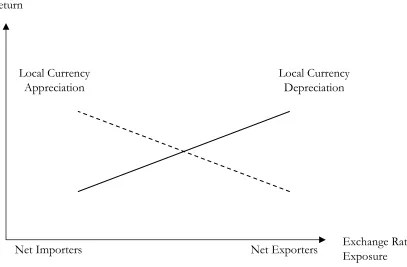
and negatively sloped when the local currency appreciates. Such a conditional relation is plotted out
in Figure 1.
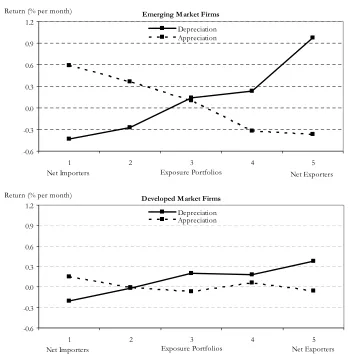
To check whether such a conditional pattern exists in the data, we sort the sample firms each
month into five portfolios on the basis of their estimated exchange rate exposure to local currency
depreciation and plot the average portfolio performance conditional on the realization of the change
in the local currency. The results for all firms are displayed in Panel A of Figure 2. The figure plots
the adjusted returns of the quintile portfolios (i.e., returns net of alpha and beta times the market
return) separately for when the local currency depreciates and appreciates. While not perfectly
matching the predicted pattern in Figure 1, these portfolios do plot out a positively sloped line for
local currency depreciations and a negatively sloped line for local currency appreciations.
To test more formally for this hypothesized relation, we report the conditional mean return
premium from Eq. (2) based upon whether the local currency depreciated or appreciated over the
month in which realized returns are measured. The results of these estimations are shown in Panel
B of Table 3.13 Compared to the unconditional premium, the conditional mean return premia are
striking. When there is a local currency depreciation over the month following the estimation of the
exposure, the return premium for a unit of exposure to local currency depreciation is positive,
0.145% per month, and highly significant (p-value < 0.001). Similarly, when there is a local currency
appreciation over the month following the estimation of the exposure, the return premium to a unit
of local currency depreciation exposure is negative, -0.078% per month, and marginally significant
(p-value = 0.078). This finding suggests that stock returns are systematically related to exchange rate
exposure, just in a conditional sense.
4.2.3 Conditional Return Relations and Realized Risk Factors
To confirm that the exchange rate exposure return premia estimated above are really due to
ex-change rate ex-changes and not some omitted correlated factor or interactions with the market
portfo-lio, we consider an additional test. We examine whether these conditional return premia are related
to the size and sign of the exchange rate change. To do this, we return to Eq(2) and model the
re-turn premia on the exchange rate, d, and the market portfolio, b, to be proportional to the realized
13 This approach is similar in structure to the approach of Pettengil et al. (1995) in which they looked at the
value of the exchange rate index return, RXR, and market index return, RM, (respectively) in the next
period:
β δ
= +( 0+ 1 )ˆ +( 0+ 1 )ˆ +
j M j XR j j
R a b b R d d R e (3)
If the estimated exposures, βˆj and δˆj, are unconditionally related to subsequent stock
re-turns, we would expect to find significant estimates for d0 and b0. If the estimated exposures are
re-lated to subsequent returns in a manner proportional to the realized values of the risk factors (the
realized returns of the exchange rate and market portfolio), we should expect to find significant
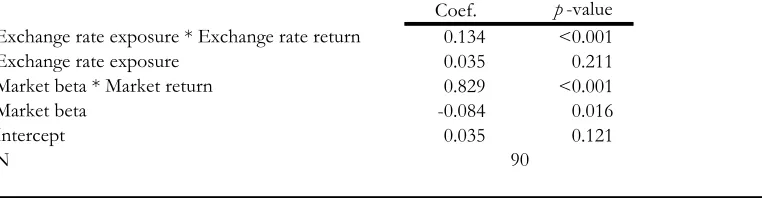
(positive) estimates for b1 and d1. We display the results of this test in Panel C of Table 3. The
coef-ficient on the interaction of the exchange rate exposure and the realized exchange rate change, d1, is
positive, 0.134, and highly significant (p-value < 0.001). In contrast, the coefficient on the exchange
rate exposure itself, d0, is not significant. This suggests that the exchange rate return premium we
identify above is directly related to returns as a function of the change (sign and size) of the
ex-change rate variable, but the exex-change rate exposure itself is not (unconditionally) related to realized
return. In other words, the return premium an investor earns on a firm as a result of the firm’s
ex-posure to exchange rates is not a function of the exex-posure itself, but the exex-posure and the realized
change in the exchange rate.
Similarly, the coefficient on the interaction of the market beta and the realized market
port-folio return, b1, is large and positive, 0.829, and highly significant (p-value < 0.001), while the
coeffi-cient on the market beta itself, b0, is negative, but small. This result is in stark contrast to the
impor-tance of the market beta in Panels A and B of Table 3, where the market betas were not related at all
to returns in an unconditional way. Here, in a manner consistent with the findings of previous work
for U.S. stocks by Pettengill, Sundaram and Mathur (1995) and Lakonishok and Shapiro (1984), the
market beta is found to be significantly related to return, but only conditionally as a function of the
direction of the return to the market portfolio.14
Not surprisingly the size of the association between the firm return and the interaction of
the market return and the firm’s market beta is much larger than that for the exchange rate. The
ra-tio of these coefficients allows us putting the currency return impact in context relative to the
14 As noted above, Cooper (2007) demonstrates that this need not imply that either of these exposures is an
ket return impact. These results suggest that for firms with similar sized exposures to local currency
depreciation and market movements, the average impact on firm return of a change in the exchange
rate index of one percent is only about one sixth (16% = 0.134/0.829) of the average impact on firm
return of a market movement of one percent.
This test supports the claim of a real relation between stock returns and exchange rate
expo-sure on a conditional basis, where the conditioning variable is the realization of the exchange rate
index itself. Moreover, the variability in realized exchange rate changes over time results in variation
of the return impact of exchange rates on these firms. Thus, it seems possible that this relation
could be the source of the time varying risk premia for exchange exposure that previous researchers
have identified, but been unable to explain.15
4.2.4 Economic Magnitude of Exchange Rate Return Premia
To confirm the implication of the regressions above and to measure the economic magnitude of
these premia to investors, we return to the quintile portfolios sorted on the basis of estimated
ex-change rate exposures across all countries. Similar to the approach used in Doidge et al. (2006) we
create a zero net investment portfolio from a long/short position in the two extreme exposure
sorted portfolio. This portfolio is very long exposure to local currency depreciation and should be
expected to produce positive returns when the local currencies depreciate and negative returns when
the local currencies appreciate. Panel A of Table 4 shows the results for local currency
deprecia-tions. Looking at the adjusted returns row, the high-low exposure portfolio produces a statistically
significant monthly return of 0.791%, about 9.5% per year (p-value < 0.001). Given that the net
ex-posure of this zero net investment portfolio to local currency depreciation is 2.875 units of
expo-sure, the per unit of exposure return in this case is approximately 3.3% (9.5%/2.875) on an
annual-ized basis. This suggests that identical firms with opposite unit exposures to local currency
deprecia-tion would be expected to produce return differences of 6.6% on an annual basis for the average
exchange rate depreciation. Panel B shows the results for local currency appreciations. From the
adjusted returns line the high-low portfolio produces a monthly return of -0.290%, about -3.5% per
year, with a marginal degree of statistical significance (p-value = 0.09). Given that the portfolio’s net
15 Additional tests, not reported, consider the role of the volatility of these factors on the return premia by
exposure to local currency depreciation in this case averages 3.024 units of exposure, the per unit of
exposure return is approximately -1.15% on an annualized basis for local currency appreciations.
4.3 Return Premia in Relation to Market Development
As discussed above, there are reasons to believe that exchange rate changes might differentially
af-fect firms in the developed markets as compared to firms in emerging markets. To examine this
is-sue, we separate the firms by country into an emerging market sample and a developed market
sam-ple based upon the classification by Morgan Stanley Capital International (MSCI).16 This
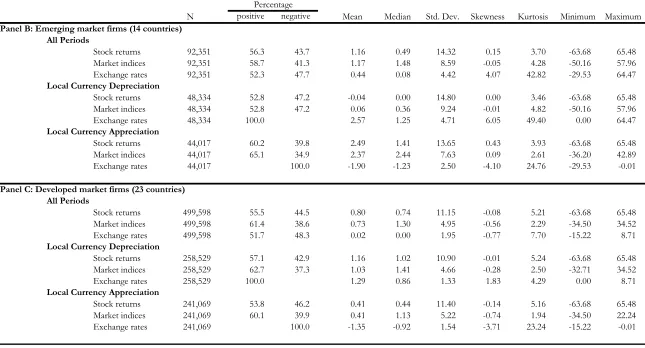
classifica-tion reveals some noticeable distincclassifica-tions. As we can see from Panels B and C of Table 1, there is a
significant difference in the average exchange rate volatility between emerging market countries and
developed market countries. In addition, and consistent with the literature on the effect of currency
crisis in emerging markets, the average equity returns in the emerging markets are much better
dur-ing local currency appreciations than depreciations. We already saw in Table 2 that exposure to local
currency depreciation is more likely to be statistically significant in the lesser developed markets than
it is in the developed markets. Given these facts, one might expect that firms in emerging markets
would have a larger return premium for currency exposure.
We first look at the plots of the returns for the exposure sorted portfolios of these two
groups of firms. These are shown in Panel B of Figure 2. For the emerging market firms, the slopes
of the portfolio’s adjusted returns conditional on the realized exchange rate change create a clear X
pattern. For the developed market firms, the X pattern is less apparent as the slope of appreciation
line is barely negative across the 5 portfolios. This suggests that we might find stronger results
amongst the emerging market firms.
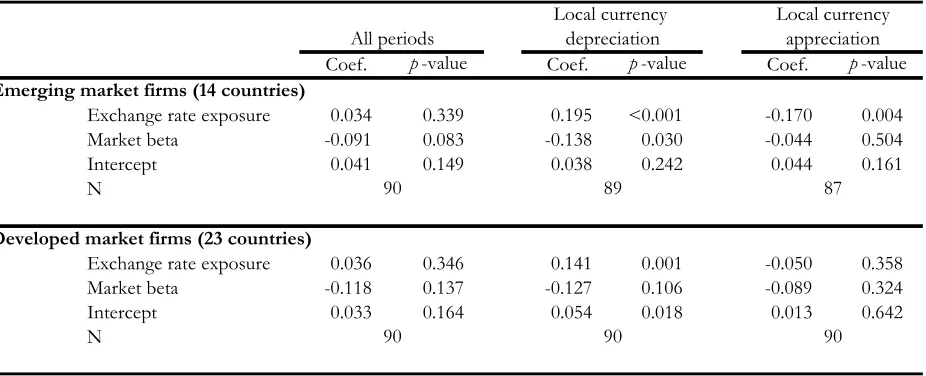
Table 5, Panel A, shows the mean return premium for the firms from the 14 emerging
mar-kets, first unconditionally and then conditionally with respect to the change in the value of the local
currency. As with the full sample of countries, the unconditional return premium is small and not
significantly different from zero. When looking at the return premia on a conditional basis, we see
our basic results. The return premium conditional on a depreciation of the local currency is positive,
0.195% per month, and highly significant (p-value < 0.001). Similarly, the return premium
16 Among the 37 countries in our sample, MSCI classifies Argentina, Brazil, Chile, India, Indonesia, Korea,
tional on an appreciation of the local currency is negative, -0.170% per month, and also highly
sig-nificant (p-value = 0.004). Note that the magnitude of these estimates of the average return premia
for the emerging market firms are noticeably larger than the size of the average return premium for
the full sample.
The table also shows the same set of results for the firms from the 23 developed markets.
Once again, the unconditional test shows no significant return premium. Conditioned on the
ex-change rate ex-change, the return premia are the same sign as those of the emerging market firms, but
smaller and less significant. In particular, the return premium for developed market firms
condi-tional on a depreciation of the local currency is positive, 0.141% per month, and significant (p-value
= 0.001), while the return premium conditional on an appreciation, while negative, is not
signifi-cantly different from zero. This result for developed market firms is somewhat surprising. It
sug-gests that there exists a systematic relation between firms’ stock returns and exchange rate exposures
only for local currency depreciations in the developing countries. While this could be the result of
more active exchange rate risk management to protect against local currency appreciations, it does
draw into question the economic significance of exchange rate exposure for these firms.
Panel B of Table 5 repeats the interacted regressions (Eq (3)) for each of the samples. The
results for the emerging market firms are qualitatively the same as for the full sample: the return
premia for both the exchange rate exposure and market beta are on average quite strongly related to
returns when interacted with the realization of the risk factor. The coefficient on the interaction of
the exchange rate exposure and the realized exchange rate return is 0.180 (p-value <0.001), while the
coefficient on the interaction of the market beta and the realized market return is 0.843 (p-value
<0.001). The ratio of these coefficients suggests that for firms with similar sized exposures to local
currency depreciation and market movements, the average impact of a one percent exchange rate
change on firm return is about 21% (0.180/0.843) of the average impact of a one percent change in
the market portfolio.
The results for the developed market firms suggest a similar though less powerful story.
There is a significant positive average relation between stock returns and the interaction of the
ex-change rate exposure and the realized exex-change rate ex-change, 0.123 (p-value 0.003), though it
noticea-bly smaller than the size of the relation found for the emerging market firms. The unconditional
effect of exchange rate exposure on equity returns in this setting has an elasticity of 0.060 with a p
market beta and realized market return being 0.811 (p-value < 0.001). Again, this finding is
consis-tent with the results of earlier research examining the relation between market beta and return for
the United States (e.g., Pettengill, Sundaram and Mathur, 1995; Lakonishok and Shapiro, 1984).
Table 6 repeats the return tests on the sorted portfolios for each subset of markets. These
tests provide a crude measure of the size of the conditional return premium available to investors for
each subset of countries. Panel A shows the results for the local currency depreciations. The
re-turns to the high-low exposure portfolios for both samples are positive and highly significant.
Di-viding the high-low adjusted portfolio returns by the high – low portfolio exposures and annualizing,
we get an annual return per unit of exposure to local currency depreciation of 8.0% for emerging
market firms and 2.3% for developed market firms. Panel B shows the results for local currency
appreciations. The return to the high minus low portfolio is statistically different from zero only for
the emerging market firms. The per unit of exposure return premium for local currency
apprecia-tions is -5.5%, while for the developed firms, as suggested by the plot, the return premium while a
small negative value is not significant. This evidence suggests that the results found for the full
sam-ple are driven to a large (but not exclusive) extent by firms in countries outside developed markets.
It is interesting to consider potential reasons for the differences in the relation between
for-eign exchange rate exposure and stock returns in emerging market and developed market countries.
To this end, Table 7 presents some relevant statistics. First, exchange rate exposure could matter
more for firms in emerging market countries simply because foreign trade might be bigger.
Never-theless, the results on the size of exports and imports (relative to the size of the economy as
meas-ured by GDP) suggests that foreign trade is relatively less important for developing countries, and
thus cannot explain the observed discrepancy in exchange rate effects. At the same time,
interna-tional trade may lead to larger foreign exchange rate exposures of firms in emerging market
coun-tries because of less expertise and more limited possibilities to hedge exchange rate risk. By the
same token, as shown in Table 7, financial markets in developing countries are less developed,
limit-ing the possibilities of efficient risk sharlimit-ing. This is documented in significantly smaller market
capi-talization of traded companies (as percentage of GDP) (median of 40.6 in emerging market
coun-tries versus 83.9 in developed councoun-tries) as well as domestic credit to the private sector (as
percent-age of GDP) (median of 35.0 in emerging market countries versus 106.9 in developed countries).
of foreign exchange rate and interest rate derivatives (% of GDP) is 0.53 and 0.06, respectively,
compared to 2.39 and 2.30 in industrialized countries.
4.4 Robustness Checks
Many of the emerging market countries were subject to a major economic or currency crisis during
the sample period. As these events are included in our sample data, it is interesting to consider the
effect of these developments for the results. On the one hand, currency exposure may simply reflect
the underlying economic problems rather than pure currency risk. On the other hand, currency
cri-ses may render currency exposure particularly important, due to the large currency movements they
entail. Thus, it is not clear that crises periods should generally be discarded, since one can, in fact,
argue that they are particularly interesting and relevant. Also, note that some of the emerging
mar-ket countries (e.g. India, South Africa) were not part of a major crisis during the sample period.
To consider the influence of crises, we repeat the analysis for the emerging market firms
ex-cluding any observations for the following countries and years: Argentina (1999-2002), Brazil
(1998-1999), Chile (1998-(1998-1999), Indonesia (1997-(1998-1999), Korea (1997-(1998-1999), Malaysia (1997-(1998-1999), Mexico
(1994), Peru (1994), Philippines (1997-1999), Thailand (1997-1999), Turkey (2001), and Venezuela
(1994-1996).17 The results, shown in Panel A of Table 8, are overall similar to those using all
avail-able observations for firms in emerging markets, the economic magnitude of the coefficients is even
slightly larger.
Another aspect to consider in the context of exchange rate exposure is the impact of fixed
exchange rate regimes. This is relevant not only because of the occurrence of exchange rate pegs
amongst the emerging market countries over this period , but also because of the targeted exchange
rate system and creation of the currency union amongst the European countries. While the
multilat-eral exchange rates will still be volatile even with some fixed bilatmultilat-eral exchange rates, it may be
inter-esting to consider the impact of fixed exchange rates for the results. To this end, we examine firms
in emerging market countries during periods where their currency was not pegged (Table 8, Panel B)
and firms in developed markets outside the Euro area (Table 8, Panel C).
17 Note that we exclude stock return observations during months in these years (for the cross-sectional
Limiting the sample to periods where the exchange of a country was floating still shows the
same result of no unconditional, but statistically and economically significant conditional return
premia for emerging market firms.18 Similarly, the results for developed markets excluding Euro
area countries are very similar to those of all industrialized countries, i.e. there is no relation between
exposure and stock returns unconditionally or for currency appreciations, while there is a (small)
ef-fect conditional on the local currency depreciating.
Lastly, the United States is the country with the largest number of firms and whose currency
plays the largest average role in the individual exchange rate indices. Thus, it is possible that the
de-veloped country results are driven by the U.S. data. We therefore replicate the tests on the
devel-oped market firms excluding the U.S. firms in the sample. Results for omitting the U.S. firms from
the developed market sample, displayed in Table 8 Panel D, show no material change on the results.
Studies on foreign exchange rate exposure typically focus on developed market countries in
recent time periods, where inflation has been low. In contrast, our sample includes emerging
mar-kets, some of which had maybe less negligible levels of inflation during the sample period. It is not
clear that inflation should have an effect on the results and would necessarily be a reason of concern
for the estimation of return premia. Nevertheless, in order to assess the potential effect of inflation
on our results, we use monthly data on local currency changes in the consumer price index from the
International Financial Statistics of the IMF to adjust individual stock returns, market returns and
exchange rates. Subsequently, we re-do all tests with these real returns. Table 9 shows that there is
no evidence of an unconditional relation between real returns and real exchange rates, while there is
also a strong conditional relation (which is weaker for developed market firms when the local
cur-rency appreciates). These results are very similar to those reported for nominal returns in Table 5.
Overall, the adjustment of returns for inflation has very little effect on the results.
The summary statistics in Table 2 document that in this study (as in the rest of the literature)
foreign exchange rate exposures are estimated imprecisely (almost 90% of them are statistically
in-significant). As a result, one might be concerned how meaningful the exposure estimates are, and
what the implications of measurement error are for the cross-sectional regression. As common
prac-tice when employing the (widely used) Fama-MacBeth (1973) methodology, we estimate Equation
(2) using ordinary least squares with a correction of the standard errors. Nevertheless, the results are
similar for alternative estimation techniques, such as weighted least squares using the absolute value
of the t-statistics (or the absolute value of the inverse of the standard errors) of the foreign exchange
rate exposure coefficients as weights and thus placing more importance on observations where
cur-rency exposures are estimated with more precision.
Another concern pertains to potential errors in variables problems that may bias the
stan-dard errors (Shanken, 1992) and potentially lead to factors independent of asset returns to show
sig-nificance (Kan and Zhou, 1999). To this end, we replace the actual exchange rates for all countries
with normally distributed random variables that have the same mean and standard deviation as the
actual exchange rates. The results show that, as expected, there is no significant relationship between
these random exchange rate series and stock returns in any of the specifications or (sub)samples for
our data set. This suggests that despite the fact that the exchange rate exposures are small and
esti-mated with error, they are economically meaningful, and their relationship to stock returns is not just
an artifact of the employed methodology. It also shows that the conditional effect we document is
not generated by construction. Finally, we note that the portfolio sorts reported in Tables 4 and 6 do
not suffer from any potential shortcomings of the Fama-MacBeth methodology and thus represent
robustness tests to the findings in the paper as well.
5 Is it a Foreign Exchange Risk Premium?
It is tempting to look at these results and argue that this return premium is in fact a conditional
ex-ante risk premium for exposure to exchange rate risk.19 As an ex-ante risk premium, it would imply
that the required rate of return that the market demands for holding the stock changes with the
ex-pectation of the exchange rate change. However, this interpretation is problematic for a couple of
reasons. First, the conditioning variable here is the realized exchange rate change, which is the risk
factor itself. Forecasting even the direction of the change in the exchange rate has proven very
diffi-cult. Second, it is unlikely that the only impact of the exchange rate change is on the firm’s
(condi-tional) required rate of return as it can also have a direct impact on the firm’s cash flows.
Given that exchange rates convert foreign currency values to local currency, they have a
me-chanical impact on the local currency valuation of foreign currency transactions and assets,
19 As Cooper (2007) points out the form of the conditional test we use cannot be used as proof of an ex-ante
pendent of any cost of capital effect. When the local currency depreciates, firms that have foreign
currency cash flows and assets (e.g., firms that would have positive exposures to local currency
de-preciations) will experience an increase in their local currency value because of the valuation impact
of the exchange rate change on these cash flows and assets (unless they are hedged). Similarly, firms
that have foreign currency payments and liabilities will experience a decrease in their local currency
value because of the direct value impact of the exchange rate change on these flows and liabilities.
This value effect occurs even if there is no change in the firm’s required rate of return (i.e., the rate
at which future cash flows are discounted).20
Obviously the conditional return premium we document in response to exchange rate
changes could be a combination of both the cash flows channel as well as the required rate of return
channel. It could be that the depreciation of the local currency both increases the cash flows to
firms with a positive exposure as well as increases the required rate of return due the conditional risk
premium from the local currency devaluation. Since the increased cash flow and the increased
re-quired rate of return counterbalance one another with respect to their impact on the current value of
the firm, it is difficult to call the net impact on the firm’s return purely a conditional premium for
currency risk.
To consider this further, take the value of a firm as the present value of its stream of
ex-pected future free cash flows (FCF), discounted back to today by the required rate of return given
some asset pricing model based upon the non-diversifiable risks of the cash flows:
∞
=
=
+
∑
0 01
( )
(1 ( ))
t t t
E FCF P
E r (4)
If we simplify this expression by assuming a perpetuity structure, one in which the expected
free cash flows are fixed at E(FCF), the expression reduces to
=
0
( )
( )
E FCF P
E r (5)
When we consider the impact of a change in the exchange rate, S(HC/FC) on the price of
the firm, we can see that the sensitivity of the price of the firm to the exchange rate change is a
tive function of the sensitivity of the value of FCF to the exchange rate change and a negative
func-tion of the sensitivity of the required rate of return to the exchange rate change:
δ =∂ln( )=∂ln( ( ))−∂ln( ( ))
ln( ) ln( ) ln( )
P E FCF E r
d S d S d S (6)
Empirically we can measure the term on the left hand side of Eq (6), this is the exchange rate
exposure elasticity of the firm. This relation can be positive or negative, depending on the nature of
the firm. Our empirics suggest that firms with positive (negative) exposures, based upon recent past
data, tend to experience a positive (negative) change in price in the next period when the home
cur-rency depreciates during that period, while the opposite pattern occurs when the home curcur-rency
ap-preciates during the next period.
It is apparent from Equation (6) that any change in price resulting from a change in the
ex-change rate must occur via either a ex-change in cash flows or a ex-change in the required rate of return,
or some combination of the two channels. What is important to note is that one channel affects the
price relation positively and the other negatively. Thus for a firm whose price rises with a
deprecia-tion of the home currency (an increase in S ), it has to be the case that the exchange rate change has
increased the expected stream of future cash flows or that the exchange rate change has reduced the
required rate of return on the cash flows.
Consider the case of a firm with a positive exposure to the exchange rate (home currency
price of foreign currency). Such a firm would see an increase in its price in response to a
deprecia-tion of the home currency. One explanadeprecia-tion for this positive reladeprecia-tion is purely through the cash
flow channel, with no impact on the required rate of return. The exchange rate, denoted as the
home price of foreign currency (S(HC/FC)) is the rate that is used to convert the foreign currency
cash flows the firm has or expects to have in the future into home currency. A depreciation of the
home currency is an increase in the exchange (HC/FC), and this rate and its future expected values
(which must also increase to prevent profitable speculative arbitrage – unless there was a significant
shift in the risk-free yield curves between HC and FC) will mechanically result in larger HC values
for current and future free cash flows denominated in FC. Thus the value of the firm today would
rise in response to a home currency depreciation purely because the new, higher exchange rate and
its higher future expectations would lead to higher free cash flow in home currency. With a fixed
To verify this effect, we create a simulation for a firm with 100% FC cash flows that are
as-sumed to be fixed in FC in perpetuity. Using the current exchange rate and its future expectations,
based directly upon interest rate parity (as we are assuming no currency risk premium), we convert
the FC cash flows into HC and discount them at a fixed HC required rate of return that is not a
function of the exchange rate. Then, by generating a set of exchange rate shocks, we are able to
ob-tain a time series of values for this firm by discounting the fixed foreign currency cash flows by the
randomly changing exchange rates (and their future expectations). Taking the changes in the price
of the firm and regressing them against the exchange rate changes, we confirm that such a firm has
an exchange rate exposure (sensitivity) of exactly 1.0. This firm displays the features of firms with
positive exchange rate exposure: Its value rises when the HC depreciates, and its value declines
when the HC appreciates. All of this occurs just due to the cash flow channel for the exchange rate
impact on the value of the firm. This is the channel for a link between exchange rate changes and
firm value that has received the most attention in the literature and is commonly discussed by
re-searchers coming at this question from the corporate finance side. Thus, the cash flow channel
would predict a time-varying relation between exposure and realized return that is directly related to
the subsequent realization of the exchange rate, which is consistent with the empirical results above.
An alternative explanation for a positive exchange rate price relation is that exchange rate
changes have an impact on the required rate of return as opposed to the expected cash flows. To
explore this possibility, we consider the extreme case of a firm with a positive exposure to exchange
rate changes, whose cash flows are not affected by the exchange rate. In this case, the relation
be-tween the exchange rate change and firm value can only occur through a change in the required rate
of return, (i.e., the firm’s discount rate). Since the exchange rate – firm value relation does not
ap-pear to be unconditional, it must be the case that the required return component related to the
ex-change rate is time varying. Given the above results, we assume that the exex-change rate risk premium
is conditional on the change in the exchange rate. We will also assume that the current required rate
of return is the rate used to discount all future cash flows.21
21 It is possible that the discount rate is affected only temporarily by the current exchange rate change and that
For this specification, what would the pattern of the return premium need to look like to
ac-count for the conditional relation documented above? From Equation (4) it is the case that the
rela-tion between required return and price is an inverse one. Thus, for a positively exposed firm to
ex-perience an increase in price when the home currency depreciates, we would need the required
re-turn used to discount the (unchanged) cash flows to decline. Thus the risk premium for pure
for-eign currency returns (in home currency) would have to be negative in order for firms with positive
exposure to the exchange rate to have lower (higher) required rates of return when the home
cur-rency depreciates (appreciates). The reason for this situation is that cash flows are assumed to be
fixed and the inverse relation between price and required return in Equation (5).
To investigate the required rate of return channel for the exchange rate to impact firm value,
we consider the simulation of an alternative firm. This firm is assumed to have no cash flows
im-pact from the exchange rate, so that its cash flows are fixed in HC in perpetuity. The only way the
exchange rate changes influence the value of this firm is through the required rate of return used to
discount the cash flows. If this firm were to have an exchange rate exposure of the same size as the
other firm, 1.0, what would the size of the expected risk premium, conditional on the sign of the
change in the exchange rate, have to be to produce changes in value that are consistent with an
ex-posure of 1.0? The results suggest a very small risk premium per unit of exchange rate exex-posure,
-0.25% (annual), in order to generate future returns that produce the assumed exposure of 1.0. Of
course if we assumed that the persistence of the impact of the exchange rate on the required rate of
return were not infinite, this premium would become much larger. Nonetheless, such a risk
pre-mium would be able to consistently explain the empirical relation between positively exposed firms
and exchange rate changes documented earlier under the assumption that the exchange rate is not
affecting the value of the firm’s cash flows.
The implication of the required rate of return channel is that the realized return will not
match the required return. In the period that the home currency depreciates, the positively exposed
firm’s value rises (empirical fact), but the required rate of return channel implies that the required
rate of return must fall. The predicted return would match the realized return in future periods if
the exchange rate were to stay constant as the increased price today implies lower average returns in
the future, but in the current period these returns diverge. More significantly, in a world in which
the exchange rate is changing randomly, the observed return and the required return would