Improving Network Lifetime Using Mobile Sink
in Clustered Wireless Sensor Networks
S. Alexander1, Dr. P. Marikkannu2
1
PG Scholar, 2Assistant Professor, Department of Information Technology, Anna University Regional Centre, Coimbatore
Abstract: In Wireless Sensor Networks, sensors are used to detect abnormal event and report the sensed data to the sink. Sensors have limited power resources. Sensor nodes deliver sensed data back to the sink. The sensor nodes near the sink will consume more battery power than others sensor nodes, the node will quickly drain out their battery energy and Shorten the network lifetime of the Wireless Sensor Network. Mobile Sink based data collection is an efficient network lifetime extension method. Divide the network into multiple clusters by using clustering algorithm. Each cluster has one cluster head (CH). Cluster head are responsible for collecting data from their node. Mobile sink is used to collects the data from the cluster head. Distance based data collection method is used to aggregate the data. Distance between the sink and sensor node is calculated by sink. Lowest distance node is allotted for first slot based on TDMA, to collect the data. It reduces the collision of data, traffic, and delay and also increases the network lifetime.
Index Terms: Wireless sensor network, cluster head, data, collision, mobile sink.
I. INTRODUCTION
A wireless sensor networks consists of small sensor devices, with limited battery power. Sensor nodes are responsible for sensing abnormal events or for collecting the sensed data of the environment. Sensor nodes are reported the data to the sink via multihopping. Sink nodes are static means the sensor node close to the sink is consume more energy than compared to the other sensor nodes. This node is called as hot spot. The battery of sensor node is quickly drained out. So mobile sink is a method to increase the lifetime of the network. Sink mobility can be classified into three categories, namely: random, predictable and controllable mobility. First, random mobility is simple with no real-time information in need to collect the information; there is a chance that the sink moves back to the area with less energy. Second, using predictable mobility, sensor nodes have known the trace of the sink. It saves energy, but the network structure must be fixed and the cache memory of sensor nodes is to be overflowed. Third, controllable mobility allows the sink to decide its movement related to the real-time information of the sensor nodes. Clustering is an efficient routing method; entire sensor network is divided into multiple clusters. Each cluster has one cluster head (CH) which is responsible for data collection. Instead of direct communication with the sink, all the nodes in the cluster send data to the cluster head. So to reduce the traffic load, delay and collision. In this paper Mobile sink is aggregate the by using Distance based data aggregation method. In these method mobile sink is send the beacon signal to the entire network. Cluster heads are ready to give the data to the mobile sink. Before going to give the data, the cluster head are sending the reply signal to the sink. Sink collect the entire reply signal and find the distance of the each cluster head. Based on the distance between the sink to sensor node, the data aggregation is started. This method reduces the delay in the data collection process. The rest of the paper is organized as follows. Section II introduces some related work of the TDMA, mobile sink. In section III is the Experimental setup of the proposed method. Performance evaluation is given in the Section IV and Section V deals with conclusion.
II. RELATED WORKS
their signals to intended receivers such that interfering signals are separated and eliminated. TDMA method increases the performance of the network by reducing the delay and increasing throughput. Congestion in the network creates the average end-to-end delay consider at the time of data communication from one node to sink node. Many times due to congestion the average end-to-end delay will be increased and energy also loss in the communication. Dattatray S. Waghole, and Vivek S. Deshpande [3] has been proposed to reduce average end-to-end delay using Movable Mobile Sink in uniform random wireless sensor network. Energy Consumption and Traffic control also other important parameters consider at the time of analysis. Mobile sink node reduces average end-to -end delay. Mobile Sink is also moving different direction, so Mobile sinks collect the data moving through different direction. So, delay is reducing for data packets collection from the networks. Priyanka M. Lokhande and A. P. Thak [4] are proposed the maximization of lifetime and minimization of delay for the performance of wireless sensor network. Energy is mostly consumed by the communication radios. Sleep-wake scheduling is an effective mechanism to increase network lifetime. Sleep-wake scheduling is efficient in increasing network lifetime but it creates delays because a transmitting node needs to wait for its next-hop relay node to wake up. To reduce these delays by developing any cast based packet forwarding method, each node forwards a packet to the first neighbouring node that wakes up among multiple candidate nodes such a set of nodes is called forwarding node set. Any cast forwarding schemes are used to forward the data packet to next hop node which minimizes the packet-delivery delays from the sensor nodes to the sink node. Xinxin Liu et al. [5] proposed the sink trail, a protective data reporting protocol. In many applications, a mobile sink cannot move freely in the deployed area. To avoid the constant sink location update traffics when a sink future locations cannot be scheduled in advance. To propose two energy-efficient proactive data reporting protocols, Sink Trail for mobile sink based data collection. The proposed protocols feature low-complexity and reduced control overheads. The movement of mobile sinks to dynamically adapt to various changes; and without requirements of GPS devices or predefined landmarks.
III.EXPERIMENTAL SETUP
A. Time Division Multiple Access (TDMA)
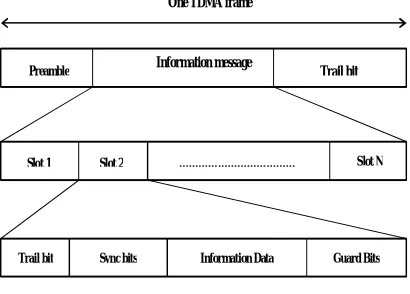
Multiple access schemes are used to allow many mobile users to share simultaneously a finite amount of radio spectrum. In the time division multiple access scheme are used to divide the channel into time slot. In each time slot only one user is allowed to either transmit or receive the data. The frame consists of number of slots. Each frame is made up of preamble, information, and trail bits. In TDMA frame, preamble contains the address and synchronization information that both the base station and subscribers use to identify each other.
Information message
Preamble Trail bit
Slot 1 Slot 2 ……… Slot N
Trail bit Sync bits Information Data Guard Bits
One TDMA frame
[image:3.612.204.409.437.584.2]
Figure.1. TDMA frames.
Figure. 1. shows the TDMA frame, which contains information message and trail bit. One slot is allotted for single user only. Slot contains trail bit, sync bits, information data, and guard bits. TDMA needs high synchronization, due to high transmission rate.
B. Ranging Techniques
effects. Variations in height between sender and receiver can also affect the accuracy. A second way to estimate distance is to measure the time it takes for a signal to travel from sender to receiver; this can be multiplied by the signal propagation speed to get the distance. Such methods are called time of arrival (TOA) techniques. This requires that the sender and receiver are synchronized and that the sender knows the exact time of transmission and sends that to the receiver. An alternative is to measure the time difference of arrival (TDOA) at two receivers, used to estimate the difference in distances between the two receivers and the sender.
RSSI = - (10 n log d + A) Eqn no. (1)
Where n is the signal propagation, D is the distance from the sender,
A is the received signal strength at 1m distance.
Based on the formula the distance between the sender and the receiver is calculated.
C. Cluster Formation
Divide the entire network into multiple clusters, using clustering algorithm. Each cluster has one cluster head. Highest residual energy node in the cluster is selected as cluster head, if two nodes in the cluster have same residual energy, and then compare the node ID of the two nodes. Smallest node ID node wins and that node is selected as cluster head (CH).
D. Distance Calculation And Data Collection Process
[image:4.612.199.413.345.393.2]1) Initial Step
Figure. 2. Signal transfer between two nodes.
Figure. 2. show the Mobile sink transfers the beacon signal to the entire network. Some of the nodes are hear the beacon signal, some nodes are not reached. The not reachable nodes are not considered, which nodes are getting the beacon signal that nodes send the reply signal to the sink. The signal contains Residual energy and data size. Mobile sink collects signal from all the nodes. Based on the RSSI the distance is calculated.
[image:4.612.136.473.540.700.2]2) Data Aggregation Step: Sensed data is aggregated by the sink node. Before going to aggregate the data from all nodes, sink first calculate the distance of each and every node. Based on the distance only sink aggregate the information from the sensor node (cluster head).
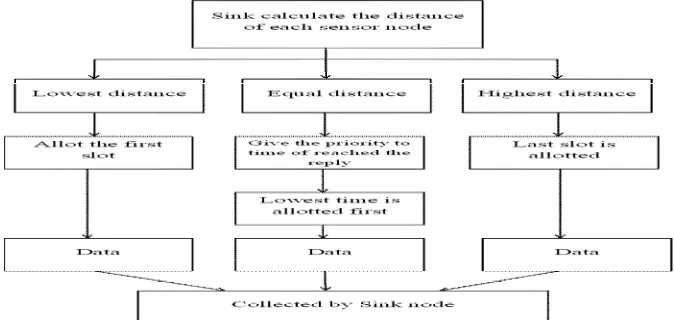
Figure. 3. show the step by step process of data aggregation. First step to calculate the distance between the each cluster head and sink. Based on the reply message from the cluster head, the distance is calculated i.e Received signal strength and Time of arrival of the signal. There are three possibilities occurred to find the distance. 1) Lowest distance, 2) Equal distance, 3) Highest distance. First priority is always given to the lowest distance only. Lowest distance node is selected and the slot 1 is assigned to the node. So, first data is collected from the node only. Second case is equal distance, if suppose two cluster head (node) are send the reply signal at the same distance or very near distance, in the case priority is given to the time. Verify both reply signals at what time the signal is reached the sink. Lowest time of arrival message is selected and the slot is assigned to the particular node. Next slot is assigned to another node. Third case is highest distance, distance between the sink and cluster head is higher. So the highest distance node is allotted for last slot. The slot assigning is based on the TDMA. This method reduces the collision of data. Delay also reduced in the scenario. Finally information from all the channels are aggregated by the sink. Sink forward information to the users.
IV. PERFORMANCE EVALUATION
[image:5.612.199.414.269.431.2]Evaluate the performance of the Distance based data aggregation of mobile sink via the simulations in Network simulator-2. Parameter like energy and delay performance in the network is evaluated.
Figure. 4. Time vs Delay.
[image:5.612.194.420.503.711.2]Figure. 4. show the relation between time and delay in the network. When time increases delay is also increases. Reduce the time for data transfer, the delay is also reduced. Distance between the source and the destination is smaller, time taken to reach the destination is small.
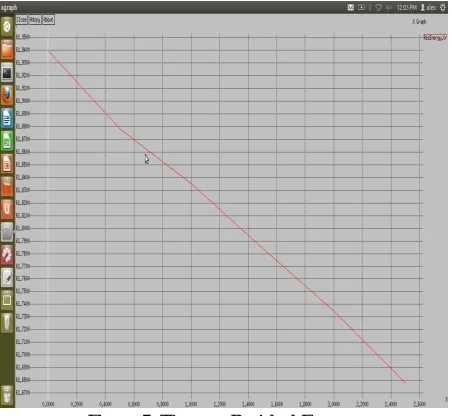
Figure. 5. shows the relation between time and energy in the network. When time increases energy consumption is also increases in the node. Reduce the distance, between the source and destination, energy consumption by the node is getting reduced.
V. CONCLUSION
Extra energy consumption in the node is shortening the network lifetime. Extra energy consumption in the network is occurred by the parameters like delay, collision, traffic and retransmission. So, to avoid the delay, collision, traffic in the network by Distance based data aggregation method. This method is used to collect the data, based on the distance between the sensor nodes to sink. Delay, traffic and collision is reduced, the network lifetime is increased.
REFERENCES
[1] Edith C.-H. Ngai, Erol Gelenbe and Gregory Humber, “Information-Aware Traffic Reduction for Wireless Sensor Networks” International Journal of Power Control Signal and Computation.
[2] Vahid Zibakalam and Mohammad Hossein Kahaei, “ Increasing Throughput and Reducing Delay in Wireless Sensor Networks Using Interference Alignment”,Izt. J. Communications, Network and System Sciences, 2012, 5, 90-97.
[3] Dattatray S. Waghole and Vivek S. Deshpande, “ Reducing Delay Data Dissemination Using Mobile Sink in Wireless Sensor Networks”, International Journal of Soft Computing and Engineering (IJSCE) ISSN: 2231-2307, Volume-3, Issue-1, March 2013.
[4] Priyanka M. Lokhande and A. P. Thakare, “Maximization of Lifetime and Minimization of Delay for Performance Enhancement of WSN”, International Journal of Technology and Management., ISSN 1927‐9000 | Vol. 2 No. 1, pp. 9‐16 (2013).
[5] Xinxin Liu, Han Zhao, Xin Yang and Xiaolin Li, “ SinkTrail: A Proactive Data Reporting Protocol for Wireless Sensor Networks” ,National Science Foundation under Grant No. CNS-0709329, CNS-0923238.
[6] Aniket M. Junghare, Balaji M. Patil and Deepali M. Shimpi, “An ImprovedTraffic Aware Dynamic Routing to Relieve Congestion in Wireless Sensor Network” International Journal of Emerging Technology and Advanced Engineering., Volume 4, Issue 1, January 2014.
[7] Liu Xiang, Jun Luo and Athanasios V. Vasilakos, “ Compressed Data Aggregation for Energy Efficient Wireless Sensor Network”,International Journal of Emerging Technology and Advanced Engineering.
[8] Pooja Kumari and Mukesh Kumar, “ Improving Quality of Service in Wireless Sensor Networks Using Prioritized Clustering Approach”International Journal of Advanced Research in Computer Science., Volume 2, No. 5, Sept-Oct 2011.
[9] Moses Nesa sudha, Muniappan Lakshapalam valarmathi and George rajsekar, “Minimization of Collision in Energy Co nstrained Wireless Sensor Network”, Wireless Sensor Network, 2009, 1, 350-357.
[10] Sinem Coleri Ergen and Pravin Varaiya, “TDMA scheduling algorithms for wireless sensor networks”, Wireless Netw., (2010) 16:985–997.
[11] Manoj kumar jain, “energy reduction and delay minimization in wireless sensor networks through asips”, International Journal of Power Control Signal and Computation (IJPCSC)., Vol. 2 No. 1
AUTHORS BIOGRAPHY
S.Alexander has completed his Bachelor’s degree in Electronics and Communication Engineering from SKR Engineering college, Chennai. Presently pursuing Master of Engineering in Mobile and pervasive computing under the faculty of Information and Communication Engineering from Anna University Regional Centre, Coimbatore. His research interest are wireless communication, wireless sensor networks, Mobile communication.