6
I
January 2018
671
©IJRASET (UGC Approved Journal): All Rights are Reserved
Novel Approach for Work Flow Scheduling In
Cloud Environment by Convex Optimization
Kiran1, Sanjay2
1
Scholar, Department of computer science, Technical University, Hamirpur, Himachal Pradesh, India. 2
Head of computer science, SIRDA institution of engineering technology, Sundernagar, (H.P), India.
Abstract: Many algorithms in the literature have been targeting the work flow scheduling problem, however, handful efficient solutions have been proposed. This paper proposed an ACO (Ant colony optimization) algorithm based on the real ant behaviour and it’s a new heuristic algorithm to solve combinational optimization problems. We use intelligence optimization ant colony optimization. This is initialized by Pareto distribution. ACO is used to converge the decision of Virtual Machine (VM) migration by its convergence to minima of cost and time. Workflow scheduling is the most important part of cloud computing, because based on the different criteria it decides cost execution and time execution. ACO performs better in comparison to GA for reduction of cost and time because of the random crossover.
Keywords: Cloud computing, ACO, intelligence optimization, Resource scheduling, VM
I. INTRODUCTION
These days, Cloud computing is a developing zone in distributed computing that conveys progressively versatile administrations on demand over the web through the equipment and programming virtualization. The greatest preferred standpoint of the cloud is its adaptability to rent and discharge resources according to the client necessity. Besides, the cloud supplier offers two sorts of plans to be specific on demand short-term plan and long-term reservation plan. It has good framework i.e. Scalability, Transparency, Security and Monitoring [1].
II. APPROACH
For the implementation, we have used the tools java, programming language JDK 1.8, eclipse. Eclipse is an integrated development environment (IDE) used in computer programming, and is the most widely used java IDE.
III.IMPLEMENTATIONANDRESULT A. Basic ACO Algorithm
The Ant algorithm was introduced by Dorrigo M. in 1996 based on the real ant behaviour and it’s a new heuristic algorithm to solve combinational optimization problems. Investigations have shown that ants have the ability to find food in an optimal path between the food and nest. With the ant motion some pheromone is released on ground, previous laid trail is encountered by isolated ant is being detected and follow with a higher probability. The ant’s probability of choosing the way depends upon the pheromone concentration on that way. Higher the pheromone concentration, higher will be the probability of that way adoption. An optimal way can be found by utilizing this positive mechanism of feedback. The steps of ant colony optimization algorithm are given below: 1) Algorithm 1:
a) Step 1: Parameters is set, pheromone trails are initializing. b) Step 2: On path segments, the virtual trail is accumulated. c) Step 3 : ACO- Construct ant solutions
From node i to node j an ant will move with probability
Pi,j=(ָ )
Where,
672
©IJRASET (UGC Approved Journal): All Rights are Reserved
According to the equation amount of pheromone is updated
T ij=(1-p)Tij+∆τi,j
According to the equation amount of pheromone is updated τi,j = (1 − ρ)τi,j + ∆τi,j
Where,
On a given edge I ,j the amount of pheromone is τi,j
ρ is the rate of pheromone evaporation is ρ
The amount of pheromone deposited is ∆τi,j, typically given by
Where,
The cost of the kth ant’s tour (typically length) is Lk.
B. Proposed Workflow Scheduling ACO Algorithm
With the above given ant algorithm characteristic utilization, the task can be scheduled. Similarly, new task can be carried out with the utilization of previous task scheduling result. The basic ideas of ACO algorithm is inherited in Workflow Scheduling-ACO algorithm for the reduction of execution time and cost.
Firstly, input the workflow to the workflow simulator and parse the task from this workflow. Pareto distribution is followed by the task. On VMs, there is a pare to distribution of ants at the beginning and then, VMi pheromone values are initialized:
Where
Number of VMi processor
Million instructions per second of each VMi processor
VMi communication bandwidth ability
Choosing VMs rule for next task: For next task, VMi choose by k-ant with probability defined as:
Where
Pheromone value of VMi at time T
VMi computing capacity Ci can be defined as:
lbiVMi load balancing factor for minimizing the degree of imbalance defined as:
Where
Virtual machine average execution time in the optimal path last iteration Expected execution time of VMi task
is defined as:
Where
673
©IJRASET (UGC Approved Journal): All Rights are Reserved
Parameters controlling the relative weight of pheromone trail along with VMs computing capacity and load balancing. Once heavily loaded are some VMs becoming bottleneck in cloud influences the given task set make span. The load balancing factor lbi is defined in the ant algorithm for improving the capacity of lead balancing. Bigger the lbi, higher will be the probability of choosing means VMi comprehensive ability is greater now.
Updating Pheromone: Ant Let at any time T be the VMi pheromone intensity. The update of the pheromone is given by:
Where
Decay coefficient of pheromone trail
The past solution impact will be less if value of is greater. The value is defined as:
After the completion of ant tour, updating the local pheromone on VM visited and value is given as:
Where
K-ant searched shortest path length at ith
iteration
In case, the current optimal solution is found by the ant while completing its tour, larger intensity pheromone is laid on its tour and updating the global pheromone on VM visited and value is given as:
Where
Current optimal solution dencouragement coefficient
If the function is optimized then we analysis the cost and time of that function.
Fig.4.1.System Model
Parse the task
Task follows the Pareto distribution
Provide VM according to critical path
Initialize
Update by fitness function Input work flow
Optimize objective function
Optimize
Time
Analysis
674
©IJRASET (UGC Approved Journal): All Rights are Reserved
IV.EXPERIMENTALRESULT
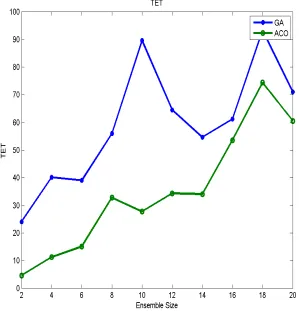
Result of GA and ACO using –SIPHT
Ensemble GA ACO
Size TET TEC Response Time TET TEC
Response Time
2 24.06 5723.855 0.01543485 4.59 4584.063 0.03872953
4 40.16 10011.35 0.02542084 11.26 8605.69 0.06121714
6 39.04 13521.19 0.0222077 15.13 12200.43 0.05127205
8 55.98 13404.39 0.02757845 32.83 14277.19 0.05764191
10 89.61 17549.09 0.02727286 27.77 16900.17 0.0473407
12 64.5 20561.6 0.02593575 34.34 19939.58 0.04683594
14 54.64 21713.64 0.02712497 34.06 22367.37 0.05854424
16 61.21 25855.99 0.02958881 53.59 30163.12 0.06301173
18 93.3 33493.56 0.03669985 74.36 33303.33 0.05073513
[image:5.612.155.454.388.699.2]20 71.03 34154.99 0.03308249 60.55 33057.34 0.05341777
Table 4.1: Comparison table of GA and ACO using SIPHT
675
©IJRASET (UGC Approved Journal): All Rights are Reserved
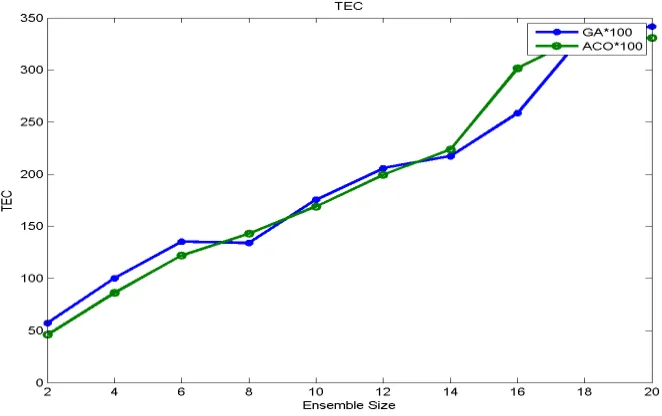
[image:6.612.138.469.85.293.2]Figure4.3: Comparison graph of TEC of GA and ACO using SIPHT
Figure 4.4: Comparison graph of Response time of GA and ACO using SIPHT
V. CONCLUSION
676
©IJRASET (UGC Approved Journal): All Rights are Reserved
VI.ACKNOWLEDGMENT
I would like to express my deepest gratitude to my supervisor Mr.Sanjay for their constant guidance and encouragement, without which this work would not have been possible. For their unwavering support, I am truly grateful. I am also grateful to all my friends whose constant inspiration and support towards better work throughout my study proved to be valuable. The perfection that he brings to each and every piece of work that he does always inspired me to do things right at first time. Without his invaluable guidance, this work would never have been a successful one. He is a great person and one of the best mentors. I will always be thankful to him.
I would also like to thank the faculty of Computer Science department (SIRDA Institute of Engineering Technology).of course, this acknowledgement would not be complete without thanking my parents and family, who supported me throughout my entire study and encouraged my activities. Thanks to the loving support and faith of my parents. I was able to finish my study and make it a great time to look back on.
My gratitude is to the College for providing me assistance in the form of necessary library and laboratory facilities during the course and research work.
REFERENCES
[1] L. Liu, M. Zhang, R. Buyya. "Deadline‐constrained co evolutionary genetic algorithm for scientific workflow scheduling in cloud computing." Concurrency and Computation: Practice and Experience (2016).
[2] E. N. Alkhanak, E. Nabiel, S. P. Lee, and S. U. R. Khan. "Cost-aware challenges for workflow scheduling approaches in cloud computing environments: Taxonomy and opportunities." Future Generation Computer Systems 50, 3-21 (2015).
[3] S. Shukla, A. K. Gupta, S. Saxena and S. Kumar "An Evolutionary Study of Multi-Objective Workflow Scheduling in Cloud Computing." International Journal of Computer Applications (0975–8887) Volume (2016).
[4] H. Liu, D. Xu and H. K. Miao, "Ant Colony Optimization Based Service Flow Scheduling with Various QoS Requirements in Cloud Computing," 2011 First ACIS International Symposium on Software and Network Engineering, Seoul, 2011, pp. 53-58.
[5] S. Abraham, M. Naghibzadeh, and D. H. Epema, “Dead line constrained workflow scheduling algorithms for infrastructure as a service clouds,” Future Generation Computer. Syst., vol. 29, no. 1, pp. 158–169, 2013..
[6] A.K. Bardsiri, S.M. Hashemi, A review of workflow scheduling in the cloud computing environment, Int. J. Computer. Sci. Manage. Res. 1 (3) (2012) 348–351. [7] S. Pandey, L. Wu, S. M. Guru, R. Buyya, "A particle swarm optimization-based heuristic for scheduling workflow applications in cloud computing
environments." Advanced information networking and applications (AINA), 2010 24th IEEE international conference on. IEEE, 2010.
[8] M. Xu, L. Cui, H. Wang and Y. Bi, "A Multiple QoS Constrained Scheduling Strategy of Multiple Workflows for Cloud Computing," 2009 IEEEInternational Symposium on Parallel and Distributed Processing with Applications, Chengdu, 2009, pp. 629-634.
[9] Z. Zhu, G. Zhang, M. Li and X. Liu, "Evolutionary Multi-Objective Workflow Scheduling in Cloud," in IEEE Transactions on Parallel and Distributed Systems,
vol. 27, no. 5, pp. 1344-1357, May 1 2016.
[10] F. Zhang, J. Cao, K. Hwang, K. Li and S. U. Khan, "Adaptive Workflow Scheduling on Cloud Computing Platforms with Iterative Ordinal Optimization," in