Anthropology Theses Department of Anthropology
4-21-2009
Old Stories, New Narratives: Public Archaeology and the Politics
Old Stories, New Narratives: Public Archaeology and the Politics
of Display at Georgia's Official Southeastern Indian Interpretive
of Display at Georgia's Official Southeastern Indian Interpretive
Center
Center
Erin Leigh Andrews
Follow this and additional works at: https://scholarworks.gsu.edu/anthro_theses
Part of the Anthropology Commons
Recommended Citation Recommended Citation
Andrews, Erin Leigh, "Old Stories, New Narratives: Public Archaeology and the Politics of Display at Georgia's Official Southeastern Indian Interpretive Center." Thesis, Georgia State University, 2009. https://scholarworks.gsu.edu/anthro_theses/30
GEORGIA’S OFFICIAL SOUTHEASTERN INDIAN INTERPRETIVE CENTER
by
ERIN L. ANDREWS
Under the Direction of Despina Margomenou, PhD
ABSTRACT
Presenting a case study of an American Indian exhibit at the Funk Heritage Center, I
critically examine how this museum’s ideologies and preferred pedagogies shape public discourse
about Southeastern Indians in the past and present. Using the methodology of Visitor Studies, this
public archaeology project illustrates the benefits of incorporating applied anthropology into
museological practice through collaboration with museum staff, volunteers, visitors, and American
Indians. Operating within the theoretical frameworks of Charles R. Garoian (2001) and Barbara
Kirshenblatt-Gimblett (1991), my results imply that inserting archaeological narratives into
institutional pedagogy alters a museum’s traditional “performance” of the past by challenging its
own authority; ultimately, I show how this process can increase viewer awareness about the
PUBLIC ARCHAEOLOGY AND THE POLITICS OF DISPLAY AT
GEORGIA’S OFFICIAL SOUTHEASTERN INDIAN INTERPRETIVE CENTER
by
ERIN L. ANDREWS
A Thesis Submitted in Partial Fulfillment of the Requirements for the Degree of
Master of Arts
in the College of Arts and Sciences
Georgia State University
Copyright by
Erin L. Andrews
PUBLIC ARCHAEOLOGY AND THE POLITICS OF DISPLAY AT
GEORGIA’S OFFICIAL SOUTHEASTERN INDIAN INTERPRETIVE CENTER
by
ERIN L. ANDREWS
Committee Chair: Despina Margomenou
Committee: Jeffrey Glover Emanuela Guano
Electronic Version Approved:
ACKNOWLEDGEMENTS
A number of key people enriched this endeavor. The following distinguished mentors
deserve recognition for their invaluable support, encouragement and insight. Foremost, I wish to
thank Dr. Despina Margomenou for offering her time, constructive criticism, and advice
throughout this arduous process; her efforts emboldened my research design and challenged me
to produce the best of myself. Many thanks are due to Dr. Jeffrey Glover, an inspirational guide
who provided me with priceless encouragement, direction, and assistance throughout my tenure
as his Graduate Assistant. I am honored that Dr. Emanuela Guano agreed to serve on my
committee. Dr. Guano possesses an impressive capability to communicate anthropological
theory effectively to her students – a quality that undoubtedly benefitted this research. I offer
my deepest thanks to the remainder of the Anthropology Department – especially its
administrative support staff for words and actions of encouragement.
This research would not have been possible without the dedicated efforts of the Funk
Heritage Center’s staff and its volunteers. Special thanks are due to Dr. Joseph Kitchens for
allowing me to conduct my research at the Bennett Museum, for offering his advice and insight,
and especially for his continual support of this undertaking. I offer many thanks to Martha Hout,
Barbara Starr and Angie Hunter for their invaluable technical support and teaching assistance for
the entire duration of my research. Thanks are also in order to the Reinhardt College Board of
Trustees for opening their venue to me for conducting research.
The following people deserve many thanks for imparting their wisdom, insight and time
to me: Robert Andrew, Dennis Blanton, Linda Baker, Russell Cutts, Scot Keith, Matt McCoy,
Joan McFather, Jamal Najm, Lorraine Norwood, Robert Rambo, Patricia Scully, Jane Shelnutt,
of your assistance throughout this process. Undoubtedly, I owe a great debt to my family and
friends for their unfailing encouragement and support; above all, I wish to thank my dear
husband, Peter Drake. Thank you for being my sounding board, your countless hours of
TABLE OF CONTENTS
ACKNOWLEDGEMENTS v
LIST OF FIGURES x
CHAPTER
1 . I N T R O D U C T I O N 1
Public Archaeology and Museums 1
Impetus for Research 1
Background Information 2
Georgia’s Official Southeastern Indian Interpretive Center 3
Limitations and Challenges 5
Ethics 6
A Note on Terminology 7
Thesis Overview 7
2. LITERATURE REVIEW OF MUSEOLOGICAL PRACTICE 10
Introduction 10
From the Old World to the New 11
Noble Conquests for the Common Man 11
The Emergence of American Museums 14
World Fairs and Exhibiting American Indians 15
From Authority to Inclusivity 19
3. THEORETICAL FRAMEWORK 22
Introduction 22
Garoian – “Performing the Museum” 23
Performing Perception 23
Autobiography 24
Museum Culture 25
Interdisciplinarity 26
Performing the Institution 26
Kirshenblatt-Gimblett – “Poetics of Detachment” 28
In Situ 29
In Context 30
Applying Performance Theory 31
Conclusion 34
4. METHODOLOGY 45
Introduction 45
Front End Analysis 45
Formative Assessment 47
Summative Evaluation 48
5. LOST NARRATIVES 50
Intended Performance vs. Actual Practice 50
From Savagery to Civilization? 54
“Another Dead Indian Museum…” 58
6. NEW NARRATIVES 67
Breathing Life Back into the “Dead Indian” Museum: Change through Collaboration
67
Viewer Agency through Archaeological Context 69
Cultural “Survivance” and Contemporary Southeastern Indians 73
Conclusion 74
7. CONCLUSION 76
Summary of Findings 76
Public Archaeology for the Museum Community 78
In Closing 78
EPILOGUE 80
REFERENCES CITED 82
APPENDICES
APPENDIX A: OPEN-ENDED SURVEY 89
APPENDIX B: SAMPLE SURVEY FOR ADULTS 90
APPENDIX C: SAMPLE SURVEY FOR CHILDREN 91
LIST OF FIGURES
Figure 1. Front façade of the Hall of the Ancients. 36
Figure 2. Front entrance of the exhibit. 36
Figure 3. Overview of the exhibit’s interior facing the petroglyph. 37
Figure 4. Layout of exhibit and intended room flow. 37
Figure 5. Touch station kiosk and signage. 38
Figure 6. Paleo Period diorama. 39
Figure 7. Archaic Period diorama. 39
Figure 8. Woodland Period diorama. 40
Figure 9. Mississippian Period diorama. 41
Figure 10. Historic Period diorama. 42
Figure 11. Trail of Tears display. 42
Figure 12. Mannequin of woman holding infant in Trail of Tears display. 43
Figure 13. Artifact cases and “poetics of detachment.” 44
Figure 14. Display of an archaeologist’s “office.” 45
CHAPTER 1
INTRODUCTION
American archaeology, despite some significant progress in the past decade, is still failing to effectively tell the public about how modern anthropological archaeology functions and about the huge gains archaeologists have made in understanding the development of ancient cultures through time and space.[Sabloff 1998:869]
Public Archaeology and Museums
Public archaeology is crucial to ensuring public interest in the preservation of past
societies and imparting archaeological knowledge to future generations. As Jeremy A. Sabloff
(1998) points out, communicating what archaeologists actually “do” and why what we do is
relevant to the public is an essential step to continuing archaeological efforts to expand our
knowledge about the past. Because archaeology enriches our understanding of our human
ancestors, its findings are pertinent toeveryone. However, while most professionals work with
local constituents for their own personal projects, few actually specialize in how to effectively
communicate their archaeological findings to the broader general public (Fagan 1977; Sabloff
1998).
Impetus for Research
To bridge this communication gap, I argue that museums are effective media through
which archaeologists may communicate their changing interpretations about the past to the
public. I propose that the representation of prehistoric American Indians in museums should be
directly tied to the complex processes of archaeological research and dissemination of
knowledge. Understanding that archaeologists shoulder the responsibility of consulting with the
local populations of the areas in which they work, I argue that simply maintaining good relations
with the public is not enough (Goodacre 2002; James 1999; McLoughlin 1999; Moser 2003;
actively shape public discourse about the past and especially about early American Indians
(Moser 2003; Nason 2003), I argue that archaeologists need to be more involved with the local
museums situated in their region(s) of study. As James D. Nason, the director of the American
Indian Studies Center at the University of Washington, points out
most Americans [have] the greatest potential access to local history museums—museums with relatively small numbers of professional staff who have, at some time or another, created long-term exhibitions that usually include local Native American materials…it is these history museums that have had the greatest museological impact on American views about Native Americans, not the professionally created anthropological displays in the larger university, state, or natural history museums. It is not the latter that we should look to as the museum sources of American attitudes toward Native American history and culture, but rather the local history museum. [2000:35 – 36]
In other words, because local history museums are ubiquitous, readily accessible to the public
and often lack the funding or personnel to update their exhibits, it is highly important for
archaeologists to support these institutions in their efforts to educate the public about the past.
Providing a model for other local cultural institutions, this ethnography shows how the
inclusion of archaeological narratives in museum tours and its educational programs engenders
public understanding about how a story is presented, who it is told about, and what information
is conveyed. Rooted in ethnographic evidence obtained from research at the Funk Heritage
Center’s Bennett Museum, this thesis offers some possible solutions for other locally based
museums wanting to update the content of their exhibits in order to improve the quality of their
public education.
Background Information
Although I work as a full-time archaeologist for a private firm, I have served as a
volunteer archaeologist at the Funk Heritage Center since 2005. Throughout my tenure, I have
taught both children and adults about the importance of archaeology through museum tours,
public discourse about archaeology and identified some of the public’s misconceptions about
American Indians. Perhaps the most troubling misunderstanding encountered over the course of
my activity is an ideology that speaks to an unawareness of living Southeastern Indian
descendants and their contemporary contributions to American cultural practices.
To deconstruct these misunderstandings, I decided to evaluate an exhibit called the Hall
of the Ancients housed within the Bennett Museum of the Funk Heritage Center. I set out to
understand the following questions: What are the pedagogies currently employed in the
institution’s presentation of the past and how do these ideologies inform its discourse about
Southeastern Indians? How do visitors view or understand the Southeastern Indians displayed in
the exhibit? Are visitors aware of the archaeological processes that shaped the main ideas of the
exhibit’s didactic displays? By inserting new narratives into the exhibit tour and its related
educational programs, how can the museum effectively change public discourse about
archaeology and the Southeastern Indians? While this intervention may appear to reflect a
personal agenda, its original formulation stemmed from the institution’s request for the
development of an archaeological education program which involved many months of respectful
collaboration with the museum’s staff, administration, and constituent communities.
Georgia’s Official Southeastern Indian Interpretive Center
Situated in the northwestern Ridge and Valley province of Georgia, the Funk Heritage
Center (FHC) is located behind the campus of Reinhardt College. Opened in 1999, the FHC was
founded by philanthropist and Atlanta physician, Dr. James Funk (FHC 2009). According to the
institution’s website, over 100,000 people have visited the FHC in the last decade making the
FHC an influential local history museum for the Southeast (Hout 2008). Marketed as “Georgia’s
Appalachian Settlement, which includes several original 19th century log structures and the John
H., Sr. and Ethel C. Bennett History Museum (Hout 2008). The Bennett Museum houses three
main exhibits: Tools of the Trades, The Sellars Collection: A Native American Art Gallery, and
the Hall of the Ancients. The latter exhibit is designed to tell the story about early American
Indians living in the Southeast and serves as the focal point of my research. To provide the
reader with an adequate context about this museum and the culture surrounding its development,
it is necessary to provide a brief summary about the formation of Reinhardt College.
Established in 1883, Reinhardt College was founded by Captain Augustus Michael
Reinhardt, son of Lewis Reinhardt (the founder of the town of Waleska, Georgia) and his
brother-in-law, Lieutenant Colonel John J. A. Sharp. Backed by the financial pledge of support
from the North Georgia Conference of the Methodist Episcopal Church South in Dalton, Georgia
these two Confederate veterans first opened the school in the remnants of an old cabinet shop
(Smith 2008). Over the past 125 years, the Methodist Episcopal Church has played a major role
in designating Reinhardt’s presidents as well as influencing the educational mission of the
college (Smith 2008).
With these roots in mind, the hierarchical structure of the entire institution is as follows:
the FHC is an extension of Reinhardt College which is governed by the budgets established by
the Board of Trustees. This board oversees all financial activity within the college, and therefore,
the museum. Managing all financial undertakings and budgetary decisions, the Board of Trustees
holds the power to entertain recommendations of action by the FHC’s Advisory Board; however,
the Advisory Board is limited in its power in shaping the FHC, in that its decisions have to be
the final call as to which funds, if any, are diverted from the college’s general pool for use at the
museum.
In this vein, institutional support from the academic college within which the FHC is
affiliated was crucial to the sustainability of this project. Therefore, I presented a proposal for
this research to the Advisory Board in October of 2008. Because some of members of the
Advisory Board sit on the Board of Trustees, this meeting helped me create a collaborative
relationship between the museum, its professional staff (including its volunteers), and Reinhardt
College. The success of this mission will be revisited in the Epilogue.
Limitations and Challenges
“Money and time are perhaps the two largest concerns in developing museological
programs whether they are in the form of exhibits or public outreach” (Outside curator, personal
communication, February 19, 2009). Based on this curator’s testimony, it is unsurprising that
these two factors served as my greatest challenges during the course of this research.
Often the Achilles’ heel of museum program development, funding can make or break
the objectives of any educational program – even with the best laid plans and a competent staff.
In the case of this research, I had intended to develop archaeological materials to supplement
visitors’ tours through the Hall of the Ancients exhibit. It quickly became apparent that the
museum could not bear the costs of these items since the FHC receives only $2500 per year for
educational program development (Museum staff, personal communication, December 21,
2008). Understanding this constraint, I worked very hard to provide cost-effective measures for
improving the exhibit’s content; furthermore, I donated my personal time and finances to achieve
the basic goals of this research. More of these goals and the means through which they were
Time, or lack thereof, served as a bit of roadblock for this undertaking. Having submitted
an expedited research protocol to the Institutional Review Board (IRB) in August of 2008, I had
originally intended to start my research by October 1, 2008. However, IRB approval of my
research design was not issued until December of 2008. Thus, my lay observations and
background research constituted the formative assessment section of this research, leaving
interviews and sanctioned participant-observation to be conducted during the months of January
and February 2009. While I had hoped to conduct research for a longer period of time, I firmly
believe that I surveyed a representative sample of the visiting population at the FHC (see
Chapter 4). Furthermore, the people I interviewed were gracious enough to donate at least half
an hour of their time or more; thus, these testimonials contributed to my understanding of
institution’s culture and the public discourses formed within it.
Ethics
Following the Code of Ethics published by the American Anthropological Association, I
ensured that this research would pose no further risk to my informants than they would
encounter in a typical day of their lives (AAA 1999). Having received Institutional Review
Board approval from Georgia State University, I employed the utmost respect for my informants
and their mental well-being and did not disclose their testimonies to anyone other than my
supervising Principal Investigator, Dr. Despina Margomenou. Additionally, deception was not
employed in any form during the course of this research and every effort was made to explicitly
announce the objectives of this research to my informants. All interviewees were provided with
informed consent forms outlining the stipulations and objectives of this research; furthermore, I
received permission from each interviewed informant to use an audio digital recording device.
transcriptions of those files are housed under the protection of a password encrypted electronic
file accessible only by the Principal and Student Investigators.
In keeping with ethical standards of ethnographic research, the identities of my
informants will remain anonymous throughout this text, including the visitors who participated
by filling out surveys and the museum’s staff. To further protect the identities of the participants
involved in this research, the results of my ethnographic findings are generally presented in
grouped categories. However, when specific commentaries are used to support a thematic
argument, I have cited these informants using generic job titles and pseudonyms to guard any
personally identifying information.
A Note on Terminology
After consulting with a number of American Indians and professional scholars, I have
decided to use the terms “Southeastern Indian,” “American Indian,” and “Native American” and
their plural forms interchangeably throughout this thesis. While all are technically incorrect,
these words are the accepted terms used in both professional and public spheres to describe the
indigenous populations of people living on the North American continent before, during, and
after European contact.
Thesis Overview
In the spirit of public archaeology, this thesis demonstrates how the inclusion of
archaeological narratives in museological practice engenders the public awareness of the politics
behind displaying the distant past. By presenting a case study of the Hall of the Ancients exhibit at
the Funk Heritage Center, I critically examine how the museum’s ideologies and preferred
pedagogies shape public discourse about Southeastern Indians in the past and present. Operating
(1991), I use this case study to illustrate how local museums can improve their traditional
“performance” of the past by inserting new narrative into their didactic displays and public
educational programming. Relying on the methods of applied anthropology through collaboration
with museum staff, volunteers, visitors, and American Indians, my research highlights the benefits
of incorporating public archaeology into museological practice.
In keeping with archaeological principles of the importance of context, Chapter 2 weaves
an historical overview from archaeological, anthropological, and museological sources, through
a review of literature concerned with the formation, development, and modern praxis of
museums in the West. Fleshing out the modern implications of this historical background,
Chapter 3 outlines the theoretical frameworks of Charles R. Garoian (2001) and Barbara
Kirshenblatt-Gimblett (1991) which stem from the fields of performance culture, museum
studies, art history, and visual anthropology. Utilizing the interdisciplinary overlap of these
theoretical paradigms, I deconstruct the take-home messages of the Hall of the Ancients and
unpack the public discourse surrounding the pedagogies of this exhibit in the latter half of
Chapter 3.
Operating within Garoian’s (2001) theoretical structure, Chapter 4 details the
methodology employed over the course of this research. This chapter is broken down into the
typical investigative phases used in the field of Visitor Studies: Front End Assessment,
Formative Interpretation, and Summative Evaluation.
Having established the means through which I conducted my research, Chapter 5
provides the bulk of my summative evaluation by analyzing the results of my ethnographic
inquiry. Entitled “Lost Narratives,” this chapter compares the museum’s original intentions of
my research. Drawing from a number of conversations, I seek to concretely define narratives lost
over time and infer some of the reasons for their loss.
Seeking to recapture some of these important narratives, Chapter 6 offers some of the
strategies I used to reduce institutional authority, increase visitor agency, enhance public
knowledge about the modern contributions of American Indians, and enrich the take-away
messages of the exhibit. Taking into account suggestions and critiques of visitors, museum staff,
volunteers, and American Indians, this chapter attempts to present some effective measures for
improving the educational quality of the Hall of the Ancients and its associated public programs
through archaeological narratives.
Based upon this ethnography, I conclude in Chapter 7 by detailing the benefits of
employing public archaeology in museums. Urging professionals to relinquish some of their
traditional authority and embrace interdisciplinary collaboration, I challenge museums,
archaeologists, and American Indians to work together to develop quality educational programs
about the past for the public. Overall, I argue that actively reinventing museological praxis by
including up-to-date archaeological information about the past viewers see on display supports
cultural institutions in their missions to maintain scholastic environments for future research,
preservation commitments, and public educational outreach. It is my hope that this research will
CHAPTER 2
LITERATURE REVIEW OF MUSEOLOGICAL PRACTICE
Introduction
Museums in the public eye are legitimate cultural storekeepers of knowledge for this
reason, visitors tend to believe that everything in an exhibit reflects an authoritative voice, or the
truth with a capital “T” (Falk and Dierking 2000; Hein, H. 2000). Aiming to demystify public
ideology about museums andthe field of archaeology, contemporary scholars have argued for
the creation of more accessible disciplines that reveal the constraints of archaeological inquiry
and the politics behind the representation of archaeological findings (Moser 2003; Pearce 1999).
For the past several decades, museums, like archaeology, have gradually moved away from the
traditional practice of collecting for the sake of creating typologies and amassing hordes of
antiquities (Binford 1962; Clark 1973). Coming to focus on forming narratives about past
cultures through collaboration with archaeologists, amateurs, and descendent communities,
museums have sought to complement the formation of their exhibits through public involvement
(Shackel 2004). These efforts, whether mandated through federal legislation or undertaken
voluntarily, largely have increased the role of the public in the creation of interpretive sites and
have acted to increase the accessibility of the discipline of museum studies (Moser 1999; Moser
2003; Pearce 1999; Saville 1999; Sørensen 1999).
To adequately understand the ancestry of contemporary museums in the United States,
the first section of this chapter will take into account the profound influences European
museological models had on the creation of American heritage institutions. From this departure
point, the subsequent text elaborates upon the profound effects the world expositions of the 19th
rights movement in museological discourse and practice will be detailed followed by a brief
sketch of the contemporary museum praxis resulting from the “culture wars” of the late 20th
century (Bunch 1992).
From the Old World to the New
Following in the footsteps of their European forerunners, early American museums
modeled themselves after Old World institutions (Ames 1992; Bunten 2008; Karp 1991a;
Kirshenblatt-Gimblett 1991; Maurer 2000). Displaying collections from myriad locations using
natural specimens, artifacts, and even people, early American museums began to build their
foundations in the early 19th century. Like their European counterparts, these American
organizations sought to bring “exotic” societies to their homeland audiences in order to illustrate
and celebrate America’s achieved status on the Western stage (Ames 1992; Karp 1991c;
Kirshenblatt-Gimblett 1991; Wood 1999). In this manner, these early cultural institutions sought
to reproduce America’s place in the world as a rising economic power by displaying “lesser”
cultures to its own citizens (Clements 2000; Maurer 2000). To make explicit the implications of
American museums adopting European models, the subsequent text will briefly trace the origins
of European museums.
Noble Conquests for the Common Man
Emerging from an era of colonialism, early European museums took shape around the
late 16th century during the vast exploration commissions initiated by European polities (Ames
1992). During these excursions, wealthy merchants and royal agents procured various cultural
items from the lands in which they traveled and housed them in their private collections (Ames
1992; Bunch 1992; Handler 1985; James 1999). Typically framed as “curiosities” obtained from
the collection and display of these alien cultural goods was to give “evidence of political virtue,
indicative of a government that provided the right things for its people” (Duncan 1991:88). As
Garoian (2001) points out, these collections were a form of public memory that “served as a tool
to store and recall knowledge, to imagine about the world, and to bring order to its chaotic
nature” (234). Eventually, these materials came to comprise the base-collections for Europe’s
most notable museological institutions like the British Museum in London (Hamilakis 1999) and
the Louvre in Paris (Hinsley 1991).
During the late 18th century in Europe, antiquarians often found themselves at the center
of public debate. Because the social discourse lauded Western European society as the pinnacle
of all world civilizations, the social purpose collecting of exotica from “savage” societies was
solely to contribute to Western knowledge; in other words, if a noble or merchant procured any
item from abroad, it had to serve nationalist intentions and could not simply be collected for the
sake of prizing the exotic – to do so would be to legitimize “barbarianism” and detract from the
West’s “civilized” status in the world (Peltz 1999; Tylor 2008[1871]). For example, collectors
from this period would bring back items that could be used for scientific inquiries about the
natural or biological world. As Peltz (1999) eloquently explains, such
salvaged fragments were the source of some contention. It was in the light of the contrast between the liberal requirement for abstract and general knowledge and the comparative vulgarity of self-indulgent and singular interests that the antiquarians’ social propriety was consistently attacked. [118]
Moving out of the Enlightenment, collections in the 18th century continued to reflect the cultural
ideologies of colonialism by highlighting the profound differences between foreign cultures and
those found in Europe through the display of different phenomena (Ames 1992; Trigger 1989).
In the 19th century, European museums transformed from the celebrated storehouses of
1992; Hinsley 1991; Honerkamp 1997). Concerned with amassing collections of exotic objects
to “save” disappearing cultures, Peers and Brown (2003) explain that early museums
consolidated knowledge as the basis of curatorial and institutional authority. Often this relationship was predicated on another set of relationships, between museums as institutions within imperial powers and source communities in colonized regions. [1]
Throughout this period, museological institutions continued exhibiting cultures from foreign
lands under the control of European powers. However, as these institutions gained legitimacy
from the public, museums burgeoned from limited pockets of collections to accessible cultural
entities. Pelz (1999) points out that
the idea of the public museum had gained importance and, from the 1830s, this resulted in the building of museums all over Europe. The pan-European foundation of national and public museums has frequently been interpreted as an expression of the self-confidence of the educated bourgeoisie. [135]
Dovetailing into the latter portion of the above sentiment, scholars offer similar ideas about the
purpose of these early European institutions. Some argue that these museological displays acted
to legitimize Western imperialism and subsequent colonization of other cultures (Alter and Ward
1994; Atalay 2006; Baxandall 1991; Goswamy 1991; Handler 1985; Kirshenblatt-Gimblett
1991; McLoughlin 1999). Others believe that the purpose of early museums was to “educate and
inform” specialized publics (Hooper-Greenhill 1991:9) about the necessity of collecting these
exotica to reaffirm nationalistic pride and the status of the West (Peltz 1999; Trigger 1989; Tylor
2008[1871]). Taking into account social and economic forces of the time, other professionals
attribute the promulgation of museums to the “printing press, the spread of education in
vernacular languages…and the development of political democracy” (Ames 1992:16).
All of these perspectives are valid on some level. Established to house items of social
significance, cultural importance, or evidence of other natural phenomena, museum
and preserve special objects for perpetuity and “salvage” vanishing cultures for national benefit
(Kirshenblatt-Gimblett 1991). This is not to say, however, that early museum collections were
not controlled by political agendas – quite the opposite. Because most of these early institutions
were established, funded, and maintained by elite social groups, access to these resources
remained primarily in the hands of dominant social classes (Ames 1992; Lang 2006; Lewis
2005; Marstine 2006). However, a number of early collections were open for public consumption
by the turn of the 19th century, though access to highly prized cultural materials remained
constrained (Ames 1992). To reinforce Western discourse about its greatness, the majority of
European museums exhibited colonized cultures through sacred objects, valuable artifacts, and
real people (Karp 1991a; Karp 1991b; Karp 1991c; Kirshenblatt-Gimblett 1991; Wood 1999).
Thus, the objects on display at these museums acted to signify cultural meanings of authenticity,
power, and authority in the West (Ames 1992; Crew 1991; Handler 1986; Kirshenblatt-Gimblett
1991; Kopytoff 1988).
The Emergence of American Museums
By the dawn of the Industrial Age in America, the great museums of the Old World were
firmly established as institutions of knowledge having procured the majority of their collections
from those amassed by venerated social elites in the previous centuries (Hooper-Greenhill
1994c; Lavine 1991). In the United States, the then-nascent capitalist model of the late 19th
century created a tense social climate between upper class elites and a burgeoning middle class
of nouveau riche (Wallace 1986). To distance themselves from “new money,” dominant class
members sought to legitimize their social status by forging linkages with the past through the
creation of ancestral societies; these elite clubs and their collections eventually formed the some
Building upon the classification system developed by Linnaeus during the age of
scientific inquiry, American museums in the 19th century sought to develop taxonomies of the
social world by collecting ethnographic objects of “primitive” societies (Greenblatt 1991; Hail
1999; Hinsley 1991; Hooper-Greenhill 1994c; Karp 1991b; Kirshenblatt-Gimblett 1998). Taking
a lead from the scholarship of scientific inquiry, museums became institutions of authority over
discrete subjects of interest, caring for and organizing their collections more mindfully
(Hooper-Greenhill 1991; Lewis 2005). Glimpses of future educational movements were visible through
mission statements of select organizations; for example, in 1856, the goal of the Chicago
Historical Society was to “encourage historical enquiry and spread historical information”
(Lewis 2005:11). During this period, museums continued to achieve social authority through the
significance attributed to the authentic objects they housed (Kirshenblatt-Gimblett 1991).
World Fairs and Exhibiting American Indians
Intended to celebrate the industrial achievements of the West, the Chicago World’s Fair
became a key event in American history by opening a public window to the “exotic” worlds
within and beyond the continental United States (Hinsley 1991; Maurer 2000). Building upon
European models like The Crystal Palace in London of 1851 and the Paris Universal Exposition
of 1867, the Chicago World’s Columbian Exposition (Chicago World’s Fair) of 1893 provided a
mold for the creation of future museums and the display of cultures through people,
performance, and materials (Kirshenblatt-Gimblett 1998; Maurer 2000). Giving a glimpse into
the magnitude of this landmark event, Maurer (2000) details that the fair
devoted to international expositions of industry, agriculture, forestry, mining, and the liberal arts. [22]
Serving as a cultural kaleidoscope for the American public, the Chicago World’s Fair
significantly impacted the trajectory of emerging American museums in the late 19th century.
Displaying living people performing their daily activities for the viewing pleasure of the general
public, the fair endorsed the exhibition of indigenous cultures, especially those of Native
Americans (Maurer 2000). While Native American people had made appearances on the
European stage of cultural exhibitions in previous centuries, their representation at this event
was unprecedented in both scale and cultural breadth. A touchstone for museums to come,
Maurer (2000:23) explains that
The largest collection of Native American displays was in the anthropology building [on the grounds of Chicago’s fair]. Architectural models, photographs, maps, didactic information, and actual Indian objects were used to present aspects of Native American life in the major geographical regions of the continent. These displays included a review of culture in the Southwest from earliest prehistoric times up to the late nineteenth century…Hundreds of Native American men, women, and children worked as guides dressed in Native clothing in the popular Indian villages and other exhibition areas.
The ethnographic objects generated from the Chicago World’s Fair and other similar
international expositions eventually were donated to museological institutions; thus, these items
became the backbone of countless museum collections worldwide. In this fashion, the museums
surfacing at the beginning of the 20th century possessed a “direct link between the European
tradition of world’s fairs displaying peoples and objects from Native American cultures and the
establishment of the first museums presenting American Indian culture to the non-Indian public”
(Maurer 2000:23).
For the next century, American Indians, their art, cultural materials, and sacred objects
would be displayed throughout the United States (and abroad) in various museums. While many
often denied the presence of contemporary Native people (Shackel 2004; West 2000; Wood
1999). Whether acting as participants in living history exhibitions (Nishioka 1998), or being
illustrated as static figures in ethnographic dioramas in natural history museums (Maurer 2000),
Native peoples were portrayed as beasts or “wild savages” (Atalay 2006; Cooper 2008;
Goswamy 1991; Rosoff 2003). For example, Maurer (2000:25-26) notes that the first exhibits of
American Indians at the Smithsonian Institution’s National Museum of Natural History
portrayed
Native Americans as they lived during the last half of the nineteenth century…[showing] various aspects of Indian life, yet [having] few references to religion or the relationship of the sacred to basic activities such as hunting, farming, of the decoration of
objects…There [was] little attempt to show any difference in tribal styles or to recognize the role of the individual …The result [was] another presentation of Native American cultures frozen in time, which brings no sense of Native American individuality to the visitor’s consciousness, and fails to depict the development of Native peoples and show how they live today.
Ubiquitous across the United States, museological praxis in the form of cultural displays denied
American Indians their voices, agencies, and contemporary existence. Over the next century,
museums continually contributed to the marginalization of Native American communities by
portraying them as environmental reactors and faceless automatons of the past (Hudson 1991;
Johnson 1999).
During this era, public discourse assumed museums as loci of institutionalized
knowledge about American Indian cultures failing to acknowledge or willingly accept Native
peoples as guardians of their own heritage. Founded upon the authenticity and legitimacy of their
collected materials, museums possessed the sole interpretive authority over cultural displays.
Thus, public ideology revered museums as sacred institutions of knowledge (Cameron 1971;
Hein 2000; Lewis 2005). In all, early American museums started a trend of ethnocentrism in the
the structure and displays of early museums were rooted in colonialist ideology (e.g. “West is
Best”), museums found it difficult to break this mold, that is, until the emergence of the civil
rights campaigns of the 1960s (Bunch 1992).
From Authority to Inclusivity
Beginning in the mid-20th century, the Western world witnessed the advent of public
museums in various forms (Wallace 1996). Very gradually, museums relinquished a portion of
their authority over their collections (Cameron 1971; Goodacre 2002). Faced with backlash
generated during the civil rights and social movements of the 1960s and 1970s, museums began
to undergo a significant transition (Csikszentmihalyi 1993; Goodacre 2002; Wallace 1996).
Increasingly, the public became concerned with issues of representation of minority groups
critiquing museums for their exclusionary practices (Lewis 2005; Sorensen 1999).
By the late 20th century, “culture wars” emerged from earlier civil rights movements,
calling for museums to undergo institutional change by accepting responsibility for maintaining
control over ethnographic objects and keeping human remains from their rightful owners (Bunch
1992; Hudson 1991; Karp 1991d; Kirshenblatt-Gimblett 1991; Rosoff 2003; Vizenor 1986).
Aided by governmental legislation like the 1990 Native American Graves Protection and
Repatriation Act (NAGPRA), the post-modern movement caused museums to show more
institutional respect for historically marginalized groups. Thus, museological discourse and
practice began to transform from object-based authority to constituent inclusivity. Lewis
explains that the American public felt it was “no longer possible to think of a museum as a site of
unquestioned authority…instead, the museum [needed to] become a forum, a space for
Additionally, the promulgation of the internet and digital technologies in the late 20th and
early 21st centuries pushed museums towards including and utilizing new pedagogical practices
(Cohen and Rosenzweig 2006). Creating virtual exhibits layered with multiple narratives and
employing pluralistic pedagogies, museums are growing more cognizant of their public displays
and their didactic exhibitions of the past (Hawkey 2006).
The Value of Visitor Experience
Due to changing socio-cultural climates of the post-modern era, cultural institutions have
undergone a pragmatic transition in museological discourse (Pearce 1999). Physical, “real”
objects are no longer at the core of museum values; rather, most cultural institutions privilege
visitor experience and audience education over the importance of archaic displays of objects
(Dailey 2006; Hein 1998; Hein 2000; Hooper-Greenhill 1991; Hooper-Greenhill 1994a; 1994b;
1994c). Faced with the challenges of an emerging “experience economy” (Pine 1998:97),
museums now compete with non-research oriented leisure destinations like Disney World and
other theme parks for visitors (Alter 1994; Dailey 2006; Kirshenblatt-Gimblett 1998; Richards
2000; Rosoff 2003; Wallace 1986; Wallace 1996). In addition to meeting the needs and wants of
their visitors, contemporary museums must follow curricula set forth by local, state and/or
national public policy to qualify for various funding sources concerned with the public relevance
of exhibits.
To combat these challenges, some museums employ marketing staffs and frame their
institution as visitor attractions in public advertising campaigns (Pine 1998). Emerging from this
practice, the discipline of visitor studies assesses the feedback of museum patrons regarding their
museum experience, tastes (likes and dislikes), and various other preferences (Wallace 1996).
museological pedagogies, visitor studies embodies the monumental shift experienced by cultural
institutions at the turn of the 21st century. Put differently, the “common sense” or hegemony
(Gramsci 1975) of museums has changed; instead of being a closed sanctuaries of authority,
CHAPTER 3
THEORETICAL FRAMEWORK
Introduction
In the wake of changing museological practice, what is the role of institutional agents
traditionally responsible for imparting museum authority? Further, if visitor experience has
gained greater legitimacy in the creation of didactic narratives communicated in museum
displays, what agency does the viewer possess in giving meaning to that which is exhibited?
What other cultural agents are at work in designing the take-home messages of museum
displays? Ultimately, how does the institution perform these narratives?
Performance theory provides a tool for tackling these issues; namely, Charles R.
Garoian’s “Performing the Museum” (2001) and Barbara Kirshenblatt-Gimblett’s “Objects of
Ethnography” (1991) offer two theoretical frameworks for explaining the politics behind cultural
representations in museums. Specifically, these frameworks suit the needs of this research
because the Hall of the Ancients’ primary means of portraying the past stems from detailed
murals within three-dimensional dioramas. Because mural art forms are ubiquitous in the Hall of
the Ancients exhibit, both of these theories offer useful strategies for understanding the complex
relationship between a cultural institution and its constituents. Furthermore, these two
approaches provide different methods for deconstructing ideologies as they are “performed” in
the Bennett Museum.
In the text below, I begin by familiarizing the reader with the essential concepts of the
theories presented by Garoian (2001) and Kirshenblatt-Gimblett (1991), respectively. At the
close of this chapter, I use these theories to critically analyze the take-home messages of the Hall
Garoian – “Performing the Museum”
Charles R. Garoian outlines a five-pronged “critical performative pedagogy” designed to
challenge institutional authority and allow “viewers” greater agency in the creation of meaning
(2001:234). While Garoian’s theory is located within the context of art history museums, his
principles may also be applied to other cultural institutions. Garoian (2001:236) lays out his
argument in the following observation:
By performing the museum, viewers bring their personal identities into play with the institution’s dominant ideologies. In doing so, they are able to imagine and create new possibilities for museums and their artifacts within their contemporary cultural lives.
Put differently, the museum and its constituents are players in a recursive dialogue that creates
meaning for objects on display (i.e., an exhibit). Effective means of deconstructing dominant
ideologies “played” out in museums by emphasizing the importance of a viewer’s individual
“cultural history,” Garoian’s (2001) strategies are “performing perception, autobiography,
museum culture, interdisciplinarity, and performing the institution” (234).
Prior to delving into an explanation of these strategies, it is worth mentioning that
Garoian’s term “viewer” is generally intended to refer to a museum visitor (2001:234); however,
for the purposes of my research I will apply the term in reference to any person viewing museum
content on display. Thus, a museum docent, volunteer, staff member, or lay visitor may indeed
be a “viewer.”
Performing Perception
The performance of perception deals with the ways in which a viewer perceives an object
(or subject) on display (Garoian 2001:240). The act of perceiving itself constitutes a performance
of the viewer, imbuing the viewer with his or her power of “subjectivity” (Garoian 2001:240).
is looking at, to be absorbed in its aesthetic qualities through empathic projection…and, in doing
so, [viewers] discover qualities of experience that metaphorically link with their own memories
and cultural histories” (240). In this way, viewers may possess more power over constructing the
meaning(s) of an item on display and ultimately challenge the intended cultural messages of a
museum.
This strategy is particularly pertinent to deconstructing museum authority because it
imparts the viewer with the agency to alter a portion of his or her social structure. Museums
represent greater social structures like state or federal governments; for instance, they design
their missions, tours, and displays based upon state mandated curricula and federally regulated
funding sources (Hooper-Greenhill 1991; 1994b; 1994c). Therefore, when an agent performs
perception in a museum setting, that agent plays a direct role in shaping larger social structures
(Bourdieu 1977; Giddens 1984).
Autobiography
As the word implies, autobiography refers to the personal experiences, “memories and
cultural histories” viewers carry with them when interpreting objects on display (Garoian
2001:241). Simply put, this strategy endows viewers with interpreting power over exhibits
through the application of their own personal knowledge collectively formed over years of life
experience. Using this strategy, viewers bring their own narratives to the table to make sense of
ideas represented (or objects on display) in museums. Similar to performing perception,
autobiography acts to voice “one’s subjective knowledge, which is contrary to the third person
narratives that are constructed by the museum that speak for the viewer” (Garoian 2001:241, his
museum pedagogies are compromised through a viewer’s practice of inserting his or her own
personal narrative.
For example, if an archaeologist visits a museum exhibit about early Georgian pottery,
she would assign meaning of what she views on display based upon her own life experiences,
personal knowledge and her own culture. Bringing these memories to the museum, she may
interpret the exhibit differently than another person because she may have background training
in archaeology and public history. She might look for tempering techniques used in the
construction of the pottery or for the presence of human agency. Continuing with this example, a
professional master gardener may interpret the exhibit quite differently. Perhaps she would
wonder about the plants burned to fire the pottery or the types of vegetables, fruits, or seeds
cooked in the ceramic vessels. In this fashion, both viewers assign different meaning(s) and
interpretation(s) to the exhibit’s content based upon their individual life experiences.
Museum Culture
A foil to autobiography, “museum culture” consists of the “academic and aesthetic codes
of…historical research and writing” used to construct museum displays (Garoian 2001:244). In
contrast to the viewer strategies of empowerment found in performing perception and
autobiography, museum culture speaks to the language institutions employ in their design of
exhibits. Building on this idea, Garoian (2001) elaborates several approaches museums consider
when creating exhibits for public display. Reiterating his argument for increased viewer
participation, Garoian (2001) suggests that this “diverse content of museum knowledge [be]
conjoined with that of viewers [so] a dialogue is made possible whereby the museum’s
viewers” (245). In all, this pedagogical strategy emphasizes Garoian’s opinion that museums
should be more reflexive in presenting their content.
Interdisciplinarity
Following the theme of challenging traditional museum authority, Garoian (2001) traces
museum roots back to the ivory towers of academia and highlights the disjuncture between
institutionalized presentations and viewer perception. Essentially, he explains that the polemic
surrounding museum representations is limited to academic pursuits, published in scholarly
journals, but remains hidden from the public. Advocating increased interdisciplinarity in
museums, Garoian (2001) argues that “socially and historically determined codes of
discipline-based culture privilege and protect…academic positions, and…resist the cross-pollination of
ideas that can elicit new ways of knowing” (245). In line with his ideas about increasing
multi-vocality, Garoian suggests that the inclusion of other perspectives in the formation of museum
narratives can deconstruct traditional museum biases by forming numerous “possibilities for
interpretation” (2001:246). Applying this logic to the Hall of the Ancients, the intersection of
museum studies, archaeology, anthropology and the public serves as a starting point for creating
new narratives informed from multiple perspectives.
Performing the Institution
This pedagogical strategy examines the performance of the museum itself. Here Garoian
questions how a cultural institution’s operations, including its practices of “collecting,
preserving, and exhibiting artifacts,” plays into shaping a viewer’s subjectivity (2001:246). He
to ignore the signifying power of the museum’s institutional context is to eliminate the ways in which its various professional practices shape knowledge. As compared to the visible display of artifacts, these behind-the-scenes operations constitute the museum’s hidden curriculum. [Garoian 2001:246]
In other words, the layout of a museum, its physical architecture inside and out, the agendas of
its staff, the content of its exhibit, and its cultural base, act together to perform the ideological
values of the institutional whole. Garoian (2001) carries this idea further by explaining that
through the use of placement, lighting, and space, the institute controls the path, sight, and
movement of its viewer (247).
Garoian (2001) argues that the museum should “perform” itself by actively making
known its inner-workings to viewers. By doing so,
viewers’ knowledge of museum workers’ professional responsibilities exposes the museum’s system of labor and the ideological underpinnings of its decisions…
Knowledge of these…responsibilities provides viewers with insight into the business and politics of museums and the ways in which they construct history through their
collections and exhibitions. Performing the institution in this way enables viewers to gain agency within museum culture. [Garoian 2001:247]
Perhaps the most important point of Garoian’s article, performing the institution embodies an
essential step to deconstructing traditional museum authority through democratic processes.
For instance, in the Hall of the Ancients, the meanings viewers assign to the artistic renderings
intended to represent the cultures of the early Southeastern Indians may change when he or she
comes to understand that the exhibit’s representations are rooted in out-dated theories of
archaeology. By updating the exhibit’s singular narrative to include multiple perspectives of
scholars (i.e., archaeologists, Native American professionals, etc.), American Indian people, and
lay people, viewers may begin to understand the dynamics involved in creating the museum
“story” they see on display. Furthermore, if the static depictions of the exhibit are ruptured by
present in the past. Put differently, by demystifying the Bennett Museum as a pinnacle of
knowledge, viewers may come to gain greater agency in producing meaning about what they see
in the Hall of the Ancients by participating in the formation of the museological narratives.
Kirshenblatt-Gimblett – “Poetics of Detachment”
How do museums visually display cultures? Who decides what aspects to exhibit? Who
decides what, or more importantly, whose story is told? Addressing these important questions,
Kirshenblatt-Gimblett’s (1991) article “Object of Ethnography” links human fascination of
singular artifacts with the public portrayals of societies, past and present, to illustrate how visual
culture reflects those who create it. By applying this design to museums and issues of
representation, Kirshenblatt-Gimblett’s (1991) theory highlights how cultural materials actively
shape and reproduce the social contexts in which they occur.
Museums rely on segmentation to portray larger cultural wholes. Approaching
segmentation from an anthropological standpoint, Kirshenblatt-Gimblett (1991:387) explains
that “ethnographic artifacts are objects of ethnography…created…by virtue of being defined,
segmented, detached, and carried away.” In a museum, an object on display appreciates in value
after it has been plucked from its original ethnographic context (Kirshenblatt-Gimblett 1991).
Terming this phenomenon a “poetics of detachment,” the author explains that the meanings of an
object changes depending upon the social whole that encompasses it (Kirshenblatt-Gimblett
1991:388).
Having established this definition, Kirshenblatt-Gimblett outlines some potential issues
associated with the exhibition of ethnographic objects. Recounting a brief history of museums,
Kirshenblatt-Gimblett uncovers the ancestry of display, beginning with the emergence of
years of the 19th century. Tracing this lineage back to the beginning of cultural displays in
museums, Kirshenblatt-Gimblett (1991:395) emphasizes that museums surfaced to “teach ‘by
means of object lessons,’ but objects could not be relied upon to speak for themselves.” Thus,
the preparers of museum displays have to account for the meaning of the objects themselves.
Kirshenblatt-Gimblett (1991) defines two approaches museums use to display
fragmentary objects in order to educate the public: in situ and in context. These two exhibition
techniques tackle the problems of interpretation and communication of meaning in different
ways.
In Situ
Displaying an object in situ supports the museum rhetoric of presenting objects as
authentic where the context “may or may not be recreated” (Kirshenblatt-Gimblett 1991:388). In
situ exhibitions highlight the inherent fragmentation of the object by employing mimesis; that is,
an object’s assumed “natural” surroundings are recreated in the display (Kirshenblatt-Gimblett
1991:388). According to Kirshenblatt-Gimblett (1991), mimesis subverts the original meaning of
an ethnographic object by imbuing it with inaccurate meanings. For example, a period diorama
exemplifies mimesis in that it portrays a synchronic “snapshot” of an idealized version of what
life looked like at certain point in time; in reality, the cultural complexities of the actual time
period are ignored (Kirshenblatt-Gimblett 1991:389). The in situ approach alsoemploys
metonymy, or the use of one object to stand for another to convey social meaning about the
object at hand. In a museum, a specific image may be displayed to represent an entire culture.
For example, in the Hall of the Ancients, each diorama is meant to represent all Southeastern
Indian cultures over time and geographic space. Spanning at least 500 years or more, each
ignoring the cultural diversity of various human groups occupying lands throughout the
American Southeast. Each scene in the exhibit employs metonymy which constructs a
pan-Southeastern Indian identity for each time period. Often biased in its constitution of cultural
meaning, in situ exhibition in this sense may compromise the original meaning of an object by
exaggerating its “boundaries to include more of what was left behind” (Kirshenblatt-Gimblett
1991:389). This is the case with the dioramic depictions in the Hall of the Ancients since each
portrayal focuses on a synchronic frame of reference and does not account for life ways of the
past that may not have conformed to the scene on display.
In Context
The in-context approach places the ethnographic object within a specific arrangement
accompanied by an appropriate, in-depth explanation. Kirshenblatt-Gimblett (1991) explains that
Objects are set in context by means of long labels, charts, and diagrams, commentary delivered via earphones, explanatory audiovisual programs, docents conducting tours, booklets, and catalogues, educational programs, and lectures, and performances. Objects are also set in context by means of other objects often in relation to a classification or schematic arrangement of some kind, based on typologies of form or proposed historical relationships. [390]
This type of contextual approach gives the viewer a “theoretical frame of reference,” but limits
the different ways in which the object may be interpreted, making the object vulnerable to
“triviality” (Kirshenblatt-Gimblett 1991: 390). Thus, the in context approach makes greater
strides in interpreting objects on display for the viewer; moreover, it supports the traditional
authority of museums and minimizes view agency by restricting interpretations to its own.
Acting as symbols of larger cultural wholes, ethnographic fragments presented in situ or
in context are designed to enhance the authenticity or “realness” of objects (1991:389). These
strategies are pertinent because they act to promulgate museological hermeneutics of the past
illustrate how these devices are employed at the museum level, I will examine how the Hall of
the Ancients performs the exhibit strategies of in situ and in context below.
Applying Performance Theory
Located at the rear of the Bennett Museum, the Hall of the Ancients gives visitors a sense
of what early Southeastern environments “looked” like through the use of natural elements like
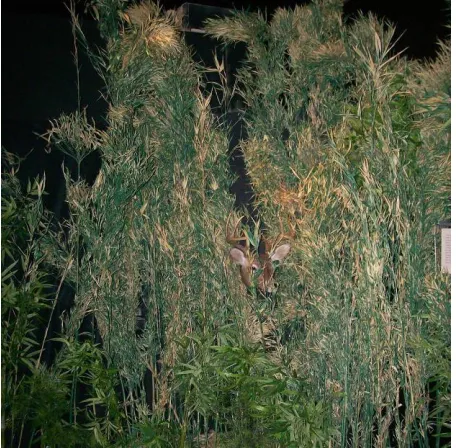
river cane, deer, and stones (Figures 1 – 3). Employing both in situ and in context display
strategies, the front entrance of the exhibit attempts to transport the visitor into the past by
recreating the natural, “authentic” environments of the prehistoric Southeast. In the center of the
room lies a “petroglyph,” or ancient rock carving (Figure 3). Surrounding the petroglyph are
synchronic dioramas intended to represent archaeologically defined cultural periods established
in early archaeological practice (Figure 3). Following Garoian’s (2001) critique of museum
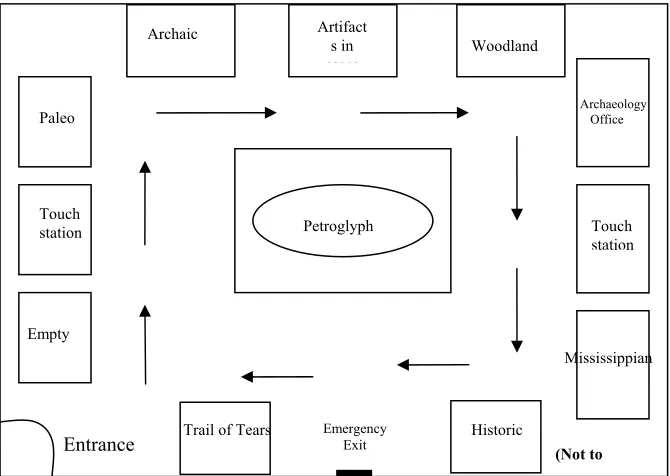
structure, the layout of the exhibit guides the viewer around the centerpiece, from left to right
through a progression in time (see Figure 4). As the viewer moves from the oldest time frame to
the most recent, the institution performs its authority over the bodies of its visitors. In other
words, the flow of the room acts to naturalize the “evolution” of the Southeastern Indians
through the passage of time. In this fashion, the structure of the physical space situates the
dioramas in context while the content of each dioramic display places its objects in situ for the
viewer (Kirshenblatt-Gimblett 1991).
Using mimesis, the exhibit houses touch station computer kiosks and signage designed to
evoke images of nature and American Indian lore of “Father Log” (Figure 5). In this vein, the
first dioramic display illustrating the Paleo Period uses metonymy showing a Paleo-Indian male
object – in this case a Paleo-Indian man – represents an entire cultural tradition and runs the risk
of ignoring variation among people from this time period.
Similarly, Western cultural constructs of American Indian racial identity plays a large
role in defining what early Southeasterners actually “looked” like. In an interview with one of
the exhibit’s designers I was informed that the consulting archaeologist arbitrarily decided how
to portray the race of each depicted figure. According to the exhibit designer, the consulting
archaeologist felt that a “Siberian-Inuit” person would best fit the description of an early
American Indian and that “his offspring should be evident in the subsequent dioramas as his
children and grandchildren moved through time.” Thus, a Western ideological construction of
racial identity acted to create the exhibit’s portrayal of early American Indians.
Concerning sex and gender, the institution’s performance of its “museum culture”
appears to be rooted in antiquated ideologies of early archaeology regarding gendered divisions
of labor (Garoian 2001:244). Most of the dioramic depictions reflect this out-dated paradigm.
For example, women are absent in the Paleo Period diorama; the only figure shown is a man
holding a spear. Similarly, the Archaic Period illustrates a man fishing while women are
portrayed as gatherers and housekeepers (see Figure 7). This trend continues in the Woodland
(Figure 8), Mississippian (Figure 9), and Historic (Figure 10) dioramas; respectively, women are
illustrated as producers or homemakers and men as hunters or protectors. Culminating with the
Trail of Tears, the exhibit closes with a small display housing a female mannequin holding an
infant (Figure 11) and shows a four minute film loop narrated by a male about the 1838 tragedy
inside a 19th century Cherokee cabin (Figure 12).
It is clear that early archaeological theories and praxis were employed in the exhibit’s
questions the oversimplified binary categories of male/female, hunter/gatherer,
producer/reproducer rooted in Western cultural perspectives (Sørensen 1999). In general,
contemporary archaeological theories allow for more variation when considering gender in
relation to the distribution of social categories (Conkey and Gero 1997; Sorensen 1999). In the
same vein, a contemporary archaeological analysis of the King site, reaffirms the need to
abandon traditional ideologies of gendered divisions of labor (Hally 2008). For example, “in the
one case of an adult female burial with abundant grave goods, the artifacts involved relate to the
deceased’s status as a warrior, a male characteristic” (Hally 2008:498). Particularly relevant to
the American Indians the Hall of the Ancients intends to portray, the King site dates to about the
mid-sixteenth century and is located near the Coosa river, less than 50 miles from the location of
the Funk Heritage Center (Hally 2008). Finally, the matrilineal social composition of these
societies would have provided women with greater social status compared to patrilineal systems
of the West. In sum, these archaeological findings contradict the exhibit’s depictions of men as
hunters and women as caretakers or homemakers. For this reason, local museums should take
these ideas into account when creating and maintaining museological exhibits about
Southeastern Indians.
The aesthetics in the exhibit employ a great deal of Kirshenblatt-Gimblett’s (1991)
principles of in situ and in context to communicate a recreated environment “designed to
heighten viewers’ experiences of symbolic artifacts” (Garoian 2001:246). For example, the
murals, artifacts, and figures on display place the viewer into an institutionally determined
context of time, place and event. In two instances, however, the context of display is inverted or
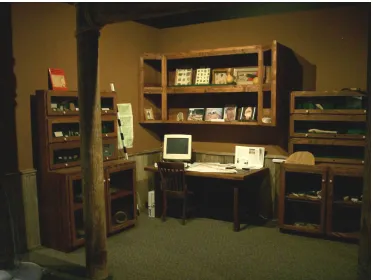
simply absent (Figures 13 and 14). The aperture pictured in Figure 13 exemplifies