R
e c o n c il ia t io n
in
P
o s t
-
g e n o c id e
R
w a n d a
D
i s c o u r s e a n dP
r a c t ic eA Dissertation submitted in partial satisfaction of the requirements for the degree of Doctorate in Development Studies
The copyright o f this thesis rests with the author and no quotation from it or information derived from it may be published without the prior written consent o f the author.
Eugenia Zorbas
Development Studies Institute (DESTIN)
UMI Number: U615485
All rights reserved
INFORMATION TO ALL USERS
The quality of this reproduction is dependent upon the quality of the copy submitted.
In the unlikely event that the author did not send a complete manuscript and there are missing pages, these will be noted. Also, if material had to be removed,
a note will indicate the deletion.
Dissertation Publishing
UMI U615485
Published by ProQuest LLC 2014. Copyright in the Dissertation held by the Author. Microform Edition © ProQuest LLC.
All rights reserved. This work is protected against unauthorized copying under Title 17, United States Code.
ProQuest LLC
789 East Eisenhower Parkway P.O. Box 1346
V '
-Signed Declaration
(a) I authorise that the thesis presented by me in 2007 for examination for the PhD degree o f the University o f London shall, if a degree is awarded, be deposited in the library o f the appropriate College and in the University o f London Library and that, subject to the conditions set out in paragraph (d) below, my thesis be made available for public reference, inter-library loan and copying.
(b) I authorise the College or University authorities as appropriate to supply a copy o f the abstract of my thesis for inclusion in any published list of theses offered for higher degrees in British universities or in any supplement thereto, or for consultation in any central file o f abstracts o f such theses.
(c) I authorise the College and the University o f London Libraries or their designated agents to make a microform or digital copy o f my thesis for the purposes o f inter- library loan and the supply o f copies.
(d) I understand that before my thesis is made available for public reference, inter- library loan and copying, the following statement will have been included at the beginning o f my thesis:
The copyright o f this thesis rests with the author and no quotation from it or information derived from it may be published without the prior written consent o f the author.
(e) I authorise the College and/or the University o f London to make a microform or digital copy o f my thesis in due course as the archival copy for permanent retention in substitution for the original copy.
(f) I warrant that this authorisation does not, to the best o f my belief, infringe the rights o f any third party.
(g) I understand that in the event o f my thesis not being approved by the examiners, this declaration will become void.
Ahabaye inkovu hadasubirana. A wound does not heal completely.
- Rwandan proverb
Ton « ethnie », c ’est la pauvrete. Your “ethnicity” is poverty.
- RPF representative
Abstract
Many government (and donor) policies in post-genocide Rwanda have been justified in the name o f “reconciliation”. Yet, reconciliation is almost never defined - in the Rwandan context, or in the literature. This thesis unpacks this nebulous concept by analysing the discourses and expectations o f different constituencies - the RPF government, a group of non-government elites, the Top Five donors to the country, and respondents from two rural communities. Despite great variance in personal circumstance, significant areas of consensus are found. For example, establishing degrees o f responsibility - and punishment - for the genocide was broadly welcomed. However, one way in which this was implemented, through a government prisoner release programme that amounted to “institutionalised forgiveness”, was not widely supported. An in-depth study o f the rural communities is also undertaken to unearth what factors had an impact on the reconciliation process. Based on these data, three explanatory factors are posited for patterns o f reconciliation and non-reconciliation, or, as per the definition o f grassroots respondents, for coexistence and non-coexistence. First, at the individual level, life stories since 1994 mattered more in explaining behaviours and attitudes today than experiences during the genocide. Second, the level, depth, breadth and type o f social interactions were equally influential, reinforcing the validity o f Sociology’s “Contact hypothesis”. Third, the RPF’s top-down style is associated with a negative impact, suggesting the government’s strategy is self-defeating. Indeed, the imposition o f “mandatory” reconciliation behaviours contradicted one o f the pillars o f the RPF reconciliation strategy, i.e. the promotion of independent thinking in order to rout out an alleged Rwandan tradition o f obedience. Overall, the thesis debunks several misconceptions about reconciliation and about Rwandan politics and society. For example, ethnic heritage did not have an explanatory or predictive quality; more important were class distinctions or, as respondents put it, distinctions between “high” and “low people”.
Acknowledgements
This PhD project has been a four and a half year long, tumultuous journey that has taken me between London, Kigali, Montreal, and Washington DC. I could not have embarked on, or survived, this project without the love, support, and encouragement o f family and friends. My parents, Maria and Efthymios Zorbas, gave me the confidence and security to not be afraid o f challenges, and when I fail, they have taught me to stand up, dust myself off, and try again. I can not adequately express what their unqualified love and support, even as I headed off to remote comers o f central Africa, has meant to me. Beatrice Alain and Jaideep Mukerji proved tireless editors o f too many draft chapters, sending me detailed comments and encouragements via email and in person for months and years on end. Michael Khouri, Ken Pippin and Eve Naftalin provided shelter and much needed moral sustenance during my trips to London in 2006 and 2007. I am also grateful to a growing group o f fellow pupils o f Rwanda, many o f whom have become cherished personal friends during the course o f this PhD project. I want to single out the insights, research tips, and sympathetic ear o f Lars Waldorf, Lee Ann Fujii and Elizabeth Levy Paluck in particular. Elizabeth Levy Paluck, Nathalie Wlodarczyk and Rene Lemarchand read the final draft o f the thesis as I prepared for my oral defence (known as the viva voce in the British system); their careful comments and detailed feedback were a treasured pleasure to receive in what has intellectually often been a solitary trip. In Kigali, Jean Charles Paras, Nadege Degris and Veronique Geoffroy provided not only friendship (and occasionally, a roof!) but also demonstrated incredible insight and humility in the face o f the complex social, economic and political processes going on in Rwanda.
At the London School o f Economics and Political Science (LSE), I am grateful to my lead supervisor, Dr. James Putzel. My second supervisor, Dr Nigel Eltringham, an anthropologist and Rwanda scholar based at Sussex University, has been an enthusiastic and meticulous reader o f all my work. His published work and his comments on my drafts have had a big influence on my thinking and writing. During the upgrade process from MPhil to PhD status, Dr Dennis Rodgers and Dr David Keen, two o f my reviewers, were tough but exceedingly fair and generous, eventually helping me to hone a research project that was not only “do-able”, but also one that I enjoyed carrying out. During the preparatory pre-fieldwork period, my fellow PhD students at the LSE’s Development Studies Institute, Claire Q. Smith, Bettina Woll, and Lauren Flejzor, with whom I shared an office (the much missed “H504 girls”) gave me more strength and determination to persevere than they know. Peter Uvin and Mark Hoffman, my examiners during the viva voce, proved to be by far the most relentlessly critical audience I have yet to face. From them I learned that as much vigour and determination is required to defend one’s positions as there is in crafting them to begin with.
the NURC staff, in particular the Executive Secretary Fatuma Ndangiza and her assistant Agnes Mukamazimpaka, who were both encouraging and exceptionally helpful. In Maraba, where I spent the second half o f my fieldwork period, the district office staff were among the most energetic and good natured people I met in Rwanda: they worked extremely hard with virtually no resources - and frequently went unpaid - yet they never lost their good cheer. They were accommodating from the beginning, patiently answering all my questions. Towards the end o f the fieldwork, they kept me smiling even as I trolled through seemingly never-ending archival data.
The people who have made the most impact on me and on this thesis, and to whom I owe the greatest debt o f gratitude, are rather predictably, my respondents and in particular my Rwandan respondents. Most, especially in the country-side, had never been interviewed before. Many had extremely painful stories to tell, about atrocity, injustice - big and small - and a quiet perseverance bom out o f a drive to survive. All proved generous, and many were extremely eloquent in their responses despite the fact that, as is often the case, I as the researcher was not able to give them back anything o f even remotely equal value. Lastly, my Rwandan research assistant and interpreter, an insightful, patient and open man, taught me more about Rwanda in a day than my previous 18 months o f reading had.
Reconciliation in Post-genocide Rwanda: Discourse and Practice
Table of Contents
Signed D eclaration... 2
A b stract...5
Acknowledgem ents... 6
Table of C ontents... 8
List of Tables, Figures and M a p s... 11
* * * P art I: Why this Study?... 12
C hapter 1: Rw anda since 1994... 14
Introduction... 14
1.1 After the Carnage: Major Developments in the 1994-2006 Period... 15
1.2 On Research Design, Methods and Limitations...35
Conclusion... 49
C hapter 2: Thinking about Reconciliation after Violent Conflict: Meanings, Approaches, Problem s... 51
Introduction... 51
2.1 A Paradigm Shift... 53
2.2 Some Shared Characteristics... 55
2.3 Getting to Reconciliation: Three Paradigms... 60
2.4 Weaknesses in the Literature... 76
Conclusion... 81
* * * P art II: Discourses on Reconciliation: W hat does Reconciliation M ean to Different Constituencies in the Rwandan C o n tex t?...83
C hapter 3: The Rw andan Patriotic Front on Reconciliation: The Official Government D iscourse... 84
Introduction... 84
3.1 Reconciliation in Theory: The RPF V ision... 87
3.2 Reconciliation in Practice: “Bad” Reconciliation and “Good” Reconciliation in Maraba District... 102
3.3 The Official Vision and the Messy Reality...116
Chapter 4: Alternatives to the Official Discourse: Rwandan In-country Elites and
International Donors on Reconciliation... 120
Introduction...120
4.1 The Other Rwandan Elites: Non-RPF Views from within Rw anda... 122
4.2 The Donor Community: The “Top Five” on Reconciliation... 139
Conclusion... 153
C hapter 5: G rassroots Discourses on Reconciliation: A Study of Two R ural Communities in Southern R w an d a...155
Introduction...155
5.1 Punishing According to Responsibility: The First RPF Reconciliation P illar...157
5.2 Re-interpreting History, Transforming Society: The Second RPF Reconciliation Pillar... 167
5.3 To Live Like We Lived Before: The “Rosy Past” Syndrome... 174
Conclusion... 176
* * * P art III: W hat Factors Promote Coexistence? A Closer Look at Two R ural Communities in Southern R w an d a...180
C hapter 6: Explaining Coexistence in Sovu and Bunzazi: The Micro- and Meso-Levels 181 Introduction...181
6.1 The Micro-Level: Individual Experiences since the Genocide...186
6.2 The Meso-Level: Institutionalised versus Spontaneous Community Relations... 199
Conclusion...209
C hapter 7: Reconciliation by Decree: Revisiting the R w andan Tradition of Obedience in Sovu and Bunzazi...211
Introduction... 211
7. 1 National Politics, Local Dynamics: Reconciliation as Government Procedure...212
7.2 The Assumption o f Rwandan Obedience...226
Conclusion...235
* * * P art IV: Is Reconciliation Succeeding? Is Coexistence?...238
C hapter 8: Conclusion...239
Introduction... 239
8.1 The Findings...240
8.2 Implications...251
Abbreviations 266
Glossary...267
Appendices... 269
Appendix 1: Maps o f Rwanda... 269
Appendix 2: Select Passages from Organic Law No 16/2004 on Gacaca... 271
Appendix 3: The RPF Eight Point P lan ... 275
Appendix 4: The 1 January 2003 Presidential Decree on Mass Provisional Releases ...276
Appendix 5: Meetings attended in Butare Province... 277
Appendix 6: Profile o f 37 Respondents in Sovu and Bunzazi... 280
Appendix 7: Interview G uide... 282
Appendix 8: List o f RPF Presidential Statements Analysed... 284
Appendix 9: Top Five Donors to Rwanda: Goals, Funding Priorities and Activities ....288
Appendix 10: Official Development Assistance Flows to Rwanda (1983-2003)... 293
Bibliography...295
Primary Sources... 295
List of Tables, Figures and Maps
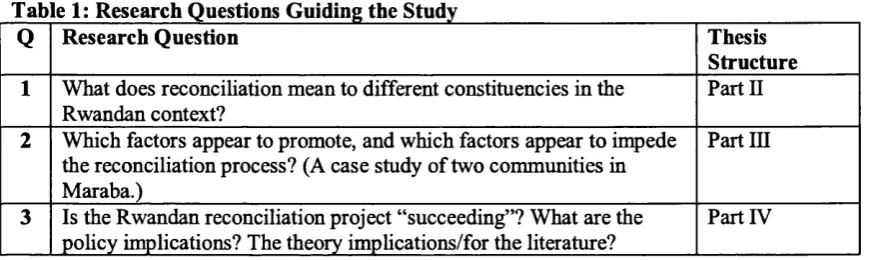
TABLESTable 1: Research Questions Guiding the Study...37
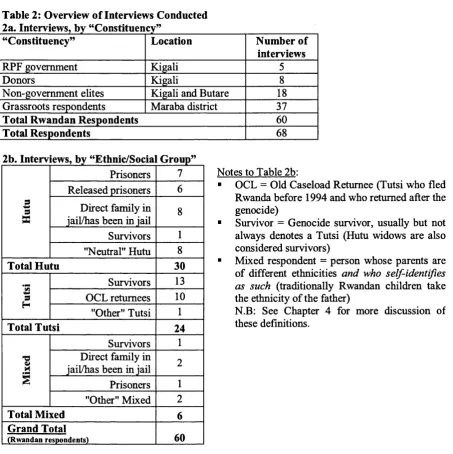
Table 2: Overview o f Interviews Conducted... 40
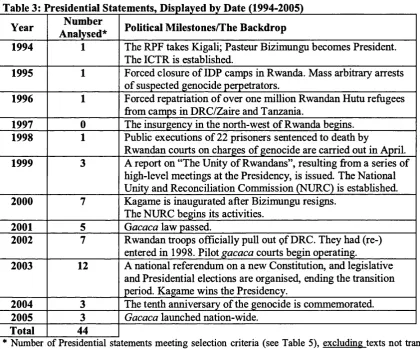
Table 3: Presidential Statements, Displayed by Date (1994-2005)... 89
Table 4: Reconciliation “Key Words” ... 90
Table 5: Major Themes in Presidential Statements on Reconciliation, in Order o f Frequency ...91
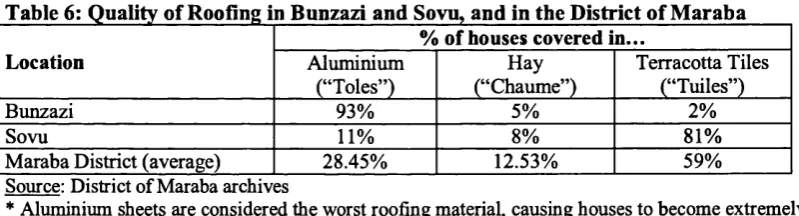
Table 6: Quality o f Roofing in Bunzazi and Sovu, and in the District o f M araba... 105
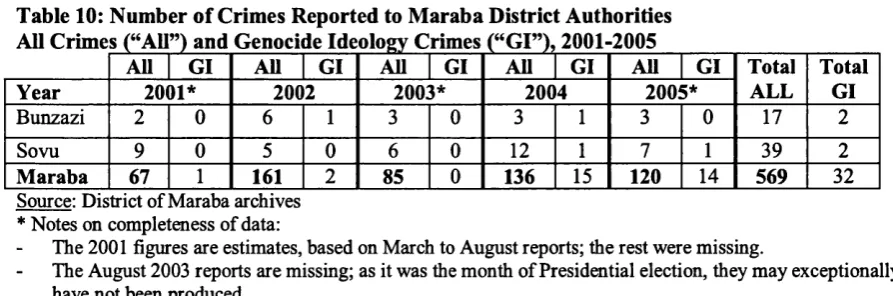
Table 7: Farm Animals per Inhabitant in Bunzazi and Sovu, and in the District o f Maraba 106 Table 8: Heads o f Households in Bunzazi and Sovu, and in the District o f M araba 106 Table 9: Estimated Ethnic Breakdown in Bunzazi, Sovu and Butare Province, post-1994108 Table 10: Number o f Crimes Reported to Maraba District Authorities...109
Table 11: Crimes by Sector as Percentage of Total Crimes Reported to Maraba District Authorities (2001 -2005)... 109
Table 12: Number o f Prisoners from Sovu and Bunzazi...116
Table 13: Profile o f Rwandan Elite Respondents... 122
Table 14: Rwandan Elites’ Answers to Question “Are you optimistic/pessimistic/...139
Table 15: The Top Five Donors to Rwanda...140
Table 16: Interviews with “Top Five” Representatives... 141
Table 17: Three Pre-conditions for Reconciliation...158
Table 18: Causes o f the Rwandan Genocide...160
Table 19 (a, b): Grassroots Attitudes towards the International Community...170
Table 20 (a, b, c): Estimates of Number and Motives o f “Justes” ... 172
Table 21: Respondents by Coexistence Score and Ethnicity... 184
Table 22: Respondents by Coexistence Score and Location... 184
Table 23: Questions that comprise the “Coexistence Score” ... 186
Table 24: Prisoners’ and Released Prisoners’ Coexistence Score... 190
Table 25: Genocide Survivors’ Coexistence Score...194
Table 22: Grassroots Perceptions o f Influence over the Reconciliation Process...219
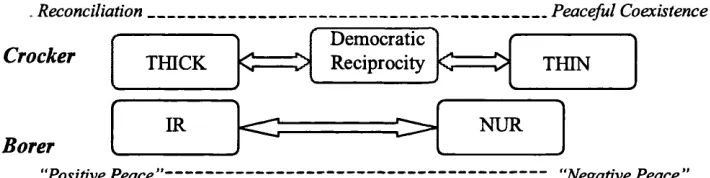
FIGURES Figure 1: The Thick-to-Thin Reconciliation Continuum...59
Figure 2: Three Reconciliation Paradigms, placed on the Thick-to-Thin Continuum 59 Figure 3: Reconciliation Discourses in Rwanda - thick to th in ...179
MAPS Map 1: Rwanda with its Twelve Provinces (pre-2006)... 103
Part I: Why this Study?
Within a matter o f weeks in 1994, Rwanda became synonymous with tribal hatreds, carnage and genocide (USIP, 1995), “the epitome o f an African Holocaust” (Lemarchand, 1994, p. 581). This emphasis on the dark, on the unfathomable violence, on neighbour killing neighbour, also meshed with some influential thinking at the time on the “Coming Anarchy” and the hopelessness and barbarity o f the African continent (Kaplan, 1994). The reactions from friends and colleagues when I mentioned I was going to take a job in Rwanda in 2002, then three years later, that I was going to conduct research there for my PhD, demonstrated to me that Rwanda continued to be immediately associated with genocide, horror and hopelessness over a decade on.
Yet, “[cjontrary to the impression conveyed [...], the history o f Rwanda does not begin in 1994” (Lemarchand, 2002, p. 500). And, I would add, neither does it end there. Accordingly, part o f the purpose o f this thesis is to dilute the strength o f the automatic and solitary association o f the words “Rwanda” with “genocide” in order to see more clearly what has been going on in Rwanda since the genocide. This is important for at least three reasons. First, because the focus of academics and o f the wider “International Community” has tended to remain on the massacres o f 1994, this has overshadowed the ambitious and complex reconciliation process led by the post-1994 Rwandan Patriotic Front (RPF)- dominated government.
legitimate the government’s rule, does not fully or accurately represent social reality on the ground.
A third reason why the post-1994 period merits more attention is the fact that many government (and donor) policies have been linked to, if not justified in the name o f “reconciliation” - a word which, similarly to “peace”, tends to gamer instinctive support. However, this thesis will show that reconciliation itself is never clearly defined. This lack o f clarity is not particular to Rwanda. Indeed, the reconciliation literature itself is characterised by a lack of consistent theoretical frameworks with which to think about the concept. As an upshot, there is a lack o f thorough empirical evidence on which to base any assessment o f “how reconciliation is going” in Rwanda (or elsewhere) - something which has nonetheless not precluded critics and supporters o f the post-1994 government alike from making assessments on progress made and prognoses for the future.
Chapter 1: Rwanda since 1994
Introduction“The limitations o f any field of study are most strikingly revealed in its shared definitions o f what counts as relevant.” (Scott, 1985, xv) This sentence was written about the less glamorous, indeed often invisible “everyday forms o f peasant resistance”, which had been neglected in the literature on peasantry in favour o f a study o f the exceedingly rare, but allegedly “more relevant” instances o f peasant rebellions and revolutions. The same statement can be made with equal validity in the case o f Rwanda and the genocide that occurred there in 1994. In this study, I concern myself with the immediate and solitary association o f “Rwanda” with “genocide”, and the neglect o f the post (and pre!) 1994 period this has led to in the academic world specifically. Indeed, the post-1994 period has - albeit perhaps understandably - received remarkably less attention than the genocide itself. Yet it has been characterised by an important array o f social, political, legal and economic processes, reforms, and institution-building. It has also been characterised by a return to some form o f “normalcy”, often misconstrued as “peace”. This very normalcy has perhaps contributed to its “low profile” and certainly to making it inherently less sexy than the spectacular revolutions, or in this instance, genocides o f the past.
1.1 After the Carnage: Major Developments in the 1994-2006 Period The New Ruling Elite
The Rwandan Patriotic Army (RPA), the armed wing o f the RPF, is the force that swept through the country and stopped the genocide in July 1994 when the rest o f the world largely “stood by and did nothing”.1 Unsurprisingly, members o f the RPF therefore see themselves as “liberators” and “heroes”: the civil war that began on 1 October 1990 (the date o f the first - then, rebel - RPA attack on Rwandan soil) and that was still raging as the genocide began on 7 April 1994 is referred to as the “Liberation War” by the RPF, and all soldiers who died during the Liberation War (known collectively as the “Unknown Fallen Soldier”) as well as the late RPA leader Fred Rwigyema are commemorated every year on National Heroes Day (AFP, 1997; The New Times, 2006). What is more, and as will be seen below, RPF members have come to see themselves as the only people who can and should guarantee the country’s security, having developed since 1994 a “strong sense o f their own moral rectitude and right to rule” (Longman and Rutagengwa, 2004, p. 162). Lastly, as a rebel group comprised mostly, though not exclusively, o f Rwandan Tutsi refugees who had fled Rwanda in waves from 1959 onwards, RPF members put an emphasis on “reconciliation” from the group’s inception in 1987: “[consolidating national unity and reconciliation” is the first point in the RPF’s founding document, the Eight Point Plan (see Appendix 3, and Chapter 3 more generally). As this review o f the 1994-2006 period will show, the RPF’s emphasis on its own indispensability, and on the imperative of reconciliation, have been maintained. The RPF-dominated government’s policy decisions must therefore be seen in this light.
A Note on “How Many Perpetrators”
There is perhaps discomfort or hesitation on the part o f some academics who have been writing on Rwanda since the genocide to acknowledge the participation, even the initiative, that came “from below” during the massacres (Mamdani, 2001). Indeed, most studies on the genocide have emphasised the role o f political and social elites, various armed groups
including the Forces Armees Rwandaises (FAR) and the famous Interahamwe militia, and o f hate media.2 Though it is now widely accepted that this “high-level” agency was a key catalyst, focusing on the top level exclusively is one-sided. As more research on the “micro-level” agency o f the genocide is published, and as the grassroots gacaca courts tasked with collecting information on, and trying, “genocidaires” (genocide perpetrators) progress in their work, who participated in the genocide, when, and how, may become increasingly better documented and, perhaps, better understood as well. Yet, it is doubtful that a consensus figure on “how many perpetrators” will ever be arrived at. This is because the number itself is highly politicised and loaded.
The RPF government has issued several estimates o f the number o f genocidaires over the years. In the first months o f 2005 for example, government estimates topped 1 million (Asiimwe, 2005; Mail and Guardian, 2005).4 Based on data collected by the body created to oversee the gacaca courts, the Service National des Juridictions Gacaca (SNJG), this was revised, later in the year, down to “over 700,000” (Gabiro, 2005; SNJG, 2005).5 These figures (700,000 and 1 million) correspond roughly to between 61% and 88% o f all adult (14 years or older in 1994) Hutu men: a startlingly statistic.6 The SNJG broke these numbers down further in a June 2005 presentation in Kigali where it stated that: (i) 11.5% o f people accused in gacaca at the time had been put in the first category (worst crimes); (ii) 61.6% o f people accused had been put in the second category; and (iii) 26.9%, in the third (SNJG, 2005).7 In other words, this meant that “regular” perpetrators - a turn o f
2 A partial list would include Chretien, Dupaquier et al. (1995), Prunier (1995), DesForges (1999), Hintjens (1999) and Melvem (2004).
3 Research on the “micro-level” o f the genocide, i.e. the motives o f individual perpetrators and the local-level dynamics of the massacres, has been carried out by a small but growing number of young scholars (see Mironko, 2004a; Straus, 2004a; McDoom, 2005; Fujii, 2006). At the time o f fieldwork, the Rwandan
government body in charge of gacaca courts, the SNJG, intended to enter all the information from the
grassroots courts into a central database, funded (at least in part) by the Belgians, which, if made available to researchers, would yield the richest data to date on the “micro-level” o f the genocide (Belgian Technical Cooperation representative, Personal communication).
4 One million is already significantly lower than earlier estimates: Mamdani describes the ballooning of genocidaires estimates given to him by government authorities he interviewed in 1995 (three to four million) and 1997 (four to five million - see Mamdani, 2001, p. 266).
5 Strauss published an article methodically outlining the various steps in his calculations - the only study to do this that I am aware of. He comes up with an estimate of 200,000 genocidaires (Straus, 2004b).
phrase used to depict those accused o f Category 2 and 3 crimes, i.e. not the “big genocidaires” - are actually likely to represent the vast bulk o f all genocidaires: 88.5% or 619,500 if we work from a total figure of 700,000. Regardless o f accuracy, this foreshadows that the RPF leadership considers it is faced with a complicit population - though not necessarily one that will (continue to) be legally held responsible for its actions, as Chapter 3 will detail.
What is more, these various estimates detract from the arguments o f those critics who tend to depict the RPF purely as power-hungry. Indeed, the figures explain (though do not justify) the RPF government’s distrust of “winner-take-all” majoritarian politics and its early and total consolidation o f control over the country (outlined below). By the same token however, the genocidaires estimates foreshadow a clear tendency, which we will come back to in subsequent chapters, to allocate guilt for the genocide collectively, to all Hutu. But, inasmuch as the RPF leadership believes these estimates to be roughly accurate, they help us understand, and reinforce the necessity to acknowledge, the RPF’s belief in its own “moral rectitude”, “indispensability” and “right to rule”.
Fighting Divisionism via Controlled Democratisation
In light o f the above, it is unsurprising that the RPF would wish to exercise maximum control over a population that is, according to gacaca figures, largely complicit in the genocide - though to differing degrees.8 In the name o f defending security and promoting reconciliation, there has therefore been a “controlled” democratisation process since 1994 and even a “criminalisation” o f any deviation from the RPF party line.9
There is much evidence o f the degree o f control exercised by the RPF: its early and continued domination o f all the organs o f the State is one case in point. Indeed, the first
8 Dorsey explains that this “concern for controlling people” has been a characteristic o f the RPF since its creation; “the genocide appears as an amplifier and a crystalliser rather than the trigger for the style of governance.” (Dorsey, 2000, p. 312)
post-genocide government was to have been established on the basis o f provisions found in the 1993 Arusha Accords and the 1991 Rwandan Constitution, allowing for power to be shared among the RPA, the MRNDD (Mouvement republicain national pour la democratic et le developpement) party o f former President Juvenal Habyarimana, and the handful o f other parties that had emerged since 1991.10 But major modifications contained in a 17 July 1994 declaration and November 1994 multi-party protocol o f understanding were undertaken by the RPF (HRW, 2003a; UK Home Office, 2004, paragraph 4.9). Some, like the exclusion o f individuals and political parties associated with the masterminding and carrying out of the genocide, were not contentious. The extremist Coalition for the Defence o f the Republic (CDR) and the MRNDD were excluded on these grounds. But others, such as the introduction o f a strong executive presidency and the redrawing o f the composition o f parliament, were very contentious (ICG, 2002; Reyntjens, 2006). The resulting government, with an RPF President, Minister o f Defence (and Vice President), and a strong majority o f seats in Parliament “illustrated the RPF’s domination o f the State institutions as well as the political importance o f the armed forces”, also dominated by the RPF (Kimonyo, Twagiramungu et al., 2004, p. 6).11
A series o f flights into exile by prominent public figures, who were then typically branded as corrupt, or adherents to “genocide ideology” (more on this expression below), or both, has been another indicator o f the degree o f control exercised by the government. Among the earliest and best known cases here is that o f the first post-genocide Prime Minister, Faustin Twagiramungu. As per the provisions o f Arusha, Twagiramungu was from the Mouvement democratique republicain (MDR) party. Barely one year after acceding to his post, in August 1995, he fled the country “citing the consolidation of power around the RPF, discrimination against both Hutu and Tutsi, and human rights violations.” (Frontline, 2005, p. 8)12 As the party of the first President o f Rwanda after Independence,
10 Multi-partyism was introduced to Rwanda in 1991, under heavy international pressure.
11 The government in 1994 featured the RPF’s Pasteur Bizimungu as President; the post of Vice-president was created and awarded to the RPF’s main military tactician and “homme fort” (Prunier, 1993, p. 134), Paul Kagame, who also became Defence Minister (and later President); and the Army (dominated by the RPA) was allotted six seats in Parliament. For details of the composition of the Transitional National Assembly, see ICG, 2002, especially Annex E.
1“X
the MDR was the only serious potential counterweight to the RPF after the genocide. It also represented a challenge to one of the central tenets o f the RPF reading o f Rwandan history: namely, that the ethnic categories o f Hutu, Tutsi and Twa are pure constructs (cf. Chapter 3). Indeed, MDR members saw themselves as inheritors o f the “social revolution” o f 1959, which led to the emancipation of the Hutu majority from the Tutsi minority, and to Independence - “conventional” numbers for the ethnic breakdown o f the country place the Hutu at 85%, the Tutsi at 14% and the Twa at 1%. Not only did this reading o f history undermine the “minority Tutsi” RPF’s legitimacy as a ruling party, it also glorified a period which RPF ideologues see as “a long genocide from 1960 to 1994 and even beyond” (Sebasoni, undated [2004?]).
The introduction o f a law in 2001 banning “divisionism” - at times also referred to as “genocide ideology” or “sectarianism” - cemented the link between dissent and criminal intent, and between dissent and adherence to a genocide project (Republic o f Rwanda, 2001b). Though Chapter 3 will show that the RPF’s initial strict imposition o f “ethnic amnesia” in public discourse has since (at least on occasion) been softened, for several years the mere mention o f the words Hutu or Tutsi had for this reason become taboo, and potentially dangerous. Indeed, it was charges o f “divisionism” levelled against the MDR party that led to its defacto dissolution in April 2003, a few months before Presidential and legislative elections were held, respectively in August and September o f that year.14 This led the EU to ask for clarification o f the term in 2004 (Frontline, 2005), in response to which the Rwandan Foreign Ministry issued a statement stating that the term was perfectly
Justice Minister Alphonse Nkubito. Moreover, during the “crisis o f 2000”, the year in which President Bizimungu resigned, Twagiramungu’s successor, Celestin Rwigema (also from the MDR) fled the country (HRW, 2003a), and the party was dissolved three years later (see below). According to an ICG report published in 2002, “[i]n total, since 1995 no fewer than forty Rwandan political leaders have taken the path of exile.” (ICG, 2002, p. 12) This number excludes flights during 2003 an important election year and 2004 -the year in which a special parliamentary report on genocide ideology was published (Frontline, 2005). 13 The MDR’s Gregoire Kayibanda served as Rwanda’s first President from Independence in 1962, until he was toppled in a 1973 coup by Habyariamana and his associates.
clear in Kinyarwanda, the language in which national laws are debated and drafted (The New Times, 2004).15
Though public figures continued to flee every year over the 1994-2006 period, many stayed in-country. O f these, no doubt most were left un-harassed; many may have flourished in their careers and personal ambitions. Nonetheless, there were also cases of documented demotions, defamations, detentions, harassment, and “disappearances” too numerous to ignore. The most high-profile example here is that o f Pasteur Bizimungu. Once one o f a handful o f prominent Hutu RPF members, he was inaugurated as President o f Rwanda in 1994. Citing his role as a “hired Hutu” serving “surrounded by Kagame’s insiders”, he resigned in March o f 2000 (Remy and Smith, 2002, my translation).16 After a lengthy period of house arrest and detention (2002-2004), Bizimungu was eventually tried in 2004 in what has been described as a severely flawed process, and sentenced to fifteen years in prison for treason, illegal possession o f a firearm and embezzlement o f public funds (HRW, 2004a; US Department of State, 2005).17
Against this backdrop, several elections were organized, in 1999, 2001, 2002, 2003 and 2006. Local elections in 1999 were for cell (“Responsables”) and sector (“Conseillers”)-level officials and committees. In 2001, district officials (Mayors) and committees were elected.18 In 2002, a second round o f local elections was held. In 2003 - a major election year representing the end o f the transitional period (postponed from 1999) - a Constitutional referendum (May), Presidential (August) and legislative (September) elections were organised. In 2006, local elections were held once again, this time as a result
15 As we will see in Chapter 3 in the context of the two communities I studied in southern Rwanda, I also find evidence that charges of divisionism and genocide ideology are too easily resorted to, sometimes apparently arbitrarily.
16 According to Transparency International, a corruption monitoring NGO, his exit “came amid a purge of top officials accused o f personal corruption, profiteering and abuse o f office that provided political cover for a consolidation o f Tutsi elite power around post-genocide strongman Paul Kagame.” (Warigi, G., 2001, p. 71) 17 He had earlier been charged with “making divisive statements” but those charges were dropped. On 6 April 2007, Bizimungu was released as a result of a presidential pardon. A spokesman for Kagame denied there was any significance to the timing; the following day marked die beginning of the 13th annual commemoration of the genocide (AFP, 2007).
18 Rwanda’s four main administrative levels are: the iniara (provinces, headed by Governors or Prefets), the
o f an administrative reform that impacted the number and borders o f provinces, districts, secteurs and cells. One recurring criticism o f the local-level (district and below) elections was the absence of secret ballots, which “perm itted] strong political control” (Kimonyo, Twagiramungu et al., 2004, p. 15).19 As a result, in many places (Human Rights Watch estimates 45% o f all constituencies for the 2001 district elections), the candidate known to have been preferred by the RPF ran unopposed, while incumbent Mayors (named at earlier dates by the RPF government) were re-elected in 80% o f localities (HRW, 2002). The pre- 2003 elections also took place with no international observers and no independent electoral commission to monitor them (Kimonyo, Twagiramungu et al., 2004). The 2003 Presidential elections, which have also been criticised - most prominently by an EU Electoral Observer Mission (Mission d’observation electorate de l'Union Europeenne, 2003) - returned
20
Kagame to the Presidency with a resounding 95.05% o f votes cast.
National Security and the Duty to Prevent Genocide: Military Campaigns in Zaire/DRC
The “controlled democratisation” described above occurred as the RPF government was involved in major military operations in neighbouring Zaire/DRC. Many officials from the genocidal regime, the former government armed forces (ex-FAR), and militia had retreated to Zaire in 1994, along with approximately 1.5 million Rwandan civilians. Some reports estimate that between 1 and 1.2 million refugees crossed the Rwanda-Zaire border within four days, forming a veritable human carpet (Halvorsen, 1999; Erlichman, 2004, p. 65).21 The refugee camps set up in eastern Zaire to cater to the needs o f this “New Caseload” (NCL) o f Rwandan (Hutu) refugees were used by armed elements to regroup, restock and launch attacks on Rwandan soil, with the support o f then Zairian President Mobutu Sese
19 “The queuing system” where voters line up behind the candidate of their choice, was used instead (Uvin, 2001b, p. 180).
20 There were four Presidential candidates in 2003: (1) Paul Kagame of the RPF, (2) Alivera Mukabaramba of the Parti pour le progres et la concorde (PPC), (3) Jean-Nepomuscene Nayinzira (independent), and (4) Faustin Twagiramungu (independent). The PPC withdrew its candidate on the eve of the elections and asked its supporters to vote for Kagame. Twagiramungu and Nayinzira received 3.62% and 1.33% respectively (Samset and Orrvar, 2003, p. 40). The other main political parties, the PL and PSD, supported the RPF candidate and the election complaints commission rejected every case that was brought to it (Samset and Orrvar, 2003, p. 43).
Seko.22 This prompted the new Rwandan government, allied with the Ugandans, to support the Congolese rebels led by Laurent Kabila (Lemarchand, 2001). Kabila ousted Mobutu and renamed the country the Democratic Republic o f Congo (DRC) in May 1997. Forced, mass repatriations of Rwandan refugees in eastern DRC began even before Kabila took Kinshasa, in November 1996, when between 500,000 and 600,000 refugees returned to Rwanda within one week.23 The Rwandan army reportedly launched direct attacks on some o f the refugee camps. As a result, an unknown number, in the tens o f thousands o f NCL refugees, were killed, either caught in the crossfire or deliberately targeted (Amnesty International, 2004c). These killings were later found by a UN Investigative Panel to amount to war crimes and crimes against humanity (UN Security Council, 1998). Moreover, hundreds o f thousands o f NCL refugees are thought to have fled deeper into Zaire during this period. Nonetheless, the ex-FAR and other Rwandan armed groups, at that stage known as the Armee de liberation du Rwanda (ALiR), continued to operate on DRC soil, even stepping up their insurgency operations in north-western Rwanda in what came to be referred to as the war against the “infiltrators” (African Rights, 1998).24 In August 1998, after a falling out with their former ally Kabila, Rwandan and Ugandan forces entered the
9 ^
DRC once again, this time in support of a new Congolese rebel movement.
22 Poorly understanding the politics at play in the camps (or inside Rwanda), the International Community, which had failed to respond to the genocide, at first quickly rushed in to assist the NCL refugees, prompting scathing criticisms by the new government in Kigali that the UN Agencies and NGOs were now “feeding the killers” (Watson, 1994). Even after the arrival of at least 200 humanitarian agencies however, a study commissioned to assess “The International Response to Conflict and Genocide” estimated that “approximately 80,000 people died in the refugee and IDP camps in Zaire, Tanzania and inside Rwanda during 1994, principally from cholera and dysentery. This figure would probably exceed 100,000 among Rwandese refugees in Burundi and Rwandese outside the IDP camps if data were available for these populations.” (JEEAR, 1996, Synthesis Report, Chapter 3) Eventually some agencies, like MSF and IRC, withdrew from the camps, citing the “ethical disaster” this relief operation represented (Chaulia, April 2002). However, the tendency had by now already swung to the other extreme, whereby all “‘the refugees’ [were branded] as perpetrators of the genocide, and ‘the people inside Rwanda’, [...] as good people, righteous, without blood on their hands.” (Pottier, 1996, p. 405)
23 Seeing the lack o f international response, mass forced repatriations were also carried out by the Tanzanian authorities (Murison, 2003, p. 7).
24 The uprising in north-western Rwanda was crushed in mid-1998, but not before thousands o f Rwandan civilians had been killed by the insurgents and, to an unknown degree, by the RPA in its counter-insurgency efforts (African Rights, 1998; Amnesty International, 1997).
Though the security threat posed by the Rwandan “negative forces” in eastern DRC and north-western Rwanda, as well as their ability to destabilize Rwanda was certainly real during this period (1994-1999), the RPF government began using language that went
>jjr
significantly beyond the duty to defend the national territory. Indeed, top Kigali officials including President Kagame made statements that indicated Rwanda’s intention to intervene to stop genocide wherever it might occur. Rwanda’s sending o f a small (some 150 soldiers) contingent to serve under the African Union forces in Darfur, Sudan, in 2004 was justified with such language (Beswick, 2007, p. 20-23). The English pro-government The New Times newspaper for example, explained that for the RDF (the State Army was renamed the “Rwandan Defence Forces” in 2002), the road to Darfur has been one “long walk” from Kagitumba - the site from which the RPA launched its “Liberation War” in 1990 (The New Times, 2005). However, a much more serious repercussion o f this self ascribed role came in the wake o f the August 2004 massacre o f ca. 160 Banyamulenge refugees in Gatumba, Burundi.27 Indeed, Rwanda’s interior minister declared at the funeral for the slaughtered refugees that “from now on Rwanda will intervene at any time anywhere to stop genocide.” (Africa Research Bulletin, 2004b, p. 15864) Several more senior government officials, including the President, echoed these words. This was a particularly explosive statement given the implied threat o f an imminent re-invasion o f the DRC; the Banyamulenge had been repeatedly described by Rwanda and its Congolese proxies as facing “genocidal violence”.28
Justice After Genocide: Courts, Laws and Policies to deal with Genocidaires
Along with establishing security throughout the country (including by pursuing enemies onto Congolese soil), banning and rooting out “genocide ideology”, and carrying out a process of “controlled democratisation”, several important institutions and reforms to deal with the presumed genocidaires were established from the early days o f the new government.
26 Rwandan armed elements in the DRC are sometimes collectively referred to by Rwandan authorities as “negative forces”; they themselves have named and renamed their shifting alliances, going since May 2000 by the name Forces democratiques pour la liberation du Rwanda (FDLR - see IRIN, 2005b).
27 Banyamulenge are Congolese ethnic Tutsi from South Kivu.
The International Criminal Tribunal for Rwanda (ICTR) was created by United Nations Security Council Resolution 955 in November 1994, i.e. four months after the end o f the genocide (UN Security Council, 1994). Interestingly, in the text o f the Resolution, the Security Council noted its conviction that prosecutions would “contribute to the process o f national reconciliation and to the restoration and maintenance o f peace” (UN Security Council, 1994, Preamble).29 Initially in favour of the court, Rwanda “cast the only vote [...] opposing the creation o f ICTR” (Cobban, 2002). The new government disagreed with several key points in the Resolution, including the Court’s seat in Tanzania, its sharing o f a Chief Prosecutor with the International Criminal Tribunal for the Former Yugoslavia (ICTY), its rejection o f the death penalty, the Court’s mandate excluding pre-1994 events (during which other instances o f anti-Tutsi genocidal violence had occurred), and its primacy over Rwandan national courts (ICG, 2001b, p. 19). Bad relations with the government in Kigali, and with major survivors associations such as Ibuka (which means “remember” in Kinyarwanda), significantly hampered the functioning o f the Court, which was also afflicted with staggering bureaucratic inefficiencies, the alleged hiring of suspected genocidaires as staff, corruption allegations, and scandals involving poor treatment o f witnesses (IRIN, 2002; Kaliisa, 2002; ICG, 2003).30 Eventually, relations with the RPF government improved and stabilized with, among other things, cooperation between a new Prosecutor and the government on the handover of whatever files will be
^ 1
remaining after the Court closes.
Whereas the ICTR was intended to try the “high ranking” genocidaires, there remained in Rwanda thousands o f prisoners in jail on genocide related charges - as well as
29 At least one signatory country (the Czech Republic) apparently disagreed, explaining that the ICTR “is hardly designed as a vehicle for reconciliation [...] Reconciliation is a much more complicated process” (Maogoto, 2006, p. 1). See in particular Chapter 5, and Tables 20a and 20b (p. 162), for more discussion on this point.
30 When Carla Del Ponte began investigating alleged RPA war crimes soon after becoming Prosecutor in 1999, relations hit a new low, with the RPF government accusing the Court of putting the RPF on the same
level as the genocidaires. Del Ponte was defacto removed in 2003 when the Prosecutor’s office was
(belatedly) split in two (with one Prosecutor for the ICTR and another for the ICTY, see UN Security Council, 2003; Edwards, 2003).
an unknown (and highly controversial, as we have seen) number o f genocidaires in exile or in-country and who had yet to be accused. A genocide law was therefore ratified in 1996; it divided genocide-related offences into four categories (Republic o f Rwanda, 1996a) later revised down to three as a result o f the experiences gleaned from pilot gacaca courts (Republique Rwandaise, 2004b). As discussed in more detail in Chapter 3, this categorisation was a first recognition by the RPF o f varying degrees o f legal responsibility for the genocide. People accused of Category 1 (worst) crimes were liable to the death penalty, and in April 1998, 22 such executions were carried out publicly in Kigali and other locations, drawing large crowds (Minow, 1998) and widespread international condemnation (BBC, 1998). These were the first and last official executions; the government moved to get rid o f the death penalty in early 2007 (The New Times, 2007).32
Incentives for confessions and guilty pleas, intended to decongest the penal and legal systems, incapable o f coping with the volume o f accused, were built into the 1996 genocide law, as well as into the subsequent gacaca laws (Schabas, 2005). For example, the law made defendants who gave complete confessions - i.e. a description o f all their offences, the names o f all their accomplices, and importantly, an apology and request for forgiveness - eligible for major sentence reductions, and if Category 1 offenders confessed before they were accused of Category 1 crimes, they were placed in Category 2 instead (Amnesty International, 2002a, p. 18). Despite these efforts, by January 2001, “only” 5,300 trials had been concluded by the Rwandan classical courts, and nine by the ICTR (Betts, 2005, p. 738). It was estimated at the time that the formal justice sector would need over one hundred years to process genocide-related cases (Uvin, 2001b, p. 182).
Faced with this backlog, the government passed a law establishing gacaca courts (Republic o f Rwanda, 2001a). I used the weekly gacaca meetings in the two communities I studied as “windows” or opportunities to observe local dynamics and triangulate data; the
32 Principally in order to facilitate extradition of suspected genocide perpetrators and to allow the transfer of genocide suspects in custody at the ICTR facilities in Arusha (Twahirwa, 2006). Even before Rwanda made moves towards giving up the death penalty, a US diplomat in Kigali confirmed that the government was no longer considering mass executions, such as the ones carried out in 1998, because o f the destabilising effects that were anticipated (Personal communication, 20 July 2005).
courts themselves were not the subject o f my study (see Section 1.2). However, as Chapters 5 through 7 will show, the gacaca courts, named after a traditional Rwandan custom o f elders mediating disputes between parties sitting “on the grass”, are an uneasy mix of retributive and restorative justice (Betts, 2005; Waldorf, 2006b), and even institutionalized forgiveness.
The courts began operating in 12 “pilot” jurisdictions in June 2002; 260,000 inyangamugayo (Kinyarwanda for “persons o f integrity”) had been elected by their local communities to sit as judges in October 2001 (African Rights, 2003, p. 2). The courts were progressively expanded until they were implemented nation-wide in March 2005. The cell- level gacaca courts had to go through a series o f steps in the pre-trial period consisting o f fairly tedious and time consuming list making (the “gathering o f information” phase) and then cross-checking o f these lists (the “validation” phase). The lack o f provisions for the defence o f alleged perpetrators, the poor training o f judges, the failure to respect the principle o f “double jeopardy”, and the fact that only crimes o f genocide (i.e. “Hutu crimes”) are allowed to be discussed are among the main sources o f concern for gacaca observers (Amnesty International, 2002a, p. 39; Corey and Joireman, 2004, p. 86; PRI, 2005, p. 44; Wolters, 2005, p. 13; Waldorf, 2006a, p. 59). As the programme was expanded from the original pilot jurisdictions, a number of adjustments, contained in successive gacaca laws, were made by government along the way.34 For example, the law was amended to allow people accused o f Category 1 crimes to be tried by gacaca as well; it had been at first intended that they be tried by the Rwandan formal courts. The first gacaca trials began - in the pilot jurisdictions - in 2005 and trials began nation-wide in July 2006. The government had hoped that the work of the gacaca courts could be wrapped up before the end o f 2007 (Avocats Sans Frontieres, Danish Centre for Human Rights et al., 2005; Waldorf, 2006a, p. 54), though some observers found this timeframe unrealistic (DesForges, 2007).
34 The 2004 genocide law (Law n° 16/2004 of 19/06/2004) revises the original, 2001 law on gacaca (Law n°
Building on the genocide and gacaca laws’ guilty plea procedure, as well as various ad hoc efforts to review the detention o f the elderly, ill, “ 1994 minors” (individuals who were under 18 at the time they allegedly committed their offences), or those with “empty” detainee files (known as the sans dossiers, see Amnesty International, 2004a, p. 4), a 1
35
January 2003 Presidential decree formalized a mass provisional release programme. As a result, in exchange for confessions, and after undergoing an ingando, also known as “civic re-education” or “solidarity” camps, pre-trial detainees were released provisionally (pending trials in gacaca) back into their communities.36 At the time o f writing, several waves o f mass provisional releases had been carried out, in January 2003 (approx. 22,000 prisoners released), in August 2005 (approx. 20,330), and in February 2007 (approx. 8,000).37 A programme o f community work as an alternative to a prison sentence was also put into practice. Known under its French acronym, TIG (for Travaux d ’lnteret General), a first shift, with approximately 800 former prisoners, was organised in September 2005 - the project involved breaking stones in a quarry in the province o f Gitarama, to serve for the construction o f a road in Kigali (Hirondelle, 2005b). It is expected that many convicted by the gacaca courts will be sent to the community service camps in lieu o f serving out the rest o f their sentence behind bars. In other words, within the next few months or years - perhaps as early as 2008 - the government expects that the backlog o f genocide cases will have been cleared, meaning that all genocide-related cases would have been heard and
38
“most” convicted genocidaires (defined above) would have served their sentences.
35 These ad hoc decongestion efforts are sometimes informally referred to as “pre-gacaca”. Pre-gacaca involved specifically bringing the detainees back to their communities in order to ask their friends, families and neighbours, congregated for the occasion, to divulge whatever information they may have (exculpatory or incriminating). There was from the outset resistance to pre-gacaca from some within the government in Kigali, and it was ultimately stopped in 2003 (US Department o f State, 2004).
36 See Appendix 4 for text of the January 2003 Presidential decree.
37 Approximately 4,200 prisoners were released in April 2004, but these releases apparently concerned exclusively people accused o f non-genocide related crimes - I therefore do not count them as part of the “mass provisional release programme” mandated by the January 2003 Presidential decree.
38 It is important to depict these as early government expectations - a result of calculations done as gacaca
was first being rolled out nation-wide in 2006. Indeed, by late 2006, it was already clear that gacaca would
not only fail in its task of decongesting prisons, but would in fact generate more prisoners. In a presentation given in March 2007, Alison DesForges o f Human Rights Watch reported that there were 90,000 prisoners in
jail at that time, and that the mass provisional releases could “not keep up” with the gacaca courts. Overall,
“It is time for Rwandans to realize their worth”: Development for Empowerment Added to this mix has been an ambitious government-led programme for macro-economic
39 reform, development and poverty reduction, which began in earnest around 1999. Even though it was considered a “good performer” in the early 1980s, Rwanda was a poor country in the throws o f an economic crisis when the genocide decimated the economy and household incomes in 1994 (Uvin, 1998). Unsurprisingly perhaps, Rwanda’s economy had still not reached its performance levels o f the early 1980s by 2006 (Ansoms, 2007, p. 372). The country was ranked number 158 in the human development index (out o f 177 countries ranked, UNDP, 2006), approximately 90% o f the population continued to be engaged in (mainly subsistence) agriculture and 56.9% of Rwandans lived on less than 250 Rw f (Rwandan Francs) per day, i.e. approximately $0.45 (Ansoms, 2007, p. 373).40 Rwanda is famous for being the most densely populated country in Africa; however it is also landlocked, has few natural resources, and minimal industry. Its population growth rate remains high however, at an average o f 3.5% per year over the 2000-2006 period.41
Given this backdrop, the bold objectives o f halving poverty rates and achieving universal primary education, in line with the UN Millennium Development Goals (MDGs) - and among the stated aims o f the RPF government at least as early as 1998 - were even bolder.42 What is more, at the time o f writing, universal free education was on track for being achieved by 2015, as per the MDG deadline, though results regarding poverty reduction were mixed if not disappointing as will be discussed below. The government had also made the first three years o f post-primary education free, a significant achievement even if “non-fee barriers” such as the cost of school uniforms and learning materials,
39 From 1994 to 1998-99, Rwanda was in an “emergency aid” period, where spending priorities were geared towards short-term humanitarian assistance and essential infrastructure (re-)construction (Republic of Rwanda, 2006b; World Bank, 2004). Rwanda entered the World Bank and IMF’s “Poverty Reduction and Strategy Paper” (PRSP) process in 2000 (Ansoms, 2007, p. 371).
40 At the time o f writing, figures for the more traditional poverty line o f $1 per head per day (at Purchasing Power Parity, or PPP) were not yet available for 2006.
41 This means that even though the incidence of poverty measured in overall percentage points has decreased since 2000 (when the PRSP process began), in absolute numbers, there are more people living under the poverty line today: the number has increased from 4.8 to 5.4 million over the 2001-2006 period (Republic of Rwanda, 2006a, p. 3).
remained.43 However, the government’s ambitions went significantly further: another aim was to achieve middle-income status for Rwanda by 2020, a path charted out in its Vision 2020 document.44 Cornerstones o f this strategy included the modernization o f agriculture, regional economic integration, the diversification o f Rwanda’s economy towards knowledge-based industries (with a heavy emphasis on Information and Communication Technology, or ICT), and the fostering o f a vibrant private sector and entrepreneurial
* • 45 spirit.
A major component o f this long-term development vision is a concomitant decentralization process. Decentralization is first and foremost an economic development strategy in the eyes o f the central government. However, it is also a tool to empower Rwandans at “lower” levels o f society by involving them in the decisions that affect their communities and everyday lives.46 Contained in this logic is a reference to an alleged Rwandan penchant for passivity and obedience, which apparently contributed directly to the genocide (a claim we will revisit in Chapter 7 ) 47 The decentralization programme has gone hand-in-hand with successive waves o f administrative reforms, where the number and responsibilities o f provinces are gradually reduced and the new focus for decision-making and economic development activities become the districts, which are “closer to the population”. Accordingly, in a 2001 administrative reform, even more “local authorities”
43 See Ministry of Education website, under “Strategic Priorities”, “Fee-free education”,
http://www.mineduc. gov.rw/. last accessed on 1 July 2007.
44 Bringing poverty rates (defined as living on less than $1 per head per day) from 64% in 2000, to 30% in 2020 (Republic of Rwanda, 2002b, Table 2, p. 9).
45 Rwanda’s government before 1994 has been described as socialist, and its economy was largely state-owned (World Bank, 2004, v and para. 1.3).
and “representative bodies” were created.48 One upshot o f such reforms is that there are now so many local authorities, that it can be argued that a sharp distinction between “the population” and “local authorities” is arbitrary.49 Another aim o f these administrative reforms is the removal o f names associated with “bad history”, “bad governance” and the genocide, as well as with “regional” identities (north versus south in particular). For example, in January 2006, Rwanda’s 12 provinces, including some with loaded names such as Ruhengeri (Habyarimana’s home region - a Hutu region in the north) and Butare (the former intellectual capital, a southern Tutsi region) were replaced with four large provinces named North, East, South (which includes Butare, and my two research sites) and West, along with the municipality o f Kigali.50
On the whole, the RPF government’s record in the domains o f economic and social development, unlike its record on justice, human rights and foreign policy (toward the DRC in particular - see above) has received very positive reviews from the donor community, and in particular the International Financial Institutions (the IFIs), namely the World Bank and IMF.51 According to one report, this is because the RPF government and the IFIs share the same economic development aspirations, as well as operating assumptions on how to best achieve these (namely “a strong technocratic and liberal economic policy outlook”, see Baare, A., D. Shearer, et al., 1999, para. 140). The IMF also highlighted Rwanda’s “effective anti-crime and, more specifically, anti-corruption strategies” (IMF, 2005, para. 90). The IFIs further largely praised the PRSP document itself and, in their annual “joint staffs assessments”, the RPF government’s Annual Progress Reports (IMF and IDA, 2005;
48 For example, the reform established ndjanama, which groups the Coordinateurs (formerly and still
commonly referred to as Conseillers, or Konseye) of each sector in a given district. What is more, seven to
nine people are elected by the ndjanama to sit on the nyobozi, including a representative for women, youth, a
charge of information and of security. The nyobozi represents the population at district-level. Finally, these
ndjanama and nyobozi also exist at sector-level, involving another set of individuals.
49 The Mayor of the district in which my two research sites were located acknowledged this when he said:
“[t]here is a tendency to say ‘the population is not telling the truth (in gacaca)'. But who is ‘the population’?
When we take the nyumbakumi [head o f traditionally ten or so households on one hill], the inyangamugayo
[gacaca judges] etc. who is left in the population? We should say ‘we are not telling the truth.” (Meeting for all gacaca judges from Maraba District, Gihindamuyaga, Maraba, 28 September 2005)
50 Butare was once Rwanda’s second city and still houses the historically important Universite Nationale du Rwanda.
IMF and IDA, 2006). According to the UK Department for International Development (DFID) figures, “[ejconomic growth [in Rwanda] averaged over 10% per annum between 1994 and 2004, the second highest in Africa, while GDP per capita growth, at 5.3%, was the third highest in Africa over the same period.” (DFID Country Profiles) As we will see in more detail in Chapter 4, Rwanda’s development and poverty reduction efforts have contributed to encouraging major donors such as the UK to deliver two-thirds o f its total aid (£46 million in 2005/06 and again in 2006/07) as direct budget support (DBS) - considered a more “mature” form of aid.
However, a study o f the broader (academic) literature leaves the reader with a decidedly more mixed, if not negative verdict on the RPF’s economic development and poverty reduction record. According to one review o f the Rwandan PRSP, economic growth over the 2001-2006 period (the period covered by the first PRSP) has been neither self-reliant nor sustainable. Indeed Rwanda’s growth was apparently fueled by aid flows that are substantial and that “largely exceed the sub-Saharan average”, whereas the GDP growth rate averages are misleading because they incorporate “exceptional growth figures in the first [post-war] years” (Ansoms, 2007, p. 372).52 Furthermore, growth was only extremely modestly “pro-poor” (Ansoms and Marysse, 2004)53 and inequalities, particularly intra-rural inequalities, had increased in all provinces (Justino and Verwimp, 2006, Ansoms, 2007).54 This last point on inequality matters a lot in terms o f certain
52 For example, using IMF data, Ansoms cites an average annual growth rate for the 2001-2006 period of 4.6%, which represents 2.7% in per capita terms (p. 372). These figures do not contradict DFID’s 10% and 5.3% figures for the 1994-2004 period; rather, they speak potently to the importance o f looking carefully at figures when averages are involved.
53 Using data from two household surveys conducted in 1984-85 and 1999-2001, supplemented by government and World Bank data for some o f the intervening years, Ansoms and Marysse conclude that “[i]n the actual [post-war] context [...], the Rwandese poor only sligjhtly benefit from growth, while a mostly small and often urban elite enjoys the advantageous effect o f increasing economic activity.” (Ansoms and Marysse, 2004)