Effect of Disk Edge Profile on Scattering Characteristics of
Liquid Droplets Splashed from Spinning Disk
Mizue Munekata1, Taichi Oseto2, Hiroaki Kurishima3, Hiroyuki Yshikawa1*
1Department of Mechanical System Engineering, Kumamoto University, Kumamoto, Japan 2Graduate School of Science and Technology, Kumamoto University, Kumamoto, Japan
3Tokyo Electron Kyushu Ltd., Koshi, Japan Email: *[email protected]
Received May 29, 2013; revised June 6, 2013; accepted June 13,2013
Copyright © 2013 Mizue Munekata et al. This is an open access article distributed under the Creative Commons Attribution License, which permits unrestricted use, distribution, and reproduction in any medium, provided the original work is properly cited.
ABSTRACT
Effects of disk edge profile on scattering characteristics of liquid droplets splashed from a rotating disk edge are ex-perimentally investigated. In the present research, aluminum disks are utilized and purified water is employed for liquid. Scattering phenomena of the droplets are captured by the high-speed digital camera. Distribution of the droplet diameter is evaluated from these images and distributions of horizontal flying velocity component and angle of the droplets are measured by human visual observation of images. Liquid filaments are stretched outward from the stagnant liquid layer on lateral surface of disk edge by centrifugal force. Two main peaks appear in the distribution of the scattered droplet diameter and they are originated from large terminal droplets and small droplets generated from filamentwise breakup. Most of the scattered droplets fly slightly inside of the tangential direction of the disk edge. The water droplets splashed from the disk scatters with regularity compared with ethanol droplets.
Keywords: Scattering Droplet; Spinning Disk; Disk Edge Profile; Visualization
1. Introduction
Recently, development of high technology has been re-quired for formation of thin uniform film in manufactur-ing process of semiconductor. Spin coatmanufactur-ing method is widely used for spreading photoresist on the wafer and thickness of the photoresist film attains thinner than 0.5
μm. If the mist of the scattered photoresist reattaches on the liquid film surface in the process, it interferes in the uniform film formation. On the other hand, in rinse process, rinse solution runs down on the wafer printed electric circuits in order to wash away the developing and etching solutions. If the mist of the scattered liquid reat- taches on the wafer in the process, it makes water mark on the wafer surface and the particle bridges and dam- ages the electric circuits on the wafer. Many researchers have investigated on filament formation and atomizing of viscous fluids from the rotating disk and air boundary flow over the disk [1-7]. However, the scattering characteris- tics of the liquid droplets and the reattachment phenom- ena of the mist on the wafer and effect of disk edge pro- file have not been clarified yet [8]. Main objective of the present research is to make clear the effect of disk edge
profile on the scattering characteristics of the liquid drop- lets splashed from the rotating disk edge experimentally. Top view images of scattered droplets are captured by a high-speed digital camera and distributions of horizontal flying velocity component and angle of the scattered drop- lets are measured under the condition of the disk rotating speed N = 1000 rpm and liquid flow rate QL = 0.5 L/min.
2. Experimental Procedure
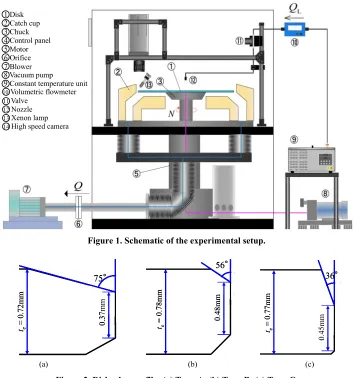
Figure 1 illustrates the schematic view of the experi- mental apparatus in the present research. It is composed of the spin coating device and measurement equipment. These are enclosed with a transparent acrylic box be- cause of the safety. The movements of the entire devices are controlled with a control panel. As the upper part of the wafer surface is opened to atmosphere. The wafer (diameter 2R = 300 mm, thickness te = 0.78 mm) is ad-
sorbed to a chuck by a vacuum pump and the rotating speed of the wafer N is less than 4000 rpm. In the present study, aluminum disks (thickness at the edge te = 0.72,
0.77, 0.78 mm) combined with chuck are utilized instead of the wafer for the sake of safety. As shown in Figure 2, he upper corner at the disk edges is treated with a slope t
1 Disk 2 Catch cup 3 Chuck 4 Control panel 5 Motor 6 Orifice 7 Blower 8 Vacuum pump
9 Constant temperature unit
10 Volumetric flowmeter
11 Valve 12 Nozzle
13 Xenon lamp
14 High speed camera
Figure 1.Schematic of the experimental setup.
75°
0.3
7m
m
te
=
0.
72
m
m
75°
0.3
7m
m
te
=
0.
72
m
m
56°
0.4
8m
m
te
= 0.
78m
m
56°
0.4
8m
m
te
= 0.
78m
m
36°
0.
45
m
m
te
= 0
.77m
m
36°
0.
45
m
m
te
= 0
.77m
m
[image:2.595.121.475.86.464.2](a) (b) (c)
Figure 2. Disk edge profile: (a) Type A; (b) Type B; (c) Type C.
of 75˚, 56˚, 36˚ similar to the standard of the wafer and lateral surface heights of disk edge has slight difference because of manufacturing precision. Purified water fil- tered with microfiltration membrane is employed for liquid or rinse solution, as it is frequently used in the rinse process and safety of handling. Flow rate of water is controlled by valve and water is discharged on the disk center through the nozzle (diameter 3.9 mm) simply, though the wafer is washed in a variety of ways during the rinse process. After water is fully fed over the disk, the disk is spun up to rotating speed N = 1000 rpm (an-gular velocity ω = 105 rad/s) and the speed is kept.
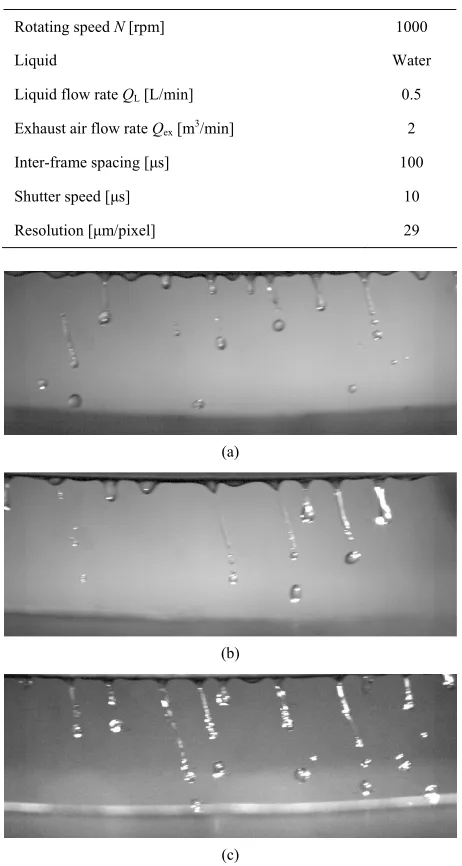
The behavior of the liquid droplets splashed from the disk edge is captured by high-speed digital camera (PHOTORON FASTCAM SA-X) above the disk as shown in Figure 1. Experimental conditions are summa-rized in Table 1. The photographing area is confined between the disk edge and the catch cup and illuminated by the xenon lamp. Downward air flow is generated be-tween the disk edge and the catch cup by the blower.
From the captured images for one rotation of the disk,
droplet diameter and droplet location are obtained by human visual observation. The horizontal flying velocity and angle of the liquid droplet are obtained at the mid- point of flying path for inter-frame spacing. The hori- zontal flying angle is defined as the angle formed by the horizontal droplet flying direction and the tangential di- rection of the circle centered on the disk center through the midpoint. The droplets which are not related in a pair of the images are deleted from the results.
Measurement uncertainty of the present experiment is mainly caused by the error of the evaluation of the drop- let center. As the other errors must be negligibly small, uncertainty of the horizontal flying velocity of the drop- let is roughly estimated Uu = 0.79 m/s. Uncertainty of the
horizontal flying angle of the droplet Uαincreases from
1.4˚ to 1.8˚ with a decreasing of the droplet velocity in the experimental range.
3. Experimental Results and Discussion
Table 1.Experimental condition.
Rotating speed N [rpm] 1000
Liquid Water
Liquid flow rate QL [L/min] 0.5
Exhaust air flow rate Qex [m3/min] 2
Inter-frame spacing [μs] 100
Shutter speed [μs] 10
Resolution [μm/pixel] 29
(a)
(b)
(c)
Figure 3. Captured images of filaments and droplets: (a) Type A; (b) Type B; (c) Type C.
and droplets splashed from the rotating disk edge for disk type A, B and C. The disk is rotating upper side of the image from right to left. Liquid flowing down on the disk is stagnant on the lateral surface of the disk edge and stagnant thin liquid layer is formed. A lot of liquid fila-ments are stretched outward from the liquid layer by the centrifugal force. It is well known that the shape of the filament is an involute curve if the aerodynamic force does not act on the liquid filament. It is obvious that all of the filaments are slightly inclined in the counter-ro- tating direction. The liquid filaments are decelerated by the aerodynamic force. All of Figures 3(a)-(c) are classi- fied into quasi-dropwise breakup. Relatively large drop- lets are observed near the filament tip and residual fila-
ment breaks into some small droplets (filamentwise breakup). The liquid filament of Figure 3(a) is slimmer and shorter than that of Figures 3(b) and (c) and its ter- minal droplets fly away near the disk edge.
Figure 4 shows distribution of the droplet diameter and Table 2 summarizes statistics of the droplet diameter. In Figure 4, each distribution is normalized by number of the droplets. Two main peaks of the droplet diameter appear for the thick and thin disks. It is presumed that the small peaks around d = 600 μm correspond to the termi- nal droplets, as shown in Figure 3. On the other hand, the peak around d = 280 μm is originated from the small droplets generated from the filamentwise breakup. In the following results, the measured droplets are readily di- vided into two groups of the droplet diameter, d < 500
μm, and d > 500 μm.
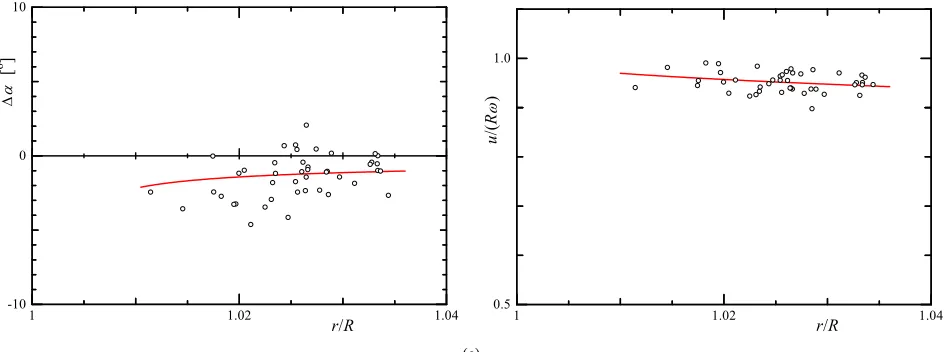
Figure 5 represents the distributions of the horizontal flying velocity and angle of the small size droplets. If it is assumed that a sphere linearly flies away in tangential direction from the circle of radius rb, the droplet flying
angle α at radius r is geometrically calculated by Equa- tion (1).
0 400
d[m] 800 0
0.1 0.2
PD
F
[-] Type A
[image:3.595.310.535.361.532.2]B C
[image:3.595.308.538.589.736.2]Figure 4. Distribution of droplet diameter.
Table 2.Statistics of droplet diameter: (a) Small size droplet (d < 500 μm); (b) Large size droplet (d > 500 μm).
(a)
Type A B C
Number of droplets 383 154 165
Mean diameter dm [μm] 265 288 306
Std.dev. σd [μm] 100 92 81
(b)
Type A B C
Number of droplets 73 40 44
Mean diameter dm [μm] 566 593 600
Red line in Figure 5 is a fitting curve obtained by least square method. Most of the plotted data points take slightly negative value. It means that the droplets fly somewhat inner side of the tangential direction from the disk edge. It is caused that the liquid filaments are stretched from the stagnant liquid layer formed outer side
1 b
cos r
r
(1)
In Figure 5, Δα is deviation angle defined by Equation (2).
1 , cos
R R
R r
(2)
1 1.02 1.04
r/R -10
0 10
[
o ]
1 1.02 r/R 1.04
0.5 1.0
u
/(
R
)
(a)
1 1.02 1.04
r/R -10
0 10
[
o ]
1 1.02 r/R 1.04
0.5 1.0
u
/(
R
)
(b)
1 1.02 1.04
r/R -10
0 10
[
o ]
1 1.02 r/R 1.04
0.5 1.0
u
/(
R
)
[image:4.595.59.534.126.707.2](c)
Figure 5. Horizontal flying angle and velocity of small size droplet (d < 500 μm): (a) Type A (left: angle, right: velocity); (b) ype B (left: angle, right: velocity); (c) Type C (left: angle, right: velocity).
of lateral disk edge as shown in Figure 3. It is clear that
hermore, if it is assumed that the droplet flies hori-zo
this deviation of type B and C is remarkable as the liquid filament of them is large and the stagnant layer of them is thick.
Furt
ntally and Allen’s experimental Formula [9]
1 2 10
C Re ,
air
ud Re
D (3)
can apply on the drag acting on the droplet, the droplet flying velocity is estimated by Equation (4) derived from an equation of motion of a rigid sphere in a stationary air.
2 1/2 2 2 air
15
b b b
L 1
4
u u Re r r
d
(4)
where ub is the droplet flying velocity at the radius rb. As
A results in slower horizontal velocity as recognized
of the horizontal flying velocity and an
4. Conclusions
edge profile on scattering characteris-
shown in Figure 5, the droplets are monotonically decel-erated in the radius direction by the drag force. For type A, the deceleration of the droplets and the deviation of the data points from the fitting curve are remarkable. It is clear from Figure 5 that the smaller size droplet of type.
from Equation (4). The distributions
gle of the large size droplets are shown in Figure 6. The droplet flying velocity and angle are very close to the fitting curve, almost within order of the measurement uncertainty. The fitting curve of angle in Figure 6 is al- most similar to that in Figure 5. On the other hand, the deceleration of large size droplet is smaller than that of small size droplet as recognized from Equation (4).
The effects of disk
tics of the liquid droplets splashed from the rotating disk edge have been investigated experimentally. The scatter- ing phenomena of the droplets were captured by the high-speed digital camera. The distribution of the droplet diameter was evaluated from these images and the dis- tributions of the horizontal flying velocity component and angle of the droplets were measured. Main results obtained are summarized as follows.
1 1.02 1.04
r/R -10
0 10
[
o ]
1 1.02 r/R 1.04
0.5 1.0
u
/(
R
)
(a)
1 1.02 1.04
r/R -10
0 10
[
o ]
1 1.02 r/R 1.04 0.5
1.0
u
/(
R
)
1 1.02 1.04 r/R
-10 0 10
[
o ]
1 1.02 r/R 1.04 0.5
1.0
u
/(
R
)
[image:6.595.62.534.86.262.2](c)
Figure 6. Horizontal flying angle and velocity of large size droplet (d > 500 μm): (a) Type A (left: angle, right: velocity); (b)
The liquid filaments are stretched outward from the st
peaks appear in the distribution of the scat-te
ly slightly inside of the ta
isk edge scatter ra
ks Mrs. Kubo, K. and Ono
REFERENCES
[1] Y. Tanasawa, Umehara, “On the
Type B (left: angle, right: velocity); (c) Type C (left: angle, right: velocity).
agnant liquid layer on the lateral surface of the disk by the centrifugal force and inclined toward counter-rotating direction.
Two main
red droplet diameter and they are originated from the large terminal droplets and the small droplets generated from the filamentwise breakup.
Most of the scattered droplets f
ngential direction on the disk edge because the liquid filaments are stretched outward from the stagnant liquid layer on the lateral surface of the disk.
The droplets splashed from the thin d
ther wider than that from the thick one because the liquid filament is slim and the small droplets are gener- ated. On the other hand, there is not apparent discrepancy for scattering of large terminal droplets.
5. Acknowledgements
The authors would like to than , K. for their experimental assistance.
Y. Miyasaka and M.
Filamentation of Liquid by Means of Rotating Discs, 3rd Report, Theory of Filament Formation of Liquid,”
Transactions of JSME, Journal of Japan Society of Me- chanical Engineers, Vol. 25, No. 156, 1959, pp. 897-905. doi:10.1299/kikai1938.25.897
[2] M. Daikoku, H. Sunanaga and N. Nagai, “Liquid
of Liquid Flow, and Drop Formation on the
zation from the Surface of a Rotating Body, 1st Report,
Rotating Body,” Transactions of JSME, Journal of Japan Society of Mechanical Engineers, Series B, Vol. 54, No. 501, 1988, pp. 1170-1178.
Behavior
doi:10.1299/kikaib.54.1170 [3] N. Gregory, J. T. Stuart and W. S. Walker, “On the Sta-
bility of Three-Dimensional Boundary Layers with Ap- plication to the Flow Due to a Rotating Disk,” Philoso- phical Transactions of the Royal Society of London, Se- ries A, Vol. 248, No. 943, 1955, pp. 155-199.
doi:10.1098/rsta.1955.0013
[4] R. Kobayashi, Y. Kohama and Ch. Takamadate, “Spiral Vortices in Boundary Layer Transition Regime on a Ro- tating Disk,” Acta Mechanica, Vol. 35, No. 1-2, 1980, pp. 71-82. doi:10.1007/BF01190058
[5] M. R. Malik, S. P. Wilkinson and S. A. Orszag, “Instabil- ity and Transition in Rotating Disk Flow,” AIAA Journal, Vol. 19, No. 9, 1981, pp. 1131-1138. doi:10.2514/3.7849 [6] H. L. Reed and W. S. Saric, “Stability of Three-Dimen-
sional Boundary Layers,” Annual Review of Fluid Me- chanics, Vol. 21, 1989, pp. 235-284.
doi:10.1146/annurev.fl.21.010189.001315
[7] A. Öztekin, D. E. Bornside, R. A. Brown and P. K. Seidel, “The Connection between Hydrodynamic Stability of Gas Flow in Spin Coating and Coated Film Uniformity,”
Journal of Applied Physics, Vol. 77, No. 6, 1995, pp. 2297-2308. doi:10.1063/1.358751
[8] M. Munetaka, A. Noguchi, J. Nishiyama, H. Kurishima and H. Yoshikawa, “Scattering Characteristics of Liquid Droplets Spun Off from Rotating Disk Edge,” Journal of Thermal Science, Vol. 21, No. 1, 2012, pp. 42-48. doi:10.1007/s11630-012-0517-6
[9] H. S. Allen, “The Motion of a Sphere in a Viscous Fluid,”