Barriers to E-Commerce Adoption: Consumers’
Perspectives from a Developing Country
Moudi Almousa
Department of Food Science and Nutrition, King Saud University, Riyadh, Saudi Arabia. Email: [email protected]
Received March 3rd, 2013; revised May 1st, 2013; accepted June 1st, 2013
Copyright © 2013 Moudi Almousa. This is an open access article distributed under the Creative Commons Attribution License, which permits unrestricted use, distribution, and reproduction in any medium, provided the original work is properly cited.
ABSTRACT
Although e-commerce has become a familiar retail channel for businesses in developed countries, it is still considered an innovation in developing countries. Specifically, electronic commerce (e-commerce) in Saudi Arabia is still in the first stage despite its advance and fast growth in ICT marketplace, the highest increase in Internet penetration in the world, strong retail sector, and young population. This research study aims to identify tangible barriers influencing consumers in Saudi Arabia to adopt e-commerce. An exploratory research design is used to shed light on the tangible barriers facing Saudi consumers when shopping online. This research study identified key tangible barriers and their relative importance for both e-commerce adapters and non-adapters facing Saudi consumer when shopping online. Practical as well as managerial implications are discussed.
Keywords: E-Commerce; Online Shopping; Barriers; Adoption; Saudi Arabia
1. Introduction
The Information and communication technologies (ICT) have transformed how retailers and consumers buy, dis- tribute, and customize products. The electronic com- merce (e-commerce) boom last decade along with the Internet boom in the 1990’s have changed the way busi- nesses interact with their customers. Fueled by mobile and social commerce, e-commerce is expected to be one of the important keys to the success and growth in the current competitive business environment. Although e- commerce has become a familiar retail channel for busi- nesses in developed countries, it is still considered an innovation in developing countries. Specifically, e-com- merce in Saudi Arabia is still in the first stage, despite its advance and fast growth in ICT marketplace, the highest increase in Internet penetration in the world, strong retail sector, and young population.
Saudi Arabia has the second largest Internet users (13 million) and the highest Facebook users (5.9 million) in the Middle East with 49.0% Internet penetration among the population [1]. Although the country is the largest retail market in the Middle East, online sales comprise only a small percentage of total retail sales. Saudi Ara- bia’s Internet users spend over $3.28 billion in B2C e-commerce during 2010, with total retail sales of $77
billion in 2010 [2]. More than forty eight percent of Internet users in Saudi Arabia reported purchasing pro- ducts and services online and through their mobile hand- sets over the past twelve months [3,4]. According to Business Monitor International Report (2009) the fore- cast annual private consumption growth in the country is 6.0% in 2012 having been boosted by higher government spending on public-sector wages and social and unem- ployment benefits. The retail market in Saudi Arabia is the largest in the Middle East. It is the fourth largest sec- tor in the country after oil, banking, and telecommunica- tion, contributing to 17% of GDP. Despite the mentioned drivers which constitute a good platform for e-commerce adoption, using the Internet as a shopping medium has not been harness at the same speed by both retailers and consumers [5,6].
Therefore, the main contribution of this study is to identify tangible barriers influencing consumers in Saudi Arabia to adopt e-commerce. An exploratory research design is used to shed light on the tangible barriers facing Saudi consumers when shopping online.
ported with US consumers, where loss of privacy of per- sonal information, after-sale services (return and ex- change), being unable to examine the product prior to purchase, shipping costs, and seller anonymity are barri- ers to online shopping adoption [14].
among Saudi Arabian consumers.
Finally, few expletory studies have been conducted recently that consider Internet shopping diffusion, e-com- merce adoption from retailers’ perspectives, an e-service adoption in Saudi Arabia. No studies have been found focusing on tangible barriers to e-commerce adoption from consumers’ perspectives. This research paper at- tempts to fill in the gap in exploring tangible barriers to e-commerce adoption from consumer perspective in the country. The paper opens with a review of the global literature in e-commerce as well as adoption barriers from a consumer perspective and the contextual setting of e-commerce in the country, followed by a research methodology, then the findings and a conclusion.
2. Literature Review
The advancement in information technology and the de- velopment of Internet impact the whole society com- merce and make a big change on economies. The diffu- sion of e-commerce in developing countries is an impor- tant economic indicator of growth due to the reduction of transaction cost [7].
2.1. E-Commerce Barriers
Many studies have been conducted globally to better understand challenges and drivers to e-commerce adop- tion from both B2B and B2C domains. E-commerce adoption has been studied from both information systems and consumer behavior. In early studies regarding e- commerce adoption in developed countries, Fram and Grady (1995) [8] concluded that the most concerns for online shoppers are transaction issues such as lack of credit card security, vendors not fully identified, and a lack of payment alternatives. In addition, fear of online transaction was identified as the most significant barriers that prevent online browsers from becoming online buy- ers [9].
Trust has been identified in e-commerce literature as a perceived risk and a barrier to Internet adoption. Con- sumers with previous Internet experience have a positive attitude towards Internet shopping and place more trust on it [10]. In addition, security concerns, for both; credit card and personal information, were identified as the major barrier to Internet shopping adoption. Consumers perceive more security during online transactions if on- line vendors can demonstrate that their websites are se- cure, the consumer then, will recognize the seller’s inten- tion to provide security requirements during online transaction [11,12].
In an early stage of online shopping adoption, [13] re- ported that consumers were most concerned about being unable to examine the product physically prior to pur- chase, cost of shipping, credit card security, and privacy of personal information. Similar findings were also re-
Gibbs, et al. (2003) [15] conduct a cross-country com-
parison study including USA, Germany, France, Den- mark, Brazil, Mexico, Japan, China and Singapore to examine global, environmental, and policy factors that act as determinant of e-commerce diffusion. Results of the study indicated that B2B is driven by global forces, while B2C is driven by local phenomena. The study fur- ther identifies that consumer demand to purchase online, consumer purchasing power, business e-readiness, strong ICT infrastructure, and government promotion act as enablers for B2C e-commerce. Whereas payment method options, language, available shopping alternatives, lack of consumer trust, shopping channel preference, on site product information, reluctance to buy online, and ine-quality in socioeconomic level act as barriers to B2C e-commerce. A study conducted by OECD (2007) [16] on barriers hindering e-commerce adoption in developing countries identified some barriers, which varied widely among countries. Most identified barriers are related to infrastructure such as (network availability of ICT skills, technology, qualified human resources), cost of equip- ment and service, security and privacy issues, payment systems, poor distribution logistics, after-sale services, and lack of feel and touch in online shopping context. Other consumers either in developing countries or in developed countries across Europe do most cross-border online shopping, where they face different barriers. SEC (2009) report on cross-border e-commerce across Euro-pean States concluded that language, cultural barriers, payment methods, delivery and after-sales support are the most important hindering factors.
2.2. E-Commerce in Saudi Arabia
Sacha Consulting Group (2012) reported some barriers that may affect the diffusion of e-commerce in Saudi Arabia. The barriers include preference of face-to-face business deals, using the Internet just to access data and not as a shopping channel, minimal payment method options, language, and resistance to change, fear of risk taking, weak customer service quality and after-sale support, online privacy, and postal system.
site language, and culture and attitude. Other consumers either in developing countries or in developed countries across Europe do most online shopping cross-border, where they face different barriers. SEC (2009) [17] re- port on cross-border e-commerce across European States concluded that language, cultural barriers, payment me- thods, delivery and after-sales support are the most im- portant hindering factors.
Retailers in Saudi Arabia are reluctant to use the Inter- net as a shopping channel. Only few online stores target- ing all Middle Eastern consumers were launched during the past few years such as (Souq.com, e-mall.com.sa) operating both as a retail site and as a marketplace for third party sellers. The majority of online purchases are bought from international online stores. Some interna- tional online stores responded to the increased volume of international purchases by arranging with a global e-commerce company that allows the online store to pre- sent international shoppers with product prices in the currency of their choice, a competitive international ship- ping cost, and the lowest possible order total
(www.macys.com).
Few studies were conducted to explore factors that in- hibit retailers from adopting the Internet as a shopping channel. Some of the most important tangible barriers from retailers’ perspectives include; Poor ICT infra- structure, lack of regulation for e-commerce to protect both retailers and consumers, mailing system, and lack of experience [5,18,23,24]. Starting 2005, Saudi postal ser- vices start delivering mail to houses after launching the Wasel service to deliver mail using smart mail boxes linked to satellite to locate home addresses using GPS. Prior to Wasel launch, mail was delivered to P O Boxes because of the lack of defined street addresses acceptable to the various delivery services. Therefore, the mailing system in the country was identified as an obstacle to e-commerce adoption in the country [6,24,25]. Despite the advancement in postal delivery, it is yet to be adopted by citizens especially in rural areas of the country. An- other obstacle facing Saudi consumers when shopping from international online stores is the unavailability of international shipping in vender’s site. Saudi post as well as other international carriers such as (Aramex) have re- sponded to such need by providing subscribers to the e-shopping service a personal address in the country they shop from and then shipped directly to their local home addresses.
As the world is moving towards globalization, firms need to target markets cross-national boundaries. By do- ing so, firms need to understand factors affecting online shopping from the perspective of consumers of different countries. However, little empirical research has exam- ined barriers affecting cross-border online shopping. Moreover, no empirical research has been found on bar- riers affecting e-commerce adoption in Saudi Arabia
from a consumer perspective and specifically when shop- ping cross-border. Almost all online shopping in Saudi Arabia are done cross-border. No local firms wear found that sell products online to consumers. This study focuses on identifying barriers to e-commerce adoption in Saudi Arabia from consumers’ perspectives.
The review of the above studies indicated that although there have been a good body of literature regarding Internet usage, online shopping, and factors influencing Internet adoption, few had focused on Saudi Arabian consumers. Moreover, no research has been found in identifying tangible barriers affecting Internet shopping adoption in Saudi Arabia from consumers’ perspectives. This research study will attempt to fill the gap regarding this area of research.
3. Methodology
This research study was built on grounded theory fol- lowing the approach of Strauss and Corbin (1990) [26] in addition to two focus group discussions to identify tangi- ble barriers to adopt e-commerce from consumers’ per- spectives in the country. The study was carried out in two phases, a focus group phase and a survey phase. Initially, focus groups were formed for the purpose of identifying general perceptions of consumers with respect to e-com- merce barriers. Students whom are Internet users attend- ing the largest university in Riyadh city participated in two focus group discussions with ten participants in each group. Focus groups participants were recruited through e-mail messages sent to ninety college students. The identified barriers from both focus group discussions as well as the reviewed previous literature were examined using a five-point Likert scale, on which 1 indicates strongly disagree and 5 strongly agree. Eight main bar- riers were identified which includes; weak after-sale sup- port, fear of product un-arrival, unavailability of interna- tional shipping in venders’ site, web site language, un- availability of house mailing address, no previous ex- perience regarding online purchasing, payment system (including not owning a credit card), and high shipping cost. The questionnaire has two sections. The first sec- tion includes demographic questions, while the second section includes statements regarding barriers related to online shopping which was identified through previous literature as well as focus groups discussion.
This research is primarily expletory in nature. Means for barriers were calculated, then a comparison of mean dif- ferences between online shoppers and none shoppers regarding identified barriers were tested using t-test.
4. Results
4.1. Sample Description
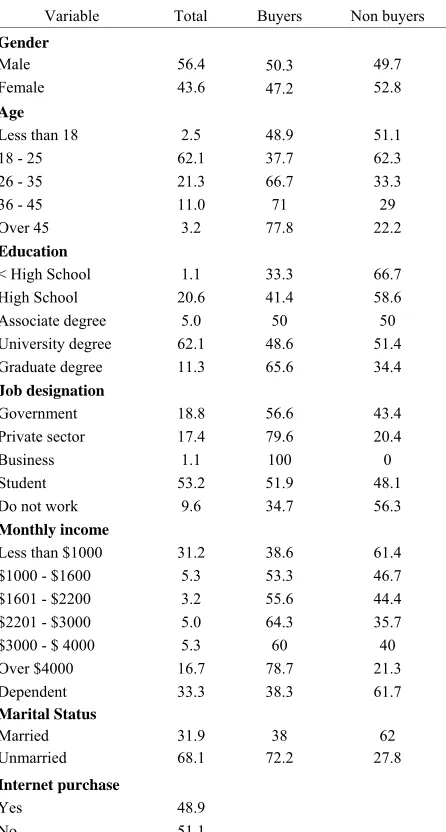
[image:4.595.304.538.241.521.2]Two hundred and seventy three responses were collected. The majority of the respondents was between the ages of 18 - 35 and had a university degree. A little over half of respondents (53%) were students and had a monthly in- come of less than $1000 (31.1%) or financially depen- dent on others (33.2%). A little over half of them have no previous experience on buying through the Internet. Per- centages related to demographic characteristics of re- spondents are presented in Table 1.
Table 1. Demographic profile of the sample.
Variable Total Buyers Nonbuyers
Gender Male Female 56.4 43.6 50.3 47.2 49.7 52.8 Age
Less than 18 18 - 25 26 - 35 36 - 45 Over 45 2.5 62.1 21.3 11.0 3.2 48.9 37.7 66.7 71 77.8 51.1 62.3 33.3 29 22.2 Education
< High School High School Associate degree University degree Graduate degree 1.1 20.6 5.0 62.1 11.3 33.3 41.4 50 48.6 65.6 66.7 58.6 50 51.4 34.4 Job designation Government Private sector Business Student Do not work
18.8 17.4 1.1 53.2 9.6 56.6 79.6 100 51.9 34.7 43.4 20.4 0 48.1 56.3 Monthly income
[image:4.595.60.283.315.731.2]Less than $1000 $1000 - $1600 $1601 - $2200 $2201 - $3000 $3000 - $ 4000 Over $4000 Dependent 31.2 5.3 3.2 5.0 5.3 16.7 33.3 38.6 53.3 55.6 64.3 60 78.7 38.3 61.4 46.7 44.4 35.7 40 21.3 61.7 Marital Status Married Unmarried 31.9 68.1 38 72.2 62 27.8 Internet purchase Yes No 48.9 51.1
Table 2 reports the means and standard deviations for
barriers affecting e-commerce adoption for the study sample. Results showed that weak after-sale support has the highest mean (M = 3.55, sd. = 1.36) while not having a home mailing address has the lowest mean score among barriers (M = 2.32, sd. = 1.48). Figure 1 illus-
trates the same information with barriers being ranked according to its mean score starting from the highest to the lowest mean score.
Table 3 and Figure 2 present means and standard de-
viation for both adapters and non-adapters with regard to barriers to e-commerce adoption in Saudi Arabia.
Figure 1. Barrier means for total respondents.
[image:4.595.309.538.570.737.2]Figure 2. Mean differences between adapters and non- adapters.
Table 2. Mean and standard deviation of the perceived bar- riers.
Barriers Mean SD
High shipping cost 3.35 1.206
No international shipping 3.27 1.228
Credit card 3.04 1.686
Experience 3.01 1.513
Language 2.86 1.457
Arrival 3.30 1.415
After-sale services 3.55 1.368
Table 3. Means and standard deviation for adopters and non-adopters.
(133) Adopters (140) Non Adopters Barrier
M SD M SD
High shipping cost 3.51 1.222 3.21 1.176
No international
shipping 3.31 1.295 3.23 1.163
Credit card 2.46 1.657 3.59 1.526
Experience 2.39 1.411 3.60 1.365
Language 2.57 1.480 3.14 1.382
Arrival 3.00 1.404 3.58 1.372
After-sale services 3.41 1.402 3.69 1.324
Mailing address 2.09 1.385 2.54 1.550
Results indicated that non-adapters showed higher means regarding seven of the nine tested barriers which includes; being not able to touch or inspect the product (M = 3.13, sd. = 1.24), not owning a credit card (M = 3.59, sd. = 1.52 ), lake of previous experience in online purchasing (M = 3.60, sd. = 1.36), web site language (M = 3.14, sd. = 1.38), fear of product un-arrival (M = 3.58, sd. = 1.37), weak after-sale support (M = 3.69, sd. = 1.32), and not having a home mailing address (M = 2.54, sd. = 1.55), while adapters showed higher mean scores in tow barriers including; high shipping cost (M = 3.51, sd. = 1.22) and unavailability of international shipping in vendors site (M = 3.31, sd. = 1.29). Weak after-sale sup- port was perceived by non-adapters as the highest barrier (M = 3.69, sd. = 1.32) followed by not having a previous experience in online purchasing (M = 3.60, sd. = 1.36), not owning a credit card (M = 3.59, sd. = 1.52), and fear of product un-arrival (M = 3.58, sd. = 1.37), while not having a home mailing address was perceived by non-adapters as the lowest barrier (M = 2.54, sd. = 1.55). Adapters differ in evaluating barriers, where high inter- national shipping cost was perceives as the highest bar- rier (M = 3.51, sd. = 3.51) followed by weak after-sale support (M = 3.41, sd. = 1.40), unavailability of interna- tional shipping in vendors site (M = 3.31, sd. = 1.29), while not having a home mailing address was also per- ceived by adapters as the lowest barrier.
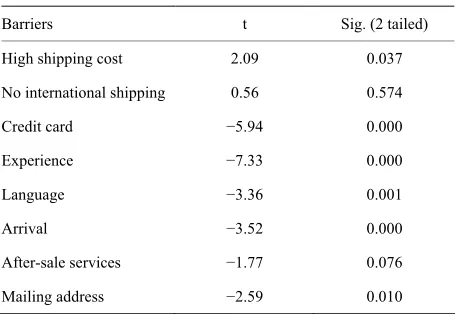
T-test was performed to examine wither the obtained barrier mean scores differ significantly between e-com- merce adapters and non-adapters. Results of the t-test indicated that they differ significantly in seven of the identified barriers, while no significant difference were found between adapters and non-adapters regarding un- availability of international shipping in vendors site and weak after-sale support Table 4.
5. Discussion, Implications and Future
Research
[image:5.595.58.288.111.261.2]This research paper presents preliminary findings re-
Table 4. Mean differences between adapters and non- adapters.
Barriers t Sig. (2 tailed)
High shipping cost 2.09 0.037
No international shipping 0.56 0.574
Credit card −5.94 0.000
Experience −7.33 0.000
Language −3.36 0.001
Arrival −3.52 0.000
After-sale services −1.77 0.076
Mailing address −2.59 0.010
garding barriers to e-commerce adoption in Saudi Arabia from a consumer perspective. It identifies and explores barriers influencing Saudi consumers when shopping online from local or cross-border e-tailers. It can be seen that the most serious barriers facing consumers when shopping online are weak or no after-sale support, fol- lowed by high international shipping cost, then fear of product un-arrival. It is obvious that these barriers are associated with cross-border online shopping.
of international shipping in vendors site was the third most important barrier facing adapters. This might be also related to the additional cost consumers pay to carri- ers to ship products from provided local mailing addres- ses to their residential addresses, where high interna- tional shipping cost were identified by adapters as the highest barrier.
Saudi government should pay attention to factors af- fecting local retailers to adopt e-commerce in the country since most barriers facing consumers are associated with cross-border online shopping. Saudi government has taken large steps in enforcement and implementation of e-government among public sectors. Though, very limi- ted efforts were done regarding e-commerce adoption for both retailers and consumers. Since e-government and e-commerce are effectively two sides of the same coin, the government role in implementing e-government should have significant implications in e-commerce adoption if more attention were paid in enforcing factors supporting its development through enactment of laws and regulations to regulate business behavior in relation- ship to online transactions. It appears that pervious lit- eratures regarding barriers to e-commerce diffusion in the country from both retailers’ and consumers’ perspec-tives are related mainly to the lack of such regulations. Barriers identified in this study are mostly associated with purchasing from international retailer due to the very limited availability of local etailers. A competitive advantage can be gained by implementing such jurisdic- tions to assist in driving e-commerce growth in the coun- try in order to gain, retain and grow this young, tech- savvy, online shopper demographic.
Future research should be carried out to extend the knowledge regarding e-commerce adoption and diffusion in the country from both consumers and retailers per- spectives. Research should concentrate in identifying urgent needed market regulation to be implemented by government as a policy maker. The question needed to be answered is why the government did not facilitate the regulatory infrastructure needed to promote e-commerce growth in the country inline with the physical infrastruc- ture created to support e-government? Following such direction would promote e-commerce diffusion which can contribute in economic growth in both the public and private sectors.
REFERENCES
[1] Internet World Stat, “Internet Usage in the Middle East,” 2012. http://www.Internetworldstats.com/stats5.htm [2] The Arab Advisors Group, “Press Release Riyadh, Saudi
Arabia,” 14 July 2009.
http://www.middleeastevents.com/site/pres_dtls.asp?pid= 7195
[3] Business Monitor International (BMI), “Research and Markets,” 20 July 2009.
http://www.researchandmarkets.com/reports/1057968/ [4] M. Almousa, “Profiling E-buyers in Saudi Arabia: Demo-
graphic, Experiential, and Attitudinal Factors,” Cross-
Cultural Communication, Vol. 7, No. 2, 2011, pp. 92-
100.
[5] S. Alfuraih, “E-Commerce and E-Commerce Fraud in Saudi Arabia: A Case Study,” IEEE, 2nd International
Conference on Information Security and Assurance, Bu- san, 24-26 April 2008, pp. 176-180.
[6] Sacha Consulting Group, “E-Commerce in Saudi Arabia: Driving the Evolution, Adoption and Growth of E-Com- merce in the Retail Industry,” Dubai, London, 2012. [7] A. Molla and P. S. Licker “E-Commerce Adoption: An
Empirical Investigation in a Developing Country,” Inter-
national Journal of Electronic Commerce, 2005.
[8] E. H. Fram and D. B. Grady, “Internet Buyers: Will the Surfers Become Buyers?” Direct Marketing, Vol. 58, No.
6, 1995, pp. 63-65.
[9] N. K. Then and M. DeLong, “Apparel Shopping on the Web,” Journal of Family and Consumer Sciences, Vol.
91, No. 3, 1999, pp. 65-68.
[10] N. Donthu and A. Garcia, “The Internet Shopper,” Jour-
nal of Advertising Research, Vol. 39, No. 3, 1999, pp.
52-58.
[11] P. A. Pavlou, “What Drives Electronic Commerce? A Theory of Planned Behavior Perspective,” Academy of
Management Annual Meeting, Denver, August 2002, pp. .
[12] T. Fenech and A. O’Cass, “Internet Users Adoption of Web Retailing: User and Product Dimensions,” Journal
of Product and brand Management, Vol. 10, No. 6, 2001,
pp. 361-81. doi:10.1108/EUM0000000006207 [13] Ernst and Young, “Global Online Retailing,” 2000.
http://www.ey.com
[14] UCLA Centre for Communication Policy, “Surveying the Digital Future,” 2003. http://www.ccp.ucla.edu
[15] J. Gibbs, K. L. Kraemer and J. Dedrick, “Environment and Policy Factors Shaping Global E-Commerce Diffu- sion: A Cross-Country Comparison,” The Information So-
ciety, Vol. 19, No. 1, 2003, pp. 5-18.
doi:10.1080/01972240309472 [16] OECD, “Regions at a Glance,” 2007.
http://www.oecd.org/document/61/0,3746,en_2649_3463 1_38690301_1_1_1_1,00.html
[17] SEC, Commission of The European Communities, “Re- port on Cross-Border E-Commerce in the EU,” Brussels, 2009.
[18] R. AlGhamdi, S. Drew and O. Alfaraj, “Issues Influenc-ing Saudi Customers’ Decisions to Purchase from Online Retailers in the KSA: A Qualitative Analysis,” European
Journal of Scientific Research, Vol. 55, No. 4, 2011, p.
580.
[19] S. A. Al-Somali, R. Gholami and B. Clegg, “An Investi-gation into the Acceptance of Online Banking in Saudi Arabia,” Technovation, Vol. 29, No. 2, 2009, pp. 130-141.
[20] H. Siddiqui, “Investigation of Intention to Use E-Com- merce in the Arab Countries: A Comparison of Self-Ef- ficacy, Usefulness, Culture, Gender, and Socioeconomic Status in Saudi Arabia and the United Arab Emirates,” PhD. Dissertation, Nova Southeastern University, Orlan- do, 2008.
[21] R. AlGhamdi, S. Drew and W. Al-Ghaith, “Factors In- fluencing Retailers in Saudi Arabia to Adoption of Online Sales Systems: A Qualitative Analysis,” Electronic Jour- nal of Information System in Developing Countries
(EJISDC), in press.
[22] M. Alsharif, “E-Commerce Adoption Factors and Their Implications for E-Commerce Business Strategy in Saudi Arabia,” Master Thesis, Simon Fraser University, London, 2011.
[23] A. M. Aladwani, “Key Internet Characteristics and E-
Commerce Issues in Arab Countries,” Information and
Management, Vol. 16, No 1, 2003, pp. 9-20.
[24] A. Al-Solbi and P. J. Mayhew, “Measuring E-Readiness Assessment in Saudi Organizations: Preliminary Results from a Survey Study,” The Proceedings of the 1st
Euro-pean Conference on Mobile Government, Brighton, 10-12
July 2005, pp. 467-475.
[25] Saudi Post, “Saudi Post: Establishment and Develop- ment,” 2009.
http://www.sp.com.sa/Arabic/SaudiPost/aboutus/Pages/es tablishmentanddevelopment.aspx