Munich Personal RePEc Archive
Non-positive scaling factor in probability
quantification methods: deriving
consumer inflation perceptions and
expectations in the whole euro area and
Ireland
Lyziak, Tomasz
14 February 2011
Online at
https://mpra.ub.uni-muenchen.de/28900/
N
N
o
o
n
n
p
p
o
o
s
s
i
i
t
t
i
i
v
v
e
e
s
s
c
c
a
a
l
l
i
i
n
n
g
g
f
f
a
a
c
c
t
t
o
o
r
r
i
i
n
n
p
p
r
r
o
o
b
b
a
a
b
b
i
i
l
l
i
i
t
t
y
y
q
q
u
u
a
a
n
n
t
t
i
i
f
f
i
i
c
c
a
a
t
t
i
i
o
o
n
n
m
m
e
e
t
t
h
h
o
o
d
d
s
s
D
Deerriivviinngg ccoonnssuummeerr iinnffllaattiioonn ppeerrcceeppttiioonnss aanndd eexxppeeccttaattiioonnss iinn tthhee wwhhoollee eeuurroo aarreeaa aanndd IIrreellaanndd
Tomasz Łyziak1
National Bank of Poland
Abstract
There are problems with using probability quantification methods when the scaling factor applied in those methods becomes nonpositive. The way of adjusting them proposed in this note and verified empirically allows using them in such circumstances. The results for the euro area and Ireland suggest that the recent financial crisis made consumer inflation per ception and expectations go down, however it did not create deflationary expectations in this groups of economic agents.
JEL: C46, D84
Keywords: Inflation Expectations, Survey Data, Euro Area
1 Contact details:
Tomasz Łyziak
National Bank of Poland ul. Świętokrzyska 11/21 00‐919 Warsaw, Poland tel.: (4822) 5854378
e‐mail: [email protected]
2
1.
Introduction
Probability quantification methods are widely used to derive numerical estimates of perceived and expected inflation on the basis of qualitative survey data. However, the use of those methods during the episodes of non‐positive inflation rates is constrained. The note proposes an adjust‐ ment in the probability method allowing quantification of survey data in such circumstances. It also presents the results of applying it in the quantification of consumer inflation perception and expectations in the euro area and Ireland during the recent financial crisis.
2.
Quantification
of
survey
responses
when
the
scaling
factor
is
positive
There are two survey questions concerning price changes in the European Commission Con‐ sumer Survey carried out every month in the EU economies. The first question concerns infla‐ tion perception: “In your opinion, is the price level now compared to that 12 months ago: (1) much higher; (2) moderately higher; (3) a little higher; (4) about the same; (5) lower; (6) difficult to say”.
The second one concerns inflation expectations: “Given what is currently happening, do you be
lieve that over the next 12 months prices will: (1) rise faster than at present, (2) rise at the same rate, (3) rise more slowly, (4) stay at their present level, (5) go down, (6) difficult to say”.
Quantifying survey data of this kind with probability methods (e.g. Batchelor and Orr 1988), survey responses are scaled given the certain type of the distribution of perceived or expected inflation and sensitivity intervals surrounding point responses (see e.g. Łyziak 2010). Consider‐ ing the question on future inflation, the scaling factor is given by the measure of perceived cur‐ rent inflation and can be represented either by the official inflation rate available to respondents when the survey is carried out or by the quantified outcome from the survey question on past inflation. For the question on perceived price changes the scaling factor can be defined as a moderate inflation rate, providing a benchmark in declaring the magnitude of perceived price increase (e.g. Batchelor and Orr 1988).
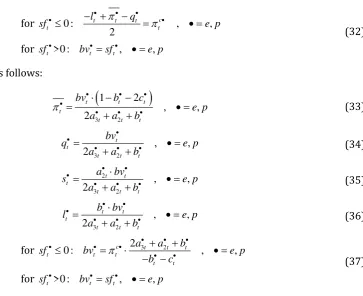
The quantification of perceived or expected inflation can be summarized in the set of the follow‐ ing equations:
(
)
( )
1 Pr , ,
t t
t t t t t t t
sf s
a π sf s f π dπ e p
•
∞
• • • • • •
+
= > + =
∫
• =(1)
(
)
( )
2 Pr , ,
t t
t t
sf s
t t t t t t t t t
sf s
a sf s π sf s f π dπ e p
• •
• •
+
• • • • • • • •
−
= − < < + =
∫
• =(2)
(
)
( )
3 Pr , ,
t t
t
sf s
t t t t t t t t
l
a l π sf s f π dπ e p
• •
•
−
• = • < • < •− • = • • • =
∫
(3)
(
)
( )
Pr , ,
t
t
l
t t t t t t t
l
b l π l f π dπ e p
•
•
• • • • • •
−
= − < < =
∫
• =(4)
(
)
( )
Pr , ,
t
l
t t t t t t
c π l f π dπ e p
•
−
• • • • •
−∞
where: ft
( )
πt• denotes density function of perceived (• =p) or expected (• =e) inflation;
1t
a•,
2t
a• , a3t
• ,
t
b• and ct
• denote percentages of respondents selecting subsequent survey responses,
t
sf• stands for the scaling factor, while st• and lt• determine the width of sensitivity intervals
surrounding zero and the scaling factor respectively. Solving the system, parameters of the den‐ sity function and both sensitivity intervals are calculated.
3.
Quantification
of
survey
responses
when
the
scaling
factor
is
non
positive
Methods described above assume that the scaling factor is positive and unique for the surveyed population. However, there are episodes, when the scaling factor becomes non‐positive. In such circumstances it is difficult to interpret survey responses using standard assumptions of prob‐ ability methods.
To make the probability method work when the scaling factor is non‐positive, we propose the following additional assumptions. Firstly, we assume that in such cases, implied perceived or expected inflation in the group of respondents selecting three initial responses is driven by
a positive benchmark value, bvt
•. Secondly, it is assumed that when the scaling factor is non‐
positive, implied price changes perceived or expected by respondents declaring a reduction of
the price level, is equal to a certain value c
t
π •
on average.
It leads to the following set of equations:
(
)
( )
1 Pr , ,
t t
t t t t t t t
bv s
a π sf s f π dπ e p
• •
∞
• • • • • •
+
+
= > + =
∫
• =(6)
(
)
( )
2 Pr , ,
t t
t t
bv s
t t t t t t t t t
bv s
a sf s π sf s f π dπ e p
• •
• •
+
• • • • • • • •
+ +
−
= − < < + =
∫
• =(7)
(
)
( )
3 Pr , ,
t t
t
bv s
t t t t t t t t
l
a l π sf s f π dπ e p
• •
•
−
• • • • • • •
+
= < < − =
∫
• =(8)
(
)
( )
Pr , ,
t
t
l
t t t t t t t
l
b l π l f π dπ e p
•
•
• • • • • •
−
= − < < =
∫
• =(9)
(
)
( )
Pr , ,
t
l
t t t t t t
c π l f π dπ e p
•
−
• • • • •
−∞
= < − =
∫
• =(10)
for 0 :
(
|)
c , ,t t t t t
sf• ≤ E π π• • < −l• =π • • =e p
for sft•>0 : bvt• =sft• , • =e p,
(11)
Solution of above equations – dependant on the type of the distribution applied and the parame‐ ter πct
• – gives both sensitivity intervals, parameters of the distribution as well as the benchmark
value.
To determine c
t
π •, i.e. the average perceived or expected inflation in the group of respondents
4
characterized by a positive scaling factor, we derive c
t
π •
based on the outcomes from the prob‐ ability quantification method, i.e.:
for >0 : c
(
|)
, ,t t t t t
sf• π • =E π π• •< −l• • =e p (12)
In the second step we estimate a behavioral model for πct
•
, e.g. regressing it on its lagged values and the scaling factor:
for >0 : 0 1 1 2 , ,
c c
t t t t t
sf• π • =β +β π−• +β sf•+ε• • =e p (13)
Using estimates of the coefficients β0, β1 and β2, we derive the average perceived or expected
inflation in the analysed subgroup of respondents for the periods of a non‐positive scaling factor,
assuming that when it is becoming increasingly negative, c
t
π • goes down:
for 0 : 0 1 1 2 , ,
c c
t t t t
sf• ≤ π • =β +β π−• −β sf• • =e p (14)
Normal distribution
Normality of the distribution of perceived or expected inflation is a common assumption in
probability methods.2 Under such distribution, equations (6)‐(10) can be expressed in the fol‐
lowing way, using density ( ft
•
) and cumulative standard normal distributions (Ft
•
):
1 1 , ,
t t t
t t
t
bv s
a F π e p
σ
• • •
• •
•
⎛ + − ⎞
= − ⎜⎜ ⎟⎟ • =
⎝ ⎠
(15)
2 , ,
t t t t t t
t t t
t t
bv s bv s
a F π F π e p
σ σ
• • • • • •
• • •
• •
⎛ + − ⎞ ⎛ − − ⎞
= ⎜⎜ ⎟⎟− ⎜⎜ ⎟⎟ • =
⎝ ⎠ ⎝ ⎠
(16)
3 , ,
t t t t t
t t t
t t
bv s l
a F π F π e p
σ σ
• • • • •
• • •
• •
⎛ − − ⎞ ⎛ − ⎞
= ⎜⎜ ⎟⎟− ⎜⎜ ⎟⎟ • =
⎝ ⎠ ⎝ ⎠
(17)
, ,
t t t t
t t t
t t
l l
b F π F π e p
σ σ
• • • •
• • •
• •
⎛ − ⎞ ⎛− − ⎞
= ⎜⎜ ⎟⎟− ⎜⎜ ⎟⎟ • =
⎝ ⎠ ⎝ ⎠
(18)
, ,
t t
t t
t
l
c F π e p
σ
• •
• •
•
⎛− − ⎞
= ⎜⎜ ⎟⎟ • =
⎝ ⎠
(19)
The solution of equations (15)‐(19) leads to the following expressions defining the mean of the distribution (πt
•
), its standard deviation (σt) and both sensitivity intervals:
(
)
(
)
, ,t t t
t
t t t t
bv G H
e p
G H E F
π
• • •
•
• • • •
⋅ +
= • =
+ − + (20)
(
)
2
, ,
t t
t t t t
bv
e p
G H E F
σ = • − ⋅• •• • • =
+ − + (21)
2 Except theoretical justifications of using this type of distribution (e.g. Carlson 1975), many empirical studies support
(
)
(
)
, ,t t t
t
t t t t
bv F E
s e p
G H E F
•
• • • •
⋅ −
= • =
+ − + (22)
(
)
(
)
, ,t t t
t
t t t t
bv H G
l e p
G H E F
•
• • • •
⋅ −
= • =
+ − + (23)
where: 1
(
)
1 1
t t t
E•=F•− −a• , Ft• =Ft•−1
(
1−a1•t−a2•t)
, Gt•=Ft•−1(
1−a1•t−a2•t−a3•t)
, Ht• =Ft•−1( )
cti .The benchmark value bvt
• used in the above equations equals the scaling factor if it is positive:
for sft•>0 : bvt• =sft•, • =e p,
(24)
Otherwise the benchmark value is calculated using the condition (11), i.e. that perceived or ex‐
pected inflation in the group of respondents declaring fall in prices equals c
t
π •, as estimated from
the equation (14). To express this condition we use the formula of the mean of the truncated distribution (Greene 2003, p. 759):
for 0 :
(
|)
, ,t t
t
t c
t t t t t t t
t t
t t
l f
sf E l e p
l F
π σ
π π π σ π
π σ
• •
• •
• • • • • • •
• •
• •
⎛− − ⎞ − ⎜⎜ ⎟⎟
⎝ ⎠
≤ < − = + = • =
⎛− − ⎞
⎜ ⎟
⎜ ⎟
⎝ ⎠
(25)
Replacing parameters of the normal distribution with their definitions (20) and (21), the bench‐ mark value is derived in the following way:
for
(
1 2)
2
0 : , ,
4 t
t t t t
c
t t t
H
t t
t
G H E F
sf bv e p
G H e
c
π
•
• • • •
• • •
−
• •
•
+ − +
≤ = ⋅ • =
+ +
(26)
Uniform distribution
Under the uniform distribution defined over the interval
(
πt• −qt•;πt• +qt•)
, equations (6)‐(11)take the following form:
1
(
)
1
, ,
2
t t t t t
t
a q bv s e p
q π
• • • • •
•
= ⋅ + − − • =
(27)
2 , ,
t t
t
s
a e p
q
• •
•
= • =
(28)
(
)
3 1
, ,
2
t t t t
t
a bv s l e p
q
• • • •
•
= ⋅ − − • =
(29)
, ,
t t
t
l
b e p
q
• •
•
= • =
(30)
(
)
1
, ,
2
t t t t
t
c l q e p
q π
• • • •
•
6
for 0 : , ,
2
c
t t t
t t
l q
sf π π e p
• • •
• ≤ − + − = • • =
for sft•>0 : bvt• =sft•, • =e p,
(32)
The solution is as follows:
(
)
3 2
1 2
, ,
2
t t t
t
t t t
bv b c
e p
a a b
π
• • •
•
• • •
⋅ − −
= • =
+ +
(33)
3 2
, ,
2
t t
t t t
bv
q e p
a a b
• •
• • •
= • =
+ +
(34)
2
3 2
, ,
2
t t
t
t t t
a bv
s e p
a a b
• •
•
• • •
⋅
= • =
+ +
(35)
3 2
, ,
2
t t
t
t t t
b bv
l e p
a a b
• •
•
• • •
⋅
= • =
+ +
(36)
for 0 : c 2 3t 2t t , ,
t t t
t t
a a b
sf bv e p
b c
π • • •
• • •
• •
+ +
≤ = ⋅ • =
− −
for sft >0 : bvt sft , e p,
• • = • • =
(37)
4.
Results
To empirically illustrate suggested adjustments in the probability method, we quantify con‐ sumer inflation expectations in the euro area based on qualitative survey data from the Euro‐
pean Commission Consumer Survey covering years 1985‐2010.3 Except quantifying expectations
for the euro area, similar measures are presented for Ireland – the economy, in which the recent financial crisis led to the highest negative inflation among euro zone economies.
Three measures of inflation expectations are derived. The first one is calculated assuming nor‐ mal distribution of expected inflation and official current inflation as a measure of perceived inflation. The second measure replaces the assumption of normal distribution with the assump‐ tion of uniform distribution. The third measure assumes normality of expected inflation, but it
uses survey‐based measure as a proxy for perceived inflation.4
For the periods, in which scaling factors were non‐positive, the average perceived or expected inflation in the group of respondents declaring fall in prices is calculated on the basis of estima‐ tion results of equation (13), presented in Table 1. Having estimated the value of the parameter
c t
π •, the benchmark value
t
bv•, used by the respondents declaring increase in prices, is derived
[image:7.595.149.513.66.362.2]with the parameters of the distribution of perceived or expected inflation.
Figure 1 presents survey data on consumer inflation perception and expectations and the results of quantification of perceived and expected inflation. It can be observed that the magnitude of the fall in the price level in Ireland – that reached as much as ‐6.5% in November and December 2009 – affected consumer opinions of perceived price changes considerably, with the fraction of
3 See: http://ec.europa.eu/economy_finance/db_indicators/surveys/index_en.htm.
4 Similar measures were used in a number of studies concerning consumer inflation expectations in the EU economies
respondents claiming that in the course of last 12 months prices have fallen increasing from
negligible levels to 57% in January 2010.5 The magnitude of the fall in prices in the euro area
was relatively small and short‐lived, therefore survey opinions on current price changes were affected less. Both in the euro area as a whole and in Ireland the distribution of responses to the survey question on future inflation was affected less than the survey opinions on past inflation. As far as the results obtained from quantification methods are concerned, it should be noted that both inflation perception and expectations in the euro area were non‐negative despite negative HICP inflation rates in the recent period. However, there was a relatively long episode of non‐ positive inflation perception in Ireland, although the maximum perceived price fall (‐1.1%) was almost six times weaker than the fall in prices measured with official statistics. Even if we find evidence of non‐positive perceived inflation in Ireland, inflation expectations – due to the fact
that survey data on inflation expectations were affected to a lower extent6 – were non‐negative
with some exceptions in May and July 2009, when both measures using current official inflation as a proxy for perceived inflation became slightly negative.
We can therefore conclude that both in the euro area as a whole and in Ireland, characterized by significantly negative inflation rates, the financial crisis and episodes of non‐positive inflation did not create consumer deflationary expectations, although the level of inflation expectations was significantly reduced.
5 For the period May 2008‐April 2009 survey data from the European Commission Consumer Survey is not available
for Ireland.
6 The fractions of respondents expecting prices to increase was not lower than 27% during the episode of negative
8
References
Batchelor R. A., Orr A. B. (1988), Inflation expectations revisited, Econometrica, New Series 55(219), 317‐
331
Berk J. M. (1999), Measuring inflation expectations: a survey data approach, Applied Economics 31(11),
1467‐1480
Carlson J. A. (1975), Are price expectations normally distributed?, Journal of American Statistical Associa‐
tion, 70(352), 749‐754
Dias F., Duarte C., Rua A. (2007), Inflation (mis)perceptions in the euro area, Working Papers 15/2007,
Banco de Portugal
Forsells M., Kenny G. (2004), Survey expectations, rationality and the dynamics of euro area inflation, Jour‐
nal of Business Cycle Measurement and Analysis 1(1), 13‐42
Greene W. H. (2003), Econometric Analysis, 5th edition, Pearson Education Inc., New Jersey.
Łyziak T. (2010), Measurement of perceived and expected inflation on the basis of consumer survey data, IFC
Working Papers, No. 5, Bank for International Settlements
Mitchell J. (2002), The use of nonnormal distributions in quantifying qualitative survey data on expecta tions, Economics Letters, 76, 101‐107
Figures
and
Tables
Table 1. Estimating average perceived/expected inflation for respondents declaring fall in prices
β0 β1 β2 adj. R2
Inflation perception – EMU
normal distr. ‐0.000 (.000) 0.672 (.049) ‐0.145 (.024) 0.99
Inflation expectations – EMU
scaled with current HICP inflation, normal distr. ‐0.002 (.000) 0.237 (.046) ‐0.362 (.028) 0.98
scaled with current HICP inflation, uniform distr. ‐ 0.883 (.039) ‐0.055 (.018) 0.98
scaled with perceived inflation, normal distr. ‐0.000 (.000) 0.682 (.072) ‐0.006 (.001) 0.83
Inflation perception – Ireland
normal distr. ‐ 0.993 (.005) ‐ 0.98
Inflation expectations – Ireland
scaled with current HICP inflation, normal distr. ‐ 0.966 (.011) ‐0.014 (.005) 0.94
scaled with current HICP inflation, uniform distr. ‐0.000 (.000) 0.887 (.033) ‐0.001 (.000) 0.80
Figure 1. Survey data and quantification results – EMU and Ireland
EMU
A.1. Survey responses – perceived inflation
0.0 0.2 0.4 0.6 0.8 1.0 19 85 19 86 19 87 19 88 19 89 19 90 19 91 19 92 19 93 19 94 19 95 19 96 19 97 19 98 19 99 20 00 20 01 20 02 20 03 20 04 20 05 20 06 20 07 20 08 20 09 20 10
prices have risen a lot prices have risen moderately prices have risen slightly prices have stayed about the same prices have fallen
do not know
Ireland
A.1. Survey responses – perceived inflation
0.0 0.2 0.4 0.6 0.8 1.0 19 85 19 86 19 87 19 88 19 89 19 90 19 91 19 92 19 93 19 94 19 95 19 96 19 97 19 98 19 99 20 00 20 01 20 02 20 03 20 04 20 05 20 06 20 07 20 08 20 09 20 10
prices have risen a lot prices have risen moderately prices have risen slightly prices have stayed about the same prices have fallen
do not know
B.1. Survey responses – expected inflation
0.0 0.2 0.4 0.6 0.8 1.0 19 85 19 86 19 87 19 88 19 89 19 90 19 91 19 92 19 93 19 94 19 95 19 96 19 97 19 98 19 99 20 00 20 01 20 02 20 03 20 04 20 05 20 06 20 07 20 08 20 09 20 10
prices will increase more rapidly prices will increase at the same rate prices will increase at slower rate prices will stay the same prices will fall
do not know
B.2. Survey responses – expected inflation
0.0 0.2 0.4 0.6 0.8 1.0 19 85 19 86 19 87 19 88 19 89 19 90 19 91 19 92 19 93 19 94 19 95 19 96 19 97 19 98 19 99 20 00 20 01 20 02 20 03 20 04 20 05 20 06 20 07 20 08 20 09 20 10
prices will increase more rapidly prices will increase at the same rate prices will increase at slower rate prices will be the same prices will fall
do not know
C.1. Quantified perceived and expected inflation
-.01 .00 .01 .02 .03 .04 .05 .06 19 85 19 86 19 87 19 88 19 89 19 90 19 91 19 92 19 93 19 94 19 95 19 96 19 97 19 98 19 99 20 00 20 01 20 02 20 03 20 04 20 05 20 06 20 07 20 08 20 09 20 10
current HICP inflation perceived inflation
inflation expectations scaled with current HICP inflation, normal distribution inflation expectations scaled with current HICP inflation, uniform distribution inflation expectations scaled with perceived inflation, normal distribution
C.2. Quantified perceived and expected inflation
-.04 .00 .04 .08 19 85 19 86 19 87 19 88 19 89 19 90 19 91 19 92 19 93 19 94 19 95 19 96 19 97 19 98 19 99 20 00 20 01 20 02 20 03 20 04 20 05 20 06 20 07 20 08 20 09 20 10
current CPI inflation perceived inflation
inflation expectations scaled with current CPI inflation, normal distribution inflation expectations scaled with current CPI inflation,uniform distribution inflation expectations scaled with perceived inflation, normal distribution