Plant Nutrient Status during Boll Development and Seed
Cotton Yield as Affected by Foliar Application of
Different Sources of Potassium
Nirmal Kaur Sekhon*, Chandra Bhushan Singh
Department of Soil Science, Punjab Agricultural University, Ludhiana, India. Email: *[email protected]
Received April 20th,2013; revised May 21st, 2013; accepted June 15th, 2013
Copyright © 2013 Nirmal Kaur Sekhon, Chandra Bhushan Singh. This is an open access article distributed under the Creative Com-mons Attribution License, which permits unrestricted use, distribution, and reproduction in any medium, provided the original work is properly cited.
ABSTRACT
Bt cotton hybrids require large supply of metabolites to support their greater boll load and commonly suffer from pre- mature leaf senescence. A field experiment was conducted to study the nutritional status of Bt cotton leaves during boll development stage and to evaluate the most profitable source of foliar fertilizers. Treatments included basal application of 0 and 60 kg·K2O·ha−1 as muriate of potash (MOP) in main plots and foliar spray treatments viz: 4 & 6 sprays of 2% potassium nitrate (Multi-K, 13-00-45), 4 & 6 sprays of NPK Blend (Polyfed, 19-19-19), 4 sprays of MOP, 4 sprays of MOP + urea (to supply same amount of N & K as in potassium nitrate) and unsprayed control in sub plots. The results revealed that only N and K contents of premature senesced leaves were below the sufficiency range for cotton sufficient levels of P, Fe, Mn, Zn and Cu were observed. Though the concentrations of N and K in both the petiole and leaf blade initially improved with foliar spray, N content declined below the unsprayed control at later stages. Basal application of MOP increased seed cotton yield by 19%. Four foliar sprays of KNO3, NPK, MOP and MOP + urea recorded yield in-crease in seed cotton yield of 22.8%, 22.4%, 18.5% and 24.5%, respectively over unsprayed control. Six sprays of KNO3 and NPK had no yield advantage over four sprays and rather proved economically less viable.
Keywords: Cotton; Foliar Fertilizers; Boll Development; Potassium; Nitrogen
1. Introduction
India is the world’s third largest cotton producer, with average production of 2707 TMT. Cotton is the main
kharif cash crop of southwest Punjab. The area under
cotton during 2007 kharif was 6.07 lakh hectares and the
state had a record production to the tune of 26.8 lakh bales (455.6 TMT) and also a record lint production of 750 kg per hectare, which was three times higher than the national productivity. These figures were 5.6 lakh hec- tares, 18.5 lakh bales (314.5 TMT) and 562 kg·ha−1, re- spectively, during 2011-2012 [1,2]. Cotton production in the state increased in recent years with the introduction of Bt cotton hybrids that require less expenditure on pes- ticides because of the resistance to the attack of Ameri- can Boll worm besides the rise in the price of the produce that helped the farmers to fetch good economic returns. Bt cotton is cultivated on nearly 90 percent of the area
under cotton in Punjab, but the crop suffers from prema- ture leaf senescence during boll development. Leaves near the top of the canopy turn bronze/red, which then fall off. The symptoms move down the canopy, defoliat- ing the crop and reducing lint yields. The characteristic rusting and premature senescence of both lower and young cotton leaves at the top of the plant late in the season, resembling potassium deficiency symptoms, have been reported earlier [3-5]. However, unlike the symp- toms on the older leaves, researchers have not been able to explain the cause of the upper-canopy deficiency symptoms. A few studies attempted to investigate the reason for premature senescence of Bt cotton. Potassium is required in larger amounts than any other mineral ele- ment except nitrogen, but in crops like banana and cotton particularly during the boll formation period, potassium uptake is more than that of nitrogen (www.incitecpivot- fertilisers.com.au/.../PotassiumFS). The occurrence of apparent “potassium deficiency” symptoms in the US
Cotton Belt had been proposed to be related to soils with K availability problems [6] and the relative inefficiency of cotton at absorbing K from the soil compared to most other crop species [7]. However, the cotton root system is notable by its low density relative to other major row crops [8]. Oosterhuis et al. [9] postulated that the wide-
spread K deficiency is related to earlier-maturing, higher- yielding, faster fruiting cotton varieties creating a greater demand than the plant root system is capable of supply- ing. The decrease in root activity after the start of flow- ering [10] may further aggravate the K deficiency syn- drome in high yielding varieties with heavy boll set as the sugars from photosynthesis are translocated to the developing bolls rather than to roots for nutrient absorp- tion. Without energy supply, plant depends upon nutrient reserves already within the plant to maintain high photo- synthetic rate, translocation of sugars and boll develop- ment. Bednarz and Oosterhuis [11] reported that modern cotton cultivars have higher yields and bigger boll loads but less K in storage prior to boll development, which could account for unpredictable appearance of premature senescence. Wright [12] reported that cotton plants with premature senescence had twice the fruit loads but lower concentrations of potassium and nitrogen in leaves com- pared to healthy leaves without symptoms in the same field.
Foliar application of nutrients is highly beneficial, as crop benefits are achieved when the roots are unable to meet the nutrient requirement of the crop at a critical stage [13]. Foliar applications of K, especially late in the season when soil application may not be feasible or ef- fective, correct the deficiency quickly and efficiently [14,15]. Brar et al. [16] reported improvement in seed
cotton yield with foliar application of potassium nitrate, irrespective of the soil status and soil applied K fertilizers. Foliar fertilization of potassium nitrate has been recom- mended to supplement soil applicationin the cotton belt of Punjab. However, there is still considerable specula- tion about the benefits and correct implementation of this practice. Various foliar fertilizers are available that vary in the concentration of nutrients, but the studies on their comparative usefulness for cotton are lacking. In order to suggest the best choice/alternate sources for foliar spray in cotton, there is a need to evaluate the comparative effi- cacy of various foliar fertilizers and whether their addi- tional sprays can be beneficial. Present investigation aimed to 1) investigate the nutrient status of cotton leaves during boll development and 2) compare the effective- ness of different foliar fertilizers on Bt cotton.
2. Materials and Methods
Field trials were conducted with Bt cotton hybrid RCH
134 at the research farm of Department of Soil Science, PAU, Ludhiana during Kharif 2008 and 2009 to compare
the effectiveness of different foliar fertilizers. The soil at the experimental site was loamy sand (84% sand and 6% silt), had pH 8.34, EC 0.238 dS·m−1 and organic carbon content of 0.25%. Available N, P and K contents were 109.8, 17.1 and 114.2 kg·ha−1, respectively. Soil mois- ture content at field capacity and permanent wilting point was 15% and 4.5% on volume basis, respectively. Treat- ments included basal application of 0 and 60 kg·K2O·ha−1 muriate of potash (MOP) in main plots and foliar spray treatments viz: 4 & 6 sprays of 2% each of potassium nitrate (Multi-K, 13-00-45) and NPK Blend (Polyfed, 19-19-19), 4 sprays of MOP, 4 sprays of MOP + urea (to supply same amount of N & K as in potassium nitrate treatment) and unsprayed control in sub plots. Sub plot size was 32.8 m2 having 54 plants. Crop was sown on 27th and 5th May, respectively during 2008 and 2009 cropping seasons, in rows 67.5 cm apart with plant to plant distance of 90 cm. Recommended practices for field preparation, seed treatment, phosphorus and nitro- gen fertilizers were followed. Foliar spray treatments were started at flower initiation and repeated at 7 - 12 days interval between treatments.
During 2008, leaf samples showing severe premature senescence as well as healthy leaves in the same field (Plate 1) were collected from farmers’ field at peak boll formation stage (8th October, 2008) and analyzed for nutrient content (N, P, K, Fe, Cu, Mn and Zn) of leaf blades and petioles. The surface soil of the same field was analyzed and found to contain 0.18% O.C., 8.8 kg·ha−1 P and 602.5 kg·ha−1·K, had pH 8.5 and EC 0.12 dS·m−1. Topmost fully expanded leaves were sampled from each plot of our field experiment at peak boll for-mation stage (12th September, 2008), separated into leaf blades and petioles, dried at 60˚C and analyzed for N, P and K content. During 2009, leaves from KNO3 sprayed and control plots were collected on different dates (
Fig-ure 1) during boll development and analyzed for N and
K content. Tissue N content was analyzed by microk-jeldahl method and P content by vanadomolybdo-phos- phoric yellow colour method on a spectrophotometer after digestion in triacid [17]. Leaf tissue were digested in diacid mixture (HNO3 and HClO4 in 3:1 ratio); K con-tent of the aqueous ex- tracts determined by flame pho-tometer [18] and concen- tration of micronutrients (Fe, Cu, Zn and Mn) using Atomic Absorption Spectropho-tometer (Varian Spectra AA 20 plus).
Table 1. Monthly mean of daily maximum and minimum air temperature (˚C), monthly cumulative pan evaporation (Ep) and
rainfall (RF) during the cropping seasons (Kharif 2008 and 2009).
2008 2009
Month Maximum
Temp.
Minimum
Temp. Ep, mm RF, mm Maximum Temp. Minimum Temp. Ep, mm RF, mm
May 36.5 22.9 263.5 0.0 39.0 23.5 317.7 0.0
June 34.3 25.5 175.9 277.3 39.9 25.2 345.4 36.6
July 34.1 27.1 152.7 152.7 33.8 25.9 141.9 566.1
August 32.8 25.7 127.6 292.8 34.1 26.9 144.2 104.6
September 32.3 22.7 116.2 44.7 32.7 23.7 110.1 83.5
October 31.7 19.4 99.6 39.0 31.8 16.4 99.3 0
Total - - 935.5 806.5 - - 1158.6 790.8
during 2008 and 2009, respectively. Corresponding val- ues for minimum temperature ranged from 19.4˚C to 27.1˚C and 16.4˚C to 26.9˚C. Cropping season rainfall was nearly same during the two years, but its distribution was different. Cumulative pan-E was higher during 2009 (1159 mm) compared to 936 mm during 2008 cropping season. Economics of different foliar spray treatments was worked out as per the latest (Year 2011) market prices of fertilizers, labour and seed cotton.
All data were subjected to statistical analysis of vari- ance as a split-plot design except for the nutrient content of premature senesced and healthy leaves that was ana- lysed as a randomized block design as described by Panse and Sukhatme [19]. Each data was the mean of three replicates. Treatment means and significant differ- ences were evaluated by the Least Significant Difference (LSD) Test at 5% probability level.
3. Results and Discussion
3.1. Nutrient Content of Leaves with Premature Senescence
Premature senesced leaves, collected from farmer’s fields, showed symptoms ranging from chlorotic leaf margins, inter veinal chlorosis, reddening and browning of leaf blade tissue that dried in extreme cases whereas healthy leaves were green (Plate 1). Nutrient content of cotton leaves (leaf blades and petioles) with and without pre-mature senescence is given in Table 2. The data indicates that N content of leaf blades and petioles declined by 54 and 41% in leaves showing premature senescence as compared to healthy leaves. Premature senesced leaf blades and whole leaf recorded N content below the suf-ficiency range. Mitchell and Baker [20] compiled the reference sufficient range of various nutrients for cotton leaf tissue at late bloom/maturity stages that were 3.0% - 4.5%, 0.75% - 2.5%, 0.15% - 0.6%, 50 - 300 ppm, 10 -
400 ppm, 50 - 300 ppm and 5 - 25 ppm, respectively for N, K and P, Fe, Mn, Zn and Cu. Petiole K content of premature senesced leaves was 0.55% (much below the critical value) that was only 1/5th of the level recorded in healthy leaves. However, the K content in leaf blades with and without premature senescence was not mark- edly different. Though P content in both the petiole and leaf blades was in sufficiency range but leaf blade P con- tent was 19% less in senesced leaves. The levels of all the micronutrients (Zn, Cu, Fe and Mn) were in the suf- ficiency range with little difference among the premature senesced and healthy leaves. The data indicates that in cotton leaves showing premature senescence, depletion of nutients was in the order: K in petiole tissue > N in whole leaf > N in petiole > P in leaf blade. Wright [12] also reported 0.4% or lower K concentration in the leaf blades with symptoms of premature senescence despite high levels of available K in soil, but N concentrations reduced to lesser extent. He attributed the greater deple- tion of N and K in leaves showing early senescence to higher fruit load. Leffler and Tubertini [21] reported dramatic increase in K requirement at boll setting that is evident from increase in total K in an individual boll from 0.19 mg/boll 10 days after flowering to 1.19 mg/ boll 56 days after flowering.
Table 2. Nutrient content of premature senesced and healthy leaves of cotton.
Leaf blade Petiole Whole leaf
Nutrients Premature senesced
Healthy
leaves LSD (0.05)
Premature senesced
Healthy
leaves LSD (0.05)
Premature senesced
Healthy
leaves LSD (0.05)
Nirogen, % 1.57 ± 0.08 3.41 ± 0.18 0.30 0.78 ± 0.06 1.33 ± 0.09 0.09 1.44 ± 0.12 3.15 ± 0.15 0.34
Potassium, % 1.05 ± 0.13 0.87 ± 0.15 NS 0.55 ± 0.05 2.80 ± 0.10 0.33 0.96 ± 0.07 1.08 ± 0.45 NS
Phosphorus, % 0.29 ± 0.02 0.36 ± 0.05 NS 0.28 ± 0.02 0.24 ± 0.04 NS 0.29 ± 0.01 0.34 ± 0.05 NS
Zinc, ppm 22.0 ± 1.0 21.3 ± 3.1 NS 16.0 ± 0.0 9.3 ± 1.2 2.87 21.0 ± 1.2 19.7 ± 1.3 NS
Iron, ppm 464 ± 19.1 425 ± 34.8 NS 127 ± 10.2 121 ± 9.9 NS 385 ± 97.7 408 ± 20.4 NS
Manganese, ppm 49.0 ± 3.6 44.0 ± 5.3 NS 8.0 ± 1.7 20.7 ± 3.1 11.2 42.0 ± 7.2 41.8 ± 11.5 NS
Copper, ppm 5.00 ± 1.0 6.67 ± 0.58 NS 3.00 ± 1.0 4.00 ± 1.0 NS 4.66 ± 0.99 6.35 ± 0.94 NS
Healthy leaves Premature senesced leaves
Plate 1. Premature senesced and healthy Bt cotton leaves
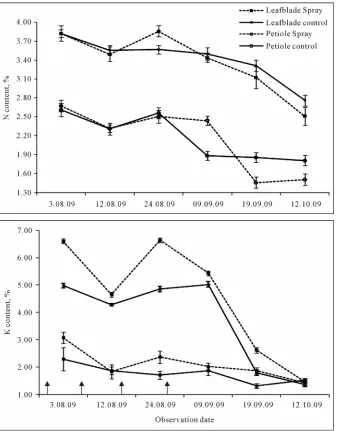
use of N. Consequently, the N content of petioles esti- mated at the time of boll development was exhausted or poor compared to unsprayed control and without basal K. Potassium plays an important role in efficient utilization of N. Bijay-Singh and Yadvinder-Singh [22] observed that with adequate amounts of potassium to crops like rice and wheat, the accumulation of NO3-N in the profile was negligible that suggested greater absorption of N by plants and higher nitrogen use efficiency. Foliar spray of 1% KCl and 1% urea from the jointing stage of both corn and wheat to silking of corn and the full heading stage of wheat increased the N and K content in the plants and stimulated N translocation to the grain [23].
During peak boll formation stage, K content of petiole was higher than the leaf blades (Table 3). Foliar spray significantly increased K content of both petiole and leaves with or without basal K application. Oosterhuis et al. [24] also reported higher K content in petioles of up-
per canopy leaves with combined soil applied and foliar K.
Basal K application significantly increased P content of petioles but had no effect on leaf blade P content. All the foliar fertilizers significantly improved P content of leaf blades but the response was variable for petioles compared to unsprayed control. Increased leaf blade P content with basal K as well as foliar fertilization may be attributed to K induced stimulation of root growth as suggested by Hackett [25], thus, resulting in greater nu- trient uptake.
Table 3. N, P and K content of leaf blade and petiole as affected by soil applied K and foliar fertilizers.
Basal K, kg·ha−1 Basal K, kg·ha−1
Foliar Fertilizers
0 60 Mean 0 60 Mean
% N in leaf blades % N in petioles
Unsprayed control 2.00 ± 0.08 2.03 ± 0.15 2.02 1.98 ± 0.19 0.95 ± 0.27 1.46
KNO3-4 sprays 2.53 ± 0.06 2.28 ± 0.16 2.40 1.20 ± 0.12 1.00 ± 0.14 1.10
KNO3-6 sprays 2.48 ± 0.09 2.31 ± 0.19 2.39 1.18 ± 0.18 0.94 ± 0.18 1.06
NPK blend-4 sprays 2.41 ± 0.08 2.22 ± 0.10 2.32 1.03 ± 0.10 0.99 ± 0.04 1.01
NPK blend-6 sprays 2.45 ± 0.05 2.40 ± 0.17 2.42 1.16 ± 0.40 1.01 ± 0.06 1.09
MOP-4 sprays 2.18 ± 0.03 2.05 ± 0.08 2.12 1.28 ± 0.42 0.89 ± 0.15 1.09
MOP + Urea-4 sprays 2.34 ± 0.08 2.25 ± 0.09 2.29 1.41 ± 0.01 1.00 ± 0.04 1.20
Mean 2.34 2.22 1.32 0.97
Basal K NS 0.140
Spray 0.136 0.245
LSD (0.05)
Interaction NS 0.346
% K in leaf blades % K in petioles
Unsprayed control 0.67 ± 0.08 0.82 ± 0.06 0.74 1.00 ± 0.10 0.97 ± 0.21 0.98
KNO3-4 sprays 0.78 ± 0.06 1.07 ± 0.08 0.93 1.47 ± 0.08 1.63 ± 0.15 1.55
KNO3-6 sprays 0.85 ± 0.09 1.17 ± 0.08 1.01 1.40 ± 0.10 1.50 ± 0.40 1.45
NPK blend-4 sprays 0.80 ± 0.10 0.90 ± 0.05 0.85 1.20 ± 0.10 1.37 ± 0.15 1.28
NPK blend-6 sprays 0.92 ± 0.08 0.97 ± 0.10 0.94 1.50 ± 0.05 1.77 ± 0.15 1.63
MOP-4 sprays 0.98 ± 0.10 1.10 ± 0.09 1.04 1.50 ± 0.10 1.53 ± 0.06 1.52
MOP + Urea-4 sprays 0.83 ± 0.06 1.07 ± 0.13 0.95 1.50 ± 0.10 1.58 ± 0.03 1.54
Mean 0.83 1.01 1.37 1.48
Basal K NS NS
Spray 0.10 0.18
LSD (0.05)
Interaction NS NS
% P in leaf blades % P in petioles
Unsprayed control 0.250 ± 0.001 0.230 ± 0.022 0.240 0.292 ± 0.010 0.292 ± 0.017 0.292
KNO3-4 sprays 0.316 ± 0.018 0.310 ± 0.022 0.313 0.321 ± 0.009 0.324 ± 0.012 0.323
KNO3-6 sprays 0.283 ± 0.014 0.285 ± 0.017 0.284 0.279 ± 0.008 0.281 ± 0.014 0.280
NPK blend-4 sprays 0.278 ± 0.004 0.326 ± 0.014 0.302 0.296 ± 0.023 0.306 ± 0.017 0.301
NPK blend-6 sprays 0.317 ± 0.030 0.358 ± 0.018 0.338 0.308 ± 0.012 0.322 ± 0.024 0.315
MOP-4 sprays 0.304 ± 0.021 0.345 ± 0.012 0.324 0.276 ± 0.016 0.316 ± 0.009 0.296
MOP + Urea-4 sprays 0.267 ± 0.005 0.271 ± 0.008 0.269 0.312 ± 0.023 0.337 ± 0.014 0.325
Mean 0.287 0.304 0.298 0.311
Basal K NS 0.007
Spray 0.021 0.018
LSD (0.05)
Figure 1. Periodic changes in N and K content of cotton leaf parts during boll development. Vertical bars at different data points indicate standard error values (Arrows indicate foliar sprays).
petiole was either the same or higher with foliar spray compared to unsprayed control but sharply decreased after 9th September. Increased boll formation with foliar spray may be the reason for depletion of leaf N.
Our data indicates that petiole accumulated higher concentrations of K (2.8% as in Table 2 and upto 5.8%
in Figure 1) than that required for normal growth and
this could be available for use by the developing bolls. Reports are available that cotton plants continue to ac- cumulate K at rates above that needed to produce maxi- mum yields, with the highest K content occurring in older leaves and petioles [26,27]. However, the luxury storage of K is beneficial and a relatively cheap insur- ance policy against environmental stress [27], although it
may be confusing for researchers to accurately predict the onset of K deficiency from tissue analysis as sug- gested by Bednarz and Oosterhuis [11]. Leffler and Tu- bertini [21] reported an increase in K concentration dur-ing the development of a boll from 19 g·kg−1 at 10 days to 55 g·kg−1 at maturity. An average cotton crop contains about 150 kg·K·ha−1 with about 50% - 65% of the K in the re- productive unit [28-30].
3.2. Seed Cotton Yield
Table 4. Seed cotton yield (q·ha−1) of Bt-RCH 134 as af-
fected by basal K application and foliar feeding with dif- ferent fertilizers.
Basal K, kg·ha−1
Foliar Fertilizers
0 60 Mean
2008
Unsprayed control 13.7 ± 0.82 16.6 ± 0.23 15.2
KNO3-4 sprays 17.7 ± 0.34 19.0 ± 1.27 18.4
KNO3-6 sprays 18.1 ± 1.24 18.6 ± 0.35 18.4
NPK blend-4 sprays 18.8 ± 0.88 20.4 ± 0.38 19.6
NPK blend-6 sprays 18.7 ± 0.21 19.6 ± 1.03 19.2
MOP-4 sprays 16.7 ± 1.38 19.5 ± 0.60 18.1
MOP + Urea-4 sprays 19.3 ± 0.61 19.8 ± 0.89 19.6
Mean 17.6 19.1 18.3
2009
Unsprayed control 14.8 ± 1.35 19.0 ± 0.67 16.3
KNO3-4 sprays 20.3 ± 0.15 24.3 ± 0.70 22.3
KNO3-6 sprays 18.8 ± 0.58 23.0 ± 0.76 20.9
NPK blend-4 sprays 19.6 ± 0.55 22.3 ± 1.60 21.0
NPK blend-6 sprays 18.7 ± 0.37 23.0 ± 1.70 20.9
MOP-4 sprays 14.8 ± 1.15 24.5 ± 0.15 19.7
MOP + Urea-4 sprays 18.4 ± 0.69 24.9 ± 1.91 21.7
Mean 17.9 23.0 20.5
Average of 2008 & 2009
Unsprayed control 14.2 ± 1.16 17.8 ± 1.38 16.0
KNO3-4 sprays 19.0 ± 1.44 21.6 ± 3.04 20.3
KNO3-6 sprays 18.5 ± 0.94 20.8 ± 2.48 19.6
NPK blend-4 sprays 19.2 ±0.78 21.4 ± 1.49 20.3
NPK blend-6 sprays 18.7 ± 0.27 21.3 ± 2.25 20.0
MOP-4 sprays 15.7 ± 1.56 22.0 ± 2.78 18.9
MOP + Urea-4 sprays 18.8 ± 0.78 22.3 ± 3.12 20.6
Mean 17.7 21.0
LSD (0.05) For pooled data
Crop season = 1.13, Basal K = 0.27, Spray = 0.79, Season × basal K = 0.39, Season × spray = 1.12, Basal K × spray = 1.12,
Season × basal K × spray = 1.58
yield improvement with basal K was more during the relatively hot and drier 2009 crop season (509 kg·ha−1) than 2008 (150 kg·ha−1) that may be attributed to protec- tive role of K against environmental stress [27]. Al-
though both the seasons received same amount of total rainfall, but early crop growth period (May-June) during 2009 received less rain and had higher temperature and evaporation (Table 1). Our observation on greater effi- cacy of potassium fertilizer in 2009 is supported by the findings of Fanaeia et al. [31] for oilseed species and
Tohidloo et al. [32] for sugar beet that reported much
higher increase in yield with potassium fertilizer under low available water than well watered treatment. Brar and Brar [33] reported improvement in seed cotton yield with KNO3 spray that ranged from 20% to 50% in dif- ferent seasons. All the foliar spray treatments signifi- cantly increased seed cotton yield compared to unsprayed control with and without basal K application (Table 4). However, increase in yield with MOP was lowest (18%) compared to 27% with KNO3 and NPK blend. Six sprays of KNO3 and NPK blend were at par with 4 sprays. Abaye [34] reported that supplementing potassium by any method increases lint yields but higher lint yield was obtained with the soil applied potassium fertilizers sup- plemented with foliar KNO3 treatments and the yield of plants given only K through spray medium was found not as good as those given additional potassium through soil. Brar and Brar [33] also reported that improvement in seed cotton yield with three mid-season foliar applica- tions at weekly intervals of potassium chloride was the lowest (22%), compared to 27% with urea and 36% with potassium nitrate. Brar et al. [16]reported that foliar ap-
plication of potassium nitrate increased the yield of seed cotton irrespective of the soil status and soil applied potassic fertilizers. Brevandan and Hodges [35] have shown that spray of KNO3 0.5% solution during flower- ing supplied both N and K which were effectively ab- sorbed as anion and cation by plants, delaying the syn-thesis of abscisic acid and promoted cytokinin activity resulting an increase in an chlorophyll content for delay-ing sensecence.
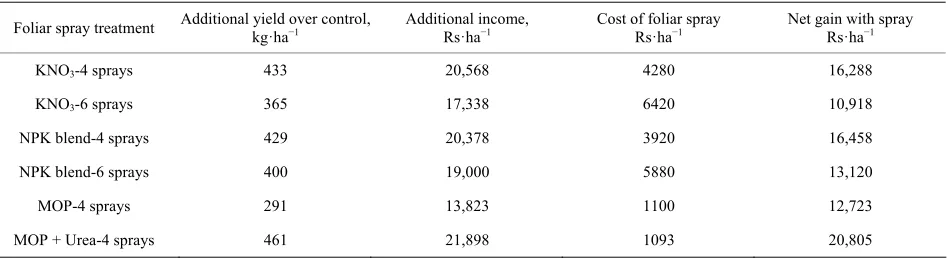
Table 5. Comparative advantages of different foliar fertilizers.
Foliar spray treatment Additional yield over control, kg·ha−1 Additional income, Rs·ha−1 Cost of foliar spray Rs·ha−1 Net gain with spray Rs·ha−1
KNO3-4 sprays 433 20,568 4280 16,288
KNO3-6 sprays 365 17,338 6420 10,918
NPK blend-4 sprays 429 20,378 3920 16,458
NPK blend-6 sprays 400 19,000 5880 13,120
MOP-4 sprays 291 13,823 1100 12,723
MOP + Urea-4 sprays 461 21,898 1093 20,805
Prices: Seed cotton = Rs 4750 per q, Multi-K = Rs 145 per kg, Polyfed = Rs 130 per kg, MOP = Rs 1250 per q, Urea = Rs 537 per q, Labour = Rs 200 ha−1 per
spray.
absorption, especially of K is expected to be more where soil K is higher. Thus, foliar K may be able to increase mining of nutrients by roots in proportion to their level in the soil i.e. more in soil with basal K application and less
without soil K application. Hackett [25] also reported retarded root growth and especially the development of laterals under K deficiency.
[image:8.595.64.538.112.241.2]The economics of different foliar fertilizers is given in Table 5. The cost of six foliar sprays of KNO3 was the highest (Rs 6420/− ha−1) and that of MOP + urea the lowest (Rs 1093/− ha−1). Yield gains and consequently the additional income due to foliar spray were the highest with MOP + urea and minimum with MOP alone. Net gain of rupees 20,805/− per hectare was obtained with the spray of MOP + urea that was nearly 25% more than the other sources. The study suggests that MOP and urea, being easily available, are most suitable and profitable sources of foliar N and K fertilizers for cotton.
Based on this study, it can be concluded that depletion of potassium and nitrogen below the sufficiency range in leaf tissue is responsible for premature senescence com-monly observed in Bt cotton. Soil application of potas-sium as well as foliar spray of fertilizers containing both these nutrients helps to maintain sufficient level of both N and K during boll development resulting in seed cotton yield improvement. Six foliar sprays of NPK blend and KNO3 had no added advantage over the exist- ing prac-tice of four sprays.
REFERENCES
[1] H. S. Bajwa, “Package of Practices for Kharif Crops of Punjab,” Punjab Agricultural University, Ludhiana, 2012, pp. 36-58.
[2] The Cotton Corporation of India Ltd., “Current Cotton Scenario,” 2013
http://cotcorp.gov.in/current-cotton.aspx?pageid=4 [3] R. L. Maples, W. R. Thompson and J. Varvil, “Potassium
Deficiency in Cotton Takes on a New Look,” Better
Crops with Plant Food, Vol. 73, No. 1, 1988, pp. 6-9.
[4] L. K. Stromberg, “Potassium Fertilizer on Cotton,” Cali-fornia Agriculture, Vol. 14, No. 4, 1960, pp. 4-5.
[5] B. L. Weir, T. A. Kerby, B. A. Roberts, D. S. Mikkelsen and R. H. Garber, “Potassium Deficiency Syndrome of Cotton,” California Agriculture, Vol. 40, No. 5-6, 1986,
pp. 13-14.
[6] K. G. Cassman, T. A. Kerby, B. A. Roberts, D. C. Bryant and S. L. Higashi, ”Potassium Nutrition Effects on Lint Yield and Fiber Quality of Acala Cotton,” Crop Science,
Vol. 30, 1990, pp. 672-677.
doi:10.2135/cropsci1990.0011183X003000030039x [7] K. G. Cassman, B. A. Roberts, T. A. Kerby, D. C. Bryant
and D. C. Higashi, “Soil Potassium Balance and Cumula- tive Cotton Response to Annual Potassium Additions on a Vermiculite Soil,” Soil Science Society of America Jour- nal, Vol. 53, 1989, pp. 805-812.
doi:10.2136/sssaj1989.03615995005300030030x
[8] T. J. Gerik, J. E. Morrison and F. W. Chichester, “Effects of Controlled Traffic on Soil Physical Properties and Crop Rooting,” Agronomy Journal, Vol. 79, 1987, pp.
434-438.
doi:10.2134/agronj1987.00021962007900030006x [9] D. M. Oosterhuis, R. G. Hurren, W. N. Miley and R. L.
Maples, “Foliar Fertilization of Cotton with Potassium Nitrate,” Proceedings of Cotton Research Meeting, Uni- versity of Arkansas, Arkansas Agriculture Experiment Station, Special Report, Vol. 149, 1991, pp. 21-25.
[10] J. J. Cappy, “The Rooting Patterns of Soybean and Cotton throughout the Growing Season,” Ph.D. Dissertation, University of Arkansas, Fayetteville, 1979.
[11] C. W. Bednarz and D. M. Oosterhuis, “Partitioning of Potassium in the Cotton Plant during the Development of a Potassium Deficiency,” Journal of Plant Nutrition,Vol.
19, 1996, pp. 1629-1638. doi:10.1080/01904169609365226
July 1998.
http://www.regional.org.au/au/asa/1998/4/153wright.htm [13] M. W. Ebelhar and J. O. Ware, “Summary of Cotton
Yield Response to Foliar Applications of Potassium Nitrate and Urea,” Proceedings of 1998 Beltwide Cotton Production Research Conference, National Cotton Council of America, Memphis,1998, pp. 683-687.
[14] D. M. Oosterhuis, “Potassium Nutrition of Cotton with Emphasis on Foliar Fertilization,” In: C. A. Constable and N. W. Forrester, Eds., Challenging the Future, Proceed-ings World Cotton Research Conference, CSIRO, 1995,
pp. 133-146.
[15] B. L. Weir, T. A. Kerby, K. D. Hake, B. A. Roberts and L. J. Zelinski, “Cotton Fertility,” In:S. J. Hake, T. A. Kerby, and K. D. Hake, Eds., Cotton Production Manual,
Divi-sion of Agricultural and Natural Resource, University of California, Oakland, 1996, pp. 210-227.
[16] M. S. Brar, M. S. Gill, K. S. Sekhon, B. S. Sidhu, P. Sharma and A. Singh, “Effect of Soil and Foliar Applica- tion of Nutrients on Yield and Nutrient Concentration in Bt Cotton,” Journal of Research, Punjab Agricultural University,Vol. 45,2008, pp. 126-31.
[17] M. L. Jackson, “Soil Chemical Analysis,” Prentice Hall of India, New Delhi, 1967.
[18] R. O. Miller, “Nitric-Perchloric Wet Acid Digestion in an Open Vessel,” In: Y. P. Kalra, Ed., Handbook of Refer- ence Methods for Plant Analysis, CRC Press, Washington
DC, 1998, pp. 57-62.
[19] V. G. Panse and P. V. Sukhatme, “Statistical Methods for Agricultural Workers,” 2nd Edition, Indian Council of Agricultural Research, New Delhi, 1967.
[20] C. C. Mitchell and W. H. Baker, “Reference Sufficiency Ranges for Field Crops—Cotton,” Southern Cooper- ative Series Bulletin, 2000,pp. 15-18.
www.ncagr.gov/agronomi/saaesd/scsb394.pdf
[21] H. R. Leffler and B. S. Tubertini, “Development of Cot- ton Fruit II. Accumulation and Distribution of Mineral Nutrients,” Agronomy Journal,Vol. 68, No. 6, 1976, pp.
858-861.
doi:10.2134/agronj1976.00021962006800060006x [22] Bijay-Singh and Yadvinder-Singh, “Potassiumim Bal-
ances and Sustainability of the Rice-Wheat Cropping System in South Asia,” In: D. K. Benbi, M. S. Brar and S. K. Bansal, Eds., Balanced Fertilization for Sustaining Crop Productivity,International Potash Institute, Horgen,
2006, pp. 157-177.
[23] G. H. Xu, Q. R. Shen, W. J. Zhen, S. H. Tan and R. H. Shi, “Biological Responses to Foliar Feeding of Macro Element Fertilizers during Middle-Later Stages of Wheat and Corn,” Acta Pedologica Sinica, Vol. 36, 1999, pp.
454-462.
[24] D. M. Oosterhuis, S. D. Wullschleger, R. L. Maples and W. N. Miley, “Foliar Feeding of Potassium Nitrate in Cotton,” Better Crops with Plant Food, Vol. 74 No. 3,
1990, pp. 8-9.
[25] C. Hackett, “A Study of Root System of Barley I Effect of Nutrition on Two Varieties,” New phytologist, Vol. 67,
No. 2, 1968, pp. 287-300.
doi:10.1111/j.1469-8137.1968.tb06384.x
[26] O. L. Bennett, R. D. Rouse, D. A. Ashley and B. D. Doss, “Yield, Fiber Quality and Potassium Content of Irrigated Cotton Plants as Affected by Rates of Potassium,” Agron- omy Journal, Vol. 57, No. 3, 1965, pp. 296-299.
doi:10.2134/agronj1965.00021962005700030024x [27] U. Kafkafi, “The Functions of Plant K in Overcoming
Environmental Stress Situations,” Proceedings 22nd Col- loquium, International Potash Institute, Bern, 1990, pp.
81-93.
[28] S. C. Hodges, “Nutrient Deficiency Disorders,” In: R. Hillocks, Ed., Cotton Diseases, CAB International, Wal-
lingford, 1992, pp. 355-403.
[29] G. L. Mullins and C. H. Burmester, “Dry Matter, Nitro- gen, Phosphorus, and Potassium Accumulation by Four Cotton Varieties,” Agronomy Journal, Vol. 82, No. 4,
1991, pp. 729-736.
doi:10.2134/agronj1990.00021962008200040017x [30] D. Rimon, “Functions of Potassium in Improving Fiber
Quality Of Cotton,” Methods of Potassium Research in Plants, Proceedings 21st Colloquium, Potash and
Phos-phate Institute, 1989, pp. 319-323.
[31] H. R. Fanaeia, M. Galavia, M. Kafib and A. Ghanbari Bonjara, “Amelioration of Water Stress by Potassium Fertilizer in Two Oilseed Species,” International Journal of Plant Production,Vol. 3, No. 2, 2009, pp. 41-54.
[32] G. Tohidloo, M. A. Chegin and S. Ghalebi, “Evaluation of Interaction between Different Levels of Potassium and Water on Sugar Yield of Sugar Beet,” 2nd International Conference on Environmental and Agriculture Engineer- ing, IPCBEE, IACSIT Press, Singapore City, Vol. 37,
2012, pp. 114-120,
[33] M. S. Brar and A. S. Brar, “Foliar Nutrition as a Supple- ment to Soil Fertilizer Application to Increase Yield of Upland Cotton (Gossypium hirsutum),” Indian Journal of Agricultural Science, Vol. 74, No. 8, 2004, pp. 472-475. [34] A. Abaye Ozzie, “Effect of Method and Time of
Potas-sium Application on Cotton Lint Yield,” Better Crops,
Vol. 82, No. 2, 1998, pp. 25-27.
[35] E. R. Brevadan and M. A. Hodges, “Effect of Moisture Deficit on 14C Translocation in Corn (
Zea mays L.),” Plant Physiology,Vol. 52, No. 5, 1973, pp. 436-439.
doi:10.1104/pp.52.5.436
[36] J. Keino, C. A. Beyrouty and D. M, Oosterhuis, “Differ- ential Uptake of Potassium by Plant Roots,” In: D. M. Oosterhuis and G. Berkowitz, Eds., Frontiers in Potas- sium Nutrition: New Perspectives on the Effects of Potas- sium on Crop Plant physiology, Potash and Phosphate In-