Ljiljana Skrba, Simon Dobbyn, Rachel McDonnell and Carol O’Sullivan
Interaction, Simulation and Graphics Lab. Trinity College Dublin
Abstract
This paper describes ongoing work on a system to animate and render large flocks of furry or woolly animals. An outside agent, the sheepdog, tries to control another group of agents (a flock of sheep) that observe two rules of flocking: cohesion and separation. We also describe our efforts to create realistic animations for the dog and sheep, using insights from animal gait studies, along with our system to render the large woolly flock in realtime using multi-view impostors with color variation.
Categories and Subject Descriptors(according to ACM CCS): I.3.3 [Computer Graphics]:
1. Introduction
Shepherding and flocking research has long been a popular topic in computer graphics, robotics and computer games. Many papers have been published which discuss different aspects of herding and flocking but very often simple prim-itives, such as spheres or triangles, are used to represent the different agents in the flock. One reason for this is that ani-mating four-legged animals can be very challenging. While motion capture has been used for some animals, in particular horses, it is difficult to accurately capture the natural gait of others, such as sheep or dogs. While improved tools are now available for animating quadropeds, it is still very difficult to find good motion data for specific animals. Furthermore, the real-time rendering of large flocks or herds of animals is a challenge. While good progress has been made in the real-time rendering of crowds of humans or herds of skinned an-imals, to our knowledge there are currently no systems that allow for real-time rendering of large realistic herds of furry or woolly animals.
In this paper, we present ongoing work and recent results from our system to animate a realistic herd of woolly sheep, that is shepherded by one or more furry dogs. We use in-sights from animal gait studies to animate the 3D models of a dog and a sheep. Then, the sheep are cloned using impostors in order to implement a more life-like flock of sheep than in previous systems. Furthermore, we implement various be-haviours for the dog and the sheep. Some of the more evident observations seen in nature involve sheep turning away from the dog as it approaches, and the dog moving with much
greater speed than the sheep. To achieve this in our system, the dog uses a galloping gait while the sheep display a walk.
2. Motivation and Background
The intermediate aim of this project is to create an interactive sheep herding environment similar to that depicted in Blum-berg et al’s "Sheepdog Trial" installation [DTB02], where users can call out commands (such as: down, sit, come, away and steady) into a microphone. An on-screen dog model re-sponds to these commands and in turn is able to herd the sheep. The animations and the behaviours are simple, how-ever, so we wish to build a system with more detailed ani-mations and more complex behaviours, using large flocks to portray a more realistic world. Research into the realistic an-imation of four-legged animals has tended to concentrate on the rendering and animation of individual creatures, without regard to the behavioural simulation. Therefore, our ultimate aim is to develop an integrated framework for the behaviour simulation, animation and real-time rendering of large herds of furry and woolly animals, beginning with the sheep sce-nario described in this paper. In this section, we will provide an overview of important work to date.
Figure 1:Several frames of our sheepdog animation
by isolating a few elementary rules that each agent obeys, in particular motivated by the opposing desires to both stay close together and to avoid collisions. Individual behaviours such as cohesion, separation, pursuit, evasion and obstacle avoidance can thus be simulated to produce quite complex patterns of behaviour. However these bahaviours are repre-sented by simple geometrical objects. Our aim is to apply the characteristic flock behaviours to a large number of detailed furry and woolly animals in order to portray a more realistic environment.
Lien et al. [LBS∗04,LRMA04] addressed the problem of shepherding flocks. A key rule is that a sheep reacts to a dog by moving away from it. The shepherd’s movements are broken down into approaching and steering: To move the flock the shepherd moves to steering points which are located near the flock - the approaching stage. Then it needs to be able to steer the flock towards a target in the most ef-ficient way possible. A variety of movements are combined and tested to form different shepherding behaviours; herd-ing (steerherd-ing flock from start position to goal position), cov-ering (flock guided to visit all positions in an environment), patrolling (preventing the flock from entering a forbidden area) and collecting (gathering a scattered flock). This work concentrates on implementing optimised shepherding ba-haviours, while the ”sheep“ observe the fundamental flock-ing bahaviours mentioned above. Once again the animals in this paper do not accurately resemble those in real life. How-ever, this paper provides important insights into the various shepherding techniques which we can apply to our more re-alistic looking dog model.
Other related work relates to robot control of flocks of an-imals [VSH∗98], where a robot system was built to exploit and control animals’ behaviour to achieve herding of flocks of living ducks. The algorithms used to simulate shepherd-ing and flockshepherd-ing behaviour in this virtual system are similar to those explained by Reynolds. Brogan et al. [BMH98] also simulate a Border collie environment populated by a small group of hopping one-legged robots, in which the user acts as the shepherd and herds the robots into a corral. While nu-merous works exist on simulating flocking and shepherding enviroments, none of them combine realistic representations of animals with their chracteristic behavours. That is the aim of this project.
In terms of animating the individuals in a flock, motion
capture can provide us with large amounts of detailed data that can be used to replicate human or animal behaviour. However, reliable data from animal motion capture is hard to find. One drawback is that attaching equipment to animals in order to track their movement can be very difficult. Their limbs are much smaller than a human’s so tracker placement is a challenge. Also, it is very hard to create a realistic en-vironment in a laboratory setting. This means that an animal will not behave as it does in its natural environment - walk-ing on grass is different to walkwalk-ing on a treadmill, result-ing in uncharacteristic motion. Thus, in animal biomechan-ical studies, force plates are often used instead to track the force exerted by particular limbs in animals such as dogs or sheep. In this way it can be determined which are the weight bearing legs, for example in dogs the front legs act as the main support for body weight (ribs, head, etc all rests on the front legs) while the back legs are used as the pushing force [NB85].
Favreau et al. [FRDC04] take a live video sequence such as wild life documentaries, and segment the video into bi-nary images on which Principal Component Analysis (PCA) is applied. Then the time varying co-ordinates of the im-ages in the PCA space are used to generate 3d animation. This is done through interpolation with Radial Basis Func-tions (RBF) of 3d pose examples associated with a small set of key images extracted from the video. Wilhems and Van Gelder [WG97] animated animals using accurate models of bones, muscles and tissues, while Reveret et al. [RFDC05] developed an intuitive method of morphing quadroped skele-tons using only a few parameters, and were thus able to cre-ate a skeleton for an animal that was not in the initial (expert modelled) database. James and Twigg [JT05] were able to simulate a large herd of skinned animals (horses, camels and elephants) at interactive frame rates (2.1hz), by reducing the degrees of freedom of the mesh animations. In the future, we may use similar methods to improve the quality and va-riety of animations used in our system. However, to start, we needed quality animation clips for our sheep and dogs.
Finally, to render most animals realistically, the addition of fur or wool is vital. This can be seen in movie spe-cial effects such as the wolf pack in "Polar Express" or the woolly mammoths in the "Ice Age" movies. The fur modi-fiers in commercial modelling programs such as 3DSMaxTM and MayaTM
real-time would slow down and even cripple many systems. In research, methods for fur rendering have been developed, see [KK89,Gol97,LPFH01], but to date it has not feasible to simulate the fur or hair of large numbers of animals in real-time.
3. Sheep and Dog Simulation
Nunamaker and Blauner [NB85] provide simplified cartoon strips of various gaits used by a dog which are easy to fol-low for animation purposes. We used the details in this book to animate our border collie. Dog gaits are divided into two groups: symmetric such as the walk, trot or pace, and asym-metric such as the gallop. At any one time a dog has never fewer than two feet on the ground during the walk cycle. The contact time between the foot and the ground is proportional to the leg length. For long-legged dogs the contact time is longer than for a short-legged dog. The head movement is related to the impact of the front legs with the ground. When the legs are placed down for the support phase of the stride there is a downward movement of the head. Once the legs are lifted for the next step the head goes up. During the walk cycle the head bobs up and down twice. The tail moves to-wards the limb striking the ground while the spine moves lat-erally away from it. The horizontal movement of the pelvis allows for a bigger swing of the back leg, thus lengthening the stride.
An example of an asymmetric gait is the gallop where all parts of the body are used in the movement - we have also animated this gait for our sheepdog, and it will be the next movement to be integrated into the system. For the legs, the duration of the standing position decreases and the duration of the swing increases. A suspension phase occurs after the leading front leg pushes off the ground. The longer the stride the faster the dog moves. Increases in the movement of head and neck aid the speed obtained during a gallop. There is a large downward swing when the front legs reach forward and an upward movement as the back legs come under the body for foot placement. Finally the gallop also uses the muscles of the trunk, hence the arching and extension of the back, as seen in greyhound racing. Several frames of our sheepdog gallop animation are shown in Figure1.
The four-legged sheep has obvious similarities with the dog model. As in the dog’s walk the diagonal pairs move almost simultaneously for the sheep. However, a sheep that uses the same walking animation as a dog looks completely unnatural. Its legs should not move in a pendulum like man-ner as with a dog. The swing of a sheep’s legs happens quickly and is much more restricted so that the support phase lasts as long as possible. Another noticeable difference is
reach forward and recline for the next step. The tail, which is very short, flaps as a result of the overall movement of the body. When a faster movement is needed the legs move more quickly, thus reducing the time they spend in contact with the ground. Some frames of our sheep animation can be seen in Figure2(bottom).
There are various differences between the dog and sheep models we used in our system. Sheep have restricted move-ment so the biped skeleton is not as complex as the one used for the dog. In terms of rendering, sheepdogs have fur that is short and smooth around the face, ears and fronts of legs, becoming long and feathered at the chest, haunches, forelegs, underside and tail. Sheep wool generally tends to be curly and clumpy which makes it difficult to model. The quality of fur is further compromised by the time it takes to render each frame of animation. We acquired two commer-cial (mesh only) models for our sheep and dog, then rigged them, modelled their fur/wool, animated and rendered them in 3DSMax.
Figure 2:Frames from real video footage of a walking sheep (top) and animation of a sheep’s walk (bottom)
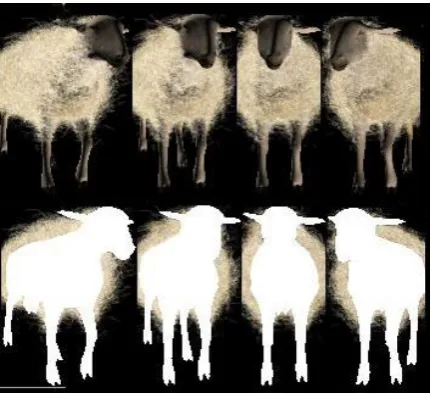
Figure 3:Impostor Sheep and Corresponding Alpha Values
4. Sheep and Dog behaviour
In order to be able to determine the behaviour of each ani-mal, its position needs to be tracked in relation to every other animal in the flock. This is done by using the Sweep and Prune technique [CLDP95]. Since we are dealing with land animals we only need to deal with their position relative to the x and z axes. The positions of each animal are sorted into an x array and a z array, in increasing order. In this it is possible to rapidly detect which sheep are close together. Using these lists also helps to keep the view of the flock lo-calised for each sheep. This is important as all the animals tend to be around the same height so that their view is lim-ited. Therefore it should not be possible for each sheep to know, for example, the size of the flock, nor the location of every sheep within that flock. Due to the slow movement of sheep, their positions change only slightly from frame to
frame. This means that at each simulation time-step, the x and z arrays can be sorted efficiently using insertion sort (which exhibits almost linear time complexity for almost-sorted lists). Each time two sheep need to be swapped in the arrays, due to their relative positions changing, collision detection is triggered for those sheep only. This allows for separationbehaviour to be achieved. A similar technique is used to detect whether sheep need to exhibitcohesion, as described below.
Cohesion and separation are the two fundamental be-haviours that have been implemented to date. Once collision detection is triggered, bounding spheres are used to separate the sheep, who then turn away from each other. Currently we are working on improving this process, as there are some jerky movements when the angle is large and the sheep turn suddenly to avoid impact. When the angle is small, the sheep can often intersect each other. Cohesion stops the sheep get-ting too far away from each other, thus leading to the forma-tion of many clusters of sheep which are close to each other. Since the position of the sheep is contantly changing it is possible to leave one cluster and join another, while wan-dering sheep are also able to come together to form a new cluster.
[image:4.595.72.288.271.468.2]If the dog is too close to a sheep, then that sheep avoids col-lisions by speeding up and turning away. The dog maintains his dominance over the sheep by keeping on their trail and making them turn away from him, as seen in nature. Since the speed of the dog is much faster than that of the sheep, the bounding sphere used for the dog may be much larger than its actual size. This means that the sheep can detect the presence of the dog well in advance and have enough time to move out of its way. Another shepherding behaviour that we are currently working on is herding sheep towards a tar-get while directing straying sheep towards the flock. Sheep who are located between the dog and the target turn away from the dog and thus move towards the target. Due to cohe-sion, this prompts other sheep to turn towards the target too. Two events need to happen in order to control the flock ef-fectively in the case where a flock of sheep is walking away from a target:
• it is necessary for a few sheep to turn away from the dog, and
• they need to turn by a large enough angle.
Both of these conditions are needed in order to influence the rest of the flock to follow. A number of sheep need to be influenced by the dog since, just one sheep alone will be overcome by the combined rules of the rest of the flock. If the angleawayfrom the dog is too small, the sheep will use cohesion to face the same direction as the rest of the flock, which will direct them away from the target once again. Therefore, a compromise needs to be reached whereby the angle away from the dog is biased in such a way that it will make up for the angles generated due to cohesion. An-other constraint is that the calculated angles need to be small enough in order to result in smooth turning motions for the sheep.
[image:5.595.311.527.80.279.2]To ensure that the dog stays on the outside perimeter of the flock, he first goes after the sheep which is furthest away from the target. This information can easily be retrieved by using the sweep and prune arrays. The dog can now move in a zig-zag motion perpendicular to the rest of the flock, which directs it towards the target. A Bezier curve is used to model the path along which the dog travels. The control points used are the positions of the sheep found along the perimeter of the flock. These control points are adjusted to ensure that the curve goes around the flock and not through it, thus prevent-ing the dog from disturbprevent-ing or splittprevent-ing the flock. In the case where one sheep has strayed out far from the flock, the con-trol points for the Bezier curve are constrained in such a way that the dog is able to focus on getting that sheep back to-wards the flock as quickly as possible. This is also used in the cases where isloated sheep are grazing. Once they sense the
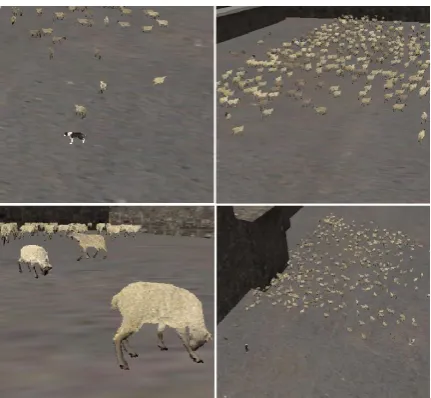
Figure 5:Several screenshots of our flocking application
dog coming (using the sweep and prune arrays), they start moving towards the target. Some recent results are shown in Figures5and6.
5. Future Work
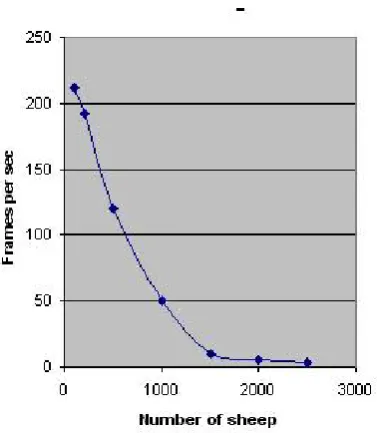
We have presented a framework that will allow us to animate large herds of woolly or furry animals. Up to 2000 sheep can be rendering in real-time using 32-viewpoint impostors. Sev-eral basic behaviours have been included and tested (separa-tion, cohesion, grazing, herding and targeting) and initial re-sults are promising - natural emergent behaviour of the sheep is observed - although some artefacts such as jerky motion and sheep-sheep interpenetration need to be resolved. We also plan to optimise collision detection by only processing animals which are close to the camera and/or the dog. This would be particularly useful in the case where the camera is positioned on the ground level so that only the animals in the first few rows are visible, depending on how the flock moves. Other ways of dealing with collision is to stop one sheep in its tracks so that the other one can pass by it. This means that the jerky movement will be reduced since the angle of the sheep is not being changed by any significant amount. An-other important challenge is to introduce dynamic lighting for the impostors, which will involve creating normal maps for fur and wool. Furthermore, reducing the size of the tex-tures currently used can result in higher framerates and the inclusion of more animations, therefore greatly improving the overall realism.
References
Com-Figure 4:Some viewpoints of the Dog Impostor from groundlevel camera
Figure 6:Rendering times for the flocks of sheep
puter Graphics and Applications 15, 5 (1998), 58–69. [CLDP95] COHENJ., LINM., D.MANOCHA, PONAMGIM. K.:
I-collide: An interactive and exact collision detection system for large-scale environments. InSymposium on Interactive 3D Graphics(1995), pp. 189–196.
[DHOO05] DOBBYN S., HAMILL J., O’CONOR K., O’SULLIVAN C.: Geopostors: a real-time geometry / im-postor crowd rendering system. InProc. Symp. on Interactive 3D graphics and games (SI3D)(2005), pp. 95–102.
[image:6.595.79.268.186.403.2][DTB02] DOWNIEM., TOMLINSONB., BLUMBERGB.: Devel-oping an aesthetic: character-based interactive installations. SIG-GRAPH Comp. Graph. 36, 2 (2002), 33–36.
[FRDC04] FAVREAUL., REVERETL., DEPRAZC., CANI M.-P.: Animal gaits from video. InACM SIGGRAPH/Eurographics Symp. on Comp. Animation(2004).
[Gol97] GOLDMAND. B.: Fake fur rendering. InProc. SIG-GRAPH ’97(1997), pp. 127–134.
[HB94] HODGINSJ. K., BROGAND.: Robot herds: Group be-haviors for systems with significant dynamics. InProc. Artificial Life IV(1994), pp. 319–324.
[JT05] JAMESD. L., TWIGGC. D.: Skinning mesh animations.
ACM Trans. Graph. 24, 3 (2005), 399–407.
[KK89] KAJIYAJ. T., KAYT. L.: Rendering fur with three di-mensional textures. InProc. SIGGRAPH ’89(1989), pp. 271– 280.
[LBS∗04] LIEN J.-M., BAYAZIT O. B., SOWELLR. T., RO-DRIGUEZS., AMATON. M.: Shepherding behaviours. InProc. IEEE Int. Conf. Robot. Autom.(2004), pp. 4159–4164. [LPFH01] LENGYELJ., PRAUN E., FINKELSTEINA., HOPPE
H.: Real-time fur over arbitrary surfaces. InSymp. on Interactive 3D graphics (SI3D)(2001), pp. 227–232.
[LRMA04] LIENJ.-M., RODRIGUEZS., MALRICJ.-P., AMATO N. M.: Shepherding behaviours with multiple shepherds, 2004. [NB85] NUNAMAKERD. M., BLAUNERP. D.:Normal and
Ab-normal Gait (Ch.91). 1985.
[Rey87] REYNOLDS C. W.: Flocks, herds and schools: A dis-tributed behavioral model. InProc. SIGGRAPH(1987), pp. 25– 34.
[Rey99] REYNOLDSC. W.: Steering behaviors for autonomous characters. InProc. Game Developers Conf.(1999), pp. 763– 782.
[RFDC05] REVERETL., FAVREAUL., DEPRAZC., CANI M.-P.: Morphable model of quadrupeds skeletons for animating 3d animals. InACM SIGGRAPH/Eurographics Symp. on Comp. An-imation(2005), pp. 135–142.
[TT94] TUX., TERZOPOULOSD.: Artificial fishes: Physics, lo-comotion, perception, behavior. InProc. SIGGRAPH’94(1994). [VSH∗98] VAUGHANR., SUMPTERN., HENDERSONJ., FROST A., CAMERONS.: Robot control of animal flocks. InIEEE Conf. on the Science and Technology of Intelligent Systems(1998). [WG97] WILHELMSJ., GELDER A. V.: Anatomically based