Classifying Lexical-semantic Relationships by Exploiting Sense/Concept
Representations
Kentaro Kanada, Tetsunori Kobayashi and Yoshihiko Hayashi
Waseda University, Japan
[email protected] [email protected]
Abstract
This paper proposes a method for classi-fying the type of lexical-semantic relation between a given pair of words. Given an inventory of target relationships, this task can be seen as a multi-class classification problem. We train a supervised classi-fier by assuming that a specific type of lexical-semantic relation between a pair of words would be signaled by a carefully de-signed set of relation-specific similarities between the words. These similarities are computed by exploiting “sense represen-tations” (sense/concept embeddings). The experimental results show that the pro-posed method clearly outperforms an ex-isting state-of-the-art method that does not utilize sense/concept embeddings, thereby demonstrating the effectiveness of the sense representations.
1 Introduction
Given a pair of words, classifying the type of lexical-semantic relation that could hold between them may have a range of applications. In particu-lar, discovering typed lexical-semantic relation in-stances is vital in building a new lexical-semantic resource, as well as for populating an existing lexical-semantic resource. As argued in (Boyd-Graber et al., 2006), even Princeton WordNet (henceforth PWN) (Miller, 1995) is noted for its sparsity of useful internal lexical-semantic rela-tions. A distributional thesaurus (Weeds et al., 2014), usually built with an automatic method such as that described in (Rychl´y and Kilgar-riff, 2007), often comprises a disorganized seman-tic network internally, where a variety of lexical-semantic relations are incorporated without having proper relation labels attached. These issues could
be addressed if an accurate method for classifying the type of lexical-semantic relation is available.
A number of research studies on the classifi-cation of lexical-semantic relationships have been conducted. Among them, Necsules¸cu et al. (2015) recently presented two classification methods that utilize word-level feature representations includ-ing word embeddinclud-ing vectors. Although the re-ported results are superior to the compared sys-tems, neither of the proposed methods exploited “sense representations,” which are described asthe fine-grained representations of word senses, con-cepts, and entitiesin the description of this work-shop1.
Motivated by the above-described issues and previous work, this paper proposes a supervised classification method that exploits sense represen-tations, and discusses their utilities in the lexical relation classification task. The major rationales behind the proposed method are: (1) a specific type of lexical-semantic relation between a pair of words would be indicated by a carefully designed set of relation-specific similarities associated with the words; and (2) the similarities could be ef-fectively computed by exploiting sense represen-tations.
More specifically, for each word in the pair, we first collect relevant sets of sense/concept nodes (node sets) from an existing lexical-semantic re-source (PWN), and then compute similarities for some designated pairs of node sets, where each node is represented by an embedding vector de-pending on its type (sense/concept). In terms of its design, each node set pair is constructed such that it is associated with a specific type of lexical-semantic relation. The resulting ar-ray of similarities, along with the underlying word/sense/concept embedding vectors is finally
1https://sites.google.com/site/
senseworkshop2017/background
fed into the classifier as features.
The empirical results that use the BLESS dataset (Baroni and Lenci, 2011) demonstrate that our method clearly outperformed existing state-of-the-art methods (Necsules¸cu et al., 2015) that did not employ sense/concept embeddings, confirm-ing that properly combinconfirm-ing the similarity features also with the underlying semantic/conceptual-level embeddings is indeed effective. These re-sults in turn highlight the utility of “the sense rep-resentations” (the sense/concept embeddings) cre-ated by the existing system referred to as AutoEx-tend (Rothe and Sch¨utze, 2015).
The remainder of the paper first reviews related work (section 2), and then presents our approach (section 3). As our experiments (section 4) uti-lize the BLESS dataset, the experimental results are directly compared with that of (Necsules¸cu et al., 2015) (section 5). Although our methods were proved to be superior through the experi-ments, our operational requirement (sense/concept embeddings should be created from the underly-ing lexical-semantic resource) could be problem-atic especially when having to process unknown
words. We conclude the present paper by dis-cussing future work to address this issue (section 6).
2 Related work
A lexical-semantic relationship is a fundamental relationship that plays an important role in many NLP applications. A number of research efforts have been devoted to developing an automated and accurate method to type the relationship between an arbitrary pair of words. Most of these stud-ies (Fu et al., 2014; Kiela et al., 2015; Shwartz et al., 2016), however, concentrated on the hyper-nymy relation, since it is the most fundamental relationship that forms the core taxonomic struc-ture in a lexical-semantic resource. In compari-son, fewer studies considered a broader range of lexical-semantic relations, e.g., (Necsules¸cu et al., 2015) and our present work.
Lenci and Benotto (2012), among the hypernymy-centered researches, compared existing directional similarity measures (Kotler-man et al., 2010) to identify hypernyms, and proposed a new measure that slightly modified an existing measure. The rationale behind their work is: as hypernymy is a prominent asymmetric semantic relation, it might be detected by the
higher similarity score yielded by an asymmetric similarity measure. Their idea of exploiting a specific type of similarity to detect a specific type of lexical-semantic relationship is highly feasible. Recently, distributional and distributed word representations (word embeddings) have been widely utilized, partly because the offset vec-tor simply brought about by vecvec-tor subtraction over word embeddings can capture some tional aspects including a lexical-semantic rela-tionship. Given these useful resources, Weeds et al. (2014) presented a supervised classification ap-proach that employs a pair of distributional vec-tors for a given word pair as the feature, argu-ing that concatenation and subtraction were al-most equally effective vector operations. Simi-lar lines of work were presented by (Necsules¸cu et al., 2015) and (Vylomova et al., 2016): the former suggested concatenation might be slightly superior to subtraction, whereas the latter espe-cially highlighted the subtraction. Here it should be noted that Necsules¸cu et al. (2015) employed two kinds of vectors: one is a CBOW-based vec-tor (Mikolov et al., 2013b), and the other involves word embeddings with a dependency-based skip-gram model (Levy and Goldberg, 2014).
The present work exploits semantic/conceptual-level embeddings, which were actually derived by applying the AutoExtend (Rothe and Sch¨utze, 2015) system. Among the recent proposals for deriving semantic/conceptual-level embed-dings (Huang et al., 2012; Pennington et al., 2014; Neelakantan et al., 2014; Iacobacci et al., 2015), we adopt the AutoExtend system, since it ele-gantly exploits the network structure provided by an underlying semantic resource, and naturally consumes existing word embeddings. More im-portantly, the underlying word embeddings are di-rectly comparable with the derived sense represen-tations. In the present work, we applied the Au-toExtend system to the Word2Vec CBOW embed-dings (Mikolov et al., 2013b) by referring to PWN version 3.0 as the underlying lexical-semantic re-source. As far as the authors know, AutoExtend-derived embeddings have been evaluated in the tasks of similarity measurements and word sense disambiguation: they are yet to be applied to a se-mantic relation classification task.
rela-. rela-. rela-.
alligator1
alligator
alligator2
. . .
alligator.n.01 alligator.n.02 leather.n.01 crocodilian_reptile.n.01
reptile1
reptile reptile.n.01
word
sense
concept
. . .
hypernym
Lalligator L
reptile
node set pair
Salligator S
reptile
[image:3.595.114.479.75.253.2]Salligator hyper
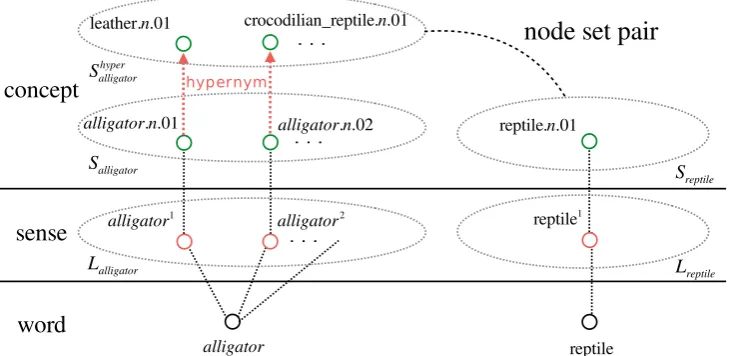
Figure 1: Creating node sets and node set pairs (inhypernymyrelation).
tion classification tasks. We utilized the BLESS dataset (Baroni and Lenci, 2011) in order to di-rectly compare our proposed method with the re-lated methods given in (Necsules¸cu et al., 2015).
3 Proposed method
We adopt a supervised learning approach for clas-sifying the type of semantic relationship between a pair of words(w1, w2), expecting that the plau-sibility of a specific semantic lexical-relationship can be measured by the similarity between the senses/concepts associated with each of the words. Figure 1 exemplifies the fundamental rationale behind the proposed method. We assume that the plausibility of thehypernymyrelation between “al-ligator” (w1) and “reptile” (w2) can be mainly measured by the similarity between the set of hy-pernym concepts of “alligator” (Swhyper1 ) and the set of concepts of “reptile” (Sw2). Based on this assumption, we calculate the similarities by the following steps. Recall that these similarities are assumed to measure the plausibilities of relation-ships that could hold between a given word pair.
1. Collect pre-defined types of node sets for each word (five types; detailed in section 3.1).
2. Build some useful pairs of node sets by con-sidering the possible relationships assumed to be held between the words (7 pair types; de-tailed in section 3.2).
3. Calculate the similarities for each node set pair by three types of calculation methods (detailed in section 3.3).
In total we calculate 21 (7 pairs × 3 meth-ods) similarities per word pair along with the co-sine similarity between word embeddings. We use these similarities and vector pairs that yielded the similarities as feature.
3.1 Collecting node sets for each word
By consulting PWN, we collect the following five types of node sets for each word. These node set types are selected so as to characterize relevant lexical-semantic relationships in the target inven-tory detailed in section 4.1.
• Lw: a set of senses that a wordwhas
• Sw: a set of concepts each denoted by a
mem-ber ofLw
• Swhyper: a set of concepts whose member is
directly linked from a member ofSw by the
PWNhypernymyrelation
• Sattri
w : a set of concepts whose member is
directly linked from a member ofSw by the
PWNattributerelation
• Smero
w : a set of concepts whose member is
directly linked from a member ofSw by the
3.2 Building node set pairs
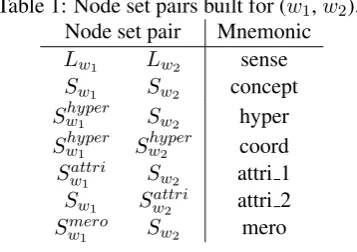
[image:4.595.90.269.162.288.2]Given a pair of words (w1, w2), we build seven types of node set pairs as shown in Table 1. Each row in the table defines the combination of node sets and presents the associated mnemonic.
Table 1: Node set pairs built for (w1,w2). Node set pair Mnemonic Lw1 Lw2 sense Sw1 Sw2 concept
Swhyper1 Sw2 hyper
Swhyper1 Swhyper2 coord
Sattri
w1 Sw2 attri 1
Sw1 Swattri2 attri 2
Smero
w1 Sw2 mero
These types of node set pairs are defined in ex-pecting that:
• sense, concept: captures semantic similar-ity/relatedness between the words;
• hyper: captureshypernymyrelation between the words;
• coord: dictates if the words share a common hypernym;
• attri 1, attri 2: dictates ifw1 describes some aspect ofw2(attri 1) or vice versa (attri 2);
• mero: captures the meronymy relation be-tween the words.
Note that the italicized words indicate lexical relationships often used in linguistic literature.
3.3 Similarity calculation
In a pair of node sets, each node set could have a different number of elements, meaning that we cannot apply element-wise computation (e.g., co-sine) for measuring the similarity between the node sets. We thus propose the following three similarity calculation methods and compare them in the experiments.
In the following formulations:cindicates a cer-tain node set pair type defined in Table 1; (Xw1, Xw2) is the node set pair for (w1, w2) specified byc; andsim(x~1, ~x2)is the cosine similarity be-tweenx~1andx~2.
simc
maxmethod:
simcmax(w1, w2) =x max
1∈Xw1,x2∈Xw2sim(x~1, ~x2)
(1) As the formula defines, this method selects a com-bination of the node sets that yield the maximum similarity, implying that it achieves a disambigua-tion funcdisambigua-tionality.
The vector pair from the most similar node sets (x~1,x~2) is also used as feature. The actual usage of this pair in the experiments is detailed in section 4.2.
simc
summethod:
simcsum(w1, w2) =sim(
X
x1∈Xw1
~ x1,
X
x2∈Xw2
~ x2)
(2) As defined by the formula, this method firstly makes a holistic meaning representation by sum-ming all embeddings of the nodes contained in each node set. We devised this method with the expectation that it could dictatesemantic related-ness rather than semantic similarity (Budanitsky and Hirst, 2006). The pair of the summed embed-dings (Px1∈Xw
1x~1,
P
x2∈Xw2 x~2) is also used as
feature. simc
medmethod:
simcmed(w1, w2) = median
x1∈Xw1,x2∈Xw2sim(x~1, ~x2)
(3) The method is expected to express the similar-ity between mediated representations of each node set. Instead of the arithmetic average, we employ the median to select a representative node in each node set, allowing us to use the associated vector pair as feature.
4 Experiments
We evaluated the effectiveness of the proposed su-pervised approach by conducting a series of clas-sification experiments using the BLESS dataset (Baroni and Lenci, 2011). Among the possi-ble learning algorithms, we adopted the Random ForestTMalgorithm as it maintains a balance
We trained sense/concept embeddings by apply-ing the AutoExtend system3 (Rothe and Sch¨utze,
2015) while using the Word2Vec embeddings as the input and consulting PWN 3.0 as the underly-ing lexical-semantic resource.
4.1 Dataset
We utilized the BLESS dataset, which was de-veloped for the evaluation of distributional se-mantic models. It provides 14,400 tetrads of (w1, w2, lexical-semantic relation type, topical do-main type): where the topical dodo-main type des-ignates a semantic class from the coarse semantic classification system consisting of 17 English con-crete noun categories (e.g., tools, clothing, vehi-cles, and animals). The lexical-semantic relation types defined in BLESS and their counts are de-scribed as follows:
• COORD (3565 word pairs): they are co-hyponyms (e.g., alligator-lizard).
• HYPER (1337 word pairs):w2is a hypernym ofw1(e.g., alligator-animal).
• MERO (2943 word pairs): w2 is a com-ponent/organ/member of w1 (e.g., alligator-mouth).
• ATTRI (2731 word pairs):w2is an adjective expressing an attribute ofw1 (e.g., alligator-aquatic).
• EVENT (3824 word pairs): w2 is a verb re-ferring to an action/activity/happening/event associated withw1(e.g., alligator-swim). Note here that these lexical-semantic relation types are not completely concord with the PWN relations described in section 3.1.
Data division: In order to compare the per-formance for the present task we divided the data in three ways: In-domain, Out-of-domain
(as employed in (Necsules¸cu et al., 2015)), and
Collapsed-domain. For theIn-domainsetting, the data in the same domain were used both for train-ing and testtrain-ing. We thus conducted a five-fold cross validation for each domain. For the Out-of-domainsetting, one domain is used for testing and the remaining data is used for training. In addi-tion, we prepared the Collapsed-domain setting, where we conducted a 10-fold cross validation for the entire dataset irrespective of the domain.
3The default hyperparameters were used.
4.2 Comparing methods
A supervised relation classification system referred to as WECE (Word Embeddings
Classification systEm) in (Necsules¸cu et al., 2015) was especially chosen for comparisons, since this method combines and uses the word embeddings of a given word pair (w1, w2) as feature. They compare two types of approaches described as W ECEoffset and W ECEconcat:
W ECEoffset uses the offset of the word
embeddings (w~2 − w~1) as the feature vector, whereas W ECEconcat uses the concatenation
of the word embeddings. Moreover, they use two types of word embeddings: a bag-of-words model (BoW) (Mikolov et al., 2013a) and a dependency-based skip-gram model (Dep) (Levy and Goldberg, 2014). In summary, the WECE system has the following variations: W ECEBoWoffset, W ECEDepoffset, W ECEconcat
BoW and
W ECEconcat
Dep .
As described in Section 3, we utilize 22 kinds of similarity and the underlying vector as fea-tures. In order to make reasonable comparisons, we compare two vector composition methods. In addition to the already described array of similari-ties, theP roposalconcatmethod uses the
concate-nated vector of the underlying vectors, whereas the P roposalconcat method employs the
differ-ence vector. As a result, the dimensionalities of the resulting vectors employed in these methods are 13,222 (22 similarities + 22×600 dimensions for concatenated vectors) and 6,622 (22 similari-ties + 22×300 dimensions for difference vectors), respectively.
Baseline: As detailed in section 3, our meth-ods utilize PWN neighboring concepts linked by particular lexical-semantic relationships, such as (hypernymy, attribute, and meronymy). We thus set the baseline as follows while respect-ing the direct relational links defined in PWN.
• Given a word pair(w1, w2), if any concept in Sw1 and that in Sw2 are directly linked by a certain relationship in PWN, letw1andw2be in the relation.
In-domain Out-of-domain Collapsed-domain
P R F1 P R F1 P R F1
W ECEBoWoffset 0.900 0.909 0.904 0.680 0.669 0.675 - - -W ECEDepoffset 0.853 0.865 0.859 0.687 0.623 0.654 - - -P roposaloffset 0.913 0.907 0.906 0.766 0.762 0.753 0.867 0.867 0.865
W ECEconcat
BoW 0.899 0.910 0.904 0.838 0.570 0.678 - -
-W ECEconcat
Dep 0.859 0.870 0.865 0.782 0.638 0.703 - -
[image:6.595.93.505.63.175.2]-P roposalconcat 0.973 0.971 0.971 0.839 0.819 0.812 0.970 0.970 0.970
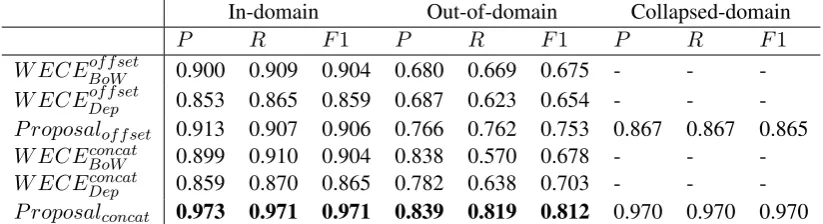
Table 2: Comparison of the overall classification results.
relation in BLESS, because the definition of the
attribute relationship in PWN differs from the definition of the ATTRI relation in the BLESS dataset. Thus, we can only compare the results for the relationships COORD, HYPER, and MERO with the common measures,P,R, andF1.
5 Results
5.1 Major results
Table 2 compares our results with that of the WECE systems in the three data set divisions (In/Out/Collapsed domains). The results show that P roposalconcatperformed best in all measures of
each division (shown in bold font). We observe two common trends across the approaches includ-ing WECE: (1) Every score in the Out-of-domain setting was lower than that in the In-domain set-ting; and (2) The methods using vector concatena-tion achieved higher scores than those using vector offsets. The former trend is reasonable, since in-formation that is also more relevant to the test data is contained in the training data in the In-domain settings. The latter trend suggests that concate-nated vectors may be more informative than off-set vectors, supporting the conclusion presented in (Necsules¸cu et al., 2015).
Nevertheless, the results in the table clearly show that P roposaloffset outperformed both
W ECEconcat
BoW andW ECEDepconcatnot only in
Pre-cision but also in Recall in the Out-of-domain setting. This may confirm that sense represen-tations, acquired by exploiting a richer structure encoded in PWN, are richer in semantic content than word embeddings learned from textual cor-pora, and hence, even the offset vectors are capa-ble of abstracting some characteristics of potential lexical-semantic relations between a word pair ef-fectively.
Table 3 breaks down the results obtained
Relationship P R F1 COORD 0.761 0.559 0.645 byBaseline 0.550 0.108 0.180
HYPER 0.767 0.654 0.706 byBaseline 0.746 0.199 0.314
MERO 0.625 0.809 0.705 byBaseline 0.934 0.034 0.065
[image:6.595.326.507.220.346.2]ATTRI 0.913 0.995 0.952 EVENT 0.974 0.983 0.979 Table 3: Breakdown of the results obtained by P roposalOoD
concat. TheBaselineresults are shown
initalics.
by P roposalconcat in the Out-of-domain setting
(P roposalOoD
concat), and compares them with the
Baseline results, showing that P roposalconcat
clearly outperformed theBaselinein Recall and F1. This clearly confirms that the direct relational links defined in PWN are insufficient for classify-ing the BLESS relationships. With respect to the internal comparison of theP roposalOoD
concatresults,
a prominent fact is the high-performance classi-fication of the ATTRI and EVENT relationships. By definition, these relationships link a noun to an adjective (ATTRI) or to a verb (EVENT), whereas the COORD, HYPER, and MERO relationships connect a noun to another noun. This may sug-gest that the information carried by part-of-speech plays a role in this classification task.
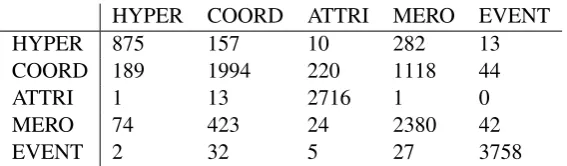
Table 4 further details the results obtained by P roposalOoD
concat by showing the confusion
HYPER COORD ATTRI MERO EVENT
HYPER 875 157 10 282 13
COORD 189 1994 220 1118 44
ATTRI 1 13 2716 1 0
MERO 74 423 24 2380 42
[image:7.595.158.442.61.144.2]EVENT 2 32 5 27 3758
Table 4: Confusion matrix for the results byP roposalOoD
concatin the Out-of-domain setting.
5.2 Ablation tests
This section more closely considers the re-sults in the Out-of-domain setting. Table 5 shows the results of the ablation tests for the P roposalOoD
concat setting, comparing the
effective-ness of the source of the similarities. Each row other than P roposalOoD
concat displays the
re-sults when the designated feature is ablated. The −word row shows the result when ablating the 601-dimensional features created from the pair of word embeddings, and the other rows show the results when ablating the corresponding 1803-dimensional features (three similarities and the three vector pairs that yielded the similarities) gen-erated from each node set pair.
P R F1 F1diff
P roposalOoD
concat 0.839 0.819 0.812
-−word 0.845 0.827 0.819 0.008
−sense 0.833 0.815 0.806 -0.006
−concept 0.826 0.809 0.802 -0.010
−coord 0.834 0.811 0.803 -0.009
−hyper 0.826 0.803 0.800 -0.012
−attri1 0.826 0.806 0.798 -0.014 −attri2 0.842 0.820 0.814 0.002 −mero 0.835 0.813 0.806 -0.006
Table 5: Ablation tests comparing the effective-ness of each node set.
This table suggests that theconcept,hyper, and attri1 node set pairs are effective, as indicated by the relatively large decreases in F1. Surpris-ingly, however, the features generated from the word embeddings affected the performance. This implies that abstract-level semantics encoded in sense/concept embeddings are more robust in the classification of the target lexical-semantic rela-tionships. However, the utility of sense embed-dings was modest.This may result from the learn-ing method in AutoExtend: it tries to split a word embedding into the senses’ embeddings without considering the virtual distribution of senses in the
[image:7.595.312.521.364.414.2]Word2Vec training corpus. It is a potential future work to address this issue.
Table 6 compares the effectiveness of thetypes
of features. Theonly similaritiesrow shows the re-sults when ablating the vectoral features and only using the 22-dimensional similarity features (21 semantic/conceptual-level similarities along with a word-level similarity). On the other hand, the
only vector pairsrow shows the results from the adverse setting, using the 22 vector pairs (using 13,200-dimensional features).
P R F1 F1 diff
P roposalOoD
concat 0.839 0.819 0.812
[image:7.595.78.287.415.538.2]-only similarities 0.704 0.687 0.683 -0.129 only vector pairs 0.834 0.812 0.804 -0.007
Table 6: Effectiveness comparison of thetypesof features.
It is shown that using vectorial features would produce more accurate results than simply using the similarity features, confirming the general as-sumption: more features yield more accurate re-sults. However, we would have to emphasize that, even only with the similarity features, our ap-proach outperformed the comparable method in Recall (shown in the Out-of domain columns of Table 2 ).
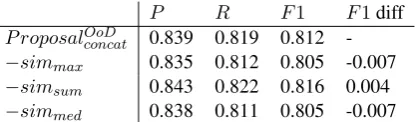
Table 7 shows the results of the other abla-tion tests, comparing the effectiveness of the sim-ilarity calculation methods. Each row in the ta-ble displays the result when ablating the 4207-dimensional features (seven similarities plus seven vector pairs that yielded these similarities).
P R F1 F1diff P roposalOoD
concat 0.839 0.819 0.812
[image:8.595.80.288.62.123.2]-−simmax 0.835 0.812 0.805 -0.007 −simsum 0.843 0.822 0.816 0.004 −simmed 0.838 0.811 0.805 -0.007
Table 7: Additional ablation tests comparing the similarity calculation methods.
6 Discussion
This section discusses two issues: the first is asso-ciated with the usage of PWN in the experiments using BLESS, and the other is concerned with the “lexical memorization” problem.
Usage of PWN: As detailed in Section 3, our methods utilize neighboring concepts linked by the particular lexical-semantic relations
hypernymy, attribute, and meronymy
defined in PWN. Some may consider that the HYPER, ATTRI, and MERO relationships can be estimated simply by consulting the above-mentioned PWN relationships. However, this is definitely NOT the case, since almost all of the semantic relation instances in the BLESS dataset are not immediately defined in PWN: Among the 14,400 BLESS instances, only 951 are defined in PWN. For an obvious example, there are no links in PWN that are labeledevent, which is a type of semantic relation defined in BLESS. The low Recall results presented in Table 3 endorsed this fact, and clearly show the sparsity of useful semantic links in PWN. However, for some of the lexical-semantic relation types that exhibit transitivity, such as hypernymy, consulting the PWN indirect links could be effectively utilized to improve the results.
Lexical memorization: Levy et al. (2015) re-cently argued that the results achieved by many su-pervised methods are inflated because of the “lex-ical memorization” effect, which only learns “pro-totypical hypernymy” relations. For example, if a classifier encounters many positive examples such as (X, animals), where X is a hyponym of animal (e.g., dog, cat, ...), it only learns to classify any word pair as ahypernymas far as the second word is “animal.” We argue that our method can be ex-pected to be relatively free from this issue. The similarity features are not affected by this effect, since any similarity calculation is a symmetric op-eration, and independent of word order.
More-over, thesimc
maxorsimcmedmethod selects a pair
of sense/concept embeddings, where the nation usually differs depending on the combi-nation of node sets. On one hand, the simc
sum
method could be affected by the memorization ef-fect, since the vectorial feature for theprototypical hypernymis invariable.
7 Conclusion
This paper proposed a method for classifying the type of lexical-semantic relation that could hold between a given pair of words. The empirical results clearly outperformed those previously ob-tained with the state-of-the-art results, demonstrat-ing that our rationales behind the proposal are valid. In particular, it would be reasonable to assume that the plausibility of a specific type of lexical-semantic relation between the words could be chiefly recovered by a carefully designed set of relation-specific similarities. These results also highlight the utility of “the sense representations,” since our similarity calculation methods rely on the sense/concept embeddings created by the Au-toExtend system.
Future work could follow two directions. First, we need to improve the classification of inter-noun semantic relations. We may particularly need to distinguish the hypernym relationship, which is asymmetric, from the symmetriccoordinate rela-tionship. In this regard, we would need to improve the creation of node sets and the combinations to capture the innate difference of the relationships.
Second, we need to address the potential draw-back of our proposal, which comes from our oper-ational requirement: a lack of sense/concept em-beddings is crucial, as we cannot collect relevant node sets in this case. Therefore, we need to de-velop a method to assign some of the existing con-cepts to anunknownword, which is not contained in PWN, by seeking the nearest concept in the re-source. A possible method would first seek the nearest concept in the underlying lexical-semantic resource for anunknownword, and then induce a revised set of sense/concept embeddings by itera-tively applying the AutoExtend system.
Acknowledgments
References
Marco Baroni and Alessandro Lenci. 2011. How we blessed distributional semantic evaluation. In Pro-ceedings of the GEMS 2011 Workshop on GEomet-rical Models of Natural Language Semantics, pages 1–10. Association for Computational Linguistics. Jordan Boyd-Graber, Christiane Fellbaum, Daniel
Os-herson, and Robert Schapire. 2006. Adding dense, weighted connections to wordnet. In Proceedings of the third international WordNet conference, pages 29–36.
Alexander Budanitsky and Graeme Hirst. 2006. Eval-uating wordnet-based measures of lexical semantic relatedness. Computational Linguistics, 32(1):13– 47.
Ruiji Fu, Jiang Guo, Bing Qin, Wanxiang Che, Haifeng Wang, and Ting Liu. 2014. Learning semantic hier-archies via word embeddings. InProceedings of the 52nd Annual Meeting of the Association for Compu-tational Linguistics (Volume 1: Long Papers), pages 1199–1209, Baltimore, Maryland, June. Association for Computational Linguistics.
Eric Huang, Richard Socher, Christopher Manning, and Andrew Ng. 2012. Improving word represen-tations via global context and multiple word proto-types. InProceedings of the 50th Annual Meeting of the Association for Computational Linguistics (Vol-ume 1: Long Papers), pages 873–882, Jeju Island, Korea, July. Association for Computational Linguis-tics.
Ignacio Iacobacci, Mohammad Taher Pilehvar, and Roberto Navigli. 2015. Sensembed: Learning sense embeddings for word and relational similarity. In Proceedings of the 53rd Annual Meeting of the Association for Computational Linguistics and the 7th International Joint Conference on Natural Lan-guage Processing (Volume 1: Long Papers), pages 95–105, Beijing, China, July. Association for Com-putational Linguistics.
Douwe Kiela, Felix Hill, and Stephen Clark. 2015. Specializing word embeddings for similarity or re-latedness. InProceedings of the 2015 Conference on Empirical Methods in Natural Language Process-ing, pages 2044–2048, Lisbon, Portugal, September. Association for Computational Linguistics.
Lili Kotlerman, Ido Dagan, Idan Szpektor, and Maayan Zhitomirsky-Geffet. 2010. Directional distribu-tional similarity for lexical inference. Natural Lan-guage Engineering, 16(04):359–389.
Alessandro Lenci and Giulia Benotto. 2012. Identify-ing hypernyms in distributional semantic spaces. In *SEM 2012: The First Joint Conference on Lexical and Computational Semantics – Volume 1: Proceed-ings of the main conference and the shared task, and Volume 2: Proceedings of the Sixth International Workshop on Semantic Evaluation (SemEval 2012),
pages 75–79, Montr´eal, Canada, 7-8 June. Associa-tion for ComputaAssocia-tional Linguistics.
Omer Levy and Yoav Goldberg. 2014. Dependency-based word embeddings. InProceedings of the 52nd Annual Meeting of the Association for Computa-tional Linguistics (Volume 2: Short Papers), pages 302–308, Baltimore, Maryland, June. Association for Computational Linguistics.
Omer Levy, Steffen Remus, Chris Biemann, and Ido Dagan. 2015. Do supervised distributional meth-ods really learn lexical inference relations? In Pro-ceedings of the 2015 Conference of the North Amer-ican Chapter of the Association for Computational Linguistics: Human Language Technologies, pages 970–976, Denver, Colorado, May–June. Association for Computational Linguistics.
Tomas Mikolov, Kai Chen, Greg Corrado, and Jef-frey Dean. 2013a. Efficient estimation of word representations in vector space. arXiv preprint arXiv:1301.3781.
Tomas Mikolov, Ilya Sutskever, Kai Chen, Greg S Cor-rado, and Jeff Dean. 2013b. Distributed represen-tations of words and phrases and their composition-ality. InAdvances in neural information processing systems, pages 3111–3119.
George A. Miller. 1995. Wordnet: a lexical database for english. Communications of the ACM, 38(11):39–41.
Silvia Necsules¸cu, Sara Mendes, David Jurgens, N´uria Bel, and Roberto Navigli. 2015. Reading between the lines: Overcoming data sparsity for accurate classification of lexical relationships. In Proceed-ings of the Fourth Joint Conference on Lexical and Computational Semantics, pages 182–192, Denver, Colorado, June. Association for Computational Lin-guistics.
Arvind Neelakantan, Jeevan Shankar, Alexandre Pas-sos, and Andrew McCallum. 2014. Efficient non-parametric estimation of multiple embeddings per word in vector space. In Proceedings of the 2014 Conference on Empirical Methods in Natu-ral Language Processing (EMNLP), pages 1059– 1069, Doha, Qatar, October. Association for Com-putational Linguistics.
Jeffrey Pennington, Richard Socher, and Christopher Manning. 2014. Glove: Global vectors for word representation. In Proceedings of the 2014 Con-ference on Empirical Methods in Natural Language Processing (EMNLP), pages 1532–1543, Doha, Qatar, October. Association for Computational Lin-guistics.
Conference on Natural Language Processing (Vol-ume 1: Long Papers), pages 1793–1803, Beijing, China, July. Association for Computational Linguis-tics.
Pavel Rychl´y and Adam Kilgarriff. 2007. An ef-ficient algorithm for building a distributional the-saurus (and other sketch engine developments). In Proceedings of the 45th Annual Meeting of the As-sociation for Computational Linguistics Companion Volume Proceedings of the Demo and Poster Ses-sions, pages 41–44, Prague, Czech Republic, June. Association for Computational Linguistics.
Enrico Santus, Frances Yung, Alessandro Lenci, and Chu-Ren Huang. 2015. Evalution 1.0: an evolving semantic dataset for training and evaluation of dis-tributional semantic models. InProceedings of the 4th Workshop on Linked Data in Linguistics (LDL-2015), pages 64–69.
Vered Shwartz, Yoav Goldberg, and Ido Dagan. 2016. Improving hypernymy detection with an integrated path-based and distributional method. In Proceed-ings of the 54th Annual Meeting of the Association for Computational Linguistics (Volume 1: Long Pa-pers), pages 2389–2398, Berlin, Germany, August. Association for Computational Linguistics.