Measuring Prerequisite Relations Among Concepts
Chen Liang† Zhaohui Wu‡ Wenyi Huang† C. Lee Giles††Information Sciences and Technology ‡Computer Science and Engineering
The Pennsylvania State University University Park, PA
[email protected] [email protected] {wzh112,giles}@ist.psu.edu
Abstract
A prerequisite relation describes a basic relation among concepts in cognition, ed-ucation and other areas. However, as a se-mantic relation, it has not been well stud-ied in computational linguistics. We inves-tigate the problem of measuring prereq-uisite relations among concepts and pro-pose a simple link-based metric, namely reference distance(RefD), that effectively models the relation by measuring how dif-ferently two concepts refer to each other. Evaluations on two datasets that include seven domains show that our single metric based method outperforms existing super-vised learning based methods.
1 Introduction
What should one know/learn before starting to learn a new area such as “deep learning”? A key for answering this question is to understand what aprerequisiteis. A prerequisite is usually a con-cept or requirement before one can proceed to a following one. And the prerequisite relation exists as a natural dependency among concepts in cog-nitive processes when people learn, organize, ap-ply, and generate knowledge (Laurence and Mar-golis, 1999). While there has been serious effort in understanding prerequisite relations in learning and education (Bergan and Jeska, 1980; Ohland et al., 2004; Vuong et al., 2011), it has not been well studied as a semantic relation in computa-tional linguistics, where researchers focus more on lexical relations among lexical items (Miller, 1995) and fine-grained entity relations in knowl-edge bases (Mintz et al., 2009).
Instead of treating it as a relation extraction or link prediction problem using traditional machine learning approaches (Talukdar and Cohen, 2012; Yang et al., 2015), we seek to better understand
prerequisite relations from a perspective of cog-nitive semantics (Croft and Cruse, 2004). Par-tially motivated by the theory of frame seman-tics(Fillmore, 2006), or, to understand a concept, one needs to understand all the related concepts in its “frame”, we propose a metric that measures prerequisite relations based on a simple observa-tion of human learning. When learning conceptA, if one needs to refer to conceptB for a lot ofA’s related concepts but not vice versa,Bwould more likely be a prerequisite ofAthanAofB. Specif-ically, we model a concept in a vector space using its related concepts and measure the prerequisite relation between two concepts by computing how differently the two’s related concepts refer to each other, orreference distance(RefD).
Our simple metric RefD successfully reflects some properties of the prerequisite relation such as asymmetry and irreflexivity; and can be prop-erly implemented for various applications using different concept models. We present an imple-mentation of the metric using Wikipedia by lever-aging the links as reference relations among con-cepts; and present a scalable prerequisite dataset construction method by crawling public available university course prerequisite websites and map-ping them to Wikipedia concepts. Experimental results on two datasets that include seven domains demonstrate its effectiveness and robustness on measuring prerequisites. Surprisingly, our single metric based approach significantly outperforms baselines which use more sophisticated supervised learning. All the datasets are publicly available upon request.
Our main contributions include:
• A novel metric to measure the prerequisite re-lation among concepts that outperforms ex-isting supervised learning baselines.
• A new dataset containing 1336 concept pairs in Computer Science and Math.
Data
mining Algorithm
A Statistics B
Machine learning Cluster analysis
Logic Pseudocode Programming
[image:2.595.75.289.63.103.2]language
Figure 1: An example of the reference structure for two concepts (“Data mining” and “Algorithm”) with a prerequisite relation.
2 Measuring Prerequisite Relations Our goal is to design a functionf :C2 → Rthat
maps a concept pair (A, B) to a real value that measures the extent to which A requires B as a prerequisite, where C is the concept space. How should a concept be represented inC? According to the theory of frame semantics, one cannot un-derstand a concept without access to all essential knowledge related to it. Such knowledge can be actually viewed as a set of related concepts. Thus, a concept could be represented by its related con-cepts inC. For example, the concept “deep learn-ing” may be represented by concepts such as “ma-chine learning”, “artificial neural network”, etc.
Compared to prerequisites, a more common and observable relation among concepts is areference, which widely exists in various forms such as hy-perlinks, citations, notes, etc. Although a single evidence of reference does not indicate a prereq-uisite relation, a large number of such evidences might make a difference. For example, if most re-lated concepts ofArefer toBbut few related con-cepts ofBrefer toA, thenB is more likely to be a prerequisite ofA, as shown in Figure 1. In or-der to measure prerequisite relations, we propose areference distance(RefD), which is defined as
RefD(A, B) = Pk
i=1r(ci,B)·w(ci,A)
Pk
i=1w(ci,A) −
Pk
i=1r(ci,A)·w(ci,B)
Pk
i=1w(ci,B)
(1)
where C = {c1, ..., ck} is the concept space;
w(ci, A) weights the importance of ci toA; and
r(ci, A)is an indicator showing whetherci refers
toA, which could be links in Wikipedia, mentions in books, citations in papers, etc.
RefD enables several useful properties for the prerequisite relation: 1) normalized:
RefD(A, B) ∈ [−1,1]; 2) asymmetric:
RefD(A, B)+RefD(B, A)=0, which means if
A is a prerequisite of B then B is not a prereq-uisite of A; and 3) irreflexive: RefD(A, A)=0, which meansA is not a prerequisite of itself. To capture all three possible prerequisite relations
between a concept pair,RefDis expected to satisfy the following constraints:
RefD(A,B)∈
(θ,1], if B is a prerequisite of A
[−θ, θ], if no prerequisite relation
[−1,−θ), if A is a prerequisite of B
whereθis a positive threshold.
Equation 1 provides a general framework to cal-culate RefD. In practice, we need to specify the concept spaceC, the weightw, and the reference indicator functionr.
3 Wikipedia-based RefD Implementation We now implement RefDusing Wikipedia. As a widely used open-access encyclopedia, Wikipedia provides relatively up-to-date and high quality knowledge and has been successfully utilized as explicit concepts (Gabrilovich and Markovitch, 2007). Moreover, the rich hyperlinks created by Wiki editors provide a natural way to calculate the reference indicator functionr.
Specifically, the concept space C consists of all Wikipedia articles. r(c, A) represents whether there is a link from Wiki article c to A. For
w(c, A), we experiment with two methods:
• EQUAL: A is represented by the concepts linked from it (L(A)) with equal weights.
w(c, A) =
(
1 ifc∈L(A) 0 ifc /∈L(A)
• TFIDF: A is represented by the concepts linked from it with TFIDF weights.
w(c, A) =
(
tf(c, A)∗log N
df(c) ifc∈L(A)
0 ifc /∈L(A)
wheretf(c, A)is the number of timesc be-ing linked fromA;N is the total number of Wikipedia articles; and df(c) is the number of Wikipedia articles wherecappears.
4 Experiments
In order to evaluate the proposed metric, we apply it to predicting prerequisite relations in Wikipedia, i.e., whether one article in Wikipedia is a prereq-uisite of another article. Given a pair of concepts (A,B), we predict whether B is a prerequisite of
Dataset Domain # Pairs # Prerequisites
CrowdComp
Meiosis 400 67
[image:3.595.307.531.61.111.2]Public-key Cryp. 200 27 Parallel Postulate 200 25 Newton’s Laws 400 44 Global Warming 400 43 Course CSMATH 678658 10875
Table 1: Statistics of CrowdComp and Course Datasets
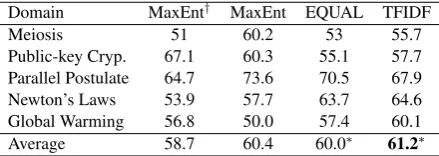
Domain MaxEnt† MaxEnt EQUAL TFIDF
Meiosis 51 60.2 53 55.7
Public-key Cryp. 67.1 60.3 55.1 57.7 Parallel Postulate 64.7 73.6 70.5 67.9 Newton’s Laws 53.9 57.7 63.7 64.6 Global Warming 56.8 50.0 57.4 60.1
Average 58.7 60.4 60.0∗ 61.2∗
Table 2: Comparison of out-of-domain training accuracies of a MaxEnt classifier andRefDusing EQUAL and TFIDF weighting. MaxEnt† is the number reported by Talukdar et al. (2012). Max-Ent shows the performance of our implementation. * indicates the difference betweenRefDand Max-Ent is statistically significant (p <0.01).
B and pairs where no prerequisite relation exists will be viewed as negative examples.
RefD is tested on two datasets: CrowdComp dataset (Talukdar and Cohen, 2012) and a Course prerequisite dataset collected by us. We compare RefDwith a Maximum Entropy (MaxEnt) classi-fier which exploits graph-based features such as PageRank scores and content-based features such as the category information, whether a title of con-cept is mentioned in the first sentence of the other concept, the number of times a concept is linked from the other, etc. (Talukdar and Cohen, 2012). All experiments use a Wikipedia dump of Dec 8, 2014.
4.1 Results on the CrowdComp Dataset
The CrowdComp dataset was collected us-ing Amazon Mechanical Turk by Talukdar et al. (2012). It contains binary-labeled concept pairs from five different domains, including meio-sis, public-key cryptography, the parallel postu-late, Newton’s laws of motion, and global warm-ing. The label of the prerequisite relation for each pair is assigned using majority vote. Details of the dataset are shown in Table 1.
Following Talukdar et al. (2012), we evaluate
CS MATH
A P R F A P R F MaxEnt 72.8 87.6 53.2 66.1 69.0 78.1 53 63.1 EQUAL 76.4∗ 80.4 69.9 74.7∗ 73.9∗ 78.4 67.3 71.9∗
[image:3.595.74.293.62.150.2]TFIDF 77.1∗ 82.3 69.1 75.1∗ 70.3∗ 76.3 60.1 66.7∗
Table 3: Comparison of in-domain training accu-racies, precision, recall, and F1 measure of Max-Ent andRefDusing EQUAL and TFIDF weight-ing. * indicates the improvement over MaxEnt is statistically significant (p <0.01).
different methods in a “leave one domain out” manner, where data from one domain is used for testing and data from other four for training. Classes in the training and testing set are balanced by oversampling the minority class. Table 2 lists the accuracies of different methods. In terms of average performance, RefDachieves comparable average accuracy as MaxEnt. When TFIDF is used to calculate w, RefD performs better than MaxEnt. Also we notice that our implementation of MaxEnt classifier achieves higher accuracy than reported in the original paper, which may be due to the difference between Wiki dumps used. In ad-dition, we can see that there are large differences in performance across different domains, which is mainly due to two reasons. First, the coverage of Wikipedia for different domains may vary a lot. Some domains are more popular and thus edited more frequently, leading to a better quality of ar-ticles and a more complete link structure. Sec-ond, since the ground-truth labels are collected by crowdsourcing and there is no guarantee for work-ers’ knowledge about a certain domain, the quality of labels for different domains varies.
4.2 Results on the Course Dataset
We also built a Course dataset with the help of information available on a university’s course website containing prerequisite relations between courses. For example, “CS 331 Data Structures and Algorithms” is a prerequisite for “CS 422 Data mining”. We get the prerequisite pairs by crawling the website and linking the course to Wikipedia using simple rules such as title match-ing and content similarity. In order to get nega-tive samples, we randomly sample 600 pairs using concepts appearing in the prerequisite pairs. All pairs are then checked by two domain experts by removing pairs with incorrect labels. Table 1 lists the information of the dataset.
[image:3.595.75.295.201.279.2]cross-0 0.2 0.4 0.6 0.8 1.0 Recall
0 0.2 0.4 0.6 0.8 1.0
Precision
MaxEnt (area = 0.777) EQUAL (area = 0.810) TFIDF (area = 0.831)
(a) CS
0 0.2 0.4 0.6 0.8 1.0 Recall
0 0.2 0.4 0.6 0.8 1.0
Precision
MaxEnt (area = 0.730) EQUAL (area = 0.802) TFIDF (area = 0.776)
[image:4.595.79.284.51.381.2](b) MATH
Figure 2: Comparison of Precision-Recall curves of MaxEnt and RefD(using EQUAL and TFIDF weighting) on the Course dataset.
validation and classes are balanced by over-sampling the minority class. Table 3 lists the performance comparison of different methods on accuracy, precision, recall and F1 score. We can see that RefD outperforms MaxEnt in terms of accuracy, recall, and F1 score on both CS and MATH domain. Because MaxEnt relies on many features but there are only limited distinct positive samples in the dataset, it is more likely to overfit the training data, which leads to high precision but low recall on test set. In order to better compare precision and recall, we plot the Precision-Recall curves of different methods, as shown in Figure 2. RefDshows a clear improvement in the area under the Precision-Recall curve.
Comparing two weighting methods, we find that TFIDF performs slightly better than EQUAL on CS while EQUAL has higher scores than TFIDF on MATH. Since how to compute w in RefD is a crucial problem, our ongoing work is to ex-plore more sophisticated semantic representations to measure prerequisite relations. A natural exten-sion to the two simple methods here is to represent
−1.0 −0.5 0.0 0.5 1.0
θ
0.50 0.52 0.54 0.56 0.58 0.60 0.62
Accuracy
(a
vg
.)
θ= 0.05
(a) CrowdComp
−1.0 −0.5 0.0 0.5 1.0
θ
0.50 0.55 0.60 0.65 0.70 0.75
Accuracy
(a
vg
.)
θ= 0.02
[image:4.595.309.521.66.153.2](b) Course
Figure 3: Average accuracy on two datasets with a given threshold ofRefDusing TFIDF weighting.
a concept using WordNet (Miller, 1995), Explicit Semantic Analysis (Gabrilovich and Markovitch, 2007), or Word2vec embeddings (Mikolov et al., 2013). Incorporating these representations may improve the performance ofRefD.
4.3 Parameter Analysis and Case Study
Since usingRefDto predict prerequisites requires setting a thresholdθ, we also investigate the rela-tion between the threshold and the performance of prediction, as shown in Figure 3. We can see that a threshold of 0.05 forRefDusing TFIDF achieves the highest average accuracy on the CrowdComp dataset while a threshold of 0.02 works the best for Course dataset. Empirically we find that a thresh-old between 0.02 and 0.1 yields a good perfor-mance for prerequisite prediction task.
Concept RefD Concept RefD Concept RefD
Deep belief network -0.38 List of Nobel laureates 0.009 Machine learning 0.32
Neocognitron -0.28 Neural development 0.009 Artificial neural network 0.31
Word embedding -0.24 Watson (computer) 0.003 Artificial intelligence 0.15
Vanishing gradient problem -0.22 Self-organization 8e-5 Algorithm 0.14
[image:5.595.80.518.62.139.2]Feature learning -0.17 Language model -0.004 Statistical classification 0.13
Table 4:RefDscores between “deep learning” and the concepts linked from it. All scores are calculated byRefD(‘deep learning’, concept).
Please note that our Wikipedia-based imple-mentation is computationally efficient especially after precomputing weights and references and can be easily incorporated as a feature into exist-ing supervised learnexist-ing based methods.
5 Related Work
In the area of education, researchers have tried to find prerequisites based on the assessment data of students’ performance (Scheines et al., 2014; Vuong et al., 2011). However, prerequisite rela-tions have not been well studied in computer sci-ence, with only a few exceptions. Liu et al. (2011) studied learning-dependency between knowledge units using classification where a knowledge unit is a special text fragment containing concepts. We focus on more general prerequisite relations among concepts. Talukdar and Cohen (2012) ap-plied a Maximum Entropy classifier to predict prerequisite structures in Wikipedia using various features such as a random walk with restart score and PageRank score. Instead of doing feature en-gineering, we propose to measure prerequisite re-lations using a single metric. Yang et al. (2015) proposed Concept Graph Learning to induce rela-tions among concepts from prerequisite relarela-tions among courses, where the learned concept prereq-uisite relations are implicit and thus can not be evaluated. Our method is more interpretable for measuring prerequisite relations.
Our work is closely related to the study of se-mantic relations. One direction is automatic lex-ical relation extraction. Different methods have been proposed to discover hypernym-hyponym re-lations based on lexical patterns (Hearst, 1992; McNamee et al., 2008; Ritter et al., 2009), dis-tributional similarity (Kotlerman et al., 2010), se-mantic word embeddings (Fu et al., 2014), etc. Another line is entity relation extraction, which can be performed by distant supervision (Mintz et al., 2009; Riedel et al., 2010), Open IE (Fader et al., 2011), and neural networks (Bordes et al.,
2011; Lin et al., 2015).
In addition, semantic relatedness measures have been widely studied, where the key is to model the semantic representation based on a latent space, such as LSA (Deerwester et al., 1990), PLSA (Hofmann, 1999), LDA (Blei et al., 2003) and distributed word embeddings (Huang et al., 2012; Mikolov et al., 2013), or an explicit concept space, such as ESA (Gabrilovich and Markovitch, 2007), SSA (Hassan and Mihalcea, 2011), and SaSA (Wu and Giles, 2015). Our work can also be served as a basis for building concept hierar-chy (Wang et al., 2015) and teaching/learning as-sistant tools (Liang et al., 2015).
6 Conclusions and Future Work
We studied the problem of measuring prerequi-site relations among concepts and proposedRefD, a general, light-weight, and effective metric, to capture the relation. We presented Wikipedia-based implementations ofRefDwith two different weighting strategies. Experiments on two datasets including seven domains showed that our pro-posed metric outperformed existing baselines us-ing supervised learnus-ing.
Promising future directions would be applying the framework of RefDto other contexts such as measuring the prerequisite relations or reading or-ders between papers and textbooks. In addition, RefDcan be incorporated into existing supervised models for a more accurate measure. Also it would be meaningful to explore ranking different prerequisites of a concept. Besides the rich link structure we could take advantage of more content information from Wikipedia and other resources such as textbooks and scientific papers.
Acknowledgments
References
John R Bergan and Patrick Jeska. 1980. An ex-amination of prerequisite relations, positive trans-fer among learning tasks, and variations in instruc-tion for a seriainstruc-tion hierarchy. Contemporary Educa-tional Psychology, 5(3):203–215.
David M Blei, Andrew Y Ng, and Michael I Jordan. 2003. Latent dirichlet allocation. the Journal of ma-chine Learning research, 3:993–1022.
Antoine Bordes, Jason Weston, Ronan Collobert, and Yoshua Bengio. 2011. Learning structured embed-dings of knowledge bases. InConference on Artifi-cial Intelligence, number EPFL-CONF-192344.
William Croft and D Alan Cruse. 2004. Cognitive lin-guistics. Cambridge University Press.
Scott C. Deerwester, Susan T Dumais, Thomas K. Lan-dauer, George W. Furnas, and Richard A. Harshman. 1990. Indexing by latent semantic analysis. JAsIs, 41(6):391–407.
Anthony Fader, Stephen Soderland, and Oren Etzioni. 2011. Identifying relations for open information ex-traction. In Proceedings of the Conference on Em-pirical Methods in Natural Language Processing, pages 1535–1545. Association for Computational Linguistics.
Charles J Fillmore. 2006. Frame semantics.Cognitive linguistics: Basic readings, 34:373–400.
Ruiji Fu, Jiang Guo, Bing Qin, Wanxiang Che, Haifeng Wang, and Ting Liu. 2014. Learning semantic hier-archies via word embeddings. InProceedings of the 52th Annual Meeting of the Association for Compu-tational Linguistics: Long Papers, volume 1.
Evgeniy Gabrilovich and Shaul Markovitch. 2007. Computing semantic relatedness using wikipedia-based explicit semantic analysis. In IJCAI, vol-ume 7, pages 1606–1611.
Samer Hassan and Rada Mihalcea. 2011. Semantic relatedness using salient semantic analysis. In Pro-ceedings of the Twenty-Fifth AAAI Conference on Artificial Intelligence, AAAI 2011, San Francisco, California, USA, August 7-11, 2011.
Marti A Hearst. 1992. Automatic acquisition of hy-ponyms from large text corpora. InProceedings of the 14th conference on Computational linguistics-Volume 2, pages 539–545. Association for Compu-tational Linguistics.
Thomas Hofmann. 1999. Probabilistic latent semantic indexing. InProceedings of the 22nd annual inter-national ACM SIGIR conference on Research and development in information retrieval, pages 50–57. ACM.
Eric H Huang, Richard Socher, Christopher D Man-ning, and Andrew Y Ng. 2012. Improving word representations via global context and multiple word prototypes. InProceedings of the 50th Annual Meet-ing of the Association for Computational LMeet-inguis- Linguis-tics: Long Papers-Volume 1, pages 873–882. Asso-ciation for Computational Linguistics.
Lili Kotlerman, Ido Dagan, Idan Szpektor, and Maayan Zhitomirsky-Geffet. 2010. Directional distribu-tional similarity for lexical inference. Natural Lan-guage Engineering, 16(04):359–389.
Stephen Laurence and Eric Margolis. 1999. Concepts and cognitive science. Concepts: core readings, pages 3–81.
Chen Liang, Shuting Wang, Zhaohui Wu, Kyle Williams, Bart Pursel, Benjamin Brautigam, Sher-wyn Saul, Hannah Williams, Kyle Bowen, and C. Lee Giles. 2015. Bbookx: An automatic book creation framework. In Proceedings of the 2015 ACM Symposium on Document Engineering. Yankai Lin, Zhiyuan Liu, Maosong Sun, Yang Liu, and
Xuan Zhu. 2015. Learning entity and relation em-beddings for knowledge graph completion. In Pro-ceedings of AAAI.
Jun Liu, Lu Jiang, Zhaohui Wu, Qinghua Zheng, and Yanan Qian. 2011. Mining learning-dependency between knowledge units from text. The VLDB Journal, 20(3):335–345.
Paul McNamee, Rion Snow, Patrick Schone, and James Mayfield. 2008. Learning named entity hyponyms for question answering. InIJCNLP, pages 799–804. Tomas Mikolov, Ilya Sutskever, Kai Chen, Greg S Cor-rado, and Jeff Dean. 2013. Distributed representa-tions of words and phrases and their compositional-ity. InAdvances in Neural Information Processing Systems, pages 3111–3119.
George A Miller. 1995. Wordnet: a lexical database for english. Communications of the ACM, 38(11):39–41.
Mike Mintz, Steven Bills, Rion Snow, and Dan Ju-rafsky. 2009. Distant supervision for relation ex-traction without labeled data. InProceedings of the Joint Conference of the 47th Annual Meeting of the ACL and the 4th International Joint Conference on Natural Language Processing of the AFNLP: Vol-ume 2-VolVol-ume 2, pages 1003–1011. Association for Computational Linguistics.
Matthew W Ohland, Amy G Yuhasz, and Benjamin L Sill. 2004. Identifying and removing a calculus pre-requisite as a bottleneck in clemson’s general engi-neering curriculum. Journal of Engineering Educa-tion, 93(3):253–257.
Knowledge Discovery in Databases, pages 148–163. Springer.
Alan Ritter, Stephen Soderland, and Oren Etzioni. 2009. What is this, anyway: Automatic hypernym discovery. InAAAI Spring Symposium: Learning by Reading and Learning to Read, pages 88–93. Richard Scheines, Elizabeth Silver, and Ilya Goldin.
2014. Discovering prerequisite relationships among knowledge components. InProceedings of Educa-tional Data Mining, pages 355–356.
Partha Pratim Talukdar and William W Cohen. 2012. Crowdsourced comprehension: predicting prerequi-site structure in wikipedia. In Proceedings of the Seventh Workshop on Building Educational Appli-cations Using NLP, pages 307–315. Association for Computational Linguistics.
Annalies Vuong, Tristan Nixon, and Brendon Towle. 2011. A method for finding prerequisites within a curriculum. InProceedings of Educational Data Mining, pages 211–216.
Shuting Wang, Chen Liang, Zhaohui Wu, Kyle Williams, Bart Pursel, Benjamin Brautigam, Sher-wyn Saul, Hannah Williams, Kyle Bowen, and C. Lee Giles. 2015. Concept hierarchy extraction from textbooks. In Proceedings of the 2015 ACM Symposium on Document Engineering.
Zhaohui Wu and C. Lee Giles. 2015. Senaware se-mantic analysis: A multi-prototypeword represen-tation model usingwikipedia. In Proceedings of the 29th AAAI Conference on Artificial Intelligence, pages 2188–2194.