Proceedings of the 2019 Conference on Empirical Methods in Natural Language Processing and the 9th International Joint Conference on Natural Language Processing, pages 1028–1039,
1028
Low-Resource Sequence Labeling via Unsupervised Multilingual
Contextualized Representations
Zuyi Bao‡, Rui Huang♦, Chen Li‡∗and Kenny Q. Zhu† ‡
Alibaba Group
♦Zhejiang University, China
†Shanghai Jiao Tong University, Shanghai, China
‡{zuyi.bzy,puji.lc}@alibaba-inc.com
♦[email protected],†[email protected]
Abstract
Previous work on cross-lingual sequence la-beling tasks either requires parallel data or bridges the two languages through word-by-word matching. Such requirements and as-sumptions are infeasible for most languages, especially for languages with large linguis-tic distances, e.g., English and Chinese. In this work, we propose a Multilingual Lan-guage Model with deep semantic Alignment (MLMA) to generate language-independent representations for cross-lingual sequence la-beling. Our methods require only monolingual corpora with no bilingual resources at all and take advantage of deep contextualized repre-sentations. Experimental results show that our approach achieves new state-of-the-art NER and POS performance across European guages, and is also effective on distant lan-guage pairs such as English and Chinese.1 1 Introduction
Sequence labeling tasks such as named entity recognition (NER) and part-of-speech (POS) tag-ging are fundamental problems in natural lan-guage processing (NLP). Recent sequence label-ing models achieve state-of-the-art performance by combining both character-level and word-level information (Chiu and Nichols, 2016; Ma and Hovy,2016;Lample et al.,2016). However, these models heavily rely on large-scale annotated train-ing data, which may not be available in most lan-guages. Cross-lingual transfer learning is pro-posed to address the label scarcity problem by transferring annotations from high-resource guages (source languages) to low-resource lan-guages (target lanlan-guages). In this scenario, a
ma-∗
Corresponding Author. †
Kenny Q. Zhu was partially supported by NSFC grant 91646205 and Alibaba visiting scholar program.
1The code is released at https://github.com/
baozuyi/MLMA.
jor challenge is how to bridge interlingual gaps with modest resource requirements.
There is a large body of work exploring cross-lingual transfer through language-independent features, such as morphological features and uni-versal POS tags for cross-lingual NER (Tsai et al.,
2016) and dependency parsers (McDonald et al.,
2011). However, these approaches require linguis-tic knowledge for language-independent feature engineering, which is expensive in low-resource settings. Other work relies on bilingual resources to transfer knowledge from source languages to target languages. Parallel corpora are widely used to project annotations from the source to the tar-get side (Yarowsky et al., 2001; Ehrmann et al.,
2011;Kim et al.,2012;Wang and Manning,2014). These methods could achieve strong performance with a large amount of bilingual data, which is scarce in low-resource settings.
Recent research leverages cross-lingual word embeddings (CLWEs) to establish inter-lingual connections and reduce the requirements of par-allel data to a small lexicon or even no bilin-gual resource (Ni et al., 2017; Fang and Cohn,
2017;Xie et al.,2018). However, word embedding spaces may not be completely isomorphic due to language-specific linguistic properties, and there-fore cannot be perfectly aligned. For example, different from English, Chinese nouns do not dis-tinguish singular and plural forms, while Spanish nouns distinguish masculine and feminine.
that the semantic meanings of words from differ-ent languages can be roughly aligned at a concep-tual level and it is more reasonable to align deep semantic representations instead of shallow word embeddings. Meanwhile, monolingual contextu-alized embeddings derived from language mod-els have shown to be effective for extracting se-mantic information and have achieved significant improvement on several NLP tasks (Peters et al.,
2018).
In this paper, we propose a Multilingual Lan-guage Model with deep semantic Alignment (MLMA). We train MLMA on monolingual cor-pora from each language and align its internal states across different languages. Then MLMA is utilized to generate language-independent rep-resentations and to bridge the gaps between high-resource and low-high-resource languages. For eval-uation, we conduct extensive experiments on the NER and POS benchmark datasets under cross-lingual settings. The experiment results show that our methods achieve substantial improvements comparing to previous state-of-the-art methods in European languages. We also validate our approaches on a distant language pair, English-Chinese, and the results are competitive with pre-vious methods which use large-scale parallel cor-pora. Our contributions are as follows:
1. Instead of word-level alignment, we propose MLMA that uses contextualized representa-tions to bridge the inter-lingual gaps.
2. We propose three methods to align contextu-alized representations without any bilingual resource.
3. Our methods achieve new state-of-the-art performance on cross-lingual NER and POS tasks in European languages, and very com-petitive results for English-Chinese NER, where previous work uses large parallel data.
2 Approach
Our approach belongs to the model transfer (Sec-tion5.2) and mainly consists of three steps:
1. Training a multilingual language model with alignment (MLMA) using monolingual cor-pora of the source and the target languages. (Section2.1,2.2and2.3)
2. Building a cross-lingual sequence labeling model based on the language-independent representations from the MLMA. (Section
2.4and2.5)
3. Learning the cross-lingual sequence labeling model (with MLMA fixed) on the annotated data of source languages and directly apply-ing it to the target languages.
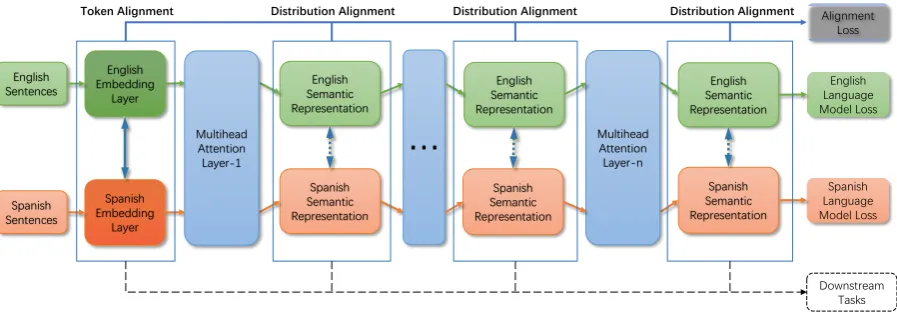
The architecture of MLMA is shown in Fig-ure1. In the following sections, we focus on in-troducing the Step 1 and 2. We first present the architecture of MLMA and describe how to build the unsupervised multilingual alignment. Next, we propose effective methods for collapsing the multi-layer hidden states from MLMA into a sin-gle representation. Finally, we introduce the se-quence labeling model used in the experiments.
2.1 Language Model Architecture
MLMA is a language model with multi-head self-attention mechanism (Vaswani et al., 2017). The architecture is similar to Radford et al. (2018), except that we combine both a forward and a backward Transformer decoder to build a bidirec-tional language model. Take the forward direction as an example, given a sentence with N tokens
W = [w1, w2,· · · , wN]T as input, we first map the sequence of tokens W to token embeddings −
→
H0 ∈RN×d: − →
H0=W Ee+Ep (1)
where Ee and Ep are the embedding matrix and the positional encoding matrix, anddis the dimen-sion of embeddings and hidden states.
Thennblocks of transformer layers are stacked above the token embeddings. Each block contains a masked multi-head self-attention and a position-wise feedforward layer. The detailed implementa-tion is the same asVaswani et al.(2017).
− →
Hl= TransformerLayer( − →
Hl−1) (2)
where −→Hl refers to the output of the l-th trans-former block. Finally, the output distribution over the next tokens is calculated through a softmax function with tied embedding matrix.
− →
P = softmax(−→HnEeT) (3)
For the backward direction, we calculate ←H−l and ←−
P in an analogous way. Finally, we jointly min-imize the negative log likelihood of the forward and backward directions:
N LL=− N
X
t=1
( logp(wt|w1, . . . , wt−1)
+ logp(wt|wt+1, . . . , wN)) (4)
param-Figure 1: The architecture of MLMA consists of language-specific embedding layers and language-agnostic Trans-former layers. MLMA is jointly learned through language modeling loss and alignment loss, and its internal representations are utilized to bridge the gap between source and target languages.
eters in Transformer layers across different lan-guages to facilitate language-agnostic representa-tions, except that we adopt an individual embed-ding matrixEefor each language.
2.2 Unsupervised Distribution Alignment
We find that only sharing Transformer layers is not enough for forcing hidden representations from different languages into a common space, as suggested in experiments (Section 3.4). There-fore, we propose three methods to build cross-lingual representations based on identical strings, mean/variance, and average linkage.
To simplify the description, we take the align-ment between two languagessandtas an exam-ple, but our methods can be directly extended to a scenario with multiple languages by adding the alignment between each pair of languages.
Notation
For the language model, given a sentence with
N tokens, the forward internal representation −
→
Hl in Eq (2) can be expanded as − →
Hl = [−→hl,1,· · ·,
− →
hl,k,· · · , − →
hl,N]T, where − →
hl,k refers to the forward hidden representation of the k-th token in the sentence. Then we concatenate the forward and backward hidden representations for each token,hl,k =
− →
hl,k⊕ ←−
hl,k.
We denote the collection of the token represen-tations hl,k at layer l from the whole corpora of languagesasCls, which can be regarded as a sam-pling from the deep semantic space of languages. Similarly,Ct
l is used for languaget.
Identical Strings
Similar language pairs such as English and Span-ish have a large number of identical strings shared
between their vocabularies, which are utilized as the seed dictionary for embedding alignment in previous work (Smith et al.,2017). Similarly, we treat identical strings as explicit supervision sig-nals and align the embeddings of identical strings between different languages. The matching of the embeddings from different languages will lead to an implicit alignment of internal representations. In the experiments, we directly minimize the Eu-clidean distance between the embeddings of each identical string across different languages:
Liden=
λiden
|Widen(s,t)|
X
w∈Widen(s,t)
||esw−etw||
where Widen(s,t) is the set of identical strings be-tween the vocabulary of languagesand language
t, and|Widen(s,t)|refers to the number of members in
Widen(s,t). λidis a scaling weight, andes
w (etw) is the embedding of wordwfrom embedding matrixEes
(Eet) of languages(t).
Mean and Variance
In this section, we propose another approach to di-rectly align the distributions of internal represen-tations between different languages. In particular, we leverage the mean and variance of internal dis-tributions for alignment. We denote the mean and variance ofClsasmsl andvls. Similarly,mtlandvlt
refer to the mean and variance ofCt
l. We minimize the Euclidean distance between the mean and vari-ance of languagesand languagetfor all layers:
Lmv = n
X
l=0
(λml ·||m s l −mtl|| |msl|+|mtl|+λ
v l ·
||vs l −vlt|| |vls|+|vtl|)
[image:3.595.75.524.63.221.2]model could escape this regularization by learning a mean and variance with low absolute values.
In practice, rather than calculating the mean and variance over the whole source and target corpora, we use the mean and variance of the source and target inner stateshl,k in the current mini-batch as an approximation.
Average Linkage
In this method, we employ another metric, aver-age linkaver-age, to perform a more precise point-wise matching. The average linkage is a widely used metric for calculating the similarity of clusters and networks (Yim and Ramdeen, 2015; Seifoddini,
1989;Newman,2012;Moseley and Wang,2017). It is sensitive to the shape, thus serves as a better choice than mean and variance. The average link-age measures the similarity of two setsX andY
by calculating the averaged distance between all members of each set:
avl(X, Y) = 1
nX ·nY
X
x∈X
X
y∈Y
f(x, y)
where nX (nY) is the number of members in X (Y), and f is a distance function. We take Eu-clidean distance as the distance function f and minimize the average linkage betweenClsandClt:
Lavl = n
X
l=0
λavll ·[2·avl(Cls, Clt)
−avl(Cls, Cls)−avl(Clt, Clt)]
Similarly, the termsavl(Cls, Cls)andavl(Clt, Clt) are used to prevent the model from escaping this regularization. In practice, we calculateLavl be-tween the source and target inner stateshl,kinside the mini-batch as an approximation.
The regularization Lavl is similar to the max-imum mean discrepancy (MMD), which is of-ten employed in domain adaptation (Tzeng et al.,
2014; Long et al., 2015) and style transfer (Li et al.,2017) for images. However, different from MMD, our method directly uses Euclidean dis-tance instead of the kernel function.
2.3 Training of MLMA
During the training stage of MLMA, we sample equivalent number of sentences from the monolin-gual corpora of each language for each mini-batch. Then MLMA is optimized through a combination of the language modeling lossLlm and the align-ment regularization lossLreg. For each alignment
method, we use its corresponding alignment loss:
L=Llm+Lreg
where Llm =
X
i∈{s,t}
λlmi ·N LLi,
Lreg ∈ {Lid, Lmv, Lavl}
whereλlmi is used for balancing the convergence speed of different languages.N LLiis the negative log likelihood of languageiin Eq (4).
2.4 Cross-lingual Representations
After the MLMA is trained, we fix its parameters and extract the hidden states as cross-lingual con-textualized representations (CLCRs). In this sec-tion, we propose two effective strategies for inte-grating these multi-layer high-dimensional repre-sentations into downstream models.
Self-Weighted SumFor each token, we concate-nate all layers of hidden states and feed them into a multi-layer perceptron (MLP) to calcu-late a (n + 1)-dimensional weight vector, s = softmax(MLP(h0,k⊕ · · · ⊕hn,k)). Then we cal-culate a weighted sum of these layers according to the weight vector,CLCRk=
Pn
l=0sl·hl,k.
Fully-Weighted SumWe introduce a weight ma-trix, F ∈ R(n+1)×2d, with separate weights for each hidden dimension. The weight matrix F
is softmaxed by column and used to calculate a weighted sum of all layers for each hidden dimen-sion, CLCRk =
Pn
l=0Flhl,k, whereis the element-wise product.
The parameters of theMLP andF are trained during the learning of sequence labeling model.
2.5 Sequence Labeling Model
The sequence labeling model is then built on the CLCRs. For both NER and POS tasks, we use an LSTM-CRF model following Lample et al.
(2016), which consists of a character-level LSTM, a word-level LSTM, and a linear-chain CRF.
More specifically, given a sequence of words as [w1, w2, . . . , wN], wherewk is composed of a se-quence of characters [ck,1, ck,2, . . . , ck,m]. First, for each wordwk, the character-level LSTM takes its character sequence [ck,1, ck,2, . . . , ck,m] as in-put and outin-puts a vector ek to represent this word. Then the pre-trained CLCRk is concate-nated with ek to form a word-level embedding
predict the probability distribution for all possible output label sequences.
3 Experiments
We first introduce the datasets used in the exper-iment and then the implementation details of our models, before presenting the results on NER and POS tasks.
3.1 Datasets
For cross-lingual NER, we evaluate the proposed approaches on CoNLL 2002/2003 datasets (Tjong Kim Sang,2002;Tjong Kim Sang and De Meul-der, 2003), which contain four European lan-guages, English (en), Spanish (es), Dutch (nl), German (de) and four entity types (person, lo-cation, organization, and MISC). We also evalu-ate a distant language pair, English-Chinese, on OntoNotes(v4.0) dataset (Hovy et al.,2006). We adopt the same dataset split and four valid entity types (person, location, organization, and GPE) as described in (Wang and Manning,2014).
For cross-lingual POS, we use the Danish (da), Dutch (nl), German (de), Greek (el), Italian (it), Portuguese (pt), Spanish (es) and Swedish (sv) portion from CoNLL 2006/2007 dataset ( Buch-holz and Marsi, 2006; Nivre et al., 2007). Fol-lowing previous work (Fang and Cohn, 2017), we train the sequence labeling model on Penn Treebank data and adopt the universal POS tagset (Petrov et al.,2011b).
In all cases, the sequence labeling model is trained on the source language (English) training data and is tested on the target language test data.
3.2 Details of MLMA
We adopt a 6-layer bi-directional Transformer de-coder with 8 attention heads. The dimension size of hidden states and inner states are 512 and 2048, respectively. The dropout rates after attention and residual connection are both 0.1. We use the Adam optimization scheme (Kingma and Ba,2014) with a learning rate of 0.0001 and a gradient clip norm of 5.0. The vocabulary size of each language is 200,000, and we train the model with a sampled softmax (Jean et al.,2015) of 8192 samples. We only keep the sentences containing less than 200 tokens for training and group them into batches by length. Each batch contains around 4096 tokens for each language. The language modeling weight
λlmi is set to be 1.0 for each language. For
align-ment,λml , λvl, λall are set to be 0.1, 0.01 and 1.0 for every layerl, andλiden is set to be 100.
For languages except English, the latest dump of Wikipedia is used as monolingual corpora. For English, we use 1B Word Benchmark (Chelba et al.,2013) to reduce the effects of potential inter-nal alignment in Wikipedia (Zirikly and Hagiwara,
2015;Tsai et al.,2016).
All characters are preprocessed to lowercase, and Chinese text are converted into the simplified version through OpenCC2. The corpora of Euro-pean languages are tokenized by nltk (Loper and Bird, 2002) and Chinese text is segmented using Ltp3.
3.3 Details of Sequence Labeling Model
In our experiments, we set the hidden size of word-level LSTM and character-word-level LSTM to be 300 and 100, respectively. The character embedding size is set to be 100. We apply dropout at both the input and the output of word-level LSTM to prevent overfitting. The dropout rate is set to be 0.5. We train the sequence labeling model for 20 epochs using Adam optimizer with a batch size of 20 and perform an early stopping when there is no improvement for 3 epochs. We set the ini-tial learning rate to be 0.001 and decay the learn-ing rate by 0.1 for each epoch. We do not update the pre-trained cross-lingual deep representations from MLMA during training. For each model, we run it five times and report the mean and standard deviation. We disable the character-level LSTM in English-German and English-Chinese NER as they have a different character pattern from En-glish. For POS, we disable the character-level LSTM followingFang and Cohn(2017).
3.4 Results for NER
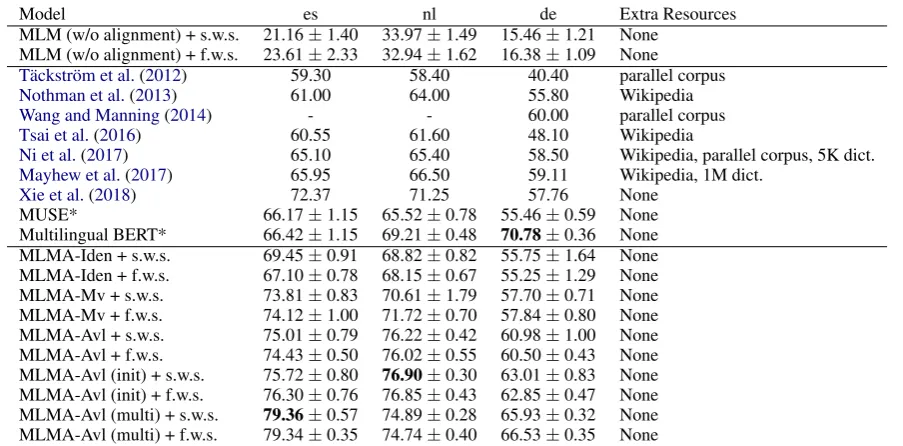
We first train a multilingual language model with-out alignment (MLM) and report its performance of cross-lingual NER in Table1. The poor perfor-mance demonstrates that only sharing part of the parameters in a language model is far from enough for cross-lingual transfer.
As shown in Table1, the mean/variance align-ment strategy (MLMA-Mv) is competitive with previous work which utilizes extra bilingual re-sources (Section5.1). The average linkage strat-egy (MLMA-Avl) performs a more precise
align-2
https://github.com/BYVoid/OpenCC
Model es nl de Extra Resources MLM (w/o alignment) + s.w.s. 21.16±1.40 33.97±1.49 15.46±1.21 None
MLM (w/o alignment) + f.w.s. 23.61±2.33 32.94±1.62 16.38±1.09 None
T¨ackstr¨om et al.(2012) 59.30 58.40 40.40 parallel corpus
Nothman et al.(2013) 61.00 64.00 55.80 Wikipedia
Wang and Manning(2014) - - 60.00 parallel corpus
Tsai et al.(2016) 60.55 61.60 48.10 Wikipedia
Ni et al.(2017) 65.10 65.40 58.50 Wikipedia, parallel corpus, 5K dict.
Mayhew et al.(2017) 65.95 66.50 59.11 Wikipedia, 1M dict.
Xie et al.(2018) 72.37 71.25 57.76 None
[image:6.595.75.527.60.283.2]MUSE* 66.17±1.15 65.52±0.78 55.46±0.59 None Multilingual BERT* 66.42±1.15 69.21±0.48 70.78±0.36 None MLMA-Iden + s.w.s. 69.45±0.91 68.82±0.82 55.75±1.64 None MLMA-Iden + f.w.s. 67.10±0.78 68.15±0.67 55.25±1.29 None MLMA-Mv + s.w.s. 73.81±0.83 70.61±1.79 57.70±0.71 None MLMA-Mv + f.w.s. 74.12±1.00 71.72±0.70 57.84±0.80 None MLMA-Avl + s.w.s. 75.01±0.79 76.22±0.42 60.98±1.00 None MLMA-Avl + f.w.s. 74.43±0.50 76.02±0.55 60.50±0.43 None MLMA-Avl (init) + s.w.s. 75.72±0.80 76.90±0.30 63.01±0.83 None MLMA-Avl (init) + f.w.s. 76.30±0.76 76.85±0.43 62.85±0.47 None MLMA-Avl (multi) + s.w.s. 79.36±0.57 74.89±0.28 65.93±0.32 None MLMA-Avl (multi) + f.w.s. 79.34±0.35 74.74±0.40 66.53±0.35 None
Table 1: NER F1 scores on test sets of European languages. For previous work which reports multiple results, we only list their best performance on each language. Results of methods with mark * are obtained by running their released source code or models. The results of MUSE embeddings are produced by using them for direct model transfer. “MLM” denotes our multilingual language model without alignment. The three alignment methods,Iden
= identical strings, Mv= mean and variance, Avl= average linkage, respectively. “s.w.s” and “f.w.s.” are self-weighted sum and fully-self-weighted sum. “init” represents using MUSE to initialize the embedding matrices in the MLMA. “multi” refer to the multi-source transfer.
Model zh
Wang and Manning(2014) 64.40
MUSE* 35.35±0.84
Xie et al.(2018)* 44.13±1.49
Our methods
MLMA-Iden + s.w.s. 11.08±0.89 MLMA-Iden + f.w.s. 11.17±0.69 MLMA-Avl + s.w.s. 50.11±1.51 MLMA-Avl + f.w.s. 45.88±2.49 MLMA-Avl (init) + s.w.s 60.33±1.39 MLMA-Avl (init) + f.w.s 58.92±1.22
Table 2: NER F1 scores on test sets for Chinese. The notations are the same as Table1. Methods with mark
require parallel corpora.
ment and gains a further improvement. We con-ducted experiments of using all three alignments together, and results show no significant improve-ment over average linkage alone. These results agree with our statements that average linkage per-forms a more precise matching, and thus, carries the benefits brought by the other methods.
To demonstrate the strengths of the pro-posed cross-lingual contextualized representations (CLCRs) over cross-lingual word embeddings (CLWEs), we also report the results of using CLWEs for direct model transfer in Table 1. Specifically, we compare with the unsupervised method MUSE from Conneau et al.(2017). The
experiment results demonstrate its effectiveness for cross-lingual sequence labeling. The align-ment method using identical strings (MLMA-Iden) outperforms MUSE, suggesting that the contextual-level representations are more effective than the word-level ones. The other proposed methods (MLMA-Mv and MLMA-Avl) achieve significant improvement over MUSE and MLMA-Iden, which shows the benefit of directly aligning the contextualized representations.
Combination with CLWEs We further demon-strate that CLWEs are compatible with our meth-ods by using MUSE embeddings to initialize the embedding layer of our multilingual language model. The results of MLMA-Avl (init) shown in Table 1indicate that the CLWEs lead to a better initialization and improved performance.
[image:6.595.94.269.396.510.2]Model es nl de da el it pt sv Avg.
Das and Petrov(2011) 84.2 79.5 82.8 83.2 82.5 86.8 87.9 80.5 83.31
Fang and Cohn(2017)† 68.40 64.50 65.90 73.5 65.5 64.8 67.8 66.0 67.05
Fang and Cohn(2017)†‡ 81.20 82.30 78.90 81.9 80.1 81.9 82.1 78.1 80.81
Xie et al.(2018)* 73.25 75.46 80.72 29.75 71.65 71.19 76.48 64.36 67.86
MUSE* 78.30 80.84 81.10 73.99 63.16 80.63 82.79 66.38 75.90
Multilingual BERT* 83.86 84.79 87.16 83.77 82.27 88.39 87.86 81.07 84.90
Our methods
[image:7.595.69.544.61.227.2]MLMA-Avl + s.w.s. 81.60 85.10 84.10 83.38 77.04 84.46 86.93 80.78 82.92 MLMA-Avl + f.w.s. 81.20 85.54 84.92 83.45 77.48 84.80 87.43 80.72 83.19 MLMA-Avl (init) + s.w.s. 82.73 85.79 85.76 82.44 80.55 86.76 85.99 79.75 83.72 MLMA-Avl (init) + f.w.s. 82.27 85.97 86.37 82.25 81.31 86.28 86.53 80.00 83.87
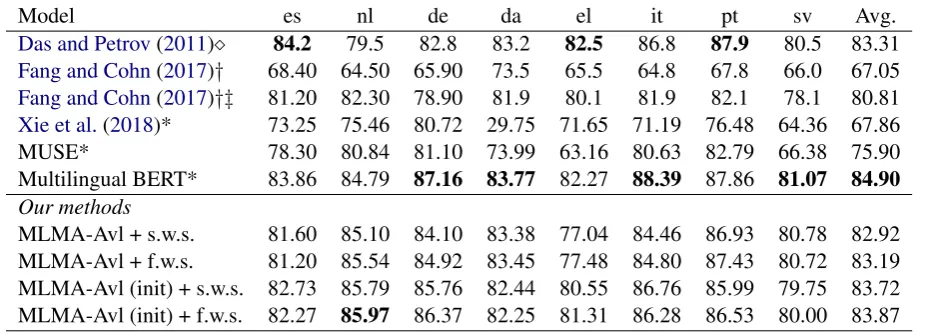
Table 3: POS accuracy on test sets of European languages. The notations are consistent with Table1. Fang and Cohn(2017) report different results according to different resource requirements. We only list their best results in each setting. Methods with mark,†,‡require parallel corpora, bilingual lexicons, and training data respectively.
Dutch. The multi-source transfer leads to a sig-nificant improvement for Spanish and German, but a slight decline for Dutch. In the follow-up experiment, we find that the Spanish training set achieves a poor cross-lingual performance on Dutch. Similar results are observed in the experi-ments of Spanish to English and Dutch to English. These results suggest that the cross-lingual trans-fer may be directional, and we leave this issue for future work.
Comparison with BERT We also compare the performance of our MLMA with the released mul-tilingual BERT (Devlin et al.,2018). As shown in Table1, our MLMA-Avl achieves a better perfor-mance on Spanish and Dutch. For German, BERT achieves a high performance as it employs effec-tive subword information through BPE. The archi-tecture of BERT also performs better than LSTM. It is worth mentioning that, in previous work and this work, the corpora used in the experi-ments are limited to the source and the target language. In contrast, the multilingual BERT is jointly learned on Wikipedia of 102 languages and may benefit from a multi-hop transfer. BERT employs a shared BPE vocabulary for different languages, which implicitly performs a subword alignment similar to MLMA-Iden. Meanwhile, the proposed MLMA-Mv and MLMA-Avl meth-ods are compatible with BERT and can be used to align the inner states of BERT.
3.5 A Case Study of Chinese NER
We conduct experiments and evaluate our ap-proaches on a distant language pair, English-Chinese. The experiment results are shown in
Ta-ble2. Wang and Manning(2014) utilize 80K par-allel sentences for annotation projection and report a strong performance. As Chinese and English do not share the alphabet, the number of identi-cal strings is significantly smaller than similar lan-guages pairs such as English-Spanish. Therefore, the MLMA-Iden achieves a lower result compar-ing to MUSE which uses adversarial traincompar-ing. The MLMA-Avl method performs a direct alignment of internal representations and achieves a signif-icant improvement over the word-level methods. The initialization from CLWEs also proves its ef-fectiveness for distant language pairs by gaining further improvement and reaching a comparable result with Wang and Manning(2014). This ex-periment suggests that cross-lingual transfer is still challenging between distant language pairs.
3.6 Results for POS
MUSE
brown: oliv´aceo (olive), negruzcas (blackish), negruzco (blackish), marr´on (brown), ocr´aceo (ochraceous)
chair: vicepresidenta (vice president), vicedecano (vice dean), c´atedra (chair), vicedecana (vice dean), catedr´atico (professor)
[image:8.595.71.531.97.206.2]MLMA-Avl
[Brown]’s office told news outlets of his visit to Afghanistan ...
[Neira]escap´o meses despu´es rumbo a Miami para ... (Neiraescaped months later heading to Miami to ...) Wearing a[brown]suit with
matching hat, ...
La corona y vientre del macho son de un[verde]esmeralda brillante iridiscente, ... (The crown and belly of the male are of an iridescent bright emeraldgreen, ...) Sweden currently holds
the EU[chair].
Tras tomar posesi´on de su[asiento], Lois decide limpiar el lago para empezar, ... (After taking possession of herseat, Lois decides to clean the lake to begin, ... ) It’s an honor to be asked to
[chair]the Man Booker Prize, ...
..., y fue la primera mujer en[presidir]un sindicato AFL-CIO. (..., and was the first woman topresideover an AFL-CIO union.)
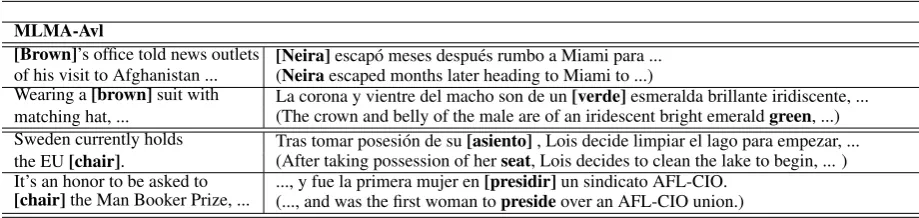
Table 4: English words and their nearest Spanish words according to MUSE and MLMA-Avl.
multilingual BERT to the POS task.4
POS mainly relies on the information of each single word, and parallel corpora providing word alignment are effective for cross-lingual POS. Thus, previous annotation projection methods through parallel corpora are strong approaches for cross-lingual POS and often achieve a signif-icantly better performance against previous unsu-pervised methods. The experimental results show that the proposed CLCRs are competitive and even achieve better average accuracy.
3.7 Self-Weighted v.s. Fully-Weighted Sum
As shown in Table 1, 2 and 3, we observe that Self-Weighted Sum (SWS) generally outperforms Fully-Weighted Sum (FWS) in NER tasks, while the opposite is true for POS tasks. SWS allows weights to vary at each position in a sequence, while FWS imposes adaptive weights for each hid-den dimension. We hypothesize that NER is more context-sensitive and requires models to adapt to different context information, which makes SWS a better option. On the other hand, the POS of words is more independent across different con-text, but certain feature dimensions in contextual-ized representations may be critical for making a judgment. Therefore, FWS has the edge over SWS for its ability to select out these dimensions.
4 What is Connected during Alignment?
In this section, we dive into the MLMA and in-vestigate the question of what is connected be-tween different languages during the alignment. From English 1B and Spanish Wikipedia, we ran-domly select 1,000 sentences for each language
4The poor performance ofXie et al.(2018) on en-da is
due to the low quality of word translation pairs generated by their method.
and extract their cross-lingual contextual represen-tations using our MLMA-Avl model. We calculate the nearest neighbors in cosine distance for each word, and some of them are listed in Table4.
In these cases, the MLMA can disambiguate word senses according to context information. For example, for the wordbrown in English, the MLMA groups color brown with verde (green), and name Brown with Neira (a person name in Spanish) in the Spanish corpus. The proposed method is different from unsupervised translation in that, instead of learning a precise matching between English and Spanish words, the CLCRs establishes a high-level semantic connection be-tween the source and the target language. The next example demonstrates that the MLMA is able to distinguish the part-of-speech of words. It con-nects an English verb chair with a Spanish verb
presidir(preside), while a nounchairwith a noun
asiento(seat) in Spanish. To compare with unsu-pervised cross-lingual word embeddings, we list the top 5 similar words calculated using MUSE. As shown in Table4, MUSE successfully groups the English wordbrown with Spanish words that are related to colors. However, without the help of contextual information, its ability of word sense disambiguation is limited.
5 Related Work
Previous work in cross-lingual transfer learning can be roughly divided into two main branches: annotation projection and model transfer.
5.1 Annotation Projection
2013;Wang and Manning,2014;Ni et al.,2017). The source language sentences of parallel corpora are first annotated either manually or by a pre-trained tagger. Then, annotations on the source side are projected to the target side through word alignment to generate distantly supervised train-ing data. Finally, a model of the target language is trained on the generated data. Wikipedia con-tains multilingual articles for various topics and can thus be used to generate parallel/comparable corpora or even weakly annotated target language sentences (Kim et al.,2012).
However, parallel corpora and Wikipedia can be rare for true low-resource languages. May-hew et al.(2017) reduce the resource requirement by proposing a cheap translation method, which “translates” the training data from the source to the target language word by word through a bilin-gual lexicon. While Xie et al.(2018) reduce the requirement of bilingual lexicons by an unsuper-vised word-by-word translation through CLWEs.
5.2 Model Transfer
Model transfer methods train a model on the source language with language-independent fea-tures. Thus, the trained model can be directly ap-plied to the target language.
McDonald et al. (2011) design a cross-lingual parser based on delexicalized features like uni-versal POS tags. T¨ackstr¨om et al. (2012) re-veal that cross-lingual word cluster features in-duced using large parallel corpora are useful. Lex-icon and Wikipedia also demonstrate effectiveness for language-independent feature engineering.
Zirikly and Hagiwara(2015) generate multilingual gazetteers from the source language gazetteers and comparable corpus. Page categories and link-age information to entries from Wikipedia are ex-tracted as strong language-independent features (wikifier features) (Tsai et al., 2016). Bharadwaj et al. (2016) facilitate the cross-lingual transfer through phonetic features, which work well be-tween languages like Turkish, Uzbek, and Uyghur, but are not strictly language independent. Re-cently, CLWEs are used as language-invariant rep-resentations for direct model transfer in NER (Ni et al.,2017) and POS (Fang and Cohn,2017).
Some of the previous work also proposes se-quence labeling models with shared parameters between languages for performing cross-lingual knowledge transfer (Lin et al.,2018;Cotterell and
Duh,2017;Yang et al.,2017;Ammar et al.,2016;
Kim et al.,2017). However, these models are usu-ally obtained through joint learning and require annotated data from the target language.
6 Conclusion
In this paper, we focused on a low-resources cross-lingual setting and proposed transfer learn-ing methods based on the alignment of deep se-mantic spaces between different languages. The proposed multilingual language model bridges dif-ferent languages by automatically learning cross-lingual disambiguated representations. Abundant NER and POS experiments are conducted on the benchmark datasets. Experimental results show that our approaches using only monolingual cor-pora achieve improved performance comparing to previous strong cross-lingual studies with extra re-sources.
References
Omri Abend and Ari Rappoport. 2013. Universal con-ceptual cognitive annotation (UCCA). In Proceed-ings of the 51st Annual Meeting of the Association for Computational Linguistics (Volume 1: Long Pa-pers), pages 228–238, Sofia, Bulgaria. Association for Computational Linguistics.
Waleed Ammar, George Mulcaire, Miguel Ballesteros, Chris Dyer, and Noah Smith. 2016. Many lan-guages, one parser. Transactions of the Association for Computational Linguistics, 4:431–444.
Akash Bharadwaj, David Mortensen, Chris Dyer, and Jaime Carbonell. 2016. Phonologically aware neu-ral model for named entity recognition in low re-source transfer settings. InProceedings of the 2016 Conference on Empirical Methods in Natural Lan-guage Processing, pages 1462–1472. Association for Computational Linguistics.
Sabine Buchholz and Erwin Marsi. 2006. Conll-x shared task on multilingual dependency parsing. In
Proceedings of the Tenth Conference on Computa-tional Natural Language Learning, CoNLL-X ’06, pages 149–164, Stroudsburg, PA, USA. Association for Computational Linguistics.
Ciprian Chelba, Tomas Mikolov, Mike Schuster, Qi Ge, Thorsten Brants, Phillipp Koehn, and Tony Robin-son. 2013. One billion word benchmark for measur-ing progress in statistical language modelmeasur-ing. arXiv preprint arXiv:1312.3005.
Alexis Conneau, Guillaume Lample, Marc’Aurelio Ranzato, Ludovic Denoyer, and Herv´e J´egou. 2017. Word translation without parallel data. arXiv preprint arXiv:1710.04087.
Ryan Cotterell and Kevin Duh. 2017. Low-resource named entity recognition with cross-lingual, character-level neural conditional random fields. InProceedings of the Eighth International Joint Conference on Natural Language Processing (Volume 2: Short Papers), pages 91–96. Asian Fed-eration of Natural Language Processing.
Dipanjan Das and Slav Petrov. 2011. Unsupervised part-of-speech tagging with bilingual graph-based projections. In Proceedings of the 49th Annual Meeting of the Association for Computational Lin-guistics: Human Language Technologies - Volume 1, HLT ’11, pages 600–609, Stroudsburg, PA, USA. Association for Computational Linguistics.
Jacob Devlin, Ming-Wei Chang, Kenton Lee, and Kristina Toutanova. 2018. Bert: Pre-training of deep bidirectional transformers for language understand-ing. arXiv preprint arXiv:1810.04805.
Maud Ehrmann, Marco Turchi, and Ralf Steinberger. 2011. Building a multilingual named entity-annotated corpus using annotation projection. In
Proceedings of the International Conference Recent Advances in Natural Language Processing 2011, pages 118–124. Association for Computational Lin-guistics.
Meng Fang and Trevor Cohn. 2017. Model transfer for tagging low-resource languages using a bilingual dictionary. InProceedings of the 55th Annual Meet-ing of the Association for Computational LMeet-inguistics (Volume 2: Short Papers), pages 587–593. Associa-tion for ComputaAssocia-tional Linguistics.
Eduard Hovy, Mitchell Marcus, Martha Palmer, Lance Ramshaw, and Ralph Weischedel. 2006. Ontonotes: The 90% solution. In Proceedings of the Human Language Technology Conference of the NAACL, Companion Volume: Short Papers, NAACL-Short ’06, pages 57–60, Stroudsburg, PA, USA. Associa-tion for ComputaAssocia-tional Linguistics.
S´ebastien Jean, Kyunghyun Cho, Roland Memisevic, and Yoshua Bengio. 2015. On using very large target vocabulary for neural machine translation. In Proceedings of the 53rd Annual Meeting of the Association for Computational Linguistics and the 7th International Joint Conference on Natural Lan-guage Processing (Volume 1: Long Papers), pages 1–10. Association for Computational Linguistics.
Joo-Kyung Kim, Young-Bum Kim, Ruhi Sarikaya, and Eric Fosler-Lussier. 2017. Cross-lingual transfer learning for pos tagging without cross-lingual re-sources. In Proceedings of the 2017 Conference on Empirical Methods in Natural Language Pro-cessing, pages 2832–2838. Association for Compu-tational Linguistics.
Sungchul Kim, Kristina Toutanova, and Hwanjo Yu. 2012. Multilingual named entity recognition using parallel data and metadata from wikipedia. In Pro-ceedings of the 50th Annual Meeting of the Associa-tion for ComputaAssocia-tional Linguistics (Volume 1: Long Papers), pages 694–702. Association for Computa-tional Linguistics.
Diederik P Kingma and Jimmy Ba. 2014. Adam: A method for stochastic optimization. arXiv preprint arXiv:1412.6980.
Guillaume Lample, Miguel Ballesteros, Sandeep Sub-ramanian, Kazuya Kawakami, and Chris Dyer. 2016.
Neural architectures for named entity recognition. InProceedings of the 2016 Conference of the North American Chapter of the Association for Computa-tional Linguistics: Human Language Technologies, pages 260–270. Association for Computational Lin-guistics.
Qi Li, Haibo Li, Heng Ji, Wen Wang, Jing Zheng, and Fei Huang. 2012. Joint bilingual name tagging for parallel corpora. InProceedings of the 21st ACM In-ternational Conference on Information and Knowl-edge Management, CIKM ’12, pages 1727–1731, New York, NY, USA. ACM.
Yanghao Li, Naiyan Wang, Jiaying Liu, and Xiaodi Hou. 2017. Demystifying neural style transfer.
arXiv preprint arXiv:1701.01036.
Ying Lin, Shengqi Yang, Veselin Stoyanov, and Heng Ji. 2018. A multi-lingual multi-task architecture for low-resource sequence labeling. InProceedings of the 56th Annual Meeting of the Association for Com-putational Linguistics (Volume 1: Long Papers), pages 799–809. Association for Computational Lin-guistics.
Mingsheng Long, Yue Cao, Jianmin Wang, and Michael I Jordan. 2015. Learning transferable fea-tures with deep adaptation networks. arXiv preprint arXiv:1502.02791.
Edward Loper and Steven Bird. 2002. Nltk: The natu-ral language toolkit. InProceedings of the ACL-02 Workshop on Effective tools and methodologies for teaching natural language processing and computa-tional linguistics-Volume 1, pages 63–70. Associa-tion for ComputaAssocia-tional Linguistics.
Xuezhe Ma and Eduard Hovy. 2016. End-to-end se-quence labeling via bi-directional lstm-cnns-crf. In
Proceedings of the 54th Annual Meeting of the As-sociation for Computational Linguistics (Volume 1: Long Papers), pages 1064–1074. Association for Computational Linguistics.
Stephen Mayhew, Chen-Tse Tsai, and Dan Roth. 2017.
Ryan McDonald, Slav Petrov, and Keith Hall. 2011.
Multi-source transfer of delexicalized dependency parsers. InProceedings of the 2011 Conference on Empirical Methods in Natural Language Process-ing, pages 62–72. Association for Computational Linguistics.
Benjamin Moseley and Joshua Wang. 2017. Approxi-mation bounds for hierarchical clustering: Average linkage, bisecting k-means, and local search. In Ad-vances in Neural Information Processing Systems, pages 3094–3103.
Mark EJ Newman. 2012. Communities, modules and large-scale structure in networks. Nature physics, 8(1):25.
Jian Ni, Georgiana Dinu, and Radu Florian. 2017.
Weakly supervised cross-lingual named entity recognition via effective annotation and represen-tation projection. In Proceedings of the 55th An-nual Meeting of the Association for Computational Linguistics (Volume 1: Long Papers), pages 1470– 1480. Association for Computational Linguistics.
Joakim Nivre, Johan Hall, Sandra K¨ubler, Ryan Mc-Donald, Jens Nilsson, Sebastian Riedel, and Deniz Yuret. 2007. The conll 2007 shared task on depen-dency parsing. In Proceedings of the 2007 Joint Conference on Empirical Methods in Natural guage Processing and Computational Natural Lan-guage Learning (EMNLP-CoNLL).
Joakim Nivre, Marie-Catherine de Marneffe, Filip Gin-ter, Yoav Goldberg, Jan Hajic, Christopher D. Man-ning, Ryan McDonald, Slav Petrov, Sampo Pyysalo, Natalia Silveira, Reut Tsarfaty, and Daniel Zeman. 2016. Universal dependencies v1: A multilingual treebank collection. InProceedings of the Tenth In-ternational Conference on Language Resources and Evaluation (LREC 2016).
Joel Nothman, Nicky Ringland, Will Radford, Tara Murphy, and James R. Curran. 2013. Learning mul-tilingual named entity recognition from wikipedia.
Artif. Intell., 194:151–175.
Matthew E Peters, Mark Neumann, Mohit Iyyer, Matt Gardner, Christopher Clark, Kenton Lee, and Luke Zettlemoyer. 2018. Deep contextualized word rep-resentations. arXiv preprint arXiv:1802.05365.
Slav Petrov, Dipanjan Das, and Ryan McDonald. 2011a. A universal part-of-speech tagset. arXiv preprint arXiv:1104.2086.
Slav Petrov, Dipanjan Das, and Ryan T. McDonald. 2011b. A universal part-of-speech tagset. CoRR, abs/1104.2086.
Alec Radford, Karthik Narasimhan, Tim Salimans, and Ilya Sutskever. 2018. Improving language under-standing by generative pre-training.
Hamid K Seifoddini. 1989. Single linkage versus av-erage linkage clustering in machine cells formation applications. Computers & Industrial Engineering, 16(3):419–426.
Samuel L Smith, David HP Turban, Steven Hamblin, and Nils Y Hammerla. 2017. Offline bilingual word vectors, orthogonal transformations and the inverted softmax. arXiv preprint arXiv:1702.03859.
Oscar T¨ackstr¨om, Dipanjan Das, Slav Petrov, Ryan McDonald, and Joakim Nivre. 2013. Token and type constraints for cross-lingual part-of-speech tagging.
Transactions of the Association for Computational Linguistics, 1:1–12.
Oscar T¨ackstr¨om, Ryan McDonald, and Jakob Uszko-reit. 2012. Cross-lingual word clusters for direct transfer of linguistic structure. InProceedings of the 2012 Conference of the North American Chapter of the Association for Computational Linguistics: Hu-man Language Technologies, pages 477–487. Asso-ciation for Computational Linguistics.
Erik F. Tjong Kim Sang. 2002. Introduction to the CoNLL-2002 shared task: Language-independent named entity recognition. In COLING-02: The 6th Conference on Natural Language Learning 2002 (CoNLL-2002).
Erik F. Tjong Kim Sang and Fien De Meulder. 2003. Introduction to the CoNLL-2003 shared task: Language-independent named entity recognition. In
Proceedings of the Seventh Conference on Natu-ral Language Learning at HLT-NAACL 2003, pages 142–147.
Chen-Tse Tsai, Stephen Mayhew, and Dan Roth. 2016.
Cross-lingual named entity recognition via wikifica-tion. InProceedings of The 20th SIGNLL Confer-ence on Computational Natural Language Learning, pages 219–228. Association for Computational Lin-guistics.
Eric Tzeng, Judy Hoffman, Ning Zhang, Kate Saenko, and Trevor Darrell. 2014. Deep domain confusion: Maximizing for domain invariance. arXiv preprint arXiv:1412.3474.
Ashish Vaswani, Noam Shazeer, Niki Parmar, Jakob Uszkoreit, Llion Jones, Aidan N Gomez, Łukasz Kaiser, and Illia Polosukhin. 2017. Attention is all you need. InAdvances in Neural Information Pro-cessing Systems, pages 5998–6008.
Mengqiu Wang and Christopher D. Manning. 2014.
Cross-lingual projected expectation regularization for weakly supervised learning. Transactions of the Association for Computational Linguistics, 2:55–66.
Zhilin Yang, Ruslan Salakhutdinov, and William W Cohen. 2017. Transfer learning for sequence tag-ging with hierarchical recurrent networks. arXiv preprint arXiv:1703.06345.
David Yarowsky, Grace Ngai, and Richard Wicen-towski. 2001. Inducing multilingual text analysis tools via robust projection across aligned corpora. InProceedings of the First International Conference on Human Language Technology Research, HLT ’01, pages 1–8, Stroudsburg, PA, USA. Association for Computational Linguistics.
Odilia Yim and Kylee T Ramdeen. 2015. Hierarchical cluster analysis: comparison of three linkage mea-sures and application to psychological data. The quantitative methods for psychology, 11(1):8–21.