Relieving the Computational Bottleneck: Joint Inference for
Event Extraction with High-Dimensional Features
Deepak Venugopal and Chen Chen and Vibhav Gogate and Vincent Ng Department of Computer Science and Human Language Technology Research Institute
University of Texas at Dallas Richardson, TX 75083-0688
[email protected],{yzcchen,vgogate,vince}@hlt.utdallas.edu
Abstract
Several state-of-the-art event extraction sys-tems employ models based on Support Vec-tor Machines (SVMs) in a pipeline architec-ture, which fails to exploit the joint depen-dencies that typically exist among events and arguments. While there have been at-tempts to overcome this limitation using Markov Logic Networks (MLNs), it re-mains challenging to perform joint infer-ence in MLNs when the model encodes many high-dimensional sophisticated fea-tures such as those essential for event ex-traction. In this paper, we propose a new model for event extraction that combines the power of MLNs and SVMs, dwarfing their limitations. The key idea is to reli-ably learn and process high-dimensional features using SVMs; encode the output of SVMs as low-dimensional, soft formu-las in MLNs; and use the superior joint in-ferencing power of MLNs to enforce joint consistency constraints over the soft for-mulas. We evaluate our approach for the task of extracting biomedical events on the BioNLP 2013, 2011 and 2009 Genia shared task datasets. Our approach yields the best F1 score to date on the BioNLP’13 (53.61) and BioNLP’11 (58.07) datasets and the second-best F1 score to date on the BioNLP’09 dataset (58.16).
1 Introduction
Event extraction is the task of extracting and la-beling all instances in a text document that corre-spond to a pre-defined event type. This task is quite challenging for a multitude of reasons: events are often nested, recursive and have several arguments; there is no clear distinction between arguments and events; etc. For instance, consider the BioNLP Ge-nia event extraction shared task (N´edellec et al.,
2013). In this task, participants are asked to extract instances of a pre-defined set of biomedical events from text. An event is identified by a keyword called thetriggerand can have an arbitrary number of arguments that correspond to pre-defined argu-ment types. The task is complicated by the fact that an event may serve as an argument of another event (nested events). An example of the task is shown in Figure 1. As we can see, eventE13takes as arguments two events,E14andE12, which in turn hasE11as one of its arguments.
A standard method that has been frequently em-ployed to perform this shared task uses apipeline
architecture with three steps: (1) detect if a token is a trigger and assign a trigger type label to it; (2) for every detected trigger, determine all its argu-ments and assign types to each detected argument; and (3) combine the extracted triggers and argu-ments to obtain events. Though adopted by the top-performing systems such as the highest scoring system on the BioNLP’13 Genia shared task (Kim et al., 2013), this approach is problematic for at least two reasons. First, as is typical in pipeline architectures, errors may propagate from one stage to the next. Second, since each event/argument is identified and assigned a type independently of the others, it fails to capture the relationship between a trigger and its neighboring triggers, an argument and its neighboring arguments, etc.
More recently, researchers have investigated joint inference techniques for event extraction us-ing Markov Logic Networks (MLNs) (e.g., Poon and Domingos (2007), Poon and Vanderwende (2010), Riedel and McCallum (2011a)), a statis-tical relational model that enables us to model the dependencies between different instances of a data sample. However, it is extremely challenging to make joint inference using MLNs work well in practice (Poon and Domingos, 2007). One reason is that it is generally difficult to model sophisti-cated linguistic features using MLNs. The
. . .demonstrated that HOIL-1L interacting protein (HOIP), a ubiquitin ligase that can catalyze the assembly of linear polyubiquitin chains, is recruited to DC40 in a TRAF2-dependent manner following engagement of CD40. . .
(a) Sentence fragment
ID Event Type Trigger Arguments
E11 Binding recruited Theme={HOIL-1L interacting protein,CD40} E12 Regulation dependent Theme=E11,Cause=TRAF2
E13 +ve Regulation following Theme=E12,Cause=E14
E14 Binding engagement Theme=CD40 (b) Events
Figure 1: Example of event extraction in the BioNLP Genia task. The table in (b) shows all the events extracted from sentence (a). Note that successful extraction ofE13depends onE12andE14.
culty stems from the fact that some of these fea-tures are extremely high dimensional (e.g., Chen and Ng (2012), Huang and Riloff (2012b), Li et al. (2012), Li et al. (2013b), Li et al. (2013c)), and to reliably learn weights of formulas that encode such features, one would require an enormous number of data samples. Moreover, even the complexity of approximate inference on such models is quite high, often prohibitively so. For example, a trigram can be encoded as an MLN formula,Word(w1,p−1)∧
Word(w2,p)∧Word(w3,p+ 1)⇒Type(p,T).
For any given position (p), this formula has W3
groundings, whereW is the number of possible words, making it too large for learning/inference. Therefore, current MLN-based systems tend to in-clude a highly simplified model ignoring powerful linguistic features. This is problematic because such features are essential for event extraction.
Our contributions in this paper are two-fold. First, we propose a novel model for biomedical event extraction based on MLNs that addresses the aforementioned limitations by leveraging the power of Support Vector Machines (SVMs) (Vapnik, 1995; Joachims, 1999) to handle high-dimensional features. Specifically, we (1) learn SVM models us-ing rich lus-inguistic features for trigger and argument detection and type labeling; (2) design an MLN composed ofsoft formulas(each of which encodes a soft constraint whose associated weight indicates how important it is to satisfy the constraint) and
hard formulas(constraints that always need to be satisfied, thus having a weight of∞) to capture the relational dependencies between triggers and arguments; and (3) encode the SVM output asprior knowledgein the MLN in the form of soft formulas, whose weights are computed using the confidence values generated by the SVMs. This formulation naturally allows SVMs and MLNs to complement each other’s strengths and weaknesses: learning
in a large and sparse feature space is much easier with SVMs than with MLNs, whereas modeling relational dependencies is much easier with MLNs than with SVMs.
Our second contribution concerns making infer-ence with this MLN feasible. Recall that inferinfer-ence involves detecting and assigning the type label to all the triggers and arguments. We show that exist-ing Maximum-a-posteriori (MAP) inference meth-ods, even the most advanced approximate ones (e.g., Selman et al. (1996), Marinescu and Dechter (2009), Sontag and Globerson (2011) ), are infea-sible on our proposed MLN because of their high memory cost. Consequently, we identify decompo-sitions of the MLN into disconnected components and solve each independently, thereby drastically reducing the memory requirements.
We evaluate our approach on the BioNLP 2009, 2011 and 2013 Genia shared task datasets. On the BioNLP’13 dataset, our model significantly outperforms state-of-the-art pipeline approaches and achieves the best F1 score to date. On the BioNLP’11 and BioNLP’09 datasets, our scores are slightly better and slightly worse respectively than the best reported results. However, they are significantly better than state-of-the-art MLN-based systems.
2 Background
2.1 Related Work
tasks on event extraction. Previous work on event extraction can be broadly divided into two cate-gories, one focusing on the development of fea-tures (henceforthfeature-based approaches) and the other focusing on the development of models (henceforthmodel-basedapproaches).
Feature-based approaches. Early work on feature-based approaches has primarily focused on designing local sentence-level features such as token and syntactic features (Grishman et al., 2005; Ahn, 2006). Later, it was realized that local features were insufficient to reliably and accurately perform event extraction in complex domains and therefore several researchers proposed usinghigh-level fea-tures. For instance, Ji and Grishman (2008) used global information from related documents; Gupta and Ji (2009) extracted implicit time information; Patwardhan and Riloff (2009) used broader sen-tential context; Liao and Grishman (2010; 2011) leveraged document-level cross-event information and topic-based features; and Huang and Riloff (2012b) explored discourse properties.
Model-based approaches. The model-based ap-proaches developed to date have focused on mod-eling global properties and seldom use rich, high-dimensional features. To capture global event struc-ture properties, McClosky et al. (2011a) proposed a dependency parsing model. To extract event ar-guments, Li et al. (2013b) proposed an Integer Linear Programming (ILP) model to encode the relationship between event mentions. To overcome the error propagation problem associated with the pipeline architecture, several joint models have been proposed, including those that are based on MLNs (e.g., Poon and Domingos (2007), Riedel et al. (2009), Poon and Vanderwende (2010)), struc-tured perceptrons (e.g., Li et al. (2013c)), and dual decomposition with minimal domain adaptation (e.g., Riedel and McCallum (2011a; 2011b)).
In light of the high annotation cost required by supervised learning-based event extraction systems, several semi-supervised, unsupervised, and rule-based systems have been proposed. For instance, Huang and Riloff (2012a) proposed a bootstrap-ping method to extract event arguments using only a small amount of annotated data; Lu and Roth (2012) developed a novel unsupervised sequence labeling model; Bui et al. (2013) implemented a rule-based approach to extract biomedical events; and Ritter et al. (2012) used unsupervised learning to extract events from Twitter data.
Our work extends prior work by developing a rich framework that leverages sophisticated feature-based approaches as well as joint inference using MLNs. This combination gives us the best of both worlds because on one hand, it is challenging to model sophisticated linguistic features using MLNs while on the other hand, feature-based approaches employing sophisticated high-dimensional features suffer from error propagation as the model is gen-erally not rich enough for joint inference.
2.2 The Genia Event Extraction Task
The BioNLP Shared Task (BioNLP-ST) series (Kim et al. (2009), Kim et al. (2011a) and N´edellec et al. (2013)) is designed to tackle the problem of extracting structured information from the biomedi-cal literature. The Genia Event Extraction task is ar-guably the most important of all the tasks proposed in BioNLP-ST and is also the only task organized in all three events in the series.
The 2009 edition of the Genia task (Kim et al., 2009) was conducted on the Genia event corpus (Kim et al., 2008), which only contains abstracts of the articles that represent domain knowledge around NFκB proteins. The 2011 edi-tion (Kim et al., 2011b) augmented the dataset to include full text articles, resulting in two collec-tions, the abstract collection and the full text col-lection. The 2013 edition (Kim et al., 2013) further augmented the dataset with recent full text articles but removed the abstract collection entirely.
intro-duced a new event type, protein-mod, and its three sub-types. Theoretically, a protein-mod event takes exactly one protein as its T heme argument and optionally one protein or event as itsCause argu-ment. In practice, however, it rarely occurs: there are only six protein-mod events havingCause ar-guments in the training data for the 2013 edition. Consequently, our model makes the simplifying assumption that a protein-mod event can only take oneT hemeargument, meaning that we are effec-tively processing protein-mod events in the same way as simple events.
2.3 Markov Logic Networks
Statistical relational learning (SRL) (Getoor and Taskar, 2007) is an emerging field that seeks to unify logic and probability, and since most NLP techniques are grounded either in logic or proba-bility or both, NLP serves as an ideal application domain for SRL. In this paper, we will employ a popular SRL approach called Markov logic net-works (MLNs) (Domingos and Lowd, 2009). At a high level, an MLN is a set of weighted first-order logic formulas (fi, wi), where wi is the weight
associated with formula fi. Given a set of
con-stants that model objects in the domain, it defines a Markov network or a log-linear model (Koller and Friedman, 2009) in which we have one node per ground first-order atom and a propositional feature corresponding to each grounding of each first-order formula. The weight of the feature is the weight of the corresponding first-order formula.
Formally, the probability of a world ω, which represents an assignment of values to all ground atoms in the Markov network, is given by:
Pr(ω) = Z1 exp X
i
wiN(fi, ω)
!
whereN(fi, ω)is the number of groundings offi
that evaluate to True inωandZ is a normalization constant called the partition function.
The key inference tasks over MLNs are com-puting the partition function (Z) and the most-probable explanation given evidence (the MAP task). Most queries, including those required by event extraction, can be reduced to these inference tasks. Formally, the partition function and the MAP tasks are given by:
Z =X
ω
exp X
i
wiN(fi, ω)
!
(1)
arg max
ω P(ω) = arg maxω
X
i
wiN(fi, ω) (2)
3 Pipeline Model
We implement a pipeline event extraction system using SVMs. This pipeline model serves two im-portant functions: (1) providing a baseline for eval-uation and (2) producing prior knowledge for the joint model.
Our pipeline model consists of two steps: trig-ger labeling and argument labeling. In the trigtrig-ger labeling step, we determine whether a candidate trigger is a true trigger and label each true trigger with its trigger type. Then, in the argument label-ing step, we identify the arguments for each true trigger discovered in the trigger labeling step and assign a role to each argument.
We recast each of the two steps as a classification task and employSVMmulticlass (Tsochantaridis
et al., 2004) to train the two classifiers. We describe each step in detail below.
3.1 Trigger Labeling
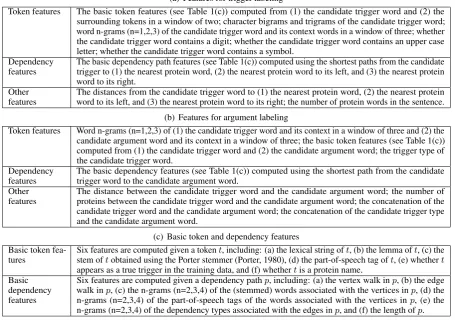
A preliminary study of the BioNLP’13 training data suggests that 98.7% of the true triggers’ head words1are either verbs, nouns or adjectives. There-fore, we consider only those words whose part-of-speech tags belong to the above three categories as candidate triggers. To train the trigger classifier, we create one training instance for each candidate trigger in the training data. If the candidate trigger is not a trigger, the class label of the corresponding instance isNone; otherwise, the label is the type of the trigger. Thus, the number of class labels equals the number of trigger types plus one. Each training instance is represented by the features de-scribed in Table 1(a). These features closely mirror those used in state-of-the-art trigger labeling sys-tems such as Miwa et al. (2010b) and Bj¨orne and Salakoski (2013).
After training, we apply the resulting trigger clas-sifier to classify the test instances, which are cre-ated in the same way as the training instances. If a test instance is predicted asNoneby the classifier, the corresponding candidate trigger is labeled as a non-trigger; otherwise, the corresponding candi-date trigger is posited as a true trigger whose type is the class value assigned by the classifier.
(a) Features for trigger labeling
Token features The basic token features (see Table 1(c)) computed from (1) the candidate trigger word and (2) the surrounding tokens in a window of two; character bigrams and trigrams of the candidate trigger word; word n-grams (n=1,2,3) of the candidate trigger word and its context words in a window of three; whether the candidate trigger word contains a digit; whether the candidate trigger word contains an upper case letter; whether the candidate trigger word contains a symbol.
Dependency
features The basic dependency path features (see Table 1(c)) computed using the shortest paths from the candidatetrigger to (1) the nearest protein word, (2) the nearest protein word to its left, and (3) the nearest protein word to its right.
Other
features The distances from the candidate trigger word to (1) the nearest protein word, (2) the nearest proteinword to its left, and (3) the nearest protein word to its right; the number of protein words in the sentence. (b) Features for argument labeling
Token features Word n-grams (n=1,2,3) of (1) the candidate trigger word and its context in a window of three and (2) the candidate argument word and its context in a window of three; the basic token features (see Table 1(c)) computed from (1) the candidate trigger word and (2) the candidate argument word; the trigger type of the candidate trigger word.
Dependency
features The basic dependency features (see Table 1(c)) computed using the shortest path from the candidatetrigger word to the candidate argument word. Other
features The distance between the candidate trigger word and the candidate argument word; the number ofproteins between the candidate trigger word and the candidate argument word; the concatenation of the candidate trigger word and the candidate argument word; the concatenation of the candidate trigger type and the candidate argument word.
(c) Basic token and dependency features Basic token
fea-tures Six features are computed given a tokenstem oftobtained using the Porter stemmer (Porter, 1980), (d) the part-of-speech tag oft, including: (a) the lexical string oft, (b) the lemma oft, (e) whethert, (c) thet
appears as a true trigger in the training data, and (f) whethertis a protein name. Basic
dependency features
[image:5.595.72.528.68.392.2]Six features are computed given a dependency pathp, including: (a) the vertex walk inp, (b) the edge walk inp, (c) the n-grams (n=2,3,4) of the (stemmed) words associated with the vertices inp, (d) the n-grams (n=2,3,4) of the part-of-speech tags of the words associated with the vertices inp, (e) the n-grams (n=2,3,4) of the dependency types associated with the edges inp, and (f) the length ofp.
Table 1: Features for trigger labeling and argument labeling.
3.2 Argument Labeling
The argument classifier is trained as follows. Each training instance corresponds to a candidate trigger and one of its candidate arguments.2A candidate argument for a candidate triggerctis either a pro-tein or a candidate trigger that appears in the same sentence asct. Ifctis not a true trigger, the label of the associated instance is set toNone. On the other hand, ifctis a true trigger, we check whether the candidate argument in the associated instance is in-deed one ofct’s arguments. If so, the class label of the instance is the argument’s role; otherwise, the class label isNone. The features used for repre-senting each training instance, which are modeled after those used in Miwa et al. (2010b) and Bj¨orne and Salakoski (2013), are shown in Table 1(b).
After training, we can apply the resulting clas-sifier to classify the test instances, which are cre-ated in the same way as the training instances. If a test instance is assigned the classNone by the classifier, the corresponding candidate argument is classified as not an argument of the trigger.
Other-2Following the definition of the GENIA event extraction task, the protein names are provided as part of the input.
wise, the candidate argument is a true argument of the trigger whose role is the class value assigned by the classifier.
4 Joint Model
In this section, we describe our Markov logic model that encodes the relational dependencies in the shared task and uses the output of the pipeline model as prior knowledge (soft evidence). We be-gin by describing the structure of our Markov logic model, and then describe the parameter learning and inference algorithms for it.
4.1 MLN Structure
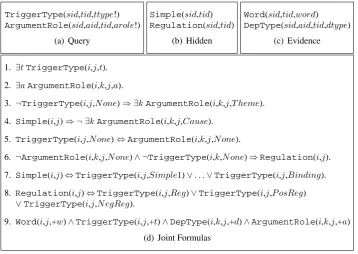
Figure 2 shows our proposed MLN for BioNLP event extraction, which we refer to as BioMLN. The MLN contains six predicates.
The query predicatesin Figure 2(a) are those whose assignments are not given during infer-ence and thus need to be predicted. Predicate TriggerType(sid,tid,ttype!) is true when the token located in sentencesidat position tidhas typettype. ∆ttype, which denotes the set of
TriggerType(sid,tid,ttype!)
ArgumentRole(sid,aid,tid,arole!) (a) Query
Simple(sid,tid)
Regulation(sid,tid) (b) Hidden
Word(sid,tid,word)
DepType(sid,aid,tid,dtype) (c) Evidence
1. ∃tTriggerType(i,j,t).
2. ∃aArgumentRole(i,k,j,a).
3. ¬TriggerType(i,j,None)⇒ ∃kArgumentRole(i,k,j,T heme).
4. Simple(i,j)⇒ ¬ ∃kArgumentRole(i,k,j,Cause).
5. TriggerType(i,j,None)⇔ArgumentRole(i,k,j,None).
6. ¬ArgumentRole(i,k,j,None)∧ ¬TriggerType(i,k,None)⇒Regulation(i,j).
7. Simple(i,j)⇔TriggerType(i,j,Simple1)∨. . .∨TriggerType(i,j,Binding).
8. Regulation(i,j)⇔TriggerType(i,j,Reg)∨TriggerType(i,j,P osReg)
∨TriggerType(i,j,NegReg).
9. Word(i,j,+w)∧TriggerType(i,j,+t)∧DepType(i,k,j,+d)∧ArgumentRole(i,k,j,+a)
[image:6.595.121.480.61.315.2](d) Joint Formulas
Figure 2: TheBioMLNstructure.
can be instantiated to, includes all possible trigger types in the dataset plusNone (which indicates that the token is not a trigger). The “!” symbol mod-els commonsense knowledge that only one of the types in the domain∆ttypeofttypeis true for every
unique combination ofsidandtid. Similarly, pred-icate ArgumentRole(sid,aid,tid,arole!) as-serts that a token in sentencesidat position aid playsexactly oneargument role, denoted byarole, with respect to the token at position tid. ∆arole
includes the two argument types, namely,T heme andCauseplus the additionalNonethat indicates that the token is not an argument.
The hidden predicates in Figure 2(b) are “clus-ters” of trigger types. PredicateSimple(sid,tid) is true when the token in sentence sid at posi-tion tid corresponds to one of the Simple event trigger types (BioNLP’13 has 9 simple events, BioNLP’09/’11 have 5) or a binding event trig-ger type. Similarly,Regulation(sid,tid) asserts that the token in sentencesidat positiontid corre-sponds to any of the three regulation event trigger types.
Theevidencepredicates in Figure 2(c) are those that are always assumed to be known during in-ference. We define two evidence predicates based on dependency structures.Word(sid,tid,word) is true when the word in sentencesidat positiontid is equal to word. DepType(sid,aid,tid,dtype) asserts thatdtypeis the dependency type in the
de-pendency parse tree that connects the token at posi-tiontidto the token at positionaidin sentencesid. If the word attidand the word ataidare directly connected in the dependency tree, thendtypeis the label of dependency edge with direction; otherwise dtypeisNone.
The MLN formulas, expressing commonsense, prior knowledge in the domain (Poon and Van-derwende, 2010; Riedel and McCallum, 2011a), are shown in Fig. 2(d). All formulas, except For-mula (9), are hard forFor-mulas, meaning that they have infinite weights. Note that during weight learning, we only learn the weights of soft formulas.
the relationship between triggers and arguments in a dependency parse tree. It joins a word and the dependency type label that connects the word token to the argument token in the dependency parse tree with the trigger types and argument types of the two tokens. The “+” symbol indicates that each grounding of Formula (9) may have a different weight.
4.2 Weight Learning
We can learnBioMLNfrom data either discrimina-tively or generadiscrimina-tively. Since discriminative learning is much faster than generative learning, we use the former. In discriminative training, we maximize the conditional log-likelihood (CLL) of the query and the hidden variables given an assignment to the evidence variables. In principle, we can use the standard gradient descent algorithm for maximiz-ing the CLL. In each iteration of gradient descent, we update the weights using the following equation (cf. Singla and Domingos (2005) and Domingos and Lowd (2009)):
wtj+1=wt
j −α(Ew(nj)−nj) (3)
wherewt
j represents the weight of thejthformula
in thetthiteration,n
jis the number of groundings
in which thejthformula is satisfied in the training
data, Ew(nj) is the expected number of
ground-ings in which thejthformula is satisfied given the
current weight vectorw, andαis the learning rate. As such, the update rule given in Equation (3) is likely to yield poor accuracy because the num-ber of training examples of some types (e.g., None) far outnumber other types. To rectify this ill-conditioning problem (Singla and Domingos, 2005; Lowd and Domingos, 2007), we divide the gradient with the number of true groundings in the data, namely, we compute the gradient using
(Ew(nj)−nj)
nj .
Another key issue with using Equation (3) is that computingEw(nj)requires performing inference
over the MLN. This step is intractable, #P-complete in the worst case. To circumvent this problem and for fast, scalable training, we instead propose to use the voted perceptron algorithm (Collins, 2002; Singla and Domingos, 2005). This algorithm ap-proximates Ew(nj) by counting the number of
satisfied groundings of each formula in the MAP assignment. Computing the MAP assignment is much easier (although still NP-hard in the worst case) than computingEw(nj), and as a result the
voted perceptron algorithm is more scalable than the standard gradient descent algorithm. In addi-tion, it converges much faster.
4.3 Testing
In the testing phase, we combineBioMLNwith the output of the pipeline model (see Section 3) to ob-tain a new MLN, which we refer to asBioMLN+.
For every candidate trigger, the SVM trigger clas-sifier outputs a vector of signed confidence val-ues (which is proportional to the distance from the separating hyperplane) of dimension ∆ttype
with one entry for each trigger type. Similarly, for every candidate argument, the SVM argu-ment classifier outputs a vector of signed confi-dence values of dimension ∆arole with one
en-try for each argument role. In BioMLN+, we
model the SVM output as soft evidence, using two soft unit clauses,TriggerType(i,+j,+t) and ArgumentRole(i,+k,+j,+a). We use the con-fidence values to determine the weights of these clauses. Intuitively, higher (smaller) the confidence, higher (smaller) the weight.
Specifically, the weights of the soft unit clauses are set as follows. If the SVM trigger classifier determines that the trigger in sentence i at po-sition j belongs to type t with confidence Ci,j,
then we attach a weight of Ci,jαni to the clause TriggerType(i,j,t). Here,nidenotes the
num-ber of trigger candidates in sentencei. Similarly, if the SVM argument classifier determines that the token at positionkin sentenceibelongs to the ar-gument roleawith respect to the token at position j, with confidenceC0
i,k,j, then we attach a weight
of Ci,k,j0 βPni
j=1mij to the clauseArgumentRole(i,k,
j,a). Here,mij denotes the number of argument
candidates for thejthtrigger candidate in sentence
i. αandβ act asscale parametersfor the confi-dence values ensuring that the weights don’t get too large (or too small).
4.4 Inference
As we need to perform MAP inference, both at training time and at test time, in this subsection we will describe how to do it efficiently by exploiting unique properties of our proposedBioMLN.
re-duced Markov network, we can then compute the MAP solution using standard MAP solvers such as MaxWalkSAT (a state-of-the-art local search based MAP solver) (Selman et al., 1996) and Gurobi3(a state-of-the-art, parallelized ILP solver).
The problem with the above approach is that grounding the MLN is infeasible in practice; even the reduced Markov network is just too large. For example, assuming a total of|∆sid|sentences and
a maximum ofN tokens in a sentence, Formula (3) alone hasO(|∆sid|N3)groundings. Concretely, at
training time, assuming 1000 sentences with 10 tokens per sentence, Formula (3) itself yields one million groundings. Clearly, this approach is not scalable. It turns out, however, that the (ground) Markov network can be decomposed into several disconnected components, each of which can be solved independently. This greatly reduces the memory requirement of the inference step. Specif-ically, for every grounding ofsid, we get a set of nodes in the Markov network that are disconnected from the rest of the Markov network and therefore independent of the rest of the network. Formally, Proposition 1. For any worldωof theBioMLN,
PM(ω) =PMi(ωi)PM\Mi(ω\ωi) (4)
whereωi is the worldωprojected on the
ground-ings of sentenceiandMi isBioMLNgrounded
only using sentencei.
Using Equation (4), it is easy to see that the MLN
Mcan be decomposed into|∆sid|disjoint MLNs,
{Mk}|k∆=1sid|. The MAP assignment toMcan be
computed using, |∆[sid|
i=1
arg max
ωi PMi(ωi)
. This result ensures that to approximate the expected countsEw(nj), it is sufficient to keep exactlyone
sentence’s groundings in memory. Specifically, Ew(nj)can be written asP|k∆=1sid|Ew(nkj), where
Ew(nkj)indicates the expected number of satisfied
groundings of thejthformula in thekthsentence.
Since the MAP computation is decomposable, we can estimateEw(nk
j)using MAP inference on just
thekthsentence.
5 Evaluation
5.1 Experimental Setup
We evaluate our system on the BioNLP’13 (Kim et al., 2013), ’11 (Kim et al., 2011a) and ’09 (Kim
3http://www.gurobi.com/
Dataset #Papers #Abstracts #TT #Events
BioNLP’13 (10,10,14) (0,0,0) 13 (2817,3199,3348)
BioNLP’11 (5,5,4) (800,150,260) 9 (10310,4690,5301)
BioNLP’09 (0,0,0) (800,150,260) 9 (8597,1809,3182)
Table 2: Statistics on the BioNLP datasets, which consist of annotated papers/abstracts from PubMed. (x, y, z): x in training,y in development andz in test.#TT indicates the total number of trigger types. The total number of argument types is2.
et al., 2009) Genia datasets for the main event ex-traction shared task. Note that this task is the most important one for Genia and therefore has the most active participation. Statistics on the datasets are shown in Table 2. All our evaluations use the on-line tool provided by the shared task organizers. We report scores obtained using theapproximate span, recursiveevaluation.
To generate features, we employ the support-ing resources provided by the organizers. Specif-ically, sentence split and tokenization are done using the GENIA tools, while part-of-speech in-formation is provided by the BLLIP parser that uses the self-trained biomedical model (McClosky, 2010). Also, we create dependency features from the parse trees provided by two dependency parsers, the Enju parser (Miyao and Tsujii, 2008) and the aforementioned BLLIP parser that uses the self-trained biomedical model, which results in two sets of dependency features.
For MAP inference, we use Gurobi, a par-allelized ILP solver. After inference, a post-processing step is required to generate biomedi-cal events from the extracted triggers and argu-ments. Specifically, for binding events, we em-ploy a learning-based method similar to Bj¨orne and Salakoski (2011), while for the other events, we employ a rule-based approach similar to Bj¨orne et al. (2009). Both the SVM baseline system and the combined MLN+SVM system employ the same post-processing strategy.
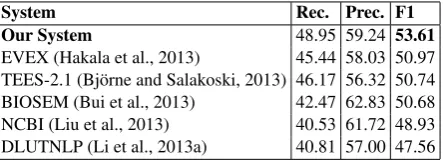
System Rec. Prec. F1
Our System 48.95 59.24 53.61
[image:9.595.76.298.62.142.2]EVEX (Hakala et al., 2013) 45.44 58.03 50.97 TEES-2.1 (Bj¨orne and Salakoski, 2013) 46.17 56.32 50.74 BIOSEM (Bui et al., 2013) 42.47 62.83 50.68 NCBI (Liu et al., 2013) 40.53 61.72 48.93 DLUTNLP (Li et al., 2013a) 40.81 57.00 47.56 Table 3: Recall (Rec.), Precision (Prec.) and F1 score on the BioNLP’13 test data.
initialize the weights. Letnibe the number of
sat-isfied groundings of formulafiin the training data
andmibe the total number of possible groundings
offi. We use a thresholdγ to determine whether
we wish to make the initial weight positive or neg-ative. If mini ≤γ, then we choose the initial weight uniformly at random from the range[−0.1,0]. Oth-erwise, we chose it from the range[0,0.1]. These steps ensure that the weights generated from dif-ferent initialization points have smaller variance. Also, in the testing phase, we set the scale parame-ters for the soft evidence asα=β=max
c∈C|c|, where
Cis the set of SVM confidence values. 5.2 Results on the BioNLP’13 Dataset
Among the three datasets, the BioNLP’13 dataset is most “realistic” one because it is the only one that contains full papers and no abstracts. As a re-sult, it is also the most challenging dataset among the three. Table 3 shows the results of our system along with the results of other top systems pub-lished in the official evaluation of BioNLP’13. Our system achieves the best F1-score (an improvement of2.64points over the top-performing system) and has a much higher recall (mainly because our sys-tem detects more regulation events which outnum-ber other event types in the dataset) and a slightly higher precision than the winning system. Of the top five teams, NCBI is the only other joint infer-ence system, which adopts joint pattern matching to predict triggers and arguments at the same time. These results illustrate the challenge in using joint inference effectively. NCBI performed much worse than the SVM-based pipeline systems, EVEX and TEES2.1. It was also worse than BIOSEM, a rule-based system that uses considerable domain exper-tise. Nevertheless, it was better than DLUTNLP, another SVM-based system.
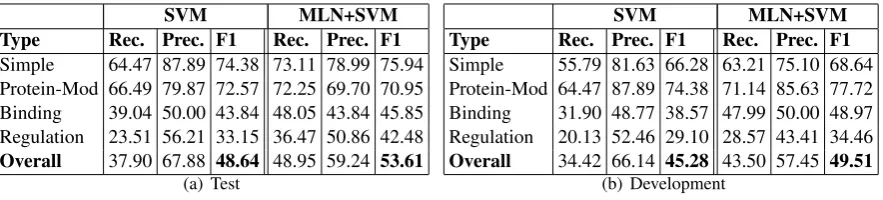
Figure 3 compares our baseline pipeline model with our combined model. We can clearly see that the combined model has a significantly better F1 score than the pipeline model on most event types.
System Rec. Prec. F1
Our System 53.42 63.61 58.07
Miwa12 (Miwa et al., 2012) 53.35 63.48 57.98 Riedel11 (Riedel et al., 2011) − − 56 UTurku (Bj¨orne and Salakoski, 2011) 49.56 57.65 53.30 MSR-NLP (Quirk et al., 2011) 48.64 54.71 51.50
Table 4: Results on the BioNLP’11 test data.
The regulation events are considered the most com-plex events to detect because they have a recursive structure. At the same time, this structure yields a large number of joint dependencies. The advantage of using a rich model such as MLNs can be clearly seen in this case; the combined model yields a 10 point and 6 point increase in F1-score on the test data and development data respectively compared to the pipeline model.
5.3 Results on the BioNLP’11 Dataset
Table 4 shows the results on the BioNLP’11 dataset. We can see that our system is marginally better than Miwa12, which is a pipeline-based system. It is also more than two points better than Riedel11, a state-of-the-art structured prediction-based joint inference system. Reidel11 incorporates the Stan-ford predictions (McClosky et al., 2011b) as fea-tures in the model. On the two hardest, most complex tasks, detecting regulation events (which have recursive structures and more joint dependen-cies than other event types) and detecting bind-ing events (which may have multiple arguments), our system performs better than both Miwa12 and Riedel11.4 Specifically, our system’s F1 score for regulation events is 46.84, while those of Miwa12 and Riedel11 are 45.46 and 44.94 respectively. Our system’s F1 score for the binding event is 58.79, while those of Miwa12 and Riedel11 are 56.64 and 48.49 respectively. These results clearly demon-strate the effectiveness of enforcing joint dependen-cies along with high-dimensional features.
5.4 Results on the BioNLP’09 Dataset
Table 5 shows the results on the BioNLP’09 dataset. Our system has a marginally lower score (by 0.11 points) than Miwa12, which is the best performing system on this dataset. Specifically, our system achieves a higher recall but a lower precision than Miwa12. However, note that Miwa12 used co-reference features while we are able to achieve
[image:9.595.312.532.62.134.2]SVM MLN+SVM Type Rec. Prec. F1 Rec. Prec. F1
Simple 64.47 87.89 74.38 73.11 78.99 75.94 Protein-Mod 66.49 79.87 72.57 72.25 69.70 70.95 Binding 39.04 50.00 43.84 48.05 43.84 45.85 Regulation 23.51 56.21 33.15 36.47 50.86 42.48
Overall 37.90 67.88 48.64 48.95 59.24 53.61
(a) Test
SVM MLN+SVM Type Rec. Prec. F1 Rec. Prec. F1
Simple 55.79 81.63 66.28 63.21 75.10 68.64 Protein-Mod 64.47 87.89 74.38 71.14 85.63 77.72 Binding 31.90 48.77 38.57 47.99 50.00 48.97 Regulation 20.13 52.46 29.10 28.57 43.41 34.46
Overall 34.42 66.14 45.28 43.50 57.45 49.51
[image:10.595.79.521.61.161.2](b) Development
Figure 3: Comparison of the combined model (MLN+SVM) with the pipeline model on the BioNLP’13 test and development data.
System Rec. Prec. F1
Miwa12 (Miwa et al., 2012) 52.67 65.19 58.27
Our System 53.96 63.08 58.16
Riedel11 (Riedel et al., 2011) − − 57.4 Miwa10 (Miwa et al., 2010a) 50.13 64.16 56.28 Bjorne (Bj¨orne et al., 2009) 46.73 58.48 51.95 PoonMLN (Poon&Vanderwende,2010) 43.7 58.6 50.0 RiedelMLN (Riedel et al., 2009) 36.9 55.6 44.4 Table 5: Results on the BioNLP’09 test data. “−” indicates that the corresponding values are not known.
similar accuracy without the use of co-reference data. The F1 score of Miwa10, which does not use co-reference features, is nearly 2 points lower than that of our system. Our system also has a higher F1 score than Reidel11, which is the best joint inference-based system for this task.
On the regulation events, our system (47.55) out-performs both Miwa12 (45.99) and Riedel11 (46.9), while on the binding event, our system (59.88) is marginally worse than Miwa12 (59.91) and signifi-cantly better than Riedel11 (52.6). As mentioned earlier, these are the hardest events to extract. Also, existing MLN-based joint inference systems such as RiedelMLN and PoonMLN do not achieve state-of-the-art results because they do not leverage com-plex, high-dimensional features.
6 Summary and Future Work
Markov logic networks (MLNs) are a powerful representation that can compactly encode rich rela-tional structures and ambiguities (uncertainty). As a result, they are an ideal representation for com-plex NLP tasks that require joint inference, such as event extraction. Unfortunately, the superior representational power greatly complicates infer-ence and learning over MLN models. Even the most advanced methods for inference and learning in MLNs (Gogate and Domingos, 2011) are
un-able to handle complex, high-dimensional features, and therefore existing MLN systems primarily use low-dimensional features. This limitation severely affects the accuracy of MLN-based NLP systems, and as a result, in some cases their performance is inferior to pipeline methods that do not employ joint inference.
In this paper, we presented a general approach for exploiting the power of high-dimensional lin-guistic features in MLNs. Our approach involves reliably processing and learning high-dimensional features using SVMs and encoding their output as low-dimensional features in MLNs. We showed that we could achieve scalable learning and in-ference in our proposed MLN model by exploit-ing decomposition. Our results on the BioNLP shared tasks from ’13, ’11, and ’09 clearly show that our proposed combination is extremely effec-tive, achieving the best or second best score on all three datasets.
In future work, we plan to (1) improve our joint model by incorporating co-reference information and developing model ensembles; (2) transfer the results of this investigation to other complex NLP tasks that can potentially benefit from joint infer-ence; and (3) develop scalable inference and learn-ing algorithms (Ahmadi et al., 2013).
Acknowledgments
[image:10.595.75.296.215.309.2]References
Babak Ahmadi, Kristian Kersting, Martin Mladenov, and Sriraam Natarajan. 2013. Exploiting symme-tries for scaling loopy belief propagation and rela-tional training. Machine Learning, 92(1):91–132.
David Ahn. 2006. The stages of event extraction. InProceedings of the Workshop on Annotating and Reasoning About Time and Events, pages 1–8.
Jari Bj¨orne and Tapio Salakoski. 2011. Generaliz-ing biomedical event extraction. InProceedings of the BioNLP Shared Task 2011 Workshop, pages 183– 191.
Jari Bj¨orne and Tapio Salakoski. 2013. TEES 2.1: Au-tomated annotation scheme learning in the bionlp 2013 shared task. In Proceedings of the BioNLP Shared Task 2013 Workshop, pages 16–25.
Jari Bj¨orne, Juho Heimonen, Filip Ginter, Antti Airola, Tapio Pahikkala, and Tapio Salakoski. 2009. Ex-tracting complex biological events with rich graph-based feature sets. In Proceedings of the BioNLP 2009 Workshop Companion Volume for Shared Task, pages 10–18.
Quoc-Chinh Bui, David Campos, Erik van Mulligen, and Jan Kors. 2013. A fast rule-based approach for biomedical event extraction. In Proceedings of the BioNLP Shared Task 2013 Workshop, pages 104– 108.
Chen Chen and Vincent Ng. 2012. Joint modeling for Chinese event extraction with rich linguistic features. InProceedings of the 24th International Conference on Computational Linguistics, pages 529–544.
Michael Collins. 1999. Head-Driven Statistical Mod-els for Natural Language Parsing. Ph.D. thesis, Uni-versity of Pennsylvania, Philadelphia, PA.
Michael Collins. 2002. Discriminative training meth-ods for hidden Markov models: Theory and experi-ments with perceptron algorithms. InProceedings of the 2002 Conference on Empirical Methods in Natural Language Processing, pages 1–8.
Pedro Domingos and Daniel Lowd. 2009. Markov Logic: An Interface Layer for Artificial Intelligence. Morgan & Claypool, San Rafael, CA.
Lise Getoor and Ben Taskar, editors. 2007. Introduc-tion to Statistical RelaIntroduc-tional Learning. MIT Press.
Vibhav Gogate and Pedro Domingos. 2011. Proba-bilistic theorem proving. InProceedings of the 27th Conference on Uncertainty in Artificial Intelligence, pages 256–265.
Ralph Grishman, David Westbrook, and Adam Meyers. 2005. NYU’s English ACE 2005 system description. In Proceedings of the ACE 2005 Evaluation Work-shop. Washington.
Prashant Gupta and Heng Ji. 2009. Predicting un-known time arguments based on cross-event prop-agation. In Proceedings of the ACL-IJCNLP 2009 Conference Short Papers, pages 369–372.
Kai Hakala, Sofie Van Landeghem, Tapio Salakoski, Yves Van de Peer, and Filip Ginter. 2013. EVEX in ST’13: Application of a large-scale text mining resource to event extraction and network construc-tion. In Proceedings of the BioNLP Shared Task 2013 Workshop, pages 26–34.
Ruihong Huang and Ellen Riloff. 2012a. Bootstrapped training of event extraction classifiers. In Proceed-ings of the 13th Conference of the European Chap-ter of the Association for Computational Linguistics, pages 286–295.
Ruihong Huang and Ellen Riloff. 2012b. Modeling textual cohesion for event extraction. In Proceed-ings of the 26th AAAI Conference on Artificial Intel-ligence.
Heng Ji and Ralph Grishman. 2008. Refining event ex-traction through cross-document inference. In Pro-ceedings of the 46th Annual Meeting of the Associ-ation for ComputAssoci-ational Linguistics: Human Lan-guage Technologies, pages 254–262.
Thorsten Joachims. 1999. Making large-scale SVM learning practical. In B. Schlkopf, C. Burges, and A. Smola, editors, Advances in Kernel Methods -Support Vector Learning. MIT Press, Cambridge, MA, USA.
Jin-Dong Kim, Tomoko Ohta, and Jun’ichi Tsujii. 2008. Corpus annotation for mining biomedi-cal events from literature. BMC bioinformatics, 9(1):10.
Jin-Dong Kim, Tomoko Ohta, Sampo Pyysalo, Yoshi-nobu Kano, and Jun’ichi Tsujii. 2009. Overview of BioNLP’09 shared task on event extraction. In Pro-ceedings of the BioNLP 2009 Workshop Companion Volume for Shared Task, pages 1–9.
Jin-Dong Kim, Sampo Pyysalo, Tomoko Ohta, Robert Bossy, Ngan Nguyen, and Jun’ichi Tsujii. 2011a. Overview of BioNLP shared task 2011. In Pro-ceedings of the BioNLP Shared Task 2011 Workshop, pages 1–6.
Jin-Dong Kim, Yue Wang, Toshihisa Takagi, and Aki-nori Yonezawa. 2011b. Overview of Genia event task in BioNLP shared task 2011. InProceedings of the BioNLP Shared Task 2011 Workshop, pages 7–15.
Jin-Dong Kim, Yue Wang, and Yamamoto Yasunori. 2013. The Genia event extraction shared task, 2013 edition - overview. InProceedings of the BioNLP Shared Task 2013 Workshop, pages 8–15.
Peifeng Li, Guodong Zhou, Qiaoming Zhu, and Libin Hou. 2012. Employing compositional semantics and discourse consistency in Chinese event extrac-tion. InProceedings of the 2012 Joint Conference on Empirical Methods in Natural Language Process-ing and Computational Natural Language LearnProcess-ing, pages 1006–1016.
Lishuang Li, Yiwen Wang, and Degen Huang. 2013a. Improving feature-based biomedical event extrac-tion system by integrating argument informaextrac-tion. In
Proceedings of the BioNLP Shared Task 2013 Work-shop, pages 109–115.
Peifeng Li, Qiaoming Zhu, and Guodong Zhou. 2013b. Argument inference from relevant event mentions in Chinese argument extraction. InProceedings of the 51st Annual Meeting of the Association for Compu-tational Linguistics, pages 1477–1487.
Qi Li, Heng Ji, and Liang Huang. 2013c. Joint event extraction via structured prediction with global fea-tures. InProceedings of the 51st Annual Meeting of the Association for Computational Linguistics, pages 73–82.
Shasha Liao and Ralph Grishman. 2010. Using doc-ument level cross-event inference to improve event extraction. InProceedings of the 48th Annual Meet-ing of the Association for Computational LMeet-inguistics, pages 789–797.
Shasha Liao and Ralph Grishman. 2011. Acquiring topic features to improve event extraction: in pre-selected and balanced collections. In Proceedings of the International Conference Recent Advances in Natural Language Processing 2011, pages 9–16. Haibin Liu, Karin Verspoor, Donald C. Comeau,
An-drew MacKinlay, and W John Wilbur. 2013. Gen-eralizing an approximate subgraph matching-based system to extract events in molecular biology and cancer genetics. In Proceedings of the BioNLP Shared Task 2013 Workshop, pages 76–85.
Daniel Lowd and Pedro Domingos. 2007. Efficient weight learning for markov logic networks. In
Proceedings of the 11th European Conference on Principles and Practice of Knowledge Discovery in Databases, pages 200–211.
Wei Lu and Dan Roth. 2012. Automatic event extrac-tion with structured preference modeling. In Pro-ceedings of the 50th Annual Meeting of the Associa-tion for ComputaAssocia-tional Linguistics, pages 835–844. Radu Marinescu and Rina Dechter. 2009. AND/OR branch-and-bound search for combinatorial opti-mization in graphical models. Artificial Intelligence, 173(16-17):1457–1491.
David McClosky, Mihai Surdeanu, and Chris Manning. 2011a. Event extraction as dependency parsing. In
Proceedings of the Association for Computational Linguistics: Human Language Technologies, pages 1626–1635.
David McClosky, Mihai Surdeanu, and Christopher Manning. 2011b. Event extraction as dependency parsing for BioNLP 2011. In Proceedings of the BioNLP Shared Task 2011 Workshop, pages 41–45.
David McClosky. 2010. Any domain parsing: Auto-matic domain adaptation for natural language pars-ing. Ph.D. thesis, Ph.D. thesis, Brown University, Providence, RI.
Makoto Miwa, Sampo Pyysalo, Tadayoshi Hara, and Jun’ichi Tsujii. 2010a. Evaluating dependency rep-resentation for event extraction. In Proceedings of the 23rd International Conference on Computa-tional Linguistics, pages 779–787.
Makoto Miwa, Rune Sætre, Jin-Dong Kim, and Jun’ichi Tsujii. 2010b. Event extraction with com-plex event classification using rich features. Jour-nal of Bioinformatics and ComputatioJour-nal Biology, 8(01):131–146.
Makoto Miwa, Paul Thompson, and Sophia Ananiadou. 2012. Boosting automatic event extraction from the literature using domain adaptation and coreference resolution.Bioinformatics, 28(13):1759–1765.
Yusuke Miyao and Jun’ichi Tsujii. 2008. Feature for-est models for probabilistic HPSG parsing. Compu-tational Linguistics, 34(1):35–80.
Claire N´edellec, Robert Bossy, Jin-Dong Kim, Jung-Jae Kim, Tomoko Ohta, Sampo Pyysalo, and Pierre Zweigenbaum. 2013. Overview of BioNLP shared task 2013. In Proceedings of the BioNLP Shared Task 2013 Workshop, pages 1–7.
Siddharth Patwardhan and Ellen Riloff. 2009. A uni-fied model of phrasal and sentential evidence for in-formation extraction. In Proceedings of the 2009 Conference on Empirical Methods in Natural Lan-guage Processing, pages 151–160.
Hoifung Poon and Pedro Domingos. 2007. Joint in-ference in information extraction. In Proceedings of the 22nd National Conference on Artificial Intelli-gence, pages 913–918.
Hoifung Poon and Lucy Vanderwende. 2010. Joint inference for knowledge extraction from biomedi-cal literature. In Human Language Technologies: The 2010 Annual Conference of the North American Chapter of the Association for Computational Lin-guistics, pages 813–821.
Martin F. Porter. 1980. An algorithm for suffix strip-ping. Program, 14(3):130–137.
Sebastian Riedel and Andrew McCallum. 2011a. Fast and robust joint models for biomedical event extrac-tion. In Proceedings of the 2011 Conference on Empirical Methods in Natural Language Processing, pages 1–12.
Sebastian Riedel and Andrew McCallum. 2011b. Ro-bust biomedical event extraction with dual decom-position and minimal domain adaptation. In Pro-ceedings of the BioNLP Shared Task 2011 Workshop, pages 46–50.
Sebastian Riedel, Hong-Woo Chun, Toshihisa Takagi, and Jun’ichi Tsujii. 2009. A Markov logic approach to bio-molecular event extraction. InProceedings of the BioNLP 2009 Workshop Companion Volume for Shared Task, pages 41–49.
Sebastian Riedel, David McClosky, Mihai Surdeanu, Andrew McCallum, and Christopher D. Manning. 2011. Model combination for event extraction in bionlp 2011. InProceedings of the BioNLP Shared Task 2011 Workshop, pages 51–55.
Alan Ritter, Mausam, Oren Etzioni, and Sam Clark. 2012. Open domain event extraction from Twit-ter. InProceedings of the 18th ACM SIGKDD Inter-national Conference on Knowledge Discovery and Data Mining, pages 1104–1112.
Bart Selman, Henry Kautz, and Bram Cohen. 1996. Local Search Strategies for Satisfiability Testing. In D. S. Johnson and M. A. Trick, editors, Cliques, Coloring, and Satisfiability: Second DIMACS Im-plementation Challenge, pages 521–532. American Mathematical Society, Washington, DC.
Parag Singla and Pedro Domingos. 2005. Discrimina-tive training of Markov logic networks. In Proceed-ings of the 20th National Conference on Artificial Intelligence, pages 868–873.
David Sontag and Amir Globerson. 2011. Introduction to Dual Decomposition for Inference. Optimization for Machine Learning.
Ioannis Tsochantaridis, Thomas Hofmann, Thorsten Joachims, and Yasemin Altun. 2004. Support vector machine learning for interdependent and structured output spaces. In Proceedings of the 21st Interna-tional Conference on Machine Learning, pages 104– 112.