Parse, Price and Cut—Delayed Column and Row Generation for Graph
Based Parsers
Sebastian Riedel David Smith Andrew McCallum Department of Computer Science
University of Massachusetts, Amherst
{riedel,dasmith,mccallum}@cs.umass.edu
Abstract
Graph-based dependency parsers suffer from the sheer number of higher order edges they need to (a) score and (b) consider during opti-mization. Here we show that when working with LP relaxations, large fractions of these edges can be pruned before they are fully scored—without any loss of optimality guar-antees and, hence, accuracy. This is achieved by iteratively parsing with a subset of higher-order edges, adding higher-higher-order edges that may improve the score of the current solu-tion, and adding higher-order edges that are implied by the current best first order edges. This amounts to delayed column and row gen-eration in the LP relaxation and is guaranteed to provide the optimal LP solution. For second order grandparent models, our method consid-ers, or scores, no more than 6–13% of the sec-ond order edges of the full model. This yields up to an eightfold parsing speedup, while pro-viding the same empirical accuracy and cer-tificates of optimality as working with the full LP relaxation. We also provide a tighter LP formulation for grandparent models that leads to a smaller integrality gap and higher speed.
1 Introduction
Many problems in NLP, and structured prediction in general, can be cast as finding high-scoring struc-tures based on a large set of candidate parts. For example, in second order graph-based dependency parsing (Kübler et al., 2009) we have to choose a quadratic number of first order and a cubic number of second order edges such that the graph is both high-scoring and a tree. In coreference, we have to select high-scoring clusters of mentions from an
exponential number of candidate clusters, such that each mention is in exactly one cluster (Culotta et al., 2007). In segmentation of citation strings, we need to consider a quadratic number of possible seg-ments such that every token is part of exactly one segment (Poon and Domingos, 2007).
What makes such problems challenging is the large number of possible parts to consider. This number not only affects the cost of search or opti-mization but also slows down the process of scor-ing parts before they enter the optimization prob-lem. For example, the cubic grandparent edges in second-order dependency parsing slow down dy-namic programs (McDonald and Pereira, 2006), be-lief propagation (Smith and Eisner, 2008) and LP solvers (Martins et al., 2009), since there are more value functions to evaluate, more messages to pass, or more variables to consider. But to even calculate the score for each part we need a cubic number of operations that usually involve expensive feature ex-traction. This step often becomes a major bottleneck in parsing, and structured prediction in general.
Candidate parts can often be heuristically pruned. In the case of dependency parsing, previous work has used coarse-to-fine strategies where simpler first order models are used to prune unlikely first der edges, and hence all corresponding higher or-der edges (Koo and Collins, 2010; Martins et al., 2009; Riedel and Clarke, 2006). While such meth-ods can be effective, they are more convoluted, often require training of addition models as well as tuning of thresholding hyper-parameters, and usually pro-vide no guarantees of optimality.
We present an approach that can solve problems with large sets of candidate parts without consider-ing all of these parts in either optimization or
ing. And in contrast to most pruning heuristics, our algorithm can give certificates of optimality before having optimized over, or even scored, all parts. It does so without the need of auxiliary models or tun-ing of threshold parameters. This is achieved by a delayed column and row generation algorithm that iteratively solves an LP relaxation over a small sub-set of current candidate parts, and then finds new candidates that score highly and can be inserted into the current optimal solution without removing high scoring existing structure. The latter step subtracts from the cost of a part the price of resources the part requires, and is often referred aspricing. Sometimes parts may score highly after pricing, but are neces-sary in order to make the current solution feasible. We add such parts in a step that roughly amounts to violatedcutsto the LP.
We illustrate our approach in terms of a second-order grandparent model for dependency parsing. We solve these models by iteratively parsing, pric-ing, and cutting. To this end we use a variant of the LP relaxation formulated by Martins et al. (2009). Our variant of this LP is designed to be amenable to column generation. It also turns out to be a tighter outer bound that leads to fewer fractional solutions and faster runtimes. To find high scoring grandpar-ent edges without explicitly enumerating all of them, we prune out a large fraction using factorized upper bounds on grandparent scores.
Our parse, price and cut algorithm is evaluated using a non-projective grandparent model on three languages. Compared to a brute force approach of solving the full LP, we only score about 10% of the grandparent edges, consider only 8% in optimiza-tion, and so observe an increase in parsing speed of up to 750%. This is possible without loss of opti-mality, and hence accuracy. We also find that our extended LP formulation leads to a 15% reduction of fractional solutions, up to 12 times higher speed, and generally higher accuracy when compared to the grandparent formulation of Martins et al. (2009).
2 Graph-Based Dependency Parsing
Dependency trees are representations of the syntac-tic structure of a sentence (Nivre et al., 2007). They determine, for each token of a sentence, the syntac-tic head the token is modifying. As a lightweight
al-ternative to phrase-based constituency trees, depen-dency representations have by now seen widespread use in the community in various domains such as question answering, machine translation, and infor-mation extraction.
To simplify further exposition, we now formalize the task, and mostly follow the notation of Martins et al. (2009). Consider a sentencex=ht0, t1, . . . , tni
where t1,. . . , tn correspond to the ntokens of the
sentence, and t0 is an artificial root token. Let
V , {0, . . . , n}be a set of vertices corresponding to the tokens inx, andC ⊆V ×V a set of candidate directed edges. Then a directed graph y ⊆ C is a
legal dependency parseif and only if it is a tree over V rooted at vertex0. Given a sentencex, we useY
to denote the set of its legal parses. Note that all of the above definitions depend onx, but for simplicity we omit this dependency in our notation.
2.1 Arc-Factored Models
Graph-based models define parametrized scoring functions that are trained to discriminate between correct and incorrect parse trees. So called arc-factored or first order models are the most basic variant of such functions: they assess the quality of a tree by scoring each edge in isolation (McDonald et al., 2005b; McDonald et al., 2005a). Formally, arc-factored models are scoring functions of the form
s(y;x,w) = X
hh,mi∈y
shh,mi(x,w) (1)
wherewis a weight vector andshh,mi(x,w)scores the edge hh, mi with respect to sentence x and weightsw. From here on we will omit bothxandw
from our notation if they are clear from the context. Given such a scoring function, parsing amounts to solving:
maximize
y
X
hh,mi∈y
shh,mi
subject to y∈ Y.
(2)
2.2 Higher Order Models
Arc-factored models cannot capture higher order
de-pendencies between two or more edges. Higher
tree (McDonald and Pereira, 2006). For example, ingrandparent models, the score of a tree also in-cludes a score sgphg,p,ci for each grandparent-parent-child triplehg, p, ci:
s(y) = X
hh,mi∈y
shh,mi+
X
hg,pi∈y,hp,ci∈y
sgphg,p,ci (3)
There are other variants of higher order models that include, in addition to grandparent triples, pairs of siblings (adjacent or not) or third order edges. However, to illustrate our approach we will focus on grandparent models and note that most of what we present can be generalized to other higher order models.
2.3 Feature Templates
For our later exposition the factored and
parametrized nature of the scoring functions will be crucial. In the following we therefore illustrate this property in more detail.
The scoring functions for arcs or higher order edges usually decompose into a sum of feature tem-plate scores. For example, the grandparent edge scoresgphg,p,ciis defined as
sgphg,p,ci, X t∈Tgp
sgp,thg,p,ci (4)
whereTgp is the set of grandparent templates, and
each template t ∈ Tgp defines a scoring
func-tion sgp,thg,p,ci to assess a specific property of the grandparent-parent-child edgehg, p, ci.
The template scores again decompose. Consider-ing grandparent scores, we get
sthg,p,ci,w>t ft hgt, htp, htc, dtg,p,c (5)
where ht
i is an attribute of token ti, say h101i =
Part-of-Speech(ti). The termdtg,p,c corresponds to
a representation of the relation between tokens cor-responding tog,pandg. For example, for template 101 it could return their relative positions to each other:
d101g,p,c ,hI[g > p],I[g > c],I[p > c]i. (6)
The feature function ft maps the representations
ofg,pandcinto a vector space. For the purposes of our work this mapping is not important, and hence we omit details.
2.4 Learning
The scoring functions we consider are parametrized by a family of per-template weight vectors w =
hwtit∈T. During learning we need to estimate w
such that our scoring functions learns to differenti-ate between correct and incorrect parse trees. This can be achieved in many ways: large margin train-ing, maximizing conditional likelihood, or variants in between. In this work we follow Smith and Eis-ner (2008) and train the models with stochastic gra-dient descent on the conditional log-likelihood of the training data, using belief propagation in order to calculate approximate gradients.
3 LP and ILP Formulations
Riedel and Clarke (2006) showed that dependency parsing can be framed as Integer Linear Pro-gram (ILP), and efficiently solved using an off-the-shelf optimizer if a cutting plane approach is used.1 Compared to tailor made dynamic programs, such generic solvers give the practitioner more modeling flexibility (Martins et al., 2009), albeit at the cost of efficiency. Likewise, compared to approximate solvers, ILP and Linear Program (LP) formulations can give strong guarantees of optimality. The study of Linear LP relaxations of dependency parsing has also lead to effective alternative methods for parsing, such as dual decomposition (Koo et al., 2010; Rush et al., 2010). As we see later, the capability of LP solvers to calculate dual solutions is also crucial for efficient and exact pruning. Note, however, that dy-namic programs provide dual solutions as well (see section 4.5 for more details).
3.1 Arc-Factored Models
To represent a parse y ∈ Y we first introduce an vector of variablesz,hzaiawherezais1ifa∈y
and 0 otherwise. With this representation parsing amounts to finding a vectorzthat corresponds to a legal parse tree and that maximizesP
azasa. One
way to achieve this is to search through theconvex hullof all legal incidence vectors, knowing that any linear objectives would take on its maximum on one of the hull’s vertices. We will useZ to denote this convex hull of incidence vectors of legal parse trees,
1Such as the highly efficient and free-for-academic-use
and callZthearborescence polytope(Martins et al., 2009). The Minkowski-Weyl theorem tells us thatZ
can be represented as an intersection of halfspaces, or constraints, Z = {z|Az≤b}. Hence optimal dependency parsing, in theory, can be addressed us-ing LPs.
However, it is difficult to describeZ with a com-pact number of constraints and variables that lend themselves to efficient optimization. In general we therefore work withrelaxations, or outer bounds, on
Z. Such outer bounds are designed to cut off all illegalintegersolutions of the problem, but still al-low forfractionalsolutions. In case the optimum is achieved at an integer vertex of the outer bound, it is clear that we have found the optimal solution to the original problem. In case we find a fractional point, we need to map it ontoZ(e.g., by projection or rounding). Alternatively, we can use the outer bound together with 0/1 constraints on z, and then employ an ILP solver (say, branch-and-bound) to find the true optimum. Given the NP-hardness of ILP, this will generally be slow.
In the following we will present the outer bound ¯
Z ⊇ Z proposed by Martins et al. (2009).
Compared to the representation Riedel and Clarke (2006), this bound has the benefit a small polyno-mial number of constraints. Note, however, that of-ten exponentially many constraints can be efficiently handled if polynomial separation algorithms exists, and that such representations can lead to tighter outer bounds.
The constraints we employ are:
No Head For Root In a dependency tree the root node never has a head. While this could be captured through linear constraints, it is easier to simply re-strict the candidate set C to never contain edges of the formh·,0i.
Exactly One Head for Non-Roots Any non-root token has to have exactly one head token. We can enforce this property through the set of constraints:
m >0 :X
h
zhh,mi= 1. (OneHead)
No Cycles A parse tree cannot have cycles. This is equivalent, together with the head constraints above, to enforcing that the tree be fully connected. Mar-tins et al. (2009) capture this connectivity constraint
using a single commodity flow formulation. This requires the introduction of flow variables φ , hφaia∈C. By enforcing that token0hasnoutgoing
flow,
X
m>0
φh0,mi=n, (Source)
that any other tokenconsumes one unit of flow,
t >0 :X
h
φhh,ti−
X
m>0
φht,mi= 1 (Consume)
and thatflow is zero on disabled arcs
φhh,mi≤nzhh,mi, (NoFlow)
connectivity can be ensured.
Assuming we have such a representation, parsing with an LP relaxation amounts to solving
maximize z≥0
X
a∈A
zasa
subject to A
z φ
≤b.
(7)
3.2 Higher Order Models
The 1st-Order LP can be easily extended to capture second (or higher) order models. For for the case of grandparent models, this amounts to introduc-ing another class of variables,zg,p,cgp , that indicate if
the parse contains both the edgehg, piand the edge
hp, ci. With the help of the indicatorszgpwe can rep-resent the second order objective as a linear function. We now need an outer bound on the convex hull of vectorshz,zgpiwherezis a legal parse tree andzgp
is a consistent set of grandparent indicators. We will refer to this convex hull as thegrandparent polytope Zgp.
We can re-use the constraintsAof section 3.1 to ensure thatzis inZ. To make surezgpis consistent with z, Martins et al. (2009) linearize the equiva-lencezg,p,cgp ⇔zg,p∧zp,c we know to hold for legal
incidence vectors, yielding
g, p, c:zhg,pi+zhp,ci−zgphg,p,ci≤1 (ArcGP)
and
g, p, c:zhg,pi≥zhg,p,cigp , zhp,ci≥zgphg,p,ci (GPArc)
There are additional constraints we know to hold in
ywithp > 0there is exactly one grandparent edge
hg, p, ci. Likewise, for an inactive edgehp, ci ∈/ y there must be no grandparent edge hg, p, ci. This can be captured through the constraint:
p >0, c:X
g
zgphg,p,ci=zhp,ci. (OneGP)
We also know that if an edge hg, pi in inactive, there must not be any grandparent edgehg, p, cithat goes throughhg, pi:
g, p:X
c
zgphg,p,ci≤nzhg,pi. (NoGP)
It can be easily shown that for integer solu-tions the constraints ArcGP and GPArc of Martins et al. (2009) are sufficient conditions for consis-tency between z andzgp. It can equally be shown
that the same holds for the constraints OneGP and
NoGP. However, when working with LP
relax-ations, the two polytopes have different fractional vertices. Hence, by combining both constraint sets, we can get a tighter outer bound on the grandparent polytopeZgp. In section 6 we show empirically that
this combined polytope in fact leads to fewer frac-tional solutions. Note that when using the union of all four types of constraints, the NoGP constraint is implied by the constraint GPArc (left) by summing overcon both sides, and can hence be omitted.
4 Parse, Price and Cut
We now introduce our parsing algorithm. To this end, we first give a general description of column and row generation for LPs; then, we illustrate how these techniques can be applied to dependency pars-ing.
4.1 Column and Row Generation
LPs often have too many variables and constraints to be efficiently solved. In such cases delayed column and row generation can substantially re-duce runtime by lazily adding variables only when needed (Gilmore and Gomory, 1961; Lübbecke and Desrosiers, 2004).
To illustrate column and row generation let us consider the following general primal LP and its
cor-responding dual problem:
Primal
maximize z≥0 s
|z
subject to Az≤b
Dual
minimize
λ≥0 λ
|b
subject to A|λ≥s.
Say you are given a primal feasiblez0and a dual fea-sibleλ0 for whichcomplementary slacknessholds: for all variablesiwe havezi0 >0⇒si =Pjλ0jai,j
and for all constraints j we haveλ0j > 0 ⇒ bj =
P
izi0ai,j. In this case it is easy to show thatz0 is
an optimal primal solution,λ0 and optimal dual so-lution, and that both objectives meet at these val-ues (Bertsekas, 1999).
The idea behind delayed column and row gener-ation is to only consider a small subset of variables (orcolumns)Iand subset of constraints (orrows)J. Optimizing over this restricted problem, either with an off-the-shelf solver or a more specialized method, yields the pair z0I,λ0J
of partial primal and dual solutions. This pair is feasible and complementary with respect to variables I and constraints J. We can extend it to a solution(z0,y0)over all variables and constraints by heuristically setting the remain-ing primal and dual variables. If it so happens that (z0,y0) is feasible and complementary for all vari-ables and constraints, we have found the optimal so-lution. If not, we add the constraints and variables for which feasibility and slackness are violated, and resolve the new partial problem.
In practice, the uninstantiated primal and dual variables are often set to0. In this case complemen-tary slackness holds trivially, and we only need to find violated primal and dual constraints. For primal constraints,P
iziai,j ≤ bi, searching for violating
constraints j is the well-known separation step in cutting plane algorithms. For the dual constraints, P
jλjai,j ≥ si, the same problem is referred to
aspricing. Pricing is often framed as searching for all, or some, variables iwith positivereduced cost
ri ,si−Pjλjai,j. Note that while these problems
are, naturally, dual to each other, they can have very different flavors. When we assess dual constraints we need to calculate a cost si for variable i, and
Algorithm 1Parse, Price and Cut.
Require: Initial candidate edges and hyperedgesP.
Ensure: The optimalz.
1: repeat
2: z,λ ←parse(P)
3: N ←price(λ)
4: M ←cut(z)
5: P ←P∪N∪M
6: untilN =∅ ∧M =∅ 7: returnz
The reduced cost ri = si −Pjλjai,j has
sev-eral interesting interpretations. First, intuitively it measures the score we could gain by settingzi = 1,
and subtracts an estimate of what we would loose because zi = 1may compete with other variables
for shared resources (constraints). Second, it cor-responds to the coefficient of zi in the Lagrangian
L(λ,z) ,s|z+λ[b−Az]. For anyλ,Uzi=k =
maxz≥0,zi=kL(λ,z)is an upper bound on the best
possible primal objective withzi = k. This means
thatri = Uzi=1 −Uzi=0 is the difference between
an upper bound that considerszi = 1, and one that
considerszi = 0. The tighter the boundUzi=0 is,
the closer ri is to an upper bound on the maximal
increase we can get for settingzi to1. At
conver-gence of column generation, complementary slack-ness guarantees thatUzi=0is tight for allz
0
i= 0, and
henceriis a true an upper bound.
4.2 Application to Dependency Parsing
The grandparent formulation in section 3.2 has a cu-bic number of variables zhg,p,ci as well as a cubic
number of constraints. For longer sentences this number can slow us down in two ways. First, the optimizer works with a large search space, and will naturally become slower. Second, for every grand-parent edge we need to calculate the scoreshg,p,ci,
and this calculation can often be a major bottleneck, in particular when using complex feature functions. To overcome this bottleneck, our parse, price and cut algorithm, as shown in algorithm 1, uses column and row generation. In particular, it lazily instantiates the grandparent edge variableszhg,p,cigp , and the cor-responding cubic number of constraints. All unin-stantiated variables are implicitly set to0.
The algorithm requires some initial set of
vari-ables to start with. In our case this setPcontains all first-order edgeshh, miin the candidate setC, and for each of these one grandparent edge h0, h, mi. The primary purpose of these grandparent edges is to ensure feasibility of the OneGP constraints.
In step 2, the algorithm parses with the current set of candidatesPby solving the corresponding LP relaxation. The LP contains all columns and con-straints that involve the edges and grandparent edges ofP. The solver returns both the best primal solu-tionz(for both edges and grandparents), and a com-plementary dual solutionλ.
In step 3 the dual variablesλare used to find unin-stantiated grandparent edges hg, p, ci with positive reduced cost. The price routine returns such edges inN. In step 4 the primal solution is inspected for violations of constraint ArcGP. The cut routine per-forms this operation, and returnsM, the set of edges
hg, p, cithat violate ArcGP.
In step 5 the algorithm converges if no more con-straint violations, or promising new columns, can be found. If there have been violations (M 6=∅) or promising columns (N 6=∅), steps 2 to 4 are repeated, with the newly found parts added to the problem. Note that LP solvers can be efficiently
warm-started after columns and rows have been added, and hence the cost of calls to the solver in step 2 is substantially reduced after the first itera-tion.
4.3 Pricing
In the pricing step we need to efficiently find a set of grandparent edge variableszhg,p,cigp with posi-tive reduced cost, or the empty set if no such vari-ables exist. Let λOneGPhp,ci be the dual variables for the OneGP constraints andλNoGPhg,pi the duals for con-straints NoGP. Then for the reduced cost ofzhg,p,cigp we know that:
rhg,p,ci=shg,p,ci−λOneGPhp,ci −λNoGPhg,pi. (8)
4.3.1 Upper Bounds for Efficient Pricing
A naive pricing implementation would exhaus-tively iterate over all hg, p, ci and evaluate rhg,p,ci
for each. In this case we can still substantially re-duce the number of grandparent variables that en-ter the LP, provided many of these variables have non-positive reduced cost. However, we still need to calculate the score shg,p,ci for each hg, p, ci, an
ex-pensive operation we hope to avoid. In the follow-ing we present an upper bound on the reduced cost, ¯
rhg,p,cigp ≥ rgphg,p,ci, which decomposes in a way that allows for more efficient search. Using this bound, we find all new grandparent edgesN¯ for which this upper bound is positive:
¯
N ←nhg, p, ci |r¯hg,p,cigp >0 o
. (9)
Next we prune away all but the grandparent edges for which the exact reduced cost is positive:
N ←N¯ \ {e:rgpe >0}. (10)
Our boundr¯gphg,p,cion the reduced cost ofhg, p, ci
is based on an upper bounds¯gphg,p,·i ≥ maxcsgphg,p,ci
on the grandparent score involvinghg, pi as grand-parent and grand-parent, and the bound ¯sgph·,p,ci ≥
maxgsgphg,p,ci on the grandparent score involving hp, cias parent and child. Concretely, we have
¯
rhg,p,cigp ,min¯sgphg,p,·i,s¯gph·,p,ci−λOneGPhp,ci −λNoGPhg,pi. (11) To find edges hg, p, ci for which this bound is positive, we can filter out all edges hp, cisuch that sgph·,p,ci−λOneGPhp,ci is non-positive. This is possible
be-cause NoGP is a≤constraint and thereforeλNoGP hg,pi ≥
0.2 Hence¯rgphg,p,ci is at most¯sgph·,p,ci−λOneGPhp,ci . This filtering step cuts off a substantial number of edges, and is the main reason why can avoid scoring all edges.
Next we filter, for each remaininghp, ci, all pos-sible grandparents g according to the definition of ¯
rhg,p,cigp . This again allows us to avoid calling the
2
Notice that in section 4.1 we discussed the LP dual in case were all constraints are inequalities. When equality con-straints are used, the corresponding dual variables have no sign constraints. Hence we could not make the same argument for
λOneGP
hp,ci.
grandparent scoring function onhg, p, ci, and yields the candidate setN¯. Only ifr¯hg,p,cigp is positive do we have to evaluate the exact reduced cost and score.
4.3.2 Upper Bounds on Scores
What remains to be done is the calculation of up-per bounds s¯gphg,p,·i and s¯gph·,p,ci. Our bounds factor into per-template bounds according to the definitions in section 2.3. In particular, we have
¯
sgph·,p,ci, X
t∈Tgp
¯
sgp,th·,p,ci (12)
wheres¯th·,p,ciis a per-template upper bound defined as
¯
sgp,th·,p,ci, max
v∈range(ht)
e∈range`
dt´
w>tft v, htp, htc, e. (13)
That is, we maximize over all possible attribute val-uesvany tokengcould have, and any possible rela-tionea tokengcan have topandc.
Notice that these bounds can be calculated offline, and hence amortize after deployment of the parser.
4.3.3 Tightening Duals
To price variables, we use the duals returned by the solver. This is a valid default strategy, but may lead to λ with overcautious reduced costs. Note, however, that we can arbitrary alter λto minimize reduced costs of uninstantiated variables, as long as we ensure that feasibility and complementary slack-ness are maintained for the instantiated problem.
We use this flexibility for increasingλOneGP hp,ci , and
hence lowering reduced costszhg,p,cigp for all tokensc.
Assume thatzhp,ci= 0and letrhp,ci=λOneGPhp,ci +K
be the current reduced cost forzhp,ciin the
instanti-ated problem. HereKis a value depending onshp,ci
and the remaining constraintszhp,ciis involved in.
We know that rhp,ci ≤ 0 due to dual feasibility
and hencerhp,cimay be0, but note thatrhp,ci<0in
many cases. In such cases we can increase λOneGPhp,ci to−Kand getrhp,ci= 0. With respect tozhp,cithis
maintains dual feasibility (because rhp,ci ≤ 0) and
complementary slackness (becausezhp,ci = 0).
4.4 Separation
What happens if both zhg,pi and zhp,ci are active
whilezgphg,p,ciis still implicitly set to 0? In this case we violate constraint ArcGP. We could remedy this by adding the cut zhg,pi +zhp,ci ≤ 1, resolve the LP, and then use the dual variable corresponding to this constraint to get an updated reduced costrhg,p,ci.
However, in practice we found this does not happen as often, and when it does, it is cheaper for us to add the corresponding columnrhg,p,ciright away instead
of waiting to the next iteration to price it.
To find all pairs of variables forzhg,pi+zhp,ci≤1 is violated, we first filter out all edges hh, mi for which zhh,mi = 0 as these automatically satisfy any ArcGP constraint they appear in. Now for each zhg,pi > 0allzhp,ci >0are found, and if their sum is larger than 1, the corresponding grandparent edge
hg, p, ciis returned in the result set.
4.5 Column Generation in Dynamic Programs
Column and Row Generation can substantially re-duce the runtime of an off-the-shelf LP solver, as we will find in section 6. Perhaps somewhat sur-prisingly, it can also be applied in the context of namic programs. It is well known that for each dy-namic program there is an equivalent polynomial LP formulation (Martin et al., 1990). Roughly speak-ing, in this formulation primal variables correspond to state transitions, and dual variables to value func-tions (e.g., the forward scores in the Viterbi algo-rithm).
In pilot studies we have already used DCG to speed up (exact) Viterbi on linear chains (Belanger et al., 2012). We believe it could be equally applied to dynamic programs for higher order dependency parsing.
5 Related Work
Our work is most similar in spirit to the relaxation method presented by Riedel and Smith (2010) that incrementally adds second order edges to a graphi-cal model based on a gain measure—the analog of our reduced cost. However, they always score every higher order edge, and also provide no certificates of optimality.
Several works in parsing, and in MAP inference in general, perform some variant of row
genera-tion (Riedel and Clarke, 2006; Tromble and Eis-ner, 2006; Sontag and Jaakkola, 2007; Sontag et al., 2008). However, none of the corresponding methods lazily add columns, too. The cutting plane method of Riedel (2008) can omit columns, but only if their coefficient is negative. By using the notion of re-duced costs we can also omit columns with positive coefficient. Niepert (2010) applies column gener-ation, but his method is limited to the case of k-Bounded MAP Inference.
Several ILP and LP formulations of dependency parsing have been proposed. Our formulation is in-spired by Martins et al. (2009), and hence uses fewer constraints than Riedel and Clarke (2006). For the case of grandparent edges, our formulation also im-proves upon the outer bound of Martins et al. (2009) in terms of speed, tightness, and utility for column generation. Other recent LP relaxations are based on dual decomposition (Rush et al., 2010; Koo et al., 2010; Martins et al., 2011). These relaxations allow the practitioner to utilize tailor-made dynamic programs for tractable substructure, but still every edge needs to be scored. Given that column gener-ation can also be applied in dynamic programs (see section 4.5), our algorithm could in fact accelerate dual decomposition parsing as well.
Pruning methods are a major part of many struc-tured prediction algorithms in general, and of pars-ing algorithms in particular (Charniak and Johnson, 2005; Martins et al., 2009; Koo and Collins, 2010; Rush and Petrov, 2012). Generally these meth-ods follow a coarse-to-fine scheme in which sim-pler models filter out large fractions of edges. Such methods are effective, but require tuning of thresh-old parameters, training of additional models, and generally lead to more complex pipelines that are harder to analyze and have fewer theoretical guar-antees.
Run-ning Dijkstra’s algorithm with these weights then amounts to A*. Column generation for the shortest path problem can then be understood as a method to lazily construct a consistent heuristic. In every step this method finds edges for which consistency is vi-olated, and updates the heuristic such that all these edges are consistent.
6 Experiments
We claim that LP relaxations for higher order pars-ing can be solved without considerpars-ing, and scorpars-ing, all candidate higher order edges. In practice, how many grandparent edges do we need to score, and how many do we need to add to the optimization problem? And what kind of reduction in runtime does this reduction in edges lead to?
We have also pointed out that our outer bound on the grandparent polytope of legal edge and grand-parent vectors is tighter than the one presented by Martins et al. (2009). What effect does this bound have on the number of fractional solutions and the overall accuracy?
To answer these questions we will focus on a set of non-projective grandparent models, but point out that our method and formulation can be easily ex-tended to projective parsing as well as other types of higher order edges. We use the Danish test data of Buchholz and Marsi (2006) and the Italian and Hungarian test datasets of Nivre et al. (2007).
6.1 Impact of Price and Cut
Table 1 compares brute force optimization (BF) with the full model, in spirit of Martins et al. (2009), to running parse, price and cut (PPC) on the same model. This model contains all constraints presented in 3.2. The table shows the average number of parsed sentences per second, the average objective, number of grandparent edges scored and added, all relative to the brute force approach. We also present the average unlabeled accuracy, and the percentage of sentences with integer solutions. This number shows us how often we not only found the optimal solution to the LP relaxation, but also the optimal solution to the full ILP.
We first note that both systems achieve the same objective, and therefore, also the same accuracy. This is expected, given that column and row
gen-eration are known to yield optimal solutions. Next we see that the number of grandparent edges scored and added to the problem is reduced to 5–13% of the full model. This leads to up to 760% improvement in speed. This improvement comes for free, without any sacrifice in optimality or guarantees. We also notice that in all cases at least 97% of the sentences have no fractional solutions, and are therefore opti-mal even with respect to the ILP. Table 1 also shows that our bounds on reduced costs are relatively tight. For example, in the case of Italian we score only one percent more grandparent edges than we actu-ally need to add.
Our fastest PCC parser processes about one sen-tence per second. This speed falls below the reported numbers of Martins et al. (2009) of about 0.6 sec-onds per sentence. Crucially, however, in contrast to their work, our speed is achieved without any first-order pruning. In addition, we expect further im-provements in runtime by optimizing the implemen-tation of our pricing algorithm.
6.2 Tighter Grandparent Polytope
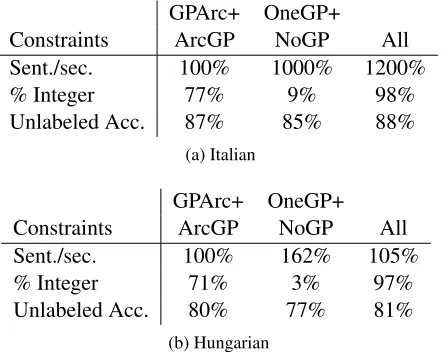
To investigate how the additional grandparent con-straints in section 3.2 help, we compare three mod-els, this time without PPC. The first model follows Martins et al. (2009) and uses constraints ArcGP and GPArc only. The second model uses only constraints OneGP and NoGP. The final model incorporates all four constraints.
Table 2 shows speed relative to the baseline model with constraints ArcGP and GPArc, as well as the percentage of integer solutions and the average un-labeled accuracy—all for the Italian and Hungarian datasets. We notice that the full model has less frac-tional solutions than the partial models, and either substantially (Italian) or slightly (Hungarian) faster runtimes than ArcGP+GPArc. Interestingly, both sets of constraints in isolation perform worse, in par-ticular the OneGP and NoGP model.
7 Conclusion
Italian Hungarian Danish
BF PPC BF PPC BF PPC
Sent./sec. relative to BF 100% 760% 100% 380% 100% 390%
GPs Scored relative to BF 100% 6% 100% 12% 100% 13%
GPs Added relative to BF 100% 5% 100% 7% 100% 7%
Objective rel. to BF 100% 100% 100% 100% 100% 100%
% of Integer Solutions 98% 98% 97% 97% 97% 97%
[image:10.612.130.485.57.167.2]Unlabeled Acc. 88% 88% 81% 81% 88% 88%
Table 1: Parse, Price and Cut (PPC) vs Brute Force (BF). Speed is the number of sentences per second, relative to the speed of BF. Objective, GPs scored and added are also relative to BF.
GPArc+ OneGP+
Constraints ArcGP NoGP All
Sent./sec. 100% 1000% 1200%
% Integer 77% 9% 98%
Unlabeled Acc. 87% 85% 88%
(a) Italian
GPArc+ OneGP+
Constraints ArcGP NoGP All
Sent./sec. 100% 162% 105%
% Integer 71% 3% 97%
Unlabeled Acc. 80% 77% 81%
(b) Hungarian
Table 2: Different outer bounds on the grandpar-ent polytope, for nonprojective parsing of Italian and Danish.
violations. This allows us to discard a large fraction of parts during both scoring and optimization, lead-ing to nearly 800% speed-ups without loss of accu-racy and certificates. We also present a tighter bound on the grandparent polytope that is useful in its own right.
Delayed column and row generation is very useful when solving large LPs with off-the-shelf solvers. Given the multitude of work in NLP that uses LPs and ILPs in this way (Roth and Yih, 2004; Clarke and Lapata, 2007), we hope that our approach will prove itself useful for other applications. We stress that this approach can also be used when working with dynamic programs, as pointed out in section 4.5, and therefore also in the context of dual de-composition. This suggests even wider applicabil-ity, and usefulness in various structured prediction
problems.
The underlying paradigm could also be useful for more approximate methods. In this paradigm, al-gorithms maintain an estimate of the cost of certain resources (duals), and use these estimates to guide search and the propose new structures. For exam-ple, a local-search based dependency parser could estimate how contested certain tokens, or edges, are, and then use these estimates to choose better next proposals. The notion of reduced cost can give guid-ance on what such estimates should look like.
Acknowledgements
This work was supported in part by the Center for Intelligent Information Retrieval and the Univer-sity of Massachusetts and in part by UPenn NSF medium IIS-0803847. We gratefully acknowledge the support of Defense Advanced Research Projects Agency (DARPA) Machine Reading Program under Air Force Research Laboratory (AFRL) prime con-tract no. FA8750-09-C-0181. Any opinions, find-ings, and conclusion or recommendations expressed in this material are those of the authors and do not necessarily reflect the view of DARPA, AFRL, or the US government.
References
Ravindra K. Ahuja, Thomas L. Magnanti, and James B. Orlin. 1993. Network Flows: Theory, Algorithms, and Applications. Prentice Hall, 1 edition, February. David Belanger, Alexandre Passos, Sebastian Riedel, and
[image:10.612.76.297.223.399.2]Dimitri P. Bertsekas. 1999. Nonlinear Programming. Athena Scientific, 2nd edition, September.
Sabine Buchholz and Erwin Marsi. 2006. Conll-x shared task on multilingual dependency parsing. In Proceed-ings of the 10th Conference on Computational Natu-ral Language Learning (CoNLL’ 06), CoNLL-X ’06, pages 149–164, Stroudsburg, PA, USA. Association for Computational Linguistics.
Eugene Charniak and Mark Johnson. 2005. Coarse-to-fine n-best parsing and maxent discriminative rerank-ing. InProceedings of the 43rd Annual Meeting of the Association for Computational Linguistics (ACL ’05), pages 173–180.
James Clarke and Mirella Lapata. 2007. Modelling compression with discourse constraints. In Proceed-ings of the 2007 Joint Conference on Empirical Meth-ods in Natural Language Processing and Computa-tional Natural Language Learning (EMNLP-CoNLL ’07), pages 1–11.
A. Culotta, M. Wick, R. Hall, and A. McCallum. 2007. First-order probabilistic models for coreference reso-lution. In Joint Human Language Technology Con-ference/Annual Meeting of the North American Chap-ter of the Association for Computational Linguistics (HLT-NAACL ’07), pages 81–88.
Peter Dienes, Alexander Koller, and Marco Kuhlmann. 2003. Statistical a-star dependency parsing. In Pro-ceedings of the workshop on Prospects and Advances of the Syntax/Semantics Interface, Nancy, 2003, pp.85-89.
P.C. Gilmore and R.E. Gomory. 1961. A linear program-ming approach to the cutting-stock problem. Opera-tions research, pages 849–859.
Dan Klein and Christopher D. Manning. 2003. A* pars-ing: Fast exact viterbi parse selection. InProceedings of the 41st Annual Meeting of the Association for Com-putational Linguistics (ACL ’03), pages 119–126. Terry Koo and Michael Collins. 2010. Efficient
third-order dependency parsers. InProceedings of the 48th Annual Meeting of the Association for Computational Linguistics (ACL ’11).
Terry Koo, Alexander M. Rush, Michael Collins, Tommi Jaakkola, and David Sontag. 2010. Dual decomposi-tion for parsing with nonprojective head automata. In
Proceedings of the Conference on Empirical methods in natural language processing (EMNLP ’10). Sandra Kübler, Ryan T. McDonald, and Joakim Nivre.
2009. Dependency Parsing. Synthesis Lectures on Human Language Technologies. Morgan & Claypool Publishers.
Marco Lübbecke and Jacques Desrosiers. 2004. Selected topics in column generation. Operations Research, 53:1007–1023.
R. Kipp Martin, Ronald L. Rardin, and Brian A. Camp-bell. 1990. Polyhedral characterization of discrete dynamic programming. Oper. Res., 38(1):127–138, February.
André F. T. Martins, Noah A. Smith, and Eric P. Xing. 2009. Concise integer linear programming formu-lations for dependency parsing. In Proceedings of the Joint Conference of the 47th Annual Meeting of the ACL and the 4th International Joint Conference on Natural Language Processing of the AFNLP (ACL ’09), pages 342–350, Morristown, NJ, USA. Associa-tion for ComputaAssocia-tional Linguistics.
André F. T. Martins, Noah A. Smith, Pedro M. Q. Aguiar, and Mário A. T. Figueiredo. 2011. Dual decomposi-tion with many overlapping components. In Proceed-ings of the Conference on Empirical methods in natu-ral language processing (EMNLP ’11), EMNLP ’11, pages 238–249, Stroudsburg, PA, USA. Association for Computational Linguistics.
R. McDonald and F. Pereira. 2006. Online learning of approximate dependency parsing algorithms. In
Proceedings of the 11th Conference of the European Chapter of the ACL (EACL ’06), pages 81–88.
R. McDonald, K. Crammer, and F. Pereira. 2005a. On-line large-margin training of dependency parsers. In
Proceedings of the 43rd Annual Meeting of the Associ-ation for ComputAssoci-ational Linguistics (ACL ’05), pages 91–98.
R. McDonald, F. Pereira, K. Ribarov, and J. Hajic. 2005b. Non-projective dependency parsing using spanning tree algorithms. InHLT-EMNLP, 2005.
Mathias Niepert. 2010. A delayed column generation strategy for exact k-bounded map inference in markov logic networks. In Proceedings of the 26th Annual Conference on Uncertainty in AI (UAI ’10), pages 384–391, Corvallis, Oregon. AUAI Press.
J. Nivre, J. Hall, S. Kubler, R. McDonald, J. Nilsson, S. Riedel, and D. Yuret. 2007. The conll 2007 shared task on dependency parsing. In Conference on Em-pirical Methods in Natural Language Processing and Natural Language Learning, pages 915—932.
Hoifung Poon and Pedro Domingos. 2007. Joint infer-ence in information extraction. InProceedings of the 22nd AAAI Conference on Artificial Intelligence (AAAI ’07), pages 913–918.
Sebastian Riedel and James Clarke. 2006. Incremen-tal integer linear programming for non-projective de-pendency parsing. InProceedings of the Conference on Empirical methods in natural language processing (EMNLP ’06), pages 129–137.
parsing. InJoint Human Language Technology Con-ference/Annual Meeting of the North American Chap-ter of the Association for Computational Linguistics (HLT-NAACL ’10), pages 760–768, Los Angeles, Cal-ifornia, June. Association for Computational Linguis-tics.
Sebastian Riedel. 2008. Improving the accuracy and ef-ficiency of MAP inference for markov logic. In Pro-ceedings of the 24th Annual Conference on Uncer-tainty in AI (UAI ’08), pages 468–475.
D. Roth and W. Yih. 2004. A linear programming formu-lation for global inference in natural language tasks. In
Proceedings of the 8th Conference on Computational Natural Language Learning (CoNLL’ 04), pages 1–8. Alexander Rush and Slav Petrov. 2012. Vine pruning for
efficient multi-pass dependency parsing. InJoint Hu-man Language Technology Conference/Annual Meet-ing of the North American Chapter of the Association for Computational Linguistics (HLT-NAACL ’12). Alexander M. Rush, David Sontag, Michael Collins, and
Tommi Jaakkola. 2010. On dual decomposition and linear programming relaxations for natural lan-guage processing. InProceedings of the Conference on Empirical methods in natural language processing (EMNLP ’10).
David A. Smith and Jason Eisner. 2008. Dependency parsing by belief propagation. InProceedings of the Conference on Empirical Methods in Natural Lan-guage Processing (EMNLP), pages 145–156, Hon-olulu, October.
D. Sontag and T. Jaakkola. 2007. New outer bounds on the marginal polytope. InAdvances in Neural Infor-mation Processing Systems (NIPS ’07), pages 1393– 1400.
David Sontag, T. Meltzer, A. Globerson, T. Jaakkola, and Y. Weiss. 2008. Tightening LP relaxations for MAP using message passing. InProceedings of the 24th An-nual Conference on Uncertainty in AI (UAI ’08). Roy W. Tromble and Jason Eisner. 2006. A fast