http://dx.doi.org/10.4236/am.2012.330187 Published Online October 2012 (http://www.SciRP.org/journal/am)
Modified Piyavskii’s Global One-Dimensional
Optimization of a Differentiable Function
Rachid Ellaia, Mohamed Zeriab Es-Sadek*, Hasnaa Kasbioui
Laboratory of Study and Research in Applied Mathematics (LRMA), Mohammadia School of Engineering, Mohammed V University (Adgal), Av Ibn Sina, Rabat, Morocco
Email: *[email protected]
Received June 21,2012; revised August 28, 2012; accepted September 4, 2012
ABSTRACT
Piyavskii’s algorithm maximizes a univariate function satisfying a Lipschitz condition. We propose a modified Piy- avskii’s sequential algorithm which maximizes a univariate differentiable function f by iteratively constructing an upper bounding piece-wise concave function Φ of f and evaluating f at a point where Φ reaches its maximum. We compare the numbers of iterations needed by the modified Piyavskii’s algorithm (nC) to obtain a bounding piece-wise concave func- tion Φ whose maximum is within εof the globally optimal value fopt with that required by the reference sequential algo- rithm (nref). The main result is that nC ≤ 2nref + 1 and this bound is sharp. We also show that the number of iterations needed by modified Piyavskii’s algorithm to obtain a globally ε-optimal value together with a corresponding point (nB) satisfies nB ≤ 4nref + 1 Lower and upper bounds for nref are obtained as functions of f(x), ε, M1 and M0 where M0 is a
constant defined by M0= supx a b , f
x and M1≥M0 is an evaluation of M0.Keywords: Global Optimization; Piyavskii’s Algorithm
1. Introduction
We consider the following general global optimization problems for a function defined on a compact set
0.9 0.15 1.4 0.9 m:
X R ex ex ex ex
(P) Find
x f,
X R 0.9 0.15 1.4ex ex ex 0.9ex such that
= .
f f x f x x X
(P1) Find xoptX such that fopt = f(xopt) ≥ f
* − ε,
where εis a small positive constant.
Many recent papers and books propose several ap- proaches for the numerical resolution of the problem (P) and give a classification of the problems and their meth- ods of resolution. For instance, the book of Horst and Tuy [1] provides a general discussion concerning deter-ministic algorithms. Piyavskii [2,3] proposes a determi-nistic sequential method which solves (P) by iteratively constructing an upper bounding function F of f and evaluating f at a point where F reaches its maximum, Shubert [4], Basso [5,6], Schoen [7], Shen and Zhu [8] and Horst and Tuy [9] give a special aspect of its appli-cation by examples involving functions satisfying a Lipschitz condition and propose other formulations of the
lin [25]. Danilin’s result was improved by Hansen, Jau-mard and Lu [26]. In the same way, we develop a refer- ence algorithm in order to study the relationship between nB and nref where nB denotes the number of iterations used by the modified Piyavskii’s algorithm to obtain an
ε-optimal value, and nref denotes the number of iterations used by a reference algorithm to find an upper bounding function, whose maximum is within εof the maximum of f. Our main result is that nB ≤ 4nref + 1. The last purpose of this paper is to derive bounds for nref. Lower and upper bounds for nref are obtained as functions of f(x), ε, M1 and
M0 where M0 is a constant defined by
0= supx a b,M f x and M1≥M0 is an evaluation of M0.
2. Upper Bounding Piecewise Concave
Function
Theorem 1. Let
2 , , 0.9 0.15 1.4 0.9
f C a b R ex ex ex ex
and suppose that there is a positive constant M such that
,
. sup
x a b
M f x
(1) Let
=b x
x a
P x f a f b
b a b a
and
=
. 2M
x P x x a b x
Then
x f x
for allx
a b, .
Proof. Let
x =
x f x
,
we have
" x = M f x" 0
.
Then Ψ is a concave function, the minimum of Ψ over [a, b] occurs at a or b. Then
0x a
b
for all x
a b, .This proves the theorem.
Remark 1. Let
1
= .
2
f b f a
a b u
M b a
Then the maximum Φ* of Φ(x) is:
2
2
1 1
2
1
= 4
,
f b f a
f b f a
M b a
M a b
if u a b
f a f b
If the function f is not differentiable, we generalize the above result by the following one:
Theorem 2. Let f be a continuous on [a, b] and sup- pose that there is a positive constant M such that for every h > 0
2
2
,
f u h f u f u h Mh u a h b h .
(2) Then
, . 2b x x a
f x f a f b
b a b a
M x a b x x a b
Proof. without loss of generality, we assume that f(a) = f(b) = 0 and M = 0.
Let us consider the function f(x) −Φ(x) instead of the function f(x). It suffice to prove that
*,
= max 0
x a b
f f x
.
Suppose by contradiction that f* > 0, and let
*
= sup , = .
u x a b f x f
The function f is continuous, f(u) = f* > 0, thus a < u < b,
consequently u
a h b h,
for h > 0 small and we have f(u −h) ≤f(u) and f(u + h) < f(u).Since M = 0, this contradicts the hypothesis (3). Hence f*≤ 0.
Remark 2. Since the above algorithm is based entirely on the result of Theorem 1, it is clear that the same algo- rithm will be adopted for functions satisfying condition (2).
If f is twice continuously differentiable, the conditions (1) and (2) are equivalents.
3. Modified Piyavskii’s Algorithm
We call subproblem the set of information
= , , ,
i i i i i
P x a b ,
=, 2
i i i
i
i i
i i
b x f a x a f b
x
b a
M
x a b x
i
, ,
= max and = arg max
i i i i
x a bi i x x x a bi i .
x
The algorithm that we propose memorizes all the sub- problems and, in particular, stores the maximum i
of each bounding concave function Φi over [ai, bi] in a structure called Heap. A Heap is a data structure that allows an access to the maximum of the k values that it stores in constant time and is updated in O(Log2k) time.
In the following discussion, we denote the Heap by H. Modified Piyavskii’s algorithm can be described as follows:
3.1. Step 1 (Initialization)
k ← 0
[a0, b0] ←[a, b]
Compute f(a0) and f(b0)
0
0 0
max ,
opt
f f a f b
0
0 0
argmax ,
opt
x f a f b
Let 0 be an upper bounding function of f over [a0,
b0]
Compute 0= maxx a b0 0, 0
x 0 0
opt
if 0 0
opt fopt
Stop, 0
opt
f is an ε-optimal value
H
P0=0, , ,x a b0 0 0
3.2. Current Step (k = 1, 2, ···)
WhileH is no empty do
k ←k + 1
Extract from H the subproblem Pm= m,x am, m,bm with the largest upper bound l
a bk, k
x bm, m
a bl, l
a xm, m3.2.1 Update of the Best Current Solution forj = l, kdo
3.2.1.1. Lower Bound
If
> k 1j opt
f x f then
j kopt
f f x
k opt j
x x
Else
1
k k
opt opt
f f
1
k k
opt opt
x x
End if
3. r Bound
Build an upper bounding function Φj on [aj, bj] 2.1.2. Uppe
Compute j = maxx a bj, j j
x
Add =j j, , ,x aj j j
P b toH
r
m H all
End fo
Delete fro subproblems
= p, p, p,
P x a bp
k p fopt
with
3.2.2. Optimality est T
Let k opt
be the maximum of all j
If k k ,
opt fopt
then Stop, fk
opt is an ε-optimal value
le
bn] denote the smallest subinterval of [a, b] n, whose end points are evaluation points. Th
m
End Whi
Let [an, containing x
en the partial upper bounding function Φn−1(x) span-
ning [an, bn] is deleted and replaced by two partial upper bounding functions, the first one spanning [an, xn] de- noted by Φnl(x) and the second one spanning [xn, bn] de- noted by Φnr(x) (Figure 1).
Proposition 1. For n≥ 2 the upper bounding function Φn(x) is easily deduced fro 1
x , , n1
x as follows:
2 1
1
4 =
4
n n n n
nl
n n
f x f a x
f a
and
2 1
1
4
= .
4
n n n
nr
n n
n
f x f b f x
f b
Proof. In the case where
f 1 =
2
n n n n
n n
x f a
a
a x
x
M x
Figure 1. Upper bounding piece-wise concave function. is in [an, xn], then from remark 1, the maximum of
nl x
is given as follows
21 4 nl
n n
n n
M x a
M x a
(3)
The maximum of
2
1 1
= 2
n n
n n
f x f a
f x f a
1
n x
spanning [an, bn] is reached at the point
1
n n
= .
2
n n
n n n
f b f a
a b
x
M b a
We deduce that
2 2
2 2
1 1
= 4 n n
1 ,
n n n n
n n
n n
x a b a f b f a
M
f b f a
b a
M
then
2
1
1 1
=
4M xn an 2 n f an
.
By substitution in expression (3), we have the result. We show in the same way that the maximum nr
of
nr x
defined in [xn, bn] is given by:
2
1 4
= n n n n
nr
1
.
4 n n
f x f b f x
f b
Remark 3. Modified Piyavskii’s al rithm obtains an
ε of the maximum value of f(x) when the gap
go upper bound on f within
n f
is not larger than ε, where
,
=maxx a b .
f f x
But f* and
,
= arg maxx a b
x f x
are unknown. So modified Piyavskii’s algorithm stops only after a solution of value within ε of the upper bound has been found, i.e., when the error n fn is not
lar-ger than ε. The number of iteratio to satisfy conditions is studied below.
4. Convergence of the Algorithm
f the n
ns needed each of these
We now study the error and the gap of Φn in modified Piyavskii’s algorithm as a function o umber n of iterations. The following proposition shows how they decrease when the number of iterations increases and provides also a relationship between them.
Proposition 2. Let n = n fn
and n = n f
ter n iterations denote respectively the error and the gap af
of modified Piyavskii's algorithm. Then, for n2 1)
2n1 n 4,
2) 2n1n 4, 3) 2n1n 2.
Proof. First, notice that
n ,
n and
n
are non increasing sequences and
fn is nondecreasing. After n iterations of the modified Piyavskii's algorittion hm, the upper bounding piece-wise concave func n
xcontains
n1
partial upper bounding concave func- tions, which we call first generation function. We call theboundi e funct ned
splitting these second generation function. m must belong to the second generation for the first time after no more than another n1 iterations of the modified Piyavskii’s algorithm, at iteration m (m≤ 2n− 1).
Let k km
be the iteration after which the maximum
n 1m of
m x
has been obtained, by splitting the maximum k 1
of k1
x . Then, in the case where
= 2 k k k k k k kf x f a
a x
x
M x a
is in
a xk,
, nd fro pro osition 1, we get:
k a m p
2 1= k k k
m
f x a
1 4 f a rg max 2 4 1
= 2 ,
4
k
k k
f f x
f a f x f x where 1 1
k k k
k f ak
k f ak
, 1
= a x a b
k k
x x
and is one of t dpoints of the in ove whi e function defined.
1) have k a ch th We he en 1 k
is
2 1
n n
terval
m
r
2 1 f2n 1 m f ,
where
=0, , 1
=maxi m = max , .
m i k k
f f x f f x
If fm= f x
k , therefore, we have
2 1 1 1 1 1 4 4 4 4 4 = . 4 n k k k k k k k k k n n nf x 2 f a f x
1 2 k k k k f x f a f a f x f f x If 1 = , m k
f f • case 1
we will consider two cases: If xk ak, then m= f a
k = fm
and if xk xk,
then m= f x
k = fm and the algorithm
case 2
stops. •
,
,k k k
x a x then we have
1 = , 2 k k k k k k k kf x f a
a x
x a
M x a
hence
2 1 2 =k k k k
k k
M
f a f x x a
f a (proposition 1). Moreover
k
k k 1
k
. f x f a f a We deduce from these two inequalities that
k
k k 1
.f x f a f ak
Therefore
2 1
2 1 1 1 11 1 1
1 1 2 4 1 2 1 3 4
=δ / 4. 4
n
k k
k k
k k
k k k k k k
k k k
k k
n
f x f a
1 k k 1 4 4 n n
f x f
f a
f x f a f x f a f
f f f f a f
2) We have
2n 1 2n 1 f m f .
the same steps to prove the second point of 1) hat
We follow
and show t 2n1n 4. 3)
• case 1
If xk ak or xk xk, then m = fm = f and the
al ops.
• case 2
gorithm st
,
.k k k
x a x First, we have
2 1 1 1 1 = 2 4 , 2 k km k k k
k k
k k
f x f a
f x f a
1
2
, 2
m
k k
n k
f
f x
f f x
therefore f x
k fn. Hence
2 1 4 2.
n k
n n
f x
This proves the proposition.
Proposition 3. Modified Piyavskii’s algorithm (with
= 0
) is convergent, i.e. either it terminates in a finite number of iterations or
,
= = = max
limn n limnfn f x a b f x .
Proof. This is an immediate consequence of the
definition of and i) of proposition 2.
Algorithm
ber of necessary function evaluations for (P) mea efficiency of
ansen and Lu [26]
um nu uation points
re tain a gua f problem (P)
where the functions involved are Lipschitz-Continuous on
δn
5. Reference
Since the num lving pro
so blem sures the a method,
Danilin [25] and H , Jaumard suggested studying the minim mber of eval
quired to ob ranteed solution o
a b, .n the sam
I e way, we propose to study the minimum number of evaluation points required to obtain guaranteed solution of problem (P) where the functions involved satisfy the condition (1).
For a given tolerance
a
and constant M this can be rence bounding piece-wise concave function that
done by constructing a refe such ref
,
=maxx a b ref x f,
with a smallest possible number f evaluations
points in ref
n o
1, , ,2 nref
y y y
a b, .boundin
Suc g e concave
function is constructed with
h a reference piece-wis
,
= maxx a b
f f x
se, designed ut rather to ry evaluation points i her algorithm
g function ref
which
o be known. It not to
lem (P) from th give a
reference number of necessa n order
to study the efficiency of ot to
is assumed t is of cour
solve prob e outset, b
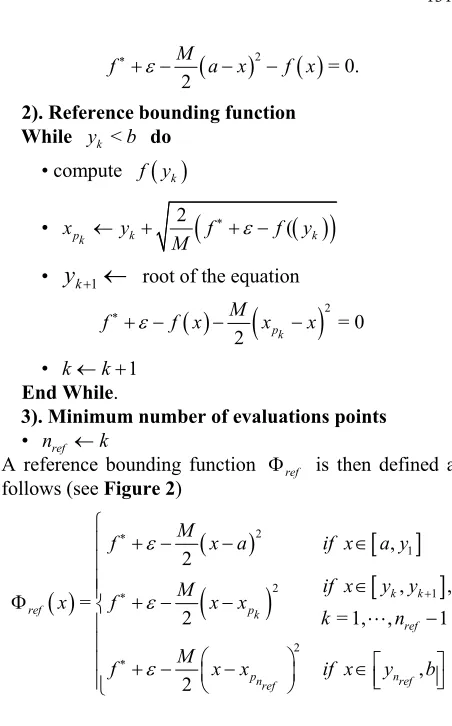
s. It is easy see that a reference boundin x can be
1). Initialization
•
obtained in the following way:
Description of the Reference Algorithm
1 k
• y1 root of the equation
2
= M
a x f x
0.
f
ction 2
2). Reference bounding fun While yk <b do
• compute f y
k• xpk yk 2
f f y(
k
M
•
y
k1
root of the equation
2= 0
2 pk
M
f f x x x
• k k 1
End While.
3). Minimum number of evaluations points
• nref k
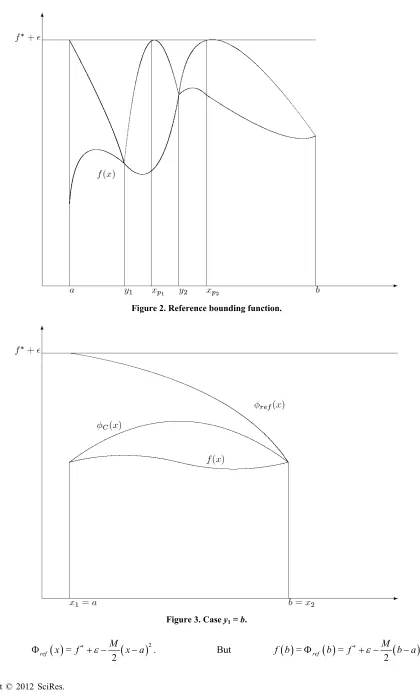
A reference bounding function is then defined as follows (see Figure 2) ref
2
, 2
M
x a y
1
, ,
k
2 1
2
=
2 = 1, , 1
, 2
k
ref pk
ref
pn n
f x a if
ref ref
if x y y
M
x f x x
k n
M
f x x if x y b
6. Estimation of the Efficiency of
Modified Piyavskii’s A
lgorithm
the
Proposition 4. For a given a tolerance
,
let ref be ding function withand a reference boun
poin ref
n evaluations ts y1, , ynref ref = f .
Let C be a
boundi ction obtained by the uation points ng fun
algorithm with eval
modified Piyavskii’s
,
1, , nC
x x
that
h
where nC of
is the smallest number iterations suc
,
= max .
C C
x a b x f
Th ave
, en we h
2 1
C ref
n n (4) and bound is sharp for all values of
Proof. The proof is by inducti on We
initia e the ind • Case 1
We have that
the nref
on nref liz uction at nref = 1.
.
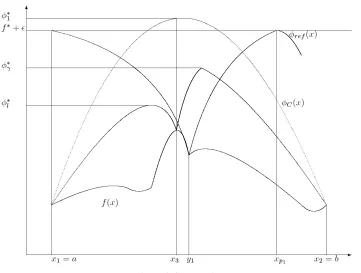
b (see Figure 3)
1=
y
to show C
x R
x , x
a b, .We have
2 x a
= b x f a x a f b
M b x
C x
[image:6.595.56.226.85.225.2]Figure 2. Reference bounding function.
Figure 3. Case y1 = b. and
=
2.2 ref
M
x f x
2= =
2 ref
M
, f b b f b a
[image:7.595.91.511.74.768.2]hence
2( ) =
2 2
= .
2 C
b x f a x a f
x
b a
M M
x a b a x a b x
b x f a x a f M
x a b a
Therefore
=
0C ref
b x
x x f a f
b a
,
hence the result holds.
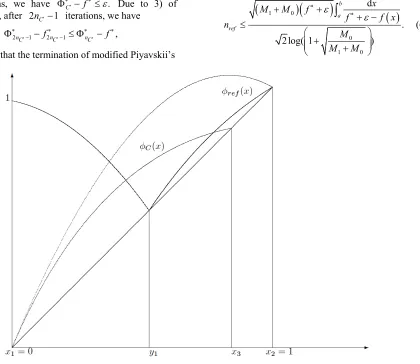
• case 2y1 < b. (see Figure 4)
If nc = 2, (4) holds. In this case, we have
2
1
2
1 1
, 2
=
, , 2
ref
p
M
f x a si x a y
x
M
f x x si x y b
where
1 1
1
2
= .
p
x y f f y
M
at
Assuming th 1 > f and
3 , 1
x a y ( the proof is similar for x3
y b1,
). We denote by l
xand r
x the ingrespectively on
partial bound functions defined
a x, 3
and
x b3,
and by r a maximum value of r
x . We show that
, 3
l x ref x x a x
and that r f. Indeed, we have
3 3
3
3
=
2
l
x x f a x a f x
x
x a
M
x a x x
and
23 3 = ,
2
ref
M
f x x f a x 3
thus
3 3
3
0 , .
l x ref x
x x
f a f
x a
x a x
If
33
3
= 2
f b f x
x b
x
M b x
is in
x b3, ,
then
2 3
3 1
1
1 1
= .
2 2 2
r
f b f x
f x f b
f b
[image:8.595.121.482.455.728.2]
As
3
1
f b f x f b
of proposition
(see the proof 2), we have
3 1
2
3 1
1 1
1 2
1
2 2
1
. 2
r f x
M
f a x
f f a f
If x b, then r= f b
f.If x ≤x3 then r = f x
3 f
and (4) holds.
e now th and
onsider nref = k + 1. The relation ( = 2, therefore we may assume that
.
at (4) holds for ref
Assum n k k
1 ,
4) holds for nc c
1 > f ,x1= anda x2 =b
If we let
,
3= argmaxx a b 1 ,
x x
the modified Piyavskii’s algorithm has to be imple- mented on two subintervals [x1, x3] and [x3, x2] There are
two cases which need to be discussed separately: • case 1 (see Figure 5)
There is a subinterval containing all the nref evaluation
points of the best bounding function ref
x .that
[
x
1,
x
. LetWithout loss of generality, we may assume con- tains all nref evaluation points of
]
3 ref
x and x be the solution of 1
x = f .
By symmetry, we
have
3= 2 .
x x
x Let ynref
tial bou
be the abscissa of the maxim f the last par nding function of
um o
.ref x
Due to our n,
assumptio we have
2
= (
nref nref nref
y y f f y x
M
,
since otherwise there is an another evaluation point of f on the interval
, .
nref
y b
Let ynref 1 be the abscissa of the maximum of the
function of
partial bounding ref
x . preceding ynref .In this case, we have
1
2
> nref = nref nref
x y y f f y
M
.
But ynref 1<x
n
[image:9.595.106.494.436.723.2]implies that nref = 1, which is not the case accordi g to the assumption (nref ≥ 2). Therefore, this case will never exist.
• case 2
None of the subintervals contains all the nref uation points of Φref(x). We can then apply induction, reasoning on the subintervals [x 2] obtained by
modi-fied Piy
eval
1, x3] and [x3, x
avskii’s algorithm. If they contain and evaluation points respectively, [x1, x] contain
1
c
n
s
2
c
n 1
2 n1cnc2
Then evaluation points as x3 belongs to b subi
(4) follows by induction on n . d
0 we hav bound (4) is sharp.
As noticed in remark 3, the modified Piyavskii’s algo- rithm does not necessarily stop as soon as a co is found as described in proposition 4, but only when the rror does not exceed ε. We now study the number of evaluation points necessary for this to happen.
Proposition 5. For a given tolerance ε, let nref be the number of evaluation points in a reference bounding function of f and nB the number of iterations after which the modified Piyavskii’s algorithm stops. We then have
. (5)
Proof. Let Due to proposition 4, after
iterations
oth ntervals. ref
Consi er the function f(x) = x defined on [0, 1], the constant M is equal to 4. For ε= e nC = nref + 1 (see Figure 6), and the
ver e
4 1
B ref
n n
= 2 1.
C ref
n n
, we have
C
n
C f .
iterations, we have
Due to 3) of proposition 2, after 2nC1
2nC 1 f2nC 1 nC f ,
algorithm is satisfied. This proves (5).
which shows that the termination of modified Piyavskii’s
7. Bounds on the Number of Evaluation
Points
e prev
modified algo
nce algorithm. We now evaluate the number nB of evaluation functions of the modified Piyavskii’s algorithm itself. To achieve this, we rive bounds on nref, from which bounds on n are readily ob-
ta he re
In th ious section, we compared the number of evaluation functions in the Piyavskii’s - rithm and in the refere
de B
ined using t lation nref ≤nB ≤ 4nref + 1.
Proposition 6. Let f be a C2 function defined on the in-
terval [a, b]. Set
0= supx a b,M f x
and let
,
=maxx a b .
f f x
Then the number nref of evaluation points in a reference cover Φref using the constant M1 ≥M2 is bounded by the
following inequalities:
1 0
0
1 0
d
.
2log( 1 )
b a ref
x
M M f
f f x
n
M
M M
(6)
[image:10.595.111.531.362.726.2]ontains all the nref evaluation points.
0
2
1 0
1
0
0 1
d
.2 .2 ,
2
d 4 2
.2 .2 .
b
ref
b a
M x
M M
in inif f
n M
M x
f f x
in inif M M
2 a f f x
(7)
Proof. We suppose that the reference cover Φref has nref− 1 partial upper bounding functions defined by the evaluation points
.
We consider an arbitrary partial upper bounding function and the corresponding subinterval [yi, yi + 1] fori i = 1, ···,
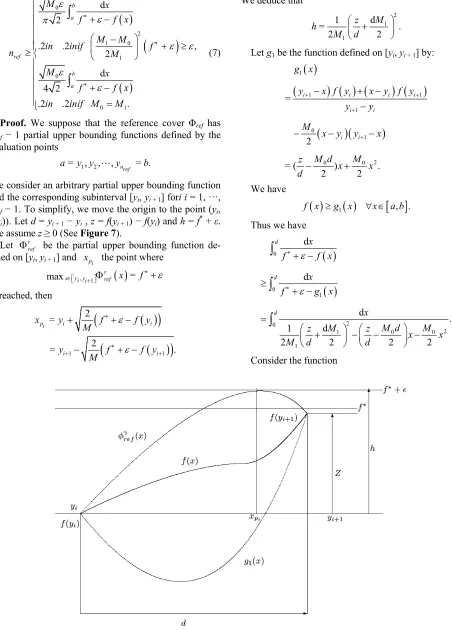
nref− 1. To simplify, we move the origin to the point (yi, f(yi)). Let d = yi + 1−yi , z = f(yi + 1) −f(yi) and h = f* + ε. We assume z≥ 0 (See Figure 7).
Let be the partial upper bounding function de- fined on yi + 1] and
1 2
= , , , nref =
a y y y b
r ref
[yi, xpi the point where
, 1 =
maxx y yi i rref x f
is reached, then
1 1
2 =
2
= .
pi i i
i i
x y f f y
M
y f f y
M
We deduce that
2 1
d 1
= .
2 2
M z h
M d
1
Let g1 be the function defined on [yi, yi + 1] by:
1
1 1
1 0
= i i i i
i i
g x
y x f y x y f y
y y
M
x y y x
1
2 i i
z
2
0 0
= ( ) .
2 2
M d M
x x
d
e We hav
1
, .f x g x x a b
Thus we have
0
d
d x
f f x
0
1
2 0
2
0 0
1
1
d
d .
d 1
2 2 2 2
d d
x
f g x
x
M d M
M
z z x x
M d d
Consider the function
[image:11.595.67.519.92.722.2]
1 2 0 0 2 1 1 d 1 = .2 2 2 2
M d M
M
z z
F x x
M d d
x
Let x1 and x2 be the roots of the equation F1(x) = 0;
they are given by 0 1
0
2 2
0 0 1
1
2
2 2
1 =
d M d
M d z
x 0 0 2 2 1 = 2 2
M d z
x
M d
M d z M M d z
M d
0 0 1
1
2 2
M d z M M d z
d M d
Then F1 is written in the following way
1 = 20 1 2 .
M
F x x x x x
Let
0
= ,
2
M d z
d
0
= ,
2
M d z
d
2 2
0 0 1
1
=
2 2
M d z M M d z
d M d
. We have
0 1d = 1 log log
1
= log log
d x F x
.Since θ≥ 0 and g1 reaches its minimum at the point θ,
then 1 and
0 1 d 1 log . d x F x
Since 0 1 0log 2log 1 M ,
M M
1 0
1 1 ,
2 M M f
then
0 0 1 0 1 0 d2 log 1 ,
d x
f f x
M
M M
M M f
and
1 0
1 0 0d
2
log 1 .
b a
ref
x
f f x
M n
M M
M M f
.Now let us consider the function G defined and con-tinuous on [yi, yi + 1] such that
•
This proves (6)
i, i 1
,f x G x x y y
. G x f•
Two cases are considered case 1: If
2 2 0 1 and 1
2M d 2 0
1 1 , 2 2 M d M d z z
M d
(8)
then, the function G is given by
0 0 2 2= =
2 2
M d M
z
G x g x x x
d . Hence
0 2 d d . d d o x xf f x f g x
We consider
1 2 0 0 2 21
1
= ,
2 2 2 2
M d M
M d
z z
F x x
M d d
x
its derivative is
02 = 2 0 ,
M d z
F x M
d
x
02
0
1
= 0 = .
2 M d z
F x x
M d
Thus F2 is expressed as follows
2 02 = 2 2 ,
hence
0 2 2 F x 00 2 2
0 2 d = arctan 2 arctan . 2 d x M d x
M F x F x
M x F x
Since
1 2 0 22
1 0
1 1
=
2 2 2 2
M d
M d z z
F x
M d M d
and arctan , 2 x
then
0 2 0 d 2 , d xF x M
and
0d 2 .
b
ref a
x n
M f f x
Moreover, the inequality
2 1 0 1 2 M M fM
implies (8), this proves the first inequality of (7). Suppose that: Case 2: 2 2 0 1 1 0
1 1 .
2 2 2 2
M d
M d z z
M d M d
(9)
Let X1 et X2 be the roots of the equation 2
2
0 0
1 1
2M d 2 d 2 2
1
= 0,
M d M
M d z z x x
2 are given by
X1 and X
0 1
0
2 2
0 0 1
0 1 0 2 1 = X
M0 d
2 2
0 0 1
0 1 1 = 2 2 , 2 2 2 2 . 2 2 M d z X M d
M d M M d
z z M
d M d
M d z
M d M M d
z z
M
d M d
In this case, G is given by
2 0 0 1 2 3 2 1 1 1 2 2 2if 0, [ , ]
= =
1
2 2
if , .
M d M
z
x x
d
x X X d
G x g x
M d z
M d
x X X
We have
0 0 3 1 0 2 0 2 0 2 d d d 2 d d X xf f x
x
f g x
x M
F x x x
M x x
Moreover, M0 = M1 implies the condition (9) and we
have
2 2
1 2
d d .
X d X X x x F x
2
2 0 1 0 0 0 1= z M d 2
X2 M0
0 = 0 1 = 2 2 2 x M d z X M M d M d F Therefore
10 0 * 2
0
d 2
£ ,
2
X x
M x x M
2 1
0
d 4 ,
2 X X x M
22 0 * 0
d 2 , 2 d X x
M x x M
and
0 0 3 d 2 4 . d x Mf g x
Hence
0 d .
4 2 b
ref a
M x
n
f f x
Table 1. Computational results with = 102.
C ref
N n Function
number Function f(x) Constant M Interval [a, b]
Optimal value fopt
Optimal
point(s) xopt NC nref
3x 1.4 sin 18 x
1 626.4 [0, 1] 1.48907 0.96609 13 7 1.85
−6.7745761
2 350 [−10, 10] 12.03125 −0.49139 76 44 1.72
5.791785
3
5
=1 sin 1
k k k x k
10 sin10x x 2100 [0, 7.9197273 1] 0.79785 16 10 1.6
sinx sin10 3x
4 12 [2.7, 7.5] 1.899599 5.145735 11 6 1.83
–7.0835
5 350 [−10, 10] 14.508 –0.8003 69 39 1.76
5.48286
x 51 [0, 4] 0.788685 0.224885 21 13 1.61
7
5
=1 cos 1
k k k x k
6 exsin 2
16x224x5
ex 24 [1.9, 3.9] 3.85045 2.868 16 11 1.452 3
128 282.5
8 25x x x 370 [0, 1] 1.72866 0.18916 33 24 1.37
4 5
278.7x 100.9x
9 sinxsin 2 3x 9 [3.1, 20.4
10
] 1.90596 17.029 30 19 1.57
sin 3 1
x x 10 [0, 6.5] 7.81567 5.87287 11 6 1.83
11 xsinx 31 [0, 10] 7.91673 7.9787 22 12 1.83
12 2cosxcos 2x 15 [−1.57, 6.28] 1.5 2.094 26 17 1.52
4.189
13 sin3xcos3x 18 [0, 6.28] 1 3.142 28 18 1.55
14 sin sin10 3 x x
12.1 [2.7, 7.5] 1.6013 5.19978 11 6 1.83
logx 0.84x 3
ations of modified Piyavskii's algorithm for different values of M. Test function No 1 Test function No 2 Test function No 3
[image:14.595.56.539.532.651.2]ε and Table 2. The number of function evalu
Mε 626.4 800 975 1500 2000 350 400 500 600 1000 2100 2150 2200 2300 3000
0.5 10 11 15 18 18 67 68 72 75 103 11 11 12 12 13
10−2 13 17 21 24 26 76 78 85 86 122 16 16 17 17 18
10−4 17 22 25 28 32 88 89 95 103 141 22 22 22 22 23
10−6 20 26 31 36 38 96 98 108 118 160 27 27 28 28 29
10−8 24 29 36 41 46 106 111 121 132 177 31 32 34 33 36
8. Computational Experiences
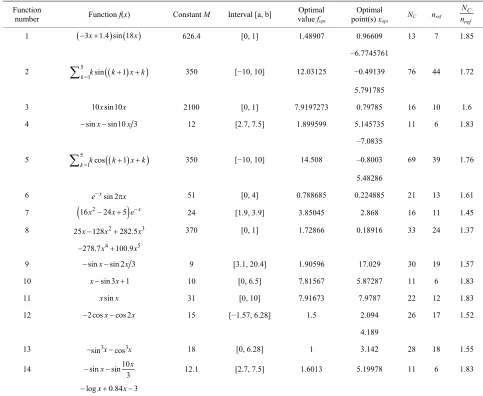
In this section, we report the results of computational experiences performed on fourteen test functions (see
Tables 1 and 2). Most of these functions are test functions drawn from the Lipschitz optimization literature (see
Hansen and Jaumard [20]).
The performance of the Modified Piyavskii’s algo- rit easured in terms of NC, the number of function evaluations. The number of function evaluations NC is compared with (nref), the number of functio uations required by the reference sequential algorithm. We ob-
hm is m
serve that NC is on the average only 1
More precisely, we have the following estimation .35 larger than (nref).
1.35 NC 1.85 ref
n .
For the first three test ions, we obser that the influe of the parameter M is not very important, since the number of function evaluations increase reciably for a same precision ε.
REFERENCES
[1] and H. Tuy, “Global Optimization-Deterministic d Edition, Springer, Berlin, 1992. [2] A. Piyavskii, “An Algorithm for Finding Absolute
nimum of a Function,” USSR omputa l Mathematical Physics, Vol. 12, No. 4, 1967, pp. 13-24.
[3] A. Piyavskii, “An Algori m for Finding Absolute nimum of a Function,” USS l
Mathematical Physics, Vol. 12, No. 4, 1967, . 57-67. doi:10.1016/0041-5553 72)90115
funct ve
nce
app
R. Horst Approaches,” 2n S.
Mi
the tiona C
matics and
S. th the
Mi
matics and R Computationa
pp ( -2
[4] l M al
Maximum of a Function,” SIAM Journal on Numerical alysis, Vol. 9, No. 3, 1972, p . 379-388.
/0709036
B. O. Shubert, “A Sequentia ethod Seeking the Glob
An p
doi:10.1137
[5] ative Method for the Localization of the bal Maximum,” SIAM urnal on Numer ,
, No. 4, 1982, pp. 781-792. doi:10.1137 719054 P. Basso, “Iter
Glo Jo ical Analysis
Vol. 19 /0
[6] P. Basso, “Optimal Search for the Global Maximum of Bounded Seminorm,” SIAM Journal on sis, Vol. 22, No. 5, 1985, pp -903. :10.1137/0722053
Function with
Numerical Analy . 888
doi
[7] choen, “On a Sequential earch Strate Global Optimization Problems,” Calcolo, Vol. 19, No. 3, 1982,
. doi:10.1007/BF02
F. S S gy in
pp. 321-334 575808
] Z. Shen and Y. Zhu, “An Interval Version of Shubert’s Ite
M
280. doi:10.10 [8
rative Method for the Localization of the Global aximum,” Computing, Vol. 38, No. 3, 1986, pp. 275-
07/BF02240102
[9] R. Horst and H. Tu Global Multi ex l O za Jo of imi n T y an plic ns, V 54, N 2, 19 pp. 253-271. 39434
Methods in tremay, “On the Convergence optimi tion,” urnalf Op- t zatio heor
doi:10.1007/BF009
d Ap atio ol. o. 87,
[1 e “G l On men al O iza
sin moo uxi Fun them al P , Vol. 81, No. 1, 1998, pp. 127-146.
/BF01584848
0] Y. D. Serg yev, loba e-di sion ptim tion U
grammingg S th A liary ctions,” Ma atic ro- doi:10.1007
[1 . Jone ttunen and E ckm “Lipschitzian Optimization without the Lipschitz Con-
lications, doi:10.1007/BF00941892
1] D R. s, C. D. Per B. . Stu an, stant,” Journal of Optimization Theory and App
Vol. 79, No. 1, 1993, pp. 157-181.
pp. 25-37
[13] D. Q. Mayne and E. Polak, “Outer Approximation Algo- for Non Diffe Opt ati oblem ” ourn mizat and Applic s, Vol. 42, No. 1, 1984, pp. 19-30 007/BF00934131
[12] Y. M. Danilin and S. A. Piyavskii, “An Algorithm for Finding an Absolute Minimum,” USSR Computational Mathematics and Mathematical Physics, Vol. 12, No. 4,
1967, . rithm
J
rentiable ion Theory
imiz on Pr ation
s, al of Opti
. doi:10.1
[14] R. H. Mladineo, “An Algorithm for Finding the Global Maximum aria Function,” M the- matical Programming No. 2, 1986, pp. 188-200.
doi:1 01580
of Multimodal, Multiv te a , Vol. 34,
583 0.1007/BF
[15] C. C. Meewella and ayne, “An Algorithm for Global Optimization of Lipschitz Functions,” Journal of Optimization Theory licati V 57, 1988, 23. do /BF0 854
D. Q. M
and App ons, ol. No. 2, pp. 307-3 i:10.1007 093 2
[16] Y. G. Evtushenko, “Numeri Methods for Finding the Global Extremum of on,” USSR Computational Mathematical Physics No. 6, 1971, pp. 38 doi:10 41-5553(71)90065-6
cal a Functi
, Vol. 11, -54. .1016/00
[17] E. A. G in, “The Cubic Algorithm,” Journal of Mathematical Analysis and Applications, Vol. 112, No. 2, 1985, 40. do /002 7X 902
alper
pp. 635-6 i:10.1016 2-24 (85) 68-9 [18] P. Ha aumard and S. H. Lu, “Global Optimiza-
tion of Univariate Lipschitz Functions: I
Prope athematical Programming, 5 o. 1-3, 1992 p. 251-272. doi:10.1007/BF01581202
nsen, B. J
. Survey Vol.
and 5, N rties,” M
, p
P. Hansen, B aumard and S. H. Lu, “Global Optimiza- tion of Univariate Lipschitz Func : ew o- rithms putat mparaison,” athematical Programming, Vol. 55, No. 1-3, 1992, pp. 273-292. doi:10 015812
[19] . J
tions II. N Alg and Com ional Co M
.1007/BF 03
[20] P. Hans d B. Jaum ipschi pt ti n: R. Horst and P. M. Pardalos, Eds., Handbook of Global Optimization, Kluwer mis Publisher Dordrecht, 1994, pp 93.
[21] R. P. Brent, “Algorithms for Minimization without De- rivativ ntice-H wood ffs, 73. [22] S. E. Jacobsen and M. Torabi, “A Global Minimization
Algorithm for a Class of e-Dimensional Functions,” Journal of Mathematical Analysis and Applications, Vol.
en an ard, “L tz O imiza on,” I
Acade s,
. 407-4
es,” Pre all, Engle Cli 19 On
62, No. 2, 1987, pp. 310-324. doi:10.1016/0022-247X(78)90128-2
[23] L. Breiman and A. Cutler, Algorithm for Glob tim n, hematical Programming, Vol. 58, No. 1-3, 1993, pp. 179-19
do .10 015 66
“A Deterministic al Op izatio ” Mat
9. i:10 07/BF 812
] W arito and A. Cut “Ac tio or Global Optimizatio overing Met s Using Second Deriva- ti Journal of Global Optimization, Vol. 4, N 3, 1994, pp. 329-341. /BF01098365
[24 . B mpa
n C ler, hod celera ns f
ves,” o.
doi:10.1007
y of [25] Y. M. Dan , “Estimation the Efficienc an
abso-lute Mini m,” SR C putational Mathematical Physics, Vol. 11, No. 4, 1971, pp. 261-267.
1)90020-6
ilin of
mum Finding Algorith US om doi:10.1016/0041-5553(7