University of Warwick institutional repository: http://go.warwick.ac.uk/wrap
A Thesis Submitted for the Degree of PhD at the University of Warwick
http://go.warwick.ac.uk/wrap/72111
This thesis is made available online and is protected by original copyright. Please scroll down to view the document itself.
A S'roDY OF
SO~.!EEARLY TRANSITIOO METAL HALIDE COMPLEXES
BY
J.HtJGHES.
A dissertation submitted in part fulfilment of the require-ments for the degree of Doctor of Philosophy at the Universit.Y of Warwick.
AVAILABLE
I would like to thank Dr. ~.R.Willey for his guid~~ce during the course of this work, and for his unyielding and contagious optimism and enthusiasm. I would like, also, to thank tr.e~ech-nicians and StaN' of the Department of ;.;olecularSciences. for
the nucerous ways they have assisted in the past three years,
in particular the G-lassblowing Workshop under the direction of !.Ir.K.Holden. I thank my sister, Barbara, for her assistance in
the t:t-pingof this 'lhesis.
the following references:
J.Hughes and ~.R.Will~, J. Amer. Chem. Soc., ~ 8758, 1973. idem., J. Coord. Chec., paper in press.
LIGA.~ ABBREVIATICNS
D: A donor.
L: A monodentate ligand. B: A bidentate ligand. T: A tridentate ligand.
dinrs: o-phcnylenebisdimethylarsine. dien: Diethylenetriamine.
en: Ethylenediamine.
HMT: Hexamethylcyclotrisilazane. !~!e6tren:Tria(2-dimethylaminoethyl)amine. OMT: Octamethylcyclotetrasilazane. pyr: ~dine.
THF: Tetrahydrofuran. THT: Tetrahydrothiophene.
temen: N,NJN:N~-tetra;nethylethylenedia:nine. tetren: Tetraethylenepentamine.
tren: Tris(2-~oethyl)amine.
A3STRACT i
C~R 1. INTRODUCTION 1 - 18
1.1. Nomenclature
1. 2. ~e Early Transition 1!etal Halides 6
1.3. Coordination Chemistry of the Early Transition
:fletu Halides 10
1.4. Eleotronic Speotra of' the Early !ransi tiot~ Metals
CHA.'PTER 2. REACTIVITY OF TRICHLOROBIS(TRIME'l'"rlYLAMINE)C:mmmm(III) 19 - 4-6
2.2. EXPERI:.lENTAL and RSSULTS
19
?3 31
2.1. :r::'i'RO:YuCTION
2.3. JISCUSSICl'l
2.3.A. Reactions of Trichlorobis (trifi1et~ylamine)chro;llu"(III)
31
2.3.A.i. Reaotion with HYdrogenChloride 31
2.3.A.ii. Reactions Involving Trimethylamine Substitution 31 2.3.A.iii. Reactions Involving Chloride Substitution 35
Conclusion 37
2.3.B. Reactions of'
Tri:)4-chloro-trichlorvtris(tri~e~~l~~e)-dichromium(III)
38
2.3.B.i. Reaction with Trimethylamine 38
2.3. B.ii. Reactior. ,vith HydroScn Chloride
2.3.B.iii. Reaction with Pyridine 39
2.4. Decomposition of the MCl,2NMe3 Mducts in Benzene Solution
41
CHAPTER 3. CO!.!PLEXES OF ':aUIlJ' LIG-ANDS
3.1. n:TRO:i>UCTION
47 - 82
47
50
60
(fj
~
3.2. EXPERIlGNTAL and RESULTS
3.3. DISCUSSICN
3.3.A. Complexes of TetrahyJrothiophene
3.3.B. Co::tplexesof N,N,N:N:-tetra.nethylethylenedi8.I:line
3.3.C. Complexes of Tris(2-~oe~~yl)amine
~~a
Tris(2-di~e~~ylacinoetQyl)amine 69 3.3.C.i. Complexes of Tris(2-~~oethyl)amine 69
3.3.C.11. Complexes of Tris(2-di~et~la~oethyl)amine 76 3.3.D. ~e Reaction of TiC14 with Tris(2-~"'linoethyl)amine 80
CHAPTERS 2 and 3 EPILOOUE 83 -86
C::~R 4. CO:~LEXES OF CYCLOSILAZk"mS
4.1. n~TRODUCTION
87 - 106
57
4. 2. EXPERIME~rTALand RESULTS 4.3. DISCUSSION
94
98
CHAPTER 5. sm~ COORDr;ATION Ci~1a:STRY OF ZIRCONIUM 5.1. INTRODUCTION
107 - 119
107
5.2. EXPERI'.~TAL and RESULTS 108
5.3. DISCUSSION 111
Analytical Methods
APPENDIX B. Experimental Teohniques
1. Preparative and Manipulative Teohniques
2. Experimental Aspeots of Struotural Investigations
REFERENCES
127
130 - 1M-13C
134
i
-ABSTRACT
'!he coordination chemistry, in particular the position of the penta-coordinate state, of the halides of the early transition metals (ti taniulll, vanadium and chromium) has been studied from two viewpoints.
1) '!he reactivity and stability of the r.letals in the penta-coordinate state has been investigated. A solution decomposition to a dimeric state, containing the metals in octahedral envir-onaenta, was found to be active in the :i~C13·2:-P..!e3adducts. 'ilie nature of this decomposition and the reactivity of the product
has been investigated.
2) '!he complex formation of the metals with bulky multi-dentate ligands, inducive to penta-coordination, was studied. '!he octahedral nature of the metal was found to be sufficiently powerful to control the donor roles of the ligands involved.
1
-1,1, Nm'{~OLATURE
The nomenclature used herein, where practical, follows that recommended by the International Union or Pure and Applied Chemistry. No attempt is made to give a detailed Rccount of these reco~~end-ations, which may be found in the I,U,P,A.C, publication
'Nom-1
enclature of Inorganic Chemistry', but those of major concern to Coordination Chemistry are briefly set out.
Coordination Compounds
In general terms a coordination entity refers to molecules or ions in which there is an atom (A) to which are attached other atoms (B) or groups (C). For the ~urposes of nomenclature the older restriction on coordination oompounds, that the ato~s (B) or groups (C) are
or
a number in excess of thAt oorresponding to the olassical or stoiohiometric valency of the atom (A), is dropped.is referred to as a 'coordination enti~', or more generally coordination oompound or -complex.
Indication of OxidRtion Number
The oxidation number of the central ato~ is given by brac-keted Roman Numerals after the name of the atom.
Order of Citation of Ligands
The ligands are listed in alphabetical order regardless of their number. The multiplicative prefixes ~no-, di-, tri-, tetra-,etc.~ are used to indicate the number of eaoh si~le
ligand present. When complex ligands, generally those which '!lay oreate struotural ~mbigui~, are present the multiplioAtive
prefixes bis-, tris-, tetrakis-, etc., are used, with the ligand being encased within braokets.
Names of Ligands Anionic Ligan!k
The names for anionic ligands end in -0. In general if ~~e
anion ends in -ide, -ite or -ate, the final -e is replaced by
-0 to give -ido, -ito and -ato. Some common anions do not follow this convention; SOMe examples of these are given below:
~ Ligand
F fluoride fluoro
01
-
chloride chloro Br- bromide bromoI- iodide iodo
0'- oxide oxo
OH hydroxide hydroxo
3
-Neutral and Cationic Ligands
The name of a coordinating molecule is used without change, except for the speoial oases of; water, whioh becomes aqua, and ammonia, which becomes aaaine, Also the groups NO and CO, when linked directly to a metal atom, become nitrosyl and car-bonyl respeotively. All neutral ligands, with the exoeption of
those oited above, are enclosed within brackets. Structural Desisnations
Bridging Atoos or Groups
a). A bridging ato'TIor group is indioated by addi."'lg-)J- -
Lmn-ediate~ before its name and separating the name from the rest of the complex by hyphens.
b). Two or more bridging groups of the same kind are indioated by a multiplicative prefix imoediately prior to the
-)4-.
c). The bridging groups are listed with the other groups in alph-betioal order, unless the symmetry o~ the molecules permit sim-pler names by the use of multiplicative prefixes.
d). Where the Same ligand is present as a bridging ligand and as a non-bridging ligand, it is cited first as a bridging ligand. Geometric Isomerism
The pref'ix'esci3-, trans-, fac- and mer- are used where they are sufficient to designate specific isomers.
a
a
b
a
cis trans
a
a
b
a
rae mer
5
-a
d_---.".':'\
/ ~c
c~
<
d
e
a
a
f
1,2, The Early Transition Metal Halides
The early transition metal halides may be regarded as those of the metallic elements of groups IVa, Va and VIa. The halides or the second and third transition series are in many ways sim-iIar, and to a large extent relate to those of the first series, but they have been the subject of far less study. The following
sections are restricted to the binary halides of the early metals of the first transition series, i.e. titanium, vanadium and
chromium, and their adduct forming reaotions in non-aqueous media. The relevant chemistry of the second and third series metals will be introduced to the text as, and when, necessary.
This partioular, and extensive, area of chemistry has been the subject of a number of reviews and textes, of whioh the works of Walton,2 and Colton and Canterford 3,4 are brought
to note. The Fluorides
Fluorine is oharaoterised by its extreme eleotronegativity and its small ionic size, so that few of its compounds, espec-ially those of the transition metals, resemble the other halides.
In the context of the following dissertation the chemistry of the fluorides is not of direct relevanoe, but may be found as the subjeot of several reoent review articles.
5,6,7
The Other Halides
7
-solids. Of the remaining tetrahalides, VBr4 melts with deoo~
• 8 9 10 11
at -23 C, and VI4' and CrC14 have only recently osition
been detected in the vapour state. CrBr4 and. CrI4 remai."lto be observed.
The tri- and dihalides all fall into one of' four main s truc-tural types; these being the rutile, oalmium dichloride, caa-mium diiodide and bismuth triiodide.
A). The structures of the dibromides and diiodides of'ti t-anium and vanadium all belong to the cadmium diiodide type,
~IGURE 1.1 ••
?IrrURE 1.1. The Cadmium Diiodide Structure
This is a layer lattice in which the halogens, in hexagonal close packed arrangement, form planes, with the metal atoms fillin~ the ootahedral sites between alternate pairs of layers.
in a structure related to oubic olose paoking, but it remains that of a layer lattice similar to the diiodide.
C). The dihalides of chromium are all related to a tetra-gonally distorted rutile structure, FI~URE 1.2 •• The metal atom
Q,
, \
,
~,
.~.
,,I,
, \,
, ,~' ,
..
...
..
,.
.
,
•
FIG-URE 1.2. The Rutile Structure
is at the centre of a distorted ootahedron, with four short and two long Cr-X bonds. This geometr,y is rationalised in terms of a Jahn-Teller distortion.
D).
The structures of the trihalides are all related to the bismuth triiodide structure, FIrrURE 1.3 •• This is a layer•
9
-lattice in which the halogens, in hexagonal close packed arr-angement, form planes, ~th the metal atoms filling two-thirds of the octahedral sites between alternate pairs of layers. This structure readily gives rise to polymorphism, of which TiCl, is a classic example. It is known to exist inoc-,
fJ-,
r-
ani0-
forms, depending on the method used for preparation. The ~ (the most common and widely studied form), ~- andJ-forms are all layer lattices, of the bismuth triiodide type, which differ only slight~ in their packing arrangements. The ~- form is quite different, consisting of single chains of TiC16
octahedra sharing two faces, FI~URE1.4 ••
oc-, ~-,
6- forms TiCl,FlcroRE 1.4.
The structures of the halides playa definite role in their reactivity, a decrease in reactivity usually being paralleled by an increase in the polymerio nature of the halide. For ex-ample VCl4 ' monomeric, VCl, ' with a bismuth triiodide type l~er lattice, and VC12 ' with a oadmium diohloride type layer lattioe, exhibit reactivity in the order VCl4) vel,
>
VCl2• The tetrachloride readily reacts with a wide range of donors, the trichloride reacts only with stronger donors, under aome-what more forcing oondi tiona, whilst the dichloride underdependence on structure, however, reliable predictions of rel-ative reactivi~ throughout the halides are not possible. The many influenoing faotors whioh are involved are often poorly understood; the oo~lex kinetics, dominant at solid-liquid inter-faces, being a major example.
1,3, Coordination ChemistEY of the Ear1v Transition Metal Halides Coordination compounds of the transition metals have been the subject of stuczy for a very long time. '!he structures of hydrates, double salts and ammonia oompounds being widely dis-cussed even before the beginning of the 19th oentuary. At this time most attention was being given to the a~onia complexes, or ammonates as they were then known, the discove~ of which
12
is usually attributed to Tassaert. The non-aqueous chemistrj of the anhydrous metal halides has, ho~ever, only comparatively recently received much attention, This is mainly a result of the diffiou1ties in handling these air-sensitive materials; which are readily hydrolysed by moist air, to hydroxy- and
OXO-species,
The halides readily form a large number of adduots with ligands of various donor types, and, in the short his to~ of this field, wide and extensive studies have been made. Many workers have been active, but few can vie with the contributions of Fowles and Clark and their co-workers.
As a1rea~ noted, the structures of the halides themselves, often pl~y a prime role in their reactions. In many ChMCS the
substlt 11 substlt
-ution has become a prime route to many cornp1p~es. Where this method is employed, the halide lattice is first destroyed by attack with a strong donor, such as pyridine, acetonitrile or
13-16 tetrahydrofUran, and the products, monomeric MX3,3L, from
.
r
l
17 18the trihall.des, and normally L~'!X2'2Ljn " !'rom the dihalides, then treated with an excess of the required ligand to induce a facile substitution.
1he adducts are mainly of six coordinate octahedral
gecr--etry, though, an increasing number of five coordinate trieona1 bipyramidal complexes are being isolated. Coordination numbers other than five and six are rare in this part of the period.ic table, but are not completely unknown. To Serve as an orient
in thb large field, there follows a brief survey of'the main
structural adduct types, with some illustrative examples. Three Coordination
No true three coordinate halide adducts have been isolated, but several trigonal metal species obtained by halide
substit-ution have been reported, The first of these being ~ (Me3Si)2N)3cr(In~ , prepared by BUrger and Wannagat,19 and ~Pri 2N)3cr(III)] ,
pre-20 21-23
pared by Bradley et al.. Later work in this area has pro-vided examples of such complexes for all the early tervalent transition metals.
Four Coordination
Four coordination is rare in adducts of the early trans-ition metal halides. In 1966 the tetrahedral
tetraha1ogeno-24,25
vanad1um(III) ion was isolated by Clark et al., and some tetrahedral chromium(II) complexes of triphenylphosphine oxide,
co-ordinate metal species,
e.s,
~(Me3Si)2N)2cr(II).2THF ] 27fi
.
J
28~Pr12N)3(NO)Cr(II) , obtained by halide substitution, also been reported.
and have
Five Coordination
In recent years five has become an inoreasingly more com-man coordination number for complexes of the halides. The first complexes isolated, of this form, are normally attributed to
29
Antler and Laubengayer, when, from the reaction of trimethyl-amine with titanium tetrachloride, they obtained the adducts TiC14·N1~3 and TiC13'2NMe3 • A comprehensive review covering the extent of penta-coordination upto 1966, including the known
transition metal compounds, has been given by Muetterties and
30 31,32
Schunn. In more recent years reviews on the structural and spectral 33,34 aspects of this coordination number have appeared.
For the most part the complexes are monomeric trigonal bi-p~~amidal species, of D3h or C3v sycmet~. However, it must be
said that, a great many of these complexes only exhibit penta-coordination either in solution, or in the solid state; often they achieve hexa-coordination in the second state via halogen bridging.
The only complex known for the +2 oxidation state is the trigonal bipyramidal chromium(n) complex, [Cr(Me6tren)x
J
X3S (X. Cl, Br, I), prepared by Ciampolini.
~ far the largest group of penta-coordinate adducts is that of the tervalent complexes, MX3·2L; these all show trans trigonal bipyramidal D3h, or distorted D3h, geomet~. This class of complex has been isolated for many adducts of large bulky
ligands containing nitrogen 15,29,36,38,39 1 h 38,40 d
13
-41
phosphorus donors. More recently, a small number of adducts containing oxygen donor ligands has been isolated.42,43
For the +4 oxidation state the amine complexes MX4'NMe3
15,29,36
(M= Ti, V. X= Cl, Br) offer examples of this coordin-ation number. These adducts were sho,m, by vibrcoordin-ational spectral
37
analysis, to have trigonal bipyramidal geometry of' C3v symmetry. Six Coordination
The vast majority of the known oomplexes of these halides are of six coordinate pseudo-octahedral geometry; numbering far too many to be detailed to any extent.
Adduct formation occurs with numerous ligands, both mono-and multidentate, containing a large variety of donor atoDs. They are both ionic and non-ionic, and often monomeric, though octahedral coordination may be obtained through halogen brid-ging to give polymeric species; the +2 oxidation state, in
part-17,18 icular, typifies this behaviour.
The adducts with monodentate ligands are typified by those
16 14 13 15
of the alkylnitriles, tetrahydrofUran and pyridine, , and are of the !~. L€_n type. A small, but interesting, class of adducts is that of the complex halides. The hexahalogenomet-a~tes and enneahalogenodimetalates have been the subjects of extensive structural, spectral and magnetic investigations,44-46 the enneahalogenodimetalates having an unusual triply halogen bridged structure.
The complexes of bidentate ligands often involve halide displacement, giving ionic species. The main adduct types may be represented by the adducts MX4-"B,47[MX2.2~X 48 and [MI3BJX3.49
typ-MX3' T 50,51 and
r.
2TJ 52 ically of the types /.},1. jX3• Seven CoordinationSeven ooordinate complexes of mono dentate ligands are rare, one exaap Le mown for vanadium is ~r(CN)~, 53 but this is not a halide adduct.
~rfultid.entateligands figure prominently in complexes of' this coordination number, with N,N-dialkyldithiocarbaI!l8.tesbeing
particularly common, Complexes of this type, Ti(S2C~1R2)3X, are known 54,55 for R= ide, Et, Pri, Bui and X= Cl, Br. Other donors include oxygen, nitrogen and arsenio, as found in the cooplexes,
56 ~ ~
Ti(tropolonate)3Cl, Ti(oxine)3Cl and MCl4' triars (!,~=Ti, V). Eight Coordination
There are exceedingly few halide complexes exhibiting this coordination number. Those which are known belong to the type MC14, 2diars 58,59 (M= Ti, V). Other examples of 'eight
coordin-~5 (IJ
ation that may be cited include Ti(S2C~)4) and Ti(N03)4' which are derived by halide displacement.
1.4, Electronic Spectra of the Early Transition Metals
15
-knowledge of the spectra of these metals, though a quantitative understanding of the theoretical principles underlying the inter-pretations is not essential.
In a simple view the five degenerate d-orbitals of a tran-sition metal ion, in the free state, will lose their degeneracy when placed in a spatially non-uniform electric field, such as that generated by a number of ligands surrounding the ion. This is because the five d-orbitals are not spatially identical, and those that are spatially in a position to interact most with a ligand generating such a field will increase in energy, those whioh do not directly interaot will deorease in energy. ?I~u~S
1.S.
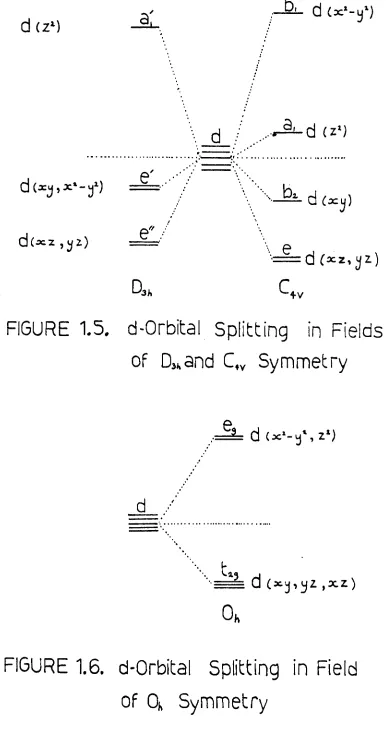
and 1.6. show the splitting of these orbitals in five- and six-coordinate chromophores, the two most common geometries of the adducts of the halides. There now exists the potential for electrons in the lower energy d-orbitals to absorb energy on irradiation and jump to a higher energy position, thus causing an absorption in the spectrum of irradiation. These absorptions are normally found in the near infrared and visible regions of the spectrum, and from their number and position a great deal of information on the environment of the central metal ion may be obtained.d :/
...~d
(Zl)._
. ..'
'-'.'
...e
··=d
(xz,~Z.)
[image:27.537.88.476.35.777.2]c.,
FIGURE 1.5.
d-Orbital Splitting
in
Fields
of D
3"and
(tV
Symmetry
..e~
d
(.xl_~~,z')
.'
..
..
d
_,
_,
_
_'.
-
..-·'0
... t2.,
"'===
d
("':1'
~z.
,x.z)
Oh
FIGURE
1.6.
d-Orbital
Splitting
in Field
16
-electric dipole selection rule (or Laporte rule) which is that transitions must be odd~even, another is that transitior.s can only occur between states of the same spin multiplicity.
As all the d-orbitals possess a centre of symmetry all 'd-d' transitions are forbidden by the Laporte selection rule. They are only observed because distortions in the geometry, caused by reasons such as vibrational displacement and 'p-d' orbital mixing. remove the centre of symmetry to some extent, thereby removing some of the "forbiddeness" of the transitions. For this reason all 'd-d' spectral absorptions are of low intensity.
~he terms ariSing from various dn configurations are given below:
Confi~ration Terms Arising:
1 2
d D
2 3p 3p 1,. 1
IS
d
,
J 17, D, •d3 4P, 4p
,
2H, 2G,
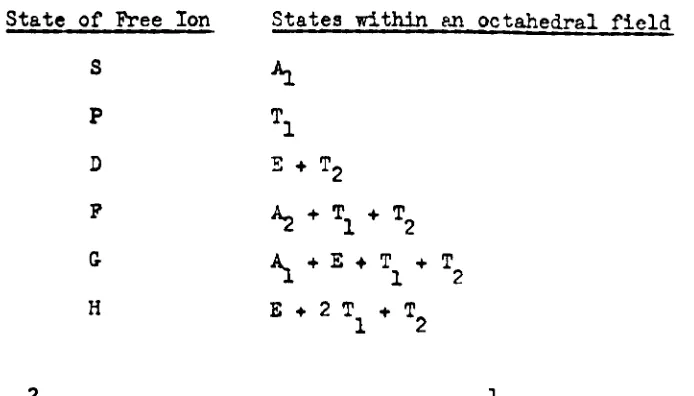
2F, 2D(2 ), 2p.Any degeneracy in these terms are,in an octahedral field, split as shown below:
State of Free Ion States within ~~ octahedral field
S
~
P Tl
D E + T2
F
~ + Tl + T2
G
\
+ E + T + T1 2
H E + 2 T + T2
1
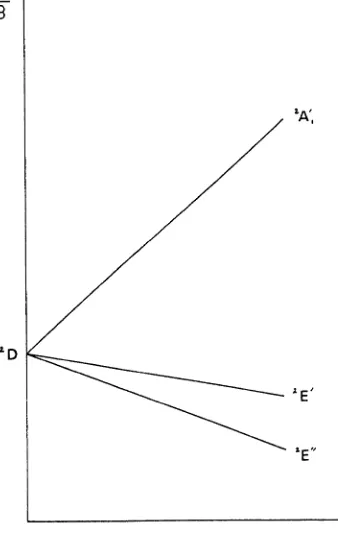
2D is the only term arising from the dl configuration, and in an octahedral field its degeneracy splits with increas-ing field as shown in the Orgel Diagram, FIGURE 1.7.. The only
2
[image:28.537.101.448.500.698.2]excited state, 2Eg, and therefore only one 'd-d' absorption is seen in the electronic spectrum of an octahedrally coordinated
1
d ion.
Increasing Field
1
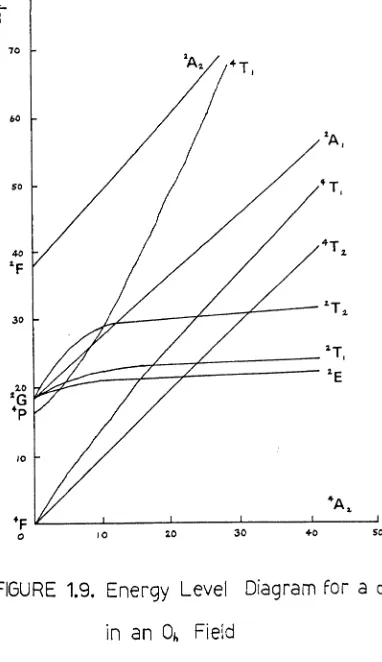
FI~L1m 1.7. Orgel Diagram of d configuration in an octahedral field The energy level diagrams for the d2 and d3 ions in an oct-ahedral field, FI~URSS 1.8. and 1.9., are far more complex, but it can be seen that three transitions, between states of the same spin multiplicity, are expected ~om each of these ions
in this environment.
Unfortunately, complete energy level diagrams for all these ions in five coordinate fields have not been fully calculated. However, the splitting schemes for trigonal bipyramidal fields, D3h symmetry, are shown in FI~S 1.10., 1.11. and 1.12••
In addition to the weak 'd-d' transitions, normally found -1
80
E
'A
B
IlA
1 70
IT
I
40
'A
,
30
'G
2.0I
T2.
10
3T
'F
L- ~ ~ ~ ~ I __ ~ ~o 10 2.0 30 40 So
B
FlGURE 1.8.
Energy
Level
Diagram for
a
d1_ion
40
4T
1.'F
2.T2,
302.T
I
lE
2.0
lG
.p
B
70
60
so
10
4A
+F ~
~
~~----~---~--~--~
6
[image:31.537.96.478.67.729.2]o ,0 2.0 30 +0 SO
8
FIGURE 1.9. Energy Level
Diagram for a d
3-ion
E
B
2.0
JoE"
Dt
[image:32.537.106.444.69.602.2]-B
FIGURE 1.10. Energy Level Diagram
for a
d'- ion in a
D3h
Field
.S
'A'
I
30
JE
I'E'
3E "
'G
2.0
3p
3 ''0
A1.
10
'»:
I'A"
L3F
IE"
'A/
I
-10
JE"
I
E
IlA'
JA
I
1--2.0
Dt
3 4
-B
E
B
---
+E~
~---~~
B
-1
high intensity bands in the region N30,OOO em onwards. They are known as charge transfer bands and are associated with the transfer of, normally non-bonding, electrons from ligand orbit-als into metal d-orbitorbit-als. The most co-amon of these are asso-ciated with metal ._ halogen transitions.
For a more detailed and rigorous treatment of the spectra of 3d metal complexes the reader is referred to the excellent
. ~ Q
art~cles by Ciampolini and Ferguson, and for a treatment 62
CtiAPTER 2.
2, I, INTRODUCTION
Readily obtained monomeric adducts of ~~e early transition metal halides, particularly those or nonodenta te liganlls, hold an illlportantplace in the synthetic coordination chenas try of these halides, fbey are frequently used as the starting mater-ials in routes to new complexes; since t~eir substitution re-actions are far more facile than the correspondin5 addition reactions of the polymeric halides.
The primar,y area in which this technique is e~loyed is in
the ohemistr,y of the tervalent metals. This indirect route is not required for reactions of the tetravalent halides, as they
are, themselves, monomeric and show comparatively hi~h react-i'Tity. The chemistry of the divalent state has been little ex-plored, but the adducts formed are normally of a poly~eric nature.
The praoticality of 118and substitution in these complexes has, 18
however, been demonstrated. The most widely employed adduct! are of MX3·3L formulation, where 1= pyridine, acetonitrile and tetrahydrof'uran, these beine readily obtained, in high yield and
purity, from direot reaction of the ligand with ~~e appropriate 13-16
metal halide. The use of these adducts has become an acc-epted part of synthetic ooordination chemistr,y,2,63,~
In this vein, the recently isolated five coordinate spe-cies, MX3'2L, being coordinatively unsaturated, and reactive, could offer a new, and extremely useful, labile starting mater-ial of this t,ype.The adduot! in the solid state are monomeric
65-67
and of trigonal bipyramidal geometry, The two amine groups are positioned tran~, occupying the axial positions or the poly-heiron, thus achieving maximum separation. Distortions from
- 20
-Ti3r3•2..1{}.te3 : BrTiBr ; two angles of 121.250 one of 117·5
•
VClf 2NMe3 : C1VCl ; two angles of 121· one of 11So
CrC13' 2NMe3 : C1CrCl ; two ~gles of 124'2° one of ill'6·
The distortions of the titanium and chromium adducts can be rationalised in terms of a Jahn - Teller distortion, but that of the vanadium adduct, free from Jahn - Teller distortion, would seem to be a c~stal packing effect.
Two advantages th~ offer, over their hexa-eoordinate count-erparts, are;
(i). Their lability; the adducts are all of large bulky ligands, and it is known that steric hinnrance greatly reduces
(J3-70
metal-ligand bond strength.
(ii). Their solubility; being for the most part soluble in non-coordinating solvents, such as benzene, and evert in some eases, aliphatic hydrocarbons.
The bis-trimethylamine adducts have alrea~ been used
syn-48,71 21
t:'letioallyto advantage, by Fowles and Bradley, but no study has been made of the potentials, or restrictions, these adducts have when employed in this role. To this end we have studied the reactivity and stability or these five coordinnte adducts, as represented by the trichlorobis(trimethylamine)
chromium(III) complex, under a variety of conditions. !he chrom-ium adduct was chosen as it is readily prepared in high yield and purity, and because the chemist~ of this metal has been extensively investigated and documented, t~ereby offering a usefUl oontrol.
2) Weak donor ligands; as repres en ted by diisopropylet:'1er and tetrakis(dimethylamino)diborane. If there exists sufficient lability, in the metal-ligand bond, these adducts might be ex-pected to offer a synthetic route to complexes which would
otherwise be extremely difficult, or izpossible, to prepare, e.g. those of very weak donors.
3) Small covalent molecules: as represented by carbondi-oxide and carbondisulphide. These small ~olecules are known to
72-76
undergo both, insertion reactions into metal-ligand bonds, and adduct formation
77-80
with the transition metals. With their compactness, and the coordinatively unsaturated nature or the metal adducts, either of these reaction modes could be ex-hibited without substitution necessarily occurring.We found that the substitution reactions of these adducts, even with strong donors, were not always strai8ht forward. Two competing reactions were found to be taking place, one being substitution, the other, the decomposition or the five coordin-ate adduct. The indications are that this decooposition is not confined solely to the chromium(III) species, but is a co~on trai t of the complexes MC13' 2NMe3 ' where Y.= Ti, V, Cr. The nature of the decomposition product, including its formation, and reaotivity, has been studied.
In addition to ligand substitution, halide substitution is also a viable proposition L~ these adducts, as demonstrated by
21
Bradley et al.. If all the halogens could be removed from the metal, and the 'naked' chrooium stabilised with very readily dis-placed ligands, an extremely useful and versatile synthetic
noncoord ~2 noncoord
-inating anion. The first perchlorato complexes were not prop-81-83
2,2. EXPSRD!ENTAL and RESULTS
Preparative and manipulative details are given in Appendices A and B.
A) Reaction of'CrC1;3.2.1Me3with Hydro,)en Chlorilie
When anhydrous HCI gas was either co-condensed with ben-zene onto, or bubbled through a benzene solution of, CrCl3'L\~e3 an immediate reaction occurred, yielding a colourless solution and a purple precipitat •• The solvent was removed in vacuo and the purple solid subjected to a soxhlet extraction with chloro-fo~, which removed a soluble white cr,ystalline solid that was
T
-identified as Me3NH Cl. 1he purple residue that remained W3.S
chromium (III)chloride.
Anal. Calcd. for CrC13 Cr, 32.9; Cl, t7.l • Found: Cr, 32.1; Cl, 66.7 •
B) Reaction of CrC13• 2NMe3 with Pyridine
'Nhen a benzene solution of crClf 2NMe3 wa.s added to excess pyridine, in vacuo, an immediate reaction occurred yielding a dark green solution and release of'NMe,. The NMe, was trapped
in an infrared gas cell and identified by its infrared s~ectrum.85 '!he solvent and excess pyridine were removed in vacuo and the resulting dark green solid subjected to a soxhlet extraction
with chloroform. The soluble dark green trichlorotris (pyridine) chromium(III) was obtained in 100% yield. The infrared spectrum was identical to that of an authentic sa:nple.13
Anal. Calcd. for C15HlsP13N3Cr: Cr, 13.1; Cl, 26.9 • Found: Cr, 13.1;
el,
26.8 •\1ben the reaction was repeated using a 1:1 molar ratio or pyridine: metal ilDJllediate reaction ocourred with releas eo!' NY.e,
-24-the solvent in vacuo gave a pink solid that was insoluble in all the common organio solvents and of non-stoichiometric composition. The infrared spectrum contained bands at~ 3110(.), 3060(m),
2990(w), 2956(w), 2922(w), 2900 (w),
2848
(w), 1603(m), l4B2(m), 1461 (w), 1446(s), l36O(w), 1261(,,), 12l7(m), 1066(m), 1047 (m), 1016(m), 980(m), 8l8(m), 770(m), 755(m), 72l(w), 696(s), 673(m),-1
641(m), 448(m), 378(m), 356(m), }42(a), 298(m) and 270(m) cm respectively.
c) Reaction of CrCl~. 2NMe3 with Tetrahydrof'uran
When a benzene solution of CrC13·2N1~e3 was add.ed to excess tetrahydrof'uran, in vacuo, an immediate reaction occurred yield-ing release of N'Me3, a pale purple solution and a purple precip-itate. The NMe3 was trapped in an infrared gas cell and. iden
t-ified by its spectrum.85 Removal of the solvent and excess THF in vacuo gave the purple solid trich1orotris(tetrahydrofUran) chromium(III) in 100,% yield. The infrared spectrum was
ident-86 ica1 to that of an authentic sample.
Anal. Calcd. for C12H24C1303Cr: Cr, 13.9; Cl, 28.4 • Found: Cr, 13.8; C1, 28.2 •
iVhen the reaction was repeated using a 1:1 molar ratio of THF:metal immediate reaction occurred with release of NMe3 and. precipitation of a purple solid. The NMe3 was trapped in an
85
infrared gas cell and identified by its spectrum. Removal of the solvent in vacuo gave a dark purple solid that was in501-uble in all the common organic solvents and of non-stoichio:n-etrie composition. The infrared spectrum contained bands at; 3110(w), 3070(w), 3010(m), 2990(w), 2932(m), 2912(m), 2902(m), 2868(w), 2848(.), 1479(s), 1458(s), 1403(w), 1258(m), 1230(,,),
1099(w), 1032(m), 10l6(m), 976(s), 837(.), 816(s), 720(w), 681(s),
-1
D) Reaction of CrC13• 2NMe3 with Acetonitrile
When a benzene solution of CrCl· 2NMe was added to
aceto-3 3
nitrile in vacuo an immediate reaction occurred wi~~ release of NMe3 and precipi tation of a dark brown solid. The i{~,\e3 was tra-pped in an infrared gas cell ani identified by its spectru~. 85 Removal of the solvent and excess MeCN in vacuo gave a dark brown/purple oily solid that was not amenable to purification. E) Formation of Cr2CIC3N'Me}
When a benzene solution of CrC13t 2NMe3 was sealed into an a.mpoule, a slow reaction occurred (IV 2 weeks) precipitating a
lilac solid, from the blue solution, and. releasing N~!.e3'The !~~:!e3 was trapped in an infrared gas cell and identified by its
spec-trum.85 Extraction of the solid product with benzene, in vacuo, removed the unreacted starting material and left the lilac solid tri-jl-chloro-trich1orotris(trimethylamine)dichromium(III). The produot showed slight solubi1i~ in benzene and dich1oromethane.
Anal. Calcd. for C9~7C16N3Cr2: C, 21.9; H, 5.4; C1, 43.1; N, 8.5; Cr, 21.1 • Found: 0, 21.8; H, 5.3; C1, 43.2; N, 8.4; Cr, 20.9 • Mol. ';it.Ca1cd. 494; Observed (osmometric), 520.
-1 -1
-3
_/\_m (298·K)
=
2.1 or~ em mole for a 10 M solution in CR2C12• Mel ting point: Deconposes at T) 418°K.Magnetic data;
(·K)
I 6
(By')
Temp.
X
per Cr atom x10 c.g.s.U. jJ-eff.m
297 5665 3.68
273 6180 3.68
243 6900 3.66
213
777,
3.E4183 8985 3.63
153 10490 3.59
123 12985 3.58
26
-The diamagnetic correction for C~2~3C16
=
270.4.2 x lo6c•g•s•u• The infrared spectrum contained bands at; 3l00(s), 302S(m),?99S(w).'?930(.), 29l0(m), 2858(.), 2830(19'),2795(.), 1480(s), 1465(s). 1405(-), 1370(.), 1260(_), l230(m), 1108(m), l035(m), 1018(19').980(s), 818(19'),720(m), 680 (m), 530(m), 445(.), 4.25(.),
-'
364(s), 3~(s), 297 (m), 25S(m), 202(19'),176(.) and 151(19')cc • respectively.
The electronic spectruc gave bands at; 13,330, 18,520, 3l,7S0(sh),
-1
38.460(sh). 45,870(sh) and 51,280 co respectively. when run
-1
as the solid, end at; 13,600 and 18,350 cm ,when run as a solution in benzene.
'!hisproduct was also obtained when the potential ligands
i
CO2, CS2, Pr 20 and (Me~)2B-B(NMe2)2 were present in the ben-zene solution. The reaction was independent of their presence. F) Reaction of crClf2NMe3 with Silver Perchlorate
When a benzene solution of erCl • 2NMe .wa.s added to a
sim-(,:3 ~I:io) 3 3
ilar solution of AgC104~in vacuo, an i~~ediate reactio~ occurred. A red colouration initBlly imparted to the solution rapidly dis-persed to give a dark green solution and a white precipitate, with release of NMey The NMe3 was trapped in an infrared gas
, 85
cell and ~dentified by its spectrum. The reaction mixture was extracted in vacuo with benzene to yield a white insoluble solid and a dark green solution. The precipitate was the stoichiomet-rio yield of AgCl. Removal of the solvent in vacuo yielded the dark green solid triperohloratochromium(III). (WARNING: This solid is a thermal and mechanical shock sensitive explosive.) The infrared spectrum con tadned bands at; l261(m), 1180 (m), l122(s). 1079(5), 10l8(s). 981(m), 895(m), 850(m), 818(m), 722(.), 681(.), 655(m), 6l9(s), 602(s), 489(19'),390(m) anti
-1
The electronic spectrum contained bands at;16,100, 2?,500 end
-1
37,000 om respectively when run as a solid, and: at; 15,800 and
-'
23,800 cn - respectively when run as a benzene solution.
G-) Reaction of cr294.3!llle3_!~~~':rrimethylf..:nine
nle reaction was carried out in a double a~oule, with neat NMe3 being dis tilled onto the lilac Cr2Cl{ 3NMe3. Immedia.te re-action occurred to give a colourless solution and a green solid. Removal of the N1.!e3in vaouo yielded an oily green solid that was insoluble in all the common organic solvents.
The infrared spectrum contained bands at; 3250(5), 3065(s), 3008
(w),
2945(s), 2898(sh), 2852(m), 2801(w), 2730(w), ~E7(s), l449(sh), 14~(m), l417(m), l378(m), l263(m), l2l7(w), l124(m), 1035(s), 1021(s), 981 (m), 907(5), 816(w), 722(w), 468(m), 43l(m),_ ( -1
354 8), 322(s), 253(m) and 250(m) cm respectively. H) Reaction of Cr2C1,'2!,n~~3wi~h Hydror,en Chloride
When anhydrous HCl gas was either co-condensed with ben-zene onto, or bubbled through a benben-zene solution of, Cr C1 • 3NMe
2 6 3
an immediate reaction occurred, yielding a colourless solution and a purple preoipitate. The solvent was renoved in vacuo end the purple solid subjected to a soxhlet extrection with chloro-fo~ This removed a soluble oily white solid of non-stoichiom-etric composition, leaving a purp1e/blue f,olid that was insol-uble in all the common organic solvents,
ana
of ~on-stoichiom-etric composition.The inhered spectrum of the purple/blue solid contained bands
at; 3110(8), 30l5(m), 2959(w), 1474(sh), 14tl(sh), lh51(s),
28
-I) Reaction of cr2~' 3N!~3 with Pyridine
The reaction of Cr2C16'3NMe3 with warm pyridine occurred rapidly, under nitrogen, to yield a dark green solution and release of NMe3• The N\~e3 was trapped in an infrared gas cell
p-and identified by its spectrum.~) The solvent was removed in vacuo and the dArk r,reen solid obtained subjected to a soxhlet extraction with chloroform. Ttis yielded the dark green trichl-orotris (pyridine)chromium(III) in 100% yield. The infrared spec-trum was identical to that ot an authentic sample. 13
Anal. Caled. for C15H15C13N3Cr: el, 26.9; Cr, 13.1 • Found: Cl, 26.7; Cr, 12.9 •
J) Rea9tion ot C;r22!6'3NMe3!1!p~~!2E1~ri~e
~~en excess acetonitrile was added to a benzene solution of Cr2C1~3NMe3 in va.cuo an imnediate reaction occurred yielding a dark purple precipitate. The solvent and excess acetonitrile was removed in vacuo to give a dark brown/purple oily solid, that was insoluble in the common organio solvents; and was not amenable to purification.
The infrared spectrutl oontained bands at: 2995(sh), 2860(m), 2890(w), 2830(m), 2790(m), 2760(sh), 2320(s), 2295(8), 2245(s), 1405(s), 1254(s), 1080(br-s), 1025(m),940(m), 865(m), 820(sh),
-'
798(s), 715(.), b75(m), 6CO(sh) and 345(br-s) co ~ respectively. The eletronic spectruo contained bands at ; l3,93C(sh), 15,040, 21,150, 32,050(sh) and 42,020(.h) co-l respectively when run as the solid.
K) Reaction of Cr2Clt:.3NMe_3 with_'!'etrabydrofUran
When excess TH1l'was added to a bensene solution or Cr2Cl( 3N~,!e3
in vacuo an immediate reaction occurred yielding a dark purple preoipitate. The solvent and excess THF were recoved in vacuo
all the commonorganic solvents, and not amenable to purification. The infrared spec trun contained bands at ; 3110 (sh ), 3059 (m),
3040(m), 3010(sh}, 2955(s ), 2898 (w), 2850(sa), 1630 (br-w), 1476(sh), 1460(sh), 14l+4(m), 1410(m), 1362(w), 1257(s), 1110(sb ), le81(s), le13(s), 862(s), 798(br-s), 698(m), 682(m), 660(sh), 525(sh),
-1 497 (br-m), 389(8), 347 (m), 320(Il), 286(sh) and 260 (sh ) ca respectively.
The electronic speotrum contained. bands at; 13,600, 20,200, -1
37,Q40(sh), 38,460(sh) and 45,450(sh) om respective~ when run as the solid.
L) Formation of V22±t;'3NM~3_
When a benzene solution of Vel· 2NMe was sealed in"::oan
3 3
ampoule, a slow reaction occurred (N 3 :nonths) precipitating a dark brovm solid and releasing NMe3• '!he N1I1e3was trapped in
85
an infrared gas cell and identified by its spectrum. Extrac-tion of the solid product with benzene, in vacuo, removed the unreacted starting material and left the brown solid tri-JA-ch1oro-trichlorotris (trimethylamine )divanadium (rrr),
Anal. caiee, for e~27e1~3v2:
c,
22.0; H, 5.5;01, 43.3; N, 3.5 • Found: e, 21.4; H, 5.4; el, 43.0; N, 8.2 •Magnetic data:
X~
per V atom x 106 ji-eff (BM)Temp. (-K) c.g.s·.u.
292 2774 2.55
259 2885 2.40
24C 2971 2.32
225 3046 2.26
209 3105 2.17
195 3207 2.10
182 3311 2.03
166 3442 1.94
30
-The diamngnetic correction for C9H27N3C16
=
270.42 x 10⁻⁶ c.g.s.u. Mel ting point: Decoeposes at T) 423-1(.The infrared spectrum contained bands at; 3090(5), 3025(sh), 3000(.), 2950(,,), 2920(,,), 28~(w), 2830(sh), 2780(w), 1478(8), 1462(s), 1406(m), 1372(m), 1251(m), 1090(m), 1040(,,), 1012 (m), 982 (8), 804(m), 720(m), 668(If), 520 (br--w ), 41+8(11), 422 (sh ), 335(s), 315(8) and 283(.) cm-1 respectively.
The electronic spectrum contained bands at; 10,300, 17,7CO,
-1
36,700(sh), 4O,000(sh) and 47, 600 (sh) CQ respectively when
pyr
-Benzene
-CS2.
--~
COl.
Pr~O
....
~
I
(Met.N)a.B B(NMelh.
[image:49.546.86.502.40.649.2]__ II
NMe_,
...
---___,-
//
~
II
Hel
-1/
(rCl, ·
3MeCN
L:::
It'
MeCN
MeCN
II ...
II __....
...
31
-2,3. DISC1JSSION
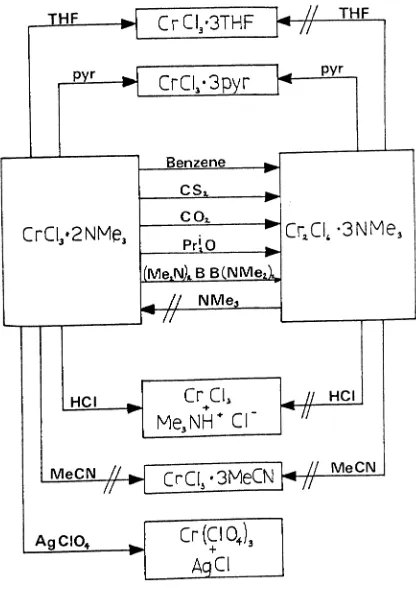
All the reactions in this section were carried out in ben-zene solution and, unless stated otherwise, an excess of ligand was used. The reactions are shown schematically in FIGl;"'RE2.1 •• 2,3,A, Reactions of Trichlorobis(trimethy1amine)chrorniurn(III) 2.3.A,i. Reaction with tlYdrogenchloride
Direct addition of anhydrous hydrogenchloride, either by bubbling or co-condensation with the benzene solvent, gave
quan-titative formation of trimethylamine hydrochloride (2 mols) ani ehromium(III)chloride (1 mol). These were the only products i80-lated from the reaction. Even under forcing conditions, e.g.
many hours heating at
T)
473'K in vacuo, the hexahe.logenometalate, formed in a similar reaction with pyridinium hydrochloride,44-wa.s not produced. '!his result is in line with previous findingS;44-,46 that an excess of the amine hydrochloride is required for this
reaction, and that the aromatic amine hydrochloride is a more
effective source of chloride ion than is an aliphatic hydrochloride. 2,3.A,ii, Reactions Involving Trimethylamine Substitution
'!he reection with excess pyridine, and the reaction wit:-, excess tetrahydrofUran, proceeded smoothly and rapidly, with
Addition using equimolar quantities of ligand and adduct again produced a rapid reaction, with release of trimethylamine. However, the insoluble products obtained, pink when pyridine was used as the ligp~d, and purple when tetr~~ydrorur~~ was used, proved to be of non-stoichiometric composition. 7.heirinfrared
spectra contained bands attributable to both coordinated tri-methylamine and the incoming ligand. The metal-halogen region,
-1
400-200 cm , waS poorly resolved in the THF adduct, but metal-halogen bridge bonding was clearly evident in the pyridine
add--1
uct. The bands found at 378, 356, 342 and 298 cm respectivelY. being assignable to lJ(Mel)terminal ,378 and 356 cm:l and
-1
1>(MC1)bridging , 34-2and 298 cm, modes. 'n1eseproducts are
seen to be polymeric material resulting from partial solvolysis. 87 and the structure shovm in FIGURE 2.2•• previously proposed for similar adducts, is favoured as their basis.
Rather surprisingly the reaction of the five coordinate adduct with excess aoetonitrile failed to give the expected
tris adduct, CrC13' 3MeCN. The product obtained was a brown/purple oily solid that proved impossible to purif'y.M. explanation of this behaviour is difficult to find. Alkyl cyanides are lmown
16,88
to reduce some transition metal species, but this action seems unlikely in the case of chromium(III). The most accept-able explanation seems to be that the product was a mixture of a number of partial and complete solvolysis products.
The outcome of the reaction with the potential lieands carbondioxide, carbondisulphide, diisopropylether and
tn
Cl>
/
2:
r_z
u
u
(f) ...!-J U ::J -0 U
«
('f'Iu
Q)c
r_
2
("CJu
u
z
oCJ'"l/
_j -0 <1J oX2:
L-a
u._'"
<l.J/
2:
'- <l>LLL
TZ
U
U.
"J...J::Jr--u ::J L L 0 .J....J (j) L Cl> ~
.o
0... o_cC
(f)II
(J')-
L-2:
0 _jU U
Z
Q_/
•u
(\j•of a lilac solid; that showed some solubility in benzene. The products from all these reactions proved to be identical, and devoid of the reacting ligand. Obviously an independent react-ion was occurring, and it was no surprise when the identical product was again isolated by simply dissolving the bis trimeth-ylamine adduct in d~ de-gassed benzene, and leavL~g to react
for two weeks.
The product from this solution decomposition of the five coordinate adduct was an air-moisture sensitive lilac selid of empirical formula Cr2C16(NMe3)3' It was non-conducting in
d~-A (
"x) -1 -1 -3chloromethane solution, m 298 K
=
2.1 ohm em mole at 10 ~,and monomeric in benzene solution (vapour pressure osmomet~). n1e eleotronic spectrum, TAB~ 2.1., obtained in both the solii state and benzene solution, resembles t..'-1oseor both t.'-1e
hexa-3-
44-halogenometalate, CrC16 ' and the enneahalogenodimeta1ate,
3- 4.5,46
Cr2C19 ' ions; and can be interpreted in a similar manner.
-1 !.tediUJT\ Absorption Maxima (ca )
a 13,330; 18,520; 31,750 (sh): 38,460 (sh): 45,870 (sh); 51,280.
b 13,600; 18,350. a: nujol mull
b: benzene solution
The electronic transitions are essentially localised an adjacent chromium(III) ions, which are set in a pseudooctahedral
-1 -1
environment. The peaks at 13,330 cm and 18,520 CD are assigned
4- 4- 4-
4-to t.'rleT2.- A... and T (F)4- A
'd.-a.'
trans i tions respee_.
N 0 ~ ~ 0 '*' C'\ c-4 Q) 02:"
~ HZ
0 M 0 • N'"
0 U :!?.:
0 U :t 0 ~ ~ 0 0 ~0...
0 ~ V) (f) 0 e-GO ~ 0 I..
.<l!
L 0 :::J...
U 0 M.
(Y).
8
0 0~ 0 8 0 0 0 0 0
N
eo '00 ..., .0
..
...
..,
elf
-
-
--t~~
w
a:
:::)
.o
ively, and the remaining absorptions at 3l,750(sh), 38,460(sh),
-1
45,870(sh) and 51,280 em, which errectively mask the
third'all-, 4 () 4
owed 'd-d' transition, Tlg P "'_~g , are of oharge transfer in origin, being of' the type metal(d)+-chlorine(-rr).
'!he room temperature magnetic moment, of 3.6S EM, confirms
3
the presence of genuine tervalent chromium(d ). The magnetic susceptibili~ data, TAB~ 2.2.,shows excellent Curie-~eiss behaviour, FIGURS 2.3., over the temperature range 103·K - 297°K
Temp. (OK) 297 273 243 213 183 153 123 103
6
5665
Q xlO c.g.s.u. 6180 6900 7775 8985 10490 12985 15010
per Cr atoll
The similarity of this magnetic behaviour with that of' t~e
3-. 45 46 89
the Cr2C19 10n ' , denies the presence of any
salts of
significant metal-metal interaction within the dimp.r.
The assigned structure for this species, FIGURE 2.4., is that of two !'used octahedra sharing a coaaon face; as was determined
90 by X-Ray analysis tor Cs, Cr2C19•
• NMe3
~ 35
-The a1temative structure with a trimethylamine occupying a ooemon apeoal position~ although favoured on symnet~ grounds, is muoh less likely from a stereochemical and bonding viewpoint; as it would involve a bridging Cr ....NMey ...Cr linkage, A number of ot.~erpossible structures can be disregarded, as apex-apex or edge-edge sharing of octahedra would be i..'1oonsistentwith the molecular stoichiocetry.
-1
'nleinfrared spectrum, 4000-400 cm, is very similar to t~at of the bis trimethylamine adduct, containing the charact-eristic bands of coordinated trimethylamine 38; ))as(CN) 1230,
2J
s(CN) 8l8~ CH3 rock 980, (CN)defas 530 and (CN)defs 445 cm-l-1
reapeot1ve~. The 400-200 em region~ containing the met~l-halogen stretching frequencies, is very similar to that of the A3Cr2C19 series, where A
=
K, Rb~cs,
Et4N, with the two stronp.;-1
bands at 364.and 354 em, and the two cedium bands at 297 and
-1
255 cm, being assigned to 1)(Cr~a)terminal and )) (CrCl~ridgbg vibrations respectively.
2.3,hzi!i, Reactions Involvin~ Chloride Substitution
The bis trimethylamine adduct reacted i~~ediately with silver perchlorate, in a 1:3 molar ratio; releasing trimethyl-amine and giving a precipitate of silver chloride (3 ~ols), in
a Breen solution of the perch1or~te oomplex. The electronic spectrum, TABLE 2.3., of the complex is the S8.r:le both in the
solid state and in 801ution, implying that no change of geOQ-etry occurs between the two states. The chromium(III) ion is seen to be in an octahedral enviroruuent, with all three oi' the expected 'd-d.'transitions, for this state, being observed. They were found at 16,100, 4T2 ~~ (10 Dq), 22,500, 4Tl (F)~A
4 g -"'2g g 2g
4 -1
TABLE
2.3.
Eleotronic Spectrum of Cr(Cl04)3
-1
~.!edium Absorption Maxima (en )
a 16,100; 22,500; 37,000.
b 15,BOO; 23, BOO.
I
a: nujol mull
b: benzene solution
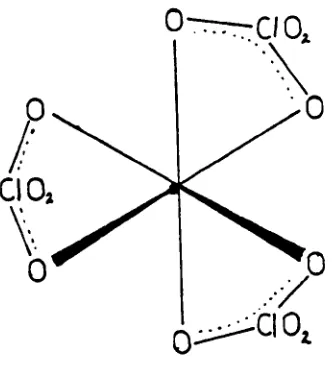
'!he three perchlorate groups are seen as p:::-oducingthis
environment by each acting as a bidentate ligand. Hathaway and
83
Underhill have demonstrated the usefulness of ~~e L~~rared
spectra of this group in determining the bonding mode of the anion. The vibrations of the group as a function of symmetry
are shown in FI~URS 2.5 •• ?he degenerate 1>3' asymmetric stretch,
and ))4' asymmetric bend, vibrations are found in the
1'11000--1 60 -1
1100 c~ and
rv
0-700 em regions, respectively, for the free ion; which exhibits tetrahedral Td symnetry.en
coordin-ation as a monodentate group the symmetry of the ion drops toC3v' and these bands split into doublets. Vmen coordination
is as a bidelltate group the symrcetry further drops to C2v and
the bands are further split to triplets. The infrared spectrun
-1
of the adduct in the 1300-400 em region is shown in "'IG-URE2.6 ••
'lhe triplet structures derived £'rom the origonal 1)3 and ))4
bands are clearly visible in the expected spectral regions. The previously infrared. inactive 1)1 and 1'2 vibrations appear as
(tWt
s"."':i
the active lJ2 and ))4 modes at 9Bl and 390Acm respectively_
The proposed structure for the adduct, derived from the
spectral data, is shown in FIc;URS 2.7., but, unfortunately, at
this point in the investigation the complex underwent a violent
com--
a:r
..
It~ .::. ...J
0'"
co'" ~
-
a:c
\1'1
..
~ c.\
w ""d c: ~ -d C?-
e.
~ d a: QI r0-o
'"
~ ..;:::,
..
~ ::l 0d (Xl
..
g/
u....\
-
,...
"'d ~ a:
a: ~ ~
..
'"'
..
tI 0~ c
::l ..::" .c "'d
4..-'"
U ~ s:"
.Q ~-
a: .:4J
..
"
..
... V) 0~ -::;.
u
+-01
*0i/
co" d-
U:::J a:
\
..
"110
~ .::::. t:
L w
"
19 .Q
-
~'"""'
a:...
d
a:
..
.u
0
..
VI tI) A II)~ ~ ..::. ~ ..._;
d~
CO- d U
~ u...
~/
u
-
'-~
...
a: a: 0 y__..
..
-
..
:::r
..;:; V) 0 ~ .::::.~
«
v; U<t. ~ (f) ..., C .,; 0
-
r: .J...J 0ro
e
...
'"
..,~
...
L.L
,/
<t. 0..0 oM o_
>
-
~"
a: ~~-
a: ~4 ~ ...UJ-
"'d~
..
a: c:
...
~ c- O
~
...
..
"
0>--=-
..0W
~-
I/) U---
~It ""
.: a:.. ....
0
~
-
..,
\I)
?
...
a: .u~ ~
U
'"
'-" U)<t. II)
"
..
0 4 ~ <t. II) ~ .:::::. <t. U > f'CEl
> ~ (,) If) ~ (,)..
+ 0I ... U
If) /'0 U 0 0 U-. U U
,~
-I
0 I .0 <l.>I
..LJ ~U-o
c
o
.J...J U C :Ju,
ro
(f) C'D 0... :Jo
L l0d
u
u_o
(f)c
o
..J.._) ~ ..0 o_>
J._JX+-t
A and B : Non degenerate E Doubly degenerate F Triply degenerate I Infrared active R Paman activeS : Symmetric
a Antisymmetric
"'
-
0"
u
'-""
L-a U
a
r
U-0
0
E
0
:J
2 L
~ U
(l)
Q..
a (J)
e
-
•0:
•
...
2
...
·
-
to
• N
0 W
e
a:
~
dJUeqJOsq'v'
~~u,
e e
...
o
I
CIO"
[image:61.533.191.357.76.267.2]\"
o
FIGURE 2.7. Proposed Structure for Cr(C10~)3
plex is extre~ely air-~oisture sensitive, but the solii
~e~~in-in6 on evaporation is very thermal, and mechanical, shock-sens-itive, exploding with considerable violence.) and further struc-tural information nas not derived.
Conclusion
Two competing reactions are found to occur when the five coordinate adduct, crClf 2:me;, is reacted with potential
lig-ands in benzene solution. One is ligand substitution of the ~~e; CrC13' 2NMe; + exces s L • CrCl;'nL + 2N~3 (1),
the other is an independent decomposition of the adduct~ 3enzene
2crC1
3
2NMe; Cr2C16'3:-r~.!e3+ NMe3 (2).With strong donor ligands reaction (1) is usually predom-inant, but in the presence of weak donor ligands reaction (2) gains dominance. Providing that strong donors, in a healthy
38
-advantages over several other adducts. However, where the stren-gth of the incoming donor is low, or in doubt, great consider-ation should be given to their trait towards decomposition
~e-fore their use is employed.
Provided th~t great eare is exercised in its handling, the new triperchloratochromium(III) complex could prove a useful intermediate in the synthesis of non-halogen chromium(III) compounds.
2,3,B. Reactions of Tri-J+-chloro-triohlorotris(trimethvla~e)» dichromium(III)
2,3,B,i. Reaction with Trimethyl~ine
The deoomposition of the CrC13'2NMe3 adduot by 1038 or tri-methylam1ne was found to be irreversible. When the dimeric pro-duct was reaoted with an excess of neat trimethylamine the pro-duct was an insoluble oily green solid. The trimethylamine obvious-ly lacks the donor strength, probable due to sterie hindrance, to break the metal-halogen bridge bonding and force the octa-hedral metal baok to five coordination. This failure to cleave the bridge bonds is shown in the infrared spectru:n of the
1m-medium 1ntensi~ bands
-1
strong bands at 354- and 322 em, and the
-1
at 293 and 250 em, being characteristic pure product; with the
ot (CrCl)terminal and (CrCl)bridging vibrations respectively, 2.3.B,ii. Reaction with tlydro3enchloride
hydro-chloride that m~ have been formed in the reaction, the infrared spectrum of the product still showed the presence of the tri-methylamine grouP. ~e white soluble extract, which oontained no metal ion, was non-stoichiometric and, by speotral compar-ison, not trimethylamine hydrochloride. Apart fro~ the bands associated with the amine, the infrared spectrum of the purple! blue product gave bands, in the metal-halogen region, at 34S(br-s), 32l(br-s) and 268(m) cm:l This profile is the same as that givem by ~t~~ ] 3 [cr2Cl9] ,46 so again it would seem that the metal-halogen bridge bonding has not been cleaved.
A possible explanation of this result is shown in the equ-ation:
This reaction is clearly not going cleanly to completion, probably because an excess of amine hydrochloride seems to be
44,46
required to produce the dimetalate. However, the reaction is obviously a ver,y attractive possibili~, as the SUbstitution would greatly relieve steric strain within the dimer.
2.3.B.iii. Reaction with Pyridine
This reaction occurs rapidly in warm solution, wit~ loss cf trimethylamine, to yield the expected mononuclear green CrCl
3
3pyr. TI1epyridine is obviously a sufficiently strongdonor, lacking the grosser steric restrictions of trimethylacinc, to break the bridge bonding and cleave the dinuclear species. 2.3.B.iv. Reactions with Acetonitrile and Tetrahydrofuran.
40
-1he complexity of the low infrared spectra, though poorly resol-ved in the acetonitrile product, is indicative that, again, the dinuclear structure has not been completely destroyed; bridge bonding still being in evidence.
A product which is probably present as a result of these reactioos is the species [erCl,
2LJ
7
previously reported for a. number of vanadium(III) cOC1plexes.24'llle presence of these speciesin acetonitrile solutions of the enneahalogenodimetalate of tit-46
mium and vanadium has already been reported, though they were not isolated. The counter ion to this adduct could be either the
corresponding cationic adduct, [CrC12• 4L ] ~ or the trimethyl-ammoniumion. The latter case would involve a proton abstraction from one of the ligand sources to form the amine cation, but
i t bl t· 1 1 in . 16,88
such a process s no unreasona e, par 1CU ar y aceton1trile.
2,4. Decocposition of the MCl}'2NMe3Adducts in Benzene Solution The decomposition of CrC13'2NMe3in benzene solution is not an isolated characteristic of the chromium adduct, but is evid-ent throughout the series MC1,.2N'Me3;where M
=
Ti, V and Cr. When any of the metal adduots are plaoed in benzene solutionthe decomposition occurs, with loss of trimethylamine and pre-cipitation of the product. The rate of decomposition varies markedly through the series in the order Cr
>
V')
rs,
The lilac produot from the ohromium decomposition has been detailed. earlier in this chapter. The product from the vanaddura
reaction is a brown insoluble solid, with empirical formula
V2C16(NMe,)" that is formed at a very slow rate. 'ilie infrared
-1
spectrum in the 4000-400 CID region is very similar to that of
the chromiumproduot, there being only minor frequency shifts -1
in some of the bands. 'llle 400-200 cm region, containing the metal-halogen vibrations, exhibits bands at 335, 315 and 283 cm-1
3- 46
and bears a very close resemblance to that of the V2C19 ion. '!be electronic spectrum, TABU; 2.4., of the product is typical of octahedral vanadium(III), with the first two 'd-d' transitions,
3 3 3 3
the T2g(F)4- Tlg(F) and Tl (p)4- Tlg(F), being observed at
-1 g
1C,300 and 17,700 cm respeotive~. This compares o1ose~ with
3-the V2C19 ion, Where the conparable peaks are found at 10,600 -1 46
17,200 cm •
TABIE2.4. Electronic Speotrum of V2C16 3NMe3
liedium Absorption Maxima (cm-1)
a 10,300; 17,700; 36,700(sh); 40,OOC(sh); 47,600 (ah ),
42
-The remaining high intensity charge transfer bands at 36,700(sh), -1
40,OOO(sh) and 47,
soo
cm prevent the observation of the third allowed 'd-d' transition, the 3~g(F)~Tlg(F).Due to the lack of solubility shown by this' adduct, it was not possible to carry out a molecular weight determination. How-ever, in view of the close chemical and spectral similarities
with both Cr2C16(NMe3)3and the V2C193-ion, the adduct is ass-igned an analogous structure, of two fused octahedra sharing a commontrigonal face of chlorine atoms.
The room temperature magnetic momentof 2. 55 B}.~(2.54 BM for [Et~~
J
3 [V2C19 ] 46 ) is significantly reduced from the normal value expected for magnetioally dilute vanadium(III)com-91
pLexesj and the moment shows a strong temperature dependence,
TABlE2.5 •• This, and marked deviations from Curie-Weiss behav-iour, gives evidenoe for definite magnetio interactions occurring in the solid.
Temp.eX 292 259 240 225 209 195 182 166 156
6
?em x10 c.g.s.u. 277~ 2885 2971 3046 3105 3207 3311 3442 3535 per V atom
r=
BM 2.55 2.40 2.32 2.26 2.17 2.10 2.03 l.~ 1.88The kinetics of the decomposition of the chromium and the vanadium bis trimethylamine adducts was investigated by spectro-photometrically following the loss of the five coordinate species
in solution. Standard benzene solutions of the adducts, in sealed 1 em silica oells, were monitored using a Cary 14 spectrophoto-meter, the cell compartment of which was thermostatted at 295°K.
In the case of CrC1
3
2~~e3 the rate of loss of the five coord-inate species was followed by monitoring the characteristic4- ., ()E ]I ...,_4, ( )E F peak at 10,100 om.-1 In the oase of the vanadium
adduct the loss was followed by monitoring the 3E: 3A2(P).--?~(F)
-1
peak at 20,000 om.
No precipitation occurred in the chromium solutions provided that the concentrations were chosen such that the product
conc--3
entration never exceeded 10 M. Tn such solutions the Cr2C16·3N~~e3
-1
adduct exhibited no absorption in the 10,000 cm region. The vanadium solutions precipitated out a very fine flocculent brown solid, whioh increased the measured optical density of the sample over that of the true solution. To avoid anomalously high read-ings being recorded, t.lJecell was centrifuged before each read-ing. No problems were enoountered with product absorptions in
solution, as the adduct was oomp1etely insoluble in benzene. Accurate values for the extinction coefficients of the abs-orptions being monitored were obtained by making plots of'ab-sorbance against time, for each solution, and extrapolating this back to zero time. From this zero time absorbance the extinction coefficients for the standard solutions were obtained. A com-parison of the values gained in this way, with those previously reported, clearly show the results of this decomposition. The value obtained for the erC13' 2NMe3 4E" (F) ~E I (F) absorption
0 0 C'4 ('0( C 0 .s:» 0-0 U) 0 0 0 .-I 0...
E
0 0 (_) 0 (l) 90 0 <"'I 0 (]) 0 ~L
z
N 0 • 0 (0\...
U L-U 0 0 L-C'oI 0 \..I_ .s:» 8 0 ~n:
Q> ..l...I ((J 0cr;
0 CIO L-<lJ U L-0 0 0..
-0 C 0 0u
0 <l.>....
(f) • 0 cD 0 0 ..t NW
0::
s
0 0:::>
~
----..
'e g 01ft 0 0 0)~ ~ 11\
C"I \") C'l ~
..::::.. lJ_
~ ..j..) 0 0
c
0'"
0 .s:» (f) 0 0 0 0... .0-
E
0u
0 Q) 00
~ CO) (l)s
L
orz
-
(\j •...,
~ U>
L-a 0 0 \.l.-2 .J.J 0 Q_ 0 0"
...LJQJCO
o;
0 L-0 Q)..
UL-a
-0 C 0 u Q) (J).
en
•N
~ III 0 '" 0 1ft 0 In 0
'"
0W
~