Designing A Mobile Learning Application Based On The
MOBIlearn Task Model
JALIL, Abdurrahman
Available from Sheffield Hallam University Research Archive (SHURA) at: http://shura.shu.ac.uk/22432/
This document is the author deposited version. You are advised to consult the publisher's version if you wish to cite from it.
Published version
JALIL, Abdurrahman (2017). Designing A Mobile Learning Application Based On The MOBIlearn Task Model. Doctoral, Sheffield Hallam University.
Copyright and re-use policy
See http://shura.shu.ac.uk/information.html
Designing A Mobile Learning Application
Based On The MOBIlearn Task Model
Abdurrahman Bin Jalil
A thesis submitted in partial fulfilment of the requirements of
Sheffield Hallam University for the degree of
Doctor of Philosophy
i
Declaration
ii Abstract
iii
Acknowledgements
First and foremost I would like to express my deepest appreciation to my Director of Studies, Dr. Martin D. Beer. It has been a pleasure to work under his supervision for the past 4 years. His advices, enthusiasm, encouragement and dedication have truly been aspirations. I would like also to thank my second supervisor Dr. Paul Crowther for his support and valuable comments in completing my research work. Without their guidance and persistent help, this thesis would not have been possible.
I would like to express my gratitude to Majlis Amanah Rakyat of Malaysia for the financial support. I also would like to thank my friends in Unit 12, members of Cultural, Communication and Computing Research Institute, Sheffield Hallam University and Dr. Frances Slack for their assistance during my entire study period.
iv
List of Tables
Table 2.1 Main theories underpinning the mobile learning pedagogy ………. 24 Table 3.1 List of relevant pedagogical requirements identified for each factor
based on the research questions ……… 62 Table 3.2 Components in the MOBIlearn2 application ……… 69 Table 4.1 List of tasks that need to be completed during the case study of
Sheffield Hallam University exploration ………. 91 Table 5.1 Components used when attending a seminar or workshop ……….. 96 Table 5.2 List of errors or issues found by participants on each component ... 97 Table 6.1 Errors and issues found by participants for each group …………... 109 Table 6.2 All partially-satisfied comments on interface design of the app
from each group ……… 110
Table 6.3 Comments and suggestions raised by participants from each group
to improve the app ……… 111
v
List of Figures
Figure 1.1 MOBIlearn task model framework ……… 4
Figure 1.2 Flow and main product of design process ………. 5
Figure 1.3 Structure of thesis for designing a mobile learning application based on MOBIlearn task model ……… 13
Figure 2.1 Divisions of mobility……….. 20
Figure 2.2 Four types of mobile learning ………... 22
Figure 2.3 Types of mobile learning across the dimension from curriculum-led classroom to informal highly mobile ………... 23 Figure 2.4 The FRAME model …………... 28
Figure 2.5 Mobile pedagogical framework ………. 29
Figure 2.6 Model of m-learning adoption ………... 31
Figure 2.7 Mobility and context in MHCI ……….. 32
Figure 2.8 m-learning framework ………... 33
Figure 2.9 Basic structure of MOBIlearn task model ………. 34
Figure 3.1 A task model for mobile learners ……….. 42
Figure 3.2 Mobile learning episodes in the semiotic space ……… 43
Figure 3.3 Mobile learning episodes in the technological space ……… 44
Figure 3.4 Classification of context ……… 57
Figure 3.5 Features to support seamless learning ………... 59
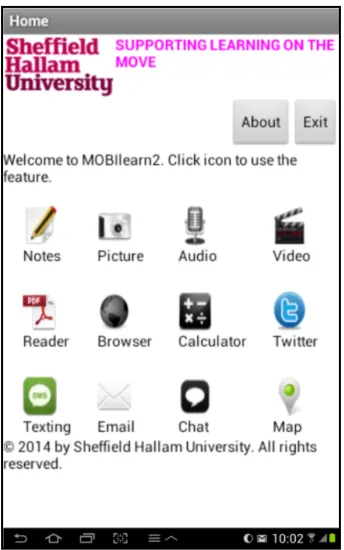
Figure 3.6 Main interface of MOBIlearn2 application ………... 68
Figure 4.1 Multiple-holistic case study design for designing a mobile learning application based on MOBIlearn task model ………….. 76
Figure 4.2 The components of MOBIlearn2 which were being investigated in this study ……… 80
Figure 4.3 Main screens for each of the basic components in MOBIlearn2 ... 81
vi
Figure 4.5 Some of participants seen collecting information of exhibits
during the visit ………... 86
Figure 4.6 (a) Note screen (b) Idea screen (c) Chat screen ………. 88
Figure 5.1 Number of participants, errors/issues and usefulness perception
on each of component of MOBIlearn2 ……….. 97
Figure 6.1 Five themes identified from the case study data ……… 105
Figure 6.2 (a) Number of participants used each of components (b) Number
of participants perceived the usefulness of each component ……. 107
Figure 6.3 New design of MOBIlearn2 Note interface ………... 113
Figure 6.4 Options to share materials when button Share is clicked in the
application ………. 114
Figure 6.5 Main interface of Idea ……… 115
Figure 7.1 Some parts of written texts are hidden by virtual keyboard …….. 123
Figure 7.2 A picture of HUBs building taken by a participant using the
MOBIlearn2 application ……… 125
Figure 7.3 (a) audio instruction is attached (b) instruction video is playing .. 126
Figure 7.4 (a) instruction created by using the Note (b) video file presenting
the instruction ……… 127
Figure 7.5 A snapshot of screen showing conversations of the participants in
a group ………... 129
Figure 7.6 Note is displayed in a list with a search function and Add New
Note button ……… 132
Figure 7.7 A list of pictures could be added and navigated ……… 132
Figure 8.1 Main interface of Collection tools ………. 148
Figure 8.2 An integration of social tools in a learning application …………. 149
Figure 8.3 Collaboration tools to support collaborative learning …………... 151
vii
List of Publications
Journal publication
1. Jalil, A., Beer, M. D., and Crowther, P. (2015). Pedagogical requirements for mobile learning: A review on MOBIlearn task model, Journal of Interactive Media in Education, vol. 2015(1), no. 12, pp. 1–17, Aug. 2015.
Conference proceeding
1. Jalil, A., Beer, M. D., and Crowther, P. (2016, December 2-4). Improving design and functionalities of MOBIlearn2 application: A case study of mobile learning in Metalwork Collection of Millennium Gallery. Proceedings of IEEE 8th International Conference on Technology for Education, Mumbai, India, pp. 19-25. Indian Institute of Technology Bombay, India: IEEE Computer Society.
IEEE Bulletin
Table of contents
Chapter 1 - Introduction 1
1.1 Introduction 1
1.2 Background of the Study 2
1.3 Statement of the Research Problem 6
1.4 Research Questions 8
1.5 Aim and Objectives 10
1.6 Significance of the Study 11
1.7 Structure of the Thesis 12
Chapter 2 - Mobile Learning 18
2.1 Introduction 18
2.2 Definitions of Mobile Learning 18
2.3 Types of Mobile Learning 21
2.4 Mobile Learning Theories 23
2.5 Models and Frameworks of Mobile Learning 27
2.5.1 The FRAME Model 27
2.5.2 Mobile Pedagogical Framework 28
2.5.3 Model of M-learning Adoption 30
2.5.4 Classification Matrix for a Mobile Learning Model 31
2.5.5 M-learning Framework 32
2.5.6 MOBIlearn Task Model 33
2.6 Summary 35
PART ONE
Chapter 3 - Systematic Review on MOBIlearn Task Model 36
3.1 Introduction 36
3.2 Background 37
3.3 MOBIlearn Task Model 40
3.4 Methodology 45
3.4.1 Framing Questions for a Review 45
3.4.2 Identifying Relevant Work 46
3.4.3 Assessing the Study Quality 46
3.4.4 Summarizing the Evidence 47
3.4.5 Interpreting the Evidence 47
3.5 Contributing Factors in the Task Model 48
3.5.1 Subject 48
3.5.2 Object 50
3.5.3 Control 53
3.5.4 Context 55
3.5.3 Communication 58
3.6 Results and Discussion 61
3.7 Conclusion and Future Works 70
3.8 Summary 72
PART TWO
Chapter 4 - Case Study Methodology 73
4.2 Case Study Strategy 73
4.3 Design of Multiple-Case Study 74
4.4 Formal Learning Context - Mobile Learning in a Seminar or Workshop: A Case Study for Evaluating MOBIlearn2 Basic Components and Their Application
79
4.4.1 Recruitment of Participants 82
4.4.2 Data Collection Methods 82
4.4.3 Data Analysis Technique 83
4.5 Informal Learning Context - Improving Design and Functionalities of MOBIlearn2 Application: A Case Study of Mobile Learning in Metalwork Collection of Millennium Gallery
83
4.5.1 Recruitment of Participants 85
4.5.2 Data Collection Methods 86
4.5.3 Data Analysis Technique 87
4.6 Non-Formal Learning Context: Final Design of MOBIlearn2 Application: A
Case Study of Sheffield Hallam University Exploration 88
4.6.1 Recruitment of Participants 89
4.6.2 Data Collection Methods 91
4.6.3 Data Analysis Technique 92
4.7 Validation Strategies 93
4.8 Summary 93
Chapter 5 - Results and Discussion of Case Study 1 95
5.1 Introduction 95
5.2 Demography 95
5.3 Data from Questionnaire 96
5.4 Data from Semi-Structured Interviews 98
5.5 Discussion 101
5.6 Conclusion 103
5.7 Summary 104
Chapter 6 - Results and Discussion of Case Study 2 105
6.1 Introduction 105
6.2 App Usage and Usefulness Perceptions 106
6.3 Errors and Issues 109
6.4 Design Perceptions 110
6.5 Improvements 111
6.6 Second Evaluation for New Design and Functionality of MOBIlearn2 Application
112
6.7 Results of Second Evaluation 115
6.7.1 Design 115
6.7.2 Functionality 116
6.8 Discussion 117
6.9 Conclusion 118
6.10 Summary 119
Chapter 7 - Results and Discussion of Case Study 3 121
7.2 Demography 121 7.3 Task 1-List At Least 3 Drinks With Price That You Can Find in Atrium or
Heartspace Café
122
7.4 Task 2-Describe About the Unique Structure of HUBs and What Activities That You Can Do There
124
7.5 Task 3-Create an Instruction of How to Go to Reception Desk area in Cantor Building from Main Reception in Main Building
125
7.6 Task 4-Create Steps or Instruction of How to Print a Document in Adsetts Learning Centre
127
7.7 Usefulness Perception and Suggestions to Improve 128
7.8 Discussion 130
7.9 Conclusion 133
7.10 Summary 134
PART THREE
Chapter 8 - Cross-Case Analysis and Discussion 136
8.1 Introduction 136
8.2 Cross-case Analysis 136
8.2.1 Case Study of Formal Learning 136
8.2.2 Case Study of Informal Learning 138
8.2.3 Case Study of Non-Formal Learning 139
8.2.4 Summary of Comparison 141
8.3 Discussion 142
8.3.1 Appropriate Use of Mobile Learning Application 143 8.3.2 Ideal Version of a Mobile Learning Application 147
8.3.3 General Guidelines for All Contexts 151
8.3.4 Steps Suggested for Educators to Implement a Mobile Learning Application into a Blended or Hybrid Learning
156
8.3.5 Enhancement on the MOBIlearn Task Model 160
8.4 Summary 164
Chapter 9 - Conclusion 166
9.1 Introduction 166
9.2 Setting the Scenes 167
9.3 Research Methods 168
9.4 Experimental Design 169
9.5 Discussion of Results 170
9.6 How They Fit into a Bigger Picture 173
9.7 Research Contributions 175
9.8 Limitations 176
9.9 Future Works 177
1 CHAPTER 1
INTRODUCTION
1.1 Introduction
Whilst there have been many experiments in mobile learning, they have all been
based on custom apps that have been specially written for a task. This is time consuming and
expensive as well as difficult to keep up to date. This research study has a methodology and a
framework which provides the basis for a common app which can be used by teachers in the
same way as they use learning management systems such as Blackboard to rapidly and
comparatively cheaply develop their own mobile learning material which they can maintain
an update regularly, as required. This thesis presents the design of a mobile learning
application based on MOBIlearn task model in order to provide guidelines for appropriate use
and tools for personal learning in mobile environment.
In this research project, pedagogical requirements are synthesised by conducting a
systematic review on current literature of the contributing factors in the MOBIlearn task
model. It proceeds with a design of mobile learning application prototype called MOBIlearn2
by mapping the requirements with components and functions that are built on Android-based
platform and evaluate it in three separated case studies that represent three different mobile
learning contexts (formal, informal and non-formal). Based on the results and feedback from
participants in each case study, the prototype is refined iteratively to address their issues and
improve its functionalities for a better design to support mobile learners in their learning
activities. At the end of the study, a cross-case analysis was conducted and the findings were
2
well as to confirm the task model as a reference to design a pedagogically sound mobile
learning application.
In this introductory chapter, the thesis presents the background of the study; describes
the statement of the research problem; states the research questions; describes the aim and
objectives of the study; explains the significance of the study; and presents a guide to the
thesis readers.
1.2 Background of the Study
The past decade has seen increasingly rapid advances in the field of mobile
technologies and these have been used to support learning. Although research in this area
began in the early years of 21st century, it is only recently that both technology and
educational needs have converged as mobile communication and equipment technologies
become capable enough to support mobile learning. The technology includes smart phones,
personal digital assistants (PDA) and tablets whilst the new paradigm in education is on
supporting the learner, in collaboration with peers and teachers, through a lifelong education,
both within inside and outside the classroom (Taylor et al., 2006). These changes, together
with the increase in power and usability of mobile devices and the speed of communication,
result in a type of learning, which is called mobile learning that takes advantages of mobile
technologies and communications to gain information and knowledge at anytime, anywhere
and any pace.
Mobile learning can benefit educational institutions in terms of pedagogical practices
to address student requirements for flexibility and ubiquity, which consequently will enhance
3
It allows educators to develop new ways of learning that are more tuned to the learner’s
needs. As an example, Zurita and Nussbaum (2004) have demonstrated the effectiveness of
wireless mobile devices in learning to construct words from syllables. In their experiment, the
children who were supported with technology had obviously higher test score improvements
than the children who were using paper-based activities. Churchill (2011) has stated that
mobile learning provides a learner with access to information and multimedia resources
within the context of learning activities. The author has reported a variety of situations for
mobile learning: during classes to enable teachers and students to share files, ask anonymous
questions, answer polls and give feedbacks; courseware and quizzes delivery; intelligent
tutoring system; for dissemination of information and collection of data during field work;
support students’ inquiries; collaborative and lifelong learning; and for disadvantaged young
adults to enhance literacy and numeracy skills. Peters (2007) has concluded in her study that
mobile learning is clearly able to provide learning that is ‘just in time’, situated and
contextualized as well as capability for learning that can be tailored to the needs of the
individual learner from diverse backgrounds.
One of the projects that has shaped research and development of mobile learning in
Europe is MOBIlearn. The project aimed to develop, implement and evaluate architecture for
mobile learning based on theories of effective teaching and learning in a mobile environment
(Kukulska-Hulme et. al., 2009). A great outcome from this project is a task model analysis
framework for mobile learners (Sharples, Taylor and Vavoula, 2005; Bo, 2005; Taylor, et al.,
2006). The objective of the framework is to capture the complexity of mobile learning system
or environment that consists of semiotic and technological spaces. It has six contributing
factors, which are tool, subject, object, control, context and communication that affect the
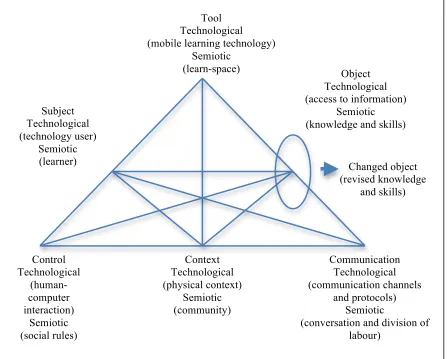
effectiveness of mobile learning implementation. Figure 1.1 presents the MOBIlearn task
4
Figure 1.1: MOBIlearn task model framework (Sharples, Taylor and Vavoula, 2005; Bo, 2005; Taylor, et al., 2006).
The MOBIlearn task model framework has been developed on the basis of a
socio-cognitive engineering approach. This is a logical approach to describing and analysing the
complex interactions between people and computer-based technology to inform the design of
socio-technical systems (Taylor, et al., 2006; Vavoula and Sharples, 2009). The key
advantage of this approach lies in the enriched view of users’ tasks and the context of use,
which leads to the illumination of the dialectical relationship between users and technology
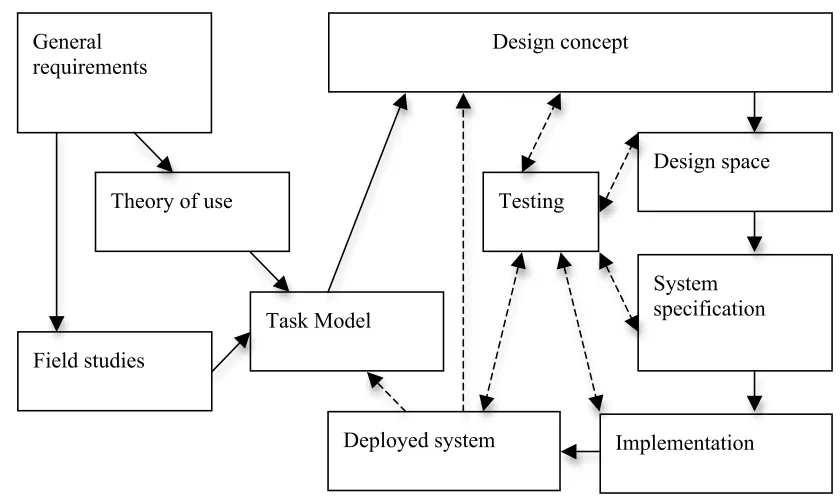
(Taylor, et al., 2006). Figure 1.2 shows how the task model provides a bridge to a cycle of
iterative design.
!
! 42!
elements are very crucial and relevant for mobile learning in order to provide a successful
educational and pedagogical environment (Sharples, Taylor and Vavoula, 2005; Taylor, et al.,
2006; Frohberg, Goth and Schwabe, 2009). Each element is connected to some other element,
showing the complex interdependencies among them.
Figure 3.2: A task model for mobile learners (Sharples, Taylor and Vavoula, 2005; Bo, 2005;
Taylor, et al., 2006).
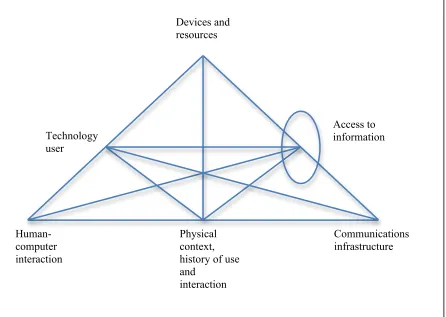
Taylor, et al. (2006) has separated the framework into two perspectives, or layers,
which are the semiotic layer and the technological layer to present a dialectical relationship
between the pedagogical space and the technological space. The semiotic framework
represents the learning as learners’ actions, which are mediated by cultural tools and signs
while the technological framework represents an engagement with technology in the process Subject Technological (technology user) Semiotic (learner) Tool Technological (mobile learning technology)
Semiotic (learn-space) Control Technological (human-computer interaction) Semiotic (social rules) Communication Technological (communication channels and protocols) Semiotic
(conversation and division of labour)
Object Technological (access to information)
Semiotic (knowledge and skills)
[image:16.595.78.525.77.436.2]5
As shown in the figure, the development process of the MOBIlearn task model was
started with identifying the general requirements and constraints for the system design. These
requirements were captured through the use of a scenario refinement process to identify basic
requirements for a mobile learning environment. This process led to two parallel studies,
which were field studies, to investigate how the activities were performed in learners’ normal
contexts, and a theory of use to study the theories of underlying cognitive and social
processes (Taylor and Evans, 2005; Taylor, et al., 2006). Both studies were assembled to
synthesize a model that could provide a foundation to understand mobile learning structure
[image:17.595.82.502.335.584.2]coherently.
Figure 1.2: Flow and main product of design process (Bo, 2005; Taylor, et al., 2006).
The MOBIlearn task model served as a reference for the activity analysis stage. This
stage analyses how people work and interact with their current tools and technologies and
sets requirements and constraints for the subsequent design processes (Sharples, Taylor and
Vavoula, 2005; Bo, 2005; Taylor, et al., 2006). The use of the task model enabled the
capturing of many possible interactions learners may engage in as they move around their General
requirements
Implementation System specification Design space Design concept
Theory of use Testing
Deployed system Task Model
6
respective environments (Bo, 2005). The author underlined the great advantage of this model
as being that the various scenarios can be instantiated according to the requirements, which
provides a common structure to an enormously complex learning situation and individualized
representation. The structure of the framework enables deeper understanding of mobile
learning environment as it clearly presents all the contributing factors and their
interdependencies.
Given the reasons, the MOBIlearn task model is examined in this research project. By
applying the task model to produce a practical mobile learning application, the study provides
more understanding and clear guidelines for learning application designers and higher
institutions to leverage mobile technology for the benefit of mobile learners.
1.3 Statement of the Research Problem
According to Pollara and Kee Broussard (2011), students have positive perceptions on
mobile learning as they see this type of learning can provide enjoyable and convenient
environments as well as strongly generate their interest in learning. As demonstrated by a
study, they are more comfortable using mobile phones for learning, and almost half (45%) of
the research group are prepared to use Internet-enabled phones as their learning tool (Fannon,
2005). Furthermore, higher institutions are increasingly recognizing student preferences,
technology affordability as well as pedagogical practices to gain the benefits of an effective
mobile learning environment. For example, a study in University of Texas at Brownsville has
found that 94% of its students and 60% of its staff are ready to adopt and implement mobile
learning for their courses (Corbeil and Valdes-Corbeil, 2007). Therefore, it is ideal to develop
innovative strategies to integrate mobile application in learning and teaching (Botzer &
7
However, there is a challenge to set guidelines for appropriate use and to provide
tools and resources for personal learning that integrate with commercial applications
(Sharples, 2013). There is still little understanding of the ways mobile application can be
developed to support contextual, interactive and social learning in mobile environment
(Uden, 2007). The development tools and standards for an e-learning environment are not
completely appropriate to create an application for mobile learning platform as it differs in
concept and practice (Bo, 2005). In addition, Peters (2007) has reported that although mobile
technologies and applications are in common use in some commercial sectors, their use
purely for learning is rare. Despite the fact that many mobile applications are being
developed for all walks of life, educational applications do not seem to receive attention from
designers and developers in the beginning stage of mobile development (Paliwal & Sharma,
2009). According to Bruck, Motiwalla and Foerster (2012), mobile learning applications are
not very popular and are not priorities for developers in spite of the explosive growing
number of mobile devices.
In response to the problem, this research project attempts to design a pedagogically
sound mobile learning application based on the MOBIlearn task model in order to provide
guidelines for appropriate use and tools for personal mobile learning activities across
different contexts. As a first step, a systematic review on the contributing factors in the task
model is conducted in order to synthesize a set of pedagogical requirements for mobile
learning. However, the review ignores the tool factor, as sound pedagogy is not tied with any
device or space (Sharples, Taylor & Vavoula, 2005; Taylor et al., 2006). Then, an initial
design of Android-based MOBIlearn2 application prototype is developed according to the
requirements and evaluated in three separated case studies that represent formal, informal and
non-formal mobile learning contexts. The results and feedback from each case study are
8
cross-case analysis is discussed to present new insights and emerged patterns of data that are
expected to gain in the research project.
1.4 Research Questions
The problem statement mentioned in the previous section and the task model analysis
framework produced by the MOBIlearn project serve as a basis to define key research
question. The key research question is:
RQ. How to design a mobile learning application based on MOBIlearn task model in
order to provide guidelines for appropriate use and to provide tools for personal
learning?
To answer the key question above and be more specific, this research project divides it into
four sub questions as follow:
1. What are the learning activities performed and resources accessed by learners
in mobile environment?
This question attempts to understand what are learning activities performed by mobile
learners and what are learning resources accessed by them by systematically
9
2. How control, context and communication could support pedagogical needs in
mobile environment?
This question attempts to understand how the factors of control, context and
communication in the MOBIlearn task model could support pedagogical requirements
for mobile learners.
3. How do learners experience the learning with the support of the mobile
learning application designed based on the pedagogical requirements?
This question evaluates the learning experiences of the participants with the support
of the MOBIlearn2 application designed based on the pedagogical requirements found
in the MOBIlearn task model. It seeks to identify issues and obtain the perception and
feedback from the participants regarding the use of the application in three different
case studies that represent three learning contexts (formal, informal and non-formal).
4. How could a mobile learning application be designed for appropriate use and
as tools for personal learning?
This question attempts to find emerged patterns of data from all of the case studies.
The findings are analysed and discussed in effort to provide guidelines for appropriate
use of mobile learning application and to provide it as tools for personal learning as
10 1.5 Aim and Objectives
This research study aims to design a pedagogically sound mobile learning application
in order to provide guidelines for appropriate use and tools for personal learning activities by
investigating the MOBIlearn task model. The specific objectives of the study are:
O1. To determine the pedagogical requirements for mobile learning from the
MOBIlearn task model
O2. To evaluate learners experiences of using a mobile learning application designed
based on the pedagogical requirements to support their learning activities
O3. To provide guidelines for appropriate use of mobile learning application and to
provide it as tools for personal learning
O4. To confirm the MOBIlearn task model as a reference for the design of a
pedagogically sound mobile learning application
To achieve the aim and objectives of the research, a three-part of study is conducted:
first, to systematically review the MOBIlearn task model to synthesize pedagogical
requirements to support mobile learners; second, to evaluate learners experiences of using a
mobile learning application prototype which is developed based on the pedagogical
requirements in three case studies to ascertain their needs and perceptions; third, to undertake
a cross-case analysis in effort to find emerged patterns of data to provide guidelines and tools
as well as to confirm the task model as a design reference.
In particular, the first objective is achieved through the findings of the systematic
review in the first part of study whilst the second objective is achieved through the findings
from all the case studies conducted in the second part of study. The third and last objectives
11 1.6 Significance of the Study
This is the first research study that provides a combined understanding amongst the
contributing factors in the MOBIlearn task model and their implications in informing the
design of a pedagogically sound mobile learning application. Most of the current works as
surveyed in the systematic review focus on the factors singly and are not based on the task
model. This view is shared with Frohberg, Goth and Schwabe (2009) as they have stated that
other prior researchers have relied on single factor to structure their overviews of the mobile
learning field. Often, previous studies lacked a connection to theory and no theoretical
framework is mentioned to support the research (Pollara & Kee Broussard, 2011). Those
kinds of study do not provide as deeper and rich insights as this research study, which could
contribute to the design improvement of mobile learning application and innovation. This
research study therefore demonstrates the usefulness of the task model framework for the
purpose of understanding the pedagogical requirements for mobile learning and as a design
reference to develop a pedagogically sound mobile learning application.
To reiterate, the practical significance of the research results are the guidelines and
design specification of a mobile learning application in enhancing educational practice
through an innovation supported by hardware and software components that are available for
mobile devices. To prove this innovation works, the research study seeks to get feedback and
recommendations by student participants on the design and functionality of the application
tested in multiple case studies. The findings from the evaluation of the application are
discussed to provide guidelines for appropriate use and tools for personal learning as well as
to confirm the task model as a reference for analysis and design stages of mobile learning
application development. Therefore, this research study attempts to move a step further in the
current mobile learning research by contributing a practical application of the MOBIlearn
12
Other works in design practice of mobile learning application and innovation can refer
to this case illustration. Hence, this research is foundational for improving learner
experiences to learn in mobile learning environments in effort to support educational goals.
1.7 Structure of the Thesis
Structure of the thesis presents a map for the readers to navigate their way through the
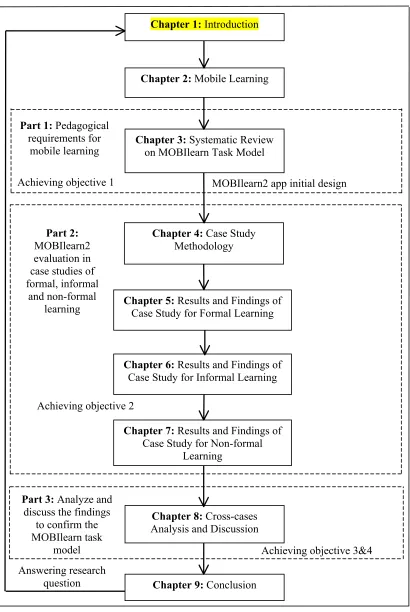
thesis as well as provides a pathway for the remaining chapters. As illustrated in Figure 1.3,
the structure shows how the chapters and concepts are interconnected throughout the research
project. The highlighted background indicates the current chapter where are the readers in.
Chapter 2 Mobile Learning
This chapter introduces the fundamental concepts of mobile learning including its
definitions, types and theories of learning. Then, six popular models and frameworks of
mobile learning including FRAME, Kearney's pedagogical framework, m-learning adoption
model, classification matrix and Motiwalla's m-learning framework are reviewed to provide
justification of the MOBIlearn task model as the research theoretical framework for further
investigation in the research project. The summary is provided at the end of the chapter to
13
Figure 1.3: Structure of thesis for designing a mobile learning application based on
MOBIlearn task model Achieving objective 1
Part 1: Pedagogical requirements for
mobile learning
Part 3: Analyze and discuss the findings
to confirm the MOBIlearn task
model
Chapter 3: Systematic Review on MOBIlearn Task Model
Chapter 5: Results and Findings of Case Study for Formal Learning
Chapter 6: Results and Findings of Case Study for Informal Learning
Chapter 7: Results and Findings of Case Study for Non-formal
Learning
Part 2:
MOBIlearn2 evaluation in case studies of formal, informal
and non-formal learning
Chapter 4: Case Study Methodology
Chapter 2: Mobile Learning
Chapter 1: Introduction
Chapter 8: Cross-cases Analysis and Discussion
Chapter 9: Conclusion Answering research
question
Achieving objective 2
MOBIlearn2 app initial design
14
Chapter 3 Systematic Review on MOBIlearn Task Model
The first section of the chapter introduces the current issue on mobile learning
application, describes the significance of the systematic review and establishes the research
questions to guide the review. The chapter then describes the MOBIlearn task model and
proceeds with explanation of the methodology of the review study. Next, each factor in the
model is examined to synthesize pedagogical requirements for mobile learning from the
selected published research articles. Results conclude that mobile learners are continually
collecting digital data or files on the move and collaboratively working together to achieve
learning goals.
In addition, optimal level of control, contextualized environment and communication
channel could support pedagogical needs for mobile learners. The results are discussed to
propose an initial design of MOBIlearn2 application at the end of the chapter.
Chapter 4 Case Study Methodology
This chapter explains case study methodology and justifications of the methods used
to evaluate learners experience of using MOBIlearn2 application prototype in the research
project. In particular, this chapter describes in detail three different case studies that represent
three different mobile learning contexts (formal, informal and non-formal) to collect data
from the participants. The first case represents the mobile learning in a seminar or workshop,
the second case represents the mobile learning in Metalwork Collection of Millennium
Gallery and the last one represents the mobile learning to explore Sheffield Hallam
University. Case selection, data collection methods and data analysis technique for each case
15
Chapter 5 Results and Findings from Case Study of Formal Learning
This chapter presents the results and findings from a case study for formal mobile
learning in a seminar or workshop. The case study focuses on the evaluation of basic
components that make up the MOBIlearn2 application for supporting students attending a one
hour seminar or workshop of their choice. The data from a qualitative survey and
semi-structured interviews are presented, analyzed and discussed in order to discover any issue on
the components of the application and to get suggestions for future enhancement for the next
case study. The findings show that the application is highly suitable for the students to collect
data for their leaning activities and it is essential to include them in the design stage of the
application development.
Chapter 6 Results and Findings from Case Study of Informal Learning
This chapter presents the results and findings from a case study of informal mobile
learning in Metalwork Collection of Millennium Gallery in Sheffield. In particular, the
chapter discusses about the evaluation of the MOBIlearn2 application in order to see how it
could support mobile learners to learn in an informal learning setting such in a gallery visit.
The data from semi-structured focus group interviews and direct observation are presented,
analysed and discussed to evaluate the participant experiences. The results show that in spite
of several technical errors and issues, which need to be addressed in the original prototype in
order to improve its design and functionalities, participants found that the application is very
useful to collect data and share visit experiences. At the end of the study, a new design with
16
Chapter 7 Results and Findings from Case Study of Non-formal Learning
This chapter presents the results and findings from a case study of mobile learning by
exploring several places in Sheffield Hallam University. The case study focuses on the
evaluation of learners experiences in using the MOBIlearn2 application to complete a given
tasks in a group by exploring several locations in the university. The data from
semi-structured focus group interviews and direct observation are presented, analysed and
discussed in order to discover any issue on the components of the application and to get
comments and suggestions for its final design and future development. The results show that
all of the participants found the application is very useful and could be used to collaborate on
a task.
Chapter 8 Cross-cases Analysis and Discussion
This chapter presents an analysis and discussion by comparing and contrasting the
findings from all case studies to identify similarities and differences in order to get new
insight and pattern from the data. From this analysis, a set of recommendations and general
features are generated in effort to provide guidelines for designers and educators to design a
mobile learning application across contexts. A series of step to implement blended or hybrid
learning with the support of a mobile learning application is mentioned as well. Finally, an
enhancement of the MOBIlearn task model is proposed in order to provide better
17 Chapter 9 Conclusion
This chapter presents a conclusion derived from the findings of the research study. It
recalls the big idea of the study, study settings, methods and experimental design to provide a
background context and summarizing the findings in order to answer the research questions.
Particularly, this chapter concludes the application and generalization of the findings in a
18
CHAPTER 2
MOBILE LEARNING
2.1 Introduction
In this chapter, this research project presents a review of fundamental concepts of
mobile learning that begins with its definitions, types and learning theories behind it. It then
proceeds with a brief overview of six most popular mobile learning models and frameworks
that are found in literature and compare each of them to justify a model or framework of
choice for further investigation in this research project as presented in the next chapter. A
summary of understanding is presented at the end of the chapter to conclude what has been
learned from this review and plan for the next step for this research project.
2.2 Definitions of mobile learning
In initial research works, mobile learning has been defined as part of electronic
learning that uses mobile and wireless devices and technologies (Motiwalla, 2007; Anani,
Zhang & Li, 2008). This definition refers to mobile learning as a subset, natural evolution and
new stage of the electronic learning. It incorporates a number of activities conducted online
and provides access to and dissemination of educational materials and knowledge for learners
in remote location. However, Jeng et al. (2010) have argued that mobile learning is diverse
from the conventional electronic learning, which happens on any pervasive computing
devices. In a similar view, electronic learning is considered to be tethered and presented in a
19
presentation (Mehdipour & Zerehkafi, 2013). Moreover, mobile learning has different
characteristics and its own terminologies (Korucu & Alkan, 2011).
Another viable definition of mobile learning is about the advent of mobile
technologies, which has created the opportunities for delivery of learning via mobile devices
such as PDA, smart phone and tablets (Peters, 2007). The mobile technologies include SMS,
MMS, WAP, GPRS, Bluetooth, Wi-Fi, 3G and 4G mobile phones, GPS and cloud storage.
According to Mobile Learning Network project (MoLeNET, 2011), mobile learning is
defined as “the exploitation of ubiquitous handheld technologies, together with wireless and
mobile phone networks, to facilitate, support, enhance and extend the reach of teaching and
learning”. Similarly, mobile learning is seen as the learning accomplished with the use of
small and portable computing tools facilitated by convergence of the Internet and wireless
technology to provide one-to-one interaction between learners and their mobile devices
(Motiwalla, 2007; Liaw, Hatala & Huang, 2010).
From a bigger scale project and perspective, mobile learning definition has been
refined to focus on the mobility of learners who move between different contexts in their
daily life (Laouris & Eteokleous, 2005; Sharples, 2007; McAndrew, Taylor & Clow, 2007).
In MOBIlearn project, it is described as any sort of learning when the learners are not in a
fixed location (mobility) and take advantage of learning opportunities by using mobile
technologies (O’Malley et al., 2003). Sanchez et al. (2009) have discussed the term mobility,
which includes the mobility in physical space, technology, conceptual space, social space as
well as the learning which is dispersed in time across either formal or informal contexts. The
authors' point of view is based on the previous of works of Taylor et al. (2006) and Sharples,
Taylor and Vavoula (2007) who have concluded that mobile learning is a conversation in
context enabled by the interaction through and with the mobile technology. In addition, the
(El-20
Hussein & Cronje, 2010). The authors have demonstrated mobile learning as any type of
learning that takes place in learning environments and spaces which consist of the mobility of
technology, mobility of learners and mobility of learning. This definition is depicted in
Figure 2.1 below.
Figure 2.1: Divisions of mobility (El-Hussein & Cronje, 2010)
Patrichi (2010) has summarized that mobile learning consists of three elements
including the process of learning itself, which is adapted to use the new technologies for
delivering information or accessing knowledge. The second element, which is adaptation, is
concern with the software and application whilst the technology as the final element is the
hardware, devices or handheld equipment. In particular, Traxler (2005) has characterized
mobile learning as spontaneous, private, portable, situated, informal, bite-sized, lightweight,
context-aware as well as connected, personalized and interactive. Despite the increasing
attention from conferences and publication, there is still no common understanding on the
definition of mobile learning (Frohberg, Goth & Schwabe, 2009; Kukulska-Hulme et al.,
21
2.3 Types of mobile learning
There are a few studies on effort to categorize formally the mobile learning due to its
immature field and complexity of nature. Traxler (2007) has categorised mobile learning into
six types which are technology-driven, portable e-learning, connected classroom, situated,
training support and remote or rural mobile learning. In technology-driven mobile learning,
there are specific innovations implemented in academic setting to demonstrate technological
and pedagogical feasibility. Portable learning is adapting the same solutions found in
e-learning to be used in handheld devices whilst collaborative e-learning is emphasised to
connected classroom. Situated learning focuses on adding functionality to enhance student's
experience in contrast with training support, which is to improve productivity of mobile
workers. Lastly, the remote mobile learning is deployed to address infrastructural challenges
to deliver education in rural area.
Recently, there are several categorization efforts that have been made usually to
structure the understanding of mobile learning before going to more details on the objectives
of particular research. For example, Frohberg, Goth & Schwabe (2009) have classified the
types of mobile learning based on the factors of context, which are independent, formalized,
physical and socialized. This context-based classification considers the environment of where
the learning is taking place. Another example is what has been done by Wong (2012) to
define the features of mobile seamless learning. The author has pointed out that mobile
learning can be loosely divided either into informal or formal, personal or social and physical
or digital. However, the author has not discussed them in detail except as continuum learning
spaces in seamless learning.
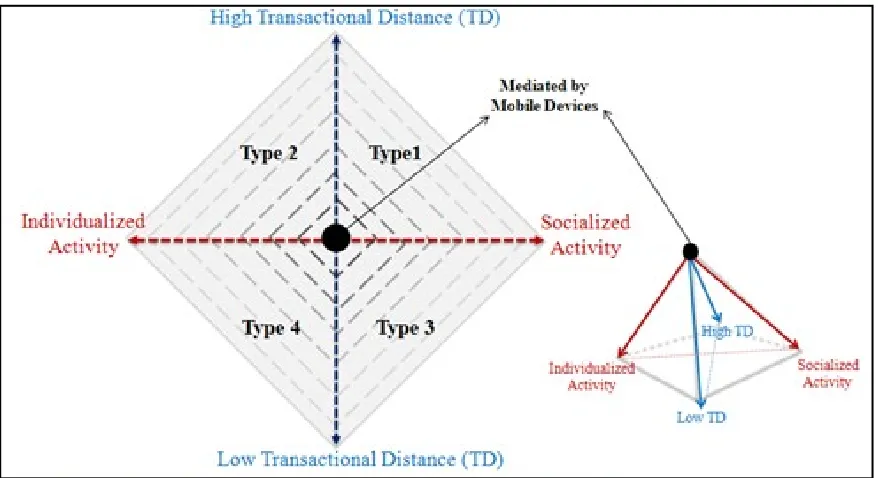
More formal work has been presented by Park (2011). The author has proposed four
22
activity), type 2 (high transactional distance and individualized activity), type 3 (low
transactional distance and socialized activity) and type 4 (low transactional distance and
individualized activity). This classification is generated based on the combination of Moore's
transactional distance theory and activity theory represented by y-axis and x-axis respectively
as shown in Figure 2.2.
The author has defined the types with certain attributes to indicate the level of
transactional distance and activity. For example, a mobile learning is classified as type 1 if
the learners have: (1) more psychological and communication space with teachers; (2)
involved in group learning; (3) received predetermined learning content; and (4) interactions
mainly occur among learners. Ultimately, the author has pointed out in his work that the most
[image:34.595.80.519.394.633.2]advanced form is type 3 in terms of versatility, but relatively few studies of this type exist.
Figure 2.2: Four types of mobile learning (Park, 2011)
Sharples (2013) has identified some types of mobile learning across the dimension
from curriculum-lead classroom such as handheld response systems to informal highly
23
demonstrated on a continuum from formal to informal settings as in Figure 2.3. In a similar
view, Wu et al. (2012) categorize the mobile learning types into formal, informal and
non-formal educational contexts. The authors point out that non-formal learning is highly institutional,
bureaucratic and curriculum driven, whereas, informal learning is the unstructured learning
that results from daily life activities related to work, family or leisure. Meanwhile,
non-formal learning tends to be short-term, has few if any prerequisites and the student
participations are more voluntary (Crowther, 2006). It can have learning objectives and
strong emphasis on practical experience (Kyndt, Dochy & Nijs, 2009).
Figure 2.3: Types of mobile learning across the dimension from curriculum-led classroom to
informal highly mobile (Sharples, 2013)
2.4 Mobile learning theories
There are several different established theories of mobile learning that become
relevant for the current pedagogical practices (Naismith et al., 2008; Keskin & Metcalf,
2011). Some main theories that are frequently found in the literature are described in Table
24
Table 2.1: Main theories underpinning the mobile learning pedagogy
Theories Description Applications References
Activity
theory
Learning that involves a subject (learners),
an object (activity) and tool or mediating
artefacts to support the learners in their
goals of transforming their knowledge and
skills. It uses the concept of activity as the
fundamental unit of analysis to understand
subjects' purposeful interaction with the
world. Gallery exhibition, mobile games Vygotsky, 1986; Sharples,
Taylor &
Vavoula,
2007
Behaviourist
learning
Learning as a change in observable actions.
It occurs when there is an appropriate
reinforcement of association between
particular response and stimulus.
Text
messages,
classroom
response
system
Smith &
Ragan,
2005.
Collaborative
learning
Learning that is facilitated and supported by
the interaction and communication between
students. It combines the pedagogies of
constructionism and social learning to
provide richer interactions between learners
and their concepts and practices. The
learners are actively interact, share
experience and engage in a common task.
Web 2.0,
Laurillard,
25
Theories Description Applications References
Constructive
learning
Learners actively construct new ideas or
concepts based on their previous and current
knowledge. It means that they have to
modify their current knowledge schemes to
integrate new information and acquire new
knowledge. They have to act and reflect in
an environment as well.
Participatory
simulation,
handheld
games
Vygotsky,
1978; Zurita
&
Nussbaum,
2004.
Conversational
learning
Learning that is formed by the conversations
between different systems of knowledge. It
provides more optimal learning experience
in both formal and informal contexts by
sharing resources and outputs with other
learners. To have a successful learning, it
requires continuous two-way conversations
and interactions between the teacher/learner
and amongst the learners.
Field trip,
laboratory classes Sharples, 2002; Laurillard, 2007
Informal and
lifelong
learning
Learning beyond formal classroom and
environment. It happens all the time
autonomously, is influenced by environment
and situations and supports both intentional
and accidental learning episodes. It is
unplanned, unstructured, and with
26
Theories Description Applications References
Situated or
contextual
learning
Learning within an authentic context or
culture. It takes place in the surrounding
applicable to learning. There are three
subcategories under this type which are: (1)
problem-based learning, that aims to
develop critical thinking based on ill-defined
problem; (2) case-based learning, that
promotes discussion on real-world examples
and: (3) context-aware learning, in which
learning is informed by history and the
environment. Museum exploration, natural science learning
Sharples et
al., 2007;
Price &
Rogers,
2004
Socio-cultural
learning
Learning as an active process of building
knowledge and skills through interaction
with social environment and community. It
focuses on the importance of social
interaction and discussion as aspects of
learning that makes use of communication
technologies.
E-mail, social
network
Vygotsky,
1978; Kim,
2000
Based on the theories that are explained in the table above, it appears that mobile
learning pedagogy is a very solid learning pedagogy. The pedagogy provides collaborative
approach whereby information and opinions are shared between the group members and
experts via technology and tools. Moreover, it allows students to engage in high-order
27
pedagogy also can be applied with blended approach in order to maximize the benefits of
both face-to-face and online methods (Ozdamli, 2012). Recently, it is becoming more
recognized and well accepted to be adopted into mainstream of education (El-Hussein &
Cronje, 2010).
2.5 Models and frameworks of mobile learning
In this section, this research study briefly provides an overview of the main popular
models and frameworks for mobile learning that are frequently found in literature. Only the
models or frameworks that have a visual presentation either in a diagram or a table are
selected for the study. Some significant strengths and weaknesses for each of them are
highlighted for comparison purpose.
2.5.1 The FRAME model
The Framework for the Rational Analysis of Mobile Education (FRAME)
model considers technical characteristics of mobile devices as well as aspect of social
and personal learning (Koole, 2010). It is represented by a Venn diagram in which all
of the three aspects intersect as shown in Figure 2.4. Device aspect refers to physical
and functional characteristics of mobile device whilst learner aspect considers an
individual's cognitive abilities, memory, knowledge, emotions and motivations. On
the other hand, the social aspect takes into account the social constructivism,
interaction and cooperation. The intersections where two circles overlap contain
attributes that belong to both aspects (DL - device and learner, DS - device and
28
Figure 2.4: The FRAME model (Koole, 2010)
The centre of the diagram shows the convergence of all the aspects that define
an ideal mobile learning environment. However, it is difficult to achieve an ideal
mobile learning, as all the aspects need to work as a whole.
2.5.2 Mobile pedagogical framework
Kearney et al. (2012) has developed a mobile pedagogical framework through
activities in two mobile learning projects located in teacher education communities.
The framework is used to examine pedagogy in a set of reported learning scenarios in
order to enable an evaluation of mobile activities and pedagogical approaches from
29
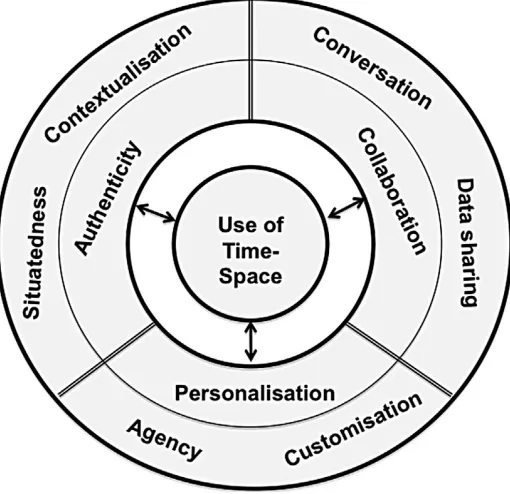
which are: authenticity, collaboration and personalisation, encapsulated in the
time-space contexts of mobile learning. The authenticity feature points out opportunities
for contextualized and situated learning; the collaboration feature highlights
conversational and communication aspects of mobile learning while the
personalisation feature has strong influences on ownership, agency and
autonomous learning (Kearney et al., 2012).
Despite it can assist the practitioner's understanding on pedagogical challenges
and facilitate critical insights to mobile learning experiences, the authors have
mentioned that there is a need to explore in more detail the time-space continuum as
[image:41.595.170.425.370.617.2]learning contexts occur in different places and at different times.
30
2.5.3 Model of m-learning adoption
Barker, Krull and Mallinson (2005) have proposed a model for m-learning
adoption for developing countries as represented in Figure 2.6. The model combines
the traditional learning environment that is supported by mobile learning policies and
guidelines. Within an adopted mobile learning environment, the communication
among the mobile devices is enabled by wireless access points. The communication
includes learner-to-learner as well as learner-to-teacher interaction.
According to the model, the critical success factors are coordination,
communication, motivation, mobility, interactivity, negotiation, collaboration and
organisation of material. Coordination refers to interaction between learners while
communication implies that a mobile learning environment needs to open
communication channels between learners and teachers. Motivation refers to how the
learning environment encourages learners to engage in learning and mobility is
regarded as the portability of the devices. Interactivity represents the interaction
between learners and their devices, negotiation allows consensus to be reached in
learning activities, collaboration refers to partnership and organisation of material
enables the proper information searching. As pointed out by Cobcroft (2006), these
factors could support certain principles of effective university teaching.
However, the model is not suitable for other than developing countries and
31
Figure 2.6: Model of m-learning adoption (Barker, Krull & Mallinson, 2005)
2.5.4 Classification matrix for a mobile learning model
To illustrate a model of mobile learning, Botha, Van Greunen and Herselman
(2010) have explained on a classification matrix based on mobility and context of
interactions as shown in Figure 2.7. Based on the matrix, mobile learning are
characterised as low context and low mobility if the interactions are generally
broadcasting information to a selection of users such as SMS to inform parents of
school activities. On the other hand, the mobile learning interactions in the class of
high context and high mobility actively use the context or environment that is on the
32
collecting data in a field study. For low context and high mobility, portable devices
and users on the move are facilitated in the interaction, but with low physical context.
Conversely, the user has a virtual context, but it is often structured and depends on
physical environment.
Figure 2.7: Mobility and context in MHCI (Botha, Van Greunen & Herselman, 2010)
Even though the model provides a clear classification of interaction, device
and social limitations would restrict the type of interaction possible. For example,
lower end mobile devices could not support the high context and high mobility
interactions.
2.5.5 M-learning framework
A study by Motiwalla (2007) proposed an m-learning framework to provide
requirements to develop m-learning applications that can be used to complement
33
that focuses on the applications and technology used by commercial establishments to
extend e-commerce and e-learning that focuses on the use of Internet and other ICT in
education. The framework is shown in Figure 2.8.
Figure 2.8: m-learning framework (Motiwalla, 2007)
Despite the framework is claimed to support constructive and conversational
learning models, it seems that it is not suitable since it is developed based on an
analysis of e-learning literature. This study argues that different approach must be
taken to develop a framework for mobile learning as it has different characteristics
compared to e- learning. As mentioned by Bo (2005), the standards for e-learning
environments are not appropriate for other technology platform.
2.5.6 MOBIlearn task model
MOBIlearn is a European based research and development project that
began from January 2002 to March 2005, which involved 24 partners from academia
and industries in ten countries. The goal of the project was to develop, apply and
assess architecture for mobile learning system, based on effective teaching and
34
product of MOBIlearn is a task model for mobile learning developed based on
Engestrom's activity system to show the process of interacting with objects using
computer-based tools that enables transformations to occur in both the objects and
also the individuals involved in carrying out work activities (McAndrew, Taylor &
Clow, 2007). Figure 2.9 shows the basic structure of the task model.
Figure 2.9: Basic structure of MOBIlearn task model
The aim of the task model is to understand mobile learning activity that
incorporates the mediation of tools, occurs at the time preferred by learners, takes
place in a contextualized setting and normally involves some sort of communication.
The task model provides a lens to analyse learning processes and outcomes for the
design of contextualized application of mobile learning (Uden, 2007). It clearly
separates the required functionalities and their embodiment in any specific technology
(McAndrew, Taylor & Clow, 2007). It is flexible when the learners are defined as
'mobile', not the mobile devices that they use and developed based on the theories of
effective teaching and learning. Importantly, it is supported by Vygotsky's
sociocultural, Engestrom's activity model, Laurillard's conversational theories of Subject
Tool
Control Communication
Object
Context
35
learning (Sharples, Taylor and Vavoula, 2005; Taylor et al., 2006; Frohberg, Goth and
Schwabe, 2009).
2.6 Summary
As found in literature, there are several different perspectives in defining mobile
learning. Each definition emphasizes on different features such as the extension of e-learning,
the advent of mobile technologies, and the learners mobility. Moreover, a few studies in the
mobile learning field also have demonstrated some efforts to characterise the types of mobile
learning in order to describe it in more detail and to provide a deeper understanding for
current and future studies. As a result, it generally can be categorized into three different
contexts, which are formal, informal and non-formal learning. Furthermore, the literature has
pointed out that the mobile learning pedagogy is supported by a different type of learning
theories such as behaviourism, constructivism, context awareness, collaborative,
conversational, informal learning and activity theory. Hence, its pedagogy is well recognized
and it is found that mobile learning is gradually embedded into mainstream education at all
levels.
In the past few years, there are some popular models and frameworks developed
specifically for mobile learning that have their own strength and weakness. However, it
appears that the MOBIlearn task model is the best model that could be applied and
implemented to inform the design of a mobile learning application to support learner activity
in mobile environment. This research project needs to conduct a further investigation on the
task model in effort to achieve its objectives. For the next chapter, the task model is explored
and explained in detail with each of its contributing factors is systematically reviewed and
36 CHAPTER 3
SYSTEMATIC REVIEW ON MOBIlearn TASK MODEL
3.1 Introduction
In this chapter, a systematic review on the MOBIlearn task model to synthesize
pedagogical requirements for mobile learning is presented. A systematic literature review is a
means of identifying, evaluating and interpreting all available research relevant to a particular
research question, or topic area, or phenomenon of interest (Kitchenham, 2004). The reason
for this research project to undertake a systematic review is to summarize existing empirical
evidences to provide in-depth understanding on the factors of the task model in effort to
capture appropriate pedagogical requirements for mobile learning.
This chapter is a part of the thesis structure that present the first part of this research
project. Most of the work in the chapter has been published in an open access journal (Jalil,
Beer & Crowther, 2015). In particular, this review basically aims to develop an understanding
of the MOBIlearn task model by providing the theories underpinning the development of the
model and systematically reviewing its contributing factors on current literature. Then, this
chapter presents the results and discusses the findings by listing out a set of synthesized
pedagogical requirements for mobile learning. Finally, the requirements are mapped with a
set of proposed components to provide functionalities in an initial design of a mobile learning