Command and Control for Grid Infrastructures
A Thesis
Submitted to the Office of Graduate Studies of
University of Dublin, Trinity College in Candidacy for the Degree of
Doctor of Philosophy
Declaration
I, the undersigned, declare that this work has not previously been submitted as an exercise for a degree at this, or any other University, and that unless otherwise stated, is my own work.
Permission to Lend and/or Copy
I, the undersigned, agree that Trinity College Library may lend or copy this thesis upon request.
Acknowledgments
I would like to acknowledge the encouragement, guidance and support of my supervisor Dr Brian Coghlan. His interest in the subject has been an inspiration.
My colleagues in the Computer Architecture Group, every one of whom has added to the enjoyment, experience and learning of the last few years. A special thanks to Gabriele for the collaboration in regard to the Social Grid Agents and the exciting brain storming sessions, to Stuart for his encouragement in relation to the active security experiments, and to Eamonn and Stephen for their advice and assistance. I would also like to thank John Walsh who was always ready to help. Thanks also to the other members of the Grid-Ireland operations team for their input, opinions and not least for their efforts in maintaining the production and test infrastructures that made this research possible.
I would like to thank Science Foundation Ireland and the Computer Science department in Trinity College for their support in funding this research.
My parents, my sisters and brother, and Nora for all their love and support over the last few years.
To my dearest Linda for her unwavering support, encouragement, and understanding.
Keith Rochford
University of Dublin, Trinity College April 2008
Abstract
The centralised management of distributed computing infrastructures presents a number of considerable challenges, not least of which is the effective monitoring of physical resources and middleware components to provide an accurate operational picture for use by administrative or management staff. The detection and presentation of real-time information pertaining to the performance and availability of computing resources is a difficult yet critical activity.
This thesis presents an architecture intended to enhance the service monitoring experience of a Grid operations team. We have designed and implemented an extensible agent-based architecture capable of detecting and aggregating status information using low-level sensors, functionality tests and existing information systems. To date it has been successfully deployed across eighteen Grid-Ireland sites.
Managing the availability of the monitored services is an associated and essential task in ensuring the availability of a grid infrastructure. This project aims to take the next step in the monitoring and management of grid computing systems by developing a standards-based distributed control plane for grid resources and middleware components. While many existing projects focus on the monitoring of grid resources and infrastructures, they make little or no provision for the active or pro-active management operations required to ensure the availability of the infrastructure.
Contents
Acknowledgments iv
Abstract v
List of Tables viii
List of Figures x
Chapter 1 Introduction 1
1.1 Motivations . . . 1
1.2 Objectives . . . 2
1.3 Contribution . . . 3
1.4 Thesis Structure . . . 3
Chapter 2 Context 4 2.1 Introduction to Grid Computing . . . 4
2.2 The Evolution of Distributed Computing . . . 6
2.3 First Generation - the birth of wide-area computing . . . 7
2.3.1 Fafner . . . 7
2.3.2 I-WAY . . . 7
2.4 Second Generation - the emergence of integrated systems . . . 9
2.4.1 Globus . . . 9
2.4.2 Legion . . . 9
2.4.3 UNICORE . . . 10
2.5 Third Generation - the adoption of Web service architectures . . . 10
2.6 Large-scale Grids . . . 11
2.6.1 NASA Information Power Grid . . . 11
2.6.2 European DataGrid . . . 11
2.6.3 LCG and EGEE . . . 12
2.6.4 CrossGrid and Int.eu.grid . . . 12
2.6.5 Open Science Grid . . . 13
2.6.6 The European Grid Initiative . . . 13
2.6.7 DEISA and TeraGrid . . . 14
2.6.8 Naregi . . . 15
2.6.9 GridPP and UK NGS . . . 15
2.6.10 Grid-Ireland . . . 16
2.7 Peer-to-Peer and Community Computing . . . 16
2.7.1 BOINC . . . 17
2.7.2 World Community Grid . . . 18
2.7.3 Distributed.net . . . 18
2.8 Utility Computing and Clouds . . . 19
2.8.1 IBM Cloud Computing . . . 20
2.8.2 Amazon Web Services . . . 21
2.8.3 Sun Grid . . . 21
2.8.4 Microsoft Clouds . . . 22
2.8.5 3Tera . . . 22
2.9 HPC Eco-Systems . . . 23
2.10 Evolution of Distributed Infrastructure Management . . . 25
Chapter 3 Distributed Infrastructure Monitoring 27 3.1 Introduction . . . 27
3.2 Information Requirements and Models . . . 28
3.2.1 The GLUE Schema . . . 30
3.2.2 The OGF NM-WG Network Measurement Schema . . . 30
3.2.3 The GOCDB Schema . . . 32
3.2.4 Common Information Model . . . 32
3.3 Cluster and Network Monitoring Tools . . . 34
3.3.1 Ganglia . . . 34
3.3.2 Lemon . . . 35
3.3.3 Nagios . . . 35
3.4 Grid Information Systems . . . 36
3.4.1 MDS . . . 36
3.4.2 gLite/EGEE Information System . . . 37
3.4.3 R-GMA . . . 40
3.5 Grid Monitoring Systems . . . 40
3.5.1 A Grid Monitoring Architecture . . . 41
3.5.2 PyGMA . . . 43
3.5.3 The Relational Grid Monitoring Architecture . . . 44
3.5.4 GridICE . . . 47
3.5.5 MonALISA . . . 47
3.5.6 GSTAT . . . 49
3.5.7 C.O.D.E. . . 49
3.5.8 Site Functional Test . . . 51
3.5.9 SAM . . . 51
3.5.10 CrossGrid Host Check . . . 51
3.5.11 JIMS . . . 54
3.5.12 I4C . . . 55
3.5.13 RB-STATS . . . 55
3.6 Real-time Grid Job Monitoring Systems . . . 55
3.7 Summary . . . 58
Chapter 4 Distributed Infrastructure Management 60 4.1 Introduction . . . 60
4.2 Bodies and Standards . . . 61
4.2.1 Global Grid Forum . . . 61
4.2.2 Distributed Management Task Force . . . 61
4.2.3 Internet Engineering Task Force . . . 62
4.2.4 OASIS . . . 62
4.2.5 Centre for Information Technology Leadership . . . 62
4.2.6 World Wide Web Consortium . . . 63
4.2.7 International Organization for Standardization . . . 63
4.2.8 International Telecommunication Union . . . 63
4.2.9 TeleManagement Forum . . . 63
4.2.10 Infrastructure Management Standards . . . 64
4.3 Grid Management Models . . . 68
4.3.1 Centralised Management . . . 68
4.3.2 Federated Management . . . 70
4.3.3 Grid Operations Centres . . . 70
4.4 Grid Management Groups . . . 72
4.4.1 LCG Monitoring Working Groups . . . 73
4.4.2 EGEE Operations Automation Team . . . 74
4.5 Grid Management Tools . . . 74
4.5.1 The LCG GOC Database . . . 75
4.5.2 SMILE . . . 75
4.5.3 ELFms . . . 76
4.5.4 InGrid . . . 77
4.5.5 Help Systems . . . 78
4.6 Command and Control . . . 79
4.6.1 Operations Other Than War . . . 81
4.6.2 Summary . . . 83
4.6.3 Application of Control Theory . . . 85
4.6.4 Control Strategies . . . 86
4.6.5 Properties of control . . . 87
4.6.6 Feedback Loop Control . . . 87
4.6.7 Model Predictive Control . . . 88
4.6.8 Control in Grid Operations . . . 89
Chapter 5 Vision 91 5.1 A Vision for Command / Control in Grid Operations . . . 92
5.2 System Requirements . . . 94
5.3 Human Machine Interface . . . 100
5.4 The Case for Automated Management . . . 104
Chapter 6 Grid Monitoring with I4C 105 6.1 Introduction . . . 105
6.2 Motivations . . . 105
6.3 Centralised vs. Agent-based Monitoring . . . 106
6.4 Architecture . . . 107
6.4.1 Monitoring Agents . . . 107
6.4.2 Configuration Database . . . 110
6.4.3 Central Monitoring WebService . . . 110
6.5 Presentation and Alerting . . . 111
6.5.1 Reports/Displays/Alerts . . . 111
6.5.2 Navigation of Information . . . 111
6.5.3 Republishing for use by higher-level software . . . 114
6.6 Deployment . . . 116
6.7 Conclusions . . . 116
Chapter 7 Grid Command/Control with Grid4C 119 7.1 Introduction . . . 119
7.2 Use cases . . . 120
7.2.1 Service Outages . . . 120
7.2.2 Automatic service recovery . . . 120
7.2.3 Managing batch queues . . . 120
7.2.4 Active Security . . . 121
7.2.5 Active Authorization . . . 121
7.2.6 Applications server monitoring . . . 121
7.2.7 Workflow based resource management . . . 121
7.2.8 Autonomic resource management and provision . . . 122
7.2.9 Alerting, visualisation, and interaction . . . 122
7.2.10 Peer resource management . . . 122
7.2.11 Extension of existing monitoring tools . . . 122
7.2.12 Scheduled management actions . . . 122
7.3 Related Work . . . 123
7.4 The potential role of WSDM . . . 123
7.4.1 The WSDM development model . . . 124
7.5 Architecture . . . 126
7.5.1 Overview . . . 126
7.5.2 The Control Element & Final Elements . . . 128
7.5.3 The Management Server . . . 129
7.5.4 The Control Client . . . 130
7.6 Event Generation and Standard formats . . . 130
7.7 Security . . . 131
7.8 Configuration . . . 131
7.9 Example Management Capability . . . 132
7.10 WSDM Implementation . . . 134
7.11 Sample Management Client . . . 135
7.12 Summary . . . 135
Chapter 8 Deployment and Evaluation 138 8.1 Testbeds . . . 138
8.1.1 TestGrid . . . 138
8.2 Deployment . . . 139
8.3 Evaluation . . . 139
8.3.1 Performance . . . 139
8.3.2 Scalability . . . 141
8.4 Use-Cases . . . 141
8.4.1 Autonomic Policy-based Resource Management . . . 141
8.4.2 Integration with the Nagios monitoring system . . . 143
8.4.3 Providing reliable resource metrics for Economic Grid Markets . . . . 144
8.4.4 Integration with Active Security Infrastructure . . . 150
8.5 Summary . . . 152
Chapter 9 Visualisation and User Interface 153 9.1 Relevant Display Technologies . . . 154
Chapter 10 Service Availability Models 158 10.1 Determining Site and Service availability statistics . . . 158
10.1.1 Measures of system availability . . . 158
10.2 Modelling Grid Service Availability as a finite space Markov Chain . . . 161
10.2.1 Predicting future states . . . 163
10.2.2 Evaluating the steady state . . . 166
10.2.3 Multi-step Transition Probabilities . . . 167
10.3 Summary . . . 167
Chapter 11 Conclusions 168 11.1 Conclusions . . . 168
11.2 Future Work . . . 169
11.2.1 WSDM-Management of web services . . . 169
11.2.2 Complex Event Processing . . . 170
11.2.3 Social Grid Agents . . . 170
11.2.4 Advanced Visualisation . . . 170
11.2.5 WSRP for Grid Management Portals . . . 171
11.2.6 Discovery and autonomic management . . . 171
11.2.7 Developing system models . . . 171
11.2.8 Using WS-BPEL to execute management workflows across Grid4C End-points . . . 171
11.3 Personal Note . . . 172
Bibliography 173
Appendices 191
Appendix A The WSDM standard capabilities 192
Appendix B The WSDM Event Format 194
B.1 WEF event components . . . 194 B.2 WEF SituationCategory types . . . 195
Appendix C WS-Notification Traces 200
Glossary 206
List of Tables
3.1 Selection of CE Attributes from the GLUE schema . . . 30
3.2 Globus MDS Version Information . . . 38
3.3 R-GMA Producer Types . . . 47
4.1 Infrastructure Management Standards . . . 64
5.1 Some of the dimensions of grid C4I requirements . . . . 96
6.1 HyperGraph Infrastructure Monitoring Key . . . 114
6.2 Example Analyser event handlers . . . 116
6.3 Grid monitoring system requirements . . . 116
7.1 A selection of typical properties and operations exposed by Grid4C manage-ment endpoints. . . 133
7.2 Properties and operations of a simple GridFTP management capability. The same selection of properties and operations are provided for GRAM, GRIS, SSH, etc. . . 133
7.3 The PBS Management Capability . . . 133
7.4 Example Resource Broker management capability . . . 134
7.5 Grid monitoring system requirements . . . 135
8.1 Baseline performance measurements for test network environment . . . 140
8.2 Metrics for gLite Workload Management System. . . 148
10.1 Annual hours of downtime for availability Vs expected period of operation . . 159
10.2 Frequency Distribution of recorded states for Grid-Ireland Sites . . . 160
10.3 Frequency Distribution of recorded states for Grid-Ireland site csTCDie . . . 160
10.4 Frequency Distribution of recorded states for CE host at site csTCDie . . . . 160
10.5 Frequency Distribution of recorded states for HTTP service on GridInstall at TCD . . . 161
List of Figures
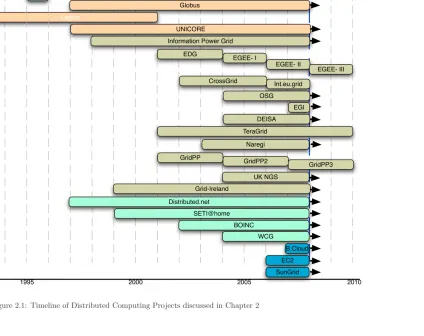
2.1 Timeline of Distributed Computing Projects discussed in Chapter 2 . . . 8
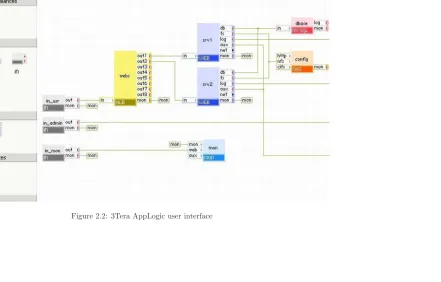
2.2 3Tera AppLogic user interface . . . 24
3.1 UML illustration of GLUE schema . . . 31
3.2 A section of the LCG Grid Operations Centre Database schema. . . 33
3.3 gLite information system architecture. [EGEc] . . . 39
3.4 The Monitoring Cycle . . . 41
3.5 Grid Monitoring Architecture components . . . 43
3.6 A GMA compound Producer/Consumer . . . 44
3.7 Architectural overview of the Relational Grid Monitoring Architecture . . . . 45
3.8 A Screenshot of the R-GMA browser interface . . . 46
3.9 A Screenshot of the GridICE browser interface monitoring the Int.eu.grid pro-duction infrastructure . . . 48
3.10 A Screenshot of the GSTAT browser interface . . . 50
3.11 A Screenshot of the Site Functional Test browser interface . . . 52
3.12 A Screenshot of the Service Availability Monitoring browser interface . . . 53
3.13 Architecture of the JIMS monitoring framework. . . 54
3.14 A Screenshot of the RB-STATS web interface . . . 56
3.15 A Screenshot of the GridPP real time job monitoring display . . . 57
3.16 A Screenshot of the Grid-Ireland real time job monitoring display . . . 58
4.1 A hierarchical operations management structure . . . 71
4.2 The GGUS web interface . . . 78
4.3 The Request Tracker web interface . . . 79
4.4 The ‘MAPE’ loop representing the execution of command . . . 81
4.5 Management by Objective applied to grid service management . . . 84
4.6 Block diagram controller/plant . . . 86
4.7 Block diagram of a feedback loop controller . . . 88
4.8 Block diagram of a PID controller . . . 88
5.1 Flow of information and control . . . 91
5.2 Unification of monitoring and control for grid management . . . 92
5.3 A proposed architecture for a grid management and operations support system. Areas of functionality provided by the systems developed by the author of this thesis are illustrated. . . 95
5.4 An example of a dedicated control facility for system operations . . . 101
5.5 An example of a ’V-Rack’ virtual instrumentation display . . . 102
6.1 Agent-based monitoring architecture . . . 108
6.2 Monitoring Agent start-up sequence . . . 109
6.3 A section of the Configuration Database Schema . . . 110
6.4 Example Nagios Display . . . 112
6.5 Detailed service monitoring information . . . 113
6.6 A snapshot of the Hypergraph Display of Infrastructure Status in mid-navigation115 7.1 Architectural overview of control backplane. . . 127
7.2 Architecture of remote management capabilities. . . 130
8.1 Analysis of WS-N driven reaction times. . . 140
8.2 Analysis of Response time. . . 141
8.3 Nagios / Grid4C integration architecture. . . 145
8.4 SGA and G4C integration architecture. . . 147
8.5 Complex interaction topology between SGA and Grid4C agents. . . 149
8.6 Integration of Grid4C components as Active Security policy enforcement points.152 9.1 The videowall at the AT&T global network operations centre, one of the largest command and control centres in the world. One hundred and forty-one rear-projection video screens are employed, each measuring 1.2 by 1.5 meters. . . 154
9.2 Consoles in the CERN Control Centre for monitoring and control of the LHC apparatus. . . 155
9.3 The Machine Control Centre (MCC) at Jefferson Labs continuous beam accel-erator facility (CEBAF). . . 156
9.4 Prototype operator consoles engineered by the author of this thesis. . . 156
9.5 The videowall in the video conferencing centre used by the Grid-Ireland Op-erations team. . . 157
9.6 TFT screens displaying monitoring information at the Grid-Ireland operations centre. . . 157 10.1 Directed graph showing all possible transitions . . . 163 10.2 Directed graph showing state transition probabilities for HTTP service on
Gridinstall at TCD . . . 164
’It’s perfectly intelligible,’ the captain said, in an offended tone, ’to anyone that understands such things.’
Lewis Carrol
Chapter 1
Introduction
This chapter introduces the subject of this dissertation; the implementation and use of a standards-based monitoring and control framework for the management of e-infrastructure resources.
The motivations for the work are outlined, along with the identification of a number of objectives and research questions that are to be addressed. Finally, the contributions made by this work are identified and an outline of the remainder of this dissertation is presented.
1.1
Motivations
The effective management of distributed computational resources is an essential task if e-infrastructures such as grids are to fulfil their potential and deliver expected levels of service. By their nature, these are complex distributed systems requiring significant management effort. There are two fundamental requirements to make such management possible; infor-mation and awareness about the managed system, its configuration and current status, and a capacity for control. It is only when these requirements are met that strategic and operational management objectives may be achieved.
A great deal of work has been carried out to date in the area of monitoring and informa-tion systems to provide the necessary awareness. So much in fact that new initiatives and working groups have been established to review and evaluate current solutions so that recom-mendations might be made to interested parties. Many of these development projects gave little thought to standard mechanisms for the representation and communication of data, interoperability, or future integration. Even fewer of these tools recognised the requirement to support control of, or action upon, the monitored resources. Once administrators were alerted to a problem, they were left to traditional manual processes to rectify the situation.
Given the number of existing monitoring tools, I believe that any further contributions should be based on sound accepted requirements, and endeavour to ensure support for stan-dards, extensibility, and interoperability. Having identified the requirements for an infras-tructure management tool, and the absence of any substantive grid control solution, simul-taneously highlighting the magnitude of the problem and presenting an opportunity not to be missed, I believe that the research and development is a worthwhile undertaking. A standards-based system for resource management, coupled with display, control, and automa-tion components, has the potential to significantly reduce the management effort required for the operation of grid infrastructures, and to increase availability, utilisation, and security. In order for such a system to be successful, it must meet a wide range of requirements, including several relating to security, performance, interoperability, and extensibility among others.
1.2
Objectives
The aim of this undertaking is to investigate whether if it is practicable to remotely monitor and control the components of a grid infrastructure and, if so, evaluate the use of such control capabilities for both centralised and distributed control. I also wish to explore the use of this control infrastructure for both manual and automatic/policy-based control of resources. The security implications must be addressed and mechanisms put in place. The benefits of this distributed management system should be illustrated through clear and simple concepts that are validated by practical implementations and deployment.
The research objectives of this work include:
• Investigation of the monitoring and management requirements of distributed computing resources.
• Identification and evaluations of existing tools that aim to satisfy these requirements • The investigation of existing technologies and standards that might be appropriate to
this task
• The design of an architecture for command and control of grid resources, and prototype implementation with which to verify it
• Evaluation of the resulting system through its deployment and a variety of use cases.
1.3
Contribution
The thesis of this dissertation is that applying a command and control system to the operation of a grid infrastructure can reduce the management effort required and increase its availability and performance, and that there is significant benefit to the development of such systems around open standard technologies.
This is investigated by conducting research into existing and potential management ac-tivities in order to identify the system requirements and applications.
Based on the identification of a number of shortcomings in available monitoring tools, Chapter 6 presents a distributed agent-based monitoring tool, I4C, developed by the author and successfully deployed on a production infrastructure.
Chapter 7 presents a standards-based, open, and extensible architecture for the manage-ment of distributed resources, Grid4C, along with a prototype implemanage-mentation. This proto-type is used to demonstrate its suitability for purpose by employing it to satisfy a number of current management requirements.
1.4
Thesis Structure
I begin by discussing the evolution of distributed computing so that the reader may under-stand the effects that this evolution and increasing complexity has had on the requirements of system management. I then describe the background to this work: in Chapter 3 I examine related monitoring mechanisms for distributed computing infrastructures, before discussing management tools and approaches in Chapter 4. Chapter 5 presents a vision and require-ments analysis for a command and control system for distributed infrastructure. In Chapter 6, I present my own contribution to the field of distributed monitoring. Chapter 7 describes an architecture and implementation of a measurement and control system that builds upon the research presented in Chapter 6 and augments it with the addition of control functionality. Chapter 8 describes the test deployments of the control system and outlines a number of use cases and experiments. In Chapter 9, I briefly outline a number of relevant display technologies that might be used for visualisation of and interaction with the managed system. Chapter 10 presents a number of models used to describe resource availability, before intro-ducing a novel means for the representation of grid service availability based on the results of the system described in Chapter 6. In Chapter 11 I present my conclusions based on this research, before concluding with the identification of some future work and further avenues of related research.
Chapter 2
Context
2.1
Introduction to Grid Computing
The term ‘Grid Computing’ became popular in the 1990’s based on a metaphor for the provision of compute resources that could be easily accessed in an on-demand fashion in a manner similar to the usage of electricity from a power grid. The initial concept proposed a distributed computing platform for advanced science and engineering. This would be achieved by providing a software environment that would make it possible to combine and share loosely coupled resources spanning organisations and geographical boundaries. In essence, the key objective is to co-ordinate resources belonging to, and managed by, multiple participants, and to negotiate sharing of those resources among a set of participants for the purposes of satisfying computational or communication requirements.
A rapid growth in interest ensued and considerable progress has since been made by many projects in their efforts to realise the vision. These projects have served to highlight the difficulties involved in the development and deployment of such infrastructures. Many of the concepts that have come out of research in the area of Grid computing have been successfully applied in the business arena.
Some popular definitions of Grids include:
• ‘A hardware and software infrastructure that provides dependable, consistent, and per-vasive access to high end computational capabilities, despite the geographical distribu-tion of both resources and users’[Laf].
• ‘The use of (powerful) computing resources transparently available to the user via a networked environment’ [SC92].
• ‘A hardware and software infrastructure that provides dependable, consistent,
sive, and inexpensive access to high-end computational capabilities’[FK03a].
• A system that allows ‘co-ordinated resource sharing and problem solving in dynamic, multi-institutional virtual organisations’[FKT01a].
Numerous architectures and classification of Grids have emerged although common to all is the objective of coordinated resource sharing, and the provision of dynamic problem solving environments involving multiple participants, often coordinated within Virtual Organisations. Some of the common classification of Grids include:
• Computational Grids - compute intensive operations, grand challenge problems,
batch job processing
• Data grids- storage and sharing of large amounts of data, data mining and exploration
• Instrument Grids - sharing sensors and devices
• Service Grids - applications and multimedia, on-demand, collaborative
Key characteristics of grid systems include: • Scalability - leverage growing infrastructure
• Adaptability- tolerate faults and transient resources
• Flexibility- support dynamic collections of participants and resources
• Security- enforce security and policy restrictions placed on component entities The success of grid technologies to date is generally attributed to the early emergence of standard architectural models, enthusiastic early developers, adopters and evangelists, and perhaps most importantly a set of computational challenges to provide a problem for the solution and to prove its worth. They are the result of an evolution of computer architecture, made possible by advances in many areas of research.
This chapter presents a brief overview of some of the developments in computing that have contributed to the emergence of Grids, before discussing a number of significant grid projects and architectures. Currently fashionable topics such as Utility and Community computing are then discussed, before closing with a brief discussion on the evolution of management systems which has accompanied the development of distributed computing.
2.2
The Evolution of Distributed Computing
It has long been recognised that one of the most cost effective ways to satisfy our demands for increased computing power is to combine the power of multiple resources. In the late 1960s, Gene Amdhal proposed what became know as Amdhal’s law [Amd00] which described the improvement in processing time that could be expected by parallelising an otherwise serially performed task. This work presented the basis and justification for multi-processor computing, although it is likely that the concept is almost as old as digital computing itself. The range of parallel computing architectures that has grown out of subsequent research is a vast topic in itself but for the predominant von Neuman architectures the results might be generally categorised in terms of the channels used for inter-processor communications, and whether they reside within or external to the computing nodes. For example, parallel architectures such as Symmetric Multiprocessors or Massively Parallel Processors typically use internal, proprietary communications busses or networks. Clusters or wide-area com-puting architectures usually use external commodity networks such as 1Gbps Ethernet, or near-commodity high-performance networks such as Myranet or Infiniband. It follows that the evolution of such distributed computing architectures has been closely linked to the de-velopment, and pervasive deployment, of the communication networks on which they depend. In 1969, the ARPANET project [Rob86] succeeded in linking four different computing centres using a commodity network infrastructure. The ARPANET project is also generally accred-ited as being the first to develop software to take advantage of this new type of computing architecture in the form of its ‘Creeper’ and ‘Reaper’ worms. These were early examples of ’CPU scavengers’, making use of idle computational power. Among the first Internet-based distributed computing projects was a factoring project undertaken by the DEC System Re-search Center in 1988 in response to a reRe-search challenge. This early approach relied on E-mail to distribute the data sets and applications for trivially parallel computations that would require no inter-process communication.
Although the development of an affordable, pervasive and high performance communica-tions infrastructure was an essential precursor to the evolution of distributed computing, the linking of the hardware resources alone is not sufficient to realise a distributed computing system. Software components must also be adapted or developed to enable the unification, virualisation and exploitation of the combined resources.
In basic terms, the creation of a distributed computing environment requires [SC92]: • The integration of individual distributed resources into a combined networked resource. • Middleware to provide a transparent view of the resources available.
• Optimised distributed applications to take advantage of the unified resource.
Although many of the projects developed to date differ in their objectives and aims, they all had to overcome similar problems such as communications, resource management, and security.
In addition to the technological challenges that accompany an increase in distribution and scale, the influence of social and political factors becomes increasingly pertinent. While these present the architects of distributed computing systems with a number of additional hurdles, their effect has not been entirely negative. The tendency for Governments and funding bodies to favour investment in projects closer to home has led to an increased number of distributed individual resources, and hence further justification for the development of the software components that support their distributed use and collaboration.
There follows a brief overview of a number of significant distributed computing projects.
2.3
First Generation - the birth of wide-area computing
2.3.1 Fafner
Fafner (Factoring via Network-Enabled Recursion)[FAF] was a distributed computing project developed in 1995 with the intention of using the Web to overcome some of the problems associated with factoring large numbers. It employed central web servers and CGI scripts with which users could register anonymously. Contributors downloaded worker daemons which would then use HTTP requests to GET data from and POST results back to the CGI scripts on the web servers. Multiple sites were recruited to host the necessary web servers thus forming a hierarchical network that reduced administrative and computational load. The Fafner project laid the foundations for the many web-based computing projects that would follow.
2.3.2 I-WAY
Conceived in 1995, the Information Wide Area Year (I-WAY) [FGN+96] [DFP+96] was an experimental high performance network designed to link high performance computers and advanced visualisation environments. The objective was to combine existing high-bandwidth networks using telephone systems. The testbed consisted of 17 different sites connected with networks of varying bandwidths and protocols. ATM, an emerging technology at the time, was the basis for this network.
In an effort to standardise the software interface and management, point-of-presence com-puters were installed at each site to act as the gateways to the I-WAY. These machines were
1995 2000 2005 2010 Fafner
I-Way
Globus
Legion
UNICORE
Information Power Grid EDG
EGEE- I
EGEE- II
EGEE- III CrossGrid Int.eu.grid
Grid-Ireland
GridPP GridPP2
GridPP3 UK NGS
DEISA TeraGrid
OSG
EGI
Naregi
SETI@home
BOINC WCG Distributed.net
B.Cloud EC2 SunGrid
UTILITY
P2P
LARGE SCALE GRIDS
2nd Gen
1st Gen
[image:27.595.171.751.85.523.2]uniformly configured Unix workstations executing a standard software environment. This standard deployment helped overcome a number of problems including heterogeneity, scala-bility, security, and performance. Security was a key consideration in the I-WAY project and an effort was made to provide a common authentication environment.
I-Way was not only an operational success, which would later contribute the the Globus project, but also demonstrated how the deployment and management of wide-area distributed computing could be simplified.
2.4
Second Generation - the emergence of integrated systems
2.4.1 Globus
Globus[FK97] provides a software infrastructure that allows applications to handle distributed, heterogeneous resources as a single virtual machine. It provides a toolkit which defines the basic capabilities required to construct a computation Grid. The components of this toolkit provide fundamental services such as security, resource location, and resource management, and have well defined API’s allowing developers to tailor solutions to their individual needs. The Globus architecture is a modular, layered one, allowing applications to employ specific features while omitting others. The services provided by the components include:
• Resource allocation and process management (GRAM) • Authentication and security services (GSI and CAS) • Directory service of structure and state information (MDS) • Data Management (GridFTP and RLS, etc.)
Globus has been widely adopted and its components incorporated into a number of other projects. Its development is ongoing.
2.4.2 Legion
Developed by Andrew Grimshaw at the University of Virginia, Legion[GWT97] is an object-based meta-system providing a software infrastructure for the interaction of distributed het-erogeneous computing resources. With the objective of presenting users with a single, coher-ent, virtual machine, the Legion system is organised into a set of classes and packages. All hardware and software resources are modelled as objects and users are free to define their own objects which can override or redefine existing ones. A number of core objects and API’s
are provided which implement the basic services required buy the meta-system. Legion has been commercialised by the Avaki Corporation, now merged with Sybase [Syb].
2.4.3 UNICORE
UNICORE[Rom02] (UNiform Interface to COmputer REsources) is a technology intended to provides seamless, secure, and intuitive access to distributed computational resources such as supercomputers, cluster systems, and information stores.
Originally conceived to integrate super-computing centres across Germany, follow-up projects have sought to extend its functionality and interoperability working towards an OGF[OGF] compliant implementation. Integration of UNICORE with Globus was carried out in the EU-funded project GRIP[MW03].
Intended as a alternative to Globus, UNICORE provides its own grid toolkit and user interface portal.
2.5
Third Generation - the adoption of Web service
architectures
Based on the experience gained in implementing the second generation grids, it became apparent that a primary requirement of future development would be the provision for inter-operability and reuse of middleware components. It was desirable that future architectures could be engineered by assembling existing components in a flexible, extensible manner. Web services and service oriented architectures present an ideal solution to these requirements for interoperability and reuse, and their adoption is characteristic of third generation Grid projects.
The third generation also saw an increase in the importance of the users and the social groups involved. Notions such as that of the Virtual Organisation became widely accepted and greater emphasis was placed on the role played by the infrastructures in supporting science, rather than on the science of their development itself.
The Open Grid Services Architecture (OGSA)[FKNT02] announced at the Global Grid Forum in 2002 was of vital importance in promoting the adoption of service based Grid architectures. Version 1 was released in 2004 as the GGF’s flagship architecture, defining a common, standard, and open architecture for Grid infrastructures. The components and services defined within the OGSA are realised using Web services in order to provide all the fundamental elements necessary for the support of e-science applications.
Due to the dynamic nature of Grid environments, the OGSA specification includes
port for life-cycle management as well as support for state data associated with Grid services. The initial implementation of the OGSA architecture, the Open Grid Services Infrastructure (OGSI)[ea03] attempted to construct Grid services by extending current Web service stan-dards to provide ‘stateful’ services. This extension to existing stanstan-dards left the OGSI open to criticism and prompted a consortium of industry and research partners to design an al-ternative infrastructure based entirely on Web service specifications. The result was the the announcement of the WS-Resource Framework (WSRF)[Glo] in 2004. WSRF includes specifications governing resource lifetime, properties, and relationships. Also included in the specification is an event based notification system.
A number of existing projects migrated to Web service architectures over the course of their ongoing development. The Globus Toolkit versions 3(GT3) and 4 (GT4), along with UNICORE 6.0, and gLite[gLi] are examples of web service based grid middlewares.
2.6
Large-scale Grids
2.6.1 NASA Information Power Grid
Development of NASA’s Information Power Grid (IPG)[JGN99] was begun in 1998, to pro-vide a high performance computing and data grid for use primarily by NASA scientists and engineers. It employed the Globus toolkit to provide access to heterogeneous resources dis-tributed among several research laboratories.
The fact that the IPG was based upon the widely used Globus toolkit meant not only that NASA scientists could gain access to the computational resources from any location, but that the resources of the IPG could be used by authorised external scientists, and all via a familiar interface. In addition to data and compute services, the IPG infrastructure provides real-time access to scientific and engineering instrumentation systems.
2.6.2 European DataGrid
The European DataGrid(EDG)[Dat] project was started in January 2001, with the goal of constructing a test infrastructure to provide shared data and computing resources to the European scientific community. It involved twenty one partners from across Europe including scientific institutes and industrial partners.
Originally aimed at three core disciplines; High Energy Physics, Biology, and Earth Obser-vation, the EDG project used Globus as it’s foundation but augmented it with the addition of several higher level services such as resource brokerage, book keeping, and data management services.
The EDG project provided European scientists with the first large-scale demonstrations of a functioning data grid and formed the basis for the LCG[lcga] infrastructure. The success of the EDG project was a critical step in the adoption of Grid computing in Europe.
2.6.3 LCG and EGEE
Designed to satisfy the computational and data-handling requirements of the experiments conducted at CERN’s Large Hadron Collider, the LHC Computing Grid (LCG)[lcga] was initiated in 2003 as one of the most wide-reaching distributed computing projects to date. The project would not only integrate resources spread across Europe, America and Asia into a global virtual computing service, but also serve to further collaboration among researchers and scientists.
The LCG project developed incrementally, with the early phases operating a set of proto-type services that later grew in complexity and functionality. The LCG middleware was based on that developed for the EDG project and components of the Virtual Data Toolkit[Ave].
The EGEE[egea] project started in 2004 entitled ‘Enabling Grids for E-science in Europe’, but was later changed to ‘Enabling Grids for E-sciencE’ following the addition of partners from the U.S. and Asia. Building on developments from EDG and LCG, the EGEE project initially used the second release of the LCG middleware, and later migrated to a more generic light-weight middleware developed within the project, gLite[gLi].
The EGEE-II project was commenced in April 2006 with a larger consortium of partners spanning 32 countries. Further middleware development was undertaken in EGEE-II with a focus on increasing the integration of external components and increased software testing. The EGEE project is now in phase 3 which will continue until 2010.
2.6.4 CrossGrid and Int.eu.grid
The CrossGrid[BMM+02] project was initiated in 2002 with the objective of developing a grid infrastructure to support a new category of applications from fields such as medicine, environmental science and physics. One of the primary aims of the CrossGrid project was to investigate and implement Grid components that would enable interactive computation, using advanced visualisation and application steering.
Grid software implemented during the course of the project included new tools for veri-fication of source code, performance prediction, evaluation and on-line analysis. The infras-tructure was also equipped with new components for monitoring of application performance, efficient distributed data access, specific resource management, as well as portals and mobile personalised user interfaces.
The work was carried out in close collaboration with the Grid Forum and the DataGrid project, in order to profit from their results and experience, and to enable interoperability. Research results were validated, tested, and demonstrated on the CrossGrid test infrastruc-ture, where an emphasis was placed on user-friendly environments and interfaces.
Following on from the successes and expertise of the CrossGrid project, the Interactive European Grid (Int.eu.grid or I2G)[Intb] project was started on 1 May, 2006 with the ob-jective of providing an advanced Grid-empowered production infrastructure in the European Research Area. This project is specifically oriented to support the execution of interactive demanding applications.
While interoperable with large e-Infrastructures such as EGEE thanks to common mid-dleware services, the Interactive European Grid maintains a primary focus on powerful vi-sualisation and interaction with demanding parallel applications that have been identified as benefiting from grid integration.
2.6.5 Open Science Grid
Built by a consortium of U.S. universities and laboratories, the Open Science Grid[Grib] is a national production-quality infrastructure for large-scale science. The basis for the Open Science Grid middleware is provided by the National Science Foundation’s Middleware Ini-tiative, incorporating Globus[FK97] and Condor[LLM88] components. The OSG middleware is packaged and supported through the Virtual Data Toolkit[Ave].
Two separate infrastructures are maintained as part of the OSG; an Integration Grid, used for testing and evaluation, and a Production Grid, which provides a stable, supported environment for sustained applications. The Operations Centre is based at Indiana University. The U.S. contribution to the LHC[CERa] experiment is being built and operated as part of the Open Science Grid.
2.6.6 The European Grid Initiative
The European Grid Initiative (EGI)[EGI] aims to protect and maximise the investment in e-infrastructures by encouraging collaboration and interoperability between national Grid infrastructures. Following considerable European investment in e-Science and the success of numerous projects, Grid technology has become recognised as a fundamental component for e-infrastructures. The EGI aims to construct a pan-European infrastructure with an emphasis on sustainability. Building on the foundation of existing National Grid Initiatives (NGI), the EGI is expected to “enable the next leap” in research infrastructures by both encouraging the linking of the existing NGIs and by supporting the development of new NGIs.
The EGI aims to coordinate middleware development and encourage standardisation by soliciting leading groups to undertake development work. It also hopes to have an advisory role in the funding of future development, based on agreed requirements and standards. The development and adoption of interface standards is obviously a high priority in facilitating the goals of the EGI. It will draw on practical experience in the areas of grid operation and middleware integration, in addition to consultation with standards organisations, in order to define its requirements in this regard.
The EGI will be expected to operate the European level of the production Grid infras-tructure and to provide global services and support that complement and/or coordinate those offered by national services, e.g. VO support, user authentication, and security. Also among its objectives are the testing, integration, and packaging of existing components from leading middleware development projects and to make them widely available along with documenta-tion and training material.
The EGI Knowledge Base encourages participants to share knowledge and experience while also being kept abreast of EGI project developments. As of September 3rd 2007, 37 National Grid Initiatives had expressed support of the EGI concept and funding for a design study has since been secured under the EU’s 7th Framework Program. The EGI is expected to deliver its blueprint for future development by June 2008 and is scheduled to begin operations in early 2010.
2.6.7 DEISA and TeraGrid
DEISA (Distributed European Infrastructure for Supercomputing Applications)[DEI] is a consortium of leading national supercomputing centres that has formed a combined infras-tructure to provide a persistent, production quality, distributed supercomputing environment with continental scope. The computing centres are interconnected with a high bandwidth network provided by GEANT. Research activities include middleware development in addi-tion to supporting a wide range of scientific disciplines through the provision of enhanced HPC capabilities.
TeraGrid[Ter] is a similar venture for US supercomputing sites which aims to provide an “open scientific discovery infrastructure”. Funded by the National Science Foundation, TeraGrid combines resources at 11 partner sites using high-performance network connections. Currently, Teragrid resources exceed 750 teraflops of computing capability and 30 petabytes of online and archival data storage. TeraGrid activities are coordinated by the Grid Infras-tructure Group (GIG) at the University of Chicago
2.6.8 Naregi
The Japanese National Research Grid Initiative[MSA+05] (NAREGI) was started as a five-year project in 2003. The NAREGI project conducts research and development of the prac-tical Grid middleware required for the operation of a robust computational research environ-ment. In addition to the provision of the Grid middleware, the NAREGI project will conduct research on the application of high-speed network technology to the grid environment and will also conduct research and development on large-scale simulation programs for use in nano-science fields. As an example of this, the Japanese Computational Nano-science Centre at the Institute of Molecular Science is conducting research into grid-enabled nano-science and nanotechnology simulation applications.
Although a number of very interesting work packages are proposed, including program-ming and problem-solving environments, the research and development of the grid middle-ware was not started from scratch. In the initial phase, existing middlemiddle-ware such as UNI-CORE, Globus, and Condor have been used appropriately for the underlying system while research concerning the upper layers of the middleware was conducted. In the second phase, it is planned that the NAREGI middleware will evolve into the Open Grid Services Frame-work(OGSA) [FKNT02] .
The NAREGI Grid middleware is used as one of the software layers in the Japanese Cyber Science Infrastructure (CSI), an information technology based environment intended to boost scientific research and education activities. Other initiatives that were reorganised and incorporated into the CSI project include the university PKI and authentication system, the next-generation high-speed network project, and the academic digital contents projects. In 2006, CSI was integrated into a seven-year “Development and Application of Advanced High-performance Supercomputer” project aimed at providing Grid middleware for peta-scale computing.
2.6.9 GridPP and UK NGS
GridPP[Grid] is a UK particle physics grid constructed as a contribution to the processing requirements of the LHC projects. The project’s main objective is the construction of a large-scale e-Science infrastructure for use by the UK and international particle physics community. GridPP is a collaboration of approximately 100 researchers from academic and research institutions including CCLRC (Council for the Central Laboratory of the Research Councils) and CERN. The aims of the project include the development of middleware and applications, and the deployment of a distributed computing infrastructure across the UK, in order to build a prototype Grid. In addition to linking resources at 17 UK sites, GridPP is connected
to other prototype Grids on an international scale. The six year project project commenced in 2001, with GridPP2, the second phase, beginning in September 2004. Phase two was intended to scale the infrastructure to the equivalent of 10,000 PCs before coming online for LHC data analysis in 2007. The project has now entered phase three, GridPP3, with funding secured until 2011.
The UK National Grid Service (NGS)[NGS] is an initiative funded by several government bodies with the goal of providing UK researchers with electronic access to the computational and data-based facilities that they require in order to carry out their research. A key function of the NGS is the training and support of users.
The resources provided by the NGS are accessed using a standard common set of services known as the Minimum Software Stack[UN]. The services provided are based on the Globus toolkit. In addition to the provision of physical resources, the NGS provides scientific software packages and libraries. The NGS currently provides services to over five hundred users and incorporates 13 sites.
2.6.10 Grid-Ireland
Grid-Ireland[CWO05] is a managed layer providing grid services to 18 sites above the Irish research network. It allows researchers to share computing and storage resources using a com-mon interface, and facilitates international collaboration by linking Irish sites to into Euro-pean grid infrastructures being developed under such EU projects as EGEE[egea], LCG[lcga], CrossGrid[BMM+02], and Int.EU.Grid[inta].
Grid-Ireland employs a centrally managed infrastructure, using identically configured ‘Gateways’ deployed as points of presence within each participating site. The default mid-dleware software stack is gLite[gLi].
2.7
Peer-to-Peer and Community Computing
Peer to peer computing systems are internet applications designed to harness the resources of a large number of autonomous participants[FK03b]. The defining characteristic is generally the lack of any centralised structure and the ability of the peers to form self-organising net-works, often layered above existing protocols. While both P2P networks and Grid computing are concerned with the sharing of distributed resources, the specific requirements of each has led to differing approaches, technologies, and architectures. In general, the connected resources differ in terms of architecture, scale, and connectivity.
The distributed flat architecture of many P2P systems is often regarded as a bonus leading to increased availability and fault tolerance. Many of the functionalities traditionally fulfilled
by nodes in hierarchical client-server networks are distributed among the co-operating peers in a P2P network. Described as an evolution of the traditional client-server model, peer-to-peer computing can be said to include the resources of the client into the model such that clients become servers allowing access to their own resources in return for use of the P2P service. In this case, the distinction between the clients and servers becomes less evident and what is left are peer resources both providing and consuming content or services. Applications of Peer to Peer systems include network management, content distribution, distributed computation and searching. Advantages include increased bandwidth (leveraging the accumulated bandwidth of participating resources), storage space, and computing power, in addition to robustness brought about by replication and the elimination of single points of failure.
Based on the strength and popularity of P2P networks, a number of distributed computing projects have emerged to take advantage of the architecture. Many of these community projects come under the banner of Volunteer Computing where computer owners donate their resources either for free or for community credits. One of the first such projects was the Great Internet Mersenne Prime Search[GIM] started in 1996 and was followed in 1997 by Distributed.net. Bayanihan[Sar98] , the well known JavaTM-based research project followed in 1998. In 1999, the launch of SETI@home[ACK+02] brought volunteer computing to the masses thanks to media coverage and popular interest. The concept has gathered pace since and there are currently a large number of active projects, some of which are described below. Several companies have been formed based in experience on volunteer computing such as Entropia and United Devices.
2.7.1 BOINC
Originally developed for the SETI@home project, the Berkeley Open Infrastructure for Net-work Computing (BOINC)[And04] is a non-commercial middleware system for volunteer com-puting. Despite its origins, BOINC is intended for use in a wide range of scientific disciplines to enable researchers to leverage the considerable computing power available from personal computers around the world.
The BOINC framework, developed at the University of California, Berkeley, is supported on a wide variety of operating systems and is available as free software under the GNU Lesser General Public License. The BOINC architecture consists of server and client components which communicate with each other in order to distribute and process the workload, and to return results.
A credit system is used to keep track of how much CPU time each volunteer has con-tributed. Results of calculations are validated prior to the awarding of credits in order to ensure that contributors cannot cheat by returning false results.
Some of the active projects using the BOINC framework include:
• Rosetta@home - Tests the assembly of specific proteins, using fragments of better-known proteins.
• BRaTS@Home A gravitational lensing study.
• Climateprediction.net Attempts to produce a forecast of the climate A number of additional projects are currently in development.
2.7.2 World Community Grid
World Community Grid (WCG)[Gric] is an effort to create the world’s largest public comput-ing grid to perform processcomput-ing for scientific research projects that benefit humanity. Launched in 2004, the WCG is funded and operated by IBM with client software currently available for a wide range of computing platforms. Many of the WCG clients currently use BOINC technology. The WCG is another example of a scavenging grid designed to utilise the idle time of connected computers from around the world. To date the project has attracted over 345,000 registered users and over 800,000 registered computers. The WCG owes it’s existence to the success of the Smallpox Research Grid Project, which was used to identify candidate compounds for development into smallpox treatments.
Rather than being designed specifically to work on a single project, the WCG offers participation in multiple humanitarian projects in a single package. Projects are approved for exection on the WCG by an advisory board and all users are included in all projects by default but can opt out of projects if they wish. Current research projects using the World Community Grid relate to AIDS, climate prediction, cancer research, and proteome folding
2.7.3 Distributed.net
Distributed.net[dis] is another distributed computing project that employs idle cpu time from worldwide resources for large-scale problem solving. Registered as a not-for-profit organisa-tion and owned by Distributed Computing Technologies Inc., it was launched in 1997 and the majority of its processing has has been used for encryption challenges and mathematical search algorithms. In order to contribute, users download and execute a client program called ’dnetc’ which is available for a range of operating systems.
The phenomenon of Peer-to-Peer computing has had a profound and far reaching effect
on both popular and scientific computing in recent years and it likely to continue to do so for the foreseeable future. The overlap between Grid and P2P computing suggests that some degree of convergence is possible. It has been suggested[FK03b] that a combination of the two technologies, e.g. a grid services infrastructure operating above a P2P substrate, may be a solution to realising the vision of utility computing on a global scale.
2.8
Utility Computing and Clouds
Utility Computing refers to a concept wherein computing resources, either hardware or soft-ware, are accessed and utilised in an on-demand fashion in a similar way to traditionally recognised utilities such as energy supply or telecommunications. The concept presents users with a number of potential advantages including the potential for considerable cost savings and increased flexibility. Utility computing generally refers to a more dynamic system than the likes of Software as a Service (SaaS) or Hardware as as Service(HaaS).
Whereas these systems are generally statically configured as described in some contract, utility computing typically employs some form of management software to look after the phys-ical provisioning in a more dynamic fashion. Many providers of utility services have adopted some form of virtualisation to help satisfy the requirements for reliability and scalability. The goal of the utility computing model is to maximize resource utilisation and minimize user costs
It is also possible to combine the concept of utility computing with other computing architectures, for example Peer-to-peer. In this scenario, a middle-man or broker might package and market the combined resources contributed by the peers in the network, and provide some form of remuneration based on the derived revenue.
Cloud computing is a variety of Utility computing. The analogy is based on the fact that the internet is commonly represented as a cloud where the users connected to it are relatively unaware of the scale and complexity of the system that exists beyond their browsers. Cloud computing builds on the utility model but aims to simplify deployment and management of services. In theory, a computing Cloud could encompass many different kinds of utilities,
From a business point of view, utility computing turns what was once large capital ex-penditure into operational costs that can be more closely compared to the revenue generated from it. Consumers can simple ‘plug-in’ to the required resources without having to invest in and manage the infrastructure. Costs of employing utility services are expected to compare favourably with the costs associated with the traditional data centre such as power, housing, cooling, and managing.
The notion of utility computing is far from new. Time-sharing of systems, which began
in the 1960s and allowed large corporations access to central mainframes for periods of time, might be considered an early precursor. It was time-sharing systems such as these that served to highlight the importance of process control and accounting that would later form key components of this business model. This was before the advent of mini-computers and PCs which would see the price of computing lowered to the point that it was affordable to the majority of businesses. Indeed it might be argued that the outsourcing of business functions such as billing to computer enabled providers in the 1960s could constitute an early example of employing computer services as a utility.
From the 1990s onwards, manufacturers of computing hardware began to show renewed interest in the field with projects from IBM, HP, and Sun among others. In more recent times, several large industry players have begun efforts to realise the opportunities offered by the utility computing model and have begun investing heavily in the technology. There follows a brief description of a number of current utility related activities
2.8.1 IBM Cloud Computing
IBM have been involved in Utility computing since the late 1990s but renewed interest in the field and the emergence of the Cloud computing concept has led to considerable recent investment of resources in the area. The IBM Blue Cloud[IBMb] was announced in late 2007 as a solution to enable and facilitate the creation of compute Clouds. Blue Cloud is a suite of components based on industry standards and open source software. It uses Red Hat’s Fedora Linux, making use of its integrated Xen hypervisor in order to virtualise the hardware resources. IBM’s Tivoli software is used for resource management and provision, along with DB2 and Websphere. Apache Hadoop is also included which includes Google technologies in the form of its Google File System[GGL03] and MapReduce [DG04].
In March of 2008, IBM and the Industrial Development Agency of Ireland (IDA Ireland) announced the opening of Europe’s first cloud computing centre operated from its HiPODS (High Performance on Demand Solutions) lab in Dublin[IBMa]. The cloud computing centre aims to replace the traditional data centre model in which companies own and manage their individual hardware and software systems. The centre will serve as a hub for the delivery of Cloud Computing research and services to a number of facilities across Europe, the Middle East, and Africa. Experts from the IBM HiPODS (High Performance on Demand Solutions) team will work directly with customers in order to encourage and support their uptake of cloud computing solutions.
With its considerable experience in the field of Autonomic Computing, IBM is well po-sitioned to provide cloud computing services at a successful business level by introducing increasingly self-managing behaviour to computing systems. Having been quick to recognise
the merits of cluster computing and virtualisation form the outset, Google is continuing its trend by joining forces with IBM to provide Cloud computing facilities to a number of US universities. IBM is the lead integrator for a Cloud utility that is being installed at Google’s data centre in California. The hardware employed includes IBM blade and rack servers which run the Blue Cloud components. Through its own operations, Google has gained considerable experience of virtualisation and on-demand resource allocation although it has not yet begun to market this expertise or its cluster resources directly.
2.8.2 Amazon Web Services
Amazon Elastic Compute Cloud (EC2)[Amaa] is a component of the Amazon web services suite, designed to allow scalable deployment of applications by allowing users to manage the creation and termination of server instances on demand. EC2 makes extensive use of Xen virtualisation for the creation and management of the virtual servers. The service allows users to:
• Upload custom machine images installed with specific applications, libraries or data. • Select from an existing set of pre-configured machine images.
• Control life-cycle, network configuration, security, and monitoring of the virtual servers via a web services API.
Associated with each user account are a number of ‘Elastic’ IP addresses which can be mapped to running instances of the virtual machines. These provide a convenient fail-over mechanism in the event of a virtual machine failure. Billing is based on the type of server instance per instance-hour and on data transfer into and out of each instance.
Amazon also offers a complimentary data storage solution, the Simple Storage Service (S3)[Amab]. S3 provides a simple standards-based (REST and SOAP) web services interface that can be used for storage and access of data on a highly scalable, reliable, fast and inexpen-sive data storage architecture. Users can choose whether they wish their data to be stored in the United States or in Europe and authentication mechanisms are provided to ensure data security. Billing for the service is dependent on data transfer and storage location but data transfer between Amazon EC2 and US-located S3 storage is free of charge.
2.8.3 Sun Grid
Sun Grid[Micb] is an on-demand computing service offered by Sun Microsystems. Designed to deliver enterprise computing power over the internet, Sun Grid is based upon open source
technologies including Solaris 10, Sun Grid Engine, and JavaTM. Users access the resources
via a web portal at www.network.com or using job submission APIs. Also included is an application catalogue which provides users with business and scientific tools and libraries to be exploited by applications deployed on Sun Grid. End users and software vendors are encouraged to publish their executables in a searchable repository called the Job Catalogue.
2.8.4 Microsoft Clouds
While Microsoft believe they are in an ideal situation to satisfy utility-like customer require-ments, where they would essentially rent the raw computing and data capacity, they believe that the greatest opportunities will be found through exploiting a services relationship with their existing software products. One of their most recent announcements relates to their approach to hosted database services where they will use components from their SQL Server product to build SQL Data Services[Mica].
Microsoft’s services architecture consists of multiple layers:
• Global Foundation Services - The managed computer resources at Microsoft data
centres.
• Cloud Infrastructure Services - The utility computing fabric supporting online
services, scaling, and automatic deployment.
• Live Platform Services- Consumer level services such as user authentication, social networking applications, and advertising tools.
Microsoft have designed the infrastructure to support a wide range of end user devices including consumer electronics such as game consoles and media centres. Their services also offer to analyse consumer behaviour within hosted services in order to support customised content and targeted advertising.
2.8.5 3Tera
Despite being a relatively recent entrant to the field of Cloud computing, 3Tera’s initial offering, AppLogic[3Te], has attracted considerable interest. AppLogic allows the definition of virtual devices that system architects can then quickly assemble into computing solutions via a simple browser interface. Figure 2.2 shows a screen shot of AppLogic being used to construct a web server cluster. Once the bundle of services is defined, it is easily deployed and started on the underlying resources. This provides an example of the simplicity that virtualisation and the utility model can bring to the deployment and management of computing resources.
Although 3Tera do offer hosting facilities, it seems their primary business intent is to provide tools and solutions to the providers of utility services so that they can easily provision and deploy scalable clustered applications.
It is reasonable to assume that some of the advantages offered by the utility model to commercial customers may also prove attractive to research and scientific users. It is inter-esting to consider what effect the emergence of the utility model might have on the utilisation and viability of National Grid Infrastructures in this regard. It could be argued that most of the services provided by NGIs are made available to researchers free of charge, but this is ultimately in the hands of the funding parties who could, at some point in the future, decide that it would be more cost effective to allocate the relevant funds to the consumers of com-puting services rather than the producers (as is already the case in Denmark). If this holds true, the directors and operators of NGIs should perhaps be quick to market their existing infrastructures as ideal platforms and delivery channels for utility computing services, or pos-sibly cease their provision of compute and data infrastructure and focus on access gateways and central services (Operations Centres) that enable access to utility computing resources. Traditional grid jobs may have to co-exist with user-defined virtual machines submitted for execution, or at least requests for their instantiation.
All of the utility computing projects discussed here are being implemented as commercial ventures involving financial transactions and therefore, point towards an economic market for ’grid’ services. Any such commercialisation or pressures to provide return on investment will highlight activities such as accounting and billing as being of crucial importance. In-frastructures with capable economic systems such as DGAS[INF], SGAS[SGE+04] and SGA [PKC05] [PLO+05a], will be to the fore.
2.9
HPC Eco-Systems
Despite finite budgets and resources, the quest for more powerful computer systems is ongoing. At a time when success in science and industry is often linked to the availability of computing power, there is growing impetus to stay at the forefront of technology and competition. In addition, those who have already invested in resources or contributed to existing projects desire and are perhaps under pressure to achieve maximum possible utilisation and efficiency. There is currently considerable interest in efforts to increase competitiveness and further collaboration through the linking of Grid and cluster environments at the international level.
Figure 2.2: 3Tera AppLogic user interface
In Europe[Kos07], the High-Performance Computing in Europe Task force (HET)[HET] has devised a strategy for the development of a European HPC “Eco-system” (an overloading of this term) with the objective of enabling compute centres with capabilities beyond one petaflop. It is likely that despite the strategy and planning, these “Eco-systems” will be seen to evolve in a manner similar to their biological counterparts.
The future demand for these infrastructures has been highlighted by the findings of the European Strategy Forum for Research Infrastructures (ESRFI)[Cor] which has identified thirty five new experiments as requiring advanced data-management capabilities and high end computing. In response, the Partnership for Advanced Computing in Europe (PRACE, an evolution of HET)[PRAa], started on Ja

![Figure 3.3: gLite information system architecture. [EGEc]](https://thumb-us.123doks.com/thumbv2/123dok_us/961328.609334/58.595.216.631.170.438/figure-glite-information-system-architecture-egec.webp)