Zero-Shot Relation Extraction via Reading Comprehension
Omer Levy1 Minjoon Seo1 Eunsol Choi1 Luke Zettlemoyer1,21Paul G. Allen School of Computer Science and Engineering
University of Washington, Seattle WA
{omerlevy,minjoon,eunsol,lsz}@cs.washington.edu
2Allen Institute for Artificial Intelligence, Seattle, WA
Abstract
We show that relation extraction can be re-duced to answering simple reading com-prehension questions, by associating one or more natural-language questions with each relation slot. This reduction has sev-eral advantages: we can (1) learn relation-extraction models by extending recent neural reading-comprehension techniques, (2) build very large training sets for those models by combining relation-specific crowd-sourced questions with distant su-pervision, and even (3) do zero-shot learn-ing by extractlearn-ing new relation types that are only specified at test-time, for which we have no labeled training examples. Ex-periments on a Wikipedia slot-filling task demonstrate that the approach can gen-eralize to new questions for known rela-tion types with high accuracy, and that zero-shot generalization to unseen relation types is possible, at lower accuracy levels, setting the bar for future work on this task.
1 Introduction
Relation extraction systems populate knowledge bases with facts from an unstructured text corpus. When the type of facts (relations) are predefined, one can use crowdsourcing (Liu et al., 2016) or distant supervision (Hoffmann et al.,2011) to col-lect examples and train an extraction model for each relation type. However, these approaches are incapable of extracting relations that werenot specified in advance and observed during training. In this paper, we propose an alternative approach for relation extraction, which can potentially ex-tract facts of new types that were neither specified nor observed a priori.
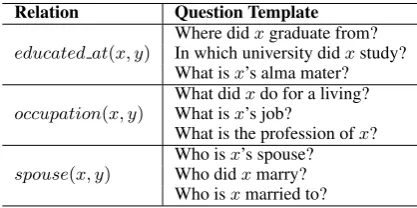
Relation Question Template
educated at(x, y) Where didIn which university didxgraduate from?xstudy? What isx’s alma mater? occupation(x, y) What didWhat isx’s job?xdo for a living?
What is the profession ofx? spouse(x, y) Who isWho didx’s spouse?xmarry?
[image:1.595.311.520.221.325.2]Who isxmarried to?
Figure 1: Common knowledge-base relations de-fined by natural-language question templates.
We show that it is possible to reduce relation ex-traction to the problem of answering simple read-ing comprehension questions. We map each re-lation type R(x, y) to at least one parametrized natural-language question qx whose answer is y.
For example, the relation educated at(x, y) can be mapped to “Where didxstudy?” and “Which university did x graduate from?”. Given a par-ticular entity x (“Turing”) and a text that men-tions x (“Turing obtained his PhD from Prince-ton”), a non-null answer to any of these questions (“Princeton”) asserts the fact and also fills the slot
y. Figure1illustrates a few more examples. This reduction enables new ways of framing the learning problem. In particular, it allows us to perform zero-shot learning: define new rela-tions “on the fly”, after the model has already been trained. More specifically, the zero-shot sce-nario assumes access to labeled data forNrelation types. This data is used to train a reading compre-hension model through our reduction. However, at test time, we are asked about a previously unseen relation typeRN+1. Rather than providing labeled
data for the new relation, we simply list questions that define the relation’s slot values. Assuming we learned a good reading comprehension model, the correct values should be extracted.
Our zero-shot setup includes innovations both
in data and models. We use distant supervision for a relatively large number of relations (120) from Wikidata (Vrandeˇci´c,2012), which are easily gathered in practice via the WikiReading dataset (Hewlett et al., 2016). We introduce a crowd-sourcing approach for gathering and verifying the questions for each relation. This process pro-duced about 10 questions per relation on average, yielding a dataset of over 30,000,000 question-sentence-answer examples in total. Because ques-tions are paired with relation types, not instances, this overall procedure has very modest costs.
The key modeling challenge is that most ex-isting reading-comprehension problem formula-tions assume the answer to the question is always present in the given text. However, for relation ex-traction, this premise does not hold, and the model needs to reliably determine when a question is not answerable. We show that a recent state-of-the-art neural approach for reading comprehension (Seo et al.,2016) can be directly extended to model an-swerability and trained on our new dataset. This modeling approach is another advantage of our re-duction: as machine reading models improve with time, so should our ability to extract relations.
Experiments demonstrate that our approach generalizes to new paraphrases of questions from the training set, while incurring only a minor loss in performance (4% relative F1 reduction). Furthermore, translating relation extraction to the realm of reading comprehension allows us to ex-tract a significant portion of previously unseen re-lations, from virtually zero to an F1 of 41%. Our analysis suggests that our model is able to gen-eralize to these cases by learning typing informa-tion that occurs across many relainforma-tions (e.g. the an-swer to “Where” is a location), as well as detect-ing relation paraphrases to a certain extent. We also find that there are many feasible cases that our model does not quite master, providing an in-teresting challenge for future work.
2 Related Work
We are interested in a particularly harsh zero-shot learning scenario: given labeled examples forN
relation types during training, extract relations of a new typeRN+1at test time. The only information
we have aboutRN+1are parametrized questions.
This setting differs from prior art in relation ex-traction. Bronstein et al.(2015) explore a similar zero-shot setting for event-trigger identification, in
whichRN+1is specified by a set of trigger words
at test time. They generalize by measuring the similarity between potential triggers and the given seed set using unsupervised methods. We focus instead on slot filling, where questions are more suitable descriptions than trigger words.
Open information extraction (open IE) (Banko et al.,2007) is a schemaless approach for extract-ing facts from text. While open IE systems need no relation-specific training data, they often treat different phrasings as different relations. In this work, we hope to extract a canonical slot value in-dependent of how the original text is phrased.
3 Approach
We consider the slot-filling challenge in relation extraction, in which we are given a knowledge-base relation R, an entity e, and a sentence s. For example, consider the relation occupation, the entity “Steve Jobs”, and the sentence “Steve Jobs was an American businessman, inventor, and industrial designer”. Our goal is to find a set of text spans A in s for which R(e, a)
holds for each a ∈ A. In our example, A =
{businessman,inventor,industrial designer}. The empty set is also a valid answer (A = ∅) whens
does not contain any phrase that satisfiesR(e,?). We observe that given a natural-language question
qthat expressesR(e,?)(e.g. “What did Steve Jobs do for a living?”), solving the reading comprehen-sion problem of answeringq fromsis equivalent to solving the slot-filling challenge.
The challenge now becomes one of querifica-tion: translatingR(e,?)intoq. Rather than quer-ifyR(e,?)for every entitye, we propose a method of querifying the relationR. We treateas a vari-able x, querify the parametrized query R(x,?)
(e.g. occupation(x,?)) as a question templateqx
(“What did xdo for a living?”), and then instan-tiate this template with the relevant entities, creat-ing a tailored natural-language question for each entitye(“What didSteve Jobsdo for a living?”). This process,schema querification, is by an order of magnitude more efficient than querifying indi-vidual instances because annotating a relation type automatically annotates all of its instances.
Applying schema querification to N relations from a pre-existing relation-extraction dataset converts it into a reading-comprehension dataset. We then use this dataset to train a reading-comprehension model, which given a sentence s
and a question q returns a set of text spans A
withinsthat answerq(to the best of its ability). In the zero-shot scenario, we are given a new relation RN+1(x, y) at test-time, which was
nei-ther specified nor observed beforehand. For ex-ample, thedeciphered(x, y) relation, as in “Tur-ing and colleagues came up with a method for ef-ficiently deciphering the Enigma”, is too domain-specific to exist in common knowledge-bases. We then querifyRN+1(x, y)intoqx(“Which code did
x break?”) or qy (“Who cracked y?”), and run
our reading-comprehension model for each sen-tence in the document(s) of interest, while instan-tiating the question template with different entities
that might participate in this relation.1 Each time the model returns a non-null answerafor a given questionqe, it extracts the relationRN+1(e, a).
Ultimately, all we need to do for a new rela-tion is define our informarela-tion need in the form of a question.2 Our approach provides a natural-language API for application developers who are interested in incorporating a relation-extraction component in their programs; no linguistic knowl-edge or pre-defined schema is needed. To im-plement our approach, we require two compo-nents: training data and a reading-comprehension model. In Section4, we construct a large relation-extraction dataset and querify it using an efficient crowdsourcing procedure. We then adapt an exist-ing state-of-the-art readexist-ing-comprehension model to suit our problem formulation (Section5).
4 Dataset
To collect reading-comprehension examples as in Figure 2, we first gather labeled examples for the task of relation-slot filling. Slot-filling examples are similar to reading-comprehension examples, but contain a knowledge-base query
R(e,?) instead of a natural-language question; e.g. spouse(Angela Merkel,?) instead of “Who is Angela Merkel married to?”. We collect many slot-filling examples via distant supervision, and then convert their queries into natural language.
Slot-Filling Data We use the WikiReading dataset (Hewlett et al., 2016) to collect labeled slot-filling examples. WikiReading was collected by aligning each Wikidata (Vrandeˇci´c, 2012) re-lation R(e, a) with the corresponding Wikipedia articleDfor the entitye, under the reasonable as-sumption that the relation can be derived from the article’s text. Each instance in this dataset con-tains a relationR, an entitye, a documentD, and an answera. We used distant supervision to se-lect the specific sentences in which eachR(e, a)
manifests. Specifically, we took the first sentence
sinDto contain botheanda. We then grouped instances byR,e, andsto merge all the answers forR(e,?)givensinto one answer setA.
1This can be implemented efficiently by constrain-ing potential entities with existconstrain-ing facts in the knowl-edge base. For example, any entity x that satisfies occupation(x, cryptographer) or any entity yfor which subclass of(y, cipher) holds. We leave the exact imple-mentation details of such a system for future work.
Relation Question Sentence & Answers
educated at What isAlbert Einstein’s alma mater? Albert Einsteinof Z¨urich, with his dissertation titled...was awarded a PhD by theUniversity occupation What didSteve Jobsdo for a living? Steve Jobsandindustrial designerwas an American. businessman,inventor,
[image:4.595.83.520.61.134.2]spouse Who isAngela Merkelmarried to? Angela Merkelchemist and professor’s second and current husband is quantumJoachim Sauer, who has largely...
Figure 2: Examples from our reading-comprehension dataset. Each instance contains a relationR, a questionq, a sentences, and an answer setA. The question explicitly mentions an entitye, which also appears ins. For brevity, answers are underlined instead of being displayed in a separate column.
(1) The wine is produced in theXregion ofFrance.
(2) X, the capital ofMexico, is the most populous city in North America. (3) Xis an unincorporated and organized territory ofthe United States. (4) TheXmountain range stretches acrossthe United StatesandCanada.
Figure 3: An example of the annotator’s input when querifying thecountry(x,?)relation. The annotator is required to ask a question aboutxwhose answer is, for each sentence, the underlined spans.
Schema Querification Crowdsourcing querifi-cation at the schema level is not straightforward, because the task has to encourage workers to (a) figure out the relation’s semantics (b) be lexically-creative when asking questions. We therefore ap-ply a combination of crowdsourcing tactics over two Mechanical Turk annotation phases: collec-tion and verificacollec-tion.
For each relation R, we present the annotator with 4 example sentences, where the entity e in each sentence sis masked by the variable x. In addition, we underline the extractable answersa∈
A that appear ins(see Figure3). The annotator must then come up with a question aboutxwhose answer, given each sentence s, is the underlined span within that sentence. For example, “In which country isx?” captures the exact set of answers for each sentence in Figure3. Asking a more general question, such as “Where isx?” might return false positives (“North America” in sentence 2).
Each worker produced 3 different question tem-plates for each example set. For each relation, we sampled 3 different example sets, and hired 3 different annotators for each set. We ran one in-stance of this annotation phase where the workers were also given, in addition to the example set, the name of the relation (e.g. country), and another instance where it was hidden. Out of a potential 54 question templates, 40 were unique on average. In the verification phase, we measure the ques-tion templates’ quality by sampling addiques-tional sen-tences and instantiating each question template with the example entity e. Annotators are then asked to answer the question from the sentences, or mark it as unanswerable; if the annotators’
an-swers matchA, the question template is valid. We discarded the templates that were not answered correctly in the majority of the examples (6/10).3
Overall, we applied schema querification to 178 relations that had at least 100 examples each (ac-counting for 99.77% of the data), costing roughly $1,250. After the verification phase, we were left with 1,192 high-quality question templates span-ning 120 relations.4 We then join these templates with our slot-filling dataset along relations, instan-tiating each template qx with its matching
enti-ties. This process yields a reading-comprehension dataset of over 30,000,000 examples, where each instance contains the original relation R (unob-served by the machine), a questionq, a sentence
s, and the set of answersA(see Figure2).
Negative Examples To support relation extrac-tion, our dataset deviates from recent reading com-prehension formulations (Hermann et al., 2015;
Rajpurkar et al., 2016), and introduces negative examples – question-sentence pairs that have no answers (A = ∅). Following the methodology of InfoboxQA (Morales et al., 2016), we gener-ate negative examples by matching (for the same entitye) a questionq that pertains to one relation with a sentencesthat expresses another relation. We also assert that the sentence does not contain the answer to q. For instance, we match “Who
3We used this relatively lenient measure because many annotators selected the correct answer, but with a slightly in-correct span; e.g. “American businessman” instead of “busi-nessman”. We therefore used token-overlap F1 as a sec-ondary filter, requiring an average score of at least 0.75.
is Angela Merkel married to?” with a sentence about her occupation: “Angela Merkel is a Ger-man politician who is currently the Chancellor of Germany”. This process generated over 2 million negative examples. While this is a relatively naive method of generating negative examples, our anal-ysis shows that about a third of negative examples contain good distractors (see Section7).
Discussion Some recent QA datasets were col-lected by expressing knowledge-base assertions in natural language. The Simple QA dataset (Bordes et al., 2015) was created by annotat-ing questions about individual Freebase facts (e.g.educated at(T uring, P rinceton)), collect-ing roughly 100,000 natural-language questions to support QA against a knowledge graph. Morales et al. (2016) used a similar process to collect questions from Wikipedia infoboxes, yielding the 15,000-example InfoboxQA dataset. For the task of identifying predicate-argument structures, QA-SRL (He et al., 2015) was proposed as an open schema for semantic roles, in which the rela-tion between an argument and a predicate is ex-pressed as a natural-language question containing the predicate (“Where was someone educated?”) whose answer is the argument (“Princeton”). The authors collected about 19,000 question-answer pairs from 3,200 sentences.
In these efforts, the costs scale linearly in the number of instances, requiring significant invest-ments for large datasets. In contrast, schema quer-ification can generate an enormous amount of data for a fraction of the cost by labeling at the rela-tion level; as evidence, we were able to gener-ate a dataset 300 times larger than Simple QA. To the best of our knowledge, this is the first ro-bust method for collecting a question-answering dataset by crowd-annotating at the schema level.
5 Model
Given a sentencesand a questionq, our algorithm either returns an answer span5awithins, or indi-cates that there is no answer.
The task of obtaining answer spans to natural-language questions has been recently studied on the SQuAD dataset (Rajpurkar et al.,2016;Xiong et al.,2016;Lee et al.,2016;Wang et al.,2016). In SQuAD, every question is answerable from the 5While our problem definition allows for multiple answer spans per question, our algorithm assumes a single span; in practice, less than 5% of our data has multiple answers.
text, which is why these models assume that there exists a correct answer span. Therefore, we mod-ify an existing model in a way that allows it to decide whether an answer exists. We first give a high-level description of the original model, and then describe our modification.
We start from the BiDAF model (Seo et al.,
2016), whose input is two sequences of words: a sentence sand a questionq. The model predicts the start and end positionsystart,yend of the
an-swer span ins. BiDAF uses recurrent neural net-works to encode contextual information within s
andq alongside an attention mechanism to align parts ofqwithsand vice-versa.
The outputs of the BiDAF model are the con-fidence scores of ystart and yend, for each
po-tential start and end. We denote these scores as
zstart,zend ∈ RN, where N is the number of
words in the sentence s. In other words, zstart i
indicates how likely the answer is to start at posi-tioniof the sentence (the higher the more likely); similarly, zend
i indicates how likely the answer
is to end at that index. Assuming the answer exists, we can transform these confidence scores into pseudo-probability distributions pstart,pend
via softmax. The probability of each i-to-j-span of the context can therefore be defined by:
P(a=si...j) =pstarti pendj (1)
wherepi indicates the i-th element of the vector pi, i.e. the probability of the answer starting at i.
Seo et al.(2016) obtain the span with the highest probability during post-processing.
To allow the model to signal that there is no answer, we concatenate a trainable bias b to the end of both confidences score vectorszstart,zend.
The new score vectors ˜zstart,˜zend ∈ RN+1 are
defined as ˜zstart = [zstart;b] and similarly for ˜
zend, where[; ]indicates row-wise concatenation.
Hence, the last elements of˜zstartand˜zendindicate
the model’s confidence that the answer has no start or end, respectively. We apply softmax to these augmented vectors to obtain pseudo-probability distributions, p˜start,p˜end. This means that the
probability the model assigns to a null answer is:
P(a=∅) = ˜pstartN+1p˜endN+1. (2)
IfP(a = ∅) is higher than the probability of the best span, arg maxi,j≤NP(a = si...j), then the
enables the model to be sensitive to the absolute values of the raw confidence scores zstart,zend.
We are essentially setting and learning a thresh-oldbthat decides whether the model is sufficiently confident of the best candidate answer span.
While this threshold provides us with a dynamic per-example decision of whether the instance is answerable, we can also set a global confidence thresholdpmin; if the best answer’s confidence is
below that threshold, we infer that there is no an-swer. In Section6.3we use this global threshold to get a broader picture of the model’s performance.
6 Experiments
To understand how well our method can generalize to unseen data, we design experiments for unseen entities (Section 6.1), unseen question templates (Section6.2), and unseen relations (Section6.3).
Evaluation Metrics Each instance is evaluated by comparing the tokens in the labeled answer set with those of the predicted span.6 Precision is the true positive count divided by the number of times the system returned a non-null answer. Recall is the true positive count divided by the number of instances that have an answer.
Hyperparameters In our experiments, we ini-tialized word embeddings with GloVe ( Penning-ton et al.,2014), and did not fine-tune them. The typical training set was an order of 1 million ex-amples, for which 3 epochs were enough for con-vergence. All training sets had a ratio of 1:1 pos-itive and negative examples, which was chosen to match the test sets’ ratio.
Comparison Systems We experiment with sev-eral variants of our model. In KB Relation, we feed our model a relation indicator (e.g. R17)
instead of a question. We expect this variant to generalize reasonably well to unseen entities, but fail on unseen relations. The second variant (NL Relation) uses the relation’s name (as a natural-language expression) instead of a question (e.g.
educated atas “educated at”). We also consider a weakened version of our querification approach (Single Template) where, during training, only one question template per relation is observed. The full variant of our model, Multiple Templates, is 6We ignore word order, case, punctuation, and articles (“a”, “an”, “the”). We also ignore “and”, which often ap-pears when a single span captures multiple correct answers (e.g. “United States and Canada”).
trained on a more diverse set of questions. We ex-pect this variant to have significantly better para-phrasing abilities thanSingle Template.
We also evaluate how asking about the same relation in multiple ways improves performance (Question Ensemble). We create an ensemble by sampling 3 questions per test instance and predict-ing the answer for each. We then choose the an-swer with the highest sum of confidence scores.
In addition to our model, we compare three other systems. The first is a random baseline that chooses a named entity in the sentence that does not appear in the question (Random NE). We also reimplement the RNN Labeler that was shown to have good results on the extractive por-tion of WikiReading (Hewlett et al.,2016). Lastly, we retrain an off-the-shelf relation extraction sys-tem (Miwa and Bansal, 2016), which has shown promising results on a number of benchmarks. This system (and many like it) represents relations as indicators, and cannot extract unseen relations.
6.1 Unseen Entities
We show that our reading-comprehension ap-proach works well in a typical relation-extraction setting by testing it on unseen entities and texts.
Setup We partitioned our dataset along entities in the question, and randomly clustered each en-tity into one of three groups: train, dev, or test. For instance, Alan Turing examples appear only in training, while Steve Jobs examples are exclusive to test. We then sampled 1,000,000 examples for train, 1,000 for dev, and 10,000 for test. This parti-tion also ensures that the sentences at test time are different from those in train, since the sentences are gathered from each entity’s Wikipedia article.
Precision Recall F1
[image:7.595.307.524.62.156.2]Random NE 11.17% 22.14% 14.85% RNN Labeler 62.55% 62.25% 62.40% Miwa & Bansal 96.07% 58.70% 72.87% KB Relation 89.08% 91.54% 90.29% NL Relation 88.23% 91.02% 89.60% Single Template 77.92% 73.88% 75.84% Multiple Templates 87.66% 91.32% 89.44% Question Ensemble 88.08% 91.60% 89.80%
Table 1: Performance on unseen entities.
Precision Recall F1
Seen 86.73% 86.54% 86.63% Unseen 84.37% 81.88% 83.10% Table 2: Performance on seen/unseen questions.
comprehension is indeed a viable approach for our Wikipedia slot-filling task.
An analysis of 50 examples thatMultiple Tem-platesmispredicted shows that 36% of errors can be attributed to annotation errors (chiefly missing entries in Wikidata), and an additional 42% result from inaccurate span selection (e.g. “8 February 1985” instead of “1985”), for which our model is fully penalized. In total, only 18% of our sam-ple were pure system errors, suggesting that our model is very close to the performance ceiling of this setting (slightly above 90% F1).
6.2 Unseen Question Templates
We test our method’s ability to generalize to new descriptions of the same relation, by holding out a question template for each relation during training.
Setup We created 10 folds of train/dev/test sam-ples of the data, in which one question template for each relation was held out for the test set, and another for the development set. For instance, “What did x do for a living?” may appear only in the training set, while “What is x’s job?” is exclusive to the test set. Each split was strati-fied by sampling N examples per question tem-plate (N = 1000,10,50 for train, dev, test, re-spectively). This process created 10 training sets of 966,000 examples with matching development and test sets of 940 and 4,700 examples each.
We trained and tested Multiple Templates on each one of the folds, yielding performance on unseen templates. We then replicated the exist-ing test sets and replaced the unseen question tem-plates with temtem-plates from the training set, yield-ing performance on seen templates. Revisityield-ing our example, we convert test-set occurrences of “What isx’s job?” to “What didxdo for a living?”.
Precision Recall F1
Random NE 9.25% 18.06% 12.23%
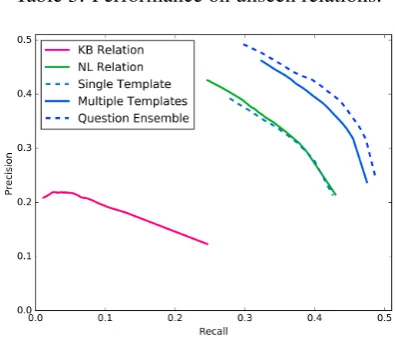
[image:7.595.76.288.62.154.2]RNN Labeler 13.28% 5.69% 7.97% Miwa & Bansal 100.00% 0.00% 0.00% KB Relation 19.32% 2.54% 4.32% NL Relation 40.50% 28.56% 33.40% Single Template 37.18% 31.24% 33.90% Multiple Templates 43.61% 36.45% 39.61% Question Ensemble 45.85% 37.44% 41.11% Table 3: Performance on unseen relations.
Figure 4: Precision/Recall for unseen relations.
Results Table 2 shows that our approach is able to generalize to unseen question templates. Our system’s performance on unseen questions is nearly as strong as for previously observed tem-plates (losing roughly 3.5 points in F1).
6.3 Unseen Relations
We examine a pure zero-shot setting, where test-time relations are unobserved during training.
Setup We created 10 folds of train/dev/test sam-ples, partitioned along relations: 84 relations for train, 12 dev, and 24 test. For example, when
educated atis allocated to test, no educated at
examples appear in train. Using stratified sam-pling of relations, we created 10 training sets of 840,000 examples each with matching dev and test sets of 600 and 12,000 examples per fold.
[image:7.595.317.515.172.341.2]Verbatim Relation
Andr´as Dombaiplays forwhat team?
Andr´as Dombai... ...currentlyplaysas a goalkeeperforFC Tatab´anya.
Type WhichRoyal Jordanian Airlines... ...from its main base atairportis most closely associated with Royal Jordanian?Queen Alia InternationalAirport...
Global Relation
Who was responsible fordirectingLes petites fugues?
Les petites fugues is a 1979 Swiss comedy filmdirected byYves Yersin. Type WhenThe Snow Hawk is awas The Snow Hawk released?1925film...
Specific Relation
WhostartedF¨urstenberg China?
[image:8.595.96.508.58.193.2]The F¨urstenberg China Factorywas founded... ...byJohann Georg von Langen... Type What´Etienne Lainez... ...was a French operaticvoice typedoes ´Etienne Lainez have?tenor...
Figure 5: The different types of discriminating cues we observed among positive examples.
some generalization. The difference between us-ing a sus-ingle question template (Single Template) and the relation’s name (NL Relation) appears to be minor. However, training on a variety of ques-tion templates (Multiple Templates) substantially increases performance. We conjecture that mul-tiple phrasings of the same relation allows our model to learn answer-type paraphrases that oc-cur across many relations (see Section7). There is also some advantage to having multiple questions at test time (Question Ensemble).
7 Analysis
To understand how our method extracts unseen relations, we analyzed 100 random examples, of which 60 had answers in the sentence and 40 did not (negative examples).
For negative examples, we checked whether a distractor – an incorrect answer of the correct an-swer type – appears in the sentence. For exam-ple, the question “Who is John McCain married to?” does not have an answer in “John McCain chose Sarah Palin as his running mate”, but “Sarah Palin” is of the correct answer type. We noticed that 14 negative examples (35%) contain distrac-tors. When pairing these examples with the re-sults from the unseen relations experiment in Sec-tion6.3, we found that our method answered 2/14 of the distractor examples incorrectly, compared to only 1/26 of the easier examples. It appears that while most of the negative examples are easy, a significant portion of them are not trivial.
For positive examples, we observed that some instances can be solved by matching the relation in the sentence to that in the question, while oth-ers rely more on the answer’s type. Moreover, we notice that each cue can be further categorized ac-cording to the type of information needed to detect it: (1) when part of the question appears
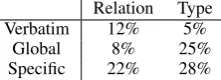
verba-Relation Type Verbatim 12% 5%
Global 8% 25%
[image:8.595.362.473.231.271.2]Specific 22% 28%
Table 4: The distribution of cues by type, based on a sample of 60.
Relation Type Verbatim 43% 33%
Global 60% 73%
[image:8.595.362.473.318.358.2]Specific 46% 18%
Table 5: Our method’s accuracy on subsets of ex-amples pertaining to different cue types. Results initalicsare based on a sample of less than 10.
tim in the text, (2) when the phrasing in the text deviates from the question in a way that is typi-cal of other relations as well (e.g. syntactic vari-ability), (3) when the phrasing in the text deviates from the question in a way that is unique to this relation (e.g. lexical variability). We name these categories verbatim, global, andspecific, respec-tively. Figure5illustrates all the different types of cues we discuss in our analysis.
We selected the most important cue for solv-ing each instance. If there were two important cues, each one was counted as half. Table 4
shows their distribution. Type cues appear to be somewhat more dominant than relation cues (58% vs. 42%). Half of the cues are relation-specific, whereas global cues account for one third of the cases and verbatim cues for one sixth. This is an encouraging result, because we can potentially learn to accurately recognize verbatim and global cues from other relations. However, our method was only able to exploit these cues partially.
Templates setting. On one hand, the model ap-pears agnostic to whether the relation cue is verba-tim, global, or specific, and is able to correctly an-swer these instances with similar accuracy (there is no clear trend due to the small sample size). For examples that rely on typing information, the trend is much clearer; our model is much better at de-tecting global type cues than specific ones.
Based on these observations, we think that the primary sources of our model’s ability to gener-alize to new relations are: global type detection, which is acquired from training on many different relations, and relation paraphrase detection (of all types), which probably relies on its pre-trained word embeddings.
8 Conclusion
We showed that relation extraction can be reduced to a reading comprehension problem, allowing us to generalize to unseen relations that are defined on-the-fly in natural language. However, the prob-lem of zero-shot relation extraction is far from solved, and poses an interesting challenge to both the information extraction and machine reading communities. As research into machine reading progresses, we may find that more tasks can bene-fit from a similar approach. To support future work in this avenue, we make our code and data publicly available.7
Acknowledgements
The research was supported in part by DARPA under the DEFT program (FA8750-13-2-0019), the ARO (W911NF-16-1-0121), the NSF (IIS-1252835, IIS-1562364), gifts from Google, Ten-cent, and Nvidia, and an Allen Distinguished In-vestigator Award. We also thank Mandar Joshi, Victoria Lin, and the UW NLP group for helpful conversations and comments on the work.
References
Michele Banko, Michael J. Cafarella, Stephen Soderland, Matt Broadhead, and Oren Et-zioni. 2007. Open information extraction from the web. In Proceedings of the 20th Interna-tional Joint Conference on Artifical Intelligence. Morgan Kaufmann Publishers Inc., San Fran-cisco, CA, USA, IJCAI’07, pages 2670–2676. http://dl.acm.org/citation.cfm?id=1625275.1625705.
7http://nlp.cs.washington.edu/zeroshot
Antoine Bordes, Nicolas Usunier, Sumit Chopra, and Jason Weston. 2015. Large-scale simple question answering with memory networks. arXiv preprint arXiv:1506.02075.
Ofer Bronstein, Ido Dagan, Qi Li, Heng Ji, and Anette Frank. 2015. Seed-based event trigger labeling: How far can event descriptions get us? In Proceed-ings of the 53rd Annual Meeting of the Association for Computational Linguistics and the 7th Interna-tional Joint Conference on Natural Language Pro-cessing (Volume 2: Short Papers). Association for Computational Linguistics, Beijing, China, pages 372–376. http://www.aclweb.org/anthology/P15-2061.
Thomas Demeester, Tim Rockt¨aschel, and Sebas-tian Riedel. 2016. Lifted rule injection for re-lation embeddings. In Proceedings of the 2016 Conference on Empirical Methods in Natural Language Processing. Association for Computa-tional Linguistics, Austin, Texas, pages 1389–1399. https://aclweb.org/anthology/D16-1146.
Luheng He, Mike Lewis, and Luke Zettlemoyer. 2015. Question-answer driven semantic role la-beling: Using natural language to annotate natu-ral language. In Proceedings of the 2015 Con-ference on Empirical Methods in Natural Lan-guage Processing. Association for Computational Linguistics, Lisbon, Portugal, pages 643–653. http://aclweb.org/anthology/D15-1076.
Karl Moritz Hermann, Tom´aˇs Koˇcisk´y, Edward Grefenstette, Lasse Espeholt, Will Kay, Mustafa Suleyman, and Phil Blunsom. 2015. Teach-ing machines to read and comprehend. In Ad-vances in Neural Information Processing Systems. http://arxiv.org/abs/1506.03340.
Daniel Hewlett, Alexandre Lacoste, Llion Jones, Illia Polosukhin, Andrew Fandrianto, Jay Han, Matthew Kelcey, and David Berthelot. 2016. Wikireading: A novel large-scale language understanding task over wikipedia. InProceedings of the Conference of the Association for Computational Linguistics.
Raphael Hoffmann, Congle Zhang, Xiao Ling, Luke Zettlemoyer, and Daniel S Weld. 2011. Knowledge-based weak supervision for information extraction of overlapping relations. InProceedings of the 49th Annual Meeting of the Association for Computa-tional Linguistics: Human Language Technologies-Volume 1. Association for Computational Linguis-tics, pages 541–550.
Kenton Lee, Tom Kwiatkowski, Ankur Parikh, and Di-panjan Das. 2016. Learning recurrent span repre-sentations for extractive question answering. arXiv preprint arXiv:1611.01436.
of the North American Chapter of the Associa-tion for ComputaAssocia-tional Linguistics: Human Lan-guage Technologies. Association for Computational Linguistics, San Diego, California, pages 897–906. http://www.aclweb.org/anthology/N16-1104. Makoto Miwa and Mohit Bansal. 2016.End-to-end
re-lation extraction using lstms on sequences and tree structures. InProceedings of the 54th Annual Meet-ing of the Association for Computational LMeet-inguistics (Volume 1: Long Papers). Association for Compu-tational Linguistics, Berlin, Germany, pages 1105– 1116.http://www.aclweb.org/anthology/P16-1105. Alvaro Morales, Varot Premtoon, Cordelia Avery, Sue
Felshin, and Boris Katz. 2016. Learning to answer questions from wikipedia infoboxes. In Proceed-ings of the 2016 Conference on Empirical Meth-ods in Natural Language Processing. Association for Computational Linguistics, Austin, Texas, pages 1930–1935. https://aclweb.org/anthology/D16-1199.
Jeffrey Pennington, Richard Socher, and Christopher Manning. 2014. Glove: Global vectors for word representation. In Proceedings of the 2014 Con-ference on Empirical Methods in Natural Language Processing (EMNLP). Association for Computa-tional Linguistics, Doha, Qatar, pages 1532–1543. http://www.aclweb.org/anthology/D14-1162. P. Rajpurkar, J. Zhang, K. Lopyrev, and P. Liang. 2016.
Squad: 100,000+ questions for machine comprehen-sion of text. InProceedings of the Conference of the Empirical Methods in Natural Language Process-ing.
Sebastian Riedel, Limin Yao, Andrew McCallum, and Benjamin M. Marlin. 2013. Relation ex-traction with matrix factorization and universal schemas. In Proceedings of the 2013 Confer-ence of the North American Chapter of the As-sociation for Computational Linguistics: Human Language Technologies. Association for Computa-tional Linguistics, Atlanta, Georgia, pages 74–84. http://www.aclweb.org/anthology/N13-1008. Tim Rockt¨aschel, Sameer Singh, and Sebastian
Riedel. 2015. Injecting logical background knowledge into embeddings for relation extrac-tion. In Proceedings of the 2015 Conference of the North American Chapter of the Associa-tion for ComputaAssocia-tional Linguistics: Human Lan-guage Technologies. Association for Computational Linguistics, Denver, Colorado, pages 1119–1129. http://www.aclweb.org/anthology/N15-1118. Minjoon Seo, Aniruddha Kembhavi, Ali Farhadi, and
Hannaneh Hajishirzi. 2016. Bidirectional attention flow for machine comprehension. arXiv preprint arXiv:1611.01603.
Kristina Toutanova, Danqi Chen, Patrick Pantel, Hoi-fung Poon, Pallavi Choudhury, and Michael Ga-mon. 2015. Representing text for joint embedding
of text and knowledge bases. In Proceedings of the 2015 Conference on Empirical Methods in Nat-ural Language Processing. Association for Compu-tational Linguistics, Lisbon, Portugal, pages 1499– 1509.http://aclweb.org/anthology/D15-1174. Patrick Verga, Arvind Neelakantan, and Andrew
Mc-Callum. 2017. Generalizing to unseen entities and entity pairs with row-less universal schema. In Pro-ceedings of the 15th Conference of the European Chapter of the Association for Computational Lin-guistics: Volume 1, Long Papers. Association for Computational Linguistics, Valencia, Spain, pages 613–622. http://www.aclweb.org/anthology/E17-1058.
Denny Vrandeˇci´c. 2012. Wikidata: A new platform for collaborative data collection. InProceedings of the 21st international conference companion on World Wide Web. ACM, pages 1063–1064.
Zhiguo Wang, Haitao Mi, Wael Hamza, and Radu Florian. 2016. Multi-perspective context match-ing for machine comprehension. arXiv preprint arXiv:1612.04211.