Munich Personal RePEc Archive
Technology and persistence in global
software piracy
Asongu, Simplice and Meniago, Christelle
January 2018
Online at
https://mpra.ub.uni-muenchen.de/91532/
A G D I Working Paper
WP/18/041
Technology and persistence in global software piracy
Forthcoming in NETNOMICS: Economic Research and Electronic Networking
Simplice A. Asongu
Development Finance Centre, Graduate School of Business, University of Cape Town, Cape Town, South Africa.
&
Department of Economics & Development Studies, Covenant University, Ota, Ogun State, Nigeria
E-mails: [email protected] / [email protected]
Christelle Meniago
School of Economics and Management Sciences, Sol Plaatje University, South Africa
2018 African Governance and Development Institute WP/18/041
Research Department
Technology and persistence in global software piracy
Simplice A. Asongu & Christelle Meniago
January 2018
Abstract
This study examines the persistence of software piracy with internet penetration vis-à-vis of PC
users, conditional on Intellectual Property Rights (IPRs) institutions. The empirical evidence is
based on a panel of 99 countries for the period 1994-2010 and the Generalised Method of
Moments. The main finding is that, compared to internet penetration, PC usage is more
responsible for the persistence of global software piracy. Knowing how technology affects the
persistence of piracy is important because it enables more targeted policy initiatives. We show
that the sensitivity of software piracy to IPRs mechanisms is contingent on the specific
technology channels through which the pirated software is consumed.
JEL Classification: F42; K42; O34; O38; O57
Keywords: Piracy; Business Software; Software piracy; Intellectual Property Rights
1. Introduction
There are two main motivations for the positioning of our inquiry on technology and persistence
in global software piracy, notably: the growing role of the knowledge economy (KE) in the 21st
century development and the gaps in the literature on fighting global software piracy. There is a
broad consensus in the position that a key driver of contemporary global economic development
is KE: a phenomenon that is essential in competitive economic development because it
represents policies associated with the production and distribution of knowledge for economic
An essential factor of competition is the degree to which Intellectual Property Rights
(IPRs) and Intellectual Property (IP) are consolidated within an economy1. It follows that
mechanisms of IPRs and IP protection play a key role in competition needed for KE in
cross-country comparative economic development of nations in the world2. The underlying linkages
are relevant in the perspective that IPRs and IP are closely connected to the four dimensions of
the World Bank’s KE index, namely: information and communication technology (ICT), economic incentives and institutional regime, innovation and education (Asongu, 2014a)3.
Accordingly, IPRs and IP laws affect the production and distribution of knowledge. When they
are less stringent, they limit the production of knowledge but increase the distribution of the
knowledge. This is essentially because less tight IP limits incentives to knowledge production
because those producing such knowledge do not have enough incentives to continue innovating
because they are not sufficiently compensated through the protection of their attendant IPRs.
Conversely, when such IPRs and IP laws are more stringent, they increase the production of
knowledge and limit the distribution of such knowledge. This is also because of limited
distribution owing to the fact that upholding IPRs restrict the distribution of knowledge
exclusively to those in society who can afford to pay in order to benefit from the knowledge.
Hence, the nature of IPRs and IP laws is closely associated with KE because KE is how a society
benefits from the way knowledge is produced and distributed for economic development.
In light of the above, the importance of KE today extends a relevant debate on the
essence of IPRs in the development process. Whereas there is some consensus in the literature
that the tightness or stringency of IPRs should move hand-in-hand with economic development,
some scholars still maintain that strict IPRs are core in the transition from developing to
developed countries (Mansfield,1994; Maskus & Penubarti, 1995; Seyoum, 1996; Lee &
Mansfield, 1996). To put the argument into more perspective, there is a broad stream of literature
1
This assertion may be true sometimes, but not always as manifested in the rise of the competitive Chinese economy, which has a poor record of intellectual property protection (Ang et al., 2014).
2
The IPRs channels include: inclusion of property rights in a country’s constitution, IPR law, main IP law, World Intellectual Property Rights Organization (WIPO) treaties, bilateral treaties and multilateral treaties.
3
maintaining that in order to enhance catch-up processes of development, reverse engineering in
developing countries is important, at least in the short run. The argument essentially builds on
the reality that technology in less developed countries is more adaptive and imitative in nature
(Maskus & Penubarti, 1995; Mansfield 1994; Seyoum, 1996; Lee & Mansfield, 1996)4. This has
motivated the proliferation of technologies that are employed to pirate, imitate and copy KE
commodities (Asongu et al., 2019). Upon reviewing contemporary literature on the subject,
while there are considerably and justifiable issues surrounding software piracy5, a consensus is
lacking in the debate on the consolidation of IPRs in the industry of software.
Central to the debate on IPRs protection are two main schools of thought. The first school
maintains that adherence to tight IPRs encourage economic progress and development catch-up
(Gould & Gruben 1996; Falvey et al., 2006). The school argues that the positive relationship
between tight IPRs and economic development is facilitated by the positive externalities of strict
IPRs on factors of productivity. In other words, the school maintains that stringent IPRs
encourage innovation and improvements in total factor productivity because IPRs holders are
provided with more incentives to innovate and produce new knowledge. It is also important to
note that while the first school favors the production of knowledge, it reduces the smooth
distribution of knowledge produced. This is essentially because stringent IPRs discourage
replication and innovation that are essential for the dissemination of existing innovation and
knowledge for economic development. Conversely, the second school perceives the adoption of
stringent IPRs as unfavorable to economic progress and development catch-up (Yang & Maskus,
2001; Andrés & Goel 2011, 2012). The argument which extends to the ratification of
international IPRs and IP treaties is relative to the short-run because, the narratives in support of
the school of thought maintain that strict IPRs are needed to discourage complacency in
innovation as economic development is gradually achieved. According to this school, while
stringent IPRs are essential to encourage innovation, the period during which exclusive IPRs are
held by innovators should be short in order to enable society to benefit from free acquisition and
4
According to this strand of the literature, more stringent regimes in IPRs regimes should be adopted as nations make the transition from ‘developing countries’ to ‘developed countries’. Such strict IPRs regimes are likely to,
inter alia: (i) favour technology transfer and innovation (Lee & Mansfield, 1996); (ii) boost exports (Maskus & Penubarti, 1995) and (iii) increase the possibility of investments from multinational corporations (see Mansfield, 1994; Seyoum, 1996). This is also broadly consistent with a recent stream of literature on relevance of ICT on development outcomes in developing countries (Afutu-Kotey et al., 2017; Asongu & Boateng, 2018; Bongomin et al., 2018; Gosavi, 2018; Hubani & Wiese, 2018; Isszhaku et al., 2018; Minkoua Nzie et al., 2018; Muthinja & Chipeta, 2018; Abor et al., 2018 ).
distribution of knowledge once the period of exclusive IP is over. The perspective supported by
this school is consistent with contemporary software piracy literature notably that software
piracy boosts: copyright holders’ gains (Tunca & Wu, 2012); scientific publications (Asongu,
2014a) and pro-poor development (Asongu, 2014b). The two schools of thought are apparent in
both qualitative literature on the relevance of IPRs protection (Peitz & Waelbroeck, 2006; Lau,
2006) and a growing stream of literature on drivers of piracy in the copyright industry (Andrés,
2006a; Bezmen & Depken, 2006; Banerjee et al., 2005; Bezmen & Depken, 2004; Goel &
Nelson, 2009).
More contemporary literature on the fight against piracy in the software industry can be
discussed in three main strands. The first deals with non-legal mechanisms by which software
piracy can be mitigated, namely: community engagements, online-only, ‘making legal easier’
and digital rights management channels (Holm, 2014); self-control and social learning (Burruss
et al., 2018; Omar & Ahmed, 2018) and a block chain approach (Bhawna et al., 2018). In the
second, we find studies on common strategies for the harmonization of IPRs against software
piracy (Asongu, 2013a; Andrés & Asongu, 2016). The third focuses on other mechanisms
through which piracy can be curbed, namely: (i) good governance (Andrés & Asongu, 2013a);
(ii) good institutions and human progress (Driouchi et al., 2015); (iii) Software User Identity
Module (Adu et al., 2014); (iv) perceptions of equity and fairness (Glass & Wood, 1996;
Douglas et al., 2007); (v) informal institutions like religion (El-Baily & Gouda, 2011); (vi)
lawsuits targeting peer-to-peer networks and corresponding customers (Tunca 2012); (vii)
knowledge about punishment at stake (Yoo et al., 2011); (viii) democratic standards (Piquero &
Piquero, 2006) and (ix) IPRs protection channels (Asongu et al., 2018), especially those that are
contingent on codes of knowledge ethics in learning institutions (Santillanes & Felder, 2015) and
legal origins (Asongu, 2015). It is important to note that the above strands also entail: (i) the
relevance of behaviour, psychology and norms; (ii) the influence of easy availability and utility
of software tools that facilitate piracy and (iii) the influence of easy availability and utility of
software tools that facilitate piracy.
Noticeably, the above literature leaves space for improvement in understanding the role
of technology in the persistence of software piracy. Knowing how technology affects the
persistence of piracy is important because it enables more targeted policy initiatives on
technology with which less pirated software is used. Two main technologies are employed in this
study, namely: internet penetration and PC users. Therefore, the research question this inquiry
seeks to address is the following: are PC users or internet penetration more responsible for the
persistence of piracy in the software industry?
The theoretical underpinnings of persistence in software piracy are in line with the
convergence literature which has been considerably documented within the framework of
neoclassical models of growth (Swan, 1956; Barro, 1991; Solow, 1956; Baumol, 1986; Mankiw
et al., 1992; Barro & Sala-i-Martin, 1992, 1995) and recently extended to other fields of
economic development, notably: financial markets (Fung, 2009; Narayan et al., 2011; Bruno et
al., 2012); human development (Mayer-Foulkes, 2010; Asongu, 2014c) and software piracy
(Andrés & Asongu, 2013b, 2016). Convergence in software piracy that is contingent on
technology adoption and IPRs can be expected for a multitude of reasons, inter alia: (i) the
migration of experts and training of workers and students abroad (Kim & Nelson, 2000; Mowery
& Sampat, 2005; Morrison et al., 2009); (ii) the changing nature of science and technology
(D’Este & Patel, 2007; Mazzoleni & Nelson, 2007) which is facilitating cross-country collaboration and (iii) the phenomenon of globalization which is enhancing cross-country
diffusion of knowledge (see Asongu & Nwachukwu, 2016a). In summary, there is a wealth of
literature on KE catch-up and/or persistence (Esler & Nelson 1998; Albuquerque, 2000; Jelili &
Jellal, 2002; Wolff & Jellal, 2003; Mowery & Sampat 2005; Murray & Stern, 2005; Mazzoleni,
2008).
It is important to articulate why the internet and Personal Computers (PCs) are the
adopted mechanisms of technology in this study on the one hand and on the other, which of the
mechanisms is theoretically projected to be more influential. The indicator of software piracy is
measured based on pirated software installed in PCs and the internet is a mechanism through
which pirated software can be downloaded and distributed. It is anticipated that software piracy
is more persistent through PCs compared to the internet because, as apparent in the next section,
the conception and definition of software piracy is directly linked to the installation of pirated
software in PCs.
The rest of the study is structured as follows. Section 2 discusses the data and
methodology while Section 3 presents the empirical results. Section 4 concludes with
2. Data and Methodology
2.1 Data
This inquiry examines a sample of 99 countries with data from three main sources,
namely from the: World Intellectual Property Organisation (WIPO); Business Software Alliance
(BSA) and World Bank Development Indicators (WDI). The periodicity is from 1994 to 2010.
Restrictions to the number of countries and periodicity are essentially due to constraints in data
availability at the time of the study.
The outcome indicator which is pirated software is defined as “the unauthorized copying
of computer software which constitutes copyright infringement for either commercial or personal
use” (SIIA, 2000)6. From a multidimensional spectrum, software piracy can be understood as
organised individuals’ piracy and commercial or business piracy. There are three main types of
software piracy, namely: counterfeiting, downloading and end-user copying. In the light of these
differences in the conception of software piracy, the concern about deriving an appropriate
indicator of software piracy has been longstanding in the literature. The present study defines
software piracy as the variation between the demand for new software applications (which are
computed on the basis of PC shipments) and software piracy that is actually supplied legally.
Therefore, pirated software is measured as the percentage of software that is illegally installed
annually (without a license) in a given country. The underlying variable ranges from 0% (a
scenario of no piracy) to 100% (a scenario where all software installed is of pirated origin). More
insights into information on the measurement of software piracy can be found in BSA (2007,
2009)7. Though it is the object of some upward bias, software piracy data from BSA has been
widely employed in the literature8.
Given that we are modeling the persistence of software piracy, our independent variable
of interest is the estimated lagged value of software piracy. Three sets of independent variables
are employed, notably: (i) technology indicators, (ii) IPRs laws and treaties and (iii)
macroeconomic variables
6
SIIA stands for Software and Information Industry Association.
7
For the most part, data from the BSA measures commercial software piracy. More insights into the reliability of the piracy data are available in the wealth of literature on the subject inter alia: Traphagan and Griffith (1998) and Png (2008).
8
First, two variables of technology are adopted, namely: internet penetration and the
number of Personal Computers (PCs). Whereas the choice of PCs is in accordance with the
definition of software piracy, internet penetration is consistent with both intuition and recent KE
literature (Tchamyou, 2017). The justification of this choice of technology variables has been
provided in the penultimate paragraph of the introduction.
Second, the study considers six IPRs channels, namely: constitution, IPR law, main IP
law, WIPO treaties, bilateral treaties and multilateral treaties. The choice of the variables is in
line with the literature on the close linkage between IPRs laws and software piracy, which also
embodies international treaties and legal frameworks (Holm, 2003; Andrés, 2006a; Van
Kranenburg & Hogenbirk, 2005; Ki et al., 2006; Baghci et al., 2006; Asongu, 2013; Driouchi et
al., 2015; Andrés & Asongu, 2016). The source of the IPRs indicator is the WIPO. The IP law
and main IP law are laws that are enacted by the legislature and enforced by governance
institutions while WIPO administered treaties are considered from the day they are enforced by
the contracting nations. The relevant multilateral and bilateral agreements or treaties are
computed in accordance with the day that they are enforced by the contracting parties. The main
rationale for the inclusion of IPRs channels in the conditioning information set is that these are
logically designed to enhance IPRs and by extension, the enhancement of IPRs entails the fight
against software piracy. The choice of these IPRs control variable is consistent with recent
literature (Asongu, 2015).
Third, three macroeconomic variables are also considered, namely: Population density,
Gross Domestic Product (GDP) and Research and Development (R& D) expenditure. The choice
of these variables is in line with recent literature on software piracy (see Andrés & Goel, 2011,
pp. 7-8; Asongu et al., 2018b). Whereas the last two are anticipated to reduce software piracy,
the first intuitively has the opposite effect. In essence, nations reflecting higher levels of GDP
per capita are linked with relatively lower software piracy levels. This is for the most part
because in less developed nations, citizens often lack the financial resources to buy the
correct/legal software (Goel & Nelson, 2009; Moores & Esichaikul, 2011). The narrative of this
expected sign also doubles as a justification for the anticipated impact of R&D. This is
essentially because nations with high R&D expenditure are also likely to be comparatively
wealthier nations. On the grounds of intuition, a growing population is very likely to be
tempted to use pirated goods and services. It is important to note that this intuition is contingent
on the stringency of IPRs laws and effectiveness of institutions. For instance, rates of piracy are
much higher in Russia, which has a declining population than in the United States, which has a
growing population. Beyond the rationales and intuition provided, the adopted control variables
have been used in recent literature on the determinants of software piracy (Asongu et al., 2018b).
Appendix 1 provides definitions of variables as well as their corresponding sources. The
number of sampled countries is also disclosed in the appendix. The summary statistics and
correlation matrix are respectively disclosed in Appendix 2 and Appendix 3. From the summary
statistics, it is apparent that the variables under investigation are comparable. Moreover, given
the variations in the corresponding standard deviations, we can be confident that reasonable
estimated linkages will emerge. The purpose of the correlation matrix is to avoid concerns of
multicollinearity that can affect the signs of estimated coefficients.
2.2 Methodology
2.2.1Generalized method of moments: justification and specification
In accordance with information development literature on persistence (Asongu &
Nwachukwu, 2017), the empirical strategy is the Generalized Method of Moments (GMM).
There are six main motivations underpinning the adoption of the estimation technique. The first
is related to the line of inquiry, the second and third are requirements of the approach while the
last three are advantages that are linked to the estimation strategy. First and foremost, the
technique is consistent with the estimation of persistence because it is a dynamic process that
involves the lagged dependent variable (Tchamyou et al., 2018). Second, the N(99)>T(17)
criterion which is essential for applying the estimation technique is met because the number of
cross sections (or countries) are substantially higher than the related number of years in each
cross section (Efobi et al., 2018). Third, an exploratory analysis of the dependent variable reveals
some evidence of persistence because the correlation between software piracy and its first lag
(0.981) is above the 0.800 rule of thumb (Asongu et al., 2018c). Fourth, since the GMM strategy
is in line with panel data structure, cross-country variations are included in the regressions
(Arellano & Bover, 1995). Fifth, inherent biases in the difference estimator are considered in the
system estimator (Blundell & Bond, 1998). Sixth, endogeneity is accounted-for by the estimation
instrumentation process (Roodman, 2009a,b). Moreover, the employment of time-invariant
omitted indicators also improves the control for endogeneity.
Consistent with Bond et al. (2001), the system GMM estimator (see Arellano & Bover,
1995; Blundell & Bond, 1998) has better properties of estimation compared to the difference
estimator (see Arellano & Bond, 1991). In this inquiry, we opt for the Roodman (2009ab)
extension of Arellano and Bover (1995) because it has been documented to: (i) limit instrument
proliferation or restrict over-identification and (ii) control for cross-sectional dependence (see
Love & Zicchino, 2006; Baltagi, 2008; Boateng et al., 2018). Hence, instead of adopting first
differences, the extended estimation procedure adopts forward orthogonal deviations.
A two-step procedure is adopted instead of a one-step approach because it addresses
concerns of heteroscedasticity given that the one-step procedure only controls for
homoscedasticity. The following equations in level (1) and first difference (2) summarise the
standard system GMM estimation procedure.
t i t i t i h h h t i t i t i t i t
i SP T IP TIP W
SP ,, ,
3 1 , 4 , 3 , 2 , 1 0 ,
(1)( ) ( ) ( ) ) ( ) ( ) ( ) ( 1 , , 2 , , , , 3 1 , , 4 , , 3 , , 2 2 , , 1 , ,
hit hit t t it ith h t i t i t i t i t i t i t i t i t i t i W W TIP TIP IP IP T T SP SP SP SP
, (2)
where, SPi,t is software piracy of country i in period t, is a constant, represents the coefficient of auto-regression, t is the time-specific constant, Ti,t represents the technology (PC
users and internet penetration) of country i in period t, IPi,t denotes intellectual property mechanisms (constitution, IPR law, main IP law, WIPO treaties, bilateral treaties and
multilateral treaties) of country i in period t, TIPi,tis the interaction between T(technology)
and IP (intellectual property mechanism) of country i in period t, Wi,tcaptures the vector of
control variables (GDP per capita, R&D expenditure and Population density) of country i in
period t, i is the country-specific effects and i,t is the error term. The specification which is
based on interactive regressions is also designed to articulate the fact that the sensitivity of
software piracy to IPRs mechanisms is contingent on the specific technology channel through
2.2.2 Identification and exclusion restrictions
Discussing properties of identification and articulating exclusion restrictions are
important for a good specification GMM. Consistent with recent literature on the technique, all
independent variables are acknowledged as suspected endogenous or predetermined indicators
and only time-invariant omitted variables or year indicator are considered to exhibit strict
exogeneity (see Boateng et al., 2018; Asongu & Nwachukwu, 2016b; Tchamyou, 2018;
Tchamyou & Asongu, 2017). The intuition for the underlying builds on the fact that it is not
likely for the time-invariant omitted variables to become endogenous upon a first difference
(Roodman, 2009)9.
With the above in mind, the time-invariant omitted variables impact software piracy
exclusive through the predetermined variables. Furthermore, the statistical validity of the
exclusion restriction is examined with the Difference in Hansen Test (DHT) for instrument
exogeneity. Accordingly, the alternative hypothesis of the DHT should not be accepted for the
time-invariant omitted variables to explain the outcome variable exclusively via the
predetermined indicators. Hence, in the results that are reported in Section 3, the assumption of
exclusion restriction is validated if the null hypothesis of the DHT related to the instrumental
variables (IV) (year, eq(diff)) is not rejected. This is broadly in accordance with the standard IV
process in which, failure to reject the alternative hypothesis of Sargan Overidentifying
Restrictions (OIR) test is an indication that the instruments affect the outcome variable through
other mechanisms beside the suggested suspected endogenous variable channels (see Beck et al.,
2003; Asongu & Nwachukwu, 2016c).
3. Empirical results
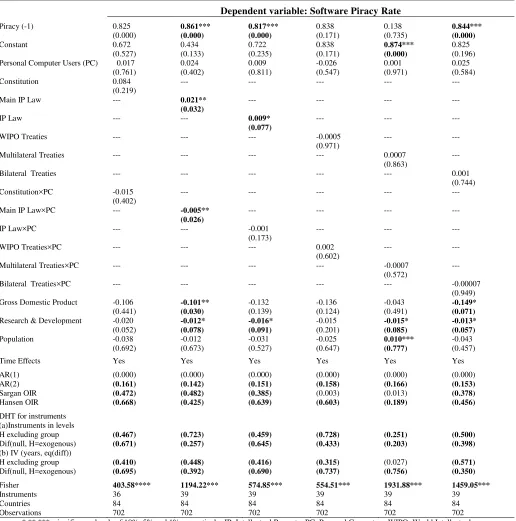
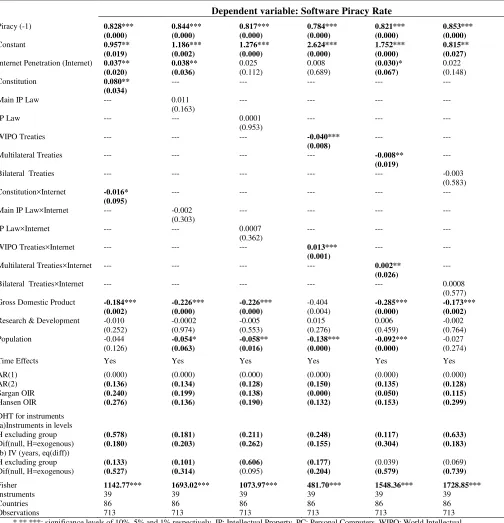
Table 1 and Table 2, present empirical findings corresponding to PC users and internet
penetration, respectively. There are six specifications in each table corresponding to each IPR
mechanism. For either table, the models are comparable because only technology variables
change from one table to another. Hence, it can logically be deduced that the choice of the
technology variable has a bearing on the estimated lagged dependent variable which is used to
assess evidence of persistence in software piracy.
9
Table 1: Personal Computer Users and IPRs
Dependent variable: Software Piracy Rate
Piracy (-1) 0.825 0.861*** 0.817*** 0.838 0.138 0.844***
(0.000) (0.000) (0.000) (0.171) (0.735) (0.000)
Constant 0.672 0.434 0.722 0.838 0.874*** 0.825 (0.527) (0.133) (0.235) (0.171) (0.000) (0.196) Personal Computer Users (PC) 0.017 0.024 0.009 -0.026 0.001 0.025
(0.761) (0.402) (0.811) (0.547) (0.971) (0.584) Constitution 0.084 --- --- --- --- ---
(0.219)
Main IP Law --- 0.021** --- --- --- ---
(0.032)
IP Law --- --- 0.009* --- --- ---
(0.077)
WIPO Treaties --- --- --- -0.0005 --- --- (0.971)
Multilateral Treaties --- --- --- --- 0.0007 --- (0.863)
Bilateral Treaties --- --- --- --- --- 0.001 (0.744) Constitution×PC -0.015 --- --- --- --- ---
(0.402)
Main IP Law×PC --- -0.005** --- --- --- ---
(0.026)
IP Law×PC --- --- -0.001 --- --- --- (0.173)
WIPO Treaties×PC --- --- --- 0.002 --- --- (0.602)
Multilateral Treaties×PC --- --- --- --- -0.0007 --- (0.572)
Bilateral Treaties×PC --- --- --- --- --- -0.00007 (0.949) Gross Domestic Product -0.106 -0.101** -0.132 -0.136 -0.043 -0.149*
(0.441) (0.030) (0.139) (0.124) (0.491) (0.071)
Research & Development -0.020 -0.012* -0.016* -0.015 -0.015* -0.013*
(0.052) (0.078) (0.091) (0.201) (0.085) (0.057)
Population -0.038 -0.012 -0.031 -0.025 0.010*** -0.043 (0.692) (0.673) (0.527) (0.647) (0.777) (0.457) Time Effects Yes Yes Yes Yes Yes Yes AR(1) (0.000) (0.000) (0.000) (0.000) (0.000) (0.000) AR(2) (0.161) (0.142) (0.151) (0.158) (0.166) (0.153)
Sargan OIR (0.472) (0.482) (0.385) (0.003) (0.013) (0.378)
Hansen OIR (0.668) (0.425) (0.639) (0.603) (0.189) (0.456)
DHT for instruments (a)Instruments in levels
H excluding group (0.467) (0.723) (0.459) (0.728) (0.251) (0.500)
Dif(null, H=exogenous) (0.671) (0.257) (0.645) (0.433) (0.203) (0.398)
(b) IV (years, eq(diff))
H excluding group (0.410) (0.448) (0.416) (0.315) (0.027) (0.571)
Dif(null, H=exogenous) (0.695) (0.392) (0.690) (0.737) (0.756) (0.350)
Fisher 403.58**** 1194.22*** 574.85*** 554.51*** 1931.88*** 1459.05***
Instruments 36 39 39 39 39 39
Countries 84 84 84 84 84 84
Table 2: Internet penetration and IPRs
Dependent variable: Software Piracy Rate
Piracy (-1) 0.828*** 0.844*** 0.817*** 0.784*** 0.821*** 0.853***
(0.000) (0.000) (0.000) (0.000) (0.000) (0.000)
Constant 0.957** 1.186*** 1.276*** 2.624*** 1.752*** 0.815**
(0.019) (0.002) (0.000) (0.000) (0.000) (0.027)
Internet Penetration (Internet) 0.037** 0.038** 0.025 0.008 (0.030)* 0.022
(0.020) (0.036) (0.112) (0.689) (0.067) (0.148)
Constitution 0.080** --- --- --- --- ---
(0.034)
Main IP Law --- 0.011 --- --- --- --- (0.163)
IP Law --- --- 0.0001 --- --- ---
(0.953)
WIPO Treaties --- --- --- -0.040*** --- ---
(0.008)
Multilateral Treaties --- --- --- --- -0.008** ---
(0.019)
Bilateral Treaties --- --- --- --- --- -0.003 (0.583) Constitution×Internet -0.016* --- --- --- --- ---
(0.095)
Main IP Law×Internet --- -0.002 --- --- --- --- (0.303)
IP Law×Internet --- --- 0.0007 --- --- --- (0.362)
WIPO Treaties×Internet --- --- --- 0.013*** --- ---
(0.001)
Multilateral Treaties×Internet --- --- --- --- 0.002** ---
(0.026)
Bilateral Treaties×Internet --- --- --- --- --- 0.0008 (0.577) Gross Domestic Product -0.184*** -0.226*** -0.226*** -0.404 -0.285*** -0.173***
(0.002) (0.000) (0.000) (0.004) (0.000) (0.002)
Research & Development -0.010 -0.0002 -0.005 0.015 0.006 -0.002 (0.252) (0.974) (0.553) (0.276) (0.459) (0.764) Population -0.044 -0.054* -0.058** -0.138*** -0.092*** -0.027
(0.126) (0.063) (0.016) (0.000) (0.000) (0.274) Time Effects Yes Yes Yes Yes Yes Yes AR(1) (0.000) (0.000) (0.000) (0.000) (0.000) (0.000) AR(2) (0.136) (0.134) (0.128) (0.150) (0.135) (0.128)
Sargan OIR (0.240) (0.199) (0.138) (0.000) (0.050) (0.115)
Hansen OIR (0.276) (0.136) (0.190) (0.132) (0.153) (0.299)
DHT for instruments (a)Instruments in levels
H excluding group (0.578) (0.181) (0.211) (0.248) (0.117) (0.633)
Dif(null, H=exogenous) (0.180) (0.203) (0.262) (0.155) (0.304) (0.183)
(b) IV (years, eq(diff))
H excluding group (0.133) (0.101) (0.606) (0.177) (0.039) (0.069) Dif(null, H=exogenous) (0.527) (0.314) (0.095) (0.204) (0.579) (0.739)
Fisher 1142.77*** 1693.02*** 1073.97*** 481.70*** 1548.36*** 1728.85***
Instruments 39 39 39 39 39 39
Countries 86 86 86 86 86 86
Four principal information criteria are employed to assess the validity of the GMM model
with forward orthogonal deviations10. Based on the criteria, the following findings are
established. First, software piracy is persistent in three of the six specifications in Table 1
whereas the corresponding persistence in Table 2 is not apparent in all of the six specifications
because they are overwhelmingly stationary. In other words, the findings on PC users are weakly
stationary. The assimilation of non-stationarity to persistence is consistent with Mishra and
Smyth (2014). Second, most of the significant control variables have the expected signs.
It is important to articulate the criterion for stationarity which is based on the estimated
lagged dependent variable. Evidence of convergence or a stationary process is established when
the absolute values of the lagged outcome indicator is in the interval of zero and one. This is
consistent with Fung (2009, p.58) and Asongu (2013, p. 49). Such criterion has been used in
recent information persistence literature (see Asongu & Nwachukwu, 2016b).
Accordingly, in order for persistence to be established, the estimated lagged endogenous
or outcome variable should be significant on the one hand and on the other, satisfy the
convergence criterion. Note should be taken of the fact that, the estimated coefficients related to
the dependent variable can be directly reported. Alternatively, beta could be derived by
subtracting one from the estimated lagged coefficient. Within this alternative framework, the
criterion for establishing convergence is a beta that is less than zero. Hence, following recent
literature, we have directly reported the estimated lagged dependent variables (Prochniak &
Witkowski, 2012a, p. 20; Prochniak & Witkowski, 2012b, p. 23; Asongu & Nwachukwu, 2016d,
p. 459).
Given the above insights, the criterion for establishing comparative persistence from PC
vis-à-vis internet penetration is as follows: when the two tables are compared, the tables with
estimated lagged coefficients reflecting higher magnitude are acknowledged to reflect more
persistence. Accordingly, the relevance of magnitude in the estimated lagged value for the
establishment of more persistence is consistent with recent literature (Asongu & Acha-Anyi,
10 “First, the null hypothesis of the second-order Arellano and Bond autocorrelation test (AR (2)) in difference for
2018; Asongu, 2018). This is essentially because a lagged estimated magnitude translates how
past values of software piracy influence future values of software piracy.
It is also important to elucidate how PCs and internet penetration used in conditioning
information set contribute to persistence in software piracy. Accordingly, the specifications in
Table 1 and Table 2 are comparable because, with the exceptions of PCs and the internet (which
are our main variables of interest), the other variables in the conditioning information set are the
same (Andrés & Asongu, 2013a). Whereas absolute persistence/convergence is modeled without
variables in the conditioning information set, conditional persistence/convergence involves a set
of control variables or variables in the conditioning information set (Narayan et al., 2011).
Conditional persistence is the type of persistence/convergence that occurs because of
cross-country differences in factors that determined the outcome variables (or software piracy)
(Narayan et al., 2011). Given that the main distinguishing feature between Table 1 and Table 2
are PCs and internet penetration, it is reasonable to infer that the changes in persistence across
tables is traceable to the type of technology used in the regression.
4. Concluding implications, caveats and future research directions
This study has examined the persistence of software piracy with internet penetration vis-à-vis PC
users, conditional on Intellectual Property Rights (IPRs) institutions. The empirical evidence is
based on a panel of 99 countries for the period 1994-2010 and the Generalised Method of
Moments with forward orthogonal deviations. The main finding is that, compared to internet
penetration, PC usage is more responsible for the persistence of global software piracy.
Knowing how technology affects the persistence of piracy is important because it enables
more targeted policy initiatives. We have shown that the sensitivity of software piracy to IPRs
mechanisms is contingent on the specific technology channels through which the pirated
software is consumed. As a main policy implication, the choice and design of IPR treaties/laws
against software piracy should be contingent on technologies with which pirated software is
used. As far as these findings are concerned, in the choice between internet penetration and PC
usage, devoting resources to the targeting of the latter would contribute more towards reducing
sustained software piracy. The conception and definition of software piracy should be extended
(to other hardware such as mobile phones and internet-linked hardware applications) and not
more on PCs as opposed to internet penetration in order to limit the persistence of pirated
software, it is also relevant to note that other contemporary hardware that use pirated software
include: Iphones and Ipads which have most software-related technical facilities available in
PCs. Moreover, policy should also be cautious of the fact that persistence in a development
outcome is contingent on the variables used in the conditioning information set. Hence, it is
relevant to engage many determinants of software piracy in the modelling exercise. This is
essentially because conditional persistence (which we have modelled) is apparent when there are
cross-country differences in factors that affect the outcome variable. Hence, the policy relevance
of our findings is contingent on determinants involved in the conditioning information set.
In the light of the above, a caveat to this study is that technology has been conceived and
measured in terms of personal computers (i.e. hardware) and internet penetration (i.e. software).
However, there are many hardware and software associated with piracy. Considering these
alternative factors (e.g. such as cloud computing) within the framework of future studies, as
more data become available, is fundamental in improving the established findings and extant
literature. Moreover, future research can improve the existing literature by assessing other
technology and IPRs mechanisms. Another caveat of the study is based on data availability
constraints at the time of the study. Hence the use of more contemporary data is warranted in
future studies. These potential studies should also consider the heterogeneity of the dataset and
the nature of the software industry which has changed since 1994.
Compliance with Ethical Standards
Appendices
Appendix 1: Definition of variables
Variables Abbreviation Definition of variables (Measurements) Sources
Piracy Piracy Logarithm of Piracy rate (annual %) BSA
Growth per capita GDP Logarithm of GDP per Capita, PPP (international constant dollars, 2005)
World Bank (WDI)
Research and Development
R & D Research and Development Expenditure (% of GDP) World Bank (WDI)
Internet Penetration Internet Logarithm of Internet Users per 1000 GMID
PC Users PC Logarithm of PC Users per capita GMID
Population Pop. Logarithm of Population World Bank (WDI)
Constitution Const. Dummy variable: Copyright is mentioned in the constitution
WIPO
Main_IP_law MIPlaw Main Intellectual Property Law WIPO
IP_rlaw IPlaw Intellectual Property Rights Law WIPO
Wipotreaties WIPO World Intellectual Property Organization WIPO
Mutilateral Multi. Multilateral Treaties WIPO
Bilateral Bilat. Bilateral Treaties WIPO
WDI: World Bank’s World Development Indicators. BSA: Business Software Alliance. GMID: Global Market Information Database. GDP: Gross Domestic Product. Log: Logarithm. WIPO: World Intellectual Property Organization.
Appendix 2: Summary Statistics (1994-2010)
Panel A: Summary Statistics
Variables Mean S.D Min. Max. Obs
Dependent Variable
Software Piracy rate (ln transformed) 0.255 0.449 -0.602 1.995 1500
Technology and control variables
GDP per capita (log) 4.006 0.433 3.008 4.924 1643 Research & Development (R & D) 1.079 0.963 0.006 4.864 811 Internet Penetration (log) 2.807 1.183 -1.000 5.622 1616 Personal Computer Users (log) 3.009 0.837 0.698 5.464 1557 Population (log) 7.063 0.712 5.424 9.126 1682
IPRs laws and treaties related
Panel B: Presentation of Countries
“Albania, Algeria, Argentina, Armenia, Australia, Austria, Azerbaijan, Bahrain, Belgium, Bolivia, Bosnia, Botswana, Brazil, Bulgaria, Cameroon, Canada, Chile, China, Colombia, Costa Rica, Croatia, Cyprus, Czech Republic, Denmark, Dominican Republic, Ecuador, Egypt, El Salvador, Estonia, Finland, France, Germany, Greece, Guatemala, Honduras, Hong Kong, Hungary, Iceland, India, Indonesia, Ireland, Israel, Italy, Japan, Jordan, Kazakhstan, Kenya, Kuwait, Latvia, Lebanon, Lithuania, Luxembourg, Macedonia, Malaysia, Malta, Mauritius, Mexico, Moldova, Montenegro, Morocco, Netherlands, New Zealand, Nicaragua, Nigeria, Norway, Oman, Pakistan, Panama, Paraguay, Peru, Philippines, Poland, Portugal, Puerto Rico, Qatar, Romania, Russia, Saudi Arabia, Senegal, Serbia, Singapore, Slovakia, Slovenia, South Africa, South Korea, Spain, Sweden, Switzerland, Thailand, Tunisia, Turkey, Ukraine, UAE, United Kingdom, United States, Uruguay, Venezuela, Vietnam, Zambia”.
S.D: Standard Deviation. Min: Minimum. Max: Maximum. ICT: Information and Communication Technology. Scandi: Scandinavian. Obs: Observations.
Appendix 3: Correlation Matrix
Piracy GDP R & D Internet PC Pop. Const. MIPlaw IPrlaw WIPO Multi. Bilat.
1.000 -0.766 -0.703 -0.503 -0.551 0.009 0.108 -0.405 -0.109 -0.215 -0.534 -0.180 Piracy 1.000 0.653 0.386 0.482 -0.206 -0.173 0.285 0.067 0.077 0.376 0.160 GDP
1.000 0.424 0.530 0.044 -0.161 0.221 -0.042 0.035 0.414 0.248 R & D 1.000 0.897 0.609 0.145 0.284 0.196 0.119 0.316 0.299 Internet
1.000 0.688 0.123 0.286 0.197 0.036 0.319 0.340 PCs 1.000 0.269 0.068 0.179 -0.087 0.031 0.231 Pop.
1.000 0.075 0.348 0.068 -0.098 0.241 Const. 1.000 0.513 0.168 0.184 -0.087 MIPlaw
1.000 0.209 0.147 -0.006 IPlaw 1.000 0.569 0.176 WIPO
1.000 0.078 Multi. 1.000 Bilat.
GDP: GDP per capita. R&D: Research and Development. Internet: Internet penetration. PC: Personal Computer Users. Pop: Population. Const: Constitution. MIPlaw: Main Intellectual Property Law. IPrlaw: Intellectual Property Rights Law. WIPO: World Intellectual Property Organization Treaties. Multi: Multilateral Treaties. Bilat: Bilateral Treaties.
References
Adu, M. K., Alese, B. K., & Adetunmbi, A. O. (2014). “Design of Software User Identity Module (SUIM) for Preventing Software Piracy”. Lecture Notes in Engineering and Computer
Science, 2211(1), pp. 525-529.
Abor, J. Y., Amidu, Y., & Issahaku, H., (2018). “Mobile Telephony, Financial Inclusion and Inclusive Growth”, Journal of African Business, 18(4), pp. 430-453.
Afutu-Kotey, R. L., Gough, K. W., & Owusu, G., (2017). “Young Entrepreneurs in the Mobile
Telephony Sector in Ghana: From Necessities to Aspirations”, Journal of African Business, 18(4), pp. 476-491.
Andrés, A. R. (2006a). “The relationship between copyright software protection and piracy: Evidence from Europe”. European Journal of Law and Economics, 21(1), pp. 29-51.
Andrés, A. R. (2006b). “Software piracy and income inequality”. Applied Economic Letters, 13 (2), pp. 101-105.
Andrés, A. R., & Asongu, S. A., (2013a). “Fighting software piracy: which governance tools
matter in Africa?”, Journal of Business Ethics, 118(3), pp. 667-682.
Andrés, A. R., & Asongu, S. A., (2013b). “Global dynamic timelines for IPRs harmonization
against software piracy”, Economics Bulletin, 33(1), pp. 874-880.
Andrés, A. R., & Asongu, S. A. (2016). “Global trajectories, dynamics, and tendencies of business software piracy: Benchmarking IPRs harmonization”. Journal of Economic Studies,
43(5), pp. 780-800.
Andrés, A. R., & Goel, R. K. (2011). “Corruption and Software Piracy: A Comparative Perspective”. Policy & Internet, 3(3), pp. 1-24.
Andrés, A. R., & Goel, R. K. (2012). “Does software piracy affect economic growth? Evidence across countries”. Journal of Policy Modeling, 34(2), pp. 284-295.
Ang, J. S., Cheng, Y., & Wu, C., (2014). “Does enforcement of intellectual property rights
matter in China? Evidence from financing and investment choices in the high-tech industry”,
Review of Economics and Statistics, 96(2), pp. 332-348.
Arellano, M., & Bond, S., (1991). “Some tests of specification for panel data: Monte Carlo
evidence and an application to employment equations”, The Review of Economic Studies, 58(2), pp. 277-297.
Arellano, M., & Bover, O., (1995). “Another look at the instrumental variable estimation of error components models”, Journal of Econometrics, 68(1), pp. 29-52.
Asongu, S. A. (2013a). “Harmonizing IPRs on software piracy: Empirics of trajectories in Africa”. Journal of Business Ethics, 118(1), pp. 45-60.
Asongu, S. A. (2013b). “African Stock Market Performance Dynamics: A Multidimensional Convergence Assessment”, Journal of African Business, 40(3), pp. 186-201.
Asongu, S. A. (2014a). “Software Piracy and Scientific Publications: Knowledge Economy Evidence from Africa”. African Development Review, 26(4), pp. 572-583
Asongu, S. A. (2014b). “Software Piracy, Inequality and the Poor: Evidence from Africa”.
Asongu, S. A., (2014c). “African Development: Beyond Income Convergence”, South African
Journal of Economics, 82(3), pp. 334-353.
Asongu, S. A. (2015). “Fighting software piracy in Africa: How do legal origins and IPRs
protection channels matter?” Journal of the Knowledge Economy, 6(4), pp. 682-703.
Asongu, S. A., (2018). “Persistence in incarcerations: global comparative evidence”, Journal of
Criminological Research, Policy and Practice, 4 (2), pp.136-147.
Asongu, S. A., & Acha-anyi, P. N., (2018). “The Murder Epidemic: A Global Comparative Study”, International Criminal Justice Review, DOI: 10.1177/1057567718759584.
Asongu, S. A., & Boateng, A., (2018). “Introduction to Special Issue: Mobile Technologies and Inclusive Development in Africa”, Journal of African Business, 19(3), pp. 297-301.
Asongu, S. A., Batuo, E., Nwachukwu, J., & Tchamyou, V., (2018c). “Is information diffusion a threat to market power for financial access? Insights from the African banking industry”, Journal
of Multinational Financial Management, 45(June), pp. 88-104.
Asongu, S. A, & De Moor, L., (2017). “Financial Globalisation Dynamic Thresholds for Financial Development: Evidence from Africa”, European Journal of Development Research. 29(1), pp 192-212.
Asongu, S. A., & Nwachukwu, J. C., (2016a). “A Brief Future of Time in the Monopoly of Scientific Knowledge”, Comparative Economic Studies, 58(4), pp 638–671.
Asongu, S. A, & Nwachukwu, J. C., (2016b). “The Mobile Phone in the Diffusion of
Knowledge for Institutional Quality in Sub Saharan Africa”, World Development, 86(October), pp. 133-147.
Asongu, S. A, & Nwachukwu, J. C., (2016c). “Foreign aid and governance in Africa”,
International Review of Applied Economics, 30(1), pp. 69-88.
Asongu, S. A., & Nwachukwu, J. C., (2016d). “Revolution empirics: predicting the Arab
Spring”, Empirical Economics, 51(2), pp. 439-482.
Asongu, S. A., & Nwachukwu, J. C., (2017). “Mobile phones in the diffusion of knowledge and persistence in inclusive human development in Sub-Saharan Africa”, Information Development. 33(3), pp. 289-302;
Asongu, S. A., & Nwachukwu, J. C., Orim, S-M, I., & Pyke, C., (2019). “Global Software Piracy, Technology and Property Rights Institutions”, African Governance and Development
Institute Working Paper, Yaoundé.
Asongu, S. A., Tchamyou, V. S., & Acha-anyi, P. N., (2018a). “Who Is Who in Knowledge Economy in Africa?” Journal of the Knowledge Economy. DOI : 10.1007/s13132-018-0547-8
Bagchi, K., Kirs, P., & Cerveny, R. (2006). “Global software piracy: can economic factors alone explain the trend?”Communications of the ACM, 49(6), pp. 70-75.
Baltagi, B. H., (2008). “Forecasting with panel data”, Journal of Forecasting, 27(2), pp. 153- 173.
Banerjee, D., Khalid, A. M., & Sturm, J.-E. (2005). “Socio-economic development and software piracy: An empirical assessment”. Applied Economics, 37(18), pp. 2091–2097.
Barro, R., (1991). “Economic Growth in a Cross Section of Countries”. Quarterly Journal of
Economics 196 (2/May), pp. 407–443.
Barro, R. J., & Sala-i-Martin, X., (1992). “Convergence”, Journal of Political Economy, 100(2), pp. 223-251.
Barro, R. J., & Sala-i-Martin, X., (1995). Economic Growth. The MIT Press, Cambridge, MA.
Baumol, W. J., (1986). “Productivity, growth, convergence and welfare: what the long run data
show”, American Economic Review, 76(5), pp. 1072-1085.
Beck, T., Demirgüç-Kunt, A., & Levine, R., (2003). “Law and finance: why does legal origin
matter?”, Journal of Comparative Economics, 31(4), pp. 653-675.
Bezmen, T. L., & Depken, C. A. (2006). “Influences on software piracy: Evidence from the various United States”. Economics Letters, 90(3), pp. 356-361.
Bezmen, T. L., & Depken, C. A. (2004). “The impact of software piracy on economic development”, Working Paper. Francis Marion University.
Bhawna, S., Shweta, T., Hemenkur, B., Edwin, J., Ayushi, J., & Akansha, P., (2018).
“Ameliorating Software Piracy-A Block chain based Approach”, International Journal of
Information Communication and Computing Technology, 6(1), pp. 338-342.
Blundell, R., & Bond, S., (1998). “Initial conditions and moment restrictions in dynamic panel
data models” Journal of Econometrics, 87(1), pp. 115-143.
Boateng, A., Asongu, S. A., Akamavi, R., & Tchamyou, V. S., (2018). “Information Asymmetry and Market Power in the African Banking Industry”, Journal of Multinational
Financial Management, 44(March), pp. 69-83.
Bond, S., Hoeffler, A., & Tample, J. (2001). “GMM Estimation of Empirical Growth Models”,
Bongomin, G. O. C., Ntayi, J. M., Munene J. C., & Malinga, C. A., (2018). “Mobile Money and Financial Inclusion in Sub-Saharan Africa: the Moderating Role of Social Networks”, Journal of
African Business, 18(4), pp. 361-384.
Bruno, G., De Bonis, R., & Silvestrini, A., (2012). “Do financial systems converge? New
evidence from financial assets in OECD countries”. Journal of Comparative Economics, 40(1), pp. 141-155.
Burruss, G. W., Holt, T. J., & Bossler, A., (2018). “Revisiting the Suppression Relationship Between Social Learning and Self-Control on Software Piracy”, Social Science Computer
Review; DOI: 10.1177/0894439317753820.
Business Software Alliance, (2007). 2006 Piracy study. BSA, New York.
Business Software Alliance: BSA, (2009). What is Software Piracy? http://www.bsa.org/Piracy%20Portal.aspx, accessed May 2012.
D’Este, P., & Patel, P. (2007). “University-Industry Linkages in the UK: What are the factors
underlying the variety of interactions with industry?”. Research Policy, 36(9), pp. 1295-1313.
Douglas, D. E., Cronan, T. P., & Behel, J. D. (2007). “Equity perceptions as a deterrent to software piracy behaviour”. Information & Management, 44(5), pp. 503-512
Driouchi, A., Wang, M., & Driouchi, T. (2015). “Determinants of software piracy under risk aversion: A model with empirical evidence”. European Journal of Information Systems, 24(September), pp. 519-530.
Efobi, U. R., Tanaken, B. V., & Asongu, S. A., (2018). “Female Economic Participation with
Information and Communication Technology Advancement: Evidence from Sub‐ Saharan
Africa”,South African Journal of Economics, 86(2), pp. 231-246.
El-Baily, N., & Gouda, M. (2011). “Enforcing IPR Through Informal Institutions: The Possible Role of Religion in Fighting Software Piracy”, (May 9, 2011). Available at SSRN:
http://ssrn.com/abstract=1950385 orhttp://dx.doi.org/10.2139/ssrn.1950385 (Accessed: 12/10/2015).
Esler, S. L., & Nelson, M. L., (1998). “Evolution of Scientific and Technical Information
Distribution”. Journal of the American Society of Information Science, 49(1), pp. 82-91.
Falvey, R., Foster, N., & Greenway, D. (2006). “Intellectual property rights and economic growth”. Review of Development Economics, 10(4), pp. 700-719.
Fung, M. K., (2009). “Financial development and economic growth: convergence or
Glass, R., & Wood, W. (1996). “Situational determinants of software piracy: An equity theory perspective”. Journal of Business Ethics, 15(11), pp. 1189-1198.
Goel, R. K., & Nelson, M. A. (2009). “Determinants of software piracy: Economics, institutions, and technology”. Journal of Technology Transfer, 34(6), pp. 637–658.
Gosavi, A., (2018). “Can mobile money help firms mitigate the problem of access to finance in Eastern sub-Saharan Africa”, Journal of African Business. 18(4), pp. 343-360.
Gould, D. M., & Gruben, W. C. (1996). “The Role of Intellectual Property Rights in Economic Growth”. Journal of Development Economics, 48(2), pp. 323-350.
Hashim, N., (2014). “How Knowledge, Policy Planning, and Implementation Succeed or Fail: The Jatropha Projects in Tanzania”, Journal of African Business, 14(3), pp. 169-183.
Holm, H. J. (2003). “Can economic theory explain piracy behavior?” The B.E Journal of
Economic Analysis & Policy, 3(1), pp. 1-15.
Holm, P. (2014). “Piracy on the simulated seas: the computer games industry's non-legal
approaches to fighting illegal downloads of games”. Information & Communications Technology Law, 23(1), pp. 61-76.
Hubani, M., & Wiese, M., (2018). “A Cashless Society for All: Determining Consumers’
Readiness to Adopt Mobile Payment Services”, Journal of African Business, 18(4), pp. 409-429..
Issahaku, H., Abu, B. M., & Nkegbe, P. K., (2018). “Does the Use of Mobile Phones by
Smallholder Maize Farmers Affect Productivity in Ghana?”, Journal of African Business, 19(3), pp. 302-322.
Jelili, R. B., & Jellal, M. (2002.) “Transferts des migrants tunisiens et qualification - théorie et évidence”. Société Canadienne de Science Economique, 78(3), pp. 397-410.
Ki, E., Chang, B., & Khang, H. (2006). “Exploring Influential Factors on Music Piracy Across Countries”. Journal of Communication, 56(2), pp. 406-426.
Kim, L., & Nelson, R. (2000). “Technology, Learning and Innovation: Experiences of Newly
Industrializing Economies”, Cambridge University Press.
Lau, E. K-W., (2006). “Factors motivating people toward pirated software”, Qualitative Market
Research: An International Journal, 9(4), pp. 404-419.
Lee, J., & Mansfield, E. (1996). “Intellectual Property Protection and U.S. Foreign Direct Investment”. The Review of Economics and Statistics, 78(2), pp. 181-86.
Love, I., & Zicchino, L., (2006). “Financial Development and Dynamic Investment Behaviour:
Mansfield, E. (1994). Intellectual Property Protection, Foreign Direct Investment, and
Technology Transfer, (Washington D.C.: International Finance Corporation).
Mankiw, N. G., Romer, D., & Weil, D. N., (1992). “A contribution to the empirics of economic growth”, Quarterly Journal of Economics, 107(May), pp. 407–437.
Marron, D. B., & Steel, D. G. (2000). “Which Countries Protect Intellectual Property? The Case of Software Piracy”. Economic Inquiry, 38(2), pp. 147-174.
Maskus, E. K. (2000). Intellectual Property Rights and Economic Development, University of Colorado, Boulder.
Maskus, K. E., & Penubarti, M. (1995). “How Trade Related Are Intellectual Property Rights?”
Journal of International Economics, 39(3-4), pp. 227-248.
Mayer-Foulkes, D., (2010). “Divergences and Convergences in Human Development”. UNDP
Human Development Research Paper No. 2010/20, New York.
Mazzoleni, R. (2008). “Catching Up and Academic Institutions: A Comparative Study of Past National Experiences”. The Journal of Development Studies, 44(5), pp. 678-700.
Mazzoleni, R., & Nelson, R., (2007). “Public research institutions and economic catch-up”.
Research Policy, 36(10), pp. 1512-1528.
Minkoua Nzie, J. R., Bidogeza, J. C., & Ngum, N. A., (2018). “Mobile phone use, transaction
costs, and price: Evidence from rural vegetable farmers in Cameroon”, Journal of African
Business, 19(3), pp. 323-342.
Mishra, V., & Smyth, R., (2014). “Unit root properties of natural gas spot and futures prices: The relevance of heteroskedasticity in high frequency data”, Monash Discussion Paper 20/14, Melbourne.
Moores, T. T., & Esichaikul, V. (2011). “Socialization and software piracy: A study”. Journal of
Computer Information Systems, (Spring 2011), pp. 1-9.
Morrison, A., Cassi, I., & Rabellotti, R. (2009). “Catching-up countries and the geography of
science in the wine industry”, Copenhagen Business School, 2009 Summer Conference.
Mowery, D. C., & Sampat, B. N., (2005). “Universities and Innovation”, The Oxford
Handbook on Innovation Ed. Fagerberg, J. Mowery, D., and Nelson, R., Oxford University Press.
Muthinja, M. M., & Chipeta, C., (2018). “What Drives Financial Innovations in Kenya’s Commercial Banks? An Empirical Study on Firm and Macro-Level Drivers of Branchless
Murray, F., & Stern, S., (2005). “Do Formal Intellectual Property Rights Hinder the Free
Flow of Scientific Knowledge? An Empirical Test of the Anti-Commons Hypothesis”. NBER
Working Paper No. 11465, Cambridge, Massachusetts.
Narayan, P.K., Mishra, S., & Narayan, S., (2011). “Do market capitalization and stocks traded converge? New global evidence”. Journal of Banking and Finance, 35(10), pp.2771-2781.
Omar, K., & Ahmed, S., (2018). “Determinants of Software Piracy Attitudes, Intentions and
Behaviors: Do Students and Non-Students Perceive Things Differently?”, Arab Journal of
Administrative Sciences,25(1), pp. 9-44.
Peitz, M., & Waelbroeck, P. (2006). “Piracy of digital products: A critical review of the theoretical literature”. Information Economics and Policy, 18(4), pp. 449-476.
Piquero, N. L., & Piquero, A. R. (2006). “Democracy and Intellectual Property: Examining Trajectories of Software Piracy”. Annals of the American Academy of Political and Social
Science, 1(605), pp. 104-127.
Png, I. (2008). On the reliability of software piracy statistics. Mimeo: National University of Singapore.
Prochniak, M., & Witkowski, B., (2012a). “Beta convergence stability among “Old” and “New”
EU countries: The Bayesian Model Averaging Perspective”, Warsaw School of Economics.
Prochniak, M., & Witkowski, B., (2012b). “Real economic convergence and the impact of monetary policy on economic growth of the EU countries: The analysis of time stability and the
identification of major turning points based on the Bayesian methods”, Warsaw School of
Economics.
Roodman, D., (2009a). “A Note on the Theme of Too Many Instruments”, Oxford Bulletin of
Economics and Statistics, 71(1), pp. 135-158.
Roodman, D., (2009b). “How to do xtabond2: An introduction to difference and system GMM in Stata”, Stata Journal, 9(1), pp. 86-136.
Santillanes, G., & Felder, R. (2015). “Software Piracy in Research: A Moral Analysis”. Science
and Engineering Ethics, 21(4), pp. 967-977.
Seyoum, B. (1996). “The Impact of Intellectual Property Rights on Foreign Direct Investment”.
Columbia Journal of World Business,31(1), pp. 50-59.
SIIA (Software and Information Industry Association). (2000). SIIA report on global software
piracy 2000. Washington, DC: Software and Information Industry Association.
Solow, R. M., (1956). “A contribution to the theory of economic growth”, Quarterly Journal of
Swan, T., (1956). “Economic growth and capital accumulation”. Economic Record, 32(2), pp. 334-361.
Tchamyou, V. S., (2017). “The Role of Knowledge Economy in African Business”, Journal of
the Knowledge Economy, 8(4), pp. 1189–1228.
Tchamyou, V. S., (2018). “Education, Lifelong learning, Inequality and Financial access:
Evidence from African countries”, Contemporary Social Science. DOI:
10.1080/21582041.2018.1433314.
Tchamyou, V. S., & Asongu, S. A., (2017). “Information Sharing and Financial Sector
Development in Africa”, Journal of African Business, 18(1) pp. 24-49.
Tchamyou, V. S., Asongu, S. A., & Nwachukwu, J. C., (2018). “Effects of asymmetric
information on market timing in the mutual fund industry”, International Journal of Managerial
Finance, 14(5), pp.542-557.
Todaro, M. P., & Smith, S. C. (2015). Economic Development, 12th ed. Harlow, England: Pearson Education.
Traphagan, M., & Griffith, A. (1998). “Software piracy and global competitiveness: Report on global software piracy”. International Review of Law, Computers & Technology, 12(3), pp. 431-451.
Tunca, T. I., & Wu, Q. (2012). “Fighting Fire with Fire: Commercial Piracy and the Role of File Sharing on Copyright Protection Policy for Digital Goods”. Information Systems Research, 24(2), pp. 436-453.
Van Kranenburg, H., & Hogenbirk, A. (2005). “Multimedia, Entertainment, and Business Software Copyright Piracy: A Cross-National Study”. The Journal of Media Economics, 18(2), pp. 109-129.
Wolff, F-C., & Jellal, M., (2003). “International migration and human capital formation”.
Economics Bulletin, 15(10), pp. 1-8.
Yang, G., & Maskus, K. E. (2001). “Intellectual Property Rights, Licensing, and Innovation in an Endogenous Product-Cycle Model”. Journal of International Economics, 53(1), pp. 169-187.