Maximum Entropy Translation Model
in Dependency-Based MT Framework
David Mareˇcek, Martin Popel, Zdenˇek ˇZabokrtsk´y
Charles University in Prague, Institute of Formal and Applied Linguistics Malostransk´e n´am. 25, Praha 1, CZ-118 00, Czech Republic {marecek,popel,zabokrtsky}@ufal.mff.cuni.cz
Abstract
Maximum Entropy Principle has been used successfully in various NLP tasks. In this paper we propose a forward transla-tion model consisting of a set of maxi-mum entropy classifiers: a separate clas-sifier is trained for each (sufficiently fre-quent) source-side lemma. In this way the estimates of translation probabilities can be sensitive to a large number of fea-tures derived from the source sentence (in-cluding non-local features, features mak-ing use of sentence syntactic structure, etc.). When integrated into English-to-Czech dependency-based translation sce-nario implemented in the TectoMT frame-work, the new translation model signif-icantly outperforms the baseline model (MLE) in terms of BLEU. The perfor-mance is further boosted in a configuration inspired by Hidden Tree Markov Mod-els which combines the maximum entropy translation model with the target-language dependency tree model.
1 Introduction
The principle of maximum entropy states that, given known constraints, the probability distri-bution which best represents the current state of knowledge is the one with the largest entropy. Maximum entropy models based on this princi-ple have been widely used in Natural Language Processing, e.g. for tagging (Ratnaparkhi, 1996), parsing (Charniak, 2000), and named entity recog-nition (Bender et al., 2003). Maximum entropy models have the following form
p(y|x) = 1
Z(x)exp
X
i
λifi(x, y)
wherefiis a feature function,λiis its weight, and
Z(x)is the normalizing factor
Z(x) =X
y
expX
i
λifi(x, y)
In statistical machine translation (SMT), trans-lation model (TM)p(t|s)is the probability that the stringtfrom the target language is the translation of the stringsfrom the source language. Typical approach in SMT is to use backward translation modelp(s|t)according to Bayes’ rule and noisy-channel model. However, in this paper we deal only with the forward (direct) model.1
The idea of using maximum entropy for con-structing forward translation models is not new. It naturally allows to make use of various features potentially important for correct choice of target-language expressions. Let us adopt a motivat-ing example of such a feature from (Berger et al., 1996) (which contains the first usage of maxent translation model we are aware of): “Ifhouse ap-pears within the next three words (e.g., the phrases
in the houseandin the red house), thendansmight be a more likely [French] translation [ofin].”
Incorporating non-local features extracted from the source sentence into the standard noisy-channel model in which only the backward trans-lation model is available, is not possible. This drawback of the noisy-channel approach is typi-cally compensated by using large target-language n-gram models, which can – in a result – play a role similar to that of a more elaborate (more con-text sensitive) forward translation model. How-ever, we expect that it would be more beneficial to exploit both the parallel data and the monolingual data in a more balance fashion, rather than extract only a reduced amount of information from the parallel data and compensate it by large language model on the target side.
1A backward translation model is used only for pruning training data in this paper.
A deeper discussion on the potential advantages of maximum entropy approach over the noisy-channel approach can be found in (Foster, 2000) and (Och and Ney, 2002), in which another suc-cessful applications of maxent translation models are shown. Log-linear translation models (instead of MLE) with rich feature sets are used also in (Ittycheriah and Roukos, 2007) and (Gimpel and Smith, 2009); the idea can be traced back to (Pap-ineni et al., 1997).
What makes our approach different from the previously published works is that
1. we show how the maximum entropy trans-lation model can be used in a dependency framework; we use deep-syntactic depen-dency trees (as defined in the Prague Depen-dency Treebank (Hajiˇc et al., 2006)) as the transfer layer,
2. we combine the maximum entropy transla-tion model with target-language dependency tree model and use tree-modified Viterbi search for finding the optimal lemmas label-ing of the target-tree nodes.
The rest of the paper is structured as follows. In Section 2 we give a brief overview of the trans-lation framework TectoMT in which the experi-ments are implemented. In Section 3 we describe how our translation models are constructed. Sec-tion 4 summarizes the experimental results, and Section 5 contains a summary.
2 Translation framework
We use tectogrammatical (deep-syntactic) layer of language representation as the transfer layer in the presented MT experiments. Tectogrammatics was introduced in (Sgall, 1967) and further elaborated within the Prague Dependency Treebank project (Hajiˇc et al., 2006). On this layer, each sentence is represented as a tectogrammatical tree, whose main properties (from the MT viewpoint) are fol-lowing: (1) nodes represent autosemantic words, (2) edges represent semantic dependencies (a node is an argument or a modifier of its parent), (3) there are no functional words (prepositions, auxiliary words) in the tree, and the autosemantic words ap-pear only in their base forms (lemmas). Morpho-logically indispensable categories (such as number with nouns or tense with verbs, but not number with verbs as it is only imposed by agreement) are stored in separate node attributes (grammatemes).
The intuition behind the decision to use tec-togrammatics for MT is the following: we be-lieve that (1) tectogrammatics largely abstracts from language-specific means (inflection, agglu-tination, functional words etc.) of expressing non-lexical meanings and thus tectogrammatical trees are supposed to be highly similar across lan-guages,2 (2) it enables a natural transfer factor-ization,3(3) and local tree contexts in tectogram-matical trees carry more information (especially for lexical choice) than local linear contexts in the original sentences.4
In order to facilitate transfer of sentence ‘syn-tactization’, we work with tectogrammatical nodes enhanced with the formeme attribute ( ˇZabokrtsk´y et al., 2008), which captures the surface mor-phosyntactic form of a given tectogrammatical node in a compact fashion. For example, the value n:pˇred+4 is used to label semantic nouns that should appear in an accusative form in a prepositional group with the preposition pˇred in Czech. For English we use formemes such as
n:subj (semantic noun (SN) in subject position),
n:for+X (SN with preposition for), n:X+ago (SN
with postpositionago),n:poss(possessive form of
SN), v:because+fin (semantic verb (SV) as a
sub-ordinating finite clause introduced by because), v:without+ger(SV as a gerund afterwithout),adj:attr (semantic adjective (SA) in attributive position),
adj:compl(SA in complement position).
We have implemented our experiments in the TectoMT software framework, which already of-fers tool chains for analysis and synthesis of Czech and English sentences ( ˇZabokrtsk´y et al., 2008). The translation scenario proceeds as follows.
1. The input English text is segmented into sen-tences and tokens.
2. The tokens are lemmatized and tagged with Penn Treebank tags using the Morce tagger (Spoustov´a et al., 2007).
2This claim is supported by error analysis of output of tectogrammatics-based MT system presented in (Popel and
ˇ
Zabok/rtsk´y, 2009), which shows that only 8 % of translation errors are caused by the (obviously too strong) assumption that the tectogrammatical tree of a sentence and the tree rep-resenting its translation are isomorphic.
3Morphological categories can be translated almost inde-pendently from lemmas, which makes parallel training data ‘denser’, especially when translating from/to a language with rich inflection such as Czech.
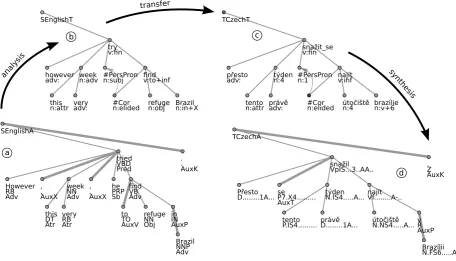
Figure 1: Intermediate sentence representations when translating the English sentence “However, this very week, he tried to find refuge in Brazil.”, leading to the Czech translation“Pˇresto se tento pr´avˇe t´yden snaˇzil naj´ıt ´utoˇciˇstˇe v Braz´ılii.”.
3. Then the Maximum Spanning Tree parser (McDonald et al., 2005) is applied and a surface-syntax dependency tree (analytical tree in the PDT terminology) is created for each sentence (Figure 1a).
4. This tree is converted to a tectogrammatical tree (Figure 1b). Each autosemantic word with its associated functional words is col-lapsed into a single tectogrammatical node, labeled with lemma, formeme, and seman-tically indispensable morphologically cate-gories; coreference is also resolved. Collaps-ing edges are depicted by wider lines in the Figure 1a.
5. The transfer phase follows, whose most dif-ficult part consists in labeling the tree with target-side lemmas and formemes5 (changes of tree topology are required relatively infre-quently). See Figure 1c.
6. Finally, surface sentence shape (Figure 1d) is synthesized from the tectogrammatical tree, which is basically a reverse operation for the
5In this paper we focus on using maximum entropy for translating lemmas, but it can be used for translating formemes as well.
tectogrammatical analysis: adding punctua-tion and funcpunctua-tional words, spreading mor-phological categories according to grammat-ical agreement, performing inflection (using Czech morphology database (Hajiˇc, 2004)), arranging word order etc.
3 Training the two models
In this section we describe two translation mod-els used in the experiments: a baseline translation model based on maximum likelihood estimates (3.2), and a maximum entropy based model (3.3). Both models are trained using the same data (3.1). In addition, we describe a target-language tree model (3.4), which can be combined with both the translation models using the Hidden Tree Markov Model approach and tree-modified Viterbi search, similarly to the approach of ( ˇZabokrtsk´y and Popel, 2009).
3.1 Data preprocessing common for both models
We used only trees from training sections (about 80 % of the whole data), which contain around 30 million pairs of aligned tectogrammatical nodes.
From each pair of aligned tectogrammatical nodes, we extracted triples containing the source (English) lemma, the target (Czech) lemma, and the feature vector.
In order to reduce noise in the training data, we pruned the data in two ways. First, we dis-regarded all triples whose lemma pair did not oc-cur at least twice in the whole data. Second, we computed forward and backward maximum likelihood (ML) translation models (target lemma given source lemma and vice versa) and deleted all triples whose probability according to one of the two models was lower than the threshold 0.01. Then the forward ML translation model was reestimated using only the remaining data.
For a given pair of aligned nodes, the feature vector was of course derived only from the source-side node or from the tree which it belongs to. As already mentioned in the introduction, the advan-tage of the maximum entropy approach is that a rich and diverse set of features can be used, with-out limiting oneself to linearly local context. The following features (or, better to say, feature tem-plates, as each categorical feature is in fact con-verted to a number of 0-1 features) were used:
• formeme and morphological categories of the given node,
• lemma, formeme and morphological cate-gories of the governing node,
• lemmas and formemes of all child nodes,
• lemmas and formemes of the nearest linearly preceding and following nodes.
3.2 Baseline translation model
The baseline TM is basically the ML translation model resulting from the previous section, lin-early interpolated with several translation models making use of regular word-formative derivations, which can be helpful for translating some less fre-quent (but regularly derived) lemmas. For exam-ple, one of the derivation-based models estimates the probabilityp(zaj´ımavˇe|interestingly)(possibly unseen pair of deadjectival adverbs) by the value ofp(zaj´ımav´y|interesting). More detailed descrip-tion of these models goes beyond the scope of this paper; their weights in the interpolation are very small anyway.
3.3 MaxEnt translation model
The MaxEnt TM was created as follows:
1. training triples (source lemma, target lemma, feature vector) were disregarded if the source lemma was not seen at least 50 times (only the baseline model will be used for such lem-mas),
2. the remaining triples were grouped by the En-glish lemma (over 16 000 groups),
3. due to computational issues, the maximum number of triples in a group was reduced to 1000 by random selection,
4. a separate maximum entropy classifier was trained for each group (i.e., one classifier per source-side lemma) using
AI::MaxEntropyPerl module,6
5. due to the more aggressive pruning of the training data, coverage of this model is smaller than that of the baseline model; in or-der not to loose the coverage, the two mod-els were combined using linear interpolation (1:1).
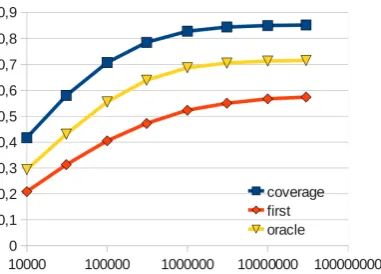
Selected properties of the maximum entropy translation model (before the linear interpolation with the baseline model) are shown in Figure 2. We increased the size of the training data from 10 000 training triples up to 31 million and eval-uated three relative quantities characterizing the translation models:
• coverage- relative frequency of source lem-mas for which the translation model offers at least one translation,
• first- relative frequency of source lemmas for which the target lemmas offered as the first by the model (argmax) are the correct ones,
• oracle- relative frequency of source lemmas for which the correct target lemma is among the lemmas offered by the translation model.
As mentioned in Section 3.1, there are context features making use both of local linear context and local tree context. After training the MaxEnt model, there are about 4.5 million features with non-zero weight, out of which 1.1 million features
Figure 2: Three measures characterizing the Max-Ent translation model performance, depending on the training data size. Evaluated on aligned node pairs from thedtestportion of CzEng 0.9.
are derived from the linear context and 2.4 million features are derived from the tree context. This shows that the MaxEnt translation model employs the dependency structure intensively.
A preliminary analysis of feature weights seems to support our intuition that the linear context is preferred especially in the case of more sta-ble collocations. For example, the most impor-tant features for translating the lemma bare are based on the lemma of the following noun: tar-get lemmabos´y(barefooted) is preferred if the fol-lowing noun on the source side isfoot, whilehol´y
(naked, unprotected) is preferred ifhandfollows. The contribution of dependency-based features can be illustrated on translating the word drop. The greatest weight for choosingkapka(a droplet) as the translation is assigned to the feature captur-ing the presence of a node with formeme n:of+X among the node’s children. The greatest weights in favor of odhodit (throw aside) are assigned to features capturing the presence of words such as
gunorweapon, while the greatest weights in favor of klesnout (to come down) are assigned to fea-tures saying that there is the lemmapercentor the percent sign among the children.
Of course, the lexical choice is influenced also by the governing lemmas, as can be illustrated with the word native. One can find a high-value feature for rodil´y (native-born) saying that the source-side parent is speaker; similarly for
mateˇrsk´y (mother) with governing tongue, and
rodn´y(home) withland.
Linear and tree features are occasionally used simultaneously: there are high-valued positive
configuration BLEU NIST
baseline TM 10.44 4.795
MaxEnt TM 11.77 5.135
[image:5.595.86.277.66.203.2]baseline TM + TreeLM 11.77 5.038 MaxEnt TM + TreeLM 12.58 5.250
Table 1: BLEU and NIST evaluation of four con-figurations of our MT system; the WMT 2010 test set was used.
weights for translatingorderasobjednat(reserve, give an order for st.) assigned both to tree-based features saying that there are words such aspizza,
mealorgoodsand to linear features saying that the very following word issomeortwo.
3.4 Target-language tree model
Although the MaxEnt TM captures some contex-tual dependencies that are covered by language models in the standard noisy-channel SMT, it may still be beneficial to exploit target-language mod-els, because these can be trained on huge mono-lingual corpora. We use a target-language depen-dency tree model differing from standard n-gram model in two aspects:
• it uses tree context instead of linear context,
• it predicts tectogrammatical attributes (lem-mas and formemes) instead of word forms.
In particular, our target-language tree model (TreeLM) predicts the probability of node’s lemma and formeme given its parent’s lemma and formeme. The optimal (lemma and formeme) la-beling is found by tree-modified Viterbi search; for details see ( ˇZabokrtsk´y and Popel, 2009).
4 Experiments
5 Conclusions
We have introduced a maximum entropy transla-tion model in dependency-based MT which en-ables exploiting a large number of feature func-tions in order to obtain more accurate translafunc-tions. The BLEU evaluation proved significant improve-ment over the baseline solution based on the trans-lation model with maximum likelihood estimates. However, the performance of this system still be-low the state of the art (which is around BLEU 16 for the English-to-Czech direction).
Acknowledgments
This research was supported by the grants MSM0021620838, M ˇSMT ˇCR LC536, FP7-ICT-2009-4-247762 (Faust), FP7-ICT-2007-3-231720 (EuroMatrix Plus), GA201/09/H057, and GAUK 116310. We thank two anonymous reviewers for helpful comments.
References
Oliver Bender, Franz Josef Och, and Hermann Ney. 2003. Maximum entropy models for named entity recognition. InProceedings of CoNLL 2003, pages 148–151.
Adam L. Berger, Vincent J. Della Pietra, and Stephen A. Della Pietra. 1996. A maximum entropy ap-proach to natural language processing. Computa-tional linguistics, 22(1):39–71.
Ondˇrej Bojar and Zdenˇek ˇZabokrtsk´y. 2009. CzEng 0.9, Building a Large Czech-English Automatic Par-allel Treebank. The Prague Bulletin of Mathemati-cal Linguistics, 92:63–83.
Eugene Charniak. 2000. A maximum-entropy-inspired parser. In Proceedings of the 1st North American chapter of the ACL conference, pages 132–139, San Francisco, USA.
George Foster. 2000. A maximum entropy/minimum divergence translation model. InProceedings of the 38th Annual Meeting on Association for Computa-tional Linguistics, pages 45–52, Morristown, USA. Association for Computational Linguistics.
Kevin Gimpel and Noah A. Smith. 2009. Feature-rich translation by quasi-synchronous lattice pars-ing. InProceedings of the 2009 Conference on Em-pirical Methods in Natural Language Processing, pages 219–228, Morristown, USA. Association for Computational Linguistics.
Jan Hajiˇc et al. 2006. Prague Dependency Treebank 2.0. CD-ROM, Linguistic Data Consortium, LDC Catalog No.: LDC2006T01, Philadelphia.
Jan Hajiˇc. 2004. Disambiguation of Rich Inflection – Computational Morphology of Czech. Charles Uni-versity – The Karolinum Press, Prague.
Abraham Ittycheriah and Salim Roukos. 2007. Direct translation model 2. In Candace L. Sidner, Tanja Schultz, Matthew Stone, and ChengXiang Zhai, edi-tors,HLT-NAACL, pages 57–64. The Association for Computational Linguistics.
Philipp Koehn. 2004. Statistical significance tests for machine translation evaluation. In Proceedings of EMNLP, volume 4, pages 388–395.
Ryan McDonald, Fernando Pereira, Kiril Ribarov, and Jan Hajiˇc. 2005. Non-projective dependency pars-ing uspars-ing spannpars-ing tree algorithms. In Proceed-ings of HLT / EMNLP, pages 523–530, Vancouver, Canada.
Franz Josef Och and Hermann Ney. 2002. Discrimina-tive training and maximum entropy models for sta-tistical machine translation. InProceedings of ACL, pages 295–302.
Kishore A. Papineni, Salim Roukos, and Todd R. Ward. 1997. Feature-based language understand-ing. In European Conference on Speech Commu-nication and Technology (EUROSPEECH), pages 1435–1438, Rhodes, Greece, September.
Martin Popel and Zdenˇek Zabok/rtsk´y.ˇ 2009. Improving English-Czech Tectogrammatical MT.
The Prague Bulletin of Mathematical Linguistics, (92):1–20.
Adwait Ratnaparkhi. 1996. A maximum entropy model for part-of-speech tagging. InIn Proceedings of EMNLP’96, pages 133–142.
Petr Sgall. 1967. Generativn´ı popis jazyka a ˇcesk´a deklinace. Academia, Prague.
Drahom´ıra Spoustov´a, Jan Hajiˇc, Jan Votrubec, Pavel Krbec, and Pavel Kvˇetoˇn. 2007. The Best of Two Worlds: Cooperation of Statistical and Rule-Based Taggers for Czech. In Proceedings of the Work-shop on Balto-Slavonic Natural Language Process-ing, ACL 2007, pages 67–74, Praha.
Zdenˇek ˇZabokrtsk´y and Martin Popel. 2009. Hidden markov tree model in dependency-based machine translation. In Proceedings of the ACL-IJCNLP 2009 Conference Short Papers, pages 145–148, Sun-tec, Singapore.