Chinese Tagging Based on Maximum Entropy Model
Ka Seng Leong
Faculty of Science and Technology of
University of Macau
Av. Padre Tomás Pereira, Taipa,
Macau, China
[email protected]
Fai Wong
Faculty of Science and Technology of
University of Macau, INESC Macau
Av. Padre Tomás Pereira, Taipa,
Macau, China
[email protected]
Yiping Li
Faculty of Science and Technology of
University of Macau
Av. Padre Tomás Pereira, Taipa,
Macau, China
[email protected]
Ming Chui Dong
Faculty of Science and Technology of
University of Macau, INESC Macau
Av. Padre Tomás Pereira, Taipa,
Macau, China
[email protected]
Abstract
In the Fourth SIGHAN Bakeoff, we took part in the closed tracks of the word segmentation, part of speech (POS) tagging and named entity recognition (NER) tasks. Particularly, we evaluated our word segmentation model on all the corpora, namely Academia Sinica (CKIP), City University of Hong Kong (CITYU), University of Colorado (CTB), State Language Commission of P.R.C. (NCC) and Shanxi University (SXU). For POS tagging and NER tasks, our models were evaluated on CITYU corpus only. Our models for the evaulation are based on the maximum entropy approach, we concentrated on the word segmentation task for the bakeoff and our best official results on all the corpora for this task are 0.9083 F-score on CITYU, 0.8985 on CKIP, 0.9077 on CTB, 0.8995 on NCC and 0.9146 on SXU.
1
Introduction
In the Fourth SIGHAN Bakeoff, besides providing the evaluation tasks for the word segmentation and NER, it also introduced another important
evalua-tion task, POS tagging for Chinese language. In this bakeoff, our models built for the tasks are sim-ilar to that in the work of Ng and Low (2004). The models are based on a maximum entropy frame-work (Ratnaparkhi, 1996; Xue and Shen, 2003). They are trained on the corpora for the tasks from the bakeoff. To understand the model, the imple-mentation of the models is wholly done ourselves. We used Visual Studio .NET 2003 and C++ as the implementation language. The Improved Iterative Scaling (IIS) (Pietra et al., 1997) is used as the pa-rameter estimation algorithm for the models. We tried all the closed track tests of the word segmen-tation, the CITYU closed track tests for POS tag-ging and NER.
2
Maximum Entropy
possible histories and Y is the set of allowable futures or classes. The conditional probability of the model of a history x and a class y is defined as class given the history is the product of the weight-ings of all features which are active under the con-sideration of (x, y) pair, normalized over the sum of the products of all the classes. The normaliza-tion constant is determined by the requirement that
( | ) 1 y
p y x
for all x.To find the optimized parameters λ of the condi-tional probability is one of the important processes in building the model. This can be done through a training process. The parameter estimation algo-rithm used for training is Improved Iterative Scal-ing (IIS) (Pietra et al., 1997) in our case. In train-ing the models for this bakeoff, the traintrain-ing data is given in the form of a sequence of characters (for the tasks of word segmentation and NER) or words (POS tagging) and their classes (tags), the parame-ters λ can be chosen to maximize the likelihood of the training data using p:
But of course, the success of the model depends heavily on the selection of features for a particular task. This will be described in Section 5.
3
Chinese Word Segmenter
We concentrated on the word segmentation task in this bakeoff. For the Chinese word segmenter, it is based on the work that treats Chinese word seg-mentation as tagging (Xue and Shen, 2003; Ng and Low, 2004). Given a Chinese sentence, it assigns a so-called boundary tag to each Chinese character
in the sentence. There are four possible boundary tags: S for a character which is a single-character word, B for a character that is the first character of a multi-character word, E for a character that is the last character of a multi-character wordand M for a character that is neither the first nor last of a mul-ti-character word. With these boundary tags, the word segmentation becomes a tagging problem where each character in Chinese sentences is given one of the boundary tags which is the most proba-ble one according to the conditional probability calculated by the model. And then sequences of characters are converted into sequences of words according to the tags.
4
POS Tagger and Named Entity
Recog-nizer
For the POS tagging task, the tagger is built based on the work of Ratnaparkhi (1996) which was ap-plied for English POS tagging. Because of the time limitation, we could only try to port our imple-mented maximum entropy model to this POS tag-ging task by using the similar feature set (discussed in Section 5) for a word-based POS tagger as in the work of Ng and Low (2004). By the way, besides porting the model to the POS tagging task, it was even tried in the NER task by using the same fea-ture set (discussed in Section 5) as used for the word segmentation in order to test the performance of the implemented model.
The tagging algorithm for these two tasks is bas-ically the same as used in word segmentation. Giv-en a word or a character, the model will try to as-sign the most probable POS or NE tag for the word or character respectively.
5
Features
To achieve a successful model for any task by us-ing the maximum entropy model, an important step is to select a set of useful features for the task. In the following, the feature sets used in the tasks of the bakeoff are discussed.
5.1 Word Segmentation Features
The feature set used in this task is discussed in our previous work (Leong et al., 2007) which is cur-rently the best in our implemented model. They are the unigram features: C-2, C-1, C0, C1 and C2,
bi-gram features: C-2C-1, C-1C0, C0C1, C1C2 and C-1C1
character at the nth position to the right (left) of the current character. For example, given the character sequence “維多利亞港” (Victoria Harbour), while taking the character “利” as C0, then C-2 = “維”, C -1C1 = “多亞”, etc. The boundary tag (S, B, M or E)
feature T-1 is also applied, i.e., the boundary tag
assigned to the previous character of C0. And the
last feature WC0: This feature captures the word
context in which the current character is found. It has the format “W_C0”. For example, the character
“利” is a character of the word “維多利亞港”. Then this will give the feature WC0 = “維多利亞港
_利”.
5.2 POS Tagging Features
For this task, because of the time limitation as mentioned in the previous section, we could only port our implemented model by using a part of the feature set which was used in the word-based tag-ger discussed in the work of Ng and Low (2004). The feature set includes: Wn (n = -2 to 2), WnWn+1
(n = -2, -1, 0, 1), W-1W1, POS(W-2), POS(W-1),
POS(W-2)POS(W-1) where W refers to a word, POS
refers to the POS assigned to the word and n refers to the position of the current word being consi-dered. For example, while considering this sen-tence taken from the POS tagged corpus of CITYU: “香港/Ng 特別/Ac 行政區/Nc 正式/Dc 成立
/Vt” (Hong Kong S.A.R. is established), taking “行 政區” as W0, then W-2 = “香港”, W-1W1 = “特別正
式”, POS(W-2) = “Ng”, POS(W-2)POS(W-1) = “Ac
Dc”, etc.
5.3 Named Entity Recognition Features
For the NER task, we directly used the same fea-ture set as for the word segmentation basically. However, because the original NE tagged corpus is presented in two-column format, where the first column consists of the character and the second is a tag, a transformation which is to transform the original corpus to a sentence per line format before collecting the features or other training data is needed. This transformation actually continues to read the lines from the original corpus, whenever a blank line is found, a sentence of characters with NE tags can be formed.
After that, the features collected are the unigram features: C-2, C-1, C0, C1 and C2, bigram features:
C-2C-1, C-1C0, C0C1, C1C2 and C-1C1, NE tag
fea-tures: T-1, WC0 (this feature captures the NE
con-text in which the current character is found) where T-1 refers to the NE tag assigned to the previous
character of C0, W refers to the named entity. So
similar to the explanation of features of word seg-mentation, for example, given the sequence from the NER tagged corpus of CITYU: “一/N 個/N 中
/B-LOC 國/I-LOC 人/N” (One Chinese), while taking the character “中” as C0, then C-2 = “一”, C -1C1 = “個國”, WC0 = “中國_中”, etc.
For all the experiments conducted, training was done with a feature cutoff of 1.
6
Testing
For word segmentation task, during testing, given a character sequence C1 … Cn, the trained model will
try to assign a boundary tag to each character in the sequence based on the probability of the boundary tag calculated. Then the sequence of characters is converted into sequence of words according to the tag sequence t1 … tn. But if each character was just
assigned the boundary tag with the highest proba-bility, invalid boundary tag sequences would be produced and wrong word segmentation results would be obtained. In particular, known words that are in the dictionary of the training corpus are segmented wrongly because of these invalid tag sequences. In order to correct these, the invalid boundary tag sequences are collected, such as for two-character words, they are “B B”, “B S”, “M S”, “E E”, etc., for three-character words, they are “B E S”, “B M S”, etc., and for four-character words, they are “B M M S”, “S M M E”, etc. With these invalid boundary tag sequences, some post correc-tion to the word segmentacorrec-tion result can be tried. That is after the model tagger has done the tagging for a Chinese sentence every time, the invalid boundary tag sequences will be searched within the preliminary result given by the tagger. When the invalid boundary tag sequence is found, the charac-ters corresponding to that invalid boundary tag se-quence will be obtained. After, the word formed by these characters is looked up to see if it is indeed a word in the dictionary, if it is, then the correction is carried out.
within the preliminary result given by the model tagger, they will be corrected no matter if there is word in the dictionary formed by the characters corresponding to the invalid boundary tag se-quence.
We believe that similar post correction can be applied to the NER task. For example, if such NE tag sequences “B-PER N”, “N I-PER N”, etc. oc-cur in the result, then the characters corresponding to the invalid NE tag sequence can be obtained again and looked up in the named entity dictionary to see if they really form a named entity. However, we did not have enough time to adapt this for the NER task finally. Therefore, no such post correc-tion was applied for the NER task in this bakeoff finally.
7
Evaluation Results
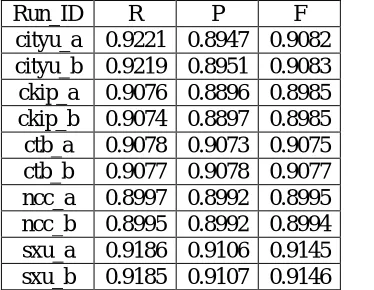
We evaluated our models in the closed tracks of the word segmentation, part of speech (POS) tagging and named entity recognition (NER) tasks. Particularly, our word segmentation model was evaluated on all the corpora, namely Academia Sinica (CKIP), City University of Hong Kong (CITYU), University of Colorado (CTB), State Language Commission of P.R.C. (NCC) and Shanxi University (SXU). For POS tagging and NER tasks, our models were evaluated on the CITYU corpus only. Table 1 shows our official results for the word segmentation task in the bakeoff. The columns R, P and F show the recall, precision and F-score respectively.
Run_ID R P F
cityu_a 0.9221 0.8947 0.9082 cityu_b 0.9219 0.8951 0.9083 ckip_a 0.9076 0.8896 0.8985 ckip_b 0.9074 0.8897 0.8985 ctb_a 0.9078 0.9073 0.9075 ctb_b 0.9077 0.9078 0.9077 ncc_a 0.8997 0.8992 0.8995 ncc_b 0.8995 0.8992 0.8994 sxu_a 0.9186 0.9106 0.9145 sxu_b 0.9185 0.9107 0.9146 Table 1. Official Results in the Closed Tracks of the Word Segmentation Task on all Corpora
We submitted a few runs for each of the tests of the corpora. Table 1 shows the best two runs for each of the tests of the corpora for discussion here.
The run (a) applied only the post correction to the known words that are in the dictionary of the train-ing corpus but are segmented wrongly because of the invalid boundary tag sequences. The run (b) applied also the guessed post correction for some invalid boundary tag sequences in the results as mentioned in Section 6. From the results above, it can be seen that the runs with the guessed post cor-rection generally gave a little bit better perfor-mance than those that did not apply. This shows that the guess somehow made some good guesses for some unknown words that appear in the testing corpora.
Table 2 shows our official results for the POS tagging task. The columns A shows the accuracy. The columns IV-R, OOV-R and MT-R show the recall on in-vocabulary words, out-of-vocabulary words and multi-POS words (multi-POS words are the words in the training corpus and have more than one POS-tag in either the training corpus or testing corpus) respectively. The run (a) used the paramters set which was observed to be the optimal ones for the model in the training phase. The run (b) used the parameters set of the model in the last iteration of the training phase.
Run_ID A IV-R OOV-R MT-R
cityu_a 0.1890 0.2031 0.0550 0.1704 cityu_b 0.2793 0.2969 0.1051 0.2538 Table 2. Official Results in the Closed Track of the POS Tagging Task on the CITYU Corpus
It can be seen that our results were unexpectedly low in accuracy. After releasing the results, we found that the problem was due to the encoding problem of our submitted result files. The problem probably occurred after the conversion from our Big5 encoded results to the UTF-16 encoded results which are required by the bakeoff. Therefore, we did the evaluation ourselves by running our POS tagger again, using the official evaluation program and the truth test set. Finally, our best result was 0.7436 in terms of accuracy but this was still far lower than the baseline (0.8425) of the CITYU corpus. This shows that the direct porting of English word-based POS tagging to Chinese is not effective.
paramters set which was observed to be the optimal ones for the model in the training phase. The run (b) used the parameters set of the model in the last iteration of the training phase.
Run_ID R P F
cityu_a 0.0874 0.1058 0.0957 cityu_b 0.0211 0.0326 0.0256 Table 3. Official Results in the Closed Track of the NER Task on the CITYU Corpus
It can be seen that our results were again unexpectedly low in accuracy. The cause of such low accuracy results was due to parts of the wrong format of the submitted result files compared with the correct format of the result file. So like the POS tagging task, we did the evaluation ourselves by running our NE recognizer again. Finally, our best result was 0.5198 in terms of F-score but this was again far lower than the baseline (0.5955) of the CITYU corpus. This shows that the similar feature set for the word segmentation task is not effective for the NER task.
8
Conclusion
This paper reports the use of maximum entropy approach for implementing models for the three tasks in the Fourth SIGHAN Bakeoff and our re-sults in the bakeoff. From the rere-sults, we got good experience and knew the weaknesses of our mod-els. These help to improve the performance of our models in the future.
Acknowledgements
The research work reported in this paper was par-tially supported by “Fundo para o Desenvolvimento das Ciências e da Tecnologia” under grant 041/2005/A.
References
Adwait Ratnaparkhi. 1996. A maximum entropy model for part-of-speech tagging, in Proceedings of Confe-rence on Empirical Methods in Natural Language Processing, Philadelphia, USA, pages 133-142.
Edwin Thompson Jaynes. 1957. Information Theory and Statistical Mechanics, The Physical Review, 106(4): 620-630.
Hwee Tou Ng, and Jin Kiat Low. 2004. Chinese part-of-speech tagging: One-at-a-time or all-at-once?
Word-based or character-Word-based? In Proceedings of the 2004 Conference on Empirical Methods in Natural Lan-guage Processing (EMNLP 2004), Barcelona, Spain, pages 277-284.
Ka Seng Leong, Fai Wong, Yiping Li, and Ming Chui Dong. 2007. Chinese word boundaries detection based on maximum entropy model, in Proceedings of the 11th International Conference on Enhancement and Promotion of Computational Methods in Engi-neering and Science (EPMESC-XI), Kyoto, Japan.
Lawrence Rabiner. 1989. A tutorial on hidden Markov models and selected applications in speech recogni-tion, Proceedings of the IEEE, 77(2): 257–286.
Nianwen Xue, and Libin Shen. 2003. Chinese word segmentation as LMR tagging, in Proceedings of the 2nd SIGHAN Workshop on Chinese Language Processing, Sapporo, Japan, pages 176-179.