The Relo-KT Process for
Cross-Disciplinary Knowledge
Transfer
Transferring linguistic understanding of
rhetorical figures to the machine translation
domain
A thesis submitted to the
University of Dublin, Trinity College
In fulfilment of the requirements of the degree of
Doctor of Philosophy
Emma Louise Clarke
School of Computer Science & Statistics Trinity College Dublin, Ireland
iii
Declaration of Authorship
I declare that this thesis has not been submitted as an exercise for a degree at this or any other university and it is entirely my own work.
I agree to deposit this thesis in the University’s open access institutional repository or allow the library to do so on my behalf, subject to Irish Copy-right Legislation and Trinity College Library conditions of use and acknowl-edgement.
Signed:
v
Abstract
Digital humanities research, by its nature, is collaborative and interdisci-plinary. A key aim when undertaking cross-disciplinary research is to in-tegrate insights from two or more distinct disciplines using both formal and informal methodologies to achieve effective knowledge transfer. Such collab-oration can lead to new ideas, creative solutions and innovation within both disciplines, in a way not possible within single discipline research and work. Whilst collaboration happens regularly in academic, creative and work en-vironments, methods of cross-disciplinary knowledge transfer in interdisci-plinary research are not often documented.
This thesis explores synergies between the linguistics discipline and the ex-tensive science around machine language translation. While both disciplines have their own distinct approach to solving problems, combining these dis-parate skills within a particular application affords exciting opportunities to develop.
The multi-step relo-KT process was developed during this thesis to formalise and codify collaborative cross-disciplinary knowledge exchange. The pro-cess incorporates establishing an interdisciplinary question; acquiring a cor-pus of data suitable for analysis and extracting domain specific understand-ing from it. The process is iterative in nature as the cross-disciplinary knowl-edge codification and transfer develops between the discipline experts.
To rigorously examine the relo-KT process, it is applied to the RF-MT (rhetor-ical figure-machine translation) use case, in which linguistic understanding of rhetorical figures is codified to facilitate a tangible transfer of linguistic knowledge to the machine translation (MT) domain.
include epanaphora, epistrophe, polyptoton and polysyndeton, each well-understood within the linguistics field, but each posing challenges for effec-tive machine translation.
vii
Acknowledgements
Firstly, I would like to express sincere gratitude to Owen Conlan. I could not have asked for a better supervisor throughout this process. Thank you for being endlessly supportive, positive and generous with your time and advice.
Thanks also to everyone in the ADAPT Centre, and the School of Computer Science & Statistics in Trinity College Dublin, especially Alex O’Connor, who has since moved to pastures new, but was instrumental in shaping my work as a co-supervisor in the early days of my PhD. Special thanks also goes to the ADAPT Centre researchers who agreed to participate in the interviews I carried out in the course of this research.
I am extremely grateful to my examiners, Steven Krauwer and Jennifer Ed-mond for taking the time to examine my work thoroughly and with insight.
To Susan Schreibman and everyone I worked with while at Maynooth Uni-versity: it was very exciting to be involved with a project like Letters of 1916. The weekly exposure to the DH world was invaluable to me during my PhD.
I’d also like to acknowledge the support of good friends I’ve made during my time in TCD especially Vicky Garnett; Angela Griffith and Antonia Hart.
On my first day of the M.Phil in DH & Culture in 2012, Karolina Badz replied to one of my tweets about a module I was taking & that was the start of a really great friendship! Thank you Kar for being a source of constant inspi-ration.
constructive criticism and general wisdom, the final two weeks of writing would have been way more challenging than they were.
There have been so many supportive ears and shoulders to cry on along the way. I’m so grateful for all of them including Marian, Mary, Elma, Tim, Patrick, Eileen, Claire, Joan, Denis, Brenda, Cathy, Lizzie, Inna, Niamh, Deirdre, The Byrne clan & all the members of the “Fake Book Club”.
Thanks to my wonderful family for their constant and unconditional sup-port. Breda, Seán, John, James, Julie, Simon & Saoirse Mae - your kind words, delicious food, hospitality, funny videos, impromptu meetups and general encouragement always arrive at the right time!
Kali and Jarvis deserve a special mention too - for all their meows, cuddles and their fluffy company on the otherwise solitary write-up days!
ix
Contents
Declaration of Authorship iii
Abstract v
Acknowledgements vii
List of Figures xiii
List of Tables xv
Glossary of Terms xvii
1 Introduction 1
1.1 Background . . . 4
1.1.1 Rhetorical figures . . . 4
1.1.2 Machine translation . . . 5
1.2 Motivation . . . 7
1.3 Research questions . . . 10
1.4 Aims and objectives . . . 11
1.5 Methodology . . . 11
1.6 Contribution . . . 12
1.7 Thesis outline . . . 13
2 Literature Review 15 2.1 Introduction . . . 15
2.2 Interdisciplinarity . . . 15
2.3 Cross-disciplinarity . . . 17
2.4 Knowledge transfer . . . 19
2.5 Interdisciplinary research . . . 20
2.5.1 Interdisciplinary knowledge transfer . . . 22
The Project Management Institute (PMI)’s knowledge
transfer life cycle . . . 27
2.6 Interdisciplinarity and digital humanities . . . 29
2.6.1 Establishing an analytical framework . . . 31
2.6.2 Digital humanities projects . . . 33
CULTURA . . . 34
Deep Maps: West Cork Coastal Cultures . . . 34
Industrial Memories . . . 35
Old Weather . . . 35
Transcribe Bentham . . . 36
2.6.3 Applying the analytical framework . . . 36
Interdisciplinarity . . . 36
Codify knowledge to enable KT . . . 36
Evaluation . . . 38
Cross-disciplinary KT . . . 38
Overview of projects . . . 41
2.7 Summary . . . 41
3 relo-KT Process Design 43 3.1 Introduction . . . 43
3.2 Design requirements . . . 43
3.3 Design description . . . 44
3.3.1 Overview . . . 44
3.3.2 The relo-KT process . . . 45
Step 1: Question . . . 45
Step 2: Acquire data . . . 46
Step 3: Extract (domain) understanding . . . 47
Step 4: Knowledge codification . . . 48
Step 5: Collaborate to evaluate . . . 49
Step 6: Repository . . . 51
3.4 Summary . . . 51
4 Rhetorical Figures and Machine Translation 53 4.1 Introduction . . . 53
4.2 Domain 1: linguistics . . . 53
4.2.1 The language of persuasion . . . 54
4.2.2 Rhetorical figures in political speech . . . 56
Rhetorical figure examples . . . 56
xi
4.2.4 Automatic detection and annotation of rhetorical
figures . . . 61
4.3 Domain 2: machine translation . . . 65
4.3.1 History of MT . . . 65
Rule based MT (RBMT) . . . 66
Example based MT (EBMT) . . . 67
Statistical MT (SMT) . . . 67
Neural MT (NMT) . . . 67
4.4 Discourse MT . . . 69
4.5 MT evaluation . . . 70
4.6 Post-editing . . . 71
4.7 MT, transcreation and persuasion . . . 71
4.8 MT and rhetorical figures . . . 73
4.9 Interdisciplinarity and MT . . . 75
4.10 Summary . . . 76
5 relo-KT Process Application 77 5.1 Introduction . . . 77
5.2 Applying the relo-KT process . . . 78
5.2.1 Step 1: Question . . . 79
5.2.2 Step 2: Acquire data . . . 80
Pilot Study . . . 80
Corpus . . . 81
5.2.3 Step 3: Extract domain understanding . . . 82
Pilot Study . . . 82
Automated rhetorical figure detection . . . 83
Rhetorica . . . 83
Extracting domain understanding from the 8thDebates corpus . . . 89
5.2.4 Step 4: Knowledge codification . . . 96
5.2.5 Step 5: Collaborate to evaluate . . . 100
Interviews . . . 101
5.2.6 Step 6: Build repository . . . 105
5.3 Summary . . . 105
6 Analysis and discussion 107 6.1 Introduction . . . 107
6.2 Overview . . . 108
6.4 Cross-disciplinary KT . . . 124
6.5 Summary . . . 126
7 Conclusion 127 7.1 Thesis summary . . . 127
7.2 Review of preceding chapters . . . 127
7.3 Research questions . . . 130
7.4 Research contributions . . . 130
7.4.1 The relo-KT process . . . 131
7.4.2 Secondary contributions . . . 132
7.5 Research limitations . . . 132
7.6 Future work . . . 133
Appendices 135
A The 8thDebates corpus 137
B Sample TD speeches from the 8thDebates corpus 143
C Getting and using the Rhetorica software 163
D The Penn Treebank POS tagset 169
E Informed consent form for interview participants 171
F Information for interview participants 173
G Interview transcripts - round 1 175
H Interview transcripts - round 2 191
xiii
List of Figures
1.1 Proposed method overview . . . 6
2.1 Visual representation of disciplinarity types . . . 18 2.2 Data-information-knowledge-wisdom hierarchy as summarised
by Rowley (2007) . . . 23 2.3 Project Management Institute’s Knowledge Transfer Life Cycle 28 2.4 Projects added to the DH project registry 1989-2017 . . . 30
3.1 The relo-KT process for cross-disciplinary knowledge transfer 45
4.1 L’Oréal Paris Color Riche lipstick advertisement. She maga-zine, March 2000 . . . 74 4.2 L’Oréal Paris Color Riche lipstick advertisement. Elle
maga-zine, July 2000 . . . 75
5.1 The relo-KT process for cross-disciplinary KT as applied in the RF-MT use case . . . 78 5.2 The 8th Debates corpus at a Glance . . . . 82 5.3 Rhetorica ’id_POS’ output for sentence 25 from 8th Debates
statement id04 . . . 92 5.4 Rhetorica output for epistrophe detected in 8th Debates
state-ment id04 . . . 94
6.1 The relo-KT process for cross-disciplinary KT as applied in the RF-MT use case . . . 109 6.2 Mock up of how rhetorical figure highlighting in a
post-editing interface might look . . . 122
xv
List of Tables
2.1 Analytical framework for determining whether, and how, cross-disciplinary knowledge transfer has been achieved in
interdisciplinary research . . . 32
2.2 Survey of DH projects’ cross-disciplinary knowledge transfer . 40 3.1 Description of the relo-KT process . . . 52
5.1 Formalism for representing rhetorical figures (Adapted from Harris and DiMarco (2009) by Java (2015)) . . . 86
5.2 Precision and Recall Tests of the Rhetorica Software (Adapted from Java (2015)) . . . 89
5.3 Word counts and rhetorical figure totals . . . 90
5.4 Natural Language Processing (NLP) data contained in the id_POS output file . . . 91
5.5 Natural Language Processing (NLP) data contained in the id_figures output file . . . 93
5.6 Interview questions . . . 106
6.1 Statement word counts . . . 112
6.2 Rhetorica output . . . 112
6.3 Post-processed Epanaphora . . . 114
6.4 Post-processed Epistrophe . . . 114
6.5 Post-processed Polyptoton . . . 115
6.6 Post-processed Polyptoton with affix issues . . . 116
6.7 Post-processed Polysyndeton . . . 118
6.8 Analytical framework for cross-disciplinary knowledge trans-fer applied to the RF-MT use case . . . 125
xvii
Glossary of Terms
Corpus
A collection of texts used for linguistic analysis
Diachronic Corpus
A corpus containing texts from different time periods which is used to study language development or change.
Discourse Analysis
The study of language beyond the sentence level - the study of real language use by real speakers in real situations.
Epanaphora
Repetition of the same word or group of words at the beginning of suc-cessive clauses, sentences, or lines (also known as anaphora).
Epistrophe
Ending a series of lines, phrases, clauses, or sentences with the same word or words.
Explicit Knowledge
Knowledge which is easy to articulate and codify.
eXtensible Markup Language
See XML.
Figure of Speech
See Rhetorical Figure.
Interdisciplinarity
Communication and collaboration across academic disciplines.
Iterative Process
A process that is repeated, using the results from the previous stage.
Knowledge Transfer
Machine Translation
The translation of text carried out by a computer, with no human in-volvement.
Markup Language
A system for annotating a document for computer processing. See also XML.
Neural Machine Translation
Neural Machine Translation uses an artificial neural network (a type of framework of machine learning algorithms) to predict the likelihood of the sequence of words in a translation.
Oxymoron
A figure of speech in which apparently contradictory terms appear in conjunction.
Polyptoton
A figure of speech in which a word is repeated in close proximity, but in a different form.
Polysyndeton
A figure of speech which employs many conjunctions between clauses, often slowing the tempo or rhythm.
Post-editing
The manual correction of texts which have been translated from a source language into a target language by a machine translation sys-tem.
Rhetoric
The art of effective or persuasive speaking or writing, especially the exploitation of figures of speech.
Rhetorical Figure
A linguistic technique for making a single phrase striking and memo-rable.
Scheme
xix
Statistical Machine Translation
Statistical Machine Translation involves learning by examining a bilin-gual corpus and producing a translation based on what it has learned.
Tacit Knowledge
Knowledge which is difficult to transfer to another person by means of writing it down or verbalizing it.
Transcreation
The process of adapting a message from one language to another, while maintaining its intent, style, tone, and context.
Tricolon
A rhetorical figure which consists of three parallel clauses, phrases, or words, which happen to come in quick succession without any inter-ruption.
Trope
An artful deviation from the ordinary or principal signification of a word. One of two general categories for figures of speech, along with scheme.
XML
A metalanguage which allows users to define their own customized markup languages, especially in order to display documents on the In-ternet.
XML Schema
xxi
Abbreviations
AI Artificial Intelligence.
ALPAC Automatic Language Processing Advisory Committee.
CHI Conference on Human Factors in Computing Systems.
CLARIAH Common Lab Infrastructure for the Arts and the Humanities.
DARIAH Digital Research Infrastructure for the Arts and Humanities.
DH Digital Humanities.
DIKW data-information-knowledge-wisdom.
DL Deep Learning.
EADH European Association for Digital Humanities.
EBMT Example Based Machine Translation.
GIS Geographic Information System.
GNMT Google Neural Machine Translation.
HT Human Translation.
IDR Interdisciplinary Research.
KM Knowledge Management.
KT Knowledge Transfer.
ML Machine Learning.
MLA Modern Language Association.
NLG Natural Language Generation.
NLP Natural Language Processing.
NLTK Natural Language Toolkit.
NMT Neural Machine Translation.
OECD Organisation for Economic Co-operation and Development.
PMI Project Management Institute.
POS Part of Speech.
RBMT Rule Based Machine Translation.
RF-MT Use case to transfer understanding of Rhetorical Figures (RF) to the Machine Translation (MT) domain.
RO Research Objective.
RQ Research Question.
SMT Statistical Machine Translation.
TD Teachta Dála.
TEI Text Encoding Initiative.
UCD University College Dublin.
UCL University College London.
US United States.
USSR Union of Soviet Socialist Republics.
WAS Waterloo Annotation Scheme.
xxiii
1
Chapter 1
Introduction
The transfer of interdisciplinary tacit and explicit knowledge has posed sig-nificant challenges for business and academic communities across the globe, especially since the emergence of the concept of the ’knowledge economy’ in the 1960s. One of the pursuits of digital humanities scholars since the inception of the field has been to explore the intricate patterns of human lan-guage using digital technologies. Linguistic insight has also contributed to the enhancement of automated machine translations with varying degrees of success. Machine translation is the translation of text carried out by a com-puter, with no human involvement, though human post-editing is typically needed in most machine translation applications. Linguistic subtleties and nuance remain difficult to transfer.
For millennia, rhetorical figures have been utilised, both consciously and un-consciously, for persuasive purposes by many orators and writers. Over 400 such figures have been documented, although a much smaller number are in common usage. Digital tools are now available to identify these rhetorical figures in linguistic corpora.
traditional solo work associated with humanities researchers, there is an in-creased trend towards interdisciplinary collaboration. Indeed, one of the cen-tral tenets of digital humanities (henceforth referred to as DH) scholarship is its collaborative nature (Edmond, Bagalkot, and O’Connor, 2016; McCarty and Deegan,2016).
DH is not an easy term to define. The ’What Is Digital Humanities?’1 web-site is a collection of 791 quotes attempting to answer that very question from participants in the Day of DH2initiative between 2009-2014. Among of the most frequently used words from those definitions are ’new’, ’methods’, ’tools’, ’technology’, ’computing’ and the terms ’digital’ and ’humanities’ themselves3. What may come as a surprise is the terms ’interdisciplinary’ ’collaborate’ and ’communicate’ are used relatively infrequently4 when de-fined by those within the field. A typical definition of DH is the one prof-fered by Kathleen Fitzpatrick initially in 2010, and again in 2012, that DH could be understood as “a nexus of fields within which scholars use com-puting technologies to investigate the kinds of questions that are traditional to the humanities” (Fitzpatrick, 2012). It is this nexus, the meeting point of disciplines, that this work focuses on. This thesis considers the interactions which take place when experts from different domains (specified spheres of activity or knowledge5) collaborate and communicate to share their exper-tise.
The concept ofknowledge transfer involves sharing knowledge, skills and expertise in a formalised way. It is a key part of knowledge management and is present in most sectors in the form of documentation, manuals, guide-lines and handovers. These systems serve to take tacit knowledge, which by its nature is difficult to transfer, and codify it in a way which makes it easier to transfer. Knowledge sharing is becoming increasingly important in
1What Is Digital Humanities?https://whatisdigitalhumanities.com/
2Day of DH is a project that examines the state of the digital humanities through the lens of
those within it:https://twitter.com/DayofDH
3Day of DH data (2009-2014) was downloaded from: https://github.com/hepplerj/
whatisdigitalhumanities. Frequencies were calculated using the open-source, web-based Voyant Tools application: https://voyant-tools.org/. The corpus contained 29,581 words in total. The frequencies for the terms are: humanities (1033), digital (947), tools (230), new (237), technology (182), methods (136), computing (128)
4interdisciplinary (32), collaborative (24), collaboration (17), collaborate (6), communication
(29), communicate (11)
Chapter 1. Introduction 3
moving away from traditional disciplinary silos towards more holistic, cross-disciplinary approaches (“Disciplinary Dilemma: Working across Research Silos Is Harder than It Looks | Andy Stirling”).
There is no "one size fits all" definition of interdisciplinarity (Barkovi´c,2010; Holbrook,2013). Similarly, there is not a particular set of challenges which arises when undertaking interdisciplinary research. Among the challenges which can arise however, is the question of how to communicate the com-plexity and nuance of subject area expertise from one discipline to another. As technology advances rapidly, one of the emerging issues that faces re-searchers is how to integrate domain-specific knowledge and understanding in their machine learning systems in a meaningful way. This thesis presents a method which can facilitate such interdisciplinary communication. To es-tablish the validity of the method, it is enacted in the relo-KT process which takes linguistic understanding of rhetorical figures for persuasion and effec-tively communicates this understanding in a grounded way which can be utilised in a machine translation (MT) workflow.
1.1
Background
I have a dream today.
Dr Martin Luther King Jr 28 August 1963
1.1.1
Rhetorical figures
In Washington DC, on a sweltering August day in 1963, the civil rights ac-tivist Martin Luther King Jr. addressed crowds of approximately 250,000, at the March on Washington for Jobs and Freedom. In what has come to be known as the“I have a dream”speech, King advocated for an end to inherent racism in the United States of America. Throughout his address, he repeated the phrase“I have a dream”, but he was not simply uttering a slogan. He used the repetition to persuade the demonstrators at the march that the time for change in race relations in the U.S.A. had come. During the speech, King uttered the phrase “I have a dream” eight times. The tautology galvanised the large gathering, and it became one of the defining moments of the U.S. Civil Rights Movement. The success of this speech can in part be attributed to King’s calculated use of the art of persuasion, in the form of rhetorical figures, to connect emotionally with demonstrators.
1.1. Background 5
A rhetorical figure is a linguistic technique “for making a single phrase striking and memorable” (Forsyth,2014). Rhetorical figures are ubiquitous. Where you find communication and persuasion in speech, rhetorical figures can be found concealed in the blend of words. One of the most commonly used figures isepanaphora, which is the repetition of a word or phrase at the beginning of successive clauses, famously used by Winston Churchill in his
We Shall Fight on the Beachesspeech delivered in the House of Commons in June 1940:
... we shall fightin France,we shall fighton the seas and oceans,
we shall fight with growing confidence and growing strength in the air, we shall defend our Island, whatever the cost may be, we shall fighton the beaches,we shall fighton the landing grounds,
we shall fightin the fields and in the streets,we shall fightin the hills; we shall never surrender...6
This speech was delivered following the successful Dunkirk evacuation of the British troops that had been defending France against Germany during World War 2. The use of epanaphora ensures that key ideas are emphasised. The repetition not only makes the phrase memorable, it adds rhythm to the spoken version. In his speech, Churchill describes honourable defeat, but by using the rhetorical figure, he was able to deliver two messages - that “we shall fight” but also that they may very well lose. His successful use of epanaphora ensured that “we shall fight” was the memorable message, while the other went relatively unnoticed (Forsyth,2014). Epanaphora is one of the rhetorical figures which will be looked at in further detail in this work.
1.1.2
Machine translation
Machine translation (henceforth referred to as MT) involves using compu-tational methods to translate a text between different natural languages (i.e. from French to Spanish). MT has a long history and is deemed to be one of the more challenging areas of AI to solve. Advances in MT have led to in-creased automation in the field and it is used globally on a large scale basis
every day (Way,2018). However, there is still a requirement for human trans-lators, particularly in the post-editing of machine translated text to ensure it meets the required standard. A human post-editor is an integral part of the MT process and this is not expected to change in the foreseeable future.
FIGURE1.1: Proposed method overview
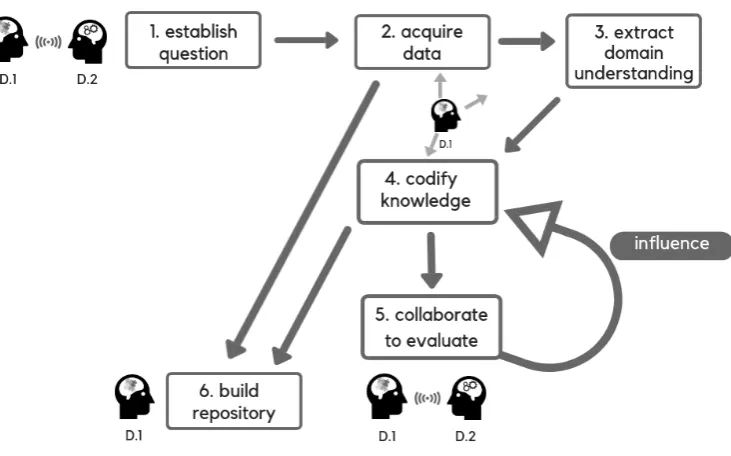
One of the challenges facing natural language researchers and developers is the difficulty in getting their systems to understand and process natural, complex human language such as rhetorical figures. There is potential for a formalised method (depicted in Figure 1.1) which takes linguistic under-standing of rhetorical figures and transmits this expertise in a way that could then be utilised in an MT workflow.
1.2. Motivation 7
1.2
Motivation
In making a speech one must study three points:
first, the means of producing persuasion; second, the language; third the proper arrangement of the various parts of the speech.
Rhetoric Aristotle
Despite the rise in interdisciplinary research as highlighted by Larivière and Gingras (2014), McCarty and Deegan (2016) and Van Noorden (2015), and the fact that collaboration, communication and interaction are so central to Digital Humanities (DH) research, Griffin and Hayler (2018) suggest that collaboration is “still under-discussed in the field”. They found that when contributors to both of their volumes on research methods in DH in 2016 (Griffin and Hayler, 2016, Hayler and Griffin, 2016) were asked about collab-orative research processes, they “were largely met with silence” (Griffin and Hayler, 2018). They observe that despite the rise in and prevalence of collab-orative, cross-disciplinary research and projects, those who do such research are reluctant to discuss the collaborative aspects of their work.
Rhetoric is “the study of effective speaking and writing” (Silva Rhetoricae: The Forest of Rhetoric). It is commonly referred to as the art of persuasion. Rhetoric is a field of study which has had a “long and vigorous history” (Silva Rhetoricae: The Forest of Rhetoric) since its origins in Ancient Greece. The term rhetoric incorporates many different aspects of persuasion such as voice, ges-ture and logic. This study is concerned with rhetorical figures (which are sometimes referred to as rhetorical devices, figures of rhetoric or figures of speech, but for the sake of clarity will only be referred to as rhetorical figures throughout this work).
or services. Rhetoric is used both consciously and instinctively in the lan-guage of news and media, film, in daily life and by politicians to convince or persuade their electorate. Famous political speeches have been analysed in depth for their use of rhetorical figures and their underlying messages. Since Ancient Greece, public speakers have practised the art of rhetoric and it is an art which has endured and can be observed in political speeches right up to the present day (Martin,2016).
As long as there has been migration and travel, the necessity to communicate and transmit from one language to another has existed. Translation has been documented as far back as ancient times. In 1799, archaeologists discovered the Rosetta Stone which had been inscribed with three versions of a decree in Egypt in 196 BC. The inscriptions were in two languages and three scripts -Greek, Demotic (Egyptian) and Hieroglyphic (Egyptian). The stone provided the key to the meaning of ancient Egyptian hieroglyphic writing systems for the first time, but it took over twenty years to decode the inscriptions fully (Parkinson,2005).
MT also has its origins in code-breaking and cryptography. American scien-tist Warren Weaver is attributed with sowing the seeds for automated trans-lation with this quote:
One naturally wonders if the problem of translation could con-ceivably be treated as a problem in cryptography. When I look at an article in Russian, I say: ’This is really written in English, but it has been coded in some strange symbols. I will now proceed to decode.’. (1947)
Despite a 1966 report by the Automatic Language Processing Advisory Com-mittee (ALPAC) which stated that MT “serves no useful purpose without post-editing, and that with post-editing the overall process is slow and prob-ably uneconomical”7, research into MT continued and the field has evolved
7Language and Machines. Computers in Translation and Linguistics:
1.2. Motivation 9
from tedious rule based approaches to statistical MT8and most recently neu-ral MT9. It is predicted that more hybrid MT approaches will emerge which integrate machine reasoning and human expertise.
According to the European Parliament, there is currently “no automatic translation system which can guarantee the high degree of precision and quality required for EU documentation”10. In saying that, another politi-cal organisation, The European Commission has successfully been using an automated MT system, called eTranslate11 (formerly MT@EC), to translate documents like press releases, reports and general communications since 2013. The lack of precision is a well-documented issue in MT research, and in the study of natural languages more widely. MT can successfully trans-late very structured, repetitive texts such as reports and forecasts. However, more complex texts with complicated, nuanced ideas and language still pose problems for MT systems.
To date, there has been little research into translating rhetorical figures, and the work that exists tends to focus on human translation rather than MT. For example, Smith (2006) focused on the translation of rhetorical figures in advertising. The premise of the study was that the aim of advertising is to attract and retain the attention of consumers, and as “the use of rhetor-ical figures is calculated to have special effects on potential consumers”, it is important to understand how such linguistic devices are dealt with in the translation process. Smith’s study focused on manual translation, carried out by humans, but the fundamental theories can be applied to MT. Despite ad-vances in the quality of MT output, and adad-vances such as neural MT systems, there has been little focus on the use of rhetorical figures in MT systems to date. This work aims to fill this gap by drawing on rhetorical figure research which may be applicable in the MT field. This includes (but is not limited to) work by Dubremetz and Nivre (2018), Gawryjolek (2009), Harris et al. (2018), Hromada (2011), Java (2015), and O’Reilly and Paurobally (2010).
8A Statistical MT system learns by examining a bilingual corpus and produces a translation
based on what it has learned
9A neural MT system uses an artificial neural network (a type of framework of machine
learning algorithms) to predict the likelihood of the sequence of words in the translation
10The profession of translator in the European Parliament:
http://bit.ly/EuroParlTranslator
While MT is currently being utilised at a commercial scale for tasks such as communicating updates or information, or to sell or provide a service across different languages, MT technology has not yet reached a standard at which it can be implemented in a politically sensitive setting such as the European Parliament without human post-editing. This research posits that as MT out-put becomes more humanlike, the interspersion of nuanced language such as rhetorical figures will become more applicable.
The aim of this work is to propose a process for cross-disciplinary knowl-edge transfer which can be built into an MT workflow in practice. In order to do this, it is imperative to develop an understanding of how rhetorical fig-ures function in political speech. This understanding is codified as part of a collaborative process in order that it can be used in an MT system.
1.3
Research questions
Based on the background information and motivation outlined above, the proposed research questions (RQs) for this study are:
1. How can a method of cross-disciplinary knowledge transfer be for-malised (e.g. transferring linguistic understanding to MT)?(RQ1)
2. To what extent can such a formalised method support the identification of persuasive rhetorical figures in a corpus; and to transfer linguistic understanding of them, to support Machine Translation (MT)?(RQ2)
1.4. Aims and objectives 11
1.4
Aims and objectives
In order to address the research questions, the objectives of the research (ROs) will be to:
1. perform a literature review of the areas of interdisciplinary knowledge transfer (with particular reference to digital humanities), rhetorical fig-ures in political speech, Machine Translation and post-editing processes
(RO1)
2. formalise a process for cross-disciplinary knowledge transfer(RO2)
3. present a use case for identifying rhetorical figures from a corpus and transferring the associated linguistic understanding to researchers in the MT domain(RO3)
4. assemble a corpus of political speech and a bank of annotated rhetorical figure exemplars in context(RO4)
1.5
Methodology
In order to address the research questions, aims and objectives, Chapter 2 re-views literature relating to digital humanities, cross-disciplinary communi-cation and knowledge transfer to ascertain the status of the current research landscape and to identify key directions being explored by research commu-nities. Chapter 4 surveys literature in the area of machine translation in order to highlight the gap and opportunity which exists in terms of integrating lin-guistic nuance in machine translation systems and processes.
To achieve this, this study adopts a mixed methods approach. Quantitative linguistic analysis is used to derive a set of rhetorical figures that are com-monly used in persuasive political speech. These are then codified in XML markup to make them machine-readable, and thus primed for integration in a machine learning process such as machine translation. Qualitative evalu-ation of the knowledge transfer process is carried out by conducting semi-structured interviews with expert practitioners from the machine translation domain.
1.6
Contribution
This PhD work is interdisciplinary in its nature and the main contributions lie within the following areas: interdisciplinarity, automatic rhetorical figure identification and Machine Translation (MT).
The primary contribution of this work is:
• a method for exchanging knowledge between disciplines which is re-alised in a process entitled the relo-KT process
The process of analysing rhetorical figure usage in the corpus and the cre-ation of the markup schema incorporates engagement with MT researchers to understand their requirements. Secondary, but significant nonetheless, contributions of this research are:
• an understanding of how persuasive rhetorical figures might be inte-grated in an MT workflow
1.7. Thesis outline 13
1.7
Thesis outline
The subsequent chapters of this thesis are organised as follows:
Chapter 2 – Literature Review
Following the introduction in this chapter, Chapter 2 outlines the concepts and background related to interdisciplinary research and digital humanities. It also explores knowledge transfer theory and offers an analytical frame-work for determining whether cross-disciplinary knowledge transfer has taken place in the course of an interdisciplinary research project. The frame-work, which is rooted in the literature, is applied to five interdisciplinary DH projects.
Chapter 3 – Process Design
Chapter 3 takes the literature outlined in Chapter 2 and uses it to shape a pro-cess (the relo-KT propro-cess) which formalises how cross-disciplinary knowl-edge transfer could take place in interdisciplinary research. The six-step pro-cess begins with defining the interdisciplinary question and in it, specifying the domains12 across which understanding needs to be transferred. Steps 2 and 3 are concerned with data acquisition, and the extraction of knowledge from the data as tangible examples. Step 4 centres on the codification of the knowledge extracted in the preceding step while Step 5 involves collaborat-ing with experts from the receivcollaborat-ing domain to share the codified knowledge. This is an iterative process in which the interviewees responses can influence the knowledge codification step. The final step of the relo-KT process is to make the data available in an open and sustainable repository.
Chapter 4 – Rhetorical Figures and Machine Translation
Chapter 4 presents additional literature, this time relating to persuasive ele-ments of speech i.e. rhetorical figures, particularly figures of repetition. In this chapter, a history of machine translation is outlined, before exploring how machine translation and rhetorical figures interact in the related litera-ture.
12The Oxford Dictionary defines domain as “a specified sphere of activity or knowledge”:
Chapter 5 – Process Application
In Chapter 5, the relo-KT process is enacted via a use case which features the linguistics and machine translation domains. Chapter 5 addresses RQ2 in that it demonstrates concretely the extent to which the formalised relo-KT process can support the identification of persuasive rhetorical figures from a corpus, and transfer the linguistic understanding of them to the MT domain.
Chapter 6 – Analysis and discussion
Chapter 6 provides an analysis and discussion of the main findings of the research. It is organised in two main sections. In the first, the findings of Chapter 5’s use case which explored how the relo-KT process might be en-acted to transfer knowledge from the linguistics domain to the MT domain. This is followed by a critical analysis of the overall findings related to the relo-KT process.
Chapter 7 – Conclusion
15
Chapter 2
Literature Review
2.1
Introduction
This chapter introduces the concept of cross-disciplinarity, and examines how interdisciplinarity is approached, and the challenges which arise when undertaking interdisciplinary research. A set of knowledge transfer tech-niques is presented, and from these an analytical framework is developed to understand how cross-disciplinary knowledge transfer is carried out in the course of an interdisciplinary research project. In the final section of the chapter, the analytical framework is applied to five interdisciplinary research projects to establish whether cross-disciplinary knowledge transfer occurred during the project.
2.2
Interdisciplinarity
It takes two flints to make a fire.
Louisa May Alcott Little Women (1869)
“there have been distinct ‘subjects’ for thousands of years”. Indeed, Plato and Aristotle considered the idea of dividing academic work into discrete categories. As scientific scholarship began to grow, there was soon too much information for one person alone to be an expert in (Ledford,2015). McKeon (1994) cites the Enlightenment1 as “the birthplace of modern disciplines”, and claims that “it is also the birthplace of modern interdisciplinary studies”. It was during the 1800s that the modern disciplinary system we understand started to develop.
The academic disciplines which were established in the nineteenth century “remain the principal organisational unit for the production and diffusion of knowledge” (Weingart,2010). During the late nineteenth century and the first half of the twentieth century, new categories of knowledge formed and fields such as social sciences emerged. The current push towards interdisci-plinary studies started in the 1970s and has been growing since (Ledford, 2015), with many universities establishing large interdisciplinary research centres (Biancani et al.,2018). Many funding programmes, such as the Euro-pean Commission’s Horizon 20202, have a requirement for interdisciplinary research (Pedersen,2016; Pray,2002). It is well-documented that finding so-lutions for many of the world’s most complex problems (e.g. climate change, water management, information privacy) requires a combination of expertise from varied disciplinary backgrounds (Rylance,2015).
However, it is the very complexity of such problems which can create a major challenge for the stakeholders involved. Pedersen (2016) cites obesity studies as an example of research which spans multiple disciplines including genet-ics, metabolism, neuroscience, psychology, ethgenet-ics, economgenet-ics, political sci-ence and regulation. Attempting to harmonise researchers from such a wide variety of disciplinary backgrounds has the potential to create obstacles. It is worth noting that some disciplines are naturally “more inclined towards interdisciplinary collaboration than others, but it is rare to find researchers today who have no engagement with scholars outside their own speciality” (Pedersen,2016).
1The Enlightenment, also known as the Age of Reason, was a philosophical movement that
took place primarily in Europe and, later, in North America, during the late 17thand early 18thcentury. Its participants were illuminating human intellect and culture after the "dark" Middle Ages
2.3. Cross-disciplinarity 17
2.3
Cross-disciplinarity
Cross-disciplinarity has been described as “an umbrella term” for inter-, trans- and multi- disciplinary studies (Blackmore and Nesbitt, 2008). In or-der to define cross-disciplinarity, it is necessary to first explore the concepts ofinter-,trans- andmulti- disciplinary activities as there is a tendency to use these terms synonymously and while each term refers “to the involvement of multiple disciplines to varying degrees on the same continuum” (Choi and Pak, 2006), there are certain differences between them which will be teased out in this section.
Interdisciplinaryresearch is defined by Klein and Newell (1997) as:
a process of answering a question, solving a problem, or address-ing a topic that is too broad or complex to be dealt with ade-quately by a single discipline or profession. . . [It] draws on dis-ciplinary perspectives and integrates their insights through con-struction of a more comprehensive perspective
Choi and Pak (2006) suggest that “interdisciplinarity analyses, synthesises and harmonises links between disciplines into a coordinated and coherent whole”, and there is an emphasis on the interaction between disciplines within academia. A prime example of an interdisciplinary project is the Human Genome Project: “an international, collaborative research program whose goal was the complete mapping and understanding of all the genes of human beings” (An Overview of the Human Genome Project 2016). This comprehensive genome mapping project was a collaboration of not only geneticists and scientists, but also experts from the fields of ethics and law.
integrated treatment plan with all members of the team responsible for the same patient-centered goals”.
Like interdisciplinarity and transdisciplinarity, multidisciplinary research also draws upon insights from two or more disciplines. However, “unlike interdisciplinary and transdisciplinary activities, multidisciplinarity simply juxtaposes these insights and does not attempt to integrate them” (Defining "Multidisciplinary" and "Cross-Disciplinary"). Choi and Pak (2006) describe multidisciplinarity as “the most basic level of involvement” in the sense that different disciplines work on the same problem in parallel, but “without chal-lenging their disciplinary boundaries”. Multidisciplinary teams are often found in healthcare or in schools where students require additional support for their educational needs.
FIGURE2.1: Visual representation of disciplinarity types
2.4. Knowledge transfer 19
that “interdisciplinarity analyses, synthesises and harmonises links between disciplines into a coordinated and coherent whole”. When the term cross-disciplinary is used, it is Szostak’s definition that should be kept in mind: that “cross-disciplinary is a general term used to refer to any activity that involves two or more academic disciplines” (Defining "Multidisciplinary" and "Cross-Disciplinary").
2.4
Knowledge transfer
The OECD’s3 Science, Technology and Industry Outlook for 1996 focused on ’the knowledge-based economy’. Knowledge-based economies are those which “are directly based on the production, distribution and use of knowl-edge and information” (OECD,1996). The report’s aim was to address the growing recognition that knowledge “as embodied in human beings and in technology, has always been central to economic development”. Accord-ing to the report, “knowledge distribution through formal and informal net-works is essential to economic performance”. With the increasing codifica-tion of knowledge for transmission through computer and communicacodifica-tions networks, there was also a requirement for tacit knowledge transfer on both an individual and organisational level. This tacit knowledge includes “the skills to use and adapt codified knowledge”.
The knowledge-based economy concept has given rise to other related con-cepts such as knowledge management (Godin,2006). Knowledge manage-ment (KM) is the efficient handling of information within an organisation. In 2000, the OECD published an indepth study entitledKnowledge Manage-ment in the Learning Society. In it, the organisation acknowledges that despite knowledge being one of the the core elements that drive economies, “it re-mains hard to understand, measure or systematise its contribution” and that “our knowledge of how knowledge is created, transferred and used remains partial, superficial and partitioned in various scientific disciplines, with the result that the basic concepts of knowledge and learning are defined and in-terpreted in different ways” (Nelson,2000). By compiling a record of over 100
3The Organisation for Economic Co-operation and Development (OECD) is an
applied definitions of the term ’knowledge management’, Girard and Girard (2015) demonstrate that the concept of KM is one that is recognised in many different sectors from information technology to engineering to health.
Knowledge transfer (KT) is a term which refers to sharing or disseminating knowledge and providing inputs to problem solving. KT “seeks to organize, create, capture or distribute knowledge and ensure its availability for future users” (Lee,2010). Hence, it is important for interdisciplinary research.
2.5
Interdisciplinary research
As mentioned above, interdisciplinarity involves the analysis, synthesis and harmonisation of links between disciplines (Choi and Pak, 2006), and has been described by Professor Irwin Feller as a "hot topic" in Pray (2002). Szostak and Gagnon (2013) define interdisciplinarity as research which "in-volves the integration of insights from multiple disciplines in order to better understand some complex topic that is addressed from different perspec-tives by different disciplines" but maintain that "such a definition tells us a lot about what we are trying to accomplish, but very little about how we might do so".
The perceived, or what Leahey, Beckman, and Stanko (2017) describe as "ex-pected", benefits of conducting interdisciplinary research are numerous and documented by many including Klein (2010); Rhoten (2004); Rylance (2015); and Sanz-Menéndez, Bordons, and Zulueta (2001).
According to the National Academy of Sciences (2005), and as mentioned in Klein (2010), among the driving forces of interdisciplinary research (IDR) are:
• IDR benefit 1: the inherent complexity of nature and society. Complex modern problems such as climate change and resource security are not amenable to single-discipline investigation (Rylance,2015).
2.5. Interdisciplinary research 21
• IDR benefit 3:the need to solve societal problems. The term interdisci-plinary “is often used to denote implicitly or explicitly the application of multiple disciplines and sectors to societal concerns, which may re-quire not only an intellectual answer but perhaps a policy action or technological strategy” Rhoten (2004).
• IDR benefit 4: the power of new technologies. Combining expertise from multiple disciplines can lead to creative, high impact research out-puts (Bhavsar,2017).
While the perceived benefits are lauded and aspirational, successful inter-disciplinary research is renowned for being difficult to measure. Despite the growth in numbers of researchers undertaking interdisciplinary research, ac-tually carrying it out can present myriad challenges which are synthesised below (Delgado and Åm,2018; MacLeod,2018; Sá,2008):
• IDR challenge 1: cognitive obstacles and methodological challenges including “the opacity of domain specific practices to outsiders, con-flicting epistemic values, large conceptual and methodological divides and unstructured task environments” (MacLeod,2018).
• IDR challenge 2: there can be a lack of a common language between researchers from different disciplines (Bhavsar, 2017; Della Chiesa, Christoph, and Hinton,2009) which can in turn lead to:
– communication challenges - Thompson (2009) suggests that “effec-tive communication patterns help teams to improve and develop rewarding working relationships”.
• IDR challenge 3: interdisciplinary work requires a lot of time (Jones, 2010) and “significant effort and learning” to overcome “differences in disciplinary culture” (McMurtry et al.,2012).
• IDR challenge 4: while “structures to support interdisciplinarity are beginning to be developed in universities and granting agencies, most university promotion systems are still oriented towards narrow disci-plinarity” (McMurtry et al.,2012).
(Rylance, 2015) and there can be ambiguity about whether interdisci-plinary activities are recognised for career progression (McMurtry et al.,2012).
The above list outlines five common challenges which can arise when carry-ing out interdisciplinary research. This list presents a context for the types of interdisciplinary challenges which exist. However, this thesis will focus primarily on IDR challenges 1 and 2. The method, and subsequent process, which will be developed in the course of the work aims to reduce the cogni-tive obstacles and methodological challenges that face researchers when they are undertaking interdisciplinary research. It also aims to address the lack of common language which can impede communication and collaboration in interdisciplinary research. Challenges 1 and 2 are tangible, and addressing them is an achievable aim in the context of this work.
The method which will be presented in the course of this thesis does not attempt to address the other challenges. For example, this method will not strive to reduce the time interdisciplinary research takes (IDR challenge 3). While efficiency is of course desirable, it not a priority in terms of this work. Challenges 4 and 5 address more institutional or departmental concerns which fall outside the remit of this study.
2.5.1
Interdisciplinary knowledge transfer
2.5. Interdisciplinary research 23
It is important to briefly differentiate between the terms data, information and knowledge here as there can be a tendency to use these terms synony-mously. The data–information–knowledge–wisdom (DIKW) hierarchy (Fig-ure 2.2) is “one of the most fundamental, widely recognized and ‘taken-for-granted’ models in the information and knowledge literatures” (Rowley, 2007). It represents the relationship between data, information, knowledge and wisdom in a pyramid with data at the base and wisdom at the pinnacle. Rowley’s work reviews “popular explicit or implicit articulations” of DIKW from relevant textbooks in the areas of knowledge revolution, information systems and knowledge management. Rowley reviews and presents a num-ber of definitions of each term and these are summarised below.
FIGURE 2.2: Data-information-knowledge-wisdom hierarchy
• Datais facts and statistics collected together for reference or analysis4;
• Information is data which has been given a meaning, relevance and purpose (Jashapara,2004);
• Knowledge is the combination of data and information, to which ex-pert opinion, skills, and experience is added. This results in a valuable asset which can be used to aid decision making (definition in Rowley (2007) from Chaffey and White (2010), quoting the European Frame-work for Knowledge Management5);
• Wisdom is an evaluated understanding (attributed to Ackoff); the ability to make sound judgements and decisions apparently without thought (Wallace,2007).
Lundvall and Johnson (1994) divide knowledge into four categories where know-what and know-why (1 and 2) correspond to Rowley’s data and infor-mation while know-how aligns more closely with knowledge on the hierar-chy:
1. Know-whatrefers to knowledge about facts;
2. Know-whyrefers to knowledge about principles and laws of motion in nature, in the human mind and in society;
3. Know-howrefers to skills;
4. Know-who refers to information about who knows what and who knows what to do. Additionally, know-who can encompass the ability to co-operate and communicate with different kinds of people.
This concept of know-how is of particular relevance to this work. Know-how (typically also incorporating elements of know-who) can be likened to tacit knowledge, the type of knowledge which develops with experience and is generally difficult to capture and codify. Johnson, Lorenz, and Lundvall (2002) describe know-how as "the kind of knowledge where information
4Oxford Dictionary:https://en.oxforddictionaries.com/definition/data 5European Framework for Knowledge Management:
2.5. Interdisciplinary research 25
technology faces the biggest problems in transforming tacit or non-explicit knowledge into an explicit, codified format". Although Lundvall and John-son (1994) refer to know-how as skills knowledge, this work is concerned withknowinghowpersuasive language is arranged in order to begin to cod-ify it for transfer across disciplines.
The OECD’s report on knowledge management highlights the importance of codifying knowledge in order to share it more easily (OECD, 2000) as did Cowan and Foray (1997) who stated that “the process by which knowledge or information evolves and spreads through the economy involves changing its nature between tacit and codified forms”. While a lot of the literature in this area focuses on the economics of knowledge, the fundamental theories of knowledge transmission can be seen as universal. The standardisation or codification of knowledge in order for it to be transferred and reused is some-thing which can be beneficial to multiple sectors, ranging from technology to education, to science, to retail.
Codified tacit knowledge is embedded in every aspect of our lives. It is maintenance manuals, recipes, knitting patterns and project documentation. Through codification, knowledge can be conveyed and quantified.
2.5.2
Analytical frameworks for interdisciplinary research
Szostak’s twelve-step process for interdisciplinarity
In ’How to Do Interdisciplinarity: Integrating the Debate’ Szostak (2002) de-velops a twelve-step process for interdisciplinary research. In it, he differen-tiates between individual researchers and “communities of interdisciplinary researchers” and notes that while “individual researchers cannot be expected to follow all of these steps in every research project, the process alerts them to the dangers of omitting steps”, but that communities (i.e. research project teams) “should ensure that all steps are followed”. Szostek’s work builds on earlier work by Newell, Wentworth, and Sebberson (2001) and Klein, Went-worth, and Sebberson (2001).
Szostak (2002)’s twelve step process for undertaking interdisciplinary re-search can be summarised as follows:
1. Start with an interdisciplinary question;
2. Identify the key phenomena involved, but also subsidiary phenomena;
3. Ascertain what theories and methods are particularly relevant to the question at hand (be careful not to casually ignore theories and meth-ods that may shed some lesser light on the question);
4. Perform a detailed literature survey;
5. Identify relevant disciplines and disciplinary perspectives;
6. If some relevant phenomena (or links among these), theories, or meth-ods identified in (2) and (3) have received little or no attention in the literature, the researcher should try to perform or encourage the per-formance of such research;
7. Evaluate the results of previous research;
8. Compare and contrast results from previous disciplinary or interdisci-plinary research;
9. Develop a more comprehensive/integrative analysis;
10. Reflect on the results of integration;
11. Test the results of integration;
2.5. Interdisciplinary research 27
While Szostak’s twelve steps provide important guidance for those under-taking interdisciplinary research, they do not detail a how-to approach to im-parting subject or domain specific expertise and know-how. There is a space in Szostak’s twelve steps where knowledge transfer could be integrated in order to provide more holistic guidance on interdisciplinary research. In Szostak’s approach, step 9 is where the main interaction between the dis-ciplines occurs - he describes it as the “integration” of disdis-ciplines. Szostak makes reference to Bailis (2001) who stresses that “integration may proceed quite differently depending on the question addressed”. Szostak follows this by saying that researchers themselves should “ascertain which types of inte-gration are most important for particular questions” and also mentions that “a common vocabulary would be invaluable” at this stage (lack of a common language was earlier outlined as IDR challenge 2 in section 2.5).
The Project Management Institute (PMI)’s knowledge transfer life cycle
The Project Management Institute PMI is a worldwide nonprofit professional organisation for project management. According to its 2017 annual report6, the PMI has over 500,000 members in 207 countries, making it “one of the world’s largest membership-based professional societies”. It awards certi-fication for project management professionals which is recognised globally7 and it also provides professional training and development for its members8.
In 2015, the PMI’s ’Capturing the Value of Project Management Through Knowledge Transfer’ publication outlined a life cycle for knowledge trans-fer. One of the aims of the report was to demonstrate that “being good at knowledge transfer improves project outcomes” (PMI, 2015). The life cycle (Figure 2.3) presents the KT process as a cyclical one which does not neces-sarily have a defined beginning or end point, indicating that KT should be seen as an ongoing, iterative endeavour.
6PMI 2017 Annual Report:https://www.pmi.org/annual-report-2017/at-a-glance 7PMI Certifications:https://www.pmi.org/certifications
FIGURE2.3: Project Management Institute’s Knowledge
Trans-fer Life Cycle
The Knowledge Transfer Life Cycle (PMI,2015) captures five key steps which are required in the KT process. These steps represent a systematic visualisa-tion of the knowledge transfer process:
1. Identifying: determine the knowledge which needs to be transferred;
2. Capturing: accumulate the essential knowledge that needs to be trans-ferred;
3. Sharing: establish methods for transferring the knowledge;
4. Applying: use the knowledge that is transferred;
2.6. Interdisciplinarity and digital humanities 29
2.6
Interdisciplinarity and digital humanities
In the specific case of digital humanities (DH), often described as research which takes place at the intersection or nexus of humanities and computing, Hayles (2012) suggests that collaboration should be the “rule rather than the exception” andedmond_toward_2015state that “digital humanities is highly interdisciplinary and highly collaborative”. Griffin and Hayler (2018) point out that collaboration has “gradually come to be a demand, if not an explicit necessity, for humanities scholars”.
In 2003, Robertson, Martin, and Singer (2003) found that a silence persisted “about the methods of interdisciplinary collaboration” although many stud-ies into interdisciplinarity had been carried out “especially in relation to the creation of new disciplines and institutions”. While researchers reported on methods of data collection and analysis, they would “seldom report the methods they employ in the process of achieving interdisciplinary collabora-tion itself”. Six years later, Dykes, Rodgers, and Smyth (2009) called for “a consistent disciplinary framework” for contemporary creative design prac-tice.
Recent literature suggests that despite the emphasis being placed on interdis-ciplinary research from funding bodies, universities and faculties, there is a disconnect with what happens in research practice. Griffin and Hayler (2018) found that the topic of collaboration in DH is “still under-discussed in the field”. They note that when contributors to their two volumes on research methods in DH were asked about collaborative research processes (Griffin and Hayler,2016; Hayler and Griffin,2016), they “were largely met with si-lence” (Griffin and Hayler,2018).
There is a long list of DH projects, many of them interdisciplinary, which could be included in a review of cross-disciplinary transfer of domain un-derstanding. Website trawls of DH centres at universities such as Stanford9, Berkeley10 and University College London11 demonstrate the wide variety of interdisciplinary DH research which is being carried out. The European Association for Digital Humanities (EADH) maintains a list of projects un-dertaken during the previous five years which “contribute meaningfully to DH in Europe”12. In December 2018, there were over 200 projects listed. In a similar vein to the DARIAH (Digital Research Infrastructure for the Arts and Humanities) DH course registry13 (which shares information about higher education DH courses in the field), the Erasmus University Rotterdam and CLARIAH-NL (Common Lab Infrastructure for the Arts and the Human-ities) maintains a DH Project Registry14 which provides an overview and visualisations of over 300 DH projects which have been carried out in the Netherlands since 1989.
FIGURE2.4: Projects added to the DH project registry 1989-2017
9DH Projects at Stanford:https://digitalhumanities.stanford.edu/projects 10DH at Berkeley Projects:https://digitalhumanities.berkeley.edu/projects 11UCL Centre for DH Research Projects:https://www.ucl.ac.uk/dh/projects 12EADH Projects:https://eadh.org/projects
2.6. Interdisciplinarity and digital humanities 31
2.6.1
Establishing an analytical framework
Five interdisciplinary DH projects will be analysed in an effort to understand whether, and how, cross-disciplinary knowledge transfer is carried out in the course of an interdisciplinary research project. The preceding sections pro-vide a lens through which domain specific knowledge transfer across disci-plines can be analysed. With regard to the research question (RQ1) stated in Chapter 1: ’How can a method of cross-disciplinary knowledge transfer be formalised?’, there are a number of key things to consider.
Firstly, there is the interdisciplinary aspect as seen in Szostak (2002)’s twelve-step ’How to do Interdisciplinarity’. In order to determine whether the DH projects achieve cross-disciplinary KT, they will be examined keep-ing Choi and Pak (2006)’s definition in mind - that the project harmonises links and findings from different disciplines into “a coordinated and coherent whole”.
Knowledge transfer, as seen in the previous section, can be complex and multifaceted. Conducting interdisciplinary research can also be fraught with challenges, among them the cognitive and methodological obstacles and lack of common language challenges established in section 2.5. In order for tacit knowledge to be transferred from one domain to another, it must first be
codifiedin an appropriate way (OECD,2000; Cowan and Foray,1997).
assessing the value or benefits of specific knowledge. The report found that the value of knowledge transfer is “difficult to measure because it’s not always tangible or precise”.
Huutoniemi (2010) quotes the OECD (1998) which stated that “highly com-petent proficiency in a single discipline is the only acceptable basis for inter-disciplinary success”. Additionally, she quotes a symposium of interdisci-plinary experts from Harvard University and the American Association for the Advancement of Science who state that “a basic premise of quality inter-disciplinary work is that it satisfies quality standards arising from the dis-ciplines involved”. Therefore, excellence within the individual disdis-ciplines is an essential element for the quality transfer of tacit knowledge between them. The PMI suggests a cyclical approach to tacit knowledge transfer.
Derived from
Relevant aspects to this work
inter-disciplinarity
Szostak (2002)
Step 9:
where interaction between the disciplines occurs:
develop a more comprehensive/ integrative analysis
codify knowledge to enable KT
Cowan and Foray (1997) OECD (2000)
In order for tacit knowledge to be transferred from one domain to another, it must first be codified in an appropriate way
evaluation Huutoniemi
(2010) PMI (2015)
Excellence within the individual disciplines
Iterative cycle of tacit KT
TABLE 2.1: Analytical framework for determining whether,
2.6. Interdisciplinarity and digital humanities 33
Table 2.1 outlines the steps of the framework which will be applied to deter-mine whether, and how, cross-disciplinary transfer of domain understanding was carried out in the execution of these projects.
2.6.2
Digital humanities projects
While the list of interdisciplinary DH projects is long and diverse, I have chosen to apply the analytical framework outlined above to five interdisci-plinary DH projects to determine how cross-disciinterdisci-plinary transfer of domain understanding was handled. Desk research was carried out to find suitable interdisciplinary DH projects. Each of the five projects were chosen because:
1. they involve collaborative effort between two or more disciplines, and have produced some concrete interdisciplinary output;
2. they are well documented, either on a project website, in peer-reviewed publications, or both.
In the descriptions which follow, I present a brief overview of each project be-fore analysing the particular approaches each one took with regard to cross-disciplinary knowledge transfer. To keep to within the analytical framework (Table 2.1), each project was examined with the following questions in mind:
1. is the project interdisciplinary - does it merge knowledge, insight and methods from two or more disciplines into “a coordinated and coherent whole”?
2. is project-specific knowledge codified in a formal way?
3. is any evaluation carried out on the project?
4. is project-related knowledge transfer between the disciplinary stake-holders documented?