Investigating Focus Constructions in an EFL Context:
a usage-based approach
Nadiah Suliman Al Eraini
This thesis is submitted in partial fulfilment of the requirements for the degree of Doctor of Philosophy in Applied Linguistics
Department of Linguistics and English Language Lancaster University
i
Acknowledgement
This thesis would not have been possible without the help of a large group of people. First of all, I would like to thank Dr Patrick Rebuschat and Dr. Chris Jones, my examiners, for the kind words and valuable comments. I owe a great debt of gratitude to Dr Willem Hollman and Dr Marije Michel, my supervisors, for their constant guidance and encouragement during my PhD journey. They have always been there for me whenever I needed their help, PhD or otherwise. Words fail me in expressing my gratitude for their unwavering enthusiasm, promotion, and support throughout this project. I would not be where I am as a researcher without their guidance over the past four years.
I am grateful to my participants at Princess Norah Bint Abdulrahman University (PNU) in Saudi Arabia for taking part in this study. In addition, I would like to thank the university who facilitated the data collection.
I am extremely grateful for my parents, Hissah Al-Shaie and Dr Suliman Al-Eraini, for the unconditional love, support as well as the many prayers that they have made for me over the years. I am also grateful for my precious siblings and friends, who have been extremely supportive during all these years.
ii
Abstract
By adopting a Construction Grammar framework and following a usage-based approach to SLA, the present study investigated Saudi advanced L2 users’ knowledge of focus constructions in English (namely it-cleft, wh-cleft, reverse wh-cleft and preposing). Little is known about the acquisition of these constructions in an EFL contexts, as these focus constructions are not very much used in oral and written forms in English (Biber et.al, 1999). One of the objectives of this study was to find out whether Saudi L2 users are aware of the appropriate contextual use of English focus constructions related to object focus in English. Another objective of this study, was to explore the extent to which L2 users of English with L1 Arabic are similar in their knowledge and on-line processing of English focus constructions to native speakers. Further, the study aimed to find some evidence as to when learners, over the course of their interlanguage development, come closer to native-like knowledge of English focus constructions and diverge from L1 norms. Therefore, the study included three proficiency levels (native English speakers, advanced and intermediate L2 users of English with Arabic as their L1).
iii
Contents
Acknowledgement ... i
Abstract ... ii
List of Tables ... vii
List of Figures ... viii
CHAPTER 1: Introduction ... 1
1.0 Overview ... 1
1.1 Motivation and background of the study ... 3
1.2 Theoretical background of the study and focus of the study ... 4
1.3 Aim and Design of the study ... 7
1.4 Research questions ... 9
1.5 Organisation of the thesis ... 9
CHAPTER 2: Literature review ... 11
2.0 Introduction ... 11
2.1 Theoretical background: Cognitive linguistics ... 12
2.2 Usage-based construction grammar ... 15
2.3 Information structure from a usage-based perspective ... 21
2.3.1 Focus as an information structure category... 27
2.3.2 Focus types and focus realisations ... 30
2.3.2.1 Focus types ... 30
2.3.2.2 Focus realisation ... 32
2.4 Focus constructions in English and Arabic ... 34
2.4.1 Focus constructions in English ... 35
2.4.1.1 Clefts... 37
2.4.1.2 Preposing ... 40
2.4.2 Focus constructions in Arabic ... 40
2.4.2.1 Obligatory preposing ... 41
2.4.2.2 Optional preposing ... 42
2.5 Usage-based perspective on language acquisition ... 44
2.5.1 Usage-based approaches to L1 acquisition ... 48
2.5.2 Usage-based approach to L2 acquisition ... 55
2.6 The role of awareness in SLA ... 62
2.6.1 Schmidt’s Noticing Hypothesis ... 64
2.6.2 Tomlin and Villa’s model of attention ... 69
2.7 Input processing ... 72
2.7.1 Models of input processing ... 73
iv
2.7.1.2 Psycholinguistic theories of input processing... 76
2.8 The nature of explicit and implicit knowledge ... 80
2.8.1 Consciousness ... 82
2.8.2 Verbalising ... 83
2.8.3 Automaticity ... 83
2.8.4 Task demands ... 84
2.9 Interface between implicit and explicit knowledge ... 85
2.9.1 Non-interface position ... 86
2.9.2 Strong-interface position ... 86
2.9.3 Weak-interface position ... 87
2.10 Measuring implicit and explicit knowledge ... 90
2.10.1 On-line and off-line measures of awareness ... 90
2.10.2 Subjective measures of awareness ... 91
2.10.3 Direct versus indirect tests ... 95
2.11 Empirical research on information highlighting in SLA research ... 97
2.12 Exploring the on-line processing of focus and focus structures ... 102
CHAPTER 3: Methodology... 112
3.1 Introduction ... 112
3.2 Research aims ... 112
3.3 Methodologies adopted in the present study ... 114
3.3.1 Motivation for the methodological choices ... 115
3.4 The pilot study leading to the main study ... 119
3.4.1 Piloting the off-line task ... 120
3.4.1.1 Context of the pilot study ... 120
3.4.1.2 Participants ... 120
3.4.1.3 Instrument used in the pilot study ... 121
3.4.1.4 Procedure ... 123
3.4.1.5 Data analysis and results... 125
3.4.1.6 Feedback and lessons learnt based on the pilot study ... 126
3.4.2 Piloting the on-line experiment (self-paced reading task) ... 127
3.4.2.1 Context of the on-line pilot study ... 128
3.4.2.2 Participants ... 128
3.4.2.3 Instrument used in the pilot study ... 129
3.4.2.4 Procedure ... 135
3.4.2.6 Feedback and lessons learnt based on pilot study ... 136
3.4.3 Piloting the two tasks together ... 138
v
3.5.1 Design of the study ... 140
3.5.2 Context of the study ... 140
3.5.3 Ethical procedure ... 141
3.5.4 Participants ... 143
3.5.5 Instruments ... 147
3.6 Data collection procedures ... 151
3.7 Data analysis ... 153
3.8 Summary ... 153
CHAPTER 4: Results ... 154
4.0 Introduction ... 154
4.1 Statistics for the Acceptability Ratings ... 155
4.1.2 Inferential statistical analyses for the acceptability rating task ... 158
It-cleft construction ... 163
Wh-cleft construction ... 163
Reverse wh-cleft construction ... 164
Preposing construction ... 164
4.2 Statistics for the Confidence-rating Task ... 168
4.2.1 Descriptive statistics ... 168
4.2.2 Inferential statistical analyses for confidence ratings ... 173
4.2.3 The relationship between acceptability ratings and confidence rating ... 180
4.3 Statistics for the On-line Experiment (Self-paced Reading Task) ... 183
4.3.1 Descriptive statistics for the on-line task ... 185
4.3.2 Inferential statistics for the on-line task... 189
4.4 Summary of the Findings for the Present Study ... 198
it-cleft construction ... 198
Wh-cleft construction………..………..182
Reverse wh-cleft construction ... 200
Preposing construction ... 201
CHAPTER 5: Discussion ... 203
5.1 Knowledge of Appropriate Contextual Use of English Focus Constructions ... 203
5.1.1 Acceptability ratings ... 204
5.1.1.1 The it-cleft construction ... 205
5.1.1.2 The wh-cleft construction ... 208
5.1.1.3 The reverse wh-cleft construction ... 213
5.1.1.4 The preposing construction ... 215
5.2 English Users’ Confidence Ratings ... 220
vi
5.2.2 Advanced L2 users ... 226
5.2.3 Intermediate L2 users ... 229
5.3 English Users’ On-line Processing ... 231
5.3.1 It-cleft construction ... 233
5.3.2 Wh-cleft construction ... 235
5.3.3 Reverse wh-cleft construction ... 239
5.3.4 The Preposing Construction ... 242
CHAPTER 6: Summary and Conclusion ... 245
6.1 Introduction ... 245
6.2 Summary of the Thesis... 245
6.2.1. Research Questions 1: On the knowledge of Saudi L2 users and English native speakers about English focus constructions related to Object focus (clefts and preposing constructions) ... 246
6.2.2 Research Questions 2: On the confidence levels of Saudi L2 users and English native speakers... 247
6.2.3 Research Questions 3: On the on-line processing of English focus constructions related to Object focus (clefts and preposing constructions) by Saudi L1 Arabic learners of L2 English and English native speakers ... 248
6.3 Contribution of the Study to the Field ... 248
6.3.1 Theoretical implications ... 249
6.3.2 Methodological contributions ... 252
6.3.3 Practical implications ... 255
6.4 Limitations and Directions for Future Research ... 258
References ... 261
Appendixes ... 298
Appendix A: ... 298
Appendix B ... 301
Appendix C ... 303
Appendix D ... 320
Appendix E ... 322
Appendix F ... 324
Appendix G ... 330
vii
List of Tables
Table 2.1 Information Structure distribution ... 22
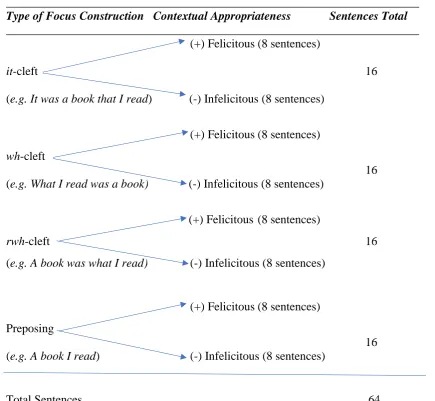
Table 3.1. Experimental Sentence Structure………... 114
Table 3.2 The target constructions in the self-paced reading task………....…...116
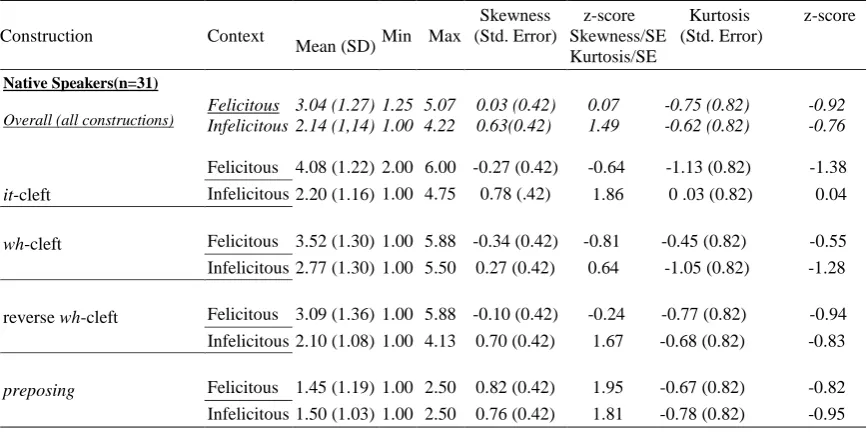
Table 4.1 Descriptive statistics for the acceptability ratings for the focus constructions 157 Table 4.2 Paired-samples t-test results for participants’ acceptability ratings ... 160
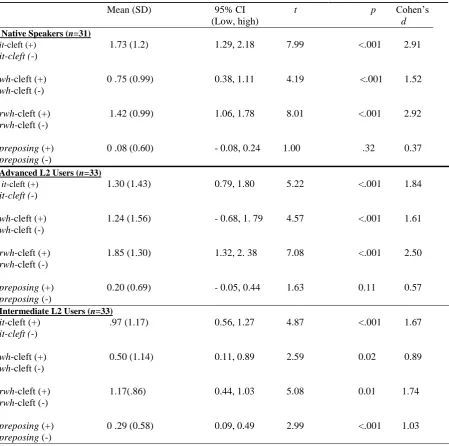
Table 4.3 Repeated measures analysis of variance ANOVA for acceptability ratings ... 162
Table 4.4 Descriptive results of participants’ confidence rating ... 170
Table 4.5 Proportions (%) across Participants’ Confidence Ratings... 172
Table 4.6 Paired-samples t-test results for participants’ confidence ... 174
Table 4.7 Repeated measures analysis of variance ANOVA for confidence ratings ... 175
Table 4.8 Summary of the correlation between scores on the acceptability ratings and confidence ratings per group ... 182
Table 4.9 Mean Reaction Times in milliseconds for the it-cleft ... 187
Table 4.10 Mean Reaction Times in milliseconds for the wh-cleft ... 188
Table 4.11 Mean Reaction Times in milliseconds for the rwh-cleft ... 188
Table 4.12 Mean Reaction Times in milliseconds for the preposing ... 189
Table 4.13 Summary of the findings for the it-cleft construction ... 199
Table 4.14 Summary of the findings for the wh-cleft construction ... 200
Table 4.15 Summary of the findings for the reverse wh-cleft construction ... 201
viii
List of Figures
Figure 3.1 Participants’ background information in pilot study (on Qualtrics) ... 124
Figure 3.2 The instructions for the questionnaire in the pilot study (on Qualtrics) ... 124
Figure 3.3 Example slide of a felicitous context used in SPR task ... 131
Figure 3.4 Example slide of an infelicitous context used in SPR task ... 131
Figure 4.1 Ratings of it-cleft in the two contexts ... 161
Figure 4.2 Ratings of wh-cleft in the two contexts... 161
Figure 4.3 Ratings of rwh-cleft in the two contexts ... 161
Figure 4.4 Ratings of preposing in the two contexts ... 161
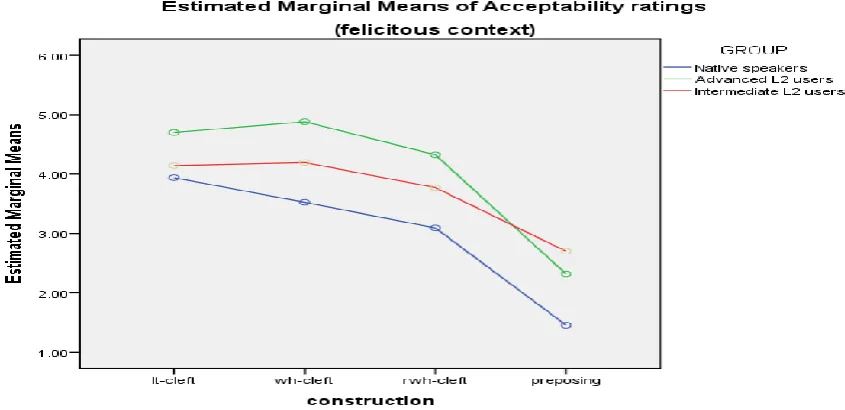
Figure 4.5 The ANOVA results of the interaction in acceptability ratings between Group and Construction in the felicitous context ... 166
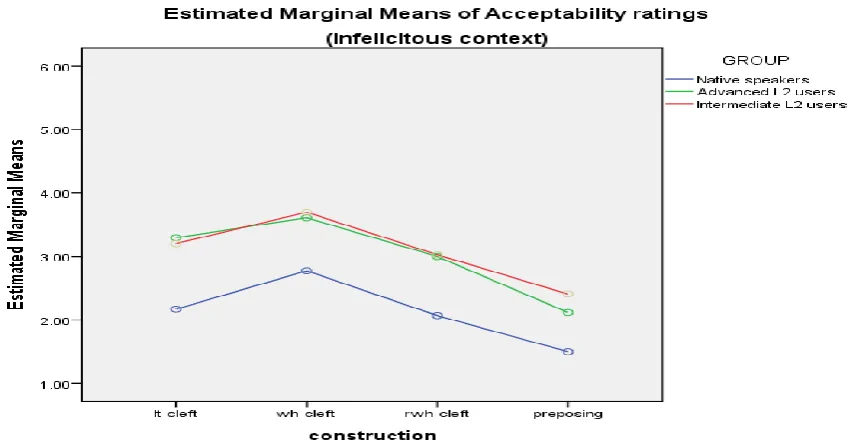
Figure 4.6 The ANOVA results of the interaction in acceptability ratings between Group and Construction in the infelicitous context ... 167
Figure 4.7 The ANOVA results of the interaction in confidence ratings between Group and Construction in the felicitous context ... 179
Figure 4.8 The ANOVA results of the interaction in confidence ratings between Group and Construction in the infelicitous context ... 179
Figure 4.9 Contextual effect on native speakers’ reaction times for it-cleft ... 191
Figure 4.10 Contextual effect on advanced L2 users’ reaction times for it-cleft ... 191
Figure 4.11 Contextual effect on intermediate L2 users’ reaction times for it-cleft ... 191
Figure 4.12 Contextual effect on native speakers’ reaction times for wh-cleft ... 193
Figure 4.13 Contextual effect on advanced L2 users’ reaction times for wh-cleft ... 193
Figure 4.14 Contextual effect on intermediate L2 users’ reaction times for wh-clef ... 193
Figure 4.15 Contextual effect on native speakers’ reaction times for rwh-cleft ... 193
Figure 4.16 Contextual effect on advanced L2 users’ reaction times for rwh-cleft ... 193
Figure 4.17 Contextual effect on intermediate L2 users’ reaction times for rwh-cleft….193 Figure 4.18 Contextual effect on native speakers’ reaction times for preposing ... 197
Figure 4.19 Contextual effect on advanced L2 users’ reaction times for preposing ... 197
1
CHAPTER 1: Introduction
1.0Overview
Cognitive linguistic approaches unanimously agree that the frequency of constructions in the language input positively impacts their acquisition, and that language acquisition is derived from and informed by language use (Croft & Cruse, 2004; N. Ellis, 2002; Ellis & Cadierno, 2009; Goldberg, 2006; Langacker, 1987; Tomasello, 2003). Nevertheless, there are some constructions that do not frequently occur in the target language input. Among these constructions is the syntactic means of information packaging in English, specifically focus constructions. These are the it-cleft, wh-cleft, reverse wh-clef (rwh-cleft)1and preposing constructions, which are exemplified in the following:
a. The students read the introductory textbook. (Canonical SVO) b. It is the introductory textbook that the students read. (it-cleft) c. What the students read was the introductory textbook. (wh-cleft) d. The introductory textbook was what the student read. (rwh-cleft)
e. The introductory textbook the students read. (preposing)
The four constructions (b-e) carry the same proposition as their canonical counterpart in (a) but present the information differently. In other words, “These constructions characteristically have a more basic counterpart differing not in truth conditions or illocutionary meaning, but in the way the informational content is presented” (Ward et.al, 2002, p.1365). Their use is optional in English and at the same time is highly restricted to context (Lambrecht, 1994). Knowledge of these constructions, as is the case with any linguistic construction, involves form-function mapping. This process of form-function
2
mapping requires cognitive processes such as attention and awareness that are involved in how learners process linguistic input (Ellis, 2005). Due to the important place that these processes have in the learning process, a plethora of research in the second language acquisition (SLA) field has been devoted to exploring how attention and awareness may influence the type of learning product (Schmidt, 1999, 2001, 2010; VanPatten, 2007, 2015). That is, whether the resulting knowledge is implicit or explicit in nature.
3
1.1 Motivation and background of the study
The motivation behind this study comes from several observations that I made when I started teaching a group of undergraduate learners of EFL with Arabic as their first language (L1). The learners were at an advanced level and were majoring in English language at the Department of Linguistics in one of the universities in Saudi Arabia. Even though they are at an advanced level of language proficiency and their written production is mainly free from grave grammatical errors, these advanced learners often face problems when trying to package information in the written mode in English. I have often observed students working in groups, discussing the appropriate ways of expressing an idea in English. In these groups students often explain to one another their intended message in Arabic and then work together to formulate this message in English. One of the communicative intentions they often struggle with is emphasising an idea or point of view in writing. On very few occasions, I have found them using the it-cleft construction where there is no obvious need to emphasise a specific sentence constituent. Also, I have often found attempts to use the wh-cleft to explicitly introduce their ideas in writing (What I want to say …, What I want to express is…). As a teacher of English grammar, this sparked my
interest in trying to find out what these learners know about the syntactic means of information packaging that are available in English to highlight information.
4
argued that L1 can influence adults’ L2 acquisition (Dekeyser, 2005, p. 2; N. Ellis, 2002). According to the usage-based approaches adopted in this study, L2 users are likely to construct a second language ‘on top of’ their L1 concepts and constructions, which they have already acquired (Tyler, 2012, p.89). This motivated me to explore the extent to which L1 had an impact on Saudi learners’ knowledge, if any, of these constructions (specifically of the preposing construction).
As I have mentioned above, some advanced L2 learns did show, although not appropriately, evidence of familiarity with some of the target constructions. This inspired me to explore when over the course of their interlanguage development advanced L2 users come close to native-like knowledge of the target construction. Moreover, given that the constructions under investigation are not highly frequent in either written or spoken L1 English, let alone in learners’ language (Schachter, 1988, p. 224), I decided to investigate the type of knowledge that advanced L2 learners rely on when dealing with English focus constructions based on evidence from experimental data.
1.2 Theoretical background of the study and focus of the study
5
investigation come to share some sort of semantic and pragmatic relationship (Lambrecht, 1994).
The focus constructions under investigation share a similar discourse function (i.e. highlighting a focal element in a sentence). However, it requires more than mere knowledge of language rules and surface structure to identify the appropriate contextual use of these constructions. According to Lambrecht (1994), the most elaborate and psychologically plausible account to date of information structure and knowledge of these constructions requires taking into account the formal features of a sentence and a speaker’s assumptions about the hearers’ state of knowledge at the time of utterance. In other words, knowledge of the appropriate contextual use forms part of what makes these constructions grammatical, that is part of the process of form-function mapping that is crucial for language learning (N. Ellis, 2002). Since usage-based approaches to language learning involve intention reading and pattern finding (Littlemore, 2009, p. 7; Tomasello, 2003), the study attempts to find out whether English users are sensitive to the contextual effects when dealing with these focus constructions. This sensitivity is likely to highlight the role of some of the cognitive processes that are involved in language acquisition (N. Ellis, 2002, 2006). One of these processes is attention, which is recognised as a crucial factor for language acquisition (Gass, 1997).
6
Existing studies in the field of SLA agree that attention to certain features in the language input is necessary for language development (Gass & Schmidt, 2012; Leow, 2013; Schmidt, 1995; VanPatten, 1996). Work carried out to investigate information packaging constructions in SLA has mainly been interested in investigating cross-linguistic influence by comparing the use of these constructions in the learners’ L1 to their use in the target construction. The aim was thus to identify any effect of the learners’ L1 on advanced L2 users’ acquisition of the target constructions (Boström Aronsson, 2001, 2002, 2003; Hinkel, 2002; Rowley-Jolivet & Carter, 2005; Zimmerman, 2000). However, there is still a gap in the literature, especially when it comes to investigating the cognitive processes involved in the L2 acquisition of optional and highly L2-specific phenomena. To the best of my knowledge, no experimental research investigating the knowledge and processing of English focus constructions by L2 users of English with L1 Arabic exists.
Recent years have shown a growing interest in the conscious status of knowledge acquired as a result of different learning conditions (e.g. Rebuschat, 2013; Rebuschat & Williams, 2012), which included theoretical elaborations on the defining characteristics of explicit versus implicit knowledge (R. Ellis, 2004, 2005). However, it is also generally recognised that the majority of the language learning process, of both L1 and L2, takes place as a result of processing input for meaning (N. Ellis, 2002; VanPatten & Williams, 2007, 2015). As such, investigating the type of knowledge that English users have about the target constructions and how this knowledge develops in relation to language proficiency might serve to elucidate the constraints on might be learnt on the basis of the evidence in the input.
7
L2 learners of English had explicit knowledge of English focus constructions. In his study, retrospective interviews were used to collected data related to participants’ explicit knowledge of English focus constructions after they had completed a written questionnaire (Callies, 2008). Such methods have been criticised for giving extra processing load to the participants since they have to verbalise what they have noticed in the given task, and also for the possibility that the learner might not be able to recall what he or she had noticed accurately. An interesting aspect of the present study is that it attempted to investigate the conscious status of participants’ knowledge of the appropriate contextual use of the target construction by using subjective measures of awareness (Dienes, 2004, 2008, 2010, 2013; Rebuschat, 2013; Rebuschat et al., 2013), namely confidence rating (see section 2.10.2). This allowed for a more refined view of the type of knowledge that the participants have about the target constructions as they completed the off-line task.
In summary, this study will attempt to fill four main gaps in the existing research. These are: (1) the lack of knowledge on what English users (Saudi L2 users with L1 Arabic) know about the appropriate contextual use of focus constructions in English; (2) introducing data collection methods to investigate the type of knowledge that English users utilise when dealing with the target constructions; (3) the nature of the on-line processing of these grammatical constructions by English users.
1.3 Aim and Design of the study
8
can motivate the use of either implicit or explicit knowledge in L2 performance (Bialystok, 1982, 1986).
According to R. Ellis and colleagues (R. Ellis, 2004, 2005; R. Ellis et al., 2009; Godfroid et al., 2015) tasks that are untimed, i.e. those that allow the participants enough time to complete the task at hand, are reflective of explicit knowledge, while tasks that are timed, allowing limited time for the participants to complete the task, are more likely to reflect implicit knowledge. This was based on the suggestion that implicit knowledge is likely to be available for automatic processing and explicit knowledge is available for controlled processing (N. Ellis, 2005; R. Ellis, 2004, 2005; R. Ellis et al., 2009), which is discussed in detail in section 2.7, 2.8 and 2.9. Thus, the off-line task in this study can be regarded as an untimed task and hence most likely to elicit more explicit knowledge. In contrast, the on-line experiment involved a timed task that is most likely to reflect more implicit knowledge.
9
1.4 Research questions
The research questions guiding the current research were as follows:
Research Question 1: What do Saudi L2 users of English and native speakers know about the appropriate contextual use of focus constructions in English?
SubQ1: Do proficiency (native speaker, advanced L2, intermediate L2), type of context (felicitous vs. infelicitous) and type of construction (it-cleft, wh-cleft, reversed wh-cleft, preposing) have an effect on participants’ knowledge of the target constructions?
Research Question 2: To what extent are Saudi L2 users of English and native speakers conscious of their knowledge that guided their decision in the off-line task?
SubQ1: Is there a difference in participants’ confidence level between the felicitous and infelicitous contexts?
SubQ2: Is there a relationship between participants’ knowledge of the use of focus constructions and their level of confidence?
Research Question3: How do Saudi L2 users of English and native speakers process focus constructions, as measured by an on-line experiment? SubQ1: Do proficiency (native speaker, advanced L2, intermediate
L2) and type of context (felicitous vs. infelicitous) have an effect on participants’ on-line processing of the target constructions?
1.5 Organisation of the thesis
10
11
CHAPTER 2: Literature review
2.0 Introduction
As mentioned in the introduction, Chapter 2 of this thesis provides the theoretical background to the present study. Since the present study is motivated by a cognitive and constructionist approach to the study of focus constructions in English, the chapter starts (section 2.1) with a review of the literature on cognitive linguistics and construction grammar. This is followed by a review on usage-based approaches to information structure (section 2.2), which includes a presentation related to focus as an information structure category, focus types and focus realisation. After that, I attempt to give a cross-linguistic perspective on the nature of focus constructions in order to identify relevant constructions in both Arabic and English (section 2.3). The chapter proceeds (section 2.4) to present the theoretical background related to usage-based perspective on language acquisition.
12
2.1 Theoretical background: Cognitive linguistics
As mentioned in the previous chapter, the main aim of this study is to investigate English users’ knowledge of the use of focus constructions in English. This involves
exploring how English users determine structure from usage. In doing so, the study follows a cognitive linguistic account, which views language use and learning as learning about all aspects of the world (Ellis & Robinson, 2008).
According to cognitive linguistics, the cognitive processes governing language use and learning are basically the same as those involved in all other types of knowledge processing (Littlemore, 2009, p. 2). In other words, the cognitive processes that we employ to make sense of our surroundings are the same as those we use when dealing with and learning languages. The set of key cognitive processes that is thought to be involved in language learning and use includes comparison, categorisation, pattern finding, remembering an utterance and episodes, the generalisation of conceptual schemas and prototypes (Ellis & Robinson, 2008, p. 3; Littlemore, 2009, p. 2). To illustrate, Croft and Cruse (2004, p. 2) state that:
the organization and retrieval of linguistic knowledge is not significantly different from the organization and retrieval of other knowledge in the mind, and the cognitive abilities that we apply to speaking and understanding language are not significantly different from those applied to other cognitive tasks, such as visual perception, reasoning, or motor activity.
13
number of closely related theories of language based on some key claims, will be examined in detail in the following section. The main hypotheses on which cognitive linguistics are built are stated by Croft and Cruse (2004, p.1):
i. language is not an autonomous cognitive faculty ii. grammar is conceptualisation
iii. knowledge of language emerges from language use
The first hypothesis opposes one of the basic hypothesis proposed by generative grammar, which considers language as an innate cognitive component of human cognition independent of other cognitive abilities. Cognitive linguists directly challenge the concept of Universal Grammar offered by generative linguists such as Chomsky (1965) and others (e.g. Fodor, 1983). Their claims about language are based on the conviction that the human mind includes a ‘language acquisition device’ that is responsible for language acquisition and language processing (Littlemore, 2009, p. 2). From a cognitive linguistics perspective, linguistic knowledge is essentially conceptual in nature, representing both form (phonology, syntax and morphology) and function (semantics and pragmatics). This linguistic knowledge relates to a syntactic, phonological and semantic representation that is considered to be conceptual as it is subject to processes and mechanisms of comprehension and production in the human mind, which are also involved in other non-linguistic cognitive abilities (Croft & Cruse, 2004). Cognitive non-linguistics is mainly concerned with developing a framework for the analysis of linguistic structures based on general cognitive processes, such as attention, comparison, categorisation and abstract thoughts (Littlemore, 2009).
14
15
are usage-based, in that knowledge of a language is “derived from and informed by language use” (Evans & Green, 2006, p. 111).
A key aspect that plays an important role in the usage-based analysis of linguistic structure and meaning is frequency of occurrence. Frequency strengthens the representation of linguistic elements in memory, which in turn facilitates the activation and processing of words and constructions (Diessel, 2017). As such, the frequent use of a particular linguistic expression in a special context motivates its entrenchment in human cognition (see Tomasello, 2003), which has various effects on language use, acquisition, and change (see Bybee 1985; Croft 2000; Croft & Cruse 2004; Tomasello 2003). Importantly for this thesis, its effects on acquisition extend to SLA as well (see Robinson & Ellis 2008) in the way that frequencies of forms and constructions can interact to produce and determine learning outcomes (Bybee & Hopper, 2001; N. Ellis, 2002; Goldberg et al., 2004). The more frequent a piece of language is found in the input, the more likely it is that it will be learned (N. Ellis, 2002). This view is crucial for usage-based interpretations of language structure and language acquisition, which will be discussed in more detail below.
2.2 Usage-based construction grammar
Cognitive linguistics holds that linguistic structure and conceptual structure are related; but the relationship between them is indirect—it is mediated by language development, which in turn is driven by language use (Croft and Cruse, 2004; Ellis & Cadierno, 2009; Goldberg, 1995, 2003; Langacker, 1987, 1990, 1999, 2005; Tomasello, 2003). This view of grammar underlies the “usage-based approach”— a term that Langacker (1988) proposed to stress on the importance of usage and development for the analysis of linguistic structure.
16
Beckner, 2010; Tomasello, 2003). In other words, a usage-based approach assumes that language is shaped by the way in which it is used. As Bybee (2010, p. 1) explains:
the structural phenomena we observe in the grammar of natural languages can be derived from domain-general cognitive processes as they operate in multiple instances of language use. The processes to be considered are called into play in every instance of language use; it is the repetitive use of these processes that has an impact on the cognitive representation of language and thus on language as it is manifested overtly.
There is evidence that the existence of particular sentence types, word order patterns, and certain kinds of expressions are motivated by interactive processes of language use (Givón, 1979; Tomlin, 1986; Diessel, 2006). Like any other grammatical theory, the usage-based model rests on particular assumptions about the nature of grammatical elements and the overall organization of the grammatical system. Diessel (2017: p.2) argues that there are two general principles that underlie or constrain the analysis of linguistic structure in this approach: “First, linguistic structure can be analysed in terms of complex signs, i.e. constructions, combining a specific structural pattern with a particular function or meaning. Second, all linguistic signs (i.e. lexical signs and grammatical signs) are connected with each other by various types of links so that grammar (or language in general) can be seen as a dynamic network of interconnected signs.”
17
Accordingly,it is not possible to posit the existence of particular syntactic categories prior to grammatical analysis (Diessel, 2017).
18
Croft and Cruse (2004, p. 225) state that “the cognitive linguistic approach to syntax goes under the name of construction grammar”. Construction grammar introduced a new grammatical model to describe a language user’s grammatical knowledge. This model differs from the model proposed by generative grammar, which claims that linguistic knowledge is organised into separate components that “are intended to be highly general rules that apply to all structures of the relevant type” (Croft & Cruse, 2004, p. 187). Moreover, generative grammar views complex multi-word constructions and idiosyncratic properties as being stored in the lexicon. In contrast, construction grammar has proposed a number of explanations for the occurrence of grammatical patterns, whether with universal or language-specific properties. These are based on general cognitive principles (such as categorisation and focus of attention) and regular communicative strategies (concerned with, for example, information flow, the nature of speaker-hearer relations and text-cohesion strategies) (Fried, 2009). This approach to grammar has made it possible for linguists to account for the peculiarity of such structures as idioms (see especially Fillmore et al., 1988). In construction grammar, language users’ grammatical knowledge is
represented in the form of constructions (Croft & Cruse, 2004; Goldberg, 1995; Tomasello, 2003), where constructions are defined as pairings of form with meaning. For instance, an imperative sentence such as Close the door! can be seen as a construction, i.e. a complex linguistic sign. This particular structural pattern (imperative sentence) is associated with a particular illocutionary force (a directive speech act).
Based on construction grammar’s core argument, constructions are considered to be the basic unit for linguistic analysis and representation (Cruse & Croft, 2004, Ch.9). These constructions represent conventional patterns of usage that directly pair form (syntactic, phonological, morphological or prosodic features) with meaning/function (semantics,
19
linguistic item, from the smallest meaningful linguistic unit (i.e. a morpheme) to a complex sentence structure, is regarded as a “construction” with its own form and meaning. Goldberg defines constructions thus:
Any linguistic pattern is recognized as a construction as long as some aspect of its form or function is not strictly predictable from its component parts or from other constructions recognized to exist. In addition, patterns are stored as constructions even if they are fully predictable as long as they occur with sufficient frequency.
(Goldberg, 2006, p. 5) Constructional approaches are basically motivated by the idea that a linguistic form is directly linked “to its meaning and its communicative function and that this connection must be the basis for any descriptively and explanatorily adequate theory of linguistic structure” (Fried, 2009, p. 1). Accordingly, construction grammar is non-reductionist: an understanding of an expression cannot be reduced to ‘form’ only, ‘meaning’ only, or ‘function’ only (Fried & Östman, 2005). This is supported by the work of a number of pioneering figures in cognitive linguistics and construction grammar, such as: Langacker (1987), Lakoff (1987), Goldberg (1995), Croft & Cruse (2004) and Tomasello (2003). It is worth stressing that “meaning” in construction grammar represents “all the conventionalized aspects of a construction’s function, which may include not only properties of the situation described by the utterance, but also properties of the discourse in which the utterance is found . . . and of the pragmatic situation of the interlocutors” (Croft
& Cruse, 2004, p. 258).
20
conviction that semantic and pragmatic factors are important for understanding the constraints on grammatical constructions. In this respect, construction grammar rejects the notion of a strict division between semantics and pragmatics, in that “information about focused constituents, topicality, and register is represented in constructions alongside semantic information” (Goldberg, 1995, p. 7).
There has been an interest within the framework of construction grammar in the information design of utterances, specifically how information is structured on a sentence level (Lambrecht, 1994). Lambrecht (1994) presented the most elaborate and psychologically plausible account to date of information structure, along with researchers such as Fillmore (1991), Goldberg (1995) and other developers of construction grammar. He introduced the term ‘information structure’ on the basis of the observation that construction alternatives (that are available but unused for expressing a given proposition) in a given language (e.g., active vs. passive sentences, canonical vs. clefted sentences) are motivated by constraints on how new information can be introduced into the discourse so that the listener can relate it to previously shared (old) information and to the interactional context. Importantly, Lambrecht clearly states that information structure is not concerned with words and their meanings, but is mainly concerned with “pragmatic construal of the relationship between entities and state of affairs in a given discourse situation” (Lambrecht, 1994, p. 215). For Lambrecht, information structure, in addition to being part of the construction grammar, is an explanatory tool for accounting for the special syntactic means that are utilised to organise information in a sentence with the aim of conveying a communicative purpose.
21
among the constituents of an utterance take the form of topic, focus, presupposition and assertion relations (Lambrecht, 1994, 2001, 2010; Reichle, 2010). A detailed discussion on information structure and related terms is presented in the following section.
2.3 Information structure from a usage-based perspective
One of the main factors that is thought to play a role in establishing the coherence and cohesion of a discourse is the existence of ‘informational links’ between utterances and a preceding context (Ward & Birner, 2004, p. 153). These links facilitate the processing of discourse by helping language users to make relationships between different entities in the discourse. In this regard, there are a number of linguistic forms that signal such relationships (Ward & Birner, 2004). For instance, in English, “the use of the definite article marks the referent of a noun phrase as being individuable within the discourse model (Birner & Ward 1994), and thereby cues the listener to the likelihood that the entity in question has been previously evoked and individuated; thus, the listener will look for an appropriate referent among his or her store of already evoked information rather than constructing a new discourse entity” (Ward & Birner, 2004, p. 153). To help illustrate how articles are used in English, the following example (1) presents a context followed by two sentences.
(1) A researcher was presenting his work for the first time in a conference. He wanted to appear in the local newspaper.
(a) The researcher invited a journalist to the conference.
22
From the example above, it can be shown that the indefinite article a precedes the noun whenever the entity introduced in the discourse is new-information, whereas the definite article the precedes the noun when the entity introduced in the discourse is old-information. As such, the researcher in 1a is considered as the old -information constituent that has already been mentioned in the context and hence is accompanied by the definite article, whereas the new-information element journalist, which is unknown to the language user, is accompanied by the indefinite article. In contrast, in 1b the informationally new discourse element the journalist is preceded by the and, therefore, is considered inappropriate.
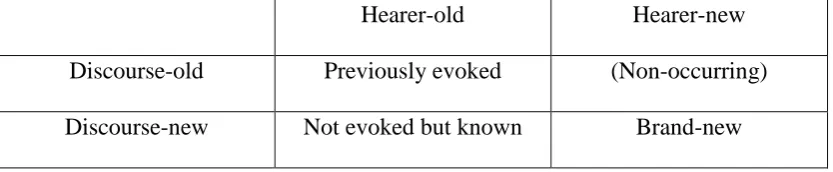
[image:31.595.86.503.459.545.2]On a similar vein, language users use a wide selection of non-canonical syntactic constructions to signal the information status (new/old) of the discourse elements (Ward & Birner, 2004, p. 153). According to Prince (1992), information status is subdivided into four different categories that interact with each other (cf. Table 2.1) (Prince, 1992, p. 313).
Table 2.1 Information Structure distribution(Prince, 1992, p. 315)
Hearer-old Hearer-new
Discourse-old Previously evoked (Non-occurring)
Discourse-new Not evoked but known Brand-new
23
across it before. To help in the understanding of these concepts, the following example is taken from Ward and Birner (2004, p. 156):
(2) The President gave a speech today, and in it he offered a new tax plan.
In the example above, the NP the President represents the information that is new but hearer-old, whereas the NP a speech represents information that is both discourse-new and hearer-new, and the pronoun it represents information that is old to both the discourse and hearer. It is worth mentioning that despite the seeming simplicity of the examples above, givenness has been found to be an indefinable concept in that many research studies have failed to identify a unitary notion of oldness that works for all of the non-canonical constructions (Callies, 2009). Prince (1981) describes this notion in terms of assumed familiarity, based on the fact that a language user structures information within discourse based on what he or she assumes is known to the hearer. Prince’s taxonomy of givenness covers several statuses, which are rephrased according to discourse-old/new and hearer-old/new (cf. Table 2.1) (Prince, 1992). This notion is important in that it relates to some of the concepts of information structure, namely focus and topic, which will be discussed below.
24
CANONICAL NON-CANONICAL
a. Laura baked a cake. b. It was a cake that Laura baked.
In the above example, b is an instance of an information packaging construction, whereas a represents its canonical (SVO) counterpart. In this pair, the truth condition is the same. Therefore, language provides different syntactic means to convey the same truth condition, with “the various versions differing in the way the content is organised informationally” (Ward et al., 2002, p. 1365). Thus, according to Ward, Birner and Huddleston (2002, p. 1366) “the non-canonical version can be regarded as less basic than its default counterpart in that the order is not only less frequent but subject to pragmatic constraints that do not apply to the default version”. However, the choice of one construction over another by language users is thought to be context dependent (Lambrecht, 1994). Information packaging (Chafe, 1976), sometimes referred to as information structure (Halliday, 1967), is mainly concerned with organising meaning by connecting old information with new information. Information packaging is understood “as a structuring
of sentences by syntactic, prosodic, or morphological means that arise from the need to meet communicative demands of a particular context or discourse” (Vallduví & Engdal, 1996, p. 460).
Lambrecht argues that some grammatical structures “arise diachronically from information structure constraints” (1994, p. 29). He suggests that an information structure is understood as being in the domain of discourse pragmatics, which “is concerned with the question of why one and the same meaning may be expressed by two or more sentence forms” (1994, p. 4). He defines information structure as follows:
25
with lexicogrammatical structures in accordance with the mental states of interlocutors who use and interpret structures as units of information in given discourse contexts
(Lambrecht, 1994, p. 5)
The above definition refers to sentence-level constructions whose function is to express differences in information structuring. These constructions are semantically similar, “but formally and pragmatically divergent surface manifestations of given propositions” (1994, p. 35). Lambrecht argues that these constructions express the same proposition, which refers to the complex meaning carried by the sentence. This proposition is made up of old information and new information, which Lambrecht refers to as “pragmatic presupposition” and “pragmatic assertion” respectively (1994, p. 52). He defines these two terms thus:
Pragmatic presupposition: The set of propositions lexicogrammatically
evoked in a sentence which the speaker assumes the hearer already knows or is ready to take for granted at the time the sentence is uttered.
Pragmatic assertion: The proposition expressed by a sentence which the hearer is expected to know or take for granted as a result of hearing the sentence uttered.
(Lambrecht, 1994, p. 52)
26
such constructions has a positive impact on language processing: “as soon as hearers can identify a given information packaging construction, they know immediately which part of the construction will convey new information to which they should pay the most attention” (Marten, 2013, p. 170).
The choice of one particular information structure construction over another is determined by several integrated factors. Of these factors through which linguistic information is structured in the exchange between speaker and hearer are: (1) the speaker’s assumption concerning the hearer’s knowledge or belief state at the time of utterance; (2) the hearer’s temporary state of consciousness; and (3) the hearer’s level of interest in the topic under discussion (Lambrecht et al., 2006). Lambrecht points out that speakers undergo a process of predicting what the hearer already knows and what could be new information, thus taking into consideration the hearer’s consciousness and awareness of the idea beingconveyed in the present context (Lambrecht, 1994, p. 53).
Lambrecht refers to the presence of ideas in the hearer’s consciousness as activation. The activation notion refers to those ideas in the hearer’s mind that are assumed by the
27
section (for a detailed discussion on the topic, the reader is referred to Lambrecht 1994, p. 117, see also Lambrecht et al., 2006).
2.3.1 Focus as an information structure category
Sentence-like utterances (utterances by which language users express a proposition) consist of a presupposition (an identification of the entity being talked about) and an assertion (a phrase that expresses what is being said about it). This latter part of the utterance, which carries and provides the new information, is called the ‘focus’. ‘Focus’ is that ‘portion of a proposition which cannot be taken for granted at the time of speech. It is
the unpredictable or pragmatically non-recoverable element in an utterance’ (Lambrecht, 1994, p. 207). Focus has been considered a universal information structural category to which many formal linguistic phenomena in many languages, such as pitch in prosody, and word reordering in syntax, often refer (Zimmerman & Onea, 2011). Focus, from a cognitive linguistic perspective, can be defined as the special attention that the speaker draws to a particular part of a sentence by evoking a set of alternatives that relates to an asserted utterance (Chen, 2003, 2013; Zimmerman & Onea, 2011).
28
Based on Lambrecht’s definition of focus, presupposition and assertion (mentioned in the previous section), Li (2008, p. 760) proposed the following formula to identify the notion of focus:
Focus = Assertion – Presupposition.
Lambrecht (1994) illustrates his definition of focus by providing a wh-question and answer such as the following:
(3) Q: Where did you go last night?
A: I went to the MOVIES. (Lambrecht, 1994:209)
Lambrecht argues that what can be inferred from the answer is the presupposition that the speaker went somewhere and the assertion provides a specification of the place by introducing the word “MOVIES”. Lambrecht (1994, p. 210) states that what makes the word MOVIES the focus of the sentence is its relation to the proposition (that the speaker went somewhere). This relation, which Lambrecht calls the ‘focus relation’, creates what is perceived as a piece of new information needed to answer the question. Accordingly, Lambrecht (1994) analyses example 2, taken from Akmajian (1973), as follows:
(4) Sentence: MITCHELL urged Nixon to appoint Carswell. Presupposition: x urged Nixon to appoint Carswell
Assertion: x=Mitchell
29
The sentence in (4) has a presupposition, and in this case Lambrecht claims that the focus is a pragmatic relation that evokes an understanding of the "focus of the assertion", which in turn facilitates the presentation of new information (Lambrecht, 1994, p. 213).
The notion of focus has often been relevant to information structural issues related to discourse management and organisation (Al-Jurgani, 1984; Birner & Ward, 1998; Kiss, 1998; Lambrecht, 1994, 2001; Zimmerman & Onea, 2011). Zimmerman and Onea (2011) state that focus belongs to common ground management as it assists information structure in the updating of common ground. They argue that “focus imposes an ordering relation on the overall set of possible worlds that serve as the general background for interpretation, such that a subset of worlds is identified as being relatively more important for the interpretation of a given utterance” (2011, p. 1652). In an attempt to establish a unified information structure for the characterisation of focus, they argue that focus indicates the presence of alternatives that hearers rely on in the process of updating common ground. From a communication perspective, these alternatives are evoked by an utterance carrying a proposition, which speakers produce based on their presuppositions or assumptions about what the hearer knows and/or needs to know (Lambrecht, 1994, 2001; Stalnaker, 2002).
From the previous discussion, then, it can be observed that focus is associated with notions such as introducing new or a missing bit of information to the discourse and evoking the existence of a set of alternatives to the focal element. In other words, focus is basically concerned with raising interlocutors’ attention to new or relevant piece of
information about the topic of an utterance or to the exclusion of other possible options that contrast with the focal element. As such, this suggests that focus is not restricted to one type, as it either carries an informational meaning or a contrastive sense. This in turn leads to the discussion of the types of focus, which will be presented in the following section.
30
2.3.2 Focus types and focus realisations
2.3.2.1 Focus types
Focus has been assigned different classifications in the literature (Zimmerman & Onea, 2011). The most widely discussed types are contrastive focus and non-contrastive focus (Kiss, 1998; Krefika, 2008; Zimmerman & Onea, 2011). Again, these types are given different names in the literature. Kiss (1998) in his treatment of focus uses the terms identificational focus and informational focus. These two types of focus serve as the part of the pragmatic proposition by which the assertion is different from the presupposition. However, identificational focus has been associated with the notion of exhaustiveness and exclusiveness (Kiss, 1998), which is not found in information focus. In this regard, it is worthwhile noting that the two terms, namely contrastive focus and identificational focus, are used interchangeably in this thesis. Li (2008, p. 760), adopting the term contrastive focus instead of identificational focus, explains that exhaustiveness refers to the idea that “the constituent under contrastive focus in a sentence is a complete list of the entities that makes the truth value of the proposition true”, while exclusiveness means that “those and only those entities under contrastive focus will make the truth value of the proposition true, excluding other entities”. This can be illustrated by considering the it-cleft construction in the following example taken from Li (2008):
(5) It was a hat and a shirt that Mary bought yesterday. (Li, 2008; 760)
31
On the other hand, information focus is usually associated with topic presentation and newness, generally referring to non-presupposed information (Halliday, 1967; Kiss, 1998; Zimmerman & Onea, 2011).
(6) a. It was a hat that Mary picked for herself.
b. Mary picked herself a HAT. (Kiss, 1998, p. 251)
Comparing the two sentences above, English it-cleft constructions evoke an exhaustive interpretation as in (6a), which means that Mary did not pick other items with the hat (this contradicts other possible alternatives as explained in 5) and in this case the sentence conveys identificational focus. The sentence in (6b) expresses the non-presupposed nature of information and hence conveys information focus (Kiss, 1998, p. 251).
32
2.3.2.2 Focus realisation
The grammatical realisation of focus constituents in languages varies and includes specific prosodic realisation, special morphological realisation and syntactic reordering. In the case of the focus constructions that are under investigation, the grammatical realisation of focus constituents is realised through both syntactic reordering and the insertion of additional lexical material (e.g. It is ...that…), apart from the preposing construction that consists of reordering only. Zimmerman and Onea (2011) provide examples for the realisations that they have taken from different languages. The following example is taken from English to illustrate the prosodic realisation of an object and a verb focus, respectively, by means of accent placement:
(7) a. Q: What did Peter sell?
A: Peter sold [the CAR\]FOC. b. Q: What did Peter do with the car?
A: He [SOLD\]FOC the car.
(Zimmerman & Onea, 2011, p. 1658)
Focus realisation by means of syntactic reordering is evident in Hungarian, where the constituent focused on is realised by placing it immediately before the verb. Zimmerman & Onea (2011) provide the following example taken from Szabolcsi (1981) to illustrate this kind of focus realisation:
33
b. A padlo´n [Pe´ter]FOC aludt. on floor Peter slept ‘PETER slept on the floor’.
(Zimmerman & Onea, 2011, p. 1661)
Zimmerman and Onea’s (2011) assumption is based on the fact that focus involves unexpected facts or a discourse shift that are/is difficult for the hearer to accommodate. Therefore, the speaker tries to assist the hearer with updating their background assumption by choosing “to use a non-canonical, i.e., a structurally more complex sentence that comes with additional grammatical marking in the form of, for instance, a particular intonation contour, syntactic movement, a cleft structure, or the insertion of morphological markers” (Zimmerman & Onea, 2011, p. 1665), as shown above.
Following a constructional grammar approach, Lambrecht (1994, 2001, 2010) argued that the dominant strategies for indicating focus vary as a function of language-specific constraints on syntax and prosody. In English, for example, the predominant means of realising or marking focus (i.e., the new or relevant information about the topic of an utterance) is through the use of word-level stress accent (i.e., stress or pitch accent) (Lambrecht, 1994; Reichle, 2010), which has relative freedom in its placement (Reichle & Birdsong, 2014). To exemplify, in the sentence “I’m eating PIZZA for dinner”, the spoken language marks “pizza” as focal through the stress or pitch accent, which in turn caries
34
2.4 Focus constructions in English and Arabic
When investigating the nature of focus constructions in English and Arabic, attention must be paid to two main dimensions: their form (morphosyntax) and function (semantics and pragmatics). The formal dimension of focus constructions is represented by the type of structure. Focus constructions in English have non-canonical word order as their main structural feature (Biber et al., 2002, p. 398), a part from the wh-cleft construction. This structural feature is also found in the Arabic focus construction, namely preposing. In this regard, the present thesis focuses on English focus constructions that involve changes in the canonical word order and aim to highlight the object in the sentence. There are two reasons for this; firstly, Arabic uses the preposing construction to focus the attention on the object only, and uses lexical means in addition to fronting to highlight the subject (Al-Jurgani, 1984). Another reason is to control for the type of focused element in the sentence (i.e. highlighting the object of the sentence not the subject or other element) in the present study to give a better understanding of the findings. It is important to highlight that the present study focuses on different English users’ knowledge of the appropriate use of focus constructions in the written mode only. Given that practical reasons did not allow for data collection on the basis of sound files, prosodic marking of focus in English will not be considered in the current work.
35
In Arabic, the non-canonical word order is the main feature of focus constructions, as the focus element is preposed to occupy an initial position in a sentence (Al-Jurgani, 1984, examples are presented in section 2.5.2, below). From a functional point of view, the focus constructions being dealt with in this study are of both the identificational focus type and the information focus kinds (see section 2.3.2.1, above). Below, more will be said about how these functions are linked to specific structures in the two languages.
2.4.1 Focus constructions in English
The range of English focus constructions covered in this study is illustrated by 8b-e, below, with 8a representing their canonical word order counterpart. These constructions, as pointed out in chapter 1, do not carry propositional meaning different from the canonical transitive construction. They basically serve a communicative function. Following a construction grammar framework, these constructions are viewed as carrying their own meaning independently of the words they contain (Goldberg, 1995). However, they are context dependent and share a similar discourse function that is highlighting the focal element. The focus constructionsunder investigation are presented in the following examples (9b-e).
(9) a. The students read the introductory textbook. (Canonical SVO) b. It is the introductory textbook that the students read. (it-cleft) c. What the students read was the introductory textbook. (wh-cleft) d. The introductory textbook was what the student read. (rwh-cleft)
e. The introductory textbook the students read. (preposing)
36
sentences 9b-e each have their own information structure that differs from 9a. In other words, each of these constructions packages the information differently without affecting the basic semantic structure of the sentence in 9a. Following Lambrecht (1994), the proposition shared by the constructions in 9 can be represented in 10:
(10) a. Presupposition (Background): The students read X.
b. Highlighted (Foreground or focus): the introductory textbook c. Assertion: X is the introductory textbook.
The choice of using a focus construction in a communicative situation is pragmatically motivated, depending on the discourse context (Lambrecht, 1994, 2001; Zimmerman & Onea, 2011). For example, some wh-questions permit special focus constructions to occur as an answer and therefore 11 b-c serve an information focus function (Kiss, 1998):
(11) a. What did the student read?
b. The introductory textbook the student read. c. The introductory textbook read the student.
d. *It was the introductory textbook that the student read.
37
the use of the it-cleft would be considered an appropriate answer in this context. For example:
(12) a. What did the student read, the article or the textbook? b. It was the textbook that the student read.
2.4.1.1 Clefts
Clefts are constructions that are present in many languages of the world and which serve as focus markers (Kiss, 1998; Lambrecht, 2001; Zimmerman & Onea, 2011). Lambrecht describes cleft constructions as follows:
A CLEFT CONSTRUCTION (CC) is a complex sentence structure consisting of a matrix clause headed by a copula and a relative or relative-like clause whose relativized argument is coindexed with the predicative argument of the copula. Taken together, the matrix and the relative express a logically simple proposition, which can also be expressed in the form of a single clause without a change in truth conditions.
(Lambrecht, 2001, p. 467)
38
(13) a. I like coffee. Canonical sentence b. It is coffee (that) I like. it- cleft
c. What I like is coffee. wh-cleft
d. Coffee is what I like. reverse wh-cleft
These three types of cleft constructions serve to package information differently but share common pragmatic aspects (Lambrecht, 2001). Lambrecht suggests that the choice of one cleft construction over another is determined by four main factors: the speaker’s assumption about the hearer’s knowledge in the current context, the end-weight principle, topicality and construction-specific constraints (see also Hilpert, 2014, p. 181). Accordingly, Hilpert (2014, p. 181) argues that the use of cleft constructions is closely related to the activation of a pragmatic presupposition in the context and the constituent under focus is often syntactically light. Although wh-cleft constructions take in to account the speaker’s assumption about the hearer’s knowledge in the current context (activation), it can possibly occur in a situation with a semi-active pragmatic preposition. Consider the following example:
(14) What did you buy from the flower shop? a. What I bought was a red rose. b. It was a rose that I bought.
39
structure of the it-clefts clause can be further analysed into the pronoun it, the copula and the focused constituent, as exemplified in 14b, above. Fronting the focused element within the it-cleft gives it an emphasising effect, which is less salient in the wh-cleft. This emphasis relates to the idea that it-clefts carry identificational (contrastive) focus (presented in section 2.3.2.1). This feature makes the it-cleft appropriate in contexts in which a pragmatic proposition is highly activated.
The wh-cleft plays a role in discourse management. It serves to indicate explicitly what is taken as background information (Biber et al., 1999, p. 963). The wh-cleft consists of a clause introduced by a wh-word, a form of the verb BE and a specially focused nominal element (Biber et al., 2002, p. 421). The wh-cleft typically presents the verb at the beginning of the sentence as in canonical sentences. This facilitates the presentation of a major point in the focus sequence (Callies, 2008, p. 47). In a wh-cleft the background information is given first, in a wh-clause, followed, after the copula, by a focus constituent occurring at the end of the sentence. It can be noted then that a wh-cleft is in line with the information flow principle, end-focus and end-weight (Biber et al., 2002, pp. 398-399; Callies, 2008, p. 57). Unlike an it-cleft, a wh-cleft does not exhibit the pragmatic meanings of exclusiveness and/or exhaustiveness but rather expresses information focus (Callies, 2008, p. 57).
40
2.4.1.2 Preposing
Preposing is broadly defined as a “sentence type in which a canonically post verbal phrase constituent appears in preverbal position” (Birner and Ward, 1998, p. 31). However,
the subject still occupies its preverbal position before the verb. Preposing has often been referred to as fronting or topicalisation (Callies, 2008; Chen, 2013). Preposed constituents are not restricted to a particular phrasal category, but the most commonly preposed elements are nominal, often objects (Callies & Keller, 2008, p. 252). An example of preposing is as follows:
(15) Brains you’re born with. A great body you have to work at.
(Ward & Prince, 1991, p. 170)
Preposing links the preposed constituent to the previous discourse, depending on the kind of context in which 15 would occur, i.e. whether Brains have already been introduced into the discourse. Preposing is often used to contrast or emphasise a particular element in a given context (Callies & Keller, 2008, p. 252). As far as the function is concerned, preposing has been associated with contrastive emphasis (Kiss, 1998; Chen, 2003), specifically in oral production.
2.4.2 Focus constructions in Arabic
41
aspects of Arabic structure when dealing with types of sentences. Preposing is considered one of the meaning-sensitive movements2 that affects the internal structure of Arabic sentences and which serves to add emphasis by drawing attention to the preposed element, as in the following example from Suleiman (1989, p. 218):
(16) daraba aliyyun zaydan (VSO)
hit Ali Zayd
‘Ali hit Zayd.’
2.4.2.1 Obligatory preposing
It is worth noting that Arabic allows two kinds of preposing (of either subject or object) to take place: obligatory preposing and optional preposing (Suleiman, 1989). Obligatory preposing “is an inherent pattern of the Arabic sentence structure in which case the meaning is normally intact and there are no special interpretations of sentence meaning incurred by preposing” (Suleiman, 1989, p. 219). Suleiman argues that this kind of preposing does not involve transformational movements3, which often “call for a reinterpretation of language functions in a discourse perspective” (1989, p. 219). Major cases of obligatory object preposing are discussed by Suleiman (1989, p. 221). One case of obligatory object preposing is when a subject contains a pronoun that refers to the object, as in the following example:
2 My use of the term “movement” here (and of “preposing” elsewhere) does not reflect a commitment to a
transformational model of grammar (for my general theoretical stance see section 2.2.1, above, on construction grammar). At this point, its use is motivated by the fact that the term is so commonly used in the literature for these kinds of constructions.
3 Please note the difference in theoretical approach between Suleiman and the present study; see fn.2,