© 2019, IRJET | Impact Factor value: 7.34 | ISO 9001:2008 Certified Journal
| Page 1077
COMPARATIVE STUDY ON CONVENTIONAL SLAB AND FLAT SLABS RCC
STRUCTURE USING PUSHOVER ANALYSIS
Mawan Rasheed
1, Dr Ramakrishna Hegde
2,
Bhavani Shankar
31
PG Student, Dept. of Civil Engineering, Srinivas School of Engineering, Mukka Suratkal, Mangalore
2
Head of Department and Professor Dr Ramakrishna Hegde,
3
Assisant Professor Bhavani Chankar Dept. of Civil Engineering, Srinivas School of Engineering,
Mukka Suratkal, Mangalore
---***---ABSTRACT - Earthquake is caused due to a geotechnical
activity in the earth strata followed by sudden release of energy which is highly unpredictable and cause heavy losses if it occurs in populated areas. It is well known said that quake does not destroy creatures nevertheless the fragile constructions do.
This study deals with the seismic demand and capacity of various types of RCC structures namely RCC structure with conventional slab and RCC structure with Flat slab by using pushover analysis using FEMA 356 and ATC-40 and ASCE 41-06 codes. The nonlinear behaviour of a building in lateral forces, base shear and roof displacement relation i.e. capacity curve is attained pushover analysis.
Inelastic, nonlinear static analysis i.e. pushover analysis is favoured aimed at the performance assessment for his effortlessness.
In present study seismic performance of 3 type of structures are compared under pushover analysis with varying heights i.e.G+5, G+6conventional building and G+5, G+6 flat slab with drop RCC building and flat slab without drop.
The gained outcomes are linked in standings of Base shear, Storey displacement, and storey drift. On comparison of conventional slab building and flat slab with drop and without drop RCC building, conventional slab building is considered to be more efficient by considering the variations in pushover curve. Base shear of various structures are having a deviation of about 60-70%.and Storey drift and storey displacement of conventional slab RCC building is found to be less than the flat slab and flat plate RCC structure at the maximum level. As a whole conventional slab structure is considered to be more seismic efficient than flat slab and flat plate RCC structure.
Key Words: Conventional slab, flat slabs, pushover analysis, Base Shear, storey displacement, storey drift, pushover curve.
1. INTRODUCTION
The abrupt discharge of energy in the ground’s shell generates seismic impressions which spread on the ground exterior next to numerous occasion of interval with diverse amount of ranks; the overhead miracle is
so-called by way of Earthquake. It results in haphazard ground indication happening all orders, burning on or after epicentre (initial point of Quake), which creates building towards vibration owed toward which tempt inertial forces advanced in assembly. Numerous present buildings are seismically poor owing to absence of consciousness about seismic performance of buildings. Owing to this, here is crucial necessity to converse this condition and do the seismic assessment of standing and fresh buildings and assess the utmost fit and desirable kind of building for seismic areas.
1.1 EARTHQUAKE AREAS OF INDIA
The India is a sub continental having a past of distressing quakes. Dynamics of Indian plates towards the Asia at the speed of 47mm/year is the key reason for high frequency and high intensity earthquake in India. The geographical study of India suspects that 54% of the India land is prone for earthquakes. Report by World Bank and United Nations predictable that about 200 million town inhabitants in India will remain unprotected to rainstorms and quakes by around2050.the newest seismic areas of India is given in earthquake resistance design codes of India IS 1893-2002(part 1) and the zones are allocated into 4 areas. Zone 2, zone 3, zone 4, zone 5 conferring towards the newest research the 5th zone is considered to have highest level of
seismicity and zone-2 is considered to be having lowest level of seismicity.
1.2 PUSHOVER ANALYSIS
The study of structure and evaluation of their performance point can be done by using various techniques under the given gravity loading. The most accurate method is non-linear time history analysis, but the buildings through less significance can be analysed by non-linear static pushover analysis.
The methodologies available designed for seismic evaluation of existing and proposed buildings are divided in to two groups.
1. Method having quantitative analysis.
© 2019, IRJET | Impact Factor value: 7.34 | ISO 9001:2008 Certified Journal
| Page 1078
Seismic analysis is a subtopic of structural engineering and exist the evaluation of response of structures for ground motion and is the part of the structural design. Seismic evaluation is very useful for earthquake work, structural valuation and retrofitting in the region where earthquake stay predominant. Structural analysis or seismic analysis is further separated into the resulting classes.
1. Equivalent Static Analysis.
2. Response Spectrum Analysis.
3. Linear Dynamic Analysis.
4. Nonlinear Static Analysis (pushover analysis).
5. Nonlinear Dynamic Analysis.
Pushover analysis is a parametric incremental non-linear static analysis accepted to determine the capability of a structure on basis of force vs displacement behaviour or to determine required capacity curve for the various structural component. The analysis contains enforcing lateral loads to a digital prototype of the assembly incrementally (i.e. pushing the structure), and comparing the applied shear force at each steps.
Pushover analysis is a parametric incremental non-linear static analysis procedure in which the degree of the structural loading is incrementally amplified. By the incremental intensification in the amount of the loading, weak links and the means of failure of building are established. The three simple fundamentals of this technique are
Capacity: - It characterizes capability of the buildings to counterattack the seismic demand the complete capability of structure rest on the structural strength and structural deformation capacity of various component of building. Non-linear pushover analysis is formulated towards determining the capability of structure beyond its elastic limit
Demand: - It symbolizes the quake ground motion. Horizontal displacement pattern is developed in a structure during quake ground motion.
Performance: - It is crossing point of capacity spectrum and demand spectrum
1.3 AREA OF STUDY
a) Understanding about interaction of RCC structure with conventional slab and flat slabs arrangement under the shaky ground condition.
b) To evaluate proposed as well as existing buildings to implement on earthquake coverage up to the potentials and in agreement with building codes.
c) To compare the RCC structures under various parameters such as Base shear, Storey displacements, Storey Drift, Height Variations etc.
1.4 PROPOSED WORK AND OBJECTIVES
a) To explore and understand standard static pushover analysis with their gains, restrictions and dominance.
b) To use structural analysis software Etabs2016 and to evaluate pushover analysis of RCC constructions under various slabs attention.
c) To examine behavior and performance of conventional slab RCC structure and Flat Slab with drop and without drop RCC structures.
d) To study and assess several seismic valuation factors such as pushover curve, capacity curve.
e) To evaluate the structures using pushover analysis by various parameters such as base shear, storey displacements, storey drift under height variations.
2. LITERATURE SURVEY
The non-linear static pushover analysis came into existence in 1970’s, but the major requirement is observed in the previous 10 to 15 years. This technique is mostly used to evaluate the strength and seismic demand of a structure of existing as well as proposed structure. The application of pushover analysis and its evaluation procedures brought in to several seismic guidelines like FEMA 356, ATC-40 etc. in recent few years.
1. Ms. Nivedita N. Raut & Ms. Swati D. Ambadkar (2013)
2. Neetu KN & Sajid KP (2015)
3. Mandanar Anusha (2016)
4. Syed Ahamed, Dr Jagadish G Kori
5. M. Mouzzoun et.al , O. Moustachi, A. Taleb, S. Jalal
6. A. Kadid et.al (2008)
7. Ms. Nivedita N. Raut et.al (2013)
8. S.C. Pednekar, [9]
3. THREORY AND FORMULATIONS
3.1 DESCRIPTION TO PUSHOVER ANALYSIS.
© 2019, IRJET | Impact Factor value: 7.34 | ISO 9001:2008 Certified Journal
| Page 1079
forces. The premature failure or weakness of structure is indicated by the plot of base shear vs displacement obtained
3.2 PERFORMANCE BASED SEISMIC APPROACH.
Federal Emergency Management Agency (FEMA) and Applied Technical Council (ATC) are the two agencies which formulated and suggested the Non-linear Static Analysis or Pushover Analysis under seismic rehabilitation programs and guidelines. The documents formulated are named asFEMA-356, FEMA-273 and ATC-40.
3.2.1 FEMA-356 GUIDELINES INTRODUCTION.
The chief aim and intentions of FEMA-356 article is to provide technically complete and country wide adequate procedures for the seismic rehabilitation of buildings.
3.2.2 ATC-40 GUIDELINES INTRODUCTION.
Earthquake/ seismic assessment and retrofitting of reinforced concrete structures usually pointed towards ATC 40 guidelines, which was financed by California safety commission and developed by a well-known council call to be Applied Technology Council (ATC).
3.4 TYPES OF PUSHOVER ANALYSIS:
1. CAPACITY SPECTRUM METHOD:
Capacity Spectrum Technique is a non-linear static examination process which delivers a graphical illustration of the predictable seismic performance of the construction using interconnecting the structure’s capacity spectrum through the response spectrum which is also called as demand spectrum under earthquake loads.
2. DISPLACEMENT COEFFICIENT METHOD
Displacement Coefficient Method is another type of pushover analysis in which the numerical technique is used to determine the displacement demand or said to be the performance of structure by using series of factors such as modification factors and other coefficients, to estimate the target displacements. But in this study the target displacement used to be 4%of storey height/ height of the building.
3.5 THE HINGES
The yielding point called to be hinges, are considered to be the point where the structure is expected to get cracks and may yield under the presence of high intensity loadings and consequently it resembles the flexural and shear displacements, when it comes nearer to the ultimate loadings.
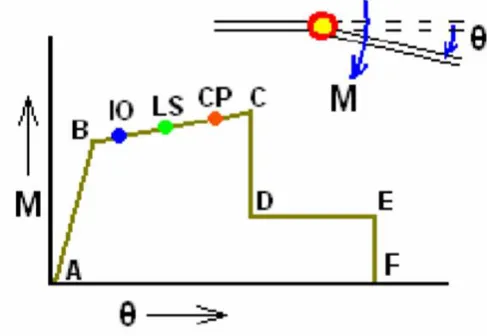
[image:3.595.316.560.324.492.2]Flexural hinge signifies the moment-rotation (M3) interaction of a beam which is typically represented in figure from the figure the range AB signifies the linear and elastic phase of the structure under unloaded state considered to be at A and elastic yielding point be at B, then followed by linear but inelastic phase from B to C which signifies the reduction in stiffness or ductility of the structure. CD phase signifies the reduction of resistance of load suddenly. And then resistance reductions from D to E again, then the total loss of resistance of loads in showcased in E to F. the hinges in the structural frame is shown in below figure. The hinges are further categories in non-linear states such as ‘Immediate Occupancy’ (IO), ‘Life Safety’ (LS) and ‘Collapse Prevention’ (CP) within its ductile range, which can be achieved by dividing the phase BC in 4 sub phases. The symbolic denotations are IO, LS, and CP, (infact the phase’s sub divisions will be based on the drift/displacement limits)
Figure-1: performance level of structure.
3.6 THE ANALYSIS OF ETABS
1. Modelling
2. Static analysis
3. Design
4. Pushover analysis
3.6.1 STAGES FOR PUSHOVER ANALYSIS IN ETABS.
© 2019, IRJET | Impact Factor value: 7.34 | ISO 9001:2008 Certified Journal
| Page 1080
2. The hinges for RCC structures are employed according to ATC 40 and for steel structure FEMA 273 will be considered.
Figure-5: pushover load definition
Figure-6: definition of pushover displacement
Figure-7: pushover analysis
4. MODELLING
In This thesis the RCC structure with various kinds of slabs arrangements are considered for the study and evaluation under the pushover analysis. The various types of slab considered under seismic study area conventional slab,
flat slab with drop, flat slab without drop for the variation of height of a building such as G+5 and G+6 under same region of quake. The several parameters which are used under the software modelling of buildings are defined in this study; additionally the basic and essential assumptions are done for the modelling and definition of model under pushover analysis
4.2. STRUCTURAL ELEMENTS:
The building dimensions used for the study is shown below.
Table-1: plan dimension of building
stor
ey Length bays in x-of direction(m eters)
Length of bays in y-direction(m eters)
Ht. of flo or
No. of Bays x-direct ion
No. of Bays y-direct ion
6 5 3 3 4 4
Table-2: preliminary details of conventional slab building
Sl.no Variable Data
1. Types of structures Moment Resisting frame
2. Storey numbers 6 & 7
3. Height of floor 3m
4. Live load 3.0 kN/m2
5. Floor finish 1.0 kN/m2
6. Wall Load external 11 kN/m 7. Wall load internal 5.5 kN/m
8. Materials or
constituents used in structure
Concrete (M25) , steel HYSD bars(Fe415)
9. Column size 300x600mm
10. Size of a beam 300x450mm 11. Slab thickness 150mm thick 12. Specific weight of RCC 25 kN/m3
13. Zone 3
14. Importance factor 1.0 15. Response reduction
factor 5.0
16. Soil condition Medium
Table-3: preliminary details of flat slab building
Sl.no Variable Data
1. Types of structures Moment Resisting frame 2. Storey numbers 6 & 7
© 2019, IRJET | Impact Factor value: 7.34 | ISO 9001:2008 Certified Journal
| Page 1081
4. Live load 3.0 KN/m3
5. Floor finish 1.0 KN/m3
8. Materials Concrete (M25) , steel HYSD bars(Fe415)
9. Column size 300x600mm
10. Depth of slab 200mm thick 11. Slab drop depth
(1.8mx1.8m) 75mm thick 12. Specific weight of
RCC 25 kN/m
3
13. Zone 3
14. Importance factor 1.0 15. Response reduction
factor 5.0
16. Soil type Medium
Table-4: preliminary details of flat plate building
Sl.no Variable Data
1. Types of structures Moment Resisting frame 2. Storey numbers 6 & 7
3. Height of floor 3m 4. Live load 3.0 KN/m3
5. Floor finish 1.0 KN/m3
8. Materials Concrete (M25) , steel HYSD bars(Fe415)
9. Column size 300x600mm
10. Depth of slab 300mm thick 11. Specific weight of
RCC 25 kN/m
3
12. Zone 3
13. Importance factor 1.0 14. Response reduction
factor 5.0
15. Soil type Medium
4.3 WORK TO BE CARRIED OUT IN THIS STUDY.
1. Performance based analysis is to be carried out for conventional slab RCC building and flat slab RCC building
2. Comparative study is to be done for conventional slab RCC building and flat slab RCC building
3. For this evaluations IS 1893-2002, ATC-40 and ASCE 41-06 is used.
4. ETABS Software is used for the evaluation work.
5. Pushover curve is evaluated for conventional slab RCC building and flat slab RCC building.
4.4 DESCRIPTION OF BUILDING
Figure-7: Basic model of G+5 conventional slab building
Figure-7: Basic model of G+5 flat slab building
Figure-7: Basic model of G+5 flat plate building
4.5 ASSUMPTIONS MADE FOR PUSHOVER ANALYSIS.
1. Material is considered to be linearly elastic, homogeneous and isotropic.
2. All columns are considered to be subjected with a fixed supports for the foundations.
3. Concrete’s tensile strength will be neglected.
4. The superstructures is analyse by neglecting the effect of soil and foundation strength.
© 2019, IRJET | Impact Factor value: 7.34 | ISO 9001:2008 Certified Journal
| Page 1082
6. Pushover hinges assigned for the analysis will be considered for auto hinge.
7. The maximum target displacement is adopted to be 4% of floor height / height of a building. (According to ASCE 41-06 and research paper considered for validation).
4.6 PERFORMANCE BASED ANALYSIS USING PUSHOVER
ANALYSIS:-The following steps are followed for pushover analysis on various types of structure to determine the seismic performance of structure.
1. Basic models of conventional slab, flat slab with drop and without drop RCC Structure for G+5 and G+6 storey buildings are created followed by respective material and section definition.
2. The required material and component of building, the section of building are defined in details.
Figure-11: definition of concrete material
Figure-12: definition of steel material
Figure-13: definition of beam section
Figure-14: definition of column section
Figure-15: slab section for conventional slab building
© 2019, IRJET | Impact Factor value: 7.34 | ISO 9001:2008 Certified Journal
| Page 1083
Figure-17: slab drop section for flat slab building
Figure-18: slab section for flat plate building
Figure-19: definition of pushover load
Figure-20: definition of pushover load-x direction
Figure-21: definition of pushover displacement
3. Hinges criteria for pushover analysis for the structure is defined according to ATC-40 for concrete structure and FEMA 273 for steel structure. Hinges are assigned for column at 5% and 95% of position for both push-x and push-y loads and of PMM type. Hinges assigned for beam while be for 5% and 95% positions and of M3 type4.
Figure-22: insertion of hinges
© 2019, IRJET | Impact Factor value: 7.34 | ISO 9001:2008 Certified Journal
| Page 1084
5. RESULTS AND DISCUSSIONS.
The structure analysed under pushover analysis will be studied by using pushover curve. Pushover curve defines the capacity of structure. The overall capacity of structure is defined and based on the deformation and load carrying capacity of individual components of a structure. Pushover analysis is pioneer to determine the capacity of structures beyond the elastic limits.
1. Pushover curve is made for controlled nodes. The pushover curve for various types of structure for G+5 and G+6 Building is shown in table and figure.
Figure-24: pushover curve G+5 Building
Figure-25: pushover curve G+6 Building
2. The base shear of structures will be compared for both types of structures. Figure 5.3 and figure 5.4 shows the base shear of conventional and flat slab RCC structures at the performance point.
Table-5: Base shear of G+5 building at performance point
Sl.no Conventional slab Flat slab Flat plate Base shear 4260.76 kN 3938.99 kN 6107.33kN %variation 69.8% 65.5% 100%
Table-6: Base shear of G+6 building at performance point
Sl.no Conventional slab Flat slab Flat plate Base shear 4219.70 kN 2549.91 kN 2553.2 kN %variation 100% 60.2% 60.51%
Figure-26: Base shear of G+5 building
Figure-27: Base shear of G+6 building
3. The storey displacement is defined by the building’s lateral displacement with respect to base of building. The plot of storey displacement with respect to the height of storey for conventional slab, flat slab and flat plate RCC structures for G+5 and G+6 building at performance point is shown in figure.
© 2019, IRJET | Impact Factor value: 7.34 | ISO 9001:2008 Certified Journal
| Page 1085
Figure-29: Storey displacement of G+6 building
Figure-28: storey displacement of G+5 building at max
Figure-28: storey displacement of G+5 building at max
Table-6: storey displacement of G+5 building at max
Height Maximum storey
displacement(mm) Percentage variations of storey
Conventi
onal slab Flat slab Flat plate
18 (G+5) 110.05 140.0 95.3 78.6 86.59 21 (G+6) 123.89 92.70 50.3 73.9 40.14
Table-7: storey displacement of G+5 building at performa
Height Storey Displacement at the Performance Point (mm)
Percentage variations
Conventi
onal slab Flat slab Flat plate
18 (G+5) 50.26 59.0 75.5 84.88 66.33 21 (G+6) 59.11 53.0 37.1 90.04 69.92
4. The storey drift is defined as the difference between displacements of two consecutive storeys by height of that storey. The plot of storey drift with height of storey at performance point of G+5 and G+6 conventional slab,
Figure-29: storey drift of G+5 building
Figure-30: storey drift of G+6 building
Table-8: storey drift at performance point
Storey displacement of G+5 building (m) At the performance point
Conventional
slab structure Flat slab Flat plate G+5 0.000991 0.001464 0.001499
© 2019, IRJET | Impact Factor value: 7.34 | ISO 9001:2008 Certified Journal
| Page 1086
6. CONCLUSION AND SCOPE OF STUDY
1. Pushover analysis generally focuses on generation of pushover curve, which represent lateral displacement with the function of force and considered to be the representation of capacity of structure for seismic demand.
2. Base shear signifies stiffness and flexibility of structure, the base shear for conventional slab, flat slab with drop and flat slab without drop RCC structure of G+5 and G+6 building at the performance point is shown in above table the overall percentage variation of base shear is considered to be 60-70%.
3. Base shear of flat slab without drop is more in case of G+5 building followed by conventional slab building and flat slab without drop structures. But as the height of the structure increases the base shear of conventional slab structure reduces slightly but there is a drastic decrease in the base shear of flat slab with drop and without drop structure.
4. It is concludes that the storey displacement of conventional slab structure and flat slab with drop structure is almost similar and flat slab without drop structure displace more in compare with other two structure for G+5 building at performance point.
5. Flat slab without drop structure displaced less in compare with other two structures for G+6 building. So at the performance point according to storey displacement by height relationship the conventional slab structure is considered to have same seismic demand for G+5 building in compared with other two buildings but in contrary the capacity of flat slab without drop is compared to be more as the height of building increases for G+6 building at performance point.
6. The percentage variations of displacement conventional slab and flat slab with drop structure in G+5 and G+6 building is 79% and 74% respectively. The percentage variations of displacement conventional slab and flat slab without drop structure in G+5 and G+6 building is 87% and 40% respectively.
7. The storey drift is considered to be less for structure having for efficient for seismic demand. From above mentioned plot the conventional slab RCC structure is more seismic efficient than flat slab with drop and without drop RCC structure.
8. The storey drift of conventional slab RCC structure is considered to be less in compared with other two structures, but in contrary as the height of building increases then the storey drift of conventional slab
RCC structure is considerably more than other two structures.
9. There is considered changes in the base shear of building on increase in number of storey. But in both the cases the flat slab structures are considered to more stiff than conventional slab RCC structure.
6.1 FUTURE SCOPE OF STUDY
1.The present study is analysed for G+5 and G+6 storey building, which can be extended for tall structures as well.
2.In present study symmetrical building is considered, this study can be extended for asymmetrical section which includes with effects involved with asymmetric structure.
3.In above study, infill walls are not considered for analysis, the structures with infill walls and with different kinds on slabs can be considered for analysis.
4.The comparative study of concrete, steel and composite can be used for the pushover analysis.
5.The comparative study on RCC or steel Structures by using different types of pushover analysis can employed for further study i.e. pushover analysis by force control and pushover analysis by displacement control.
REFERRENCE
[1] Ms Nivedita N. Raut & Ms Swati D Ambadkar, “pushover analysis of multi-storey building” ISSN: 2249-4596 Volume 13, Issue 4 (2013).
[2] Neetu KN & Sajid KP, “pushover analysis of RCC building” ISSN: 2319-7046 Volume 4, Issue 8 (August 2015).
[3] Rathod Chiranjivi, Saddinent Ramakala, Mandala Venugopal and, Mandanar Anusha, “seismic analysis of flat slab with drop and conventional structure” ISSN 2278-0181 volume 5 Issue 10 (October 2016).
[4] Syed Ahamed and Dr Jagdish G Kori “performance based seismic analysis of an unsymmetrical building using pushover analysis” ISSN 2321-7758 Volume 1, Issue 2 (2013).
[5] M. Mouzzoun, O.Moustachi, A. Taleb, S. Jalal, “Seismic performance assessment of reinforced concrete buildings using pushover analysis” ISSN: 2278-1684 Volume 5, Issue 1 (Jan. - Feb. 2013).
© 2019, IRJET | Impact Factor value: 7.34 | ISO 9001:2008 Certified Journal
| Page 1087
civil engineering” (BUILDING AND HOUSING) VOL. 9, NO.1 (2008).
[7] Federal Emergency Management Agency, “NEHRP Guidelines for the Seismic Rehabilitation of Buildings”, FEMA356, Washington, D.C., 2000.
[8] Applied Technology Council, “Seismic Evaluation and Retrofit of Concrete Building, ATC-40”, Volume 1and 2, Report NO.SSC 96-01, Seismic Safety Commission, Redwood City, 1996.
[9] S. C. Pednekar, h. S. Chore, s. B. Patil pushover analysis of reinforced concrete structures international journal of computer applications (0975 – 8887) international conference on quality up-gradation in engineering, science and technology (icquest2015)
[10] Dhileep. M, Trivedi. A, Bose. P.R. Behavior of high frequency modal responses in nonlinear seismic analysis.
BIOGRAPHIES
Dr Ramakrishna Hedge, head of department and Professor Srinivas School of Engineering Mukka Mangalore
Mr Bhavani Shankar Assistance Professor Civil Engineering Department Srinivas School of engineering Mukka Mangalore