University of South Carolina
Scholar Commons
Theses and Dissertations
2015
The Essence of Alternative Education: A
Phenomenological STudy of the Lived Experiences
of At-Risk Secondary Alternative School Students
LaTunya Glenn MeansUniversity of South Carolina - Columbia
Follow this and additional works at:https://scholarcommons.sc.edu/etd Part of theEducational Administration and Supervision Commons
This Open Access Dissertation is brought to you by Scholar Commons. It has been accepted for inclusion in Theses and Dissertations by an authorized
administrator of Scholar Commons. For more information, please [email protected].
Recommended Citation
The Essence of Alternative Education: A Phenomenological Study of the
Lived Experiences of At-Risk Secondary Alternative School Students
by
LaTunya Glenn Means
Bachelor of Arts
University of South Carolina, 1992
Master of Arts
University of South Carolina, 2000
Master of Arts Converse College, 2004
Educational Specialist University of South Carolina, 2008
Submitted in Partial Fulfillment of the Requirements
For the Degree of Doctor of Philosophy in
Educational Administration
College of Education
University of South Carolina
2015
Accepted by:
Zach Kelehear, Major Professor
Warren Carson, Committee Member
Rhonda Jeffries, Committee Member
D
EDICATIONTo my husband, Reginald Means, Sr., I know love is an action word. You have shown
your love for me throughout this process. It takes a strong man to stand in the gap and to
keep the family stable as I spent countless hours in the library and at the research site
writing and gathering data respectively. Honey, I love you. Thank you for loving me!
This is OUR degree! To my children, Derrick, Maurice, and Kayla, I thank you for
giving me space to work. You are a pleasure to be around, and you keep amazing me.
You are destined for greatness. God has not given you the spirit of fear—don’t forget!
To my parents, Hilliard Glenn and Louise Redmond Glenn, and to my parents Arthur
Means, Sr. and Mamie Means, you have all taught me so much about myself. You
encouraged me to never quit and to follow through until the end. I love you. I could
never have gotten here without leaning on you—you are my rocks. To my brothers, Erik
and Michael and my other brothers, Arthur, Jr., Michael, and RoDerick, and to my
nieces, nephews and cousins, go get everything you want out of life! To my best friend,
Adrienne Crowley, you know…girl you KNOW!!! I love you all!!!
Finally, I stand on the shoulders of my grandparents, aunts, uncles and others who have
paved the way for me before I was ever born. I am who I am because of those who made
it though the middle passage, decades of degradation, and years of humiliation so that I
A
CKNOWLEDGEMENTSPraise God from whom all blessings flow! I am eternally grateful to God for
placing the right people in my life at the precise moments I needed them on my journey toward
the Ph.D. I would like to acknowledge my committee: Dr. Zach Kelehear, thank you for being
the anchor that held tight when I wanted to sink the ship. Dr. Lynn Harrill, thank you for being
the periscope that kept me focused on the task at hand. Dr. Rhonda Jeffries, thank you for
helping me to explore different perspectives. Dr. Warren Carson, I thank you for being my life
vest, when I had fallen into the inevitable choppy waters—over and over again. A million
accolades would not suffice! Although she was not a committee member, I would like to thank
Dr. Michelle Meekins who saw an educator in me when I thought my career as an accountant was
settled.
To the Superintendents whose students are served at my research site, I would like to
thank you for giving me permission to work with the participants. I would like to acknowledge
the director of my research site for opening his doors to me and trusting me with his students,
faculty and staff. Finally, I would like to thank Dock, Jass, Herb, and Kaye for their commitment
to me during this process. Without their input, my study would have been a bust. They took the
time to share their experiences that will hopefully lead to more productive educational
opportunities and better educational outcomes for the students who find themselves placed in
alternative schools for “at-risk” students.
A
BSTRACTWhat do the lived experiences of at-risk high school students reveal about the
essence of alternative education? This phenomenological study sought to reflectively
examine the experiences of at-risk students who are being educated in a large, Type II,
alternative school in South Carolina. The research participants are high school
students--grades 9-12--who have spent at least one year in a traditional high school setting and at
least one year in the County Alternative Program (CAP). The literature review
highlighted the historical role of high schools in the United States, the role of high
schools, high school redesign and the evolving role of alternative schools serving at-risk
students. The review of literature also identified effective alternative school programs.
The literature review helped the reader to understand the current state of affairs related to
alternative education and how such affairs are connected to the socially constructed
themes participants revealed in the study. The researcher used qualitative methodology
such as individual interviews and focus group interviews to organize participant data into
thematic statements that reveal the essence of alternative education. This study, based on
student perspectives, is not meant to be a prescriptive fix for the ills associated with
alternative education. It is meant to open streams of dialogue about alternative education.
Through increased dialogue, those in educational leadership may be led to consider
student experiences in addition to student behavior and academic performance as they
T
ABLE OFC
ONTENTSDEDICATION ... iii
ACKNOWLEDGEMENTS ... iv
ABSTRACT ... v
CHAPTER 1 INTRODUCTION ... 1
1.1 OVERVIEW OF STUDY CONTEXT ... 2
1.2 PROBLEM STATEMENT ... 4
1.3 PURPOSE STATEMENT ... 6
1.4 RESEARCH QUESTION ... 6
1.5 RESEARCH APPROACH ... 6
1.6 RESEARCHER’S EXPERTISE ... 8
1.7 RESEARCHER’S ASSUMPTIONS ... 9
1.8 RATIONALE AND SIGNIFICANCE ... 9
1.9 DEFINITION OF KEY TERMINOLOGY ... 11
1.10 THEORETICAL FRAMEWORK ... 15
CHAPTER 2 LITERATURE REVIEW ... 16
2.1 THE HISTORICAL ROLE OF HIGH SCHOOLS ... 17
2.2 HIGH SCHOOL REDESIGN ... 22
2.3 THE EVOLVING ROLE OF ALTERNATIVE SCHOOLS SERVING AT RISK STUDENTS .... 25
2.4 NEGATIVE OBSERVATIONS ASSOCIATED WITH ALTERNATIVE SCHOOOL ... 29
CHAPTER 3 METHODOLOGY ... 37
3.1 INTRODUCTION TO RESEARCH MEHTODOLOGY ... 37
3.2 RATIONALE FOR STUDY AND USE OF QUALITATIVE RESEARCH APPROACH ... 38
3.3 OVERVIEW OF PEHNOMENOLOGICAL RESEARCH ... 40
3.4 OVERVIEW OF INFORMATION NEEDED ... 42
3.5 METHODS AND PROCEDURES FOR DATA ANLYSIS AND SYNTHESIS ... 46
3.6 ISSUES OF TRUSTWORTHINESS ... 48
3.7 LIMITATIONS OF THE STUDY ... 50
3.8 CHAPTER SUMMARY ... 50
CHAPTER 4 FINDINGS ... 51
4.1 INTRODUCTION TO RESEARCH FINDINGS ... 51
4.2 PRE-INTERVIEW CONTEXT CLUES—THE FIRST TWO DAYS ... 52
4.3 PARTICIPANT PROFILES ... 62
4.4 CODE-RECODE PROCEDURES ... 63
4.5 UNIFICATION OF TEXTUAL DESCRIPTORS ... 64
4.6 UNIFICATION OF STRUCTURAL DESCRIPTORS ... 70
4.7 CHAPTER SUMMARY ... 85
CHAPTER 5 INTERPRETATIONS, ISSUES AND IMPLICATIONS ... 86
5.1 INTERPRETATION OF INVARIANT STRUCTURE ... 87
5.2 STUDY TAKEAWAYS AND IMPLICATIONS FOR PRACTICE ... 89
5.3 NEW RESEARCH POSSIBILITIES/RECOMMENDATIONS FOR FUTURE STUDIES ... 93
5.4 WHERE DO I GO FROM HERE? ... 94
APPENDIX A – CONSENT FORM ... 108
APPENDIX B – INDIVIDUAL INTERVIEW PROTOCOL ... 111
APPENDIX C – INDIVIDUAL INTERVIEW PROTOCOL WITH PROBING QUESTIONS ... 112
APPENDIX D– FOCUS GROUP INTERVIEW PROTOCOL ... 114
APPENDIX E – FOCUS GROUP INTERVIEW PROTOCOL WITH PROBING QUESTIONS ... 115
APPENDIX F – TEXTUAL DESCRIPTORS ... 118
CHAPTER
1
I
NTRODUCTIONAfter more than twenty years as an educator, I am continuously awed, and
sometimes overwhelmed by the expectations placed on public school systems to meet the
educational, social and emotional needs of all students. These high expectations, when
coupled with rapid technological advances, high stakes testing, value-added
accountability, and the anticipation that every student will graduate high school college
and career ready, leaves me and other educators struggling to keep up with the demands.
Yet, there are countless unknowns for us educators in this age of educational
transformation, and just as many unknowns for our students. Some students will adjust to
the changes and move along with few hitches, many will struggle, and others will simply
quit. As an educator serving in an alternative school, I wonder how many policymakers,
administrators, and classroom teachers have given serious consideration to what will
happen to those students who have not been able to thrive in a traditional school setting?
How will the educational system adjust to reach those students who are the most
vulnerable when it comes to high school completion? With these questions in mind, I
designed this phenomenological study to investigate the experiences of a group of high
school students who are educated in a large alternative school in the Southeastern region
of the United States. I used qualitative methodology to highlight the phenomenon of
alternative education geared toward meeting the needs of at-risk high school students. I
alternative school education and inform the practices of educators and
policymakers who seek to positively impact students who are at risk of failing or not
completing high school.
I begin this first chapter with an overview of the study’s context, the problem
statement, and the purpose statement for the proposed study. The remainder of the
chapter focuses on my research question, my research approach, my research
perspectives, and my research assumptions. I conclude the chapter with the rationale and
significance of my study as well as definitions of key terminology.
Overview of Context
The recent decline in the US economy accompanied by rapid technological
advances in a shrinking global society has drawn attention to how education is conducted
throughout the nation; many fear that the United States is quickly losing its edge as a
world superpower due to the citizens’ lack of educational preparation. This lack of
preparation leads to all sorts of problems. Educational attainment is directly related to the
amount of money one can expect to make throughout his or her lifetime. The US Census
Bureau’s Annual Social and Economic Supplement (ASEC) of 2007 reports as the
educational attainment of individuals increase, the total household earnings do the same.
If a person fails to obtain a high school credential or its equivalent, his or her chances of
success decline exponentially. As personal wealth declines, a decline in the collective
wealth of the nation naturally follows. Today’s educational leaders must consider how to
our nation for survival in the tough and competitive global society of the 21st century and
beyond.
Although there have been several educational changes, nothing has changed the
educational landscape of the 21st century more than the latest version of the Elementary
and Secondary Education Act (ESEA)--which federal lawmakers approved in 2001.
Commonly known as the No Child Left Behind Act (NCLB), it has been the catalyst for
wide-sweeping changes in secondary education. One of the initial provisions of this law
required high schools to make Adequate Yearly Progress (AYP) by moving 100 percent
of the nation’s students to complete academic proficiency in language arts, science and
mathematics by 2014.
The Obama administration argued design flaws of NCLB in its Blueprint for
Reform of the Elementary and Secondary Education Act (2010). Realizing the goal of
100 percent proficiency for all students was highly improbable, many state leaders
petitioned the federal government for an ESEA Waiver. The intent of an ESEA waiver is
to allow schools the flexibility to be innovative in their approaches to education. As part
of the waiver agreement, educational leaders on all levels are required to closely monitor
disadvantaged students’ progress towards graduation (Balfanz et al, 2013, p. 7).
Educators in South Carolina, like others in the nation, are attempting to reform
education within the bounds established by its ESEA waiver. The SC Statehouse website,
www.scstatehouse.gov outlines the requirements of SC Act 200 which was passed May
20, 2014. This law requires the establishment of an assessment system that ensures
system must also provide a clear indication that students are prepared for postsecondary
success in colleges and future workplaces.
Problem Statement
NCLB’s focus on the educational achievement of all students has fine-tuned
national attention to the needs of those students most at-risk of not completing high
school. Those who fail to complete high school with a diploma are considered dropouts.
In March 2010, President Obama warned the citizens that the dropout problem is “a
problem we cannot afford to accept and we cannot afford to ignore.”
The South Carolina Longitudinal Information Center for Education (SLICE) has
a statewide system for gathering education-related data and reporting that data via its
website. SLICE reports between the years of 2008 and 2013, the SC on-time graduation
rate had improved from 74.9% to 77.5%. However, there still remained a 2.5% state
dropout rate with 5,232 students leaving school prior to graduation or prior to completion
of the coursework required to graduate high school.
Past studies have shown a number of reasons for dropout rates (e.g. Shannon &
Bylsma, 2003); other studies have focused on effective ways to help students recover
prior to their dropping out of school. In their study of high school dropouts, Balfanz et al
(2010) listed the reasons dropouts reported leaving the traditional school system:
• Boredom;
• Disconnection;
• Lack of challenge;
• Family issues
Recovery of these high school dropouts is important to the social and economic well
being of the United States and the state of South Carolina.
Educators, policy makers and philanthropists have given great thought to the
development of alternative education programs in their efforts to thwart this large number
of dropouts. Many states have established these programs as possible solutions to
educating at-risk youth who are not faring well in traditional school settings. The US
Department of Education published the first national study of public alternative schools
in 2002. At that time, there were 10,900 alternative schools in the nation that served 612,
900 students. In spite of the large number of students being served in alternative schools,
the NCES reports “Few existing national-level measures have focused on public
alternative education for students at risk of education failure”
(http://nces.ed.gov/surveys/frss/publications/2002004/index.asp?sectionid=6).
There are still no well-delineated, systemic plans to address the needs of students
who are unsuccessful in a traditional high school setting. This is an educational
leadership problem. More students are entering alternative school settings, but we do not
understand what this means for them. As I mentioned earlier, educators are mandated to
serve all students so that they graduate high school prepared for colleges and careers.
This mandate does not exempt students being served in alternative school programs. Very
few studies have taken the initiative to ask at-risk students about their experiences.
Through my study, I sought to interject into the body of knowledge the voices of at-risk
Purpose Statement
I designed this phenomenological study to uncover the essence of alternative
education through the lived experiences of at-risk high school students currently being
served in an alternative school setting. For the purposes of this study, an alternative
school is defined as one that is separate from a traditional school. It is established to help
marginalized high school students meet graduation requirements or transition back into a
traditional school setting.
Research Question
When compared to other areas of education, alternative schools and how students
interpret their experiences in them have received little attention. Many scholars seem
highly interested and motivated when it comes to researching the top academic
performers; however, those students in the bottom quartile of academic performance are
often pushed into the academic background to be seen—but seldom heard. My study
sought to uncover the essence of an alternative school education through qualitative data
collected from the research participants. My question is: What does an examination of the
lived experiences of at-risk high school students reveal about the phenomenon of
alternative school education?
Research Approach
I investigated the phenomenon of alternative education using qualitative research
methodology. My research participants were high school students--grades 9-12--who
have spent at least one year in a traditional high school setting and at least one year in the
selected these criteria because students within this age range are considered adolescents
who are in Piaget’s formal operational stage of development. In this time of their lives,
the participants should be able to think logically about abstract concepts and offer
conjectures about the impact an alternative school education will have on their futures
(Atherton, 2013). It is my desire to promote deep reflection, which will help participants
develop their personal identities and increase their self-awareness.
County Alternative Program (pseudonym) is located in the state of South
Carolina. It serves hundreds of at-risk students in grades 6-12. According to the CAP
website, the school offers the following to students:
• access to middle school and high school coursework, which will give them
an opportunity to regain lost academic ground;
• an opportunity to recover credits toward a high school diploma;
• character education and service learning opportunities;
• a safe learning environment that pushes students to grow academically,
socially, emotionally, and physically;
• teachers who use a variety of creative instructional strategies to promote
real-world connections and authentic learning opportunities;
• faculty and staff who believe all students are valuable, and they need
extra guidance to identify their positive attributes;
• a judgment-free environment to promote the student confidence; and
• the ultimate goal of successfully transitioning the students back into their
Researcher’s Expertise
I have been a professional educator for more than twenty years. I obtained
National Board Certification in AYA-ELA and I am certified to teach Advanced
Placement Literature, Language and Composition. I was a classroom teacher for thirteen
years, and I have spent a total of nine years in secondary educational administration. I
am an Education Specialist, and I am certified to be a k-12 Superintendent. My expertise
brought to this study practical knowledge and first-hand experiences working with at-risk
students.
For the past three years, I have served as the Director of an alternative school
program in another part of South Carolina. In my daily work with alternative school
students, I wonder what their experiences at my school really mean to them. Are they
receiving the type of quality education I believe my program is offering? Does the
absence of misbehavior necessarily mean the presence of high-level educational
attainment for my students? Is the instructional program at my school comparable to the
traditional schools when it comes to preparing our students for colleges and careers? I
have often been told that my work with at-risk students is a waste of time; that their fate
is sealed. However, it would be a travesty if educators of at-risk students fail to learn as
much as possible about such students and what is required to lead these most vulnerable
students toward more successful educational outcomes.
While my expertise provides valuable insight, as I conducted my study, I kept in
and research interpretation. I made a conscious effort to recognize and discuss any biases
that arose as I conducted this study.
Researcher’s Assumptions
As I began my study, I considered these assumptions:
• There would be enough willing participants to conduct the study. This
assumption was based on my work with students who have been in an alternative
school setting for multiple years.
• Because the participants have been in an alternative high school setting for
multiple years, they would have the maturity level needed to participate in
interviews and to create artifacts based on their educational experiences.
• The participants had the maturity level to relay the affective impact of their
experiences via artifact production. This assumption was based on my prior
experience as a classroom teacher.
• I would be given access to the participants as well as permission to conduct the
research on the CAP campus. This was based on my administrative experiences.
• It would take more than one session to gain the trust of the participants. This
assumption was based on my past work with alternative school students.
Rationale and Significance
Dropping out of high school has a negative impact and long-reaching
consequences for those individuals who have dropped out. Their failure to earn a high
school credential also negatively impacts their state, local and national communities.
health care, criminal justice and public assistance. “Without the right skills, dropouts
face limited job prospects, less earning potential, and a lower quality of life”
(EEDCCASC 2006, p.iii). The federal and state governments have invested a
tremendous amount of resources in an effort to reengage students and to prevent them
from dropping out of school. In 2010, President Obama announced that the federal
government would invest $900 million dollars to improve the nation’s graduation rates
(Almeida, Steinberg, Santos, &Le, 2010).
While the No Child Left Behind Act (NCLB) mandated that school districts
graduate more students, some students undoubtedly fell through the cracks. In response to
the call to increase the number of high school graduates, there has been a surge in the
number of alternative school programs that serve at-risk students. The rapid rise in
alternative school programs has led to an increased need to understand more about this
phenomenon. Giroux (2004) cautions educators and students to become more reflective
about how knowledge is produced, how knowledge is received and how knowledge is
consumed. Such reflection is as important in alternative school settings as it is in
traditional school settings. Again, there has been very little reflection in the area of
alternative education.
This phenomenological study sought to reflectively examine the experiences of
students served in alternative school settings. Past studies of alternative education
focused on program and student characteristics, but not the experiences of the students
from their perspectives; DuCloux (2009) posits, “…we haven’t taken the time to ask
them what would help them be successful” (p.9). Hopefully, the design of my study will
streams of dialogue concerning alternative school programs in South Carolina,
specifically, and alternative education in general. Through increased dialogue,
educational leaders and policy makers may be led to consider student experiences in
addition to student behavior and academic performance as they make decisions about
alternative education. For teachers of at-risk students, my study may also uncover
instructional practices students consider valuable to their academic success. This is
important because many states are gravitating toward teacher evaluation systems that
gauge teacher effectiveness through some assessment of their students’ academic growth
in a given school year. Finally, I hoped my study would help practitioners and students
alike to view alternative education as viable route to future success and not a dead-end
road.
Definition of Key Terminology
AYP-Adequate Yearly Progress—a measurement of a school’s educational progress
which uses standardized test results. It is required by the No Child Left Behind Act of
2001.
Alternative Classroom—a self-contained classroom within a traditional school
(Hefner-Packer 1991)
Alternative School—a school, separated from a traditional school, established to help
marginalized students meet graduation requirements or transition back into a traditional
At-Risk — involving the risk of education failure as indicated by poor grades, truancy,
disruptive behavior, pregnancy, or similar factors associated with temporary or
permanent withdrawal from school (NCES)
Bracketing—a researcher’s discussion of personal experience with the phenomenon
under study (Creswell 2013)
Continuation school—schools such as street academies or job-training facilities
developed for students who have dropped out of traditional school (Hefner-Packer 1991)
Credit Recovery—the opportunity to recover a Carnegie unit; it is designed for students
who have previously taken a course and who did not receive credit for that course due to
a non-passing grade, excessive absences, etc.
Cyber schools—Schools that only offer online courses.
Dropout—In accordance with the CCD definition, a drop out isa student who leaves
school prior to completion of the program of study approved to receive a high school
diploma. Transfer students, dead students, ill students, or students who have moved to
another country are not considered dropouts. Also in accordance with the CCD
definition, students who are receiving a general educational development credential
(GED) are considered dropouts.
Essence—the culminating aspect of a phenomenological study that incorporates what
participants experience and how they experienced it (Creswell 2013)
Event Dropout rate—the computed number of students who drop out of school in one
GED—General Educational Development Credential
Graduate—a student who has received credit for all courses necessary to receive a high
school diploma. In South Carolina graduates must have 24 Carnegie units and pass the
High School Assessment Program (HSAP).
Invariant (Essential) Structure—a composite description, focused on the common
experiences of research participant, that presents the essence of a phenomenon in a
phenomenological study (Creswell 2013)
Magnet school- a self-contained program with an intense focus on one or more subject
areas such as science, technology, engineering or math (Hefner-Packer 1991)
NCLB—No Child Left Behind
Online classroom—a classroom in which instruction is delivered via Internet.
Reductio—bracketing of the researcher’s experience in a phenomenological study
(http://www.phenomenologyonline.com/inquiry/methodology/)
School year—the 12-month period of time from the 1st day of school (operationally set
as Oct. 1)
Structural descriptions—descriptions in phenomenological research that focus on
“how” the participants have experienced a common phenomenon (Moustakas, 1994) as
Textural descriptions—descriptions in phenomenological research that focus on “what”
the participants have experienced a common phenomenon (Moustakas, 1994 as reported
by Creswell (2012)
Transcendental phenomenology—occurs when the researcher suspends prejudgment
according to the phenomenon being investigated (Husserl
Virtual school—schools that primarily use the Internet to create online classrooms
(Tucker, 2007)
Vocatio—the act of expressing the essence of meaning in a phenomenological study
through the use of written language
(http://www.phenomenologyonline.com/inquiry/methodology).
CHAPTER 2
L
ITERATURE REVIEWAgain, the purpose of this phenomenological study was to shed light on the lived
experiences of high school students who have spent at least one year in a traditional
school setting and are currently being served in an alternative school setting. Based on a
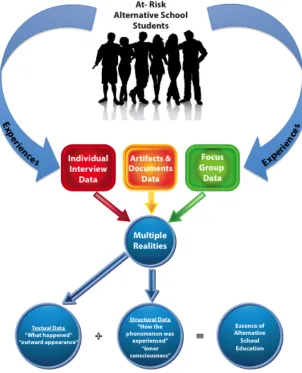
social constructivist framework (see figure 1.1), the study sought to examine themes
revealed from the multiple realities of individuals and focus groups in order to extract the
essence of alternative education.
Social constructivism assumes social interactions are vital in the creation of
reality, knowledge and learning. To social constructivists, these social interactions are
influenced by context and culture (Derry, 1999, McMahon, 1997, Vygotsky, 1978). “In
this view, an organization exists not ‘out there’ but in the minds and actions of its
constituents” (Bolman & Deal, 2008, p.42). Following this train of thought, the true
meaning of alternative education exists in the minds and actions of alternative students.
This literature review highlights the historical role of high schools in the United
States, high school redesign, the evolving role of alternative schools serving at-risk
students and the identification of effective alternative school programs. Furthermore, this
literature review helps the reader to understand the current state of affairs in
alternative education and how such affairs are connected to the socially constructed
The Historical Role of High Schools
The first two decades of the twentieth century were a time the United States began
to develop ideas about how the masses should be educated. It was during this time The
National Educational Association (NEA) established a committee to determine the
purpose of secondary education and to explore this essential question: What knowledge is
of most worth? Through an analytical process, the committee developed The Report of
the Commission on the Reorganization of Secondary Education, which presented seven
cardinal principles that would promote “uniformity in school programmes and in
requirements for admission to college” (p.1). These principles are: health, command of
fundamental processes (the basics of reading, writing and arithmetic), worthy home
membership, vocation, citizenship, worthy use of leisure and ethical character. The
report concluded that these educational goals could best be met with a comprehensive
high school that offered a diverse curriculum to an increasingly diverse study body.
Mirel (2006), compared the NEA’s Cardinal Principles Report to the NEA’s Committee
of Ten Report which was presented in 1893. The Committee of Ten Report recommended
the standardization of secondary school via a college preparatory curriculum. Mirel
(2006) concluded the developers of the Cardinal Principles Report assumed students of
the time were not as smart as students of previous generations; therefore, to expect the
students to complete a college preparatory curriculum was counterproductive.
Based on those assumptions, the Cardinal Principles Report suggested a diversification
of the high school curriculum, which allowed students to “choose a course of study
workforce” (Barton, 2011,p.6). The Cardinal Principles Report, along with the Social
Efficiency Movement, the Progressive Education Movement, and the Social Meliorist
Movements led educators and policy makers to explore the role of the comprehensive
high school in society and how to best deliver instruction within the high school
classroom.
The Social Efficiency Movement gained momentum with the ideas of researchers
such as Frederick Taylor and through the ideas of educators such as Franklin Bobbitt.
Machine theory is firmly rooted at the core of the Social Efficiency Movement. Machine
theory models such as scientific management, Administration Management, and
Bureaucracy theory, “focus rather heavily on workflow strategies for improving worker
efficiency” (Marion, 2002, p.21). Taylor offered scientific management as a solution to
inefficiency in steel mills and other industries. He theorized that organizations would
operate more efficiently if managers specified tasks, standardized movements and closely
monitored employees as they worked (Marion, 2002). The ideas of “educational
engineering” and the analogy of students being viewed as raw material were introduced
through Bobbitt’s publications The Elimination of Waste in the Curriculum (1913) and
The Curriculum (1918). According to Bobbitt, the purpose of education is one of
practicality: preparation of students for life as productive adults in society. As Bobbitt’s
contemporary Ralph Tyler (1949) stated, “…education is a process of changing the
behavior of people” (p.62)—hence educational engineering deals with scientifically
managing the behavior of the students so that they have the skills society deems
determine educational objectives, instructional activities and how efficiently students
meet those objectives:
1. What is the educational purpose (objective) of the school?
2. What educational activities would help students to meet the educational
purposes?
3. How can the educational activities be purposefully organized?
4. How can educators determine whether the purpose has been met?
Schiro (2009) highlights the term efficiency. He states, “Effective organization of
learning experiences allows curriculum objectives to be efficiently accomplished by
stimulating learning to take place in the most efficient manner possible—where
efficiency is defined in terms of expenditure of time, money, and human resources”
(p.59). The Social Efficiency philosophy requires educators to find out the specific needs
of society and prepare scientifically sound objectives that modify student behavior
through the use of measurable behavior objectives. From this perspective, the role of the
high school is to make sure students meet those objectives as they train for adulthood.
Progressive educators also focused on occupations and took a scientific approach
to education; however, in contrast to the Social Efficiency Movement, the Progressive
Education Movement included a focus on students’ interests as well as their physical,
mental, spiritual and emotional needs. John Dewey, the “Father of Progressive
Education” viewed school as a microcosm of a democratic society. He believed education
was life itself—not merely preparation for life. According to his convictions, schools
democracy would be commonplace. Dewey, as reported via Waddington (2006),
presents the following goals of education through occupation:
1. Habits of industry and self-discipline
2. Cooperation;
3. Technological transparency;
4. Scientific insight;
5. Artistic expression; and
6. Freedom
In My Pedagogical Creed, Dewey (1897) provides the reader with five
argumentative articles that support the idea of thoughtful children who are able to convert
education into something useful in the historical context of the early twentieth century. In
Article I, Dewey admonishes educators to appeal to the students’ interests and abilities
lest they lose interest and become disengaged in the classroom. In the next four articles,
the reader will recognize a fusion of Dewey’s educational philosophy and his background
in psychology.
In Article II, Dewey defines the school as a social institution that must represent
present life and simplify existing social life so that education is real and vital to the child.
The teacher’s role is to design experiences and find ways for the “discipline of life” to be
revealed to the students. Dewey also believed examinations (assessments) should “test
the child’s fitness for social life and reveal the place in which he can be of the most
In Article III, Dewey outlines the subject matter of education. He champions
educators’ use of students’ interests and activities as a gateway to core area content--such
as literature or science. In this article he also directly opposes the notion of Social
Efficiency when he writes, “The progress is not in the succession of studies but in the
development of new attitudes towards and new interest in, experience.”
In Article IV, Dewey discusses, again, how student interests should permeate the
educational environment. He includes an emphasis on the child’s natural development.
He discusses the process of how a child’s intellect is developed--how movement comes
before consciousness, how imagery is an important part of instruction, and how paying
attention to students’ natural interests reveal their developmental levels and the future
direction of their learning.
In Article V, Dewey revisits the role education plays in changing society. It is
through a formal education that students begin the process of coming to share in the
social consciousness. It is this common consciousness that will change the individual and
eventually change, or reconstruct, society. Dewey ultimately wanted to “outline a
blueprint for a new kind of free citizen who would be both capable of, and favorably
disposed toward, building a better society (Waddington, 2006, p.14).
The focus on an individual’s intellectual development, whether through efficiency
or through interests, was not the focus of Social Meliorates. Education, according to the
Social Meliorates, would lead to the evolution of the personality rather than intelligence.
According to Kliebard (1995), Social Meliorism is founded on the work of Albion Small
better social relationships, not merely to develop the individual. Ward believed the work
of schools is to develop a better society; schools should be vehicles of social reform,
social progress and social revitalization. In the 1930s, professors at Columbia College
pondered if schools could build new social orders. Harold Rugg introduced textbooks
that focused on “the treatment of immigrants, sexism, efforts to organize labor, inequality
in income and living conditions, and government corruption” (p. 82). Education was
meant to prepare citizens to tackle these issues and come up with solutions that move
society forward.
High School Redesign
Like the Social Meliorates, Progressivists and others who sought to clarify which
knowledge is of most worth, today’s educators are grappling with the purpose and
functionality of secondary schools. Mirroring the schools in the early twentieth century,
the schools of the twenty-first century are functioning in a context of rapid technological
changes, pervasive societal dis-ease, and political uncertainty. Hoyle et al (2005) have
identified three distinct waves of educational reform. The first wave, 1983-1986, started
with the National Commission on Excellence in Education’s report entitled A Nation at
Risk. This wave brought with it an increased focus on accountability that shifted policy
making from the district-level to the state level. There was a reinforcement of centralized
bureaucratic control. The states expanded regulatory control of education through a focus
on standardized testing, increasing requirements for graduation, lengthening school days,
and toughening teacher licensure requirements. The second wave, 1986-1989, continued
to focus on accountability and improving student performance on summative
Diversity was recognized as it related to cultures and learning styles. During this second
wave school-based management became more prevalent as educators sought to limit the
negative impacts of bureaucracy such as low academic performance and high failure
rates. The third wave, 1989-2003, included amendments to ESEA (1994) and NCLB
(2001). This third wave focused on the student’s well-being—no child should be
academically left behind. Church (2000) states while the first two waves targeted
segments of the educational system, the third wave is directed towards a systemic change
in education “with special focus on schools with large populations of disadvantaged
students” (p.2). This third wave of reform, he reasoned, would be important due to
educators and policy makers increased focus on proficiency standards and test-based
accountability. Harvey and Daniels (2009) posited three good aspects of NCLB
legislation: education was placed at the top of the national agenda; weaker schools and
school systems were exposed; and the disaggregated data “shined a harsh spotlight on the
shameful disparity between students of privilege and those from poverty, those with
special needs, and speakers of other languages” (p.9).
In his research at John Hopkins University, Balfanz (2009) posed the question:
Can the American high school become an avenue of advancement for all? There has
been a clear call from the public and private sectors as well as national, state and local
governments to revamp America’s high schools. In his 2013 State of the Union Address,
President Obama announced the formation of the Partnership to Rebuild America that
includes the creation of “modern schools worthy of our children” and secondary schools
that award high school diplomas that forge a path to a gainful employment or college
…ensure our high schools are putting our kids on a path to college and a good
job. The Budget includes a new competitive fund that will help redesign
America’s high schools to prepare students with the real world skills they need to
find a job right away or go to college.
Millions of dollars have been allocated to implement said changes; $300 million dollars
have been allocated to redesign high schools and to expand the career and technical
education demanded by the growing manufacturing sector. A $125 million competitive
grant program has been established to “expand the capacity of school districts to
implement effective and sustainable school reform” (Obama, 2013), and $265 million has
been allocated for the development of Science, Technology, Engineering and Math
(STEM) Innovation Networks.
The National Conference of State Legislatures (NCSL) and the National
Governors’ Association (NGA) support the idea of high school redesign as well. In 2005,
the NGA held its first national summit on the status of high school in America.
School systems are being asked to transform rather than reform. The purpose for the
comprehensive high school is shifting away from an industrial-age model whose main
product was factory workers to a model more aligned to the needs of the global society of
the 21st century. Barnard (2013) states we need “professionals who can work on teams to
solve complex problems” and students who are “skillful manipulators, synthesizers and
creators of knowledge” (p.12). According to the Redesigning America’s High Schools
Fact Sheet (2013) the following must occur:
2. Personalized learning opportunities must be provided;
3. Students must be offered academic and wrap around support services;
4. Schools must provide high-quality career and college exploration counseling;
5. Students must be offered opportunities to earn postsecondary credits while still in
high school;
6. Students must be offered career-related experiences or competencies;
7. School systems must strategically use learning time in more meaningful ways;
and
8. Educators must be provided evidence-based professional development.
The Evolving Role of Alternative Schools Serving At-Risk Students
The literature on high school redesign does not outline a specialized plan to
educate students who are not successful in a traditional school setting. The SC High
School Redesign Commission cautions, “America can no longer afford the educational
practices of the past—educating a third of our students well, with an eye toward higher
education, and educating the rest moderately well or hardly at all, with an eye toward
minimally skilled jobs and few intellectual demands” (South Carolina Department of
Education [SCDE], 2006, p.2). Effective alternative schools may answer the educational
needs of the two-thirds of America’s students who are leaving school woefully
unprepared for success in the colleges and workplaces of the future. The National
Dropout Prevention Center (NDPC) website dropoutprevention.org supports the use of
alternative schools as a way for school and community leaders to meet the legal mandate
Alternative schools were first started in the 1960s during the Civil Rights era to
assist students who were not succeeding in traditional school settings (Lange & Sletten,
2002). They were established to help marginalized students; especially those who were
in danger of dropping out or being pushed out of a traditional school. They were also
established to help students complete graduation requirements or to help students
transition back into a traditional school setting (Barton, 2005; DuCloux, 2009; Edwards,
2013). Today’s alternative schools primarily serve secondary school students. The
educational programs in alternative schools include an emphasis on core curriculum,
social services, community-based learning, and individualized instruction (NCES 2010).
There is no nationally defined system of alternative schools; however, several
researchers have tried to develop ways to categorize types of alternative schools. For
example, the Education Commission of the States website (www.ecs.org) has identified
two types of alternative schools:
1) those for students who would be considered “at-risk” or who have not
flourished in a traditional school; and
2) those for students with a history of disciplinary problems and/or
disruptive behavior.
Hefner-Packer (1991) devised five models of alternative schools: The alternative
classroom; the school-within-a-school; the separate alternative school; the continuation
school; and the magnet school. Their descriptions are as follows:
1) Alternative classroom—a self-contained classroom within a traditional
2) School-within-a-school—a school housed within a traditional school that has
specialized educational programs and is semi-autonomous;
3) Separate alternative school—a school separated from the traditional school
that has different academic and social adjustment programs;
4) Continuation school—schools such as street academies or job-training
facilities developed for students who have dropped out of traditional school;
and
5) Magnet school-a self-contained program with an intense focus on one or
more subject areas such as science, technology, engineering or math.
Raywid (1994) has created a three-tier category system of alternative schools that
is often cited in literature:
• Type I alternative schools serve all students (schools of choice);
• Type II alternative schools are focused on “forced choice” students who
are removed from traditional schools for disciplinary reasons (last-chance
schools); and
• Type III alternative schools are focused on providing therapeutic
assistance for students who are socially and/or emotionally challenged
(remedial schools).
Melissa Roderick’s typology differs from other classifications because she
chooses to focus on students’ educational needs rather than the type of program or
• Students who are off track due to disciplinary problems, but they are due
to go back to regular schools;
• Students who have had to assume adult roles such as parenting or caring
for parents;
• Students who are older, but are returning to complete a high school
diploma or GED; and
• Students who are behind educationally due to special needs such as
learning disabilities or severe mental or emotional problems.
In 2001, the National Center for Education Statistics (NCES) conducted its first
study of public alternative schools and programs for at-risk students, the District Survey
of Alternative Schools and Programs. The Education Commission of the States (ECS)
website defines at risk as “involving the risk of education failure as indicated by poor
grades, truancy, disruptive behavior, pregnancy, or similar factors associated with
temporary or permanent withdrawal from school.” The NCES study sought to provide
data concerning the number of public alternative schools in the US, their student
enrollment, staffing, programs and other services for at-risk students. When the study
was conducted, 39% of public school districts in the US had at least one alternative
school program. The US Department of Education published the results of the study in
2002; at that time, 10,900 alternative schools in the nation served 612, 900 students
(NCES). The study was repeated during the 2007-2008 school year. The results of this
most recent study show an increase in the number of alternative schools serving an
increased number of students: 64% of the public school districts serving 646,500
and increasing the graduation rates of US citizens, alternative education is becoming a
more essential segment of the educational system (DuCloux, 2009).
The increase in alternative school students is attributed to changes in state and
federal laws. State laws and policies throughout the US have common enrollment
practices which call for students to be enrolled in alternative schools for being suspended
or expelled from traditional schools, having an at-risk student status, being persistently
disruptive, being behind academically or overage for their respective grade levels
(DuCloux, 2009). Physical attacks/fights, possession or use of drugs, possession of
firearms and other weapons, and continual truancy are also reasons for students to be
transferred to alternative school settings from traditional school settings (NCES, 2006 &
Verdugo & Glenn, 2006).
Negative Observations Associated With Alternative School Programs
There are a few negative observations that need to be mentioned in this review of
alternative education. According to Kellmayer’s (1995) review of literature, programs
that serve at risk students do not serve as “real alternatives” because most of the
programs are punitive in nature; the programs are not operated much differently than
traditional schools; and student and staff are involuntarily assigned to the programs (p.6).
Another issue is the lack of clear educational oversight for alternative school programs.
Lange and Sletten (2002) indicate, “There is still very little consistent, wide-ranging
This lack of oversight has led researchers such as McCargar (2011) to refer to
alternative schools as black holes that offer sub-par educational environments that house
future prisoners. McCarger (2011) completed a case study of alternative schools in
Connecticut. This is one of the few studies that examines the educational experiences and
outcomes of alternative school students. The researcher argues that alternative programs
are established to help struggling students get their high school credentials—in theory.
However, in application these programs become “an off-the-radar extension of [the]
disciplinary system, enabling schools and districts to remove their most challenging
students while functionally absolving schools of responsibility and accountability for
student discipline and educational outcome” (p.4). In this study, the researcher refers to
alternative students as “invisible students” and presents the notion of the “the secret
pipeline” in which students are pushed into alternative education through counseling,
coercion and involuntary placement. The secret pipeline is defined as undocumented
disciplinary practices that lead to the students’ removal from traditional schools into
alternative schools or adult education. Both placements usually have low graduation
rates that usher students into the juvenile justice system and places them on the path to
prison.
The research on the school-to-prison pipeline shows that a disproportionate
number of minority students are affected by strict disciplinary practices that push them
out of schools into prisons. This is another negative observation associated with
alternative school programs. Similar to the research on the school-to-prison pipeline, the
highest numbers of referrals to alternative schools for disruptive behavior are in districts
related to the presence of alternative schools and it may be that such environments are
being used to house minority students” (Verdugo & Glenn, 2006, p.20). Most of these
students have been labeled as problems and troublemakers, and they are disproportionally
targeted for placement in alternative schools. In response to working with such students,
many alternative school leaders establish collaborations with the juvenile justice system,
child protective services, and the police. Leaders were least likely to establish
collaborative partnerships with the parks and recreation system, job placement agencies,
or family planning agencies (Verdugo & Glenn, 2006).
Another negative observation deals with the lack of a clearly established
accountability system associated with alternative education programs. Some researchers
suggest that it would be a misstep to gauge the effectiveness of alternative programs
using current accountability measures (Aron, 2006; Lange & Sletten, 2002). They argue
alternative students’ poor performance on accountability tests could negate any positive
measurements of nontraditional outcomes such as increased satisfaction and better
self-esteem. Another misstep associated with the current accountability measures is that
alternative schools are identified as programs instead of schools. Programs do not have
to complete strategic school profiles or school report cards to document their Annual
Yearly Progress (AYP); therefore, it is impossible to isolate information related to
alternative students’ academic growth, school enrollment and student outcomes.
There are two risks associated with secondary school reform efforts and their
impact on alternative education. First, the increased availability and the convenience of
student placement into alternative school programs may lead traditional schools to
weak alternative programs at the first sign of struggle, and policies and practices within
the alternative system work to keep them stuck for the duration of their educational
career” (McCarger, 2011, p.13).
Identification of Effective Alternative School Programs
Although there are not large quantities of studies related to effective alternative
school programs, the National Dropout Prevention Center (NDPC) located at Clemson
University, has compiled a database of 129 research-based alternative education
programs that have been deemed highly effective in educating at-risk youth. These
schools have organizational patterns that range from summer school to charter schools.
The exemplary schools provide strong evidence demonstrating program effectiveness in
decreasing dropout rates, increasing graduation rates and a mitigating impact on
dropout-related risk factors. The NDPC website (http://www.dropoutprevention.org) identified
eight key characteristics of successful programs:
• A maximum teacher/student ratio of 1:10;
• A small student base with no more than 250 students;
• A clear mission and discipline code;
• A caring faculty that is provided opportunities for continuous staff
development;
• An atmosphere of high expectations for student achievement;
• Individualized education plans based on student expectations and learning
• Flexible school schedules with ample community involvement and
support; and
• Total commitment to the success of each student.
Of the 129 alternative school programs identified, five have been selected for this
literature review. These programs have been highlighted because they have been
evaluated using a quantitative experimental design. Furthermore the, NDPC verified the
information presented about the programs via an external review team. These programs
were also included in the literature review to provide insight for researchers, educators
and policymakers interested in innovative programs that offer strong quantitative
evidence of effectiveness.
The Career Academy is located in Sacramento, California. It serves 50-250 high
school students each year. It has a school-within-a school organization pattern. Its initial
mission was to help inner city students remain in school and to give them occupational
training. According to the NDPC, it has evolved to reduce delinquent behavior and to
promote the development of the students’ protective factors. The school addresses
individual risk factors such as low achievement and misbehavior; family risk factors such
as low socio-economic status; and community risk factors such as family composition.
The school focuses on developing relationships as the primary protective factor.
Supportive adults, opportunities and rewards for pro-social involvement, social
competence and creative problem solving were used to establish positive relationships
within the school.
Diploma Plus, Inc. is located in Boston, Massachusetts. It is considered a small
with college and career readiness initiatives. What makes this program different from
others is that it does not use traditional grade levels; it is a three-phase program that takes
a performance-based approach to high school completion. According to their website
(diplomaplus.net), the students work at their own paces. Students are promoted according
to their mastery of core competencies rather than seat time requirements, credits or their
ages. Students monitor their learning and track their progress through competency-based
rubrics. The NDPC cites low achievement, poor attendance, low educational expectations
lack of effort, and low commitment to school completion as risk factors targeted through
Diploma Plus, Inc. Like the Career Academy program, Diploma Plus, Inc. focuses on
developing relationships as a protective factor for the program. Students are surrounded
by caring adults, are rewarded for pro-social behavior, and are provided opportunities for
positive engagement with peers through authentic learning tasks. This program boasts
higher graduation rates and higher program completion rates when compared to other
alternative high schools.
Foxfire High School is located in Zanesville, Ohio. Foxfire High School and
Foxfire Intermediate School serve at-risk students ages 11-22. Foxfire High School is
listed as a model for best practice on the US Department of Education website. The
school’s wraparound services and supporting partners and organizations are significant.
The students have access to a social worker, nurse, mental health counselor, 21st century
director, drug and alcohol counselor and an outreach coordinator. There are over forty
supporting partners and organizations that assist with the education of Foxfire’s students.
The NDPC selected this program as a model because it addresses numerous risk factors
their communities. Positive relationships, independence, competence, creativity, and
optimism are protective factors the NDPC touted as high points of this program.
Lamar Academy, located in McAllen, Texas, consists of Options High School and
an 8th grade Transitional Program. This program was selected as a model because it
showcases accelerated learning in a self-paced environment. It also has a flexible
schedule. The program uses a Sheltered Instruction Observation Protocol (SIOP) for
students with limited English proficiency. It is one of the few model alternative
programs that serve reenrolled students with disabilities. In addition, Lamar Academy
employs unique strategies for locating students. Educators make phone calls and home
visits. The students are contacted via personalized letter, television and radio ads, public
events and friend-to-friend recruitment just to name a few avenues. The NDPC lists low
achievement, retention, being over-age for grade, poor attendance, low educational
expectations and lack of effort as the individual risk factors Lamar Academy addresses.
Although the protective factors of relationships and creativity are addressed, there is a
stronger emphasis on the protective factors associated with school.
Union Alternative School is located in Tulsa, Oklahoma. It is a suburban high school
whose enrollment is completely voluntary. The school accepts students with social and
emotional issues, returning dropouts, and students who have issues with drug and alcohol
abuse. It is not considered a punitive program. The program incorporates block
scheduling, innovative teaching strategies in what they call a kind and respectful
environment to help students experience academic and social success. According to the
NDPC, the program addresses numerous risk factors associated with the individual,
surprising that counseling is focal point of this program. The program promotes
protective factors such as relationships, independence, competence, creativity and
optimism.
Chapter Summary
This chapter presented a literature review, which highlighted the historical role of
high schools in the United States, high school redesign, the evolving role of alternative
schools serving at-risk students and the identification of effective alternative school
programs. Furthermore, this literature review helped the reader to understand the current
state of affairs in alternative education and how such affairs are connected to the socially
CHAPTER 3
METHODOLOGY
Introduction to Research Methodology
Through this qualitative study, I intended to explore the phenomenon associated
with the experiences of at-risk high school students who have spent at least one year in a
traditional high school and are currently being served a Type II alternative school setting
in South Carolina. Type II alternative schools are focused on “forced choice” students
who are removed from traditional schools for disciplinary reasons (Raywid, 1994).
I have included an observation protocol, individual and group interview protocols
and directions for the creation of student artifacts. I designed these documents to explore
the participants’ insights and perspectives. These have been included in the appendix.
Through this study, I sought to uncover the essence of an alternative school education as
culled from the rich descriptions obtained via student discourse.
My primary research question is:
What does an examination of the experiences of at-risk high school students reveal about
the phenomenon of alternative school education?
In this chapter, I included the rationale for the research approach, an overview of
credibility, dependability, transferability and confirmability. I concluded this chapter with
a discussion of ethical considerations and limitations of my study.
Rationale for Study and Use of Qualitative Research Approach
With the approval of the University of South Carolina’s Institutional Review
Board, I desired to conduct a qualitative study dedicated to the experiences of at-risk high
school students, ages 15-19, who have spent at least one year in a traditional high school
setting and are currently working towards a high school diploma in an alternative
education program.
A qualitative research approach is appropriate because I sought to reveal the
voices and experiences of students who are missing from the body of literature
concerning secondary alternative education. I sought to empower the study participants
through the presentation of their profiles and reflections, in order to cultivate what
Creswell (2013) calls a “complex detailed understanding of the issue.” In this case, the
issue is the complex and detailed essence of alternative education.
Nkwi, Nyamongo & Ryan (2001) state, “qualitative research involves any
research that uses data that do not indicate ordinal values” (p.1). Creswell (2013) outlines
four philosophical assumptions of qualitative research, based on a social constructivist or
interpretive framework, and their implications for practice that will support this study.
First of all, the ontological assumption is that the participants represent multiple realities
that may be organized into common themes. I will conduct in-depth interviews and use
participants’ original artifacts to collect data related to these multiple realities. Seidman
of participants and the meaning they make of that experience” (p. 16). I share the
participants’ experiences through a thorough analysis of the data collected. I also
synthesize these experiences into themes to extract the essence of what it means to be
educated in an alternative school setting.
The setting or context of the study is the focus of the second philosophical
assumption. The epistemological assumption in qualitative research holds that studies
should be conducted in context, and the researcher is an active observer in the study
rather than an objective observer. Creswell (2013) states, the researcher should use the
participants’ own words as evidence and work collaboratively as an insider with the
participants. Through observation of the students in the alternative school setting, I tried
to establish myself as an insider. This insider status allowed me to gather extensive data
from the participants, which I used to develop and justify the knowledge claims of this
study.
As an active observer, I uncovered and admitted my biases--which is the basis of
the third philosophical assumption—axiology. According to Creswell (2013), the
axiological assumption allows the researcher to present his or her value-laden
interpretation alongside the interpretations of the participants. I bracket my experiences to
fully disclose any sources of bias.
The final assumption Creswell (2013) discusses is the methodological
assumption, which seeks to understand the process of research and its language. The
researcher understands through inductive reasoning that knowledge will emerge and the