2845
Student’s Worksheet Design To Improving
Problem-Solving Ability Of Seventh Grade With
PBL
Adhitya Prasetyaningtyas, Suparman
Abstract: The purpose of this study was to develop student’s worksheet design based on PBL to improve student’s problem solving abilities of seventh
class. The development model used in this study is the ADDIE development model. The steps in this study are analysis, design, development, implementation, and evaluation. The subjects in this study were seventh grade students of Muhammadiyah 1 Junior high school in Depok, in Indonesia. The objects in this study are curriculum, material, and student characteristics. The results in this study are, first, studen ts need teaching materials that are in accordance with the curriculum, material, and characteristics of students who can improve problem solving skills. Second, the design results in this study include cover, preface, and table of contents, instructions for using student’s worksheet, basic competencies, supporting information, work steps, and individual assignments. The results of design validation show that the student’s worksheet has very good criteria with an average value of 43.
Index Terms: Student’s worksheet, Problem Based Learning, Problem Solving
—————————— ——————————
1.
INTRODUCTION
Problem solving ability is one of the important aspects that must be have by students in learning mathematics [1]. Problem solving ability are part of a very important mathematics curriculum [2]. The process in problem solving makes us know the extent to which students understand the concept [3]. Problem solving probes make students able to build many ideas [4]. Problem solving skills will make students feel more meaningful learning [5]. One of the mathematics learning objectives stated is that students are able to solve problems or commonly called problem solving. Problem solving ability is one of the 21st century skills that must be have by students in the 2013 curriculum. Problem solving is the ability needed by all people who apply mathematics in their daily lives [1]. The ability to solve problems seems to be one of the important things and must be developed in mathematics learning [6]. By learning to solve problems in mathematics, students will acquire ways of thinking, habits of tenacity and curiosity, and beliefs in foreign situations they will face in life, outside of mathematics [4]. Problem solving is an important way of carrying out the process of learning and teaching mathematics [7]. Students who have low problem solving skills will have difficulty in working on HOTS type questions. The low ability of students in solving mathematical problems is susceptible to ineffective learning in the classroom. Effective learning is learning that influences students' mathematical skills, one of which is problem solving ability [8]. Based on the results of observations made at Muhammadiyah 1 Junior High School in Depok, it was found that students had low problem-solving abilities. Students have difficulty in problem-solving problems in the form of story problems. Most story problems are in the form of problems in everyday life (contextual problems) that seem long. This is also in accordance with Kartikaningtyas, Kusmayadi, and Riyadi's opinion that some students have
difficulties in solving contextual problems [9]. Various learning models can be applied to improve students' problem-solving abilities. Problem Based Learning (PBL) learning model is one learning model that can be applied.. PBL learning model can improve creative thinking skills and problem-solving abilities in students [10]. The characteristics of the PBL model are learning by solving problems [11]. Using the problem-based learning model, students are expected to be able to master the concepts to solve problems [1]. In the PBL model, students are required to solve the questions given by the teacher [12]. In PBL students collaborate in solving problems, starting from understanding problems, applying concepts, analyzing, and evaluating solution steps [13]. PBL learning model can train students to solve problems related to daily life [14]. Activities in the PBL model allow students to be involved in solving everyday problems, high-level thinking, and motivating students in learning activities [15]. The application of the PBL learning model will be helped by the presence of teaching materials in the form of worksheet. Student’s worksheets are sheets of assignments that must be completed by students [16]. Student’s worksheet is one of the tools that can facilitate learning activities to run effectively and can build interactions between teachers and students [17]. Student’s worksheet contains steps that are arranged in a coherent manner to guide students in carrying out activities to solve problems [18]. Student’s worksheet is a tool that is used as a learning facility to facilitate students in understanding the concept of learning [19]. The purpose of this study was to develop Student’s Worksheet design to improving problem-solving abilities of seventh grade with PBL.
2 METHOD
The development model in this research uses the ADDIE model. The ADDIE model is a model used in the process of designing learning systems [20]. There are 5 processes in this ADDIE model, namely: Analysis, Design, Development, Implementation, and Evaluation. Firstly is analysis, where at this stage the teacher collects more information about the knowledge, skills and attitudes of students that need to be achieved and taught during learning. The second stage is design. At the design stage, the teacher must design instructions that will be used in learning, including the learning methods to be used and the learning objectives to be achieved. Third is the development stage. At this stage, the ————————————————
Adhitya Prasetyaningtyas is currently pursuing master’s degree
program in Mathematics Education at Ahmad Dahlan University, Indonesia, PH-085601439094. E-mail:
Suparman is an associate professor in mathematics education at
teacher makes and composes what material will be used in the learning process. The teacher must make a description of the learning steps that are delivered in a practical manner. The fourth stage is implementation. In this implementation phase, products that have been analyzed, designed and developed will be used or tested on students. The last step in this process is evaluating the product. This evaluation phase is used to evaluate whether the product that is prepared has reached the desired goal. This evaluation phase is also the stage of determining the improvement of a product [21], [22], [23], [24], [25], [26], [27], [28], [29]. The steps taken in this study are only limited to the second stage, namely analysis and design. The flow process ADDIE work can be seen in Figure 1.
Fig 1. Flow Process ADDIE Work [30]
The subjects of this study were seventh grade students of Muhammadiyah 1 Junior High School in Depok, Yogyakarta. The sampling technique is done by random sampling technique. Data collection techniques used tests and interviews. Tests are conducted to determine students' problem-solving abilities. The problem used for the test is the question of quadrilateral and triangles. Interviews were conducted to seventh grade mathematics teachers.
3 RESULT AND DISCUSSION
This research was conducted to design student’s worksheets with PBL to improve problem-solving abilities of seventh class Muhammadiyah 1 Junior High School in Depok, Yogyakarta. The following are the results of the ADDIE stages that have been carried out.
3.1 Analysis Stage
3.1.1 Analysis Curriculum
Based on the results Interview with one of teacher at Muhammadiyah 1 Junior High School in Depok , Yogyakarta was obtained that the curriculum used in schools is 2013 curriculum . Competence Core and Competence bases used already based on with what was stated on 2013 curriculum. 3.1.2 Analysis Material
The materials in class VII in second semester are proportion, social arithmetic’s, and angles, quadrilateral and triangles, and data presentation. Based on the results Interview and observation, obtained that students difficulty in complete problem contextually related with rectangular and triangle. 3.1.3 Analysis Student’s Characteristic
Student experience difficulty in do question the story. This caused because students already especially first feel confused
and lazy when read question enough story long. Students’ assume that about the length is difficult problem for done. Moreover again teaching materials used in school only the book that looks less interesting for students. So that development of this student’s worksheet expected could improve will students in learn mathematics, specifically in complete issues related with quadrilateral and triangles.
3.2 Design Stage
During this period, researchers designed several parts of Student’s Worksheets. The parts that have been designed include covers, introductory words, table of contents, basic competencies, material, exercise and assignments.
3.2.1 Covers
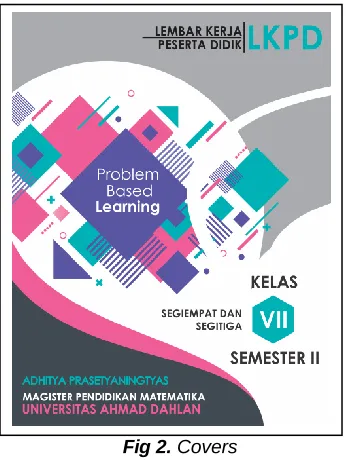
Cover from this Student’s worksheet entitled "Problem Based Learning Based Worksheets for Class VII SMP/ MTs". The cover of this Student’s worksheet can be seen in Figure 2.
Fig 2. Covers
3.2.2 Introductory Word
2847
Fig 3. Introductory Word
3.2.3 Table of Contens
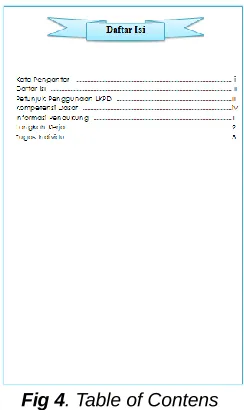
The table of contents contains a list of pages that will make it easier for readers to find the material they want. The table of contents can be seen in Figure 4.
Fig 4. Table of Contens
3.2.4 Instructions
The instructions for using the student’s worksheet contain information about the steps in using the student’s worksheet. The Guidance Sheet for using student’s worksheet can be seen in Figure 5 below.
Fig 5. Intructions
3.2.5 Base Competencies
Basic competencies contain learning goals that must be achieved by students after studying the material on the worksheet. Basic competency can be seen in Figure 6.
Fig 6. Base Competencies
In base competencies, there are indicators of ability achievement which are abilities that must be possessed by students after learning the material on the worksheet.
3.2.6 Suporting Information/ Material
The material contains a summary of the material about quadrilaterals and triangles. Giving material aims to facilitate students in getting the knowledge they need. Knowledge that has been obtained by students is expected to help students in solving problems that will be presented. The material on worksheet can be seen in Figure 7.
Fig 7. Suporting Information
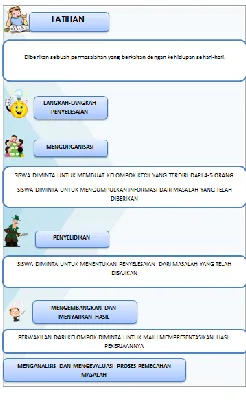
3.2.7 Work Step
Fig 8. Work Step
3.2.8 Individual Task
Individual tasks must be completed by students. Tasks function to measure students' ability to solve problems. Individual assignments given to each student can be seen in Figure 9.
Fig 9. Individual Task
This student’s worksheet design has been validated by two validators. The first validator was Ms. Sri Yuni Astuti, S. Pd. Si, as the mathematics teacher at Muhammadiyah 1 Junior High School in Depok. The second validator is Mr. Eddy Supriyadi, S.Pd, as the mathematics teacher at Muhammadiyah 2 Junior High School Kalasan. Comments and suggestions given by the validator regarding the student’s worksheet design can be seen in Table 1 below.
TABLE 1. COMMENTS AND SUGGESTIONS FROM THE VALIDATOR
Comments Suggestions
The picture on the cover less Describes the shape of the Quadrilateral and triangle
Look for images that are truly Rectangles and triangles
Material must be presented Clearly
Too many indicators written on The Basic Competency page
Indicators do not need to be written all, select the indicators to be achieved through the student’s worksheet
The student’s worksheet must load the material and sample questions.
Giving questions and material accompanied by pictures
The comments and suggestions given by validator are used as references to revise the design of the student’s worksheet. Then, the design feasibility is assessed by both validators. The following is the calculation of the questionnaire from the student’s worksheet presented in Table 2.
TABLE 2. CALCULATION OF THE QUESTIONNAIRE
Validator Position Score Criteria
Sri Yuni Astuti, S.Pd.Si
Mathematics teacher in SMP Muhammadiyah 1 Depok
42 Very Good
Eddy Supriyadi, S.Pd
Mathematics teacher in SMP Muhammadiyah 2 Kalasan
44 Very Good
Total 86
Average 43 Very Good
The table above shows that the average student’s worksheet design value is 43. These results indicate that the student’s worksheet design has a very good category.
4
CONCLUSION
Student’s worksheet development has been carried out in the analysis and design stages. At the design stage, researchers have designed covers, preface, and table of contents, instructions for using student’s worksheet, basic competencies, supporting information, work steps, and individual assignments. The student’s worksheet developed has the advantage of being able to improve students' problem-solving abilities. Student’s worksheet was made using Corel Draw and Microsoft Word 2010. Based on the results of design validation, it was found that student’s worksheet was in a very good category with an average of 43.
ACKNOWLEDGMENT
The author thanks Ahmad Dahlan University for giving the opportunity to facilitate the author in completing this research. Thanks also to schools and teachers who have allowed us to do this research.
REFERENCES
[1] I.K. Darma, I. M. Candiasa, I.W. Sadia, and N. Dantes. “The effect of problem based learning model and authentic assessment on mathematical problem solving ability by using numeric ability as the covariable,”Journal of Physics: Conference Series, Vol 1040, issue 1, p. 012035, 2018.
2849
self-efficacy,”Journal of Physics: Conference Series, Vol 1008, issue 1, p. 012063, 2018.
[3] S.A. Widodo, “Development comic based problem solving
in geometry,” International Electronic Journal of Mathematics Education, vol 12, issue 3, pp. 233-241, 2017.
[4] N.A. Dina and S.M Amin, “Flexibility in Mathematics Problem Solving Based on Adversity Quotient,” Journal of Physics: Conference Series, vol 947, issue 1, p. 012025, 2018.
[5] D. Yulianawati, L. Hasanah, and A. Samsudin, “A case study of analyzing 11th graders’ problem solving ability on heat and temperature topic,”Journal of Physics: Conference Series, vol 1013, issue 1, p. 012042, 2018.
[6] A. Muniroh, B. Usodo, and S. Subanti, “Algebraic form Problem Solving Based on Student Abstraction Ability,” vol 895, issue 012038,pp. 1-8, 2017.
[7] I. Karatas and A. Baki, “The Effect of Learning Environments Based on Problem Solving on Students’ Achievements of Problem Solving,” vol 2, issue 3, pp. 249-268, 2013.
[8] R. Mushlihuddin, Nurafifah, and Irvan, “The effectiveness
of problem-based learning on students’ problem solving ability in vektor analysis course,” vol 948, pp. 1-7, 2018.
[9] V. Kartikaningtyas and T.A. Kusmayadi, “Contextual Approach with Guided Discovery Learning and Brain Based Learning in Geometry Learning,” Journal of Physics: Conference Series, vol 895, issue 1, p. 012024, 2017.
[10] M.L Nasution, Y. Yerizon, and R. Gusmiyanti, “Students’
Mathematical Problem-Solving Abilities Through The Application of Learning Models Problem Based Learning,” IOP Conference Series: Materials Science and Engineering,” vol 335, issue 1, p. 012117, 2018.
[11] A. Miatun, “The effect of discovery learning and
problem-based learning on middle school students’ self-regulated learning,” Journal of Physics: Conference Series,” vol 948, issue 1, p. 012021, 2018.
[12] M. Hafiz and J.A. Dahlan, “Comparison of Mathematical
Resilience among Students with Problem Based Learning and Guided Discovery Learning Model,” Journal of Physics: Conference Series, vol 895, issue 1, p. 012098, 2017.
[13] K.D.P. Meke, D.U. Wutsqa and H.D. Alfi, “The Effectiveness of Problem-based Learning Using Manipulative Materials Approach on Cognitive Ability in Mathematics Learning,” Journal of Physics: Conference Series, vol 1097, issue 1, p. 012135, 2018.
[14] Z. Amir, M.S. Lubis, and M. Syafri, ” The effect of problem
based learning model (PBL) towards creative thinking ability and self-efficacy of junior high school students in Pekanbaru,” Journal of Physics: Conference Series, vol 1116, issue 2, p. 022039, 2018.
[15] M. Ruhimat, E. Ningrum, and B. Wijayanto, “The Implementation of Problem Based Learning toward Students’ Reasoning Ability and Geography Learning Motivation,” IOP Conference Series: Earth and Environmental Science, vol 145, issue 1, p. 012035, 2018.
[16] N. Ragilia, A. Ambarita, and N.E. Rusminto, “Development of Problem Based Learning Model Learner Worksheet To Improve Critical Thinking Ability,” IOSR
Journal of Research & Method in Education, vol 8, issue 1, pp 65-72, 2018.
[17] D. Pamungkas and Suparman, “The Design of Student Worksheet based on RME to Improve Student’Mathematical Communication Skills,” Journal of Advanced Research in Social and Behavioural Sciences vol 15, Issue 1, pp. 41-48, 2019.
[18] D. Yulianti, “Problem-Based Learning Model Used to Scientific Approach Based Worksheet for Physics to Develop Senior High School Students Characters,” Journal of Physics: Conference Series, vol 824, issue 1, p. 012009, 2017.
[19] T. Akma and Suparman, “The Design of Student Worksheet Problem Based Learning to Improve Problem Solving Ability of the Eighth-Grade Students Junior High School in Indonesia,” International Journal of Engineering & Technology, vol 7, issue 4.30, pp. 11-15, 2018.
[20] H. Wiphasith, R. Narumol, and C. Sumalee, “The design of the contents of an e-learning for teaching M. 5 English language using ADDIE model,” International Journal of Information and Education Technology, vol 6, issue 2, p.127, 2016.
[21] L. Cheung, “Using the ADDIE model of instructional design to teach chest radiograph interpretation,” Journal of Biomedical Education, 2016.
[22] N.R. Wahyuaji and Suparman, “Development of STEM
Integrated E-Learning Design to Improve Student’s Creative Thinking Capabilities,” International Journal of Scientific & Technology Research, vol. 8, issue 10, pp. 1164-1168, 2019.
[23] B.P. Syafina and Suparman, “Designing Student Worksheets to Improve Critical Thinking Ability Based on Problem Based Learning,” International Journal of Scientific & Technology Research, vol. 8, issue 10, pp. 1194-1199, 2019.
[24] Isnaepi and Suparman, “Design of Moodle-Based Mathematics Learning to Improve Spatial Ability for Class XII High School Students,” International Journal of Scientific & Technology Research, vol. 8, issue 10, pp. 1174-1177, 2019.
[25] L.F. Nuari and Suparman, “Designing Worksheets for the
Mentally Retarded Student in Multiplication Operations,” International Journal of Scientific & Technology Research, vol. 8, issue 10, pp. 3579-3584, 2019.
[26] M. Faulina and Suparman, “Design Guided Discovery Student Worksheets to Construct the Understanding of the Blind,” International Journal of Scientific & Technology Research, vol. 8, issue 10, pp. 3685-3689, 2019.
[27] N.L. Fitri and Suparman, “Designing Worksheet Using the
Context of Sugarcane,” International Journal of Scientific & Technology Research, vol. 8, issue 10, pp. 3669-3672, 2019.
[28] Suhendri and Suparman, “Development Mathematics Modules Based on Guided Discovery Learning to Improve Creativity Skills of Blind Students,” International Journal of Scientific & Technology Research, vol. 8, issue 10, pp. 1169-1173, 2019.
[29] S. Solihati and Suparman, “Design of Mathematics Module Development Based on PMRI to Improve Critical Thinking Ability Students of Class VIII Junior High School in Indonesia,” International Journal of Scientific & Technology Research, vol. 8, issue 10, pp. 3673-3679, 2019.
[30] G. Welty, “The'design'phase of the ADDIE model,” Journal