Article
Spatio-Temporal Changes and Dependencies of Land
Price Development: A Case Study of the City of
Olomouc
Jaroslav Burian 1,*, Karel Macků 1, Jarmila Zimmermannová 2 and Barbora Kočvarová 1
1 Department of Geoinformatics, Palacký University in Olomouc, 17. listopadu 12, 779 00, Olomouc, Czech
Republic; [email protected], [email protected], [email protected]
2 Department of Economics, Moravian Business College Olomouc, tř. Kosmonautů 1288/1, 779 00 Olomouc,
Czech Republic, [email protected]
* Correspondence: [email protected]; Tel.: +42-072-471-2953
Abstract: Land price sustainability issues have been addressed by many authors in the past. Most of these researchers used land prices (from land price maps) as the primary data source in their studies. Only a few papers analysed official land price maps, which are available very rarely. For this reason, we studied the spatial and temporal changes of land prices in the city of Olomouc based on an analysis of official land price maps from 1993 to 2017. We proposed several research hypotheses to confirm some general statements about land price development. We concluded that some macroeconomic indicators had a significant impact on changes in land prices. In the residential and commercial areas and historical centre, land prices are significantly higher than in other monitored aspects (land-use types). We also concluded that no link existed between land-use stability and land price stability. Surprisingly, no long-term stable areas were found in the area of interest. The analysis also confirmed that land price and its change over time varied in different spatial aspects. Surprisingly, the smallest influence was reflected in the economic aspect. Regarding natural events in recent decades, we observed a significant drop in land prices in the vicinity of watercourses threatened by flooding. These findings can assist in better understanding local development and changes in land price.
Keywords: land price map, land-use development, GIS, spatio-temporal changes, sustainability, Olomouc
1. Introduction
1.1. Land Price Sustainability
Land price plays an important role in guiding land resource allocation for urban planning and development, particularly in big cities of fast developing countries where infrastructures and populations change frequently [1]. This is one of the main reasons why land price sustainability issues have been previously addressed by other authors (e.g., [2] or [3]). The research centres on issues linked to land price volatility [4,5], inflation [3], structure [6], development [7–9] and factors influencing land price [1,10–12]. The specific research field deals with predictive models [13], implementation of GIS (Geographic Information System) software [14] and many others.
Researchers in the Czech Republic studied land prices after the Velvet Revolution in 1989. After 40 years of communism, ownership of land was returned in restitution processes to the original owners (or their descendants), and prices started to grow rapidly. Almost all Czech studies have looked at general housing prices issues or land price analysis at the regional or state level (e.g., [15]). Lux and Musil [16–18] studied the housing system and its development during the transition period. Sklenička et al. [19] focused their research on farmland prices; Temelová et al. [20] elaborated on
housing estate issues associated with segregation. Other researchers examined price bubbles and their determinants in the Czech Republic [21] and compared the housing system to those in other countries [15].
Another area of research investigated land price maps of building parcels. Official land price maps are essential documents which influence and control the real estate market in the big cities of the Czech Republic. They are one of the most critical aspects of a city’s economy for entrepreneurs and citizens. Land price map analysis in the Czech Republic has been pursued by only a few authors [22–28]. Dobiášová [22] compared the price maps of selected EU countries, Chrudimská [23] and Pászto et al. [27] proposed a new procedure for updating the land price map of Olomouc in the ArcGIS for Desktop software. Emphasis was placed on the technological process, which would automate and improve the efficiency of processing land price maps. Šindelářová [28] and Kovaříková [25] also analysed price maps, describing the development and practical use of price maps in the Czech Republic using the price maps of Brno and Olomouc. The land price map in relation to rent was discussed in dissertation thesis [26]. The author investigated the relationship between land rent and price in price maps of the Czech Republic. The author questioned whether it was possible to use this to determine the rental price of similar plots in the same way as with price maps. According to Kubíček [26], with a sufficient amount of quality data, it would be possible to set a coefficient for price conversion in the price map to the rental price of the land.
Only a few authors performed a detailed analysis of land price at a local level (municipality) [24], [28]. This is surprising, because local studies can explain many connections, relationships and dependencies which are not visible at a national level. This is due to the fact that only a few cities in the Czech Republic produce land price maps as the primary land price data source. For this reason, we decided to perform an in-depth analysis of land prices in the city of Olomouc, which has produced land price maps since 1993. This issue has not been previously studied and is currently highly relevant because land prices in Olomouc (100,494 population in 2018) are the third highest in the Czech Republic after Brno (379,527 population in 2018) and Prague (1,294,513 population in 2018) [29], [30]. This is mainly explained by the high attractiveness of Olomouc (UNESCO heritage, quiet city, high standard of living), which is, however, in contrast to average regional salaries (third lowest in the Czech Republic) [2].
Based on these findings, our study examined the spatial and temporal changes of land prices in Olomouc by analysing official land price maps from 1993 to 2017. For this purpose, the following research hypotheses were proposed: 1) Changes of land prices are dependent on macro-economic indicators; 2) The highest increase in land prices can be observed in residential and commercial areas and the historical city centre; 3) Stable areas exist (comparable to stabilized land-use) where land prices do not change over time; 4) Land price sustainability is influenced by spatial factors (environmental, economic and social).
1.2. Land Price Maps in the Czech Republic
Two land price sources can be found in the Czech Republic in the form of official or unofficial land price maps. The official land price map (land price map of building plots) is defined by the relevant legislation ([31,32]) and its acquisition and updating is maintained by the respective municipality. This type of map displays the prices of building plots and is created according to prices in purchase contracts (managed by the regional cadastral offices) and modified according to the type of land and its other characteristics.
A comparable parcel means land that is intended for the same use and located in a similar location as the parcel being valued. The final price of a building parcel is calculated as a multiple of the base price of the group of land to which it belongs and its total area in square metres. The price of the parcel is then increased by the price of the building(s) standing on the parcel and by the price of green areas. The price map does not include prices of agricultural or forested land or water areas. Information about the parcel is taken from the Land Register of the Czech Republic.
The land price map is updated at the end of each year by adding new prices of land parcels. After the price map is processed, the municipality is obliged to submit a proposal to the Ministry of Finance of the Czech Republic, which subsequently publishes it in the Price Bulletin. Any citizen can see the content of the price map of a given municipality free of charge. The land price map serves as a basis for evaluating issues addressed by court experts, banks or government officials.
Land price maps have been created in the Czech Republic since 1991 for 54 municipalities, but many municipalities have ceased this activity due to fluctuating prices and the need for regular updates. Eight municipalities in the Czech Republic have created more than ten price maps. Most of these were published in Ostrava (18), Prague (21) and Olomouc (21). Currently (3 October 2018), price maps are valid only in seven municipalities in the Czech Republic.
Besides the price maps governed by law, several unofficial price maps (e.g., [33]) are also available and are usually created by real estate agencies who process them very individually. These maps, however, do not show land prices but rather the average prices of apartments and houses or rents. Data sources are most often recorded by real estate agencies from achieved sales or rentals. The validity of these maps is not guaranteed by law and depends only on the quality of processing [28]. Access to these maps often requires payment.
1.3 Land Price Map of the City of Olomouc
The first land price map of Olomouc was created in 1939 because people had foreknowledge of the Second World War. During the 1930s, many Czech people invested their money primarily in real estate, which caused a disproportionate increase in land prices. The government was therefore forced to fix prices at the level current at the time, which was subsequently taken into account in a price map to prevent further price increases. After the Second World War, land price maps were not used, and city development was mainly based on master plans ([34,35]). The first modern land price map of Olomouc was created in 1993. The city was divided into zones according to the character and function of individual areas. For these zones, the average purchase price (base price) was used to calculate the actual price of a parcel. For each zone type, coefficients were defined to multiply the base price. This procedure was based on the relevant legislation and has been preserved to this day, except for 1993, 1995, 1996, 2000 and 2002, when the price map was not updated because of minimal changes. The only significant difference in the pricing methodology was in connection with parcels which had not been valued. These are predominantly areas used for public administration, education, culture, health, security, defence, communications and other technical equipment that practically do not change ownership and their price cannot be determined regularly.
In total, 21 price maps were created in Olomouc between 1993 and 2017. Since 2006, they have been created digitally (CAD and GIS) and are also published via the web map application available at http://apps.hfbiz.cz/apps/olomouc/cm/.
2. Data and Methods
2.1. Used Datasets
As our primary data source, official land price maps of the city of Olomouc in a scale of 1:5000 were used. The maps cover the whole Olomouc area (100,494 population; 103.4 km2). The city is the
selected (1993 and 1999). Land price maps from the period 2006–2017 are available in vector format (dgn), and all of them were used for the analysis.
In order to digitize and georeference analogue land price maps, cadastral maps from the comparable period were used. In order to analyze different land-use types, the master plans of the city of Olomouc from 1999 and 2016 were used. Master plans (land-use types, flood areas, evaluated soil ecological units, urban conservation areas, urban conservation zones), cadastral maps and land price maps were obtained from the Magistrate of the City of Olomouc (Department of Research and Development).
For the statistical analysis, the following data sources were used: Czech Statistical Office – Statistical Yearbook of the Olomoucký Region [36], Statistics on Income and Living Conditions [37]; Czech National Bank – CNB official discount rates [38].
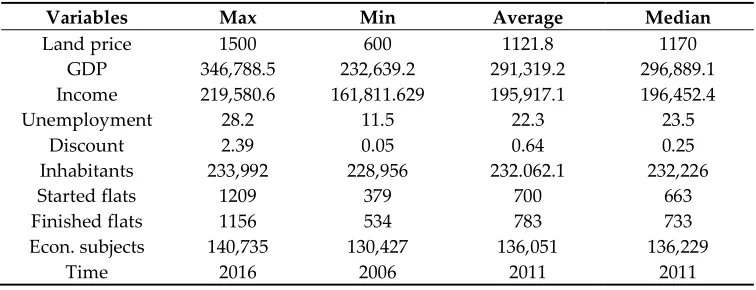
Table 1. Descriptive Statistics – Correlation and Regression Analyses.
Variables Max Min Average Median
Land price 1500 600 1121.8 1170 GDP 346,788.5 232,639.2 291,319.2 296,889.1 Income 219,580.6 161,811.629 195,917.1 196,452.4 Unemployment 28.2 11.5 22.3 23.5
Discount 2.39 0.05 0.64 0.25 Inhabitants 233,992 228,956 232.062.1 232,226 Started flats 1209 379 700 663 Finished flats 1156 534 783 733 Econ. subjects 140,735 130,427 136,051 136,229
Time 2016 2006 2011 2011
Details of the variables presented in the Table 1 are as follows: “Land price”– in Olomouc in CZK per square metre, calculated as a median of all prices of all land in Olomouc in certain years in the period 2006–2016; “GDP” – per capita in CZK per year, Olomouc Region [36]; “Income” – total net income per capita in CZK per year in municipalities with a population of 100,000+ [37]; “Unemployment” – number of unemployed people in thousands, Olomouc Region [36]; “Discount” – average discount rate per year, Czech Republic [38]; “Population” – number of inhabitants, district of Olomouc [36]; “Started flats” – number of started flats, district of Olomouc [36]; “Finished flats – number of finished flats, district of Olomouc [36]; “Econ. subjects” – registered economic entities (31 December), district of Olomouc [36] ; “Year” – the period 2006–2016.
2.2. Data Processing
As mentioned above, land price maps were available in vector and analogue (printed) format. Data in digital format (dgn files) from 2006–2016 (11 layers) were imported into the spatial geodatabase in GIS. Analogue land price maps (maps from 1993 and 1999) were georeferenced (each map comprised 36–39 map sheets) and digitized. Historical cadastral maps from suitable years were used for georeferencing. The output polygons of land price maps were checked and repaired by using topology rules in ArcGIS for Desktop, and the final layers were imported into the spatial geodatabase of all land price maps.
chosen as the reference year, and all other years across all dates were recalculated to produce a time series of comparable values.
2.3. Data Analysis
2.3.1. Spatial Analysis
Several basic statistical characteristics were calculated from the available data: mean, median and mode. For the reasons given above, the same quantity of priced parcels was not available for each time interval. The number of valued parcels in the years had decreased from 44% to 28%. Medium-value indicators have served as a general tool for assessing land price developments over the past 15 years.
For spatial analysis of the development of the land price map in Olomouc, the data was modified with overlay operations to be able to monitor the development of land price at each location. Only three years were selected for spatial analyses: 1993, 2006 and 2016. These years have approximately the same time interval. Adding additional years would increase the number of unvalued parcels obtained by overlay operations. Using a GIS tool, a new layer was created to aggregate changes in the periods 1993–2006 and 2006–2016. This processing tool performs the geometric union of all input layers. The result contains information from all inputs, which allows the development in every part of the original area of interest to be analysed. Since not all parcels in the input data were valued, it was necessary to remove those areas where price for one of the years was absent. A total of 5020 new areas with an area of 4109 ha were created, of which 1999 ha (48.7%) were valued in all three years. In these areas, land prices were analysed to identify stable / developing sites. These were subsequently classified into synthetic classes describing the development of land prices in years.
2.3.2 Regression Analysis
For the purposes of analysing possible dependencies between economic, social and demographic indicators, methods of correlation and regression analysis were used. Since suitable data are not available for all years in the period 1993–2016 and both statistical methods are based on a regular time period, we used the data for the period 2006–2016.
Correlation analysis serves as a means for observing possible relationships between certain variables mainly if a statistically significant positive or negative relationship exists. A Pearson correlation coefficient was therefore used.
The second step required a more complex model to be created in order to include all possible variables at once and to detect any variable(s) within the model which could be important in increasing the land price in the selected region. Based on this key idea and the results obtained from the correlation analysis, different regression models were tested. For the purposes of our analysis, three regression models MOD1, MOD2 and MOD3 are presented. Certain models differ in parts of independent variables, while the dependent variable is the same in all tested models. MOD2 represents the most suitable model, MOD1 and MOD3 represent other selected models for the purposes of comparing and evaluating certain possibilities which include possible independent variables. MOD1 is based on indicators connected mainly with households and their behaviour, MOD3 also includes a commercial parameter and calculates the number of economic entities in Olomouc. Detailed characteristics of regression models are as follows.
MOD1
𝑌 = 𝛽0 + 𝛽1𝑋1 + 𝛽2𝑋2 + 𝛽3𝑋3 + 𝛽4𝑋4 + 𝛽5𝑋5 + 𝛽6𝑋6 + 𝛽7𝑋7 + 𝛽8𝑋8 + 𝑢 (1)
where β0...β8 represent regression coefficients which can show the influence of independent variables on a dependent variable. Dependent variable Y is represented by land price in Olomouc in CZK per square metre, calculated as a median of all prices of all land in Olomouc in certain years of the period 2006–2016. Variable u represents a dummy variable. MOD1 is based on the following independent variables:
- X2 – total net income per capita in CZK per year, municipalities with a population of 100 000+ (Inc);
- X3 – number of unemployed people in thousands, Olomouc Region (Unem); - X4 – average discount rate per year, Czech Republic (Disc);
- X5 – population/number of inhabitants, district of Olomouc (Inhab); - X6 – number of started flats, district of Olomouc (Flatst);
- X7 – number of finished flats, district of Olomouc (Flatfi); - X8 – time/years 2006–2016 (Time).
MOD2
𝑌 = 𝛽0 + 𝛽1𝑋1 + 𝛽2𝑋2 + 𝛽3𝑋3 + 𝛽4𝑋4 + 𝛽5𝑋5 + 𝑢 (2)
where β0...β5 represent regression coefficients which can show the influence of independent variables on a dependent variable. Dependent variable Y is represented by land price in Olomouc in CZK per square metre, calculated as a median of all prices of all land in Olomouc in certain years of the period 2006–2016. Variable u represents a dummy variable. MOD2 is based on the following independent variables:
- X1 – GDP per capita per year, Olomouc Region (GDP);
- X2 – number of unemployed people in thousands, Olomouc Region (Unem); - X3 – population/number of inhabitants, district of Olomouc (Inhab);
- X4 – number of started flats, district of Olomouc (Flatst); - X5 – number of finished flats, district of Olomouc (Flatfi).
MOD3
𝑌 = 𝛽0 + 𝛽1𝑋1 + 𝛽2𝑋2 + 𝛽3𝑋3 + 𝛽4𝑋4 + 𝛽5𝑋5 + 𝛽6𝑋6 + 𝛽7𝑋7 + 𝛽8𝑋8 + 𝛽9𝑋9 + 𝑢 (3)
where β0...β9 represent regression coefficients which can show the influence of independent variables on a dependent variable. Dependent variable Y is represented by land price in Olomouc in CZK per square metre, calculated as a median of all prices of all land in Olomouc in certain years of the period 2006–2016. Variable u represents a dummy variable. MOD3 is based on the following independent variables:
- X1 – GDP per capita per year, Olomouc Region (GDP);
- X2 – total net income per capita in CZK per year, municipalities with a population of 100 000+ (Inc);
- X3 – number of unemployed people in thousands, Olomouc Region (Unem); - X4 – average discount rate per year, Czech Republic (Disc);
- X5 – population/number of inhabitants, district of Olomouc (Inhab); - X6 – number of started flats, district of Olomouc (Flatst);
- X7 – number of finished flats, district of Olomouc (Flatfi);
- X8 – registered economic entities (31 December), district of Olomouc (EconS); - X9 – time/years 2006–2016 (Time).
3. Temporal Dependencies and Changes in Land Prices
3.1. Temporal Changes
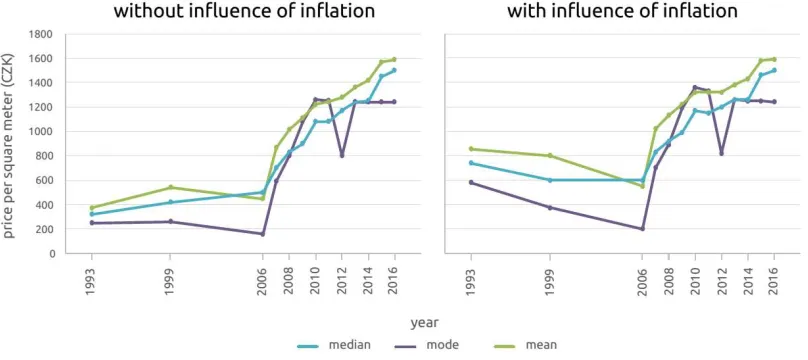
Figure 1. Land price development in Olomouc. The differences between the original and recalculated values (mean, median and mode) can be observed. The most significant differences are evident in the oldest records (1993 and 1999), where inflation was the most influential.
Two significant periods can be observed in the development of prices. The first is in the period 1993–2006, when land prices fell slightly. In this post-revolutionary period, economic growth was not yet strong and people were not affluent, and there was therefore no leading demand for land. This claim is based only on three values, but the tendency is evident. The effect of adjusting price for inflation is significant: excluding inflation, prices are shown as slightly higher, whereas according to price levels from today’s point of view (2016), we see a slight decline. For comparison, see Figure 1. The most expensive land in the city centre was around CZK 9000 (1993), and in the following years, it dropped significantly (CZK 4600 in 1996). Until 2006, the median price was almost unchanged (around CZK 600), mainly because of the overall saturation of the real estate market caused by extensive construction of apartment buildings in the 1990s. Another event which affected land prices was the flood of 1997. This revealed the propensity of some urban areas to flooding, which may have contributed to price stability/decline.
The year 2006 was a breakthrough in the second phase, in which a much more dynamic development of prices is observed, especially growth. Except for the period 2010–2011, when the median price dropped slightly, the value of land has increased since 2006. The reason is the re-awakening of demand for housing in the form of both dwellings and family houses. The most significant leap in the maximum price of land was in 2007, when the highest price increased from CZK 5900 to CZK 10,850. Stagnating prices in the period 2010–2011 can be attributed to the impact of the 2008 global financial crisis (visible in the Czech Republic after a two year delay).
3.2. Temporal Dependencies
Regarding the evaluation of temporal dependencies between economic, social and demographic indicators, it is worth starting with a correlation analysis. The results of the correlation analysis show possible relationships between certain variables, in our case, between “Land price”, “GDP”, “Income of households”, “Unemployment rate”, “Discount rate”, “Inhabitants”, “Started flats”, “Finished flats”, “Registered Economic Subjects” and “Time”.
Table 2. Correlation Analysis.
Price GDP Inc Unem Disc Inhab Flatst Flatfi EconS Time
Price 1
Inc 0.975 0.958 1
Unem -0.366 -0.519 -0.353 1
Disc -0.763 -0.671 -0.744 -0.141 1
Inhab 0.979 0.954 0.981 -0.408 -0.702 1
Flatst -0.434 -0.325 -0.407 -0.470 0.831 -0.346 1
Flatfi -0.261 -0.286 -0.169 -0.004 0.343 -0.084 0.308 1
Econs 0.923 0.9321 0.932 -0.417 -0.659 0.906 -0.394 -0.291 1
Time 0.967 0.9776 0.955 -0.371 -0.785 0.941 -0.462 -0.350 0.903 1
In the key variable “Land price”, we observe a statistically significant positive correlation between Price and GDP, Income, Inhabitants and Time. By contrast, a statistically significant negative correlation can be seen between Price and Discount rate. The possible relationship between Price and Unemployment rate, Flats started and Flats finished is rather negative, but not statistically significant. In the second step, we created and tested more complex regression models, working with all the variables used in the correlation analysis. Based on the results of the correlation analysis, three regression models MOD1, MOD2 and MOD3 were created. Detailed characteristics of these regression models are described in Chapter 2. The Durbin-Watson test was used for the purposes of eliminating autocorrelation.
All models work with the same dependent variable Y, which is represented by land price in Olomouc in CZK per square meter, calculated as a median of all prices of all land in Olomouc in certain years in the period 2006–2016. The key results of all regression models are shown in Table 3.
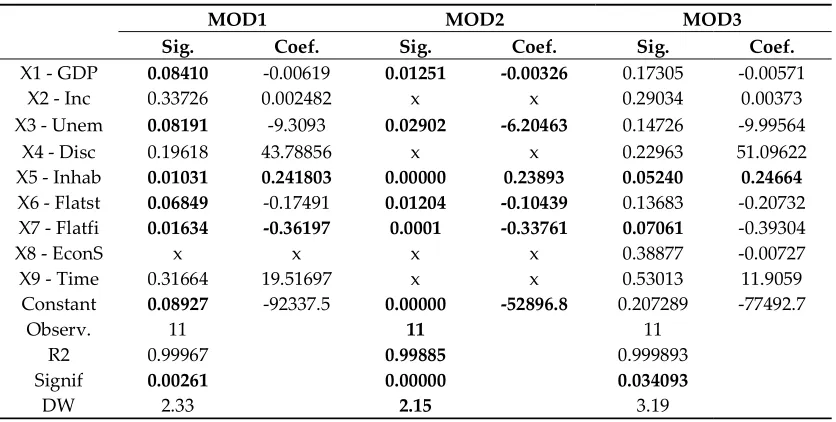
Table 3. Regression Analysis.
MOD1 MOD2 MOD3
Sig. Coef. Sig. Coef. Sig. Coef.
X1 - GDP 0.08410 -0.00619 0.01251 -0.00326 0.17305 -0.00571 X2 - Inc 0.33726 0.002482 x x 0.29034 0.00373 X3 - Unem 0.08191 -9.3093 0.02902 -6.20463 0.14726 -9.99564
X4 - Disc 0.19618 43.78856 x x 0.22963 51.09622 X5 - Inhab 0.01031 0.241803 0.00000 0.23893 0.05240 0.24664
X6 - Flatst 0.06849 -0.17491 0.01204 -0.10439 0.13683 -0.20732 X7 - Flatfi 0.01634 -0.36197 0.0001 -0.33761 0.07061 -0.39304 X8 - EconS x x x x 0.38877 -0.00727 X9 - Time 0.31664 19.51697 x x 0.53013 11.9059
Constant 0.08927 -92337.5 0.00000 -52896.8 0.207289 -77492.7
Observ. 11 11 11
R2 0.99967 0.99885 0.999893 Signif 0.00261 0.00000 0.034093
DW 2.33 2.15 3.19
Looking at the models in more detail, MOD1 represents in general a statistically significant model, the Durbin-Watson test simultaneously confirming no autocorrelation. Not all included variables are statistically significant, though. Therefore, we excluded some of the non-significant variables and created the shorter yet statistically significant model MOD2.
Model MOD2 also contains no autocorrelation. Regarding the significance of certain variables, we can distinguish 0.01 and 0.05 as two levels of significance. Regarding the 0.01 significance level, we can say that the number of inhabitants influences land price in Olomouc rather positively and the number of finished flats rather negatively. Other coefficients represent variables with 0.05 significance level, and their influence is rather negative (GDP, unemployment, number of started and finished flats).
Compared to MOD1 and MOD2, MOD3 also includes the number of registered economic entities. However, based on the results of regression analysis, this model is not statistically correct, the Durbin-Watson test showing autocorrelation. Furthermore, the influence of certain macroeconomic indicators on land price development is not statistically significant in this model.
4. Spatial Dependencies and Changes in Land Prices
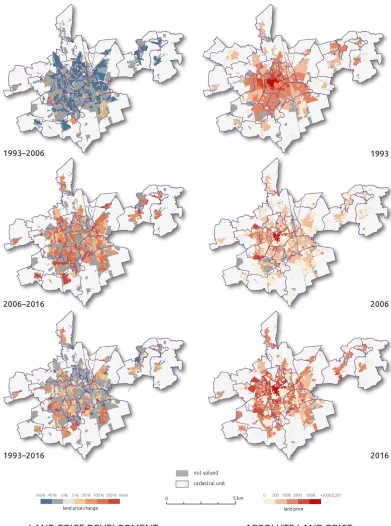
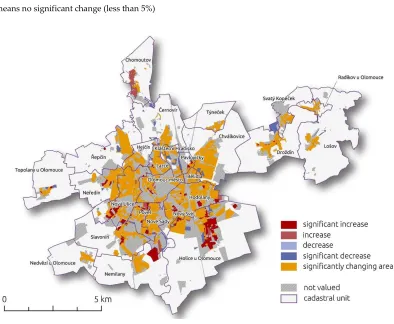
The first objective was to identify areas where prices did not change significantly over time or where price development might have been occurring. For this analysis, the data was modified as described in Chapter 2.3. First, the absolute price difference between two years was calculated, which was then converted to a relative value for better mutual comparison. The values were adjusted to logic: 0% – the price did not change; 100% – the price increased by 100%, (i.e., twice the original value), etc. Stable areas were defined as areas where the price changed by a maximum of 5%. Both absolute values and temporal developments were visualized (Fig. 2) and the basic spatial distribution of prices and changes was evaluated.
In the first part of the monitored period (1993–2006), the overall decline in prices in most parts of the city, even in the historical centre, which was the most expensive area (the absolute value of the land is still, however, in the highest category above CZK 5000), was observed. In this period, the value grew only in the south-eastern part Holice, where areas of individual housing dominate. A significant area of long-term growth is also located in the south of Nemilany, where a retail/industrial complex has gradually been established. The highest land prices were in the historical city centre. In the following period (2006–2016), prices increased across the city. Relevant growth was seen in the city districts Slavonín and Řepčín (the southern and north-western parts of the city), which both had new shopping centres established in 2002 and 2005. In part of the city centre, prices were strengthened, for example, by the completion of the Šantovka shopping centre, which increased the attractiveness of this locality. Another increase is also found in the Nedvězí and Nemilany cadastres. Here, areas of personal housing dominate, and the rise in prices is related to an overall trend of suburbanization when areas in the suburbs started being attractive for living and several new residential areas of individual housing were created.
Figure 2. Land price development changes in Olomouc.
Table 4. Typology of Land Price Changes.
1993–2006 2006–2016 Development Category Area Ratio
+ + significant increase 9.2% / or + + or / increase 3.7%
/ / stable area 0%
/ or - - or / decrease 0.5% - - significant decrease 5.2% + or - + or - significantly changing area 81.4%
where:
+ means a significant price increase (more than 5%) - means a significant price decrease (more than 5%) / means no significant change (less than 5%)
Figure 3. Land price development changes in Olomouc.
land prices. Long-term rising price parcels are located mainly in the suburbs; their largest representation is in the residential south-eastern part of the city.
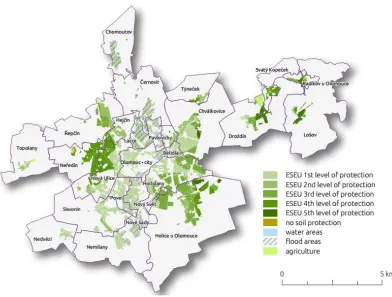
Since the changing patterns of parcel price dominates the typology, we concluded that partial temporal changes and trends are not significantly decisive for overall spatial assessment. Therefore, relative price development in the period 1993–2016 followed by absolute price in 2016 were used to assess overall sustainability in three individual aspects (environmental, social and economic). These were defined as a key part of evaluating sustainability development. In each aspect, we identified several topics for assessing price development in a spatial context. All topics and their values are presented in the following figures and subchapters.
Figure 4. Land price development changes related to economic, environmental and social aspects.
Figure 5. Land prices related to economic, environmental, and social aspects.
4.1. Economic Aspects
utilities and infrastructure (Fig. 6). The aim was to elaborate on the dependencies between land-use type and land price and to find out whether any land-use category was more significant for the real estate market than others. Surprisingly, prices did not develop as dramatically as in other aspects. For brownfields, we observed even a slight overall decline in prices, as these locations are probably not interesting to investors, perhaps because of the higher costs for reconstruction and elimination of environmental burdens. From a spatial point of view, these categories do not have any spatial pattern, except for production and warehouses located mainly in the eastern part of the city near rail transport. Generally, it is possible to say that the four selected economic spatial aspects are the most stable in terms of price development and did not record any dramatic changes in the monitored period. Also, regarding absolute price (2016), the price of most land in economic land-use categories did not exceed CZK 2500.
Figure 6. Spatial distribution of economic aspects.
4.2. Environmental Aspects
than 26,000 inhabitants were evacuated from the area [41]. The propensity of these locations to flooding was therefore reflected in the price of land. The most significant decline occurred in the northern part of the city in the Černovír, Klášterní Hradisko and Lazce cadastral units. The flood area mostly comprises areas of individual housing. Least important for the analysis is the agricultural area category, which covers only a few parcels of the monitored area. Similarly, the water area category includes only a limited number of parcels, but flood areas complement it.
Figure 7. Spatial distribution of environmental aspects.
4.3. Social Aspects
regarding absolute price, it is unequivocally the highest. The variation of prices here is also great; however, even 50% of all parcels in this category surpass all other assessed aspects.
Figure 8. Spatial distribution of social aspects.
The overall assessment points to the most significant impact of social and environmental spatial aspects: a rise in prices occurred in these categories. Categories with a decrease in price are minimal— these are primarily risk areas near watercourses which are prone to flooding. The growth of land prices for high-quality land is also significant. This might be because the Olomouc Region is characterized by soil of the highest quality in the Czech Republic. Parcels with lower soil quality were built on in the past and the city can now only be developed on parcels with higher soil protection levels. These classes compare to those of personal housing, which has seen increased interest in recent years and lead construction activities to being focused on this type of housing. The analysis confirmed the expectation that the most lucrative parcels are located in the city’s historical core. This is demonstrated both in the absolute price of land and its change over the monitored period.
4. Discussion
Regarding the influence of the development of macroeconomic indicators on land price, the results of the regression analysis show that the most significant indicators for land price increase/decrease in time are the indicators “number of inhabitants” and “number of finished flats”. Other indicators with a significant impact are “GDP”, “unemployment” and “number of started flats”. It partially corresponds to the results of Yang [12], where the influence of immigrant population, GDP and investment in residential buildings were observed. However, the influence of “net income per capita” is not significant for land price development in Olomouc compared to results obtained by Mou [10] in his analysis, which also includes the influence of average wages of employees on land price in selected cities.
and their results show that the significance, direction and magnitude of the relationships between selected factors can vary across cities [10].
Based on an analysis of master plans, Burian [35] explored the changes in several stable areas in Olomouc (450 ha of agricultural land; 352 ha of housing areas; and 128 ha of city parks and public services areas). We assumed that these stable areas would have been linked to stable land prices. Surprisingly, no long-term stable areas were found in the area of interest, with a 5% (or higher) tolerance of change. There is a link, however, between price increase and some changes in the land-use type in the master plan. This study shows that long-term rising parcel prices are seen mainly in the suburbs, their largest representation being in the residential south-eastern part of the city. Most are located in areas marked by Burian [35] as the most variable localities. Two of them are represented by commercial activities (Globus shopping centre in the Řepčín cadastre and Šantovka shopping centre in the city’s centre).
In relation to the spatial analysis of the impact of different aspects, some valued parcels overlap and a parcel may comprise several aspects (for example, parcels in the historical centre are included in both residential area and urban conservation area categories). As evaluation was performed from different points of view, this phenomenon cannot be avoided. This means the differences in price changes in individual categories are not so significant, however, the analysis offers a more complex evaluation.
The overall assessment of total prices and their changes over the three time intervals revealed some patterns in price map behaviour. The most conspicuous is the city’s historical centre: here, we can see the highest long-term land prices, even in the period of decrease in prices. As we move away from the city centre, prices gradually decreased. In the second interval of the monitored period, the original spatial pattern disappeared as the value of peripheral parts of the city increased because of personal housing construction. The temporal development described in Chapter 3.1 is also reflected in the spatial visualization. An overall decline in prices in most parts of the city, even in the most expensive historical centre, was observed. Between 1993 and 2016, there was primarily an increase of price; the decrease is particularly evident in some parts of the city, affected mainly by the environmental aspect of flood areas.
5. Conclusions
Land price sustainability issues have been analysed by other authors previously. Based on the literature review, we discovered that only a few researchers had focused on an analysis of official land price maps, which are available very rarely. These maps are very significant documents which influence and control the real estate market in the larger cities of the Czech Republic. For this reason, we decided to perform an in-depth analysis of land prices of the city of Olomouc. Official land price maps from 1993 to 2016 were used as the primary data source for temporal and spatial dependencies and changes in land prices in Olomouc. Spatial changes were analysed from three aspects of sustainability: economic, environmental, and social. We proposed several research hypotheses to confirm some general statements about land price development.
The first research hypotheses concerned the link between changes in land prices and changes in macroeconomic indicators. The results of the regression analysis and consequent development of certain variables for the observed period suggests the answer to this question is partially affirmative. Some macroeconomic indicators had a significant impact on the changes in land prices in Olomouc in the period 2006–2016, but not in the case of all the observed macroeconomic indicators. We can conclude that the development of land prices is influenced by a mixture of economic, demographic and social indicators. It is also important to highlight that the analysis is based on land prices in CZK per square meter in Olomouc, calculated as a median of all prices of all land in Olomouc only. In case of using different prices for different localities, the results can be more precise.
revealed. The price increase in three selected factors was quite low. Brownfields even showed a decrease in price. The hypothesis concerning residential areas and the historical centre is valid: price changes were highest in the three monitored categories. Absolute price in residential areas, especially those located in the historical centre, have been highest in the long term.
We assumed that there would be stable areas with no land price change which were comparable to stabilized use. Based on our analysis, we conclude that no connection exists between land-use stability and land price stability. Surprisingly, no long-term stable areas were found in the area of interest. Parcels with changes in land-use type are located mostly in areas with a significant land price increase (commercial areas).
The analysis confirmed that land price and its change over time varied in different spatial aspects. Surprisingly, the smallest influence was reflected in the economic aspect. However, price was significantly affected by land quality and its location within or outside the protected urban conservation area, as discussed above. Regarding natural events in recent decades, we observed a significant drop in land prices in the vicinity of watercourses threatened by flooding.
Author Contributions: Conceptualization, J.B., J.Z. and K.M.; Methodology, J.B., J.Z. and K.M.; Investigation, J.Z., B.K. and K.M..; Data Curation, B.K. and K.M.; Writing-Original Draft Preparation, J.B., J.Z. and K.M.; Visualization, K.M.; Supervision, J.B.
Funding: The research was supported by the ERASMUS+ project no. 2016-1-CZ01-KA203-024040 and by the
Internal Grant Agency of Palacký University Olomouc (project IGA_PrF_2018_028). Conflicts of Interest: The authors declare no conflict of interest.
References
1. Hu, S.; Yang, S.; Li, W.; Zhang, C.; Xu, F. Spatially non-stationary relationships between urban residential land price and impact factors in Wuhan city, China. Appl. Geogr. 2016, 68, 48–56, doi:10.1016/J.APGEOG.2016.01.006.
2. Czech Statistical Office Average salaries in regions in 2018 [Průměrné mzdy - 1. čtvrtletí 2018] Available online: https://www.czso.cz/csu/czso/cri/prumerne-mzdy-1-ctvrtleti-2018.
3. Black, J. T.; Hoben, J. E. Land price inflation and affordable housing. Urban Geogr.1985, 6, 27–47, doi:10.2747/0272-3638.6.1.27.
4. Benirschka, M.; Binkley, J. K. Land Price Volatility in a Geographically Dispersed Market. Am. J. Agric. Econ.1994, 76, 185, doi:10.2307/1243620.
5. Sunega, P.; Lux, M.; Zemčík, P. Housing Price Volatility and Econometrics. Crit. Hous. Anal.2014, 1, 1, doi:10.13060/23362839.2013.1.2.117.
6. Colwell, P. F.; Munneke, H. J. The structure of urban land prices. J. Urban Econ. 1997, doi:10.1006/juec.1996.2000.
7. Liu, Z.; Wang, P.; Zha, T. Land-Price Dynamics and Macroeconomic Fluctuations. Econometrica2013, 81, 1147–1184, doi:10.3982/ECTA8994.
8. Huang, D.; Yang, X.; Liu, Z.; Zhao, X.; Kong, F. The dynamic impacts of employment subcenters on residential land price in transitional China: An examination of the Beijing Metropolitan Area. Sustainability2018, 10, 1–22, doi:10.3390/su10041016.
9. Rosenthal, S. S.; Helsley, R. W. Redevelopment and the urban land price gradient. J. Urban Econ.1994, doi:10.1006/juec.1994.1012.
10. Mou, Y.; He, Q.; Zhou, B. Detecting the spatially non-stationary relationships between housing price and its determinants in China: Guide for housing market sustainability. Sustainability 2017, 9, 1–17, doi:10.3390/su9101826.
12. Yang, S.; Hu, S.; Li, W.; Zhang, C.; Torres, J. A. Spatiotemporal effects of main impact factors on residential land price in major cities of China. Sustainability2017, 9, doi:10.3390/su9112050.
13. Simlai, P. Estimation of variance of housing prices using spatial conditional heteroskedasticity (SARCH) model with an application to Boston housing price data. Q. Rev. Econ. Financ. 2014, doi:10.1016/j.qref.2013.07.001.
14. Xu, Z.; Li, Q. Integrating the empirical models of benchmark land price and GIS technology for sustainability analysis of urban residential development. Habitat Int. 2014, 44, 79–92, doi:10.1016/J.HABITATINT.2014.04.012.
15. Fearn, J. TOO POOR TO MOVE, TOO POOR TO STAY. A Report on Housing in the Czech Republic, Hungary and Serbia; 2004;
16. Lux, M. Housing policy and housing finance in the Czech Republic during transition : an example of the schism between the still-living past and the need of reform; Delft University of Technology, 2009; ISBN 1607500582. 17. Lux, M.; Sunega, P. The future of housing systems after the transition - The case of the Czech Republic.
Communist Post-Communist Stud.2010, doi:10.1016/j.postcomstud.2010.04.001.
18. Musil, J. The Czech Housing System in the Middle of Transition. Urban Stud. 1995, 32, 1679–1684, doi:10.1080/00420989550012311.
19. Sklenicka, P.; Molnarova, K.; Pixova, K. C.; Salek, M. E. Factors affecting farmland prices in the Czech Republic. Land use policy2013, 30, 130–136, doi:10.1016/J.LANDUSEPOL.2012.03.005.
20. Temelová, J.; Novák, J.; Ouředníček, M.; Puldová, P. Housing Estates in the Czech Republic after Socialism. Urban Stud.2011, 48, 1811–1834, doi:10.1177/0042098010379279.
21. Hlaváček, M.; Komárek, L. Regional Analysis of Housing Price Bubbles and Their Determinants in the Czech Republic. Czech J. Econ. Financ.2011, 61, 67–91.
22. Dobiášová, S. Comparison of price maps of selected EU countries and the Czech Republic. Diploma thesis [Srovnání cenových map vybraných zemí Evropské unie a České republiky], Bankovní institut vysoká škola Praha Katedra, 2013.
23. Chrudimská, J. Innovation of land price map of Olomouc city. Diploma thesis [Inovace cenové mapy města olomouce], Univerzita Palackého v Olomouci, 2010.
24. Kočvarová, B. Spatio-temporal analysis of land price map of Olomouc city. Diploma thesis [Časoprostorová analýza cenové mapy Olomouce], Univerzita Palackého v Olomouci, 2018.
25. Kovaříková, V. Land price maps. Diploma thesis [Cenové mapy], Bankovní institut vysoká škola Praha, 2012.
26. Kubíček, J. Rents and the land price relationship based on the price map. Doctorate thesis [Vztah mezi nájemným a cenou pozemku v cenové mapě], VUT v Brně, 2009.
27. Paszto, V.; Burian, J.; Macku, K. Mapping the economic data - case studies and best practices. In 17th International Multidisciplinary Scientific GeoConference SGEM 2017; 2017.
28. Šindelářová, K. Price Maps in Public Administration Practice. Diploma thesis [Cenové mapy v praxi veřejné správy], Masaryk University, Brno, 2009.
29. Realitymix Price per Square Meter to Buy Apartment [Průměrná cena za 1 m2 bytu] Available online: https://realitymix.centrum.cz/statistika-nemovitosti/byty-prodej-prumerna-cena-za-1m2-bytu.html. 30. Czech Statistical Office Number of inhabitants in Czech municipalities [Počet obyvatel v obcích - k
1.1.2018] Available online: https://www.czso.cz/csu/czso/pocet-obyvatel-v-obcich-see2a5tx8j.
32. Ministry of Finance Decree No. 3/2008 Coll. [Vyhláška č. 3/2008 Sb., o provedení některých ustanovení zákona č. 151/1997 Sb., o oceňování majetku a o změně některých zákonů, ve znění pozdějších předpisů, (oceňovací vyhláška)].
33. Land price map [Cenová mapa] Available online: www.cenovamapa.cz (accessed on Oct 4, 2018). 34. Burian, J.; Brychtová, A.; Vávra, A.; Hladišová, B. Analytical material for planning in Olomouc, Czech
Republic. J. Maps2016, 12, 649–654.
35. Burian, J.; Brus, J.; Voženílek, V. Development of Olomouc city in 1930-2009: based on analysis of functional areas. J. Maps2013, 9, 64–67.
36. Czech Statistical Office Time Series – Selected Indicators for Olomouc Region [Časové řady za Olomoucký kraj] Available online: https://www.czso.cz/csu/xm/casove-rady-vybrane-ukazatele-za-olomoucky-kraj.
37. Czech Statistical Office Statistics on Income and Living Conditions. Households by labour activity and size of municipality. [Příjmy a životní podmínky domácností - 2017] Available online: https://www.czso.cz/csu/czso/prijmy-a-zivotni-podminky-domacnosti-rn2to6gtkz.
38. Czech National Bank Discount Rate Development. [Vývoj diskontní sazby] Available online: http://www.cnb.cz/cs/faq/vyvoj_diskontni_historie.txt.
39. Zimmermannova, J.; Skalickova, J.; Siroky, J. WHAT CAN TAX REVENUES TELL US ABOUT THE ECONOMIC ACTIVITY OF REGIONS? Sociol.2016, 9, doi:10.14254/2071.
40. Burian, J.; Paszto, V.; Langrova, B. Possibilities of the definition of city boundaries in GIS - The case study of a medium-sized city. In SGEM2014 Conference Proceedings, Vol. 3; 2014; pp. 777–784.