Performance Analysis of TFT-OFDM Systems
in Long Delay Channels Using Turbo Codes
Sheba Priya Roy
1, Saju A
2PG Student [CE], Dept. of ECE, CAARMEL Engineering College, Pathanamthitta, Kerala, India1
Associate Professor & Head of the Department, Dept. of ECE, CAARMEL Engineering College, Pathanamthitta,
Kerala, India2
ABSTRACT:In this paper a very efficient compressive sensing technique is applied in a time frequency training multiplexing (TFT-OFDM).From the channel information received from TFT OFDM we apply it to the auxillary subspace pursuit (A-SP) algorithm.This algorithm has lesser complexity and makes use of the PN coarse path delay estimation.The path delay estimation is done by making use of the most significant taps.We make use of the pilot carriers which should be sparse.The sparse signals are generated by using the theory of Compressive Sensing(CS).The performance evaluation was done for both low density parity check (LDPC) code and turbo codes with puncturing.It was seen that the turbo coded TFT OFDM showed better performance especially when the channel length is close to or even greater than the guard interval length for 256 quadrature amplitude modulation(QAM) in different channels.
KEYWORDS:Compressive Sensing,Auxillary Subspace Pursuit algorithm,path delays,Turbo codes.
I.INTRODUCTION
In the previous year’s OFDM is being widely implemented in various wireless devices.Among the different multiplexing technique TFT –OFDM has gained wide acceptance because of its feature of making use of both the time and frequency.It has proved to be more progressive than the time domain synchronous (TDS) OFDM as the TDS OFDM can’t mitigate the interblock interference (IBI). The pseudo noise OFDM (DPN-OFDM) was used to overcome this disadvantage.But it had lesser spectral efficiency.The TFT-OFDM makes use of higher modulation schemes such as 256QAM and thus finds application in ultra high definition television(UHDTV).In long delay channels all the signals that are arriving from different direction need not be of maximum importance.Therefore the method of finding the most significant taps is used in which the signals found are the base.These signals are sparse in nature. The algorithm has two important characteristics: low computational complexity, comparable tothat of orthogonal matching pursuit techniques and has priori knowledge as aswell when appliedto very sparse signals, and accuracy with lesser complexity.
II. LITERATURE SURVEY
III.COMPRESSIVE SENSING
A signal that has its most weighting coefficients in the transform domain as zero can be represented or created by using lesser number of samples than usually required in a sampling process.It is basically dependent on the sampling matrix and the sampling rate.In compressive sensing the sampling rate is less than 2𝑓𝑏which means that it takes lesser sampling rate than nyquist rate.Compressive Sensing has wide applications in the field of medical apllications like ECG,MRI and pixel cameras.Itis used to know the individual arrivals in a multipath arrival environment.In the previous studies priori aided compressive sampling matching pursuit (PA-CoSaMP) algorithm was used.In this we paper we propose the auxillary subspace pursuit with lesser complexity.With this algorithm we do the CS based channel estimation(CE). .There are two properties:
1)incoherence
2)sparse nature
The incoherence is of two types that is the lower coherence and higher coherence.Lowerincoherence means more difference and compressive sensing provides that.Thus the signals can be recovered with high probability.To implement this compressive sensing process in an OFDM we need to consider the following points:i)A channel model should be considered to estimate the sparse signalsii)We need to place the pilots in such a way that the interference from other pilots have to be observed and from other data symbols has to be also considered as noise.
IV.TURBO CODED TFT OFDM SYSTEM
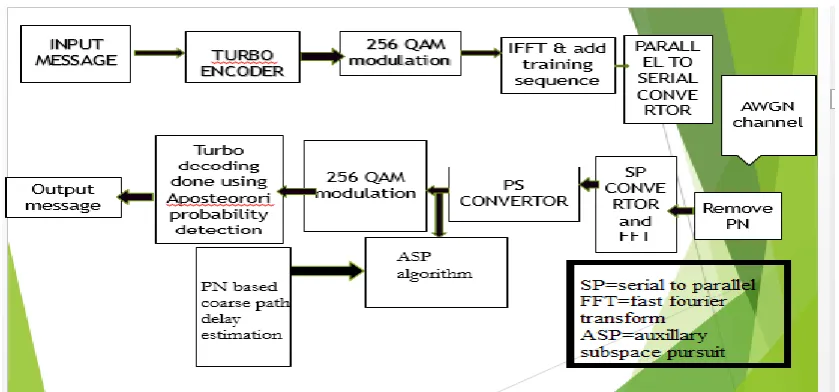
Fig 1. TFT OFDM system model using turbo codes
There are two recursive systematic convolutional encoders. The first encoder received the data stream from the random generator, while an interleaved version is received by the other encoder. The interleaver used is a random interleaver.It is used so the interleaved output maybe different from the other output to avoid the occurance of low weights in all the output. The inter-lacers distribute the incoming information in both out- puts. It is done to provide a systematic and a recursive version of the input. In the typical parallel system two interlacers provided three outputs in which the first output is systematic while the other two are the recursive versions or the parity bits.An additional puncture block produced another recursive signal. Puncturing is done to acquire better performance in BER rate.We increase the data rate by using puncturing.It systematically adjusts the code rate with the system performance.There are different types of puncturing and is used in applications like satellite communication.Then transmission done using OFDM as shown in fig1.
codes BICM techniques it is seen that the it finds much application in digital broadcasting.It also can double the capacity.It can be used in a multipath environment such as SFN and will use less guard interval time.
Turbo codes are those codes that are able to reach close to the Shannon limit. Low Density Parity-Check (LDPC) codes have a generator matrix of the code word to be identified. In LDPC decoding we use the belief propagation algorithm. Finally, a comparative analysis on turbo and LDPC codes is done. Experimental results show turbo codes perform better than LDPC codes.The most popular algorithms for the path delay estimation are the greedy algorithms, like Matching Pursuit (MP) orOrthogonal Matching Pursuit (OMP), that identify the nonzero elements of x in an iterative
fashion.The nonzero element set is first set to zero.The observations are set as the residual, r = z.Correlate all columns of A with the residual andchoose the largest element by magnitude and add it to the set of non-zero elements. We apply the condition that only elements of x are nonzero that have been added , this helps in finding an estimate that can
minimize.Thus we can update the new residueˆ. Repeat steps until we get below a predetermined threshold.This type of algorithm has been popular mainly because it can be easily implemented and has low computational complexity. This has lead to renewed interest in dynamic, leading to new greedy pursuit algorithms like the priori aided compressive sensing sampling matching pursuit(PA-CoSaMP) algorithm.The input that is given are:
1) Initial path delay set D0, channel sparsity levelS, initial channel sparsity level S0;
2) Noisy measurements y, observation matrix Φ.The output that we get is Ssparse estimate ĥof the channel impulse response(CIR).
V.AUXILLARY SUBSPACE PURSUIT ALGORITHM(ASP)
Basically there are three steps:
1) Coarse path delay estimation done using PN sequence.This can be done by the parity aided compressive sampling pursuit (PA-CoSaMP) algorithm. From this we get the path delay estimation.We do not consider the path gains.The path delays of the most significant taps are calculated.This is given as the auxillary information for the Auxillary Subspace Pursuit(ASP).The auxillary information is taken for the initial configuration of the ASP algorithm.The coarse channel estimate is found.We find the channel sparsity level S.Thus this will contain only the initial path delay
2)In the second step we have to reconstruct the OFDM block.This is done using the overlap add (OLA) algorithm.This helps in removing the IBI caused by the PN sequence.After using the OLA algorithm we also get the useless part that is formed by the linear convolution of PN sequence and OFDM block.This has to be removed so as to get cyclicity . 3)In the third step we make use of the ASP algorithm the exact channel impulse response (CIR) .The auxillary information received will reduce the complexity of the ASP algorithm.Herewe have the initial value from the path delay and therefore it helps in providing initial configuration.In ASP we subtract after each iteration, the remaining most significant values are taken.The main three steps in ASP algorithm are:
1)Initial Configuration
2)Significant Entry Identification. 3)No of iteration
VI. TFT OFDM SYSTEM
Fig 2. TDS-OFDM system
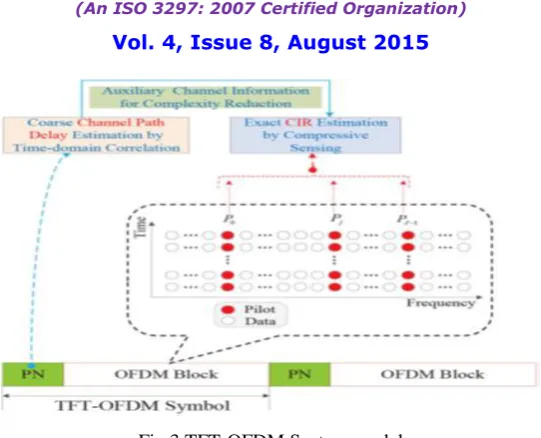
Fig 3.TFT-OFDM System model
Fig. 3 shows that TFT-OFDM hastraining information in both the time and frequency domainsfor every signal symbol, i.e., the time-domain TS and thefrequency-domain pilots scattered over the signal bandwidthare jointly used in
TFT-OFDM. The ith TFT-OFDM signalsymbol 𝒔𝒊= 𝒔 𝟎 𝒊, 𝒔
𝟏 𝒊, … . , 𝒔
𝑴+𝑵−𝟏
𝒊 𝑻is composed of theknown PN sequence 𝒄 = 𝒄𝟎,𝒄𝟏,….,𝒄𝑴−𝟏𝑇of length M and the OFDM block = 𝒙𝒊=𝒙𝟎𝒊,𝒙𝟏𝒊,….,𝒙𝑵−𝟏𝒊𝑻of length N,
i.e𝒔𝒊= 𝑐
𝒙𝒊
In contrast to the conventional TDSOFDM, the OFDM block in TFT-OFDM contains not only the traffic data, but also a small number J of pilots.ɼ is the pilot location set and represented asɼ= {𝑃0𝑃1, … . , 𝑃𝑗 −1}where 0 ≤P0 < P1 <・・<
PJ−1 ≤N − 1 . By the use of CS the pilot number J could be reduced significantly and hence the spectral efficiency loss is negligible. The difference is that the pilots are equally spaced in exixting schemes, while the pilots are randomly located in the proposed scheme to ensure good CE performance based on CS.
So far it was assumed that y is available, and that one can simply apply the transform into the domain of {{𝜓𝑘=1𝑛 } to determine which 𝑥𝑘 are relevant (non-zero). Although thiscase does exist and is important for some forms of data compression, the real application of compressive sensing is theacquisition of the signal from m, possibly noisy, measurementsz = 𝚽𝑯
𝒍y + 𝑣𝑙 for l= 1, . . . ,m, where here it is assumed that 𝑣𝑙 is zero-mean complex Gaussian distributed with variance N0 and the noiseless case is included for N0 → 0. The signal acquisition process can now be written using the m×n matrixA,
z = 𝚽𝑯y + v = 𝚽𝑯𝜓𝑥 + 𝑣 .
where𝚽 = [𝚽1, 𝚽1, … … , 𝚽𝑚] is an n × m matrix and z =[𝑧1, 𝑧2, … . , 𝑧𝑀]𝑇 is the stacked measurement vector.Sincethis is a simple linear Gaussian model, it is “well posed” aslong as A is at least of rank n. By “well posed” we simplymean that there exists some estimator ˆx (or ˆy for that matter),whose estimation error is proportional to the noise variance;therefore as the noise variance approaches zero, the estimationerror does as well.If the channel is exactly known at the receiver, the IBI of thePN sequence on the OFDM block can be completely removed.Then, by using the idea of the classical overlap and add (OLA)algorithm , the cyclicity reconstruction of the OFDM block can be obtained and hence the CP effect can be restored.In the proposed scheme, the time-domain PN sequence and the frequency-domain pilots are jointly exploited to perform the CE.
VII. RESULT AND DISCUSSION
Fig. 4 BER vs SNR of TFT-OFDM using turbo codes in SARFT channel
In the fig4, it shows the graph of BER vs SNR rate in different channel for the TDS-OFDM system and the proposed system.It is seen that the proposed system enjoys a performance of 10−1 than that of the proposed system.Thus better performance with lesser complexity.This is evaluated in a SARFT channel which supports the wireless standards.
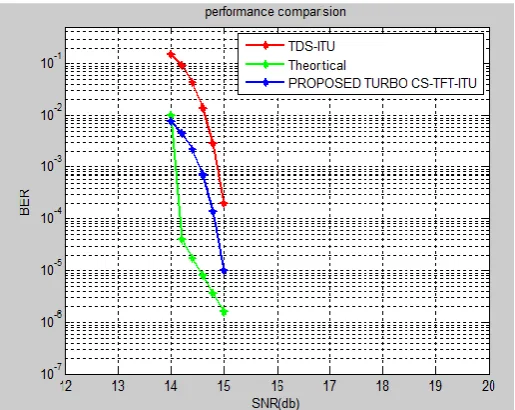
Fig. 5 BERvs SNR of TFT-OFDM using turbo codes in ITU-VB channel
In fig5 the BER is evaluated in ITU-VB channel model for static environment.Itis evaluated on the condition that the guard interval is greater than the channel length.This is for the extreme case.It is seen that the proposed TFT-OFDM system has a BER rate close to the theoretical value. The vehicular channel models are there for different power levels.
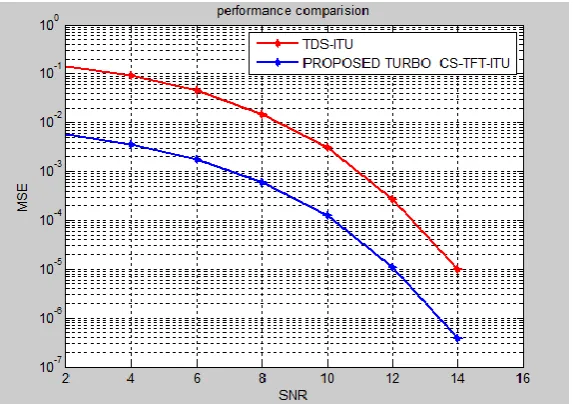
Fig.6MSE vs SNR of TFT-OFDM using turbo codes in SARFT channel
The difference occurring because of randomness or because the estimation doesn't account for a value that could produce a accurate estimate is called mean square error (MSE).In fig6 the mean square error value is almost close to the theoretical value.Thus spectral efficiency is increased.It can be seen that under the State Administration of Radio, Film & Television (SARFT) channelwhich is responsible for controlling the access to satellite and cable networks as well as supervising their operations, the MSE performance of the proposed scheme enjoys a significant SNR gain
Fig .7 MSEvs SNR of TFT-OFDM using turbo codes in ITU-VB channel
VIII.CONCLUSION
Compressive sensing has made a great impression in the signal processing and broadcasting community, where besides an intriguing theory it offers versatile applicability to many challenging problems. In the communications community the application of compressive sensing has been mainly on sparse channel estimation with MST’s, with extensions to multiuser and cognitive radio systems. In this paper, we illustrated the application of the compressive sensing techniques in long delays by using the joint estimation. Every TFT-OFDM symbol has time-frequencytraining information composed of the timedomain TS and a very small number of frequency-domain grouped pilots. With the joint timefrequency channel estimation, the received TSis directly utilized to merely acquire the path delay information of the channel, while the path coefficientsare estimated by the frequency-domain pilots.The present system has lesser complexity and since we use turbo codes with puncturing ,it uses lesser system memory.It also helps in retrieval of data in large clusters.The interleaving done will also help in increasing code rate.
.
REFERENCES
[1] C. Berger, Z. Wang, J. Huang, and S. Zhou, Application of compressive sensing to sparse channel estimation, IEEE Commun Mag., vol. 48, no. 11, pp. 164174, Nov. 2010.
[2] L. Dai, Z. Wang, and Z. Yang, Compressive sensing based time domain synchronousOFDM transmission for vehicular communications, IEEE J. Sel. Areas Commun., vol.31, no. 9, pp. 460469, Sep. 2013.
[3] Z. Tang, R. Cannizzaro, G. Leus, and P. Banelli, Pilot-assisted timevarying channelestimation for OFDM systems, IEEE Trans. Signal Process., vol. 55, no. 5, pp. 22262238,May 2007.
[4] B. Yang, K. Letaief, R. Cheng, and Z. Cao, Channel estimation for OFDM transmission inmultipath fading channels based on parametric channel modeling, IEEE Trans. Commun.,vol. 49, no. 3, pp. 467479, Mar. 2001.
[5] Jitendra Prakash Shreemukh, Prof. (Dr.) B.S. Rai,Analysis of Puncturing in Turbo Code using MATLAB,IJARCCE ,Vol. 3, PP.192-195, April 2014.