Dwt Based Ofdm System for Reliable Ber Performance Using
Barcode System in Mobile Devices
G.Chaithnaya Kumar Reddy
(M.Tech)1S. Farooq Anwar
(M.Tech. Assistant Professor)2Department of ECE, Global College of Engineering and Technology, Anantapuramu, Kadapa – 516 001-India
[email protected]
&
[email protected]
Abstract---In wireless communication, mobile
devices attains more prominent role in this generation. In today’s world everything can be done
through electronic gadgets. 2D barcode is used to hide the data or information given as input and the generated QR code is modulated through DPSK-FFT based OFDM system to securely transfer QR code from one device to other. In the simulation results, the performance of BER is evaluated for different modulation techniques such as PAM, QPSK and DPSK. As the simulation results, shows that the performance of BER is less when compared to previous modulation techniques. The data rate as well as the reliability of proposed scheme yields better performance over traditional state-of-art
methods in terms of complexity and efficiency.
In the future scope, Discrete Wavelet Transform is used to improve the transformation performance of the signal. DWT has the ability to transform a signal from one format to other without any data loss. So the generated barcode is transformed without any data loss. Such that the DWT based OFDM yields better BER performance compared to FFT.
Keywords: Barcode, DPSK-OFDM, FFT, DWT,
Data transmission
1. INTRODUCTION
Communication industry has grown enormously in past six decades and supports various applications belong to different research fields. Wireless communication is major constituent of communication industry which has 75% of total market share. Wireless communication takes the communication domain to next level in terms of reliability and performance. Mobile data transmission is considered as 21st century system which offers
higher data rate but suffers from complexity.
based modulation framework achieves high performance along with nearly low complexity. Barcode implementation in late 1950’s has emerged as solution to security problems and became popular system for secured data transmission. Transfer of information is an interesting area in communication domain and transferring more information in less bandwidth is an assumption in analog systems while it became reality with introduction of barcode in digital systems. Encoding the information into un-understandable form provides security and the process is well accomplished by using barcode and 2-D QR code.
A novel barcode modulation system is proposed in this work to handle the complexity with ease and yields better performance with respect to low run time complexity. DPSK modulation along with OFDM is used for attaining higher data rates while barcode system is implemented in this work for high security provisions providing to data which is transferred between two devices with high accuracy. DPSK- DWT OFDM system has shows its supremacy over traditional algorithms in terms of performance and efficiency.
2. JUSTIFICATION
Digitalization and its dependent digital gadgets make human life easy and comfortable. Invention of internet has take digitalization to next level. Mobile device invention is designed to meet various requirements in well defined manner. According to international statistics, in 1990 for every 1 million people there is one mobile while in 2016 for 7 billion there are almost 15 billion mobiles are in usage.
Although mobile device is considered as most prominent thing in daily life but still data transmission through mobile device is still concerned area in digital world. Various drawbacks are addressed in well organized way in literature but still it is unresolved issue and the proposed work is proposed to solve the all issues in mobile transmission and justification of the proposed work relies how effectively proposed method handle the complexity issue.
2.1 New Knowledge to be generated by the Research
A. Conventional algorithms proposed for handheld device transmission area miserably fail to achieve low complexity. Traditional barcode modulations mechanisms are based on PAM, BPSK and QPSK attains complexity levels more than 30% and high complexity levels makes handheld device transmission an unresolved issue in wireless transmission.
B. DPSK based barcode modulation scheme along with OFDM is newly implemented to handle the complexity issue in efficient way.
C. Handling the complexity with increasing performance another new thing implemented in this work
2.2 Objectives
1. High speed mobile transmission 2. Low complexity
4. High performance 5. Better efficiency 6. Reliability
3. RELATED INFORMATION
Automatic systems introduction in wireless communications is consider as path breaking innovation which helps to transfer the information between two entities desired time with good accuracy and better performance. Manual data identification consumes more time which eventually declines the system performance and provides ample security measurements for securing data transmission proves from unnecessary distortions. ‘Barcode technology’ are vividly used various research fields for achieving creating automatic identification and data capture. Barcode modulation is explained as follows
(i) 1-D one-dimensional barcodes:
One-dimensional barcode appearance looks in a peculiar form consists of white and black lines in parallel form with essential spacing between them. Generally scanner reads the white lines excluding the black lines which decoding the barcode and it’s the interesting fact about the one-dimensional barcode spacing consists of white and black lines.
(ii) 2-D Two-dimensional barcodes:
Two-dimensional barcode is a purely a graphical image which has ability to preserve the necessary information both in horizontal as well as vertical way. There are many 2D barcode are available from that some uses for camera phone applications these are QR code, visual code, data matrix, VS code. But
along these codes QR code is more widely used in camera phone application since QR code is a unique code and it has a larger data storage capacity
4. ORTHOGONAL FREQUENCY
DIVISION MULTIPLEXING (OFDM)
In 21st century, the role of the technology to
offer high data rates and mobility is crucial and the technology is changing its face every other because of immense research work carried out on the advance wireless communications. Actually the research on parallel data transmission is traced out in the mid 1960’s but it takes 25 long years to make it compatible to real time applications. The OFDM gradually seen its presence in the various application and now various international standards consider it as promising modulation scheme which initially supports wireless standards like WIFI, WIMAX, LTE etc. The two important parameters required better transmission of data from one entity to another are data rate and the modulation scheme should support different channel conditions to obtain better spectral efficiency.
The evolution of the third Generation Partnership Project (3GPP) development based on the Long term evolution (LTE) supports two networks namely Radio access network (RAN) and core network. The transformation of the 3G to 4G observes the changes in terms of data rate and spectral efficiency. International Telecommunication Union Radio communication Sector (ITU-R) initialized a set of requirements for the 4th generation
cellular system and requirement of the high data rate is specified by International Mobile Telecommunications Advanced project (IMT-Advanced) for 4G. OFDM is a modulation scheme which is one of the techniques employed in LTE to enhance the data stream.
5. PROPOSED METHOD
Demand for high data rate communication system leads to design of OFDM architecture which offers high data rate up to 100mbps. Introduction of blur in digital images has become a major concern area in the data transfer and usage of orthogonal subcarriers from OFDM has successfully handled the problem of image contamination. Orthogonal frequency division multiplexing scheme utilizes the low pass filter in efficient way to ensure the transfer of low frequency bits in uncontaminated way and only requirement needed is high phase coherency which helps in detect data bits in accurate and reliable way. A detailed explanation with well defined modification is presented in this paper based on above study and the proposed idea mainly relies on equipped modulation scheme along with LCD camera [9] movements which is used in capturing the single frame and the acquired images are perceived in better way.
eliminates the unnecessary channel estimation requirements which results in low processing power.
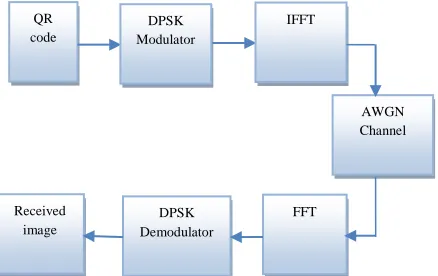
Figure 1: Transmission of information using DPSK Algorithm
Transmission information from the transmission end at maximum level is a concerned area especially from a single image and in order to meet the criteria, maximum data must be extracted from the single which is followed by increasing the data rate of the consecutive frames for decoding purpose. Extraction of the information depends on the LCD display design while in some cases it depends on the receiver end camera respectively.
(A) DATA CAPACITY
Data capacity is crucial part in data transfer from transmission end to receiver end though channel. Number of bits viewed on LCD screen especially of raw image. A color image shown on display composed of rows and columns as ‘M’ and ‘N’ and transmission of data is done through channel represented as 𝐿𝐷 and depth of color bit 𝐵𝐷bits per channel. The maximum information is represented as
𝐶𝐼=𝑀𝐷× 𝑁𝐷× 𝐿𝐷× 𝐵𝐷 𝑏𝑖𝑡𝑠 𝑝𝑒𝑟 𝑖𝑚𝑎𝑔𝑒 … (1) The discrete nature of the LCD display puts serious limitations to perceive maximum information as
shown in above notation and desired information rate cannot be achieved due to certain limitations as described below.
(i) Power related Limitations
According to the Shannon hypothesis theory, the power passing through channel is directly depends on the signal force. The signal force represents the speed achieved by the respective signal while it sent through the medium in effective way. So power limitations deployed in the communication theories pose major limitation is transmitting the information using barcode modulation. The major reasons which vividly cause power limitations are as follows
Signal compression while transmission results in distortions. These compression distortions are the one of the predominant reason for causing power limitations.
Subjective relative motion
(ii) Finding the relevant patterns
Modulation/demodulation is considered as heart of the modern day communication system which is offering high data rates to various indoor and outdoor applications by international communication standards. Extraction of inscribed information from respective barcode modulation is highly affected by power distortions. Standard finder pattern used for QR code is 1:1:3:1:1.
(C) DPSK – OFDM
Transmission of information through wireless scenario is possible because of reliable modulation schemes. In traditional approaches vast amount of modulation schemes along OFDM has implemented AWGN
Channel QR
code
DPSK Modulator
IFFT
Received image
DPSK Demodulator
but none can achieve low complexity. In this work, DPSK-OFDM modulation scheme has implemented for better transmission of information from transmitter end to the receiver end. The transmission of information through DPSK OFDM approach is shown in following figure 1.Here the respective input taken is ‘TEXT’. The encoding process helps in achieving secured QR code for reliable transmission. Encoding and decoding of QR code is achieved by Zxing open link source [10]. Cyclic extension is used to prevent the inter carrier interference (ICI) in a OFDM system [7].
(i) DPSK Modulator
DPSK takes the converted data as a input source. Each symbol is converted to a complex phase by following rules
11→𝑒𝑗1𝜋4 , 10→𝑒𝑗7𝜋4 , 01→𝑒𝑗3𝜋4 , 00→𝑒𝑗5𝜋4 ,
First bit modulates the Real component & second bit modulates the imaginary component of the phase of each symbol.
S matrix converted into Differential matrix D using following method:
• D(0,0)=S(0,0); (2)
• D(0,n)=D(0, n-1) × s (0,n)1≤n<N-2 (3)
• D(m, n)=D(m-1,n)×s(m,n)1≤m<M/2-1, 0≤n< N-2 (4)
D matrix is converted into two matrices: • D1(m,n)=D(m,n); (5)
• D2(m,n)=D(m,n+N-2/2 ; (6)
Where 0≤m<M/2-1, 0≤n<N/2-1
These two matrices are used to fill regions 1 and 2 of the transmission matrix.
(ii) IFFT
IFFT is used to convert the frequency domain data into time domain. Output of DPSK modulator is in frequency domain, so IFFT is used to convert it in Time domain representation using following equation:
X[n]= ∑𝑵−𝟏𝑿(𝒌)
𝒌=𝟎 . 𝒆
𝒋𝒌𝟐𝝅𝒏
𝑵 𝒏 = 𝟎, 𝟏, 𝟐, … , 𝑵 − 𝟏 (𝟕)
(iii ) AWGN channel
AWGN channel is widely used in OFDM. In OFDM multipath signals are transmitted then these signals are received as a train of pulses at the receiver .In this white Gaussian Noise are considered with constant spectral density.
(iv) FFT
FFT is used to convert time domain representation of data into frequency domain using following equation: X[K]=1/N
∑𝑵−𝟏𝒏=𝟎𝒙[𝒏]. 𝒆𝒋𝟐𝜫𝒏𝒌𝑵 𝒌 = 𝟎, 𝟏, 𝟐, … , 𝑵 − 𝟏(8)
(v) DPSK Demodulator
Data can be extracted using phase differences between respective elements. Data corresponding to region 1 & 2 should be concatenated to form matrix R corresponding to transmitted matrix T.
• Rd(0,0) =R(0,0) (9)
transmitter. Each element is evaluated using its real and imaginary components. The sign of the real component determines the first bit and sign of the imaginary components determines the second bit. In wireless medium to increase the data rate with high performance orthogonal frequency division multiplexing (OFDM) is used which uses inverse fast fourier transform at the transmitter to modulate a high bit rate signal onto a number of carriers. The problem to this technique is that it requires more complex IFFT core. Over this, we can use discrete wavelet transform to generate the output with lower computational complexity. Extension diagram is as shown in figure 2. Wavelet transform is the most suited for use in AWGN channel and measures the performance in terms of Bit Error Rate (BER) and signal to noise ratio (SNR). It increases the spectral efficiency and decreases the bit error rate as compare to fourier transform and we get the better performance.
Figure 2: Extension method block diagram for data transfer using DWT
4. RESULTS
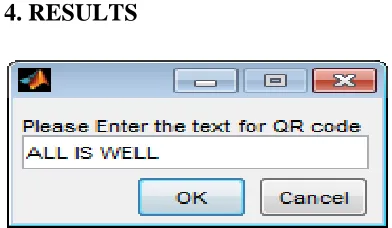
Figure 3: Input Text
Fig.3. Analysis: The first step is to enter the text to generate a QR code. Our main aim is to retrieve the entered text back. So, now I have entered “ALL IS WELL”.
Figure 4: Generated QR Code
Figure 4: Analysis: The text which was entered is generated as a QR code as shown in the above Fig.
DPSK modulation
Channel
Output data stream
Real data as output
DPSK demodulation
DWT
Remove cyclic prefix Input data
stream Real data
as input
IDWT
Figure 5: Received Image
Figure 5: Analysis: The generated QR code is captured by the receiver and this is analysed to extract the text entered.
Figure 6: Shows Entered Text
Figure 6: Analysis: Finally the above QR code is analysed and the original text is retrived as shown in above Fig.
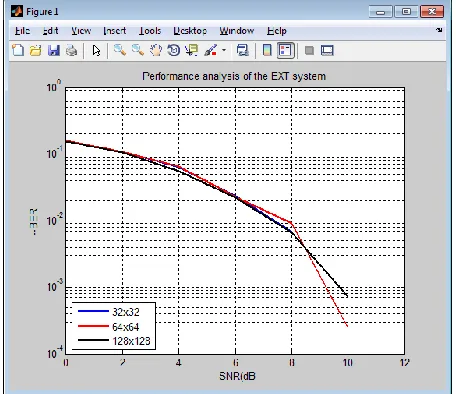
Figure 7: Performance Analysis of Proposed Method Figure 7: Analysis: Now the next step is to analyse the performance of the received QR code for16 × 16,
32 × 32, 64 × 64, 128 × 128. The above figure shows as the bits size increases BER also increases. So, our main Aim is to reduce BER and for 16 × 16
the BER has got reduced.
Fig.8. Performance Analysis of Extension Method Fig.8. Analysis: The above performance is the extension of the proposed method. In this Discrete Wavelet Transform (DWT) is used to increase the SNR as well as to reduce the BER. The performance is Shown for32 × 32, 64 × 64, 128 × 128. As compared to the proposed technique BER is much more less in the extension method
5. CONCLUSION
hacking world. In Mobile handheld devices, barcode is used to transfer information from one device to other for security purpose. DPSK-FFT is used to transform a signal through channel and achieves better BER performance. Compared to previous modulation techniques such as PAM and QPSK the performance of BER is reduced upto 8%.
In the future scope, Discrete Wavelet Transform is used to improve the transformation performance of the signal. DWT has the ability to transform a signal from one format to other without any data loss. So
the generated barcode is transformed without any data loss. Such that the DWT based OFDM yields better BER performance compared to FFT.
REFERENCES
[1] Information Technology-Automatic Identification and Data Capture Techniques-QR Code 2005Bar Code Symbology Specification, ISO/IEC 18004:2006,2006.
[2] Amin Motahari, Malek Adjouadi, “Barcode Modulation Method for Data Transmission in Mobile Devices,” IEEE Trans. Multimedia, Vol 17,No.1, Jan
2015.
[3] H.Kato and K. Tan, “Pervasive 2d barcodes for camera phone applications,” Pervasive Comut.,vol.6,no.4,pp.76-85, oct. 2007.
[4] S. D. Perli, N. Ahmed, and D. Katabi, “Pixnet: Interference-free wireless links using LCD-camera pairs,” in Proc. Mobicom,2010, pp.137-148.
[5] X. Liu, D. Dremann, and H. Li, “Vcode-pervasive data transfer using video barcode,” IEEE Trans. Multimedia, vol. 10, no. 3,pp. 361-371,Apr.2008. [6] Rama kanti, Dr. Manish Rai, “Comparative analysis of different wavelets in OWDM with OFDM for DVB-T,” International Journal of Advancements in Research and Technology, vol.2, Issue 3, March-2013. ISSN 2278-7763
[7] R. Morrison, L. Cimini, and S. Wilson, “ On the use of a cyclic extension in OFDM,” in Proc. 54th
IEEE Veh. Technol. Conf., 2001, vol. 2, pp.664-668. [8] Rohan Kankapurkar et al, “Comparative study of Barcode, QR-code and RFID System,” Int. Computer Technology and Applications, vol 4(5),pp.817-821, Sept-Oct 2013
[9] J. Memeti, F. Santos, M. Waldburger, and B. Stiller, “Data transfer using a camera and a
three-dimensional code,” Praxis der Informationsverarbeitung and Communikation, vol.36, no.1,pp.31-37,2013.
[10] Zxing (open source qr library), 2012, http://code.google.com/p/zxing
[11] Yue Liu, Ju Yang and M. Liu, “ Recognition of QR code with mobile phones,” in Proc. Chinese Control Decision Conf., Jul 2008, pp 203-206.
processing, wireless communications feature extraction and computer vision
S. FAROOQ ANWAR
received the Bachelor of Technology degree in Electronics and Instrumentations
Engineering