Implementation of WSN’s Device Addressing, Data Aggregation &
Secure Control in IoT Environment
U. S. Thakare1, S.M.Borkar.2,
1M.Tech Student, Department of CSE, NIT, Nagpur. 2Asst. Prof Department of CSE, NIT, Nagpur.
Abstract- A sensor interface device is important for sensor data collection of industrial wireless sensor networks (WSN) in IoT environments. However, the current connect Number, sampling rate, and types of sensors are restricted by the device. Meanwhile, in the Internet of Things (IoT) environment; each sensor connected to the device is required to write complicated and cumber some data collection program code. In IoT environment base of sensor are used improper use of power including non standard addressing scheme and lack of device security In this paper, to solve these problems, we proposed are IoT based network to overcome all problems to developed IoT based network using integration of hash based addressing scheme for device by developing data aggregation to reduce power consumption and also provide Kerbaros based authentication system for device control so that our IoT based environment will be used for all environment monitoring security.
Design a reconfigurable smart sensor interface for industrial WSN in IoT environment, in which complex programmable logic device (CPLD) is works as the core controller. Thus, it can read data in parallel and in real time system with high speed on multiple different sensor data. The standard of IEEE1451.2 intelligent sensor interface specification is adopted for this design. It combine
software design framework and relevant interface protocol to realize the intelligent acquisition for common sensors .A new solution is provided for the general sensor data acquisitions. The device is combined with the newest CPLD programmable technology and the standard of IEEE1451.2 intelligent sensor specification. Performance of the proposed system is verified and good effects are achieved in practical application of IoT .
Keywords – Internet of Things, Cloud Computing, Wireless Sensor Network, CPLD, Kerberos .
I. INTRODUCTION
Smart connectivity with existing networks and context-aware computation by using network resources is necessary part
process and convey the information to where it is relevant, and (3) the analytics tools in the Internet of Things that aim for autonomous and smart behavior. With these fundamental grounds in place, smart connectivity and context-aware computation can be accomplished.
Wireless sensor network (WSN) is a group of spatially interspersed and working the sensors for monitoring and recording the physical conditions of the environment and maintaining the collected data at the central sensor node. Generally, WSN measures the environmental conditions like temperature, sound, pollution levels, humidity, wind speed and direction, speed etc. A fig1 consist the number of nodes which are able to interact with environment by sensing and controlling the physical parameters. Initially wireless sensor network used by only military field for various operations but nowadays used in various field like health, traffic and many other industrial areas. Cloud computing technologies have been intensively exploited in development and management of the large-scale IoT systems, because theoretically, cloud offers unlimited storage, compute and network capabilities to integrate diverse types of IoT devices and provide an elastic runtime infrastructure for IoT systems. Self-service, utility oriented model of cloud computing
can potentially offer fine grained IoT resources in a pay-as-you-go manner, reducing front end costs and possibly creating cross-domain application opportunities and enabling new business and usage models of the IoT cloud systems.
Fig1. Wireless Sensor Network Example
II. OBJECTIVES OF RESEARCH Our objectives of research will be as follows:-
Development of an IoT based network. Integration of a hash based addressing
scheme for devices.
Development of data aggregation to reduce power consumption.
Provide Kerberos based authentication for device control.
III. LITERATURE REVIEW
operating picture (COP). Fueled by the recent adaptation of a variety of enabling wireless technologies such as RFID tags and embedded sensor and actuator nodes, the IoT has stepped out of its infancy and is the next revolutionary technology in transforming the Internet into a fully integrated Future Internet. As we move from www (static pages web) to web2 (social networking web) to web3 (ubiquitous computing web), the need for data-on-demand using sophisticated intuitive queries increases significantly. This paper presents a Cloud centric vision for worldwide implementation of Internet of Things. The key enabling technologies and application domains that are likely to drive IoT research in the near future are discussed. A Cloud implementation using Aneka, which is based on interaction of private and public Clouds is presented. We conclude our IoT vision by expanding on the need for convergence of WSN, the Internet and distributed computing directed at technological research community. The proliferation of devices with communicating–actuating capabilities is bringing closer the vision of an Internet of Things, where the sensing and actuation functions seamlessly blend into the background and new capabilities are made possible through access of rich new information sources. The evolution of the next generation mobile system will depend on the creativity of the users in designing new applications. IoTis an ideal emerging technology to influence this domain by providing new evolving data and the required computational resources for creating revolutionary apps. Presented here is a user-centric cloud based model for approaching this goal through the
interaction of private and public clouds. In this manner, the needs of the end-user are brought to the fore. Allowing for the necessary flexibility to meet the diverse and sometimes competing needs of different sectors, we propose a framework enabled by a scalable cloud to provide the capacity to utilize the IoT. The framework allows networking, computation, and storage and visualization themes separate thereby allowing independent growth in every sector but complementing each other in a shared environment. The standardization which is underway in each of these themes will not be adversely affected with Cloud at its center. In proposing the new framework associated challenges have been highlighted ranging from appropriate interpretation and visualization of the vast amounts of data, through to the privacy, security and data management issues that must underpin such a platform in order for it to be genuinely viable. The consolidation of international initiatives is quite clearly accelerating progress towards an IoT, providing an overarching view for the integration and functional elements that can deliver an operational IoT.
sensors that are linked up together using networks that generate a sea of data. With the benefit of integrated information processing capacity, industrial products will take on smart capabilities. They may also take on electronic identities that can be queried remotely, or be equipped with sensors for detecting physical changes around them. Such developments will make the merely static objects of today dynamic ones - embedding intelligence in our environment and stimulating the creation of innovative products and new business opportunities. The Internet of Things will enable forms of collaboration and communication between people and things, and between things themselves, so far unknown and unimagined. With continuing developments in miniaturization and declining costs, it is becoming not only technologically possible but also economically feasible to make everyday objects smarter, and to connect the world of people with the world of things. Building this new environment however, will pose a number of challenges. Technological standardization in most areas is still in its infancy, or remains fragmented. Not surprisingly, managing and fostering rapid technological innovation will be a challenge for governments and industry alike. But perhaps one of the most important challenges is convincing users to adopt emerging technologies like RFID. Concerns over privacy and data protection are widespread, particularly as sensors and smart tags can track a user’s movements, habits and preferences on a perpetual basis. Fears related to nanotechnology range from bio-medical hazards to robotic control. But whatever the concern, one thing remains clear: scientific and technological advances
Stefan Nastic, Sanjin Sehic, Duc-Hung Le, Hong-Linh Truong, and Schahram Dustdar discuss that Cloud computing is ever stronger converging with the Internet of Things (IoT) offering novel techniques for IoT infrastructure virtualization and its management on the cloud. However, system designers and operations managers face numerous challenges to realize IoT cloud systems in practice, mainly due to the complexity involved with provisioning large-scale IoT cloud systems and diversity of their requirements in terms of
IoT resources consumption, customization of IoT capabilities and runtime governance. In this paper, we introduce the concept of software-defined IoT units – a novel approach to IoT cloud computing that encapsulates fine-grained IoT resources and IoT capabilities in well-defined APIs in order to provide a unified view on accessing, configuring and operating IoT cloud systems.Our software-defined IoT units are the fundamental building blocks of software-defined IoT cloud systems.
They present framework for dynamic, on-demand provisioning and deploying such software-defined IoT cloud systems. By automating provisioning processes and supporting managed configuration models, our framework simplifies provisioning and enables flexible runtime customizations of software-defined IoT cloud systems. We demonstrate its advantages on a real-world IoT cloud system for managing electric fleet vehicles. They introduced the conceptual model of software-defined IoT units. To our best knowledge this is the first attempt to apply software-defined principles on IoT systems. We showed how they are used to abstract IoT resources and
capabilities in the cloud, by encapsulating them in software-defined API. We presented automated unit composition and managed configuration, the main techniques for provisioning software-defined IoT systems. The initial results are promising in the sense that software-defined IoT system enable sharing of the common IoT infrastructure among multiple stakeholders and offer advantages to IoT cloud system designers and operations managers in terms of simplified, on demand provisioning and flexible customization. Therefore, we believe that software-defined IoT systems can significantly contribute the evolution of the IoT cloud systems. In the future we plan to continue developing the prototype and extend it in several directions: a) Providing techniques and mechanisms to support runtime governance of software defined IoT systems; b) Enabling our software-defined IoT systems to better utilize the edge of infrastructure, e.g., by providing code distribution techniques between cloud and IoT devices; c) Enabling policy-based automation of data-quality, security and safety aspects of software-defined IoT systems.
Jitendra Pal Thethi concludes that Cloud Computing is a model for provisioning and consuming IT capabilities on a need and pay by use basis. This helps in shifting the cost structure from capital expenditure to operating expenditure and also helps the IT systems become more agile. This innovative model of acquiring IT related services has made organization to relook at their Infrastructure and platform services strategy and optimize their IT spending while improving overall agility.
an enterprise is a challenge as concerns around data privacy, security and SLAs would need incorporating changes into the organizations IT policies and procedures. Still there are many of the use cases are favorable for adoption today, while others would require careful evaluation of risks and benefits derived.
V.PROBLEM STATEMENT
IoT is the future of technology which will decide how we control and interact with our day to day devices and make them more efficiently. The scheme main problem with IoT is improper use of power, non standers addressing scheme and lack of device security. Our problem statement is to remove all the three drawbacks.
VI. IMPLEMENTATION
1. The addressing of device will be done based on a secure hashing algorithm. (SHA) where each device ID will be first hash and then used for device tracking and control. 2. For data aggregation we will be
using a threshold based aggregation scheme this will reduce total number of byte communicated there by reducing the power consumption. 3. The Kerberos based security
system will be developed for authentication of user.
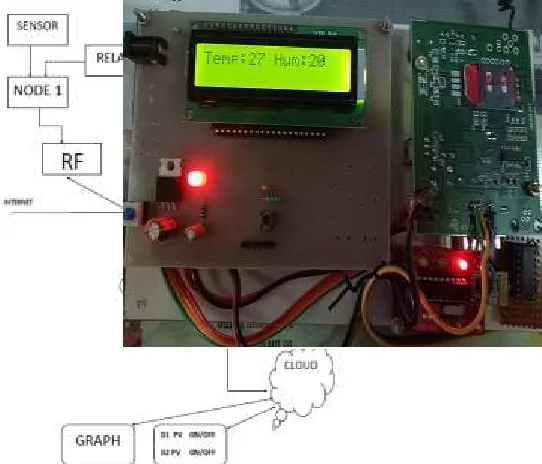
4. The overall system architecture can be describe as fallows
Fig.1 node 1 temperature
VII.OUTPUT
Fig. 3. Control Unit
VIII. CONCLUSION & FUTURE WORK
An efficient system for parameter
monitoring and device control has been built, and tested with real time sensors and
actuators IoT is the future of technology
which will decide how we control and interact with our day to day devices and make them more efficiently. We can add the concept of machine learning and artificial intelligence in the system in order to get more efficient data collection and control
REFERENCES
[1].Qingping Chi, Hairong Yan, Chuan Zhang, Zhibo Pang, And Li Da Xu, Senior Member, IEEE “A Reconfigurable Smart Sensor Interface For Industrial WSN In Iot Environment” IEEE TRANSACTIONS ON
INDUSTRIAL INFORMATICS, VOL. 10, NO. 2, MAY 2014
[2].Jayavardhana gubbi, Rajkumar buyyab,, Slavenmarusic, Marimuthu palaniswami “Internet Of Things (Iot): A Vision, Architectural Elements, And Future Directions” Future Generation Computer Systems 29 (2013) 1645–1660
[3].Kumar swamy Krishna kumar “Data Analytics and Visualization in Cloud Computing Environments” Distributed Computing Project COMP90019, University Of Melbourne,
[4].Stefan Nastic, Sanjinsehic, Duc-Hung Le, Hong-Linh Truong, And Schahramdustdar” Provisioning Software-Defined Iot Cloud Systems ”Distributed Systems Group, Vienna University Of Technology, Austria