ISSN 2286-4822
www.euacademic.org DRJI Value: 5.9 (B+)
Effectiveness of Animation-based and
Analogy-based instructions on Tenth-Grade Students’
Achievement in Chemistry: A Comparative Study
Dr. UZMA SIDDIQUI Assistant Professor Department of Education Aligarh Muslim University (A.M.U) Aligarh (U.P.), India
Abstract:
This paper investigated the effects of teaching one of the most fundamental concepts of Chemistry ‘Acids and Bases: Strong and Weak’ using Traditional Teaching (TT), Traditional Teaching supplemented with Analogies (TTA) and Traditional Teaching supplemented with Computer Animations (TTCA) on students’ achievement in Chemistry. A total of 90 tenth-grade students participated in this pretest-posttest control group quasi-experimental study. Control Group (n = 30) was taught by TT, whereas the two Experimental Groups EG1 (n = 30) and EG2 (n = 30) were subjected to
TTCA and TTA respectively. An analysis of covariance on Chemistry achievement posttest scores with students’ pretest scores as the covariate showed that TTCA was more effective in enhancing the students’ achievement in Chemistry than both TTA and TT. It is, therefore, suggested computer animations are good tools for teaching Chemistry.
Key words: Chemistry, Acids, Bases, Traditional Teaching, Computer Animations, Analogies, Achievement.
INTRODUCTION
Symington, 1996; Nakhleh, 1992). The reasons for students‟ difficulties vary from the abstract nature of many Chemistry concepts to the difficulty of the language of Chemistry. Firstly, Chemistry curricula commonly include many abstract concepts, which are central to further learning in both Chemistry and other sciences (Taber, 2002). Secondly, three levels of Chemistry make it difficult to learn (Johnstone, 1999; Nelson, 1999). These levels are macroscopic, microscopic and symbolic, only one of which can be readily observed. But teachers do not usually emphasize the transitions between these levels as well as ignore the link among them for a meaningful learning to occur (Harrison & Treagust, 2000; Raviola, 2001). Numerous studies support the idea that the interplay between macroscopic and microscopic phenomena is a source of difficulty for many Chemistry students. According to Sirhan (2007), the interactions and distinctions between them are important characteristics of Chemistry learning and necessary for achievement in comprehending chemical concepts. Therefore, if students possess difficulties at one of these levels, it may influence the others. The most important reason of students‟ difficulties is the ineffectiveness of traditional teaching methods. A majority of teachers use teacher-centered strategies to teach Chemistry. Students learn the concepts by heart and they try to apply them without understanding. These traditional teaching strategies are ineffective to help students in complete understanding of the abstract concepts in order to build correct conceptions and alleviate alternative conceptions (Westbrook & Marek, 1991).
computer-assisted instruction (Herman, 1996; Ozmen, 2008) and laboratory activities (Hart, Mulhall, Berry, Loughran, & Gunstone, 2000) are effective teaching strategies for meaningful Chemistry instruction. These studies suggest that the teachers must use alternative teaching ways to improve the conceptual understanding of Science, especially in Chemistry. This has prompted the researcher to combine traditional teaching with animations and analogies respectively to study their effectiveness on students‟ understanding of „Acids and
Bases: Strong and Weak‟.
PURPOSE OF THE STUDY
The main purpose of this study was to investigate the comparative effects of Traditional Teaching (TT), Traditional Teaching supplemented with Analogies (TTA) and Traditional Teaching supplemented with Computer Animations (TTCA) respectively on tenth-grade students‟ achievement in Chemistry.
In order to suitably address the above mentioned purpose, the following null hypotheses were formulated:
H0 1: There is no significant difference between the
mean pretest and posttest Chemistry achievement scores for students in the Control Group (CG) subjected to Traditional Teaching.
H0 2: There is no significant difference between the
mean pretest and posttest Chemistry achievement scores for students in the Experimental Group (EG1)
subjected to Traditional Teaching supplemented with Analogies.
H0 3: There is no significant difference between the
subjected to Traditional Teaching supplemented with Computer Animations.
H0 4: There is no significant difference between the
mean posttest Chemistry achievement scores for students in the Control Group and Experimental Groups (EG1 and EG2), after controlling for the effect of pretest
scores.
METHOD
Participants
The participants included 75 students, who were enrolled in tenth-grade and belonged to three different sections during the session 2014-15, in a secondary school in Kishanganj, Bihar, India. These three sections were randomly assigned to Traditional Teaching (TT), Traditional Teaching supplemented with Computer Animations (TTCA) and Traditional Teaching supplemented with Analogies (TTA) respectively. In other words, one section, subjected to TT, was considered as Control Group, namely CG (n = 30) and the remaining two sections, subjected to TTA and TTCA respectively, were considered as Experimental Groups, namely EG1 (n = 30) and EG2 (n = 30).
The three B.Ed. trainees „A‟, „B‟ and „C‟ (who were enrolled in B.Ed. course during the session 2014-15, at Department of Education, A.M.U. Centre, Kishanganj, Bihar) also participated in this study. All three of them were male, held an equivalent Bachelor‟s degree in Chemistry and had no experience of teaching Chemistry at secondary school level. The trainees were also randomly assigned to these three sections/groups. Trainees „A‟, „B‟ and „C‟ taught CG, EG1 and EG2 respectively.
Research Design
This design permitted an investigation of the effectiveness of instructional methods used on students‟ achievement in Chemistry. This experimental design can be represented as:
Pretest Treatment Posttest
CG T XA T
EG1 T XB T
EG2 T XC T
Where, CG represents the Control Group, subjected to Traditional Teaching TT (XA), and EG1 and EG2 represent
Experimental Groups, subjected to Traditional Teaching supplemented with Analogies TTA (XB) and Traditional
Teaching supplemented with Computer Animations TTCA (XC)
respectively.
T represents the Chemistry Achievement Test (CAT). CAT was given as pre- and post-tests to students in all the groups at the beginning and end of the instruction to measure students‟ achievement in Chemistry.
Measuring Instrument
Students‟ achievement in Chemistry, based on „Acids and
Bases: Strong and Weak‟, was measured using the Chemistry
Achievement Test (CAT). The instrument, containing 30 four-option, multiple-choice questions, was developed by the researcher. The test was intended to determine the knowledge, comprehension and application levels of students related to the fundamental concepts. Its content validity was established by subject experts. Cronbach‟s alpha reliability coefficient of the test was 0.84.
Instructional Materials
„Acids and Bases‟ are one of the most important and
„Acids and Bases‟, the following sub-topics need to be studied by students:
Acids: Definition, Strong and Weak Acids, Concentrated and Dilute Acids, Physical and Chemical Properties, Uses
Bases: Definition, Strong and Weak Bases, Physical and Chemical Properties, Uses
Strength of Acidic and Basic Solutions: pH Scale
Students generally have no difficulty in learning the definition of an acid as a proton donor and a base as a proton acceptor. Acids may dissolve in water to form its aqueous solution and then they may ionize into H+ (aq). It is not hard to understand
that in aqueous solution, an acid causes an increase in the free proton concentration, which lowers the pH below 7. Likewise, what makes a base a base is its ability to bond to H+ (aq) and
Analogy
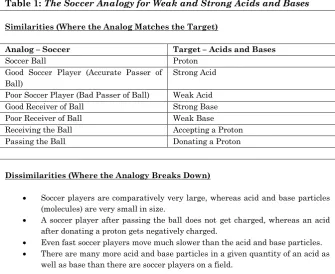
In this research study, the „The Soccer Analogy for Weak and
Strong Acids and Bases‟ developed by Silverstein (2000) was
used for teaching the Experimental Group EG2. This analogy is
summarized in Table 1.
Table 1: The Soccer Analogy for Weak and Strong Acids and Bases
Similarities (Where the Analog Matches the Target)
Analog – Soccer Target – Acids and Bases
Soccer Ball Proton
Good Soccer Player (Accurate Passer of Ball)
Strong Acid
Poor Soccer Player (Bad Passer of Ball) Weak Acid Good Receiver of Ball Strong Base Poor Receiver of Ball Weak Base Receiving the Ball Accepting a Proton Passing the Ball Donating a Proton
Dissimilarities (Where the Analogy Breaks Down)
Soccer players are comparatively very large, whereas acid and base particles (molecules) are very small in size.
A soccer player after passing the ball does not get charged, whereas an acid after donating a proton gets negatively charged.
Even fast soccer players move much slower than the acid and base particles. There are many more acid and base particles in a given quantity of an acid as
well as base than there are soccer players on a field.
Computer Animations
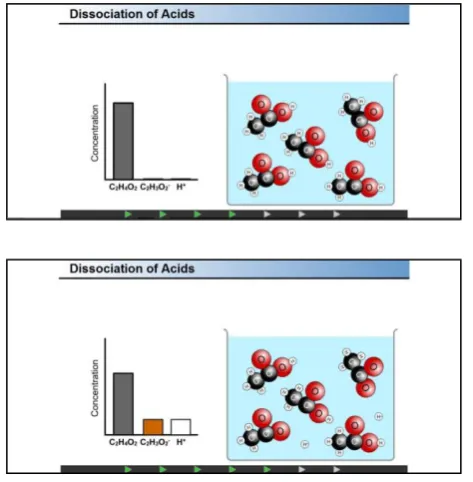
In this research study, computer animations were developed by a computer software expert in consultation with the researcher to illustrate the following: self-ionisation of water; dissolution and ionization (dissociation) of strong and weak acids and bases in water; chemical reaction between acid and base. These animations were used for teaching the Experimental Group EG1. The screen shots of these animations are given below in
Figure 1: Screen Shots for Dissociation of Strong Acid
Instructional Methods
The Control Group (CG) was subjected to Traditional Teaching (TT) without any exposure to computer animations and analogies. This instructional approach emphasized direct lectures given by teachers, interactive discussions between the teacher and students, use of textbook materials and charts, and clear explanation of important concepts to students, but no use of animations and analogies was done. B.Ed. trainee „A‟ did not incorporate the use of any animations and analogies in his lesson plans.
The Experimental Group (EG1) was subjected to
Traditional Teaching supplemented with Analogies (TTA). This instructional approach consisted of TT (as was done in case of CG) along with appropriate use of animations. B.Ed. trainee „B‟ incorporated the use of animations in his lesson plans.
The second Experimental Group (EG2) was subjected to
Traditional Teaching supplemented with Computer Animations (TTCA). This instructional approach consisted of TT (as was done in case of CG) along with appropriate use of analogies. B.Ed. trainee „C‟ incorporated the use of analogies („The Soccer
Analogy for Weak and Strong Acids and Bases‟) in his lesson
plans.
DATA ANALYSIS
The data from the Chemistry Achievement Test (CAT) were analyzed using SPSS 16.0. Means (M) and standard deviations (SD) were calculated. A paired samples t-test was used to determine if there was a statistically significant difference between the pre- and posttest achievement scores in Chemistry for each of the three groups. Analysis of Covariance (ANCOVA) was used to determine whether there was a significant difference between group means of achievement in Chemistry for the Control and Experimental groups when differences in pretest scores were controlled. An alpha level of 0.05 was used for all statistical tests. Post hoc tests were conducted using Bonferroni‟s test. It consists of pairwise comparisons that are designed to compare means of all different combinations of the treatment groups. Pairwise comparisons control the familywise error by correcting the level of significance for each test such that the overall Type I error rate (α) across all comparisons remains at .05. In Bonferroni correction, α is divided by the number of comparisons, thus ensuring that the cumulative Type I error is below .05 (Field, 2009).
RESULTS
In order to evaluate the impact of TT on Control Group (CG) students‟ achievement in Chemistry, descriptive statistics were calculated first for their Pretest and Posttest scores on CAT. The Pretest and Posttest means and standard deviations for the Control Group are reported in Table 2.
Table 2: Descriptive Statistics of Chemistry Achievement Scores for the Control Group (CG)
Achievement in Chemistry
N Mean SD
Pretest 30 6.16 2.96
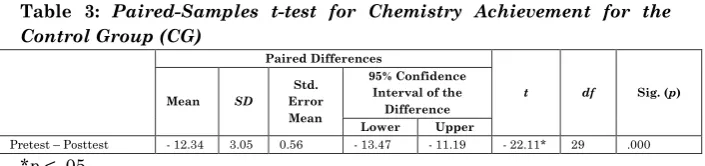
Then, a paired-samples t-test was conducted to determine if there was a significant difference between the mean Pretest and Posttest scores for the Control Group. The results in Table 3 indicate that there was a significant difference between the Pretest and Posttest scores, t (29) = - 22.11, p < .05. The Control Group scored significantly greater on the Posttest (M = 18.50, SD = 1.74) than on the Pretest (M = 6.16, SD = 2.96). Therefore, the null hypothesis H0 1 stating that, there is no significant difference between the mean pretest and posttest Chemistry
achievement scores for students in the Control Group, was
rejected at 0.05 level of significance.
Table 3: Paired-Samples t-test for Chemistry Achievement for the Control Group (CG)
Paired Differences
t df Sig. (p) Mean SD
Std. Error Mean
95% Confidence Interval of the
Difference Lower Upper
Pretest – Posttest - 12.34 3.05 0.56 - 13.47 - 11.19 - 22.11* 29 .000
*p < .05
In order to evaluate the impact of TTA on Experimental Group (EG1)students‟ achievement in Chemistry, descriptive statistics
were calculated first for their Pretest and Posttest scores on CAT. The Pretest and Posttest means and standard deviations for the Experimental Group (EG1)are reported in Table 4.
Table 4: Descriptive Statistics of Chemistry Achievement Scores for the Experimental Group (EG1)
Achievement in Chemistry
N Mean SD
Pretest 30 5.93 2.82
Posttest 30 22.56 2.23
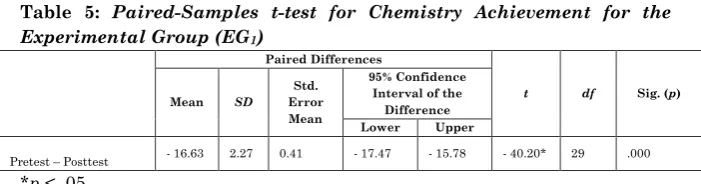
Then, a paired-samples t-test was conducted to determine if there was a significant difference between the mean Pretest and Posttest scores for the Experimental Group (EG1). The
difference between the Pretest and Posttest scores, t (29) = - 40.20, p < .05. The Experimental Group (EG1) scored
significantly greater on the Posttest (M = 22.56, SD = 2.23) than on the Pretest (M = 5.93, SD = 2.82). Therefore, the null hypothesis H0 2 stating that, there is no significant difference between the mean pretest and posttest Chemistry achievement
scores for students in the Experimental Group (EG1), was
rejected at 0.05 level of significance.
Table 5: Paired-Samples t-test for Chemistry Achievement for the Experimental Group (EG1)
Paired Differences
t df Sig. (p) Mean SD
Std. Error Mean
95% Confidence Interval of the
Difference Lower Upper
Pretest – Posttest - 16.63 2.27 0.41 - 17.47 - 15.78 - 40.20* 29 .000
*p < .05
In order to evaluate the impact of TTCA on Experimental Group (EG2) students‟ achievement in Chemistry, descriptive
statistics were calculated first for their Pretest and Posttest scores on CAT. The Pretest and Posttest means and standard deviations for the Experimental Group (EG2) are reported in
Table 6.
Table 6: Descriptive Statistics of Chemistry Achievement Scores for the Experimental Group (EG2)
Achievement in Chemistry
N Mean SD
Pretest 30 7.47 2.08
Posttest 30 24.33 1.78
Then, a paired-samples t-test was conducted to determine if there was a significant difference between the mean Pretest and Posttest scores for the Experimental Group (EG2). The
54.45, p < .05. The Experimental Group (EG2) scored
significantly greater on the Posttest (M = 24.33, SD = 1.78) than on the Pretest (M = 7.47, SD = 2.08). Therefore, the null hypothesis H0 3 stating that, there is no significant difference between the mean pretest and posttest Chemistry achievement
scores for students in the Experimental Group (EG2), was
rejected at 0.05 level of significance.
Table 7: Paired-Samples t-test for Chemistry Achievement for the Experimental Group (EG2)
Paired Differences
t df Sig. (p) Mean SD
Std. Error Mean
95% Confidence Interval of the
Difference Lower Upper
Pretest – Posttest - 16.86 1.69 0.31 - 17.50 - 16.23 - 54.45* 29 .000
*p < .05
In order to test hypothesis H0 4, a one-way analysis of
Table 8: Descriptive Statistics for Achievement Scores on CAT by Instructional Group
Instructional
Group N
Pretest Posttest Adjusted Posttesta
Mean SD Mean SD Mean SE
CG 30 6.16 2.96 18.50 1.74 18.63 0.32
EG1 30 5.93 2.82 22.56 2.32 22.78 0.32
EG2 30 7.47 2.08 24.33 1.78 23.98 0.32 a. Adjustments based on the mean of Pretest (covariate) = 6.52
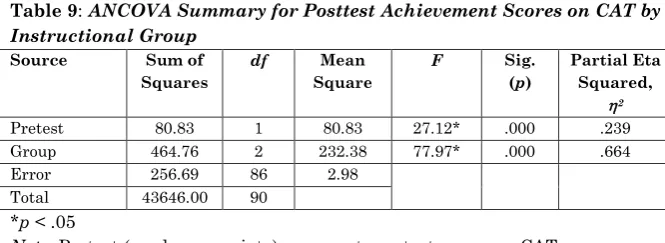
Results in Table 9 show that the ANCOVA yielded a significant effect for the covariate, F (1, 86) = 27.12, p < .05, partial η2 =
0.239 and a significant main effect for the instructional method,
F (2, 86) = 77.97, p < .05, partial η2 = 0.664; this latter effect
accounted for 66.4 % of the total variance in posttest scores on CAT, after controlling for the effect of pretest scores used as a covariate. The covariate (Pretest) accounted for 23.9 % of the total variance in achievement on CAT. Since the results of ANCOVA indicate that there was a statistically significant difference for the adjusted Posttest means between the groups, therefore the null hypothesis H0 4 stating that, there is no significant difference between the mean posttest Chemistry achievement scores for students in the control group and experimental group, after controlling for the effect of pretest
scores, was rejected at 0.05 level of significance.
Table 9:ANCOVA Summary for Posttest Achievement Scores on CAT by Instructional Group
Source Sum of Squares
df Mean Square
F Sig. (p)
Partial Eta Squared,
2
Pretest 80.83 1 80.83 27.12* .000 .239 Group 464.76 2 232.38 77.97* .000 .664
Error 256.69 86 2.98
Total 43646.00 90
*p < .05
Follow-up or post hoc analyses to the significant main effect for instructional method are conducted to determine which instructional method is more effective. The post hoc tests consist of all pairwise comparisons among the three instructional groups and are conducted in order to find out whether the differences in adjusted Posttest means of the groups are significantly different from each other. EG2 has the
largest adjusted mean (M = 23.98), EG1 has comparatively
smaller adjusted mean (M = 22.78) than EG2, and CG has the
smallest adjusted mean (M = 18.63). The Bonferroni procedure is used to control for Type I error across the three pairwise comparisons ( = .05/3 = .017). The results in Table 10 show that the adjusted Post-test mean for EG2 differs significantly
from that of EG1 at.05 level but not at .017 level. Moreover, the
adjusted Posttest mean for EG2 differs significantly from that of
CG at both .05 and .017 levels. Also, the adjusted Posttest mean for EG1 differs significantly from that of CG at both .05 and
.017 levels. Overall, ANCOVA followed by pairwise comparisons indicates superiority for the instructional methods as far as their effects on students‟ achievement in Chemistry are concerned in the following order: TTCA > TTA > TT.
Table 10: Pairwise Comparisons of Differences in Adjusted Posttest Means by Instructional Group
Instructional Group (I)
Instructional Group (J)
Mean Difference
(I-J)
Standard Error of Difference
Sig. (p)a
EG2 (23.98) EG1 (22.78) 1.20* 0.459 .030
EG2 (23.98) CG (18.63) 5.35* 0.455 .000**
EG1 (22.78) CG (18.63) 4.15* 0.446 .000** *p < .05 **p < .017
a. p-values are adjusted using the Bonferroni method.
DISCUSSION
Chemistry significantly increased for both the groups. The lower pretest scores of groups were due to the students‟ insufficient knowledge of the topic prior to instruction. The increase in students‟ performance from pretest to posttest in both the groups was very normal because they received instruction based on „Acids and Bases‟. Therefore, an increase in students‟ performance in all the groups was not surprising. All groups benefited from their respective instructional method, and their posttest results for achievement were consequently higher.
The results of ANCOVA followed by pairwise comparisons show that the students in both the experimental groups were more successful than those of the control group. This may be due to the use of novel instructional methodologies such as animations and analogies which seemed to have contributed to the students‟ enthusiasm to learn. The results show that both the combinations of traditional instruction with animations and analogies respectively improved students‟ learning and understanding. TTCA instruction seemed to help students visualize microscopic world via computer animations. Based on the dual-coding theory Kelly et al. (2004), it is expected that the better recall of pictures is possible because they are coded both visually and verbally; and, if one mental representation is lost, the other is still available. Thus, TTCA (consisting of verbal explanations and animations which included a series of visual images displayed in rapid succession on a computer screen) became more successful than TT for students‟ understanding of the fundamental concepts related to
„Acids and Bases: Strong and Weak‟. Moreover, the results of
Phelps, & Sanger, 2004; Özmen, 2007; Özmen, Demircioğlu & Demircioğlu, 2009; Sanger & Greenbowe, 1997, 2000; Talib, Matthews, & Secombe, 2005; Tasker & Dalton, 2006; Velazquez-Marcano, Williamson, Ashkenazi, Tasker, & Williamson, 2004; Yezierski & Birk, 2006). The reason for this is probably due to the detailed explanations found in TT and dynamic and interactive character of CA. They may have helped students understand the abstract concepts of Chemistry by showing them the chemical phenomena that involve particles in motion, enabling them make connections among macroscopic, microscopic, and symbolic levels of representations of several dynamic chemical and physical processes, and thus, help them understand how these processes occur. Therefore, it can be concluded that TTCA may be a useful way for teaching even other fundamental concepts of Chemistry.
The great advantage of TTA over TT is the use of „The
Soccer Analogy for Weak and Strong Acids and Bases‟ that
seemed to have provided students with visual imagery for understanding the fundamental differences between weak and strong acids and between weak and strong bases. This analogy has an additional advantage of being based upon a sport in which a huge percentage of the students is immensely interested. Moreover, the concept of throwing and catching a ball is quite basic, and easy to visualize and comprehend. Consistent with the results of many studies on the positive effects of traditional teaching supplemented with analogies on achievement in Chemistry (Çalık & Ayas, 2005; Chiu & Lin, 2005; Harrison & Jong, 2005; Iding, 1997; Orgill & Bodner, 2004; Pekmez Sahin, 2010; Silverstein, 1999, 2000; Tsai, 1999), this study confirms that analogies are useful tools for teaching and learning.
(Kelly, Phelps, & Sanger, 2004). Naturally, instruction based on macroscopic properties and symbolic representations is also helpful for students in understanding Chemistry concepts, but such an instruction have some problems because students cannot see the nature and movement of atoms and molecules. TT mostly made use of static models and diagrams and thus, was found to be ineffective in increasing students‟ understanding of concepts (Kozma & Russell, 1997; Kozma, Chin, Russell, & Marx, 2000; Wu, Krajcik, & Soloway, 2001) and unsuitable for teaching the microscopic nature of matter.
CONCLUSION
The main findings of this study are as follows:
1. Paired-samples t-test results showed that there was a significant difference between the Pre-test and Post-test means for the Control Group. This indicates that Traditional Teaching had positive impact on achievement in Chemistry for students in the Control Group.
2. There was a significant difference between the Pre-test and Post-test means for the TTCA group, as indicated by the paired-samples t-test. This shows that TTA had greater positive impact on achievement in Chemistry for students in the Experimental Group (EG1) as compared to Traditional Teaching
but lesser positive impact as compared to TTCA.
3. Paired-samples t-test results showed that there was a significant difference between the Pre-test and Post-test means for the TTCA group. This indicates that TTCA had the greatest positive impact on achievement in Chemistry for students in the Experimental Group (EG2).
achievement in Chemistry was concerned, in the following order: TTCA > TTA > Traditional Teaching.
RECOMMENDATIONS
The findings of this study suggest that the combinations of instructional methods such as, TT and TTCA as well as TT and TTA, are the innovative ways useful for teaching the concepts of Chemistry. Based on the findings, the researcher would like to make the following recommendations:
1. Curriculum planners should recommend computer animations and innovative analogies to improve students‟ knowledge, comprehension and assimilation of Chemistry concepts.
2. Relevant stakeholders at all levels should organize conferences, seminars, workshops and in-service training for Chemistry teachers to maximize the benefits of using computer animations and analogies in the teaching-learning process.
3. Authors of Chemistry textbooks should design and include elaborative analogies to facilitate students‟ knowledge, comprehension and assimilation of textbook contents. Moreover, they should plan and design appropriate computer animations for illustrating the dynamic concepts of Chemistry. The publishers should supplement textbooks with CDs consisting of these animations.
REFERENCES
Ardac, D., & Akaygun, S. (2004). Effectiveness of multimedia-based instruction that emphasizes molecular
representations on students‟ understanding of chemical change. Journal of Research in Science Teaching, 41(4), 317-337.
Çalık, M., & Ayas, A. (2005). An analogy activity for incorporating students‟ conceptions of types of solutions.
Asia Pacific Forum on Science Learning and Teaching,
6(2), Article 6.
Campbell, D. T., & Stanley, J. C. (1966). Experimental and
quasi-experimental designs for research. Boston:
Houghton Mifflin Company.
Chang, H. Y., Quintana, C., & Krajcik, J. S. (2010). The impact of designing and evaluating molecular animations on how well middle school students understand the particulate nature of matter. Science Education, 94, 73-94.
Chiu, M. H. & Lin, W. ( 2005). Promoting fourth graders‟ conceptual change of their understanding of electric current via multiple analogies. Journal of Research in
Science Teaching, 42(4), 429-464.
Ebenezer, J. V. (2001). A hypermedia environment to explore and negotiate students‟ conceptions: Animations of the solution process of table salt. Journal of Science
Education and Technology, 10(1), 73-91.
Harrison, G. A., & Jong, D. O. (2005). Exploring the use of multiple analogical models when teaching and learning chemical equilibrium. Journal of Research in
Science Teaching, 42 (10), 1135-1159.
multiple-model use in grade 11 chemistry. Science
Education, 84, 352-381.
Hart, C., Mulhall, P., Berry, A., Loughran, J., & Gunstone, R. (2000). What is this purpose of this experiment? Or can students learn something from doing experiments?
Journal of Research in Science Teaching, 37, 655-675.
Herman, W. (1996). Assessing the impact of computer based learning in science. Journal of Research on Computing
in Education, 28(4), 461-486.
Iding, M. K. (1997). How analogies foster learning from science texts. Instructional Science, 25, 233-253.
Johnstone, A. H. (1999). The nature of chemistry. Education in
Chemistry, 36, 45-47.
Kelly, R. M., & Jones, L. L. (2007). Exploring how different features of animations of sodium chloride dissolution affect students‟ explanations. Journal of Science
Education and Technology, 16, 413-429.
Kelly, R. M., Phelps, A. J., & Sanger, M. J. (2004). The effects of a computer animation on students‟ conceptual understanding of a can-crushing demonstration at the macroscopic, microscopic, and symbolic levels. The
Chemical Educator, 9, 184-189.
Kirkwood, V., & Symington, D. (1996). Lecturer perceptions of student difficulties in a first-year chemistry course.
Journal of Chemical Education, 73, 339-343.
Kozma, R., Chin, E., Russell, J., & Marx, N. (2000). The roles of representations and tools in the chemistry laboratory and their implications for chemistry learning. The
Journal of the Learning Sciences, 9(2), 105-143.
Kozma, R. B., & Russell, J. (1997). Multimedia and understanding: Expert and novice responses to different representations of chemical phenomena.
Nakhleh, M. B. (1992). Why some students don‟t learn chemistry: Chemical misconceptions. Journal of
Chemical Education, 69, 191-196.
Nelson, P. G. (1999). Levels of description in chemistry. Journal
of Chemical Education, 76, 16-22.
Orgill, M. & Bodner, G. (2004). What research tells us about using analogies to teach chemistry. Chemistry
Education: Research and Practice, 5(1), 15-32.
Ozmen, H. (2007). The effectiveness of conceptual change texts in remediating high school students‟ alternative conceptions concerning chemical equilibrium. Asia
Pacific Education Review, 8(3), 413-425.
Ozmen, H. (2008). The influence of computer-assisted instruction on students‟ conceptual understanding of chemical bonding and attitude toward chemistry: A case for Turkey. Computers & Education, 51(1), 423-438. Özmen, H., Demircioğlu, H., & Demircioğlu, G. (2009). The
effects of the conceptual change texts accompanied with the animations on overcoming 11th grade students‟ alternative conceptions of chemical bonding. Computers
& Education, 52, 681-695.
Pekmez Sahin, E. (2010). Using analogies to prevent misconceptions about chemical equilibrium. Asia-Pacific
Forum on Science Learning and Teaching, 11(2), 1-35.
Raviola, A. (2001). Assessing students‟ conceptual understanding of solubility equilibrium. Journal of
Chemical Education, 78(5), 629-631.
Sanger, M. J., & Greenbowe, T. J. (1997). Students‟ misconceptions in electrochemistry: Current flow in electrolyte solutions and the salt bridge. Journal of
Chemical Education, 74, 819-823.
animations and conceptual change. International
Journal of Science Education, 22, 521-537.
Silverstein, T. P. (1999). The “big dog-puppy dog” analogy for resonance. Journal of Chemical Education, 76(2), 206-207.
Silverstein, T. P. (2000). Weak, strong acids and bases: the football analogy. Journal of Chemical Education, 77(7), 849-850.
Sirhan, G. (2007). Learning difficulties in chemistry: An overview. Journal of Turkish Science Education, 4(2), 2-20
Taber, K. S. (2002). Alternative conceptions in
chemistry-prevention, diagnosis and cure: Theoretical
background. London: The Royal Society of Chemistry.
Talib, O., Matthews, R., & Secombe, M. (2005). Computer-animated instruction and students‟ conceptual change in electrochemistry: Preliminary qualitative analysis.
International Education Journal, 5(5), 29-42.
Tasker, R., & Dalton, R. (2006). Research into practice. Visualization of the molecular world using animations.
Chemistry Education Research and Practice, 7(2),
141-159.
Tsai, C. C. (1999). Overcoming junior high school students‟ misconceptions about microscopic views of phase change: a study of an analogy activity. Journal of
Science Education and Technology, 8(1), 83-91.
Velazquez-Marcano, A., Williamson, V. M., Ashkenazi, G., Tasker, R., & Williamson, K. C. (2004). The use of video demonstrations and particulate animations in general chemistry. Journal of Science Education and
Technology, 13(3), 315-323.
Westbrook, S. L., & Marek, E. A. (1991). A cross-age of student understanding of the concept of diffusion. Journal of
Wu, H., Krajcik, J. S., & Soloway, E. (2001). Promoting understanding of chemical representations: students‟ use of a visualization tool in the classroom. Journal of
Research in Science Teaching, 38, 821-842.