IJEDR1604081
International Journal of Engineering Development and Research (www.ijedr.org)555
Human Computer Interaction And Natural Hand
Gestures Recognition System
Saurabh Mittal, Geetika Singla Associate Professor, Research Scholar
Department of Computer Science and Engineering, Galaxy Global Group of Institutions, Dinarpur, Ambala, Haryana ,India
________________________________________________________________________________________________________
Abstract—Expressive and meaningful body motions involving physical movements associated with hands, arms, and face can be hugely ideal for conveying meaningful information, and interacting with the surroundings. This calls for a posture or a gesture a movement that is dynamic of body part. Generally, there exist many-to-one mappings from concepts to gestures and other method around. Hence gestures are ambiguous and incompletely specified. Each hand gesture recognition depends on character in Sign Language. The related study area of sign gesture recognition is Human Computer Interaction (HCI) and image processing that assist within the solution to this matter. This technology having the potential to progress way that is traditional which user connect to computers through the elimination of input devices such as for instance joysticks, mice and keyboards and allowing the human body to give signals into computer through gestures such as for example finger pointing. This paper provides Ann based gesture recognition approaches that have been implemented over the years.
Index Terms—HCI, Gesture Recognition, Posture Recognition, Artificial Neural Networks.
________________________________________________________________________________________________________
I.INTRODUCTION
Gestures are the unsaid words of human that human expresses in form of actions [1]. It permits people to converse thoughts and thoughts alongside disparate emotions alongside words or lacking words. Gesture Recognition has come to be an alert analysis span in field of Computer vision, image Processing and Manmade Intelligence. Gesture made with human being can be insufficient but each have a distinct meaning. Human hand can have movement in each association and can arc to each slant in all obtainable coordinates.
Figure 1 Depiction of sign language
Gesture Sample of Sign language as shown in Figure 1, utilized hand gestures to embodies digits as fine as alphabets.
Countless researchers have endeavored alongside disparate instruments and supplies to compute hand movements like gloves, sensors or wires, but in these methods user have to wear the mechanism that doesn’t make logic in useful use. So people believed concerning a method of link less gesture recognition that might be believed as analysis is span in Contraption Vision and Computer Vision and that should be as usual as human to human interaction. According to Authors gesture recognition is a procedure whereas user made gesture and receiver understands it. Employing this method, we can facilely interact alongside mechanisms and can give them particular memo according to nature and request syntax. Even people who can’t converse orally (sick, aged or youthful child), they should additionally become benefit from this technology. It is probable to create a gesture recognition arrangement for these people. Mobile firms are trying to make handsets that can understand gesture and might work from slight distance also. Here we are concentrating on human to Computer Interaction (HMI) [2], in that contraption should be able to understand the gesture made by human. There are ways of two types.
[1] Appearance established ways whereas hand picture is reconstructed
[2] Model established ways whereas disparate models are utilized to ideal picture
IJEDR1604081
International Journal of Engineering Development and Research (www.ijedr.org)556
hand is a convoluted deformable object and gesture itself has countless characteristics, such as diversities, ambiguities, temporal and spatial contrasts and human vision itself is an ill-posed problem”. Pickering delineated a real period gesture established steering arrangement simulator industrialized at Carnegie Mellon University alongside the aid of Finished Motors. Countless researchers have utilized a color strip and a shirt to notice hand image in the seized picture. For a methodical survey of gesture recognition you can see. Gesture segmentation a portion of gesture recognition procedure, have been studied in and established on color spaces.It brings attention of researchers pointing out an aged setback of the incrementing processing period of algorithm’s intricacy and say “the mainly vital subject in field of gesture recognition is the simplification of algorithm and the reduction of processing time”. He utilized morphological procedure to apply his arrangement employing center points removed from primitive agents via morphological form decomposition. Disparate threads are requested in such way that they can run in parallel and can compute faster. Lee describes his arrangement that he industrialized for remote manipulation arrangements that worked for gesture recognition also. He uses 3D arrangements alongside two and extra cameras to notice order delivered by hand. Authors have endeavored to develop an arrangement for teaching mathematics to deafen alongside an facile user interface. Morimoto made interesting adjacent arrangement, in that he shoved adjacent buttons employing fingers in the air and understood it employing 3D sensors.
II. APPLICATION AREAS FOR HAND POSTURES AND GESTURES
Various requests have been utilized for hand postures and gestures as alternative level of contact in disparate request areas, as remarked in: encompassing adjacent settings, intelligent surveillance, signal speech translation, strength arrangements etc. This serving gives a brief overview of a little gesture recognition request areas. Hardware cutting and cutting processing price can frolic a main factor for making gesture recognition arrangement upcoming setting and can proposal extra useful spans as well. Table 2 demonstrates little requests on gesture recognition system.
Sign Language Recognition
Sign speech believed as an vital and interesting request fields of hand posture and gesture recognition arrangement whereas countless arrangements have been requested for this purpose. Signal speech has distinct significance for contact as gestures are way utilized for clarification and explanation of specific subject. It can be utilized for disabled peopled after conversing alongside supplementary people, and alongside computer as well. American Signal Speech is one example that has consented momentous attention in the gesture works.
Robotics, Human Manipulation and Instruction
One of competent requests that can use hand postures or gestures is robot tele-manipulation. Tele-robotic requests are normally categorized below space discovery and martial analysis domain. Employing gestures for manipulating robots is corresponding to adjacent reality contact system. Present researches utilized postures and gestures to discover robot a little contact commands by clarifying its appropriate meaning for the robot. Assorted researches for robot manipulation requests are requested.
Virtual Reality
For adjacent reality request gestures have believed as one of competent spreading periods in computing span (Murthy, 2009). Adjacent reality contact uses hand gesture to impact adjacent movements employing one and two labor for 2D and 3D contact display (Murthy, A little adjacent reality requests are available. Thomas (2008) worked alongside multimodal user interfaces that contain discernible, aural.
Gesture-to-speech
Gesture-to-speech request that converts hand gestures into speech, this arrangement enables hearing-impaired people to converse alongside their encircling settings across computers and interacts facilely alongside supplementary people even lacking knowing for signal speech gave Glove Converse arrangement interface amid speech synthesizer employing data glove mechanism that mapping hand-gestures to speech employing neural webs.
Games
For computer games, requested gesture recognition on adjacent game applications. Chambers utilized hierarchical recognition of human gestures for sports video annotation. Many requested computer vision gesture recognition methods, and industrialized a vision established low value input mechanism for manipulating the VLC contestant across gestures.
Television Control
Final request for hand postures and gestures is manipulating Television devices. Freeman industrialized an arrangement to manipulation a television set by hand gestures. Employing an open hand and the user can change the channel, coil the television on and off, rise and cut volume, and mute the sound.
III.HAND DETECTION AND RECOGNITION
Hidden Markov Models
IJEDR1604081
International Journal of Engineering Development and Research (www.ijedr.org)557
colour pixel belongs to the blob that has alike locale and colourimetry component. Deictic gestures are pointing movements towards the left (right) of the body–face space and symbolic gestures are aimed to present commands (grasp, click, rotate) on the left (right) of shoulder.YUV Colour Space and CAMSHIFT Algorithm
This method deals with recognition of hand gestures. It is done in the following five steps. [1] First, a digital camera records a video stream of hand gestures.
[2] All the frames are taken into consideration and then using YUV colour space skin colour based segmentation is performed. The YUV colour system is employed for separating chrominance and intensity. The symbol Y indicates intensity while UV specifies chrominance components.
[3] Now the hand is separated using CAMSHIFT algorithm. Since the hand is the largest connected region, we can segment the hand from the body.
[4] After this is done, the position of the hand centroid is calculated in each frame. This is done by first calculating the zeroth
and first moments and then using this information the centroid is calculated.
[5] Now the different centroid points are joined to form a trajectory. This trajectory shows the path of the hand movement and thus the hand tracking procedure is determined.
Using Time Flight Camera
This way uses x and y-projections of image and discretional depth features for gesture classification. The arrangement uses a 3-D time-of-flight (TOF) sensor that has large supremacy of elucidating hand segmentation. Gestures utilized in arrangement display a good separation possible alongside two picture axes. Hence, the protrusions of the hand onto the x- and y-axis are utilized as features for the classification [3]. The span of the arm is discarded as it encompasses no functional data for the association and due to forceful variation amid human beings. Additionally, depth features are encompassed to discriminate precise gestures: gestures that have alike protrusions, but disparate alignments.
The algorithm can be tear into five steps:
[1] Segmentation of the hand and arm via distance values: The hand and arm are segmented by an iterative seed fill algorithm. [2] Determination of the bounding box: The segmented span is projected onto the x- and y-axis to ascertain the bounding box
of the object.
[3] Extraction of the hand.
[4] Projection of the hand span onto the x- and y-axis
Naïve Bayes Classifier
This method is a competent and quick technique for static hand gesture recognition. This method is established on categorizing disparate gestures according to geometric-based invariants that are obtained from image data afterward segmentation; therefore, unlike countless supplementary recognition methods, this technique is not reliant on skin colour. Gestures are removed from every single construction of video, alongside a static background. Segmentation is completed by vibrant extraction of environment pixels according to the histogram of every single picture. Gestures are categorized employing a weighted K-Nearest Neighbors Algorithm that is joined alongside a Naïve Bayes [4] method to guesstimate the probability of every single gesture type. After this method was tested in area of the JAST Human Robot dialog arrangement, it categorized extra than 93% of gestures correctly.
This algorithm proceeds in three major steps. Early pace is to segment and label objects of attention and to remove geometric invariants from them. Then, the gestures are categorized employing a K-nearest acquaintance algorithm alongside distance weighting algorithm (KNNDW) to furnish suitable data for a innately weighted Naïve Bayes’ classifier. Input vector for this classifier consists of invariants of each single span of attention, as output is the kind of gesture. Later gesture has been categorized, the final pace is to find specific properties of gesture that are demanded for processing in system—for example, the fingertip for a pointing gesture or the center of the hand for a holding-out gesture.
Vision Based Hand Gesture Recognition
In vision established hand gesture recognition arrangement, movement of hand is recorded via video camera(s). This input video is decomposed into a set of features seizing individual constructions into account. Labor are remote from supplementary body portions as fine as supplementary background objects. Remote labor are understood for disparate postures. Since, gestures are nothing but a sequence of hand postures related via constant gestures, a recognizer can be trained opposing a probable grammar. With this, hand gestures can be enumerated as constructing up out of a cluster of hand postures in assorted methods of constitution, just as phrases are crafted up by words. Understood gestures can be utilized to drive a collection of applications.
The ways to Vision established hand posture and gesture recognition [1] 3D hand ideal established way.
[2] Appearance established way
3D Hand Model Based Approach
IJEDR1604081
International Journal of Engineering Development and Research (www.ijedr.org)558
Appearance Based ApproachThis technique use image features to ideal discernible emergence of hand and difference these parameters alongside removed image features from video input. Usually articulating, emergence established way have the supremacy of real period presentation due to easier 2D image features that are employed. There have been a number of analysis efforts on emergence established methods in present years. A frank and easy method that is frequently utilized is to gaze for skin colored spans in the image. Even though extremely accepted, this has a little drawbacks like skin colour detection is extremely sensitive to lighting conditions. As practicable and effectual methods continue for skin colour detection below manipulated (and known) illumination, setback of discovering a flexible skin ideal and adapting it above period is challenging. This merely works if we accept that no supplementary skin like objects is present in scene. One more way is to use the eigen space [5] for bestowing an effectual representation of a colossal set of high-dimensional points employing a tiny set of basis vectors.
IV.RELATED WORK
Yannick L. Gweth et al., 2012 [6] In this analysis paper a Gaussian Hidden Markov Ideal (GHMM) established automatic signal speech recognition arrangement is crafted on SIGNUM database. The arrangement is trained on appearance-based features as fine as on features derived from a multilayer understanding (MLP). Appearance-based features are undeviatingly removed from early pictures lacking both colored gloves and sensors. Posterior estimates are derived from a neural network. Whereas MLP established features are well-known in speech and optical character recognition, this is early period that these features are utilized in a signal speech system. MLP established features enhance the word error rate (WER) of the arrangement from 16% to 13% contrasted to the appearance-based features.
In order to benefit from disparate feature kinds they examine a combination technique. Models trained on every single feature set are joined across recognition step. By method of combination method, they might enhance word error rate of their best arrangement by extra than 8% comparative and outperform best published aftermath on this database by concerning 6% relative.
Yale Song et al., 2011 [7] in this analysis paper their aim here is to understand a signal speech measured from wearable sensor gloves. A signal speech is expressed as a sequence of gestural pat- terns to communicate a meaning. Hidden Markov models (HMMs) have been shown to be prosperous in temporal outline recognition, such as speech, handwriting, and gesture recognition [8]. In this undertaking, they examine how well HMMs can per- form after requested to signal speech recognition. They additionally examine how disparate initialization methods and ideal selections alter the finished presentation on classification.
Helen Cooper et al., 2011 [8] In this analysis paper covers key aspects of Signal Speech Recognition (SLR), commencing alongside a brief introduction to motivations and necessities, pursued by a précis of signal linguistics and their encounter on field. The kinds of data obtainable and comparative merits are discovered permitting examination of features that can be extracted. Categorizing manual aspects of signal (similar to gestures) is next debated from a pursuing and non-tracking viewpoint beforehand condensing a little of ways to the non-manual aspects of signal languages. Methods for joining signal association aftermath into maximum SLR are given displaying the progression towards speech recognition methods and more adaptations needed for signal specific case. In the end present frontiers are debated and the present analysis presented. This covers the task of constant signal recognition, work towards real signer autonomy, how to efficiently join disparate modalities of signal, making use of the present linguistic analysis and adapting to larger more loud data sets.
Zaki M. Mahmoud et al., 2011 [9] In this analysis paper Signal tongues are established on four constituents hand form, locale of articulation, hand orientation, and movement. This paper presents a novel combination of vision established features in order to enhance recognition of underlying signs. Three features are selected to be mapped to these four components. Two of these features are presently gave for American Signal Speech recognition: kurtosis locale and main constituent analysis, PCA. Even though PCA has been utilized beforehand in signal a speech as a dimensionality reduction technique, it is utilized here as a descriptor that embodies a globe image feature to furnish a compute for hand configuration and hand orientation. Kurtosis locale is utilized as a innate feature for computing borders and imitating locale of articulation recognition. third feature is gesture shackle program that embodies hand movement. On the basis of these features a prototype is projected, crafted and its presentation is evaluated. It consists of skin color detector, related constituent locator and dominant hand tracker, feature extractor and a Hidden Markov Ideal classifier. The input to arrangement is a signal from RWTH-BOSTON-50 database and output is the corresponding word alongside a recognition error rate of 10.90%.
Dominique Uebersax et al., 2011 [10] In this analysis paper work, they present an arrangement for knowing messages and finger-spelled words of American Signal Speech (ASL) in real-time. To this conclude, arrangement segments the hand and estimates hand orientation from seized depth data. Message association is established on average area margin maximization and relies on segmented depth data of hands. For word recognition, message confidences are aggregated. Furthermore, the word recognition is utilized to enhance the message recognition by notifying the training examples of the message classifiers on-line.
Paulraj, Murugesa Pandiyan et al., 2010 [11] In this analysis paper a signal speech is a speech that, instead of aurally communicated sound outlines, uses visually sent signal patterns. Signal tongues are usually industrialized for deafened areas, that can contain interpreters, friends and families of deafened people as fine as people who are deafened or hard of hearing themselves. Growing a signal speech recognition arrangement will aid hearing impaired to converse extra fluently alongside normal people. This paper presents an easy signal speech recognition arrangement that has been industrialized employing skin color segmentation and Manmade Neural Network. Moment invariants features removed from right and left hand gesture pictures are utilized to develop a web model. The arrangement has been requested and tested for its validity. Experimental aftermath display that the average recognition rate is 92.85%.
IJEDR1604081
International Journal of Engineering Development and Research (www.ijedr.org)559
considerably less fine than joined feature vector, even after tested on the training set. They design to extra discover what kinds of methods they can use for dealing alongside loud detecting in background.They are presently collaborating alongside Assistive Knowledge researchers and associates of Deafened area for endured design work. Gesture recognition knowledge is merely one constituent of a larger arrangement that they yearn to one date be an alert instrument for Deafened community. Analysis endures on wearable form factor, outline recognition methods, and user interface.
Christian Vogler et al., 1999 [13] In this analysis paper they clarified that PaHMMs can enhance robustness of ASL recognition even on a tiny scale. Because Pa- HMMs are potentially extra scalable than supplementary expansions to HMMs, they are an interesting analysis case for gesture and signal speech recognition. Upcoming analysis ought to institute how PaHMMs behave alongside larger vocabularies, and chiefly alongside exceedingly inflected signals that can display a colossal number of phoneme combinations inside one solitary sign. Upcoming analysis ought to additionally add hand configuration and orientation, and facial expressions as new channels to the PaHMM framework.
Rung-Huei Liang et al., 1998 [14] In this analysis paper a colossal vocabulary signal speech translator is gave alongside real-time constant gesture recognition of signal speech employing a Data Glove TM. most critical setback, end-point detection in a stream of gesture input is early resolved and next statistical analysis is completed according to 4 parameters in a gesture : posture, locale, orientation, and motion. They have requested a prototype arrangement alongside a lexicon of 250 vocabularies in Taiwanese Signal Speech (TWL). This arrangement uses hidden Markov models (HMMs) for 51 frank postures, 6 orientations, and 8 gesture primitives. In a signer reliant technique, a sentence of gestures established on these vocabularies can be unceasingly understood in real-time and the average recognition rate is 80.4%.
Thad Starner et al., 1997 [15] In this analysis paper Hidden Markov models (HMM’s) have been utilized prominently and prosperously in speech recognition and, extra presently, in handwriting recognition. Consequently, they seem flawless for discernible recognition of convoluted, structured hand gestures such as are discovered in signal language. They delineate two examinations that. Clarify a real-time HMM-basseyds term for knowing sentence level American Signal Speech (ASL) lacking explicitly modeling the fingers. early examination tracks labor wearing colored gloves and attains a word accuracy of 99%. Subsequent examination tracks labor lacking gloves and attains a word accuracy of 92%. Both examinations have a 40 word lexicon.
Kirsti Grobel et al., 2014 [16] In this analysis paper is conceded alongside video-based recognition of remote signs. Pondering on manual parameters of signal speech, arrangement aims for the signer reliant recognition of 262 disparate signs. For Hidden Markov Modeling a signal is believed a doubly stochastic procedure, embodied by an unobservable state sequence. Observations emitted by the states are considered as feature vectors that are removed from video frames. Arrangement achieves recognition rates up to 94%.
V.RESULTS
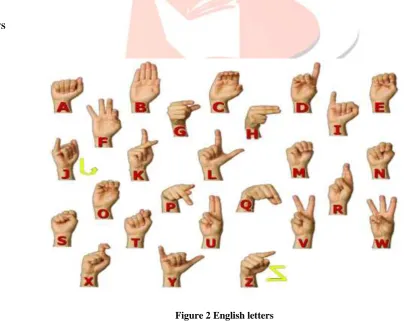
Figure 2 English letters
IJEDR1604081
International Journal of Engineering Development and Research (www.ijedr.org)560
Figure 3 Architecture of Neural Network for Training
In figure 3 after initialization of Neural network we receive the BPNN Architecture which contains 132 input symbols and 50 hidden layers and 1 output values after output and summation layer.
100 102 104
gr
ad
ie
nt
Gradient = 4.2886, at epoch 42
0 5 10 15 20 25 30 35 40
0 2 4 6
va
l f
ai
l
42 Epochs
Validation Checks = 6, at epoch 42
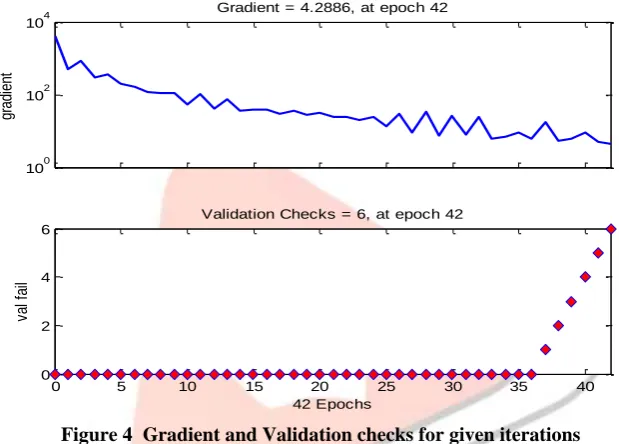
Figure 4 Gradient and Validation checks for given iterations
In Figure 4 the gradient describes the change in error which arises during validation checks in the training proceducre, figure 5 below describes the Validation performance during Epochs in Training testing and Validation with Best Validation performance.
0 5 10 15 20 25 30 35 40
100 101 102 103
Best Validation Performance is 14.4017 at epoch 36
M
e
a
n
S
q
u
a
re
d
E
rr
o
r
(
m
s
e
)
42 Epochs
Train Validation Test Best
IJEDR1604081
International Journal of Engineering Development and Research (www.ijedr.org)561
VI.CONCLUSION
Gesture credit arrangements normally encompass countless allocations patterns. A colossal number of compression and supplementary parameters are associated alongside Gesture data. This makes them both sluggish to decode Gesture, and colossal to store. Methods have been counseled to cut number of parameters and hence raise compression of Gestures.
Gesture credit alongside colossal data set is a computationally luxurious task alongside models needing a colossal number of parameters to attain fine error rates. As we have debated in this report that there are assorted methods obtainable for Gesture credit namely: Neural Networks, Hidden Markov Models and Genetic Algorithms others. Main supremacy of employing Neural Webs in Gesture Outline Credit is its low computational burden after contrasted alongside supplementary methods such as Hidden Markov Models. Main drawback after contrasted to Hidden Markov Models is that it does not seize into report the temporal progress of the signals (Gesture, signature, etc.) because all vectors are varied up in input gesture. In this report we have debated generally concerning Gesture credit and employing Neural Webs for same. We have prosperously clarified that Neural Webs can be utilized for Gesture credit in alongside extra than 86.7% accomplishment rate. As we finished in our aftermath that the arrangement we projected employing neural webs produced less error rates in gesture credit as challenge to employing merely one method at a time. As the Results show the maximum accuracy achieved by the system is 94.93% achieved during training procedure. ANN provides good and powerful solution for gesture recognition in MATLAB. Artificial Neural networks are applicable to multivariate non-linear problems. It has a fast computational ability. The ability of neural nets to generalize makes them a natural for gesture recognition.
VII.FUTURE SCOPE
The experiments show encouraging outcome on using for sign language recognition task. Further work could be done to progress strategy for recognition. Sign Language Recognition has long since advanced level beyond classifying separated signs and alphabet kinds for little finger spelling. The focus has shifted to approach the extra linguistic features associated with the challenge while the field may continue steadily to draw in the advances in Gesture Recognition. Work is promoting on extracting signs from continuous streams and utilizing grammars that are linguistic aid recognition. Previous works only presented isolated indication recognition right here; however continuous sign language recognition would be the next step to create system more useful. Sign language recognition also provides a good point that is beginning natural gesture recognition.
REFERENCES
[1] Nayakwadi, Vishal, and N. B. Pokale. "Natural Hand Gestures Recognition System for Intelligent HCI: A Survey." International Journal of Computer Applications Technology and Research 3, no. 1 (2014): 10-19.
[2] Dix, Alan. Human-computer interaction. Springer US, 2009.
[3] Cui, Yan, Sebastian Schuon, Derek Chan, Sebastian Thrun, and Christian Theobalt. "3D shape scanning with a time-of-flight camera." In Computer Vision and Pattern Recognition (CVPR), 2010 IEEE Conference on, pp. 1173-1180. IEEE, 2010.
[4] Patsadu, Orasa, Chakarida Nukoolkit, and Bunthit Watanapa. "Human gesture recognition using Kinect camera." In Computer Science and Software Engineering (JCSSE), 2012 International Joint Conference on, pp. 28-32. IEEE, 2012. [5] Marcel, Sébastien, Olivier Bernier, Jean-Emmanuel Viallet, and Daniel Collobert. "Hand gesture recognition using
input-output hidden markov models." In 2013 10th IEEE International Conference and Workshops on Automatic Face and Gesture Recognition (FG), pp. 456-456. IEEE Computer Society, 2000.
[6] Yannick L. Gweth, Christian Plahl, and Hermann Ney. "Enhanced continuous sign language recognition using PCA and neural network features." In Computer Vision and Pattern Recognition Workshops (CVPRW), 2012 IEEE Computer Society Conference on, pp. 55-60. IEEE, 2012.
[7] Yale Song, David Demirdjian, and Randall Davis. "Tracking body and hands for gesture recognition: Natops aircraft handling signals database." In Automatic Face & Gesture Recognition and Workshops (FG 2011), 2011 IEEE International Conference on, pp. 500-506. IEEE, 2011.
[8] Helen Cooper, Brian Holt, and Richard Bowden. "Sign language recognition." In Visual Analysis of Humans, pp. 539-562. Springer London, 2011.
[9] Zaki M. Mahmoud and Samir I. Shaheen. "Sign language recognition using a combination of new vision based features." Pattern Recognition Letters 32, no. 4 (2011): 572-577.
[10] Dominique Uebersax, Juergen Gall, Michael Van den Bergh, and Luc Van Gool. "Real-time sign language letter and word recognition from depth data." In Computer Vision Workshops (ICCV Workshops), 2011 IEEE International Conference on, pp. 383-390. IEEE, 2011.
[11] Paulraj, Murugesa Pandiyan, Sazali Yaacob, Mohd Shuhanaz bin Zanar Azalan, and Rajkumar Palaniappan. "A phoneme based sign language recognition system using skin color segmentation." In Signal Processing and Its Applications (CSPA), 2010 6th International Colloquium on, pp. 1-5. IEEE, 2010.
[12] Helene Brashear, Thad Starner, Paul Lukowicz, and Holger Junker. "Using multiple sensors for mobile sign language recognition." (2003).
IJEDR1604081
International Journal of Engineering Development and Research (www.ijedr.org)562
[14] Rung-Huei Liang, and Ming Ouhyoung. "A real-time continuous gesture recognition system for sign language." InAutomatic Face and Gesture Recognition, 1998. Proceedings. Third IEEE International Conference on, pp. 558-567. IEEE, 1998.
[15] Thad Starner, and Alex Pentland. "Real-time american sign language recognition from video using hidden markov models." In Motion-Based Recognition, pp. 227-243. Springer Netherlands, 1997.